


EN 30-1-4:2026
(Main)Domestic cooking appliances burning gas - Part 1-4: Safety - Appliances having one or more burners with an automatic burner control system
General Information
- Abstract
This European Standard specifies the construction and performance characteristics as well as the requirements and methods of test for the safety and marking of domestic cooking appliances, capable of using the combustible gases defined in EN 30-1-1:2008+A2:2010, that have one or more burners with an automatic burner control system, referred to in the text as "appliances".
This European Standard includes specific requirements and methods of test that are applicable to burners having an automatic burner control system, whether or not the appliance is equipped with a fan for the supply of combustion air to, and/or the evacuation of the products of combustion from the burner concerned. These specific requirements and methods of test are only applicable when the burner has an automatic burner control system and do not apply to burners having automatic ignition that fall within the scope of
EN 30-1-1:2008+A2:2010.
This European Standard is intended to be used in conjunction with EN 30-1-1:2008+A2:2010 and, where appropriate, other parts of EN 30-1 covering appliances having:
- forced-convection ovens and/or grills;
- a glass ceramic hotplate.
It does not cover all of the safety requirements and methods of test that are specific to forced-convection ovens and/or grills and glass ceramic hotplates.
Unless specifically excluded hereafter, this standard applies to these appliances or their component parts, whether or not the component parts are independent or incorporated into a single appliance, even if the other heating components of the appliance use electrical energy (e.g. combined gas-electric cookers).
This European Standard includes requirements covering the electrical safety of equipment incorporated in the appliance that is associated with the use of gas. It does not include requirements covering the electrical safety of electrically heated component parts of their associated equipment ).
This European Standard does not apply to:
- outdoor appliances;
- appliances connected to a combustion products evacuation duct;
- appliances having a pyrolytic gas oven;
- appliances having automatic burner control systems that:
- have a second safety time (see EN 298:2003), or
- control one or more burners that incorporate a separate ignition burner;
- appliances having an uncovered burner or a non-enclosed covered burner (see 3.1.1) that utilises a fan for the supply of its combustion air;
- appliances having enclosed covered burners that are not equipped with an automatic burner control system;
- appliances having one or more burners that are capable of remote operation (type1), unless the burner(s) concerned are:
- oven burners equipped with an automatic burner control system, or
- oven burners of time-controlled ovens that are designed for a delayed start without the user being present;
- appliances having one or more burners that are capable of remote operation (type 2), unless the burner(s) concerned are:
- oven, grill or hotplate burners equipped with automatic burner control systems, or
- oven burners of time-controlled ovens that are designed for a delayed start without the user being present;
- appliances supplied at pressures greater than those defined in 7.1.3;
- appliances equipped with air-gas ratio controls;
- appliances incorporating one or more hotplate or grill burners that enable the user to program the delayed start of a cooking cycle.
This European Standard does not cover the requirements relating to automatic on-off cycling multi-ring hotplate burners for which specific requirements are under consideration.
This European Standard does not cover the requirements relating to third family gas cylinders, their regulators and their connection.
This European Standard only covers type testing.
- Status
- Published
- Publication Date
- 24-Mar-2026
- Technical Committee
- CEN/TC 49 - Gas cooking appliances
- Drafting Committee
- CEN/TC 49/WG 1 - Revision of EN 30
- Current Stage
- 6060 - Definitive text made available (DAV) - Publishing
- Start Date
- 25-Mar-2026
- Due Date
- 23-Mar-2022
- Completion Date
- 25-Mar-2026

Overview
EN 30-1-4:2026 by CEN defines the essential safety requirements, test methods, and marking guidelines for domestic cooking appliances burning gas, specifically those featuring one or more burners with an automatic burner control system. This European Standard covers various types of gas cooking appliances, ensuring they meet stringent safety criteria when equipped with such advanced control features. It applies to appliances designed for use with gases specified in EN 30-1-1:2008+A2:2010 and intended for domestic kitchens. The standard is utilized alongside EN 30-1-1 and other relevant EN 30-1 parts, aiming to harmonize product safety across the European market.
Key Topics
Scope and Applicability:
The standard addresses requirements for construction, performance, safety, and marking of gas-fueled domestic cooking appliances with automatic burner control systems. It is applicable to appliances with one or more burners, including those with or without fans for combustion air or exhaust.Safety Requirements:
- Automatic shut-off valves and flame supervision devices
- Compliance for both direct and indirect burner control methods
- Protection against accumulation of unburnt gas
- Measures related to electrical safety for components involved in gas operation
Testing and Verification:
- Type testing methodologies for operational safety and constructional integrity
- Specific test procedures for ignition, flame stability, combustion quality, and fail-safe operation
Marking & User Information:
Clearly defines labeling requirements, including warnings and installation-use-maintenance instructions to ensure user safety and regulatory compliance.Exemptions and Limitations:
The standard does not cover:- Outdoor gas cooking appliances
- Appliances with a pyrolytic gas oven or certain remote operation and air-gas ratio controls
- Connections to ducts for combustion product evacuation
- Appliances using gas pressures outside the defined test ranges
Applications
EN 30-1-4:2026 offers direct value to a range of industry stakeholders:
Manufacturers:
Ensures safe design, manufacturing, and CE marking of gas cooking appliances with automatic burner control systems, which enhances product reliability and market acceptance within the EU.Testing Laboratories and Inspectors:
Provides standardized test procedures to validate compliance, covering construction, performance, and operational safety.Installers and Technicians:
Supplies reference guidelines for the correct installation and adjustment of compliant appliances, helping avoid hazardous scenarios during setup and use.Regulators:
Facilitates harmonization across the European market, supporting the enforcement of gas safety directives and ensuring conformity for trade and import across member states.
Typical domestic appliances benefiting from adherence to this standard include:
- Gas hobs, ranges, ovens, and combined gas-electric cookers with automatic burner controls
- Appliances with enclosed covered burners, with or without fans, for enhanced safety and ease of use
Related Standards
EN 30-1-4:2026 should be used in conjunction with the following relevant European Standards for a comprehensive approach to domestic gas appliance safety:
- EN 30-1-1:2008+A2:2010 – Safety - General requirements for domestic cooking appliances burning gas
- EN 30-1-2 – Safety - Appliances with forced-convection ovens and/or grills
- EN 30-1-3 – Safety - Appliances with a glass ceramic hotplate
- EN 30-2-1 – Rational use of energy for gas cooking appliances
- EN 298:2012 – Automatic burner control systems for burners and appliances burning gaseous or liquid fuels
- EN 88-1:2011+A1:2016, EN 161:2011+A3:2013, EN 257:2010 – For associated safety devices, shut-off valves, and thermostats
EN 30-1-4:2026 is part of the broader framework guiding the safe use of domestic gas appliances in Europe, supporting compliance with EU Regulation 2016/426/EU and related directives for gas appliances. For optimal safety and regulatory alignment, manufacturers and stakeholders should always consult this standard in context with its referenced documents.
Relations
- Effective Date
- 18-Jan-2023
- Effective Date
- 08-Apr-2026
- Effective Date
- 08-Apr-2026
- Effective Date
- 08-Apr-2026
- Effective Date
- 08-Apr-2026
- Effective Date
- 08-Apr-2026
- Effective Date
- 08-Apr-2026
- Effective Date
- 08-Apr-2026
- Effective Date
- 08-Apr-2026
- Effective Date
- 08-Apr-2026
- Effective Date
- 08-Apr-2026
- Effective Date
- 08-Apr-2026
- Effective Date
- 08-Apr-2026
- Effective Date
- 08-Apr-2026
- Effective Date
- 08-Apr-2026
Frequently Asked Questions
EN 30-1-4:2026 is a standard published by the European Committee for Standardization (CEN). Its full title is "Domestic cooking appliances burning gas - Part 1-4: Safety - Appliances having one or more burners with an automatic burner control system". This standard covers: This European Standard specifies the construction and performance characteristics as well as the requirements and methods of test for the safety and marking of domestic cooking appliances, capable of using the combustible gases defined in EN 30-1-1:2008+A2:2010, that have one or more burners with an automatic burner control system, referred to in the text as "appliances". This European Standard includes specific requirements and methods of test that are applicable to burners having an automatic burner control system, whether or not the appliance is equipped with a fan for the supply of combustion air to, and/or the evacuation of the products of combustion from the burner concerned. These specific requirements and methods of test are only applicable when the burner has an automatic burner control system and do not apply to burners having automatic ignition that fall within the scope of EN 30-1-1:2008+A2:2010. This European Standard is intended to be used in conjunction with EN 30-1-1:2008+A2:2010 and, where appropriate, other parts of EN 30-1 covering appliances having: - forced-convection ovens and/or grills; - a glass ceramic hotplate. It does not cover all of the safety requirements and methods of test that are specific to forced-convection ovens and/or grills and glass ceramic hotplates. Unless specifically excluded hereafter, this standard applies to these appliances or their component parts, whether or not the component parts are independent or incorporated into a single appliance, even if the other heating components of the appliance use electrical energy (e.g. combined gas-electric cookers). This European Standard includes requirements covering the electrical safety of equipment incorporated in the appliance that is associated with the use of gas. It does not include requirements covering the electrical safety of electrically heated component parts of their associated equipment ). This European Standard does not apply to: - outdoor appliances; - appliances connected to a combustion products evacuation duct; - appliances having a pyrolytic gas oven; - appliances having automatic burner control systems that: - have a second safety time (see EN 298:2003), or - control one or more burners that incorporate a separate ignition burner; - appliances having an uncovered burner or a non-enclosed covered burner (see 3.1.1) that utilises a fan for the supply of its combustion air; - appliances having enclosed covered burners that are not equipped with an automatic burner control system; - appliances having one or more burners that are capable of remote operation (type1), unless the burner(s) concerned are: - oven burners equipped with an automatic burner control system, or - oven burners of time-controlled ovens that are designed for a delayed start without the user being present; - appliances having one or more burners that are capable of remote operation (type 2), unless the burner(s) concerned are: - oven, grill or hotplate burners equipped with automatic burner control systems, or - oven burners of time-controlled ovens that are designed for a delayed start without the user being present; - appliances supplied at pressures greater than those defined in 7.1.3; - appliances equipped with air-gas ratio controls; - appliances incorporating one or more hotplate or grill burners that enable the user to program the delayed start of a cooking cycle. This European Standard does not cover the requirements relating to automatic on-off cycling multi-ring hotplate burners for which specific requirements are under consideration. This European Standard does not cover the requirements relating to third family gas cylinders, their regulators and their connection. This European Standard only covers type testing.
This European Standard specifies the construction and performance characteristics as well as the requirements and methods of test for the safety and marking of domestic cooking appliances, capable of using the combustible gases defined in EN 30-1-1:2008+A2:2010, that have one or more burners with an automatic burner control system, referred to in the text as "appliances". This European Standard includes specific requirements and methods of test that are applicable to burners having an automatic burner control system, whether or not the appliance is equipped with a fan for the supply of combustion air to, and/or the evacuation of the products of combustion from the burner concerned. These specific requirements and methods of test are only applicable when the burner has an automatic burner control system and do not apply to burners having automatic ignition that fall within the scope of EN 30-1-1:2008+A2:2010. This European Standard is intended to be used in conjunction with EN 30-1-1:2008+A2:2010 and, where appropriate, other parts of EN 30-1 covering appliances having: - forced-convection ovens and/or grills; - a glass ceramic hotplate. It does not cover all of the safety requirements and methods of test that are specific to forced-convection ovens and/or grills and glass ceramic hotplates. Unless specifically excluded hereafter, this standard applies to these appliances or their component parts, whether or not the component parts are independent or incorporated into a single appliance, even if the other heating components of the appliance use electrical energy (e.g. combined gas-electric cookers). This European Standard includes requirements covering the electrical safety of equipment incorporated in the appliance that is associated with the use of gas. It does not include requirements covering the electrical safety of electrically heated component parts of their associated equipment ). This European Standard does not apply to: - outdoor appliances; - appliances connected to a combustion products evacuation duct; - appliances having a pyrolytic gas oven; - appliances having automatic burner control systems that: - have a second safety time (see EN 298:2003), or - control one or more burners that incorporate a separate ignition burner; - appliances having an uncovered burner or a non-enclosed covered burner (see 3.1.1) that utilises a fan for the supply of its combustion air; - appliances having enclosed covered burners that are not equipped with an automatic burner control system; - appliances having one or more burners that are capable of remote operation (type1), unless the burner(s) concerned are: - oven burners equipped with an automatic burner control system, or - oven burners of time-controlled ovens that are designed for a delayed start without the user being present; - appliances having one or more burners that are capable of remote operation (type 2), unless the burner(s) concerned are: - oven, grill or hotplate burners equipped with automatic burner control systems, or - oven burners of time-controlled ovens that are designed for a delayed start without the user being present; - appliances supplied at pressures greater than those defined in 7.1.3; - appliances equipped with air-gas ratio controls; - appliances incorporating one or more hotplate or grill burners that enable the user to program the delayed start of a cooking cycle. This European Standard does not cover the requirements relating to automatic on-off cycling multi-ring hotplate burners for which specific requirements are under consideration. This European Standard does not cover the requirements relating to third family gas cylinders, their regulators and their connection. This European Standard only covers type testing.
EN 30-1-4:2026 is classified under the following ICS (International Classification for Standards) categories: 97.040.20 - Cooking ranges, working tables, ovens and similar appliances. The ICS classification helps identify the subject area and facilitates finding related standards.
EN 30-1-4:2026 has the following relationships with other standards: It is inter standard links to EN 30-1-4:2012, EN 30-1-1:2021+A1:2023, EN 161:2022+A1:2025, EN 257:2022+A1:2023, EN 30-1-3:2003+A1:2006, EN 298:2022, EN 126:2025, EN IEC 60730-2-9:2019/A2:2020, EN 437:2021, EN 60335-2-102:2016, EN IEC 60730-2-9:2019, EN 60335-2-6:2015/A11:2020, EN 60335-2-6:2015/A1:2020, EN 60335-2-6:2015, EN 30-1-2:2023+A1:2024. Understanding these relationships helps ensure you are using the most current and applicable version of the standard.
EN 30-1-4:2026 is associated with the following European legislation: EU Directives/Regulations: 2016/426; Standardization Mandates: M/595, M/BC/CEN/89/6. When a standard is cited in the Official Journal of the European Union, products manufactured in conformity with it benefit from a presumption of conformity with the essential requirements of the corresponding EU directive or regulation.
EN 30-1-4:2026 is available in PDF format for immediate download after purchase. The document can be added to your cart and obtained through the secure checkout process. Digital delivery ensures instant access to the complete standard document.
Standards Content (Sample)
SLOVENSKI STANDARD
01-julij-2026
Nadomešča:
SIST EN 30-1-4:2012
Plinski gospodinjski aparati za kuhanje - 1-4. del: Varnost - Aparati z enim ali več
gorilniki z avtomatskim nadzorom gorilnikov
Domestic cooking appliances burning gas - Part 1-4: Safety - Appliances having one or
more burners with an automatic burner control system
Haushalt-Kochgeräte für gasförmige Brennstoffe - Sicherheit - Teil 1-4: Geräte mit einem
oder mehreren Brenner(n) mit Feuerungsautomat
Appareils de cuisson domestiques utilisant les combustibles gazeux - Sécurité - Partie 1-
4: Appareils comportant un ou plusieurs brûleurs avec système automatique de
commande des brûleurs
Ta slovenski standard je istoveten z: EN 30-1-4:2026
ICS:
97.040.20 Štedilniki, delovni pulti, Cooking ranges, working
pečice in podobni aparati tables, ovens and similar
appliances
2003-01.Slovenski inštitut za standardizacijo. Razmnoževanje celote ali delov tega standarda ni dovoljeno.
EN 30-1-4
EUROPEAN STANDARD
NORME EUROPÉENNE
March 2026
EUROPÄISCHE NORM
ICS 97.040.20 Supersedes EN 30-1-4:2012
English Version
Domestic cooking appliances burning gas - Part 1-4: Safety
- Appliances having one or more burners with an
automatic burner control system
Appareils de cuisson domestiques utilisant les Haushalt-Kochgeräte für gasförmige Brennstoffe - Teil
combustibles gazeux - Partie 1-4: Sécurité - Appareils 1-4: Sicherheit - Geräte mit einem oder mehreren
comportant un ou plusieurs brûleurs avec système Brenner(n) mit Feuerungsautomat
automatique de commande des brûleurs
This European Standard was approved by CEN on 19 January 2026.
CEN members are bound to comply with the CEN/CENELEC Internal Regulations which stipulate the conditions for giving this
European Standard the status of a national standard without any alteration. Up-to-date lists and bibliographical references
concerning such national standards may be obtained on application to the CEN-CENELEC Management Centre or to any CEN
member.
This European Standard exists in three official versions (English, French, German). A version in any other language made by
translation under the responsibility of a CEN member into its own language and notified to the CEN-CENELEC Management
Centre has the same status as the official versions.
CEN members are the national standards bodies of Austria, Belgium, Bulgaria, Croatia, Cyprus, Czech Republic, Denmark, Estonia,
Finland, France, Germany, Greece, Hungary, Iceland, Ireland, Italy, Latvia, Lithuania, Luxembourg, Malta, Netherlands, Norway,
Poland, Portugal, Republic of North Macedonia, Romania, Serbia, Slovakia, Slovenia, Spain, Sweden, Switzerland, Türkiye and
United Kingdom.
EUROPEAN COMMITTEE FOR STANDARDIZATION
COMITÉ EUROPÉEN DE NORMALISATION
EUROPÄISCHES KOMITEE FÜR NORMUNG
CEN-CENELEC Management Centre: Rue de la Science 23, B-1040 Brussels
© 2026 CEN All rights of exploitation in any form and by any means reserved Ref. No. EN 30-1-4:2026 E
worldwide for CEN national Members.
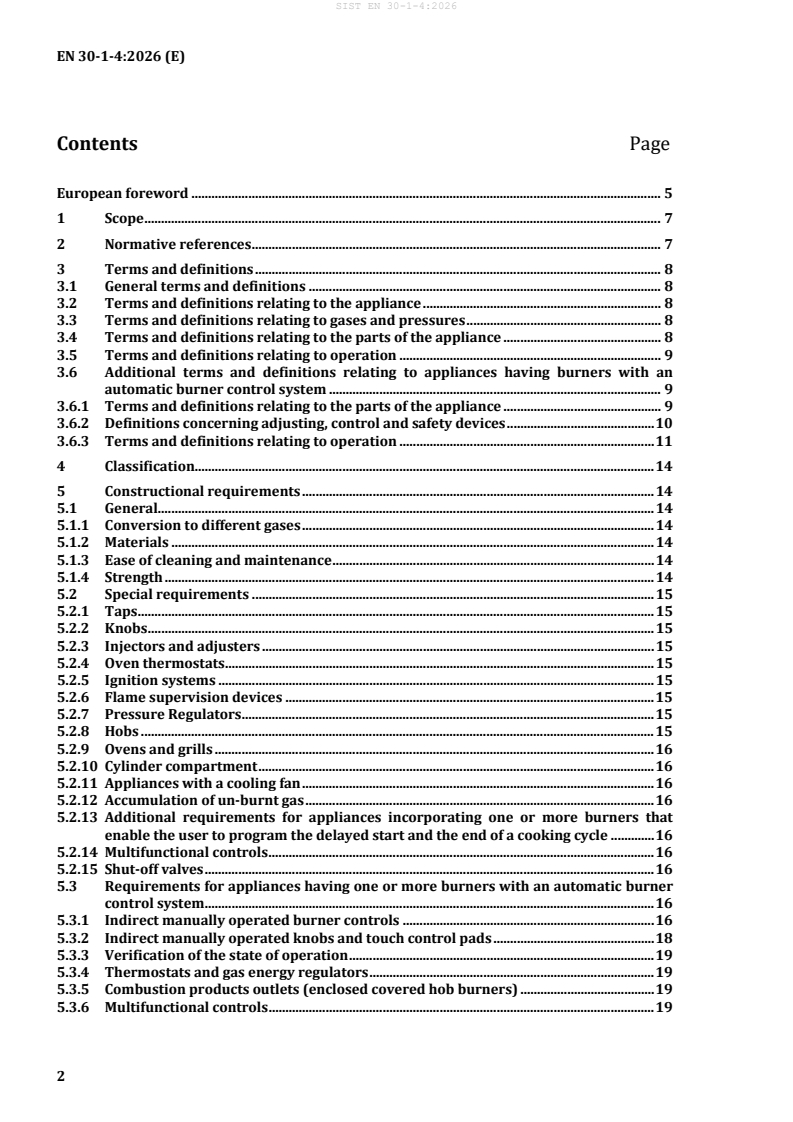
Contents Page
European foreword . 5
1 Scope . 7
2 Normative references . 7
3 Terms and definitions . 8
3.1 General terms and definitions . 8
3.2 Terms and definitions relating to the appliance . 8
3.3 Terms and definitions relating to gases and pressures . 8
3.4 Terms and definitions relating to the parts of the appliance . 8
3.5 Terms and definitions relating to operation . 9
3.6 Additional terms and definitions relating to appliances having burners with an
automatic burner control system . 9
3.6.1 Terms and definitions relating to the parts of the appliance . 9
3.6.2 Definitions concerning adjusting, control and safety devices . 10
3.6.3 Terms and definitions relating to operation . 11
4 Classification. 14
5 Constructional requirements . 14
5.1 General. 14
5.1.1 Conversion to different gases . 14
5.1.2 Materials . 14
5.1.3 Ease of cleaning and maintenance . 14
5.1.4 Strength . 14
5.2 Special requirements . 15
5.2.1 Taps . 15
5.2.2 Knobs . 15
5.2.3 Injectors and adjusters . 15
5.2.4 Oven thermostats . 15
5.2.5 Ignition systems . 15
5.2.6 Flame supervision devices . 15
5.2.7 Pressure Regulators . 15
5.2.8 Hobs . 15
5.2.9 Ovens and grills . 16
5.2.10 Cylinder compartment . 16
5.2.11 Appliances with a cooling fan . 16
5.2.12 Accumulation of un-burnt gas . 16
5.2.13 Additional requirements for appliances incorporating one or more burners that
enable the user to program the delayed start and the end of a cooking cycle . 16
5.2.14 Multifunctional controls . 16
5.2.15 Shut-off valves . 16
5.3 Requirements for appliances having one or more burners with an automatic burner
control system . 16
5.3.1 Indirect manually operated burner controls . 16
5.3.2 Indirect manually operated knobs and touch control pads . 18
5.3.3 Verification of the state of operation . 19
5.3.4 Thermostats and gas energy regulators . 19
5.3.5 Combustion products outlets (enclosed covered hob burners) . 19
5.3.6 Multifunctional controls . 19
5.3.7 Automatic shut-off valves . 20
5.3.8 Accumulation of un-burnt gas . 21
5.4 Requirements for burners having an automatic burner control system . 22
5.4.1 General . 22
5.4.2 Burners without a fan for the supply of combustion air and/or for the evacuation of
the products of combustion . 22
5.4.3 Burners with a fan for the supply of combustion air and/or for the evacuation of the
products of combustion . 25
5.5 Additional requirements for appliances with one or more burners that are capable of
remote on-site operation . 29
5.5.1 Application . 29
5.5.2 General . 29
5.5.3 Remote on-site operation . 30
6 Operational requirements . 30
6.1 General . 30
6.1.1 Soundness . 30
6.1.2 Obtaining the input rates . 30
6.1.3 Flame supervision devices . 30
6.1.4 Safety of operation . 30
6.1.5 Heating . 31
6.1.6 Temperature of the LPG cylinder and its compartment . 31
6.1.7 Total input of the appliance . 31
6.1.8 Pressure regulator performance . 31
6.1.9 Blocking of the cooling fan and failure of the thermostat . 31
6.2 Special requirements for hobs . 31
6.2.1 Ignition, cross-lighting and flame stability . 31
6.2.2 Combustion . 31
6.3 Special requirements for ovens and grills . 31
6.3.1 Ignition, cross-lighting and flame stability . 31
6.3.2 Combustion . 31
6.4 Additional requirements for appliances having burners with an automatic burner
control system . 32
6.4.1 Obtaining the input rates . 32
6.4.2 Safety in the event of failure of thermostats and gas energy regulators . 32
6.5 Additional requirements for hob burners having an automatic burner control system
................................................................................................................................................................... 33
6.5.1 Ignition, cross-lighting and flame stability . 33
6.5.2 Combustion . 34
6.5.3 Air proving devices (enclosed covered hob burners with a fan for the supply of
combustion air and/or for the evacuation of products of combustion) . 35
6.6 Additional requirements for oven and grill burners having an automatic burner
control system . 35
6.6.1 Ignition, cross-lighting and flame stability . 35
6.6.2 Combustion . 37
6.6.3 Air proving devices (oven and/or grill burners with a fan for the supply of combustion
air and/or for the evacuation of products of combustion) . 37
7 Test methods . 38
7.1 General . 38
7.1.1 Reference and test gases . 38
7.1.2 Test pressures. 38
7.1.3 Test procedures . 38
7.1.4 Pans and oven and grill accessories . 39
7.1.5 Temperature of the oven and grill . 39
7.1.6 Appliances having a mains electrical supply . 39
7.2 Verification of the constructional characteristics . 39
7.2.1 Strength . 39
7.2.2 Strength, stability . 39
7.2.3 Appliances with a glass lid having a device for shutting off the gas to the hob burners
................................................................................................................................................................... 40
7.3 Verification of operational characteristics . 40
7.3.1 General tests . 40
7.3.2 Specific tests for hobs . 42
7.3.3 Specific tests for ovens and grills . 42
7.4 Verification of the constructional requirements specific to parts of the appliance
having burners with an automatic burner control system . 43
7.4.1 Accumulation of un-burnt gas . 43
7.4.2 Manually operated devices (see 5.4.1) . 44
7.4.3 Safety times . 44
7.4.4 Appliances incorporating a hob having touch controls . 44
7.5 Verification of the operational requirements specific to parts of the appliance having
burners with an automatic burner control system . 45
7.5.1 General tests . 45
7.5.2 Specific tests for hobs . 48
7.5.3 Specific tests for ovens and grills . 57
7.6 Accuracy of measuring instruments . 66
8 Marking and instructions . 66
8.1 Marking . 66
8.1.1 General. 66
8.1.2 Marking and warnings on the appliance . 66
8.1.3 Additional marking and warnings on the appliance . 66
8.1.4 Marking and warning on the packaging . 67
8.1.5 Additional marking on the packaging . 67
8.2 Instructions general . 67
8.3 Instructions for installation . 67
8.3.1 General. 67
8.3.2 Instructions for installation and adjustment. 67
8.3.3 Additional instructions for installation . 67
8.4 Instructions for use and maintenance . 67
Annex A (informative) National situations . 68
Annex B (informative) Guidelines for extension to other categories . 69
Annex C (normative) Characteristics of the pans required . 70
Annex D (normative) Surface temperature probe (7.3.1.5.3.2) . 71
Annex E (normative) Use of the symbol on the appliance and packaging . 72
Annex F (normative) Fault analysis procedure for assessing the safety of the appliance in
the event of failure of any single automatic shut-off valve in the automatic burner
control system . 73
F.1 Procedure . 73
F.2 Explanation of decisions taken during assessment of fault . 74
Annex ZA (informative) Relationship between this European Standard and the essential
requirements of EU Regulation 2016/426/EU aimed to be covered . 76
European foreword
This document (EN 30-1-4:2026) has been prepared by Technical Committee CEN/TC 49 “Gas cooking
appliances”, the secretariat of which is held by UNI.
This European Standard shall be given the status of a national standard, either by publication of an
identical text or by endorsement, at the latest by September 2026, and conflicting national standards shall
be withdrawn at the latest by March 2029.
Attention is drawn to the possibility that some of the elements of this document may be the subject of
patent rights. CEN shall not be held responsible for identifying any or all such patent rights.
This document supersedes EN 30-1-4:2012.
This document has been prepared under a standardization request addressed to CEN by the European
Commission. The Standing Committee of the EFTA States subsequently approves these requests for its
Member States.
For the relationship with EU Legislation, see informative Annex ZA, which is an integral part of this
document.
The main modifications in this document with respect to the previous edition (EN 30-1-4:2012) are the
following:
— Alignment with Regulation 2016/426/EU throughout the full text;
— Alignment with EN 30-1-1:2021+A1:2023 and its structure;
— Alignment with the requirements of EN 298:2022 (5.4);
— Harmonization of the safety times for hobs and ovens (5.4);
— Clarification for requirements about appliances capable of remote operation (5.5);
— Alignment with EN 30-1-1:2021+A1:2023 of the requirement for delayed start and end of a cooking
cycle (5.2.13);
— Clarification for requirements about accumulation of unburnt gas (5.3.8).
It is intended to use this document with EN 30-1-1:2021+A1:2023, on which the requirements and
methods of test for appliances having one or more burners with an automatic burner control system are
based. In particular, this document identifies the requirements and methods of test specific to these
appliances, which are in addition to, or replace, those given in EN 30-1-1:2021+A1:2023.
This present part is intended to be used together with any other part of EN 30-1-x related to “Safety”,
whenever the appliances covered by this other part includes a burner with an automatic burner control
system.
Requirements relating to ‘Rational use of energy’ are given in other appropriate parts of this document,
EN 30-2-x.
Other documents covering domestic cooking appliances burning gas are as follows:
— EN 30-1-1, Domestic cooking appliances burning gas — Part 1-1: Safety — General;
— EN 30-1-2, Domestic cooking appliances burning gas — Part 1-2: Safety — Appliances having forced-
convection ovens and/or grills;
— EN 30-1-3, Domestic cooking appliances burning gas — Part 1-3: Safety — Appliances having a glass
ceramic hotplate;
— EN 30-2-1, Domestic cooking appliances burning gas — Part 2-1: Rational use of energy — General;
— EN 30-2-2, Domestic cooking appliances burning gas — Part 2-2: Rational use of energy — Appliances
having forced-convection ovens and /or grills.
Requirements concerning the emission of NOx are not mentioned in this document; taking account of the
usage of the appliances and their low output, their contribution to environment pollution is negligible.
This document covers type testing.
Any feedback and questions on this document should be directed to the users’ national standards body.
A complete listing of these bodies can be found on the CEN website.
According to the CEN-CENELEC Internal Regulations, the national standards organisations of the
following countries are bound to implement this European Standard: Austria, Belgium, Bulgaria, Croatia,
Cyprus, Czech Republic, Denmark, Estonia, Finland, France, Germany, Greece, Hungary, Iceland, Ireland,
Italy, Latvia, Lithuania, Luxembourg, Malta, Netherlands, Norway, Poland, Portugal, Republic of North
Macedonia, Romania, Serbia, Slovakia, Slovenia, Spain, Sweden, Switzerland, Türkiye and the United
Kingdom.
1 Scope
This document specifies the construction and performance characteristics as well as the requirements
and methods of test for the safety and marking of domestic cooking appliances, capable of using the
combustible gases given in EN 437:2021 that have one or more burners with an automatic burner control
system, referred to in the text as “appliances”.
NOTE EN 30-1-1:2021+A1:2023 applies where appliances are not equipped with an automatic burner control
system.
The appliances covered by this document are intended to be used in a domestic dwelling.
It is intended to use this document with EN 30-1-1:2021+A1:2023, on which the requirements and
methods of test for appliances having one or more burners with an automatic burner control system are
based. In particular this document is intended to be used in conjunction with EN 30-1-1:2021+A1:2023
and, where appropriate, EN 30-1-2:2023+A1:2024 and EN 30-1-3:2003+A1:2006.
This document also applies to gas cooking appliances incorporating electrical heating elements (e.g. gas-
electric cooking appliances).
This document does not apply to:
— outdoor appliances;
— appliances connected to a combustion products evacuation duct;
— appliances having a pyrolytic gas oven;
— appliances having an uncovered burner or a non-enclosed covered burner that utilizes a fan for the
supply of its combustion air;
— appliances equipped with air-gas ratio controls;
— appliances incorporating one or more hob or grill burners that enable the user to program the
delayed start of a cooking cycle;
— Appliances designed and constructed to burn gases containing carbon monoxide or other toxic
components.
This document does not cover the requirements relating to third family gas cylinders, their regulators
and their connection.
2 Normative references
The following documents are referred to in the text in such a way that some or all of their content
constitutes requirements of this document. For dated references, only the edition cited applies. For
undated references, the latest edition of the referenced document (including any amendments) applies.
EN 30-1-1:2021+A1:2023, Domestic cooking appliances burning gas - Part 1-1: Safety - General
EN 30-1-2:2023+A1:2024, Domestic cooking appliances burning gas - Part 1-2: Safety - Appliances having
forced-convection ovens
EN 30-1-3:2003+A1:2006, Domestic cooking appliances burning gas - Part 1-3: Safety - Appliances having
a glass ceramic hotplate
EN 126:2025, Safety and control devices for burners and appliances burning gaseous fuels - Multifunctional
controls
EN 161:2022+A1:2025, Automatic shut-off valves for gas burners and gas appliances
EN 257:2022+A1:2023, Mechanical thermostats for gas-burning appliances
EN 298:2022, Automatic burner control systems for burners and appliances burning gaseous or liquid fuels
EN 437:2021, Test gases - Test pressures - Appliance categories
EN 60335-2-6:2015, Household and similar electrical appliances - Safety - Part 2-6: Particular
requirements for stationary cooking ranges, hobs, ovens and similar appliances
EN 60335-2-102:2016, Household and similar electrical appliances - Safety - Part 2-102: Particular
requirements for gas, oil and solid-fuel burning appliances having electrical connections
EN IEC 60730-2-9:2019, Automatic electrical controls - Part 2-9: Particular requirements for temperature
sensing controls
3 Terms and definitions
For the purposes of this document, the terms and definitions given in EN 30-1-1:2021+A1:2023 and the
following apply.
ISO and IEC maintain terminology databases for use in standardization at the following addresses:
— ISO Online browsing platform: available at https://www.iso.org/obp/
— IEC Electropedia: available at https://www.electropedia.org/
3.1 General terms and definitions
EN 30-1-1:2021+A1:2023, 3.1 shall apply.
3.2 Terms and definitions relating to the appliance
EN 30-1-1:2021+A1:2023, 3.2 shall apply.
3.3 Terms and definitions relating to gases and pressures
EN 30-1-1:2021+A1:2023, 3.3 shall apply.
3.4 Terms and definitions relating to the parts of the appliance
The following additional definitions to EN 30-1-1:2021+A1:2023, 3.4 shall apply.
3.4.101
direct-acting manually operated burner control
device to isolate the gas supply to a burner and possibly to adjust its thermal function during use in which
case the device is mechanical in operation (e.g. a tap or cock) and the gas flow is controlled directly by
manipulation of a knob as given in EN 30-1-1:2021+A1:2023, 3.4.3.1
This document is impacted by A1:2020 and A11:2020.
This document is impacted by A1:2019 and A2:2020.
3.4.102
indirect manually operated burner control
device to isolate the gas supply to a burner and possibly to adjust its thermal function during use in which
case the opening and closing of the gas supply to the burner is achieved indirectly by means of one or
more automatic shut off valves
Note 1 to entry: This control may incorporate means of adjusting the thermal function of the burner. For example:
- by adjusting the gas flow (e.g. high-low thermostat);
- by on-off cycling (e.g. on-off thermostat, gas energy regulator).
3.5 Terms and definitions relating to operation
The following additional definition to EN 30-1-1:2021+A1:2023, 3.5 shall apply.
3.5.101
remote on-site operation
operation by means of a separate hand-held control designed for use only when the appliance is in the
same room/space as the user of the control and it is in-sight of the user of the control
Note 1 to entry: Examples of remote communication which are considered to be on-site include but are not limited
to:
- NFC (near field communication);
- optical communication with line of sight (infrared rays or visual rays);
– hardwired configurations constructed of physical media;
3.5.102
technical nominal heat input
heat input stated in the technical documentation that corresponds to the maximum gas rate when the
burner is operating at its maximum thermal function
Note 1 to entry: The nominal heat input, in this case, is the heat input stated on the data plate that corresponds to
the gas rate when the burner is operating at its maximum thermal function. In case of burners operating with
ON/OFF or high/low cycles, the average of the gas rate is considered.
3.6 Additional terms and definitions relating to appliances having burners with an
automatic burner control system
3.6.1 Terms and definitions relating to the parts of the appliance
3.6.1.1
combustion circuit
assembly comprising the air supply circuit, the combustion chamber and the products of combustion
circuit up to the outlet of the appliance
3.6.2 Definitions concerning adjusting, control and safety devices
3.6.2.1
total air adjuster
device enabling the total air flow required for the burner or, where appropriate, the burners to be set to
predetermined value according to the supply conditions
Note 1 to entry: The operation of changing the setting of this device is termed the “adjustment of the total air”.
3.6.2.2
touch control
indirect manually operated burner control actuated by contact or the close proximity of a finger, with
little or no movement of the contact surface
3.6.2.3
touch control pad
one of the contact surfaces of a touch control by which it is actuated
3.6.2.4
gas energy regulator
indirect manually operated burner control that cycles the burner on and off periodically
Note 1 to entry: The thermal function of the burner can be controlled by adjusting the duration of the “on” and/or
“off” cycles times.
3.6.2.5
automatic burner control system (ABCS)
system which includes a programming unit, a flame detector and may include an ignition system and
which monitors the operation of gas burner
Note 1 to entry: 3.6.2.5 (EN 298:2022, 3.110 modified)
3.6.2.6
programming unit
device which controls the burner operation in a declared sequence from start-up to shut-down within
declared timings and in response to signals from regulating, limiting and monitoring devices
Note 1 to entry: 3.6.2.6 (EN 298:2022, 3.111 modified)
3.6.2.7
programme
sequence of control operations determined by the programming unit involving switching on, starting up,
supervising and switching off the burner
3.6.2.8
flame detector device
device by which the presence of a flame is detected and signalled
Note 1 to entry: It can consist of a flame sensor, an amplifier and a relay for signal transmission. These parts, with
the possible exception of the actual flame sensor, may be assembled in a single housing for use in conjunction with
a programming unit.
Note 2 to entry: 3.6.2.8 (EN 298:2022, 3.101 modified)
3.6.2.9
flame signal
signal given by the flame detector device, normally when the flame sensor senses a flame
Note 1 to entry: 3.6.2.9 (EN 298:2022, 3.107 modified)
3.6.2.10
automatic shut-off valve
valve which opens when energized and closes automatically when de-energized
Note 1 to entry: 3.6.2.10 (EN 298:2022, 3.107 modified)
3.6.2.11
air proving device
device that monitors the air provided by a fan and which causes safety shut-down condition of the
burner(s) controlled by the device in the event of there being inadequate combustion air
3.6.2.12
thermal cut-out
device which during abnormal operation limits the temperature of the controlled part automatically by
shutting off the gas supply to the burner or by reducing its heat input, and which is constructed so that
its setting cannot be altered by the user
3.6.3 Terms and definitions relating to operation
3.6.3.1
start gas rate
mean volume rate or mass rate during the safety time where this gas rate is limited by design for the
purposes of ignition
3.6.3.2
start gas flame
flame that can only be established at the start gas rate of the burner
3.6.3.3
main flame
flame established, or capable of being established, at the full-on gas rate of the burner for the purposes of
ignition
3.6.3.4
running conditions
condition of the automatic burner control system in which the burner is in normal operation under the
supervision of the programming unit and its flame detector device
Note 1 to entry: 3.6.3.4 (EN 298:2022, 3.118 modified)
3.6.3.5
ignition energy restoration
process by which, after disappearance of the flame signal in the running condition or, where appropriate,
in the event of failure to ignite, the ignition device is energized again without the gas supply having been
totally interrupted
Note 1 to entry: This process ends with the restoration of the running condition or, if there is no flame signal at the
end of the safety time:
either:
with volatile or non-volatile lock-out of the system,
or:
according to the design of the automatic burner control system, with volatile or non-volatile lock-out of the burner.
Note 2 to entry: 3.6.3.5 (EN 298:2022, 3.122 modified)
3.6.3.6
automatic recycling of the system
process by which, following accidental interruption of the operation of the automatic burner control
system, loss of flame signal during the running condition or, where appropriate, failure to ignite, the gas
supply to all of the burners controlled by the automatic burner control system is interrupted and the
complete start sequence is automatically re-initiated
Note 1 to entry: This process ends with the restoration of the running condition or, if there is no flame signal at the
end of the safety time, or if the cause of the accidental interruption has not disappeared, with volatile lock-out or
non-volatile lock-out of the system.
3.6.3.7
automatic recycling of the burner
process within an automatic burner control system by which, following loss of flame signal during the
running condition or, where appropriate, failure to ignite, the gas supply to the burner concerned is
interrupted and the burner start sequence is automatically re-initiated
Note 1 to entry: This process ends with the restoration of the running condition or, if there is no flame signal at the
end of the safety time, with volatile lock-out or non-volatile lock-out of the system or with volatile or non-volatile
lock-out of the burner.
3.6.3.8
controlled shut-down
process by which the power to the automatic shut-off valve(s) is removed in order to shut off the supply
of gas to a burner under the control of the automatic burner control system within the extinction safety
time, e.g. as a result of the action of a controlling function
Note 1 to entry: 3.6.3.8 (EN 298:2022, 3.119 modified)
3.6.3.9
safety shut-down condition of the system
process which is effected immediately following the detection of a fault in the automatic burner control
system or the response of a safety limiter or sensor and which shuts off the gas supply to all burners
under the control of the automatic burner control system within the extinction safety time by removing
the power to all of their automatic shut-off valves
Note 1 to entry: 3.6.3.9 (EN 298:2022, 3.120 modified)
3.6.3.10
safety shut-down condition of the burner
process which is effected immediately following the response of a safety limiter or sensor and which
shuts off the gas supply to the burner concerned within the extinction safety time by removing the power
to its automatic shut-off valve(s)
Note 1 to entry: 3.6.3.10 (EN 298:2022, 3.120 modified)
3.6.3.11
lock-out
Note 1 to entry: 3.6.3.11 (EN 298:2022, 3.121 modified)
3.6.3.11.1
non-volatile lock-out of the system
safety shut-down condition of the system, such that a restart of the automatic burner control system can
only be accomplished by a manual reset of the system and by no other means
3.6.3.11.2
volatile lock-out of the system
safety shut-down condition of the system, such that a restart of the automatic burner control system can
only be accomplished by either the manual reset of the system, or an interruption of the electrical supply
and its subsequent restoration
3.6.3.11.3
non-volatile lock-out of the burner
safety shut-down condition of a burner, such that a restart of the burner can only be accomplished by a
manual reset of the burner control and by no other means
3.6.3.11.4
volatile lock-out of the burner
safety shut-down condition of a burner, such that a restart of the burner can only be accomplished by
either the manual reset of the burner control, or an interruption of the electrical supply and its
subsequent restoration
3.6.3.12
purge
forced introduction of air through the combustion chamber and the products of combustion circuit in
order to displace any remaining gas/air mixture and/or products of combustion:
— pre-purge: the purge which takes place between the start signal and the energising of the ignition
device;
— post-purge: the purge that takes place immediately following shut-down
Note 1 to entry: 3.6.3.12 (EN 298:2022, 3.113 modified, 3.114 modified, 3.115 modified)
3.6.3.13
safety time
interval between the ignition burner gas valve, the start gas valve or main gas valve, as applicable, being
energized and the ignition burner gas valve, start gas valve or main gas valve, as applicable, being de-
energized if the flame detector signals the absence of a flame at the end of this interval
Note 1 to entry: 3.6.3.13 (EN 298:2022, 3.116 modified)
3.6.3.14
extinction safety time
time interval between extinction of the supervised flame and the moment when the signal for valve
closure is given to shut off the gas supply to the burner
Note 1 to entry: extinction safety time is referred to as “flame failure response time” in EN 298:2022, 3.105.1
4 Classification
The classification given in EN 30-1-1:2021+A1:2023, Clause 4 shall apply.
5 Constructional requirements
5.1 General
5.1.1 Conversion to different gases
EN 30-1-1:2021+A1:2023, 5.1.1 and all its subclauses shall apply with the following modification:
All requirements concerning adjustment of primary air shall also apply to total air adjusters.
5.1.2 Materials
EN 30-1-1:2021+A1:2023, 5.1.2 and all its subclauses shall apply.
5.1.3 Ease of cleaning and maintenance
EN 30-1-1:2021+A1:2023, 5.1.3 shall apply.
5.1.4 Strength
EN 30-1-1:2021+A1:2023, 5.1.4 and all its subclauses shall apply.
5.2 Special requirements
...