

EN 15534-6:2015+A1:2017
(Main + Amendment)Composites made from cellulose-based materials and thermoplastics (usually called wood-polymer composites (WPC) or natural fibre composites (NFC)) - Part 6: Specifications for fencing profiles and elements
General Information
- Abstract
This part of EN 15534 specifies the characteristics of fencing profiles and elements made from cellulose-based materials and thermoplastics, usually called wood-polymer composites (WPC) or natural fibre composites (NFC).
It is applicable to fencing profiles and elements for non-structural fencing systems.
The security systems, perimeter protections, handrails and load bearing applications are out of the scope of this part of EN 15534.
Any systems made from profiles in the scope of this part of EN 15534 that are affected by regulations are under the responsibility of the system supplier.
EN 15534 1 specifies some of the test methods relevant to this part of EN 15534.
NOTE For editorial reasons, in EN 15534 the abbreviation "WPC" is used for "composites made from cellulose-based materials and thermoplastics".
- Status
- Published
- Publication Date
- 24-Oct-2017
- Technical Committee
- CEN/TC 249 - Plastics
- Drafting Committee
- CEN/TC 249/WG 13 - Wood Plastics Composites (WPC)
- Current Stage
- 9060 - Closure of 2 Year Review Enquiry - Review Enquiry
- Start Date
- 02-Sep-2026
- Completion Date
- 02-Sep-2026


Overview - EN 15534-6:2015+A1:2017 (WPC / NFC fencing profiles)
EN 15534-6:2015+A1:2017 is the CEN European standard that specifies performance and testing requirements for fencing profiles and elements made from cellulose‑based materials and thermoplastics - commonly called wood‑polymer composites (WPC) or natural fibre composites (NFC). It applies to non‑structural fencing systems (fencing profiles and assembled elements) and excludes security/perimeter systems, handrails and load‑bearing applications. EN 15534-1 provides many of the referenced test methods.
Key topics and technical requirements
Scope and applicability
- Defines fencing profiles, fencing elements and fencing systems.
- Limits application to non‑structural fencing; regulatory responsibilities remain with the system supplier.
Material declaration
- Manufacturers must declare base polymer and cellulose‑based content. Reprocessable/recyclable feedstocks are permitted if compliant.
Appearance and production control
- Visual comparison to a stored control sample (illumination per EN 15534‑1). Control samples stored in dark, renewed every 6 months.
Physical properties
- Manufacturer declares linear mass, dimensions (thickness, width, length), tolerances, deviation from straightness and cupping. Test methods referenced to EN 15534‑1.
Mechanical performance
- Falling mass impact resistance: specified test parameters (H = 1000 ±5 mm; mass = 500 ±2 g). For non‑cellular and cellular profiles, no more than one failure allowed per 10 specimens per face.
- Flexural properties: declaration of modulus of elasticity in bending and bending strength. Test span l1 = 20 × thickness (minimum 100 mm).
Durability
- Resistance to biological agents using use classes derived from EN 335:
- Use class 3 - external, above ground (basidiomycetes)
- Use class 4 - external, in ground contact (soft‑rotting micro‑fungi)
- Aging, moisture and thermal deformation tests are addressed (see Annexes B–D and EN 15534‑1 for detailed methods).
- Resistance to biological agents using use classes derived from EN 335:
Marking and documentation
- Clause 6 covers required marking, and Annex A gives minimum factory production control testing frequencies.
Applications and who uses this standard
Who uses it:
- WPC/NFC fencing manufacturers - product specification, production control and type testing.
- Test laboratories - to perform falling‑mass, flexural, ageing and biological resistance tests.
- Specifiers, procurement officers and architects - to evaluate product claims and suitability for non‑structural fencing.
- System suppliers/compliance officers - to ensure assemblies meet regulatory requirements beyond profile performance.
Practical uses:
- Product development, performance declarations, CE / national standard compliance, and quality assurance for WPC fencing profiles and assembled elements.
Related standards and references
- EN 15534‑1 (test methods for WPC/NFC)
- EN 927‑6, EN 16472, EN ISO 4892 series (artificial weathering / photo‑ageing)
- EN 335 (use class definitions)
Keywords: EN 15534‑6, WPC fencing profiles, wood‑polymer composites, natural fibre composites, fencing specifications, impact resistance, flexural properties, durability testing, factory production control.
Relations
- Effective Date
- 30-Aug-2017
- Effective Date
- 30-Aug-2017
- Effective Date
- 28-Jan-2026
- Effective Date
- 28-Jan-2026
- Effective Date
- 28-Jan-2026
- Effective Date
- 28-Jan-2026
- Effective Date
- 28-Jan-2026
Get Certified
Connect with accredited certification bodies for this standard

DIN CERTCO
DIN Group product certification.
Gozdarski inštitut Slovenije
Slovenian Forestry Institute. Forest management certification support, timber testing.

Smithers Quality Assessments
US management systems and product certification.
Sponsored listings
Frequently Asked Questions
EN 15534-6:2015+A1:2017 is a standard published by the European Committee for Standardization (CEN). Its full title is "Composites made from cellulose-based materials and thermoplastics (usually called wood-polymer composites (WPC) or natural fibre composites (NFC)) - Part 6: Specifications for fencing profiles and elements". This standard covers: This part of EN 15534 specifies the characteristics of fencing profiles and elements made from cellulose-based materials and thermoplastics, usually called wood-polymer composites (WPC) or natural fibre composites (NFC). It is applicable to fencing profiles and elements for non-structural fencing systems. The security systems, perimeter protections, handrails and load bearing applications are out of the scope of this part of EN 15534. Any systems made from profiles in the scope of this part of EN 15534 that are affected by regulations are under the responsibility of the system supplier. EN 15534 1 specifies some of the test methods relevant to this part of EN 15534. NOTE For editorial reasons, in EN 15534 the abbreviation "WPC" is used for "composites made from cellulose-based materials and thermoplastics".
This part of EN 15534 specifies the characteristics of fencing profiles and elements made from cellulose-based materials and thermoplastics, usually called wood-polymer composites (WPC) or natural fibre composites (NFC). It is applicable to fencing profiles and elements for non-structural fencing systems. The security systems, perimeter protections, handrails and load bearing applications are out of the scope of this part of EN 15534. Any systems made from profiles in the scope of this part of EN 15534 that are affected by regulations are under the responsibility of the system supplier. EN 15534 1 specifies some of the test methods relevant to this part of EN 15534. NOTE For editorial reasons, in EN 15534 the abbreviation "WPC" is used for "composites made from cellulose-based materials and thermoplastics".
EN 15534-6:2015+A1:2017 is classified under the following ICS (International Classification for Standards) categories: 79.080 - Semi-manufactures of timber; 83.140.99 - Other rubber and plastics products. The ICS classification helps identify the subject area and facilitates finding related standards.
EN 15534-6:2015+A1:2017 has the following relationships with other standards: It is inter standard links to EN 15534-6:2015/prA1, EN 15534-6:2015, EN ISO 4892-1:2000, EN ISO 4892-2:2013, EN 15534-1:2014, EN 927-6:2018, EN 16472:2014. Understanding these relationships helps ensure you are using the most current and applicable version of the standard.
EN 15534-6:2015+A1:2017 is available in PDF format for immediate download after purchase. The document can be added to your cart and obtained through the secure checkout process. Digital delivery ensures instant access to the complete standard document.
Standards Content (Sample)
2003-01.Slovenski inštitut za standardizacijo. Razmnoževanje celote ali delov tega standarda ni dovoljeno.Kompoziti iz materialov na osnovi celuloze in plastomerov (navadno imenovani lesno-polimerni kompoziti (WPC) ali kompoziti iz naravnih vlaken (NFC)) - 6. del: Specifikacije za profile ograj in elementovVerbundwerkstoffe aus cellulosehaltigen Materialien und Thermoplasten (üblicherweise Holz-Polymer-Werkstoffe (WPC) oder Naturfaserverbundwerkstoffe (NFC) genannt) - Teil 6: Anforderungen an Zaunprofile und -elementeComposites à base de matières cellulosiques et de thermoplastiques (communément appelés composites bois-polymères (WPC) ou composites fibres d'origine naturelle (NFC)) - Partie 6 : Spécifications relatives aux profilés et éléments pour clôturesComposites made from cellulose-based materials and thermoplastics (usually called wood-polymer composites (WPC) or natural fibre composites (NFC)) - Part 6: Specifications for fencing profiles and elements83.140.99Drugi izdelki iz gume in polimernih materialovOther rubber and plastics products79.080Polizdelki iz lesaSemi-manufactures of timberICS:Ta slovenski standard je istoveten z:EN 15534-6:2015+A1:2017SIST EN 15534-6:2015+A1:2018en,fr,de01-februar-2018SIST EN 15534-6:2015+A1:2018SLOVENSKI
STANDARD
EUROPEAN STANDARD NORME EUROPÉENNE EUROPÄISCHE NORM
EN 15534-6:2015+A1
October
t r s y ICS
y {ä r z râ
z uä s v rä { { Supersedes EN
s w w u væ xã t r s wEnglish Version
Composites made from celluloseæbased materials and Specifications for fencing profiles and elements Composites à base de matières cellulosiques et de profilés et éléments pour clôtures
Verbundwerkstoffe aus cellulosehaltigen Materialien und æelemente This European Standard was approved by CEN on
s w August
t r s w and includes Amendment
s approved by CEN on
{ August
t r s yä
egulations which stipulate the conditions for giving this European Standard the status of a national standard without any alterationä Upætoædate lists and bibliographical references concerning such national standards may be obtained on application to the CENæCENELEC Management Centre or to any CEN memberä
translation under the responsibility of a CEN member into its own language and notified to the CENæCENELEC Management Centre has the same status as the official versionsä
CEN members are the national standards bodies of Austriaá Belgiumá Bulgariaá Croatiaá Cyprusá Czech Republicá Denmarká Estoniaá Finlandá Former Yugoslav Republic of Macedoniaá Franceá Germanyá Greeceá Hungaryá Icelandá Irelandá Italyá Latviaá Lithuaniaá Luxembourgá Maltaá Netherlandsá Norwayá Polandá Portugalá Romaniaá Serbiaá Slovakiaá Sloveniaá Spainá Swedená Switzerlandá Turkey and United Kingdomä
EUROPEAN COMMITTEE FOR STANDARDIZATION COMITÉ EUROPÉEN DE NORMALISATION EUROPÄISCHES KOMITEE FÜR NORMUNG
CEN-CENELEC Management Centre:
Avenue Marnix 17,
B-1000 Brussels
t r s y CEN All rights of exploitation in any form and by any means reserved worldwide for CEN national Membersä Refä Noä EN
s w w u væ xã t r s w ªA sã t r s y ESIST EN 15534-6:2015+A1:2018
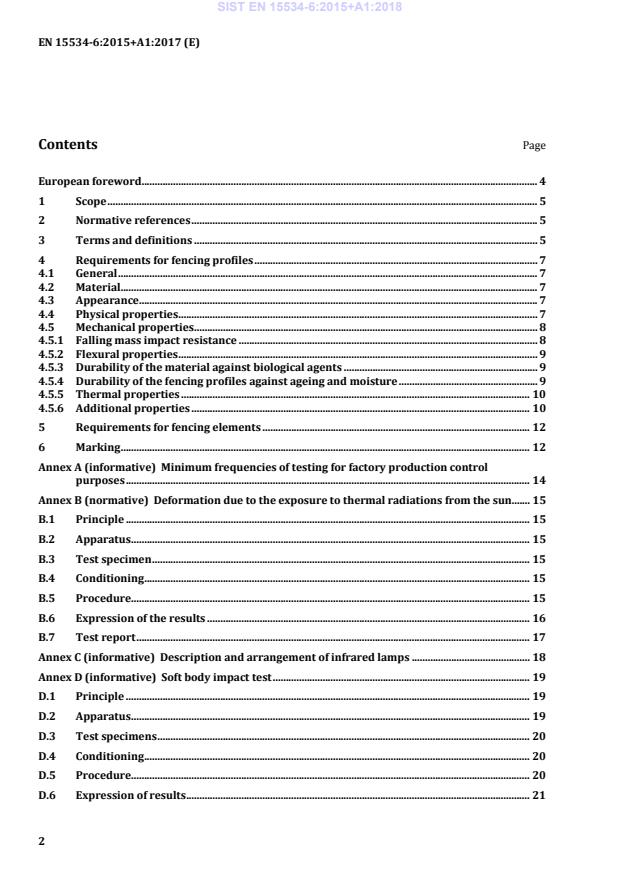
Minimum frequencies of testing for factory production control purposes . 14 Annex B (normative)
Deformation due to the exposure to thermal radiations from the sun. 15 B.1 Principle . 15 B.2 Apparatus . 15 B.3 Test specimen . 15 B.4 Conditioning . 15 B.5 Procedure. 15 B.6 Expression of the results . 16 B.7 Test report . 17 Annex C (informative)
Description and arrangement of infrared lamps . 18 Annex D (informative)
Soft body impact test . 19 D.1 Principle . 19 D.2 Apparatus . 19 D.3 Test specimens . 20 D.4 Conditioning . 20 D.5 Procedure. 20 D.6 Expression of results . 21 SIST EN 15534-6:2015+A1:2018
Key 1 bow Figure 1 — Illustration of bow 3.5 cupping curvature of a fencing profile across its width Note 1 to entry: see Figure 2.
Key 1 cupping Figure 2 — Illustration of cupping SIST EN 15534-6:2015+A1:2018
95 % declared value by the manufacturer. The linear mass and tolerances shall be declared by the manufacturer. EN 15534–1:2014, 6.5 3 specimens Thickness, width and length The relevant dimensional values and their tolerances shall be declared by the manufacturer. EN 15534–1:2014, 6.6.2 3 specimens Deviation from straightness The deviation of straightness and its tolerance shall be declared by the manufacturer. EN 15534–1:2014, 6.6.3 3 specimens Cupping (if relevant) The cupping value and its tolerance shall be declared by the manufacturer. EN 15534–1:2014, 6.6.4 3 specimens 4.5 Mechanical properties 4.5.1 Falling mass impact resistance When tested in accordance with the test methods as specified in Table 2, using the parameters indicated, the fencing profiles, as delivered to the customer, shall have properties conforming to the requirements given in Table 2. Table 2 — Falling mass impact resistance Requirements Test parameters Test method Number of test specimens Non-cellular material profiles No more than one test specimen out of 10 test specimens shall show a failure. H: (1 000 ± 5) mm Ms: (500 ± 2) g EN 15534–1:2014, 7.1.2.2.1 10 specimens/facea Cellular material profiles No more than one test specimen out of 10 test specimens shall show a failure. H: (1 000 ± 5) mm Ms: (500 ± 2) g EN 15534–1:2014, 7.1.2.2.2 10 speci
...