


EN ISO 13402:2025
(Main)Surgical and dental hand instruments - Determination of resistance against autoclaving, corrosion and thermal exposure (ISO 13402:2025)
Surgical and dental hand instruments - Determination of resistance against autoclaving, corrosion and thermal exposure (ISO 13402:2025)
This document describes test methods to determine the resistance of stainless steel surgical and dental hand instruments against autoclaving, corrosion and thermal exposure.
Chirurgische und zahnärztliche Handinstrumente - Bestimmung der Beständigkeit gegenüber Sterilisation, Korrosion und Wärmebehandlung (ISO 13402:2025)
Dieses Dokument beschreibt Prüfverfahren zur Bestimmung der Beständigkeit von chirurgischen und zahnärztlichen Handinstrumenten aus nichtrostendem Stahl gegen Autoklavieren, Korrosion und Wärmeeinwirkung.
Instruments chirurgicaux et dentaires à main - Détermination de la résistance au passage à l'autoclave, à la corrosion et à l'exposition à la chaleur (ISO 13402:2025)
Le présent document décrit des méthodes d’essai qui permettent de déterminer la résistance des instruments chirurgicaux et dentaires à main en acier inoxydable au passage à l’autoclave, à la corrosion et à l’exposition à la chaleur.
Kirurški in zobozdravstveni ročni instrumenti - Določanje odpornosti proti avtoklaviranju, koroziji in toplotni izpostavljenosti (ISO 13402:2025)
Ta dokument opisuje preskusne metode za določanje odpornosti kirurških in zobozdravstvenih ročnih instrumentov iz nerjavnega jekla proti avtoklaviranju, koroziji in toplotni izpostavljenosti.
General Information
- Status
- Published
- Publication Date
- 18-Mar-2025
- Technical Committee
- CEN/TC 55 - Dentistry
- Drafting Committee
- CEN/TC 55 - Dentistry
- Current Stage
- 6060 - Definitive text made available (DAV) - Publishing
- Start Date
- 19-Mar-2025
- Completion Date
- 19-Mar-2025
Relations
- Effective Date
- 18-Jan-2023
- Effective Date
- 09-Feb-2026
- Effective Date
- 28-Jan-2026
- Effective Date
- 28-Jan-2026
Overview - EN ISO 13402:2025
EN ISO 13402:2025 - titled Surgical and dental hand instruments - Determination of resistance against autoclaving, corrosion and thermal exposure (ISO 13402:2025) - defines harmonized type test methods to assess the resistance of stainless steel surgical and dental hand instruments to autoclaving, corrosion and thermal exposure. Approved by CEN in March 2025, this second edition supersedes the 2000/2001 edition and compiles standardized procedures for evaluating instrument surface integrity and material stability.
Key topics and technical requirements
- Scope: Test methods apply to stainless steel instruments (martensitic, austenitic, ferritic and precipitation‑hardening steels) to determine resistance to sterilization, corrosion and thermal stress.
- Type tests: All procedures in the standard are defined as type tests (not routine production checks).
- Sampling plan: Manufacturers must define sampling according to ISO 7554-3 to ensure representative testing; rejected lots can be re‑passivated and re‑tested.
- Test methods (Annexes A–H):
- Boiling tests (Annex A - deionized water; Annex B - 0.9 % NaCl) to detect surface imperfections and free iron.
- Copper sulfate tests (Annex C for ≥16 % Cr steels; Annex D for martensitic <16 % Cr) to detect improper heat treatment or surface contamination.
- Corrosion tests for austenitic steels (Annex E - 0.3 % NaCl; Annex F - citric acid) - informative methods for specific corrosion assessment.
- Thermal test (Annex G) for resistance to thermal stress.
- Autoclave test (Annex H) to simulate normal sterilization cycles.
- Applicability rules: The standard provides guidance on which tests apply to which steel types and chromium contents (notably the 16 % chromium threshold).
- Test reporting: Required report items include sample identification, reference to ISO 13402:2025, method used, observed anomalies, deviations, dates and testing laboratory identification.
Applications - who uses this standard
- Medical device manufacturers: Specify and validate material and finishing processes for surgical and dental hand instruments.
- Quality and regulatory teams: Demonstrate conformity to accepted test methods for product approval and CE/national standards alignment.
- Test laboratories and inspection bodies: Perform standardized type testing, report results and advise manufacturers on failures or rework.
- Purchasers and procurement (hospitals, clinics): Reference required resistance tests in purchase specifications and supplier contracts.
- Sterilization engineers: Ensure instruments tolerate routine autoclave cycles without corrosion or thermal damage.
Related standards
- ISO 7151, ISO 9173‑1 (product standards referenced for instrument testing practices)
- ISO 7554‑3 (sampling and test plan guidance)
EN ISO 13402:2025 is a practical, harmonized reference for evaluating stainless steel instrument durability against autoclaving, corrosion and heat - essential for safe, long‑lasting surgical and dental tools.

Get Certified
Connect with accredited certification bodies for this standard

BSI Group
BSI (British Standards Institution) is the business standards company that helps organizations make excellence a habit.

TÜV Rheinland
TÜV Rheinland is a leading international provider of technical services.

TÜV SÜD
TÜV SÜD is a trusted partner of choice for safety, security and sustainability solutions.
Sponsored listings
Frequently Asked Questions
EN ISO 13402:2025 is a standard published by the European Committee for Standardization (CEN). Its full title is "Surgical and dental hand instruments - Determination of resistance against autoclaving, corrosion and thermal exposure (ISO 13402:2025)". This standard covers: This document describes test methods to determine the resistance of stainless steel surgical and dental hand instruments against autoclaving, corrosion and thermal exposure.
This document describes test methods to determine the resistance of stainless steel surgical and dental hand instruments against autoclaving, corrosion and thermal exposure.
EN ISO 13402:2025 is classified under the following ICS (International Classification for Standards) categories: 11.040.30 - Surgical instruments and materials; 11.060.25 - Dental instruments. The ICS classification helps identify the subject area and facilitates finding related standards.
EN ISO 13402:2025 has the following relationships with other standards: It is inter standard links to EN ISO 13402:2000, ISO 3696:1987, EN 13018:2016, EN 1639:2009. Understanding these relationships helps ensure you are using the most current and applicable version of the standard.
EN ISO 13402:2025 is available in PDF format for immediate download after purchase. The document can be added to your cart and obtained through the secure checkout process. Digital delivery ensures instant access to the complete standard document.
Standards Content (Sample)
SLOVENSKI STANDARD
01-maj-2025
Nadomešča:
SIST EN ISO 13402:2001
Kirurški in zobozdravstveni ročni instrumenti - Določanje odpornosti proti
avtoklaviranju, koroziji in toplotni izpostavljenosti (ISO 13402:2025)
Surgical and dental hand instruments - Determination of resistance against autoclaving,
corrosion and thermal exposure (ISO 13402:2025)
Chirurgische und zahnärztliche Handinstrumente - Bestimmung der Beständigkeit
gegenüber Sterilisation, Korrosion und Wärmebehandlung (ISO 13402:2025)
Instruments chirurgicaux et dentaires à main - Détermination de la résistance au
passage à l'autoclave, à la corrosion et à l'exposition à la chaleur (ISO 13402:2025)
Ta slovenski standard je istoveten z: EN ISO 13402:2025
ICS:
11.040.30 Operacijski instrumenti in Surgical instruments and
materiali materials
11.060.25 Zobotehnični instrumenti Dental instruments
2003-01.Slovenski inštitut za standardizacijo. Razmnoževanje celote ali delov tega standarda ni dovoljeno.
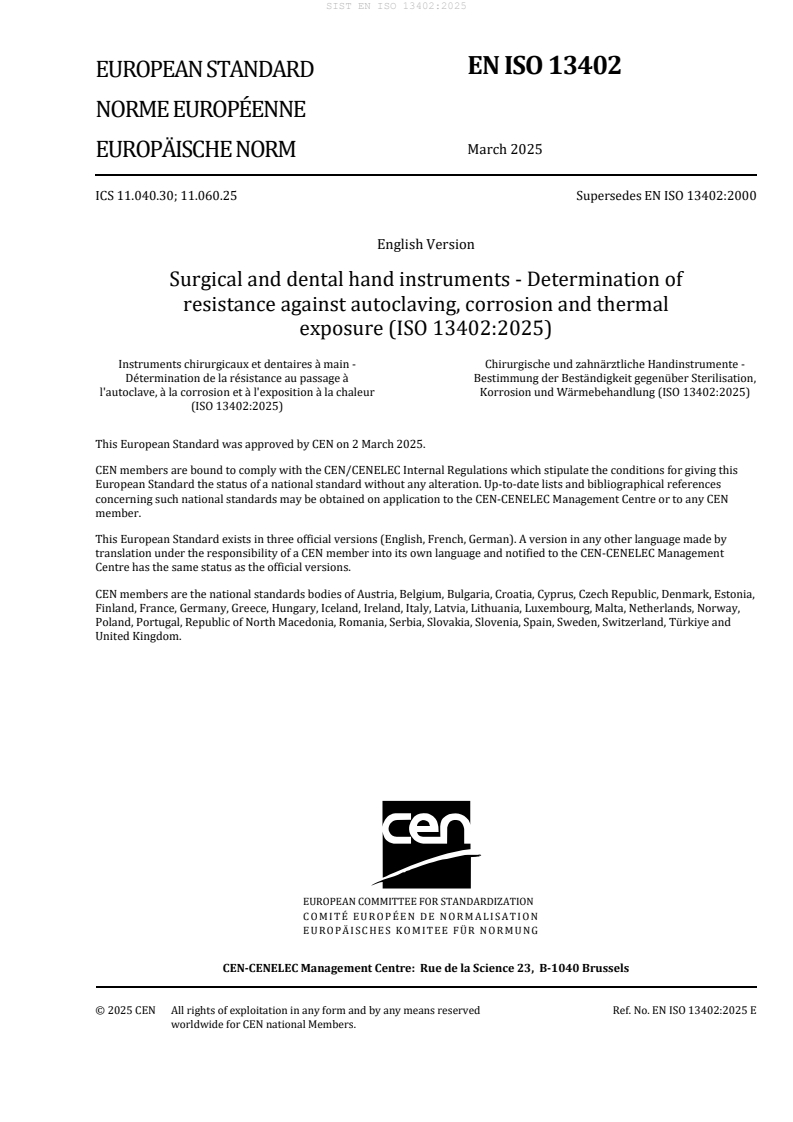
EN ISO 13402
EUROPEAN STANDARD
NORME EUROPÉENNE
March 2025
EUROPÄISCHE NORM
ICS 11.040.30; 11.060.25 Supersedes EN ISO 13402:2000
English Version
Surgical and dental hand instruments - Determination of
resistance against autoclaving, corrosion and thermal
exposure (ISO 13402:2025)
Instruments chirurgicaux et dentaires à main - Chirurgische und zahnärztliche Handinstrumente -
Détermination de la résistance au passage à Bestimmung der Beständigkeit gegenüber Sterilisation,
l'autoclave, à la corrosion et à l'exposition à la chaleur Korrosion und Wärmebehandlung (ISO 13402:2025)
(ISO 13402:2025)
This European Standard was approved by CEN on 2 March 2025.
CEN members are bound to comply with the CEN/CENELEC Internal Regulations which stipulate the conditions for giving this
European Standard the status of a national standard without any alteration. Up-to-date lists and bibliographical references
concerning such national standards may be obtained on application to the CEN-CENELEC Management Centre or to any CEN
member.
This European Standard exists in three official versions (English, French, German). A version in any other language made by
translation under the responsibility of a CEN member into its own language and notified to the CEN-CENELEC Management
Centre has the same status as the official versions.
CEN members are the national standards bodies of Austria, Belgium, Bulgaria, Croatia, Cyprus, Czech Republic, Denmark, Estonia,
Finland, France, Germany, Greece, Hungary, Iceland, Ireland, Italy, Latvia, Lithuania, Luxembourg, Malta, Netherlands, Norway,
Poland, Portugal, Republic of North Macedonia, Romania, Serbia, Slovakia, Slovenia, Spain, Sweden, Switzerland, Türkiye and
United Kingdom.
EUROPEAN COMMITTEE FOR STANDARDIZATION
COMITÉ EUROPÉEN DE NORMALISATION
EUROPÄISCHES KOMITEE FÜR NORMUNG
CEN-CENELEC Management Centre: Rue de la Science 23, B-1040 Brussels
© 2025 CEN All rights of exploitation in any form and by any means reserved Ref. No. EN ISO 13402:2025 E
worldwide for CEN national Members.
Contents Page
European foreword . 3
European foreword
This document (EN ISO 13402:2025) has been prepared by Technical Committee ISO/TC 170 "Surgical
instruments" in collaboration with Technical Committee CEN/TC 55 “Dentistry” the secretariat of which
is held by DIN.
This European Standard shall be given the status of a national standard, either by publication of an
identical text or by endorsement, at the latest by September 2025, and conflicting national standards
shall be withdrawn at the latest by September 2025.
Attention is drawn to the possibility that some of the elements of this document may be the subject of
patent rights. CEN shall not be held responsible for identifying any or all such patent rights.
This document supersedes EN ISO 13402:2000.
Any feedback and questions on this document should be directed to the users’ national standards
body/national committee. A complete listing of these bodies can be found on the CEN website.
According to the CEN-CENELEC Internal Regulations, the national standards organizations of the
following countries are bound to implement this European Standard: Austria, Belgium, Bulgaria,
Croatia, Cyprus, Czech Republic, Denmark, Estonia, Finland, France, Germany, Greece, Hungary, Iceland,
Ireland, Italy, Latvia, Lithuania, Luxembourg, Malta, Netherlands, Norway, Poland, Portugal, Republic of
North Macedonia, Romania, Serbia, Slovakia, Slovenia, Spain, Sweden, Switzerland, Türkiye and the
United Kingdom.
Endorsement notice
The text of ISO 13402:2025 has been approved by CEN as EN ISO 13402:2025 without any modification.
International
Standard
ISO 13402
Second edition
Surgical and dental hand
2025-03
instruments — Determination of
resistance against autoclaving,
corrosion and thermal exposure
Instruments chirurgicaux et dentaires à main — Détermination
de la résistance au passage à l'autoclave, à la corrosion et à
l'exposition à la chaleur
Reference number
ISO 13402:2025(en) © ISO 2025
ISO 13402:2025(en)
© ISO 2025
All rights reserved. Unless otherwise specified, or required in the context of its implementation, no part of this publication may
be reproduced or utilized otherwise in any form or by any means, electronic or mechanical, including photocopying, or posting on
the internet or an intranet, without prior written permission. Permission can be requested from either ISO at the address below
or ISO’s member body in the country of the requester.
ISO copyright office
CP 401 • Ch. de Blandonnet 8
CH-1214 Vernier, Geneva
Phone: +41 22 749 01 11
Email: copyright@iso.org
Website: www.iso.org
Published in Switzerland
ii
ISO 13402:2025(en)
Contents Page
Foreword .iv
Introduction .v
1 Scope . 1
2 Normative references . 1
3 Terms and definitions . 1
4 Test methods . 1
4.1 General .1
4.2 Sampling plan .1
4.3 Overview of test methods and applicability .2
5 Test report . 2
Annex A (normative) Boiling test in deionized water . 4
Annex B (normative) Boiling test in 0,9 % NaCl solution. 6
Annex C (normative) Copper sulfate test for steels with equal or greater than 16 % chromium . 8
Annex D (normative) Copper sulfate test for martensitic steels with less than 16 % chromium .10
Annex E (informative) Test in 0,3 % sodium chloride solution of austenitic steels .12
Annex F (informative) Test with citric acid solution for austenitic steels . 14
Annex G (informative) Thermal test . 16
Annex H (informative) Autoclave test . 17
Bibliography .18
iii
ISO 13402:2025(en)
Foreword
ISO (the International Organization for Standardization) is a worldwide federation of national standards
bodies (ISO member bodies). The work of preparing International Standards is normally carried out through
ISO technical committees. Each member body interested in a subject for which a technical committee
has been established has the right to be represented on that committee. International organizations,
governmental and non-governmental, in liaison with ISO, also take part in the work. ISO collaborates closely
with the International Electrotechnical Commission (IEC) on all matters of electrotechnical standardization.
The procedures used to develop this document and those intended for its further maintenance are described
in the ISO/IEC Directives, Part 1. In particular, the different approval criteria needed for the different types
of ISO document should be noted. This document was drafted in accordance with the editorial rules of the
ISO/IEC Directives, Part 2 (see www.iso.org/directives).
ISO draws attention to the possibility that the implementation of this document may involve the use of (a)
patent(s). ISO takes no position concerning the evidence, validity or applicability of any claimed patent
rights in respect thereof. As of the date of publication of this document, ISO had not received notice of (a)
patent(s) which may be required to implement this document. However, implementers are cautioned that
this may not represent the latest information, which may be obtained from the patent database available at
www.iso.org/patents. ISO shall not be held responsible for identifying any or all such patent rights.
Any trade name used in this document is information given for the convenience of users and does not
constitute an endorsement.
For an explanation of the voluntary nature of standards, the meaning of ISO specific terms and expressions
related to conformity assessment, as well as information about ISO's adherence to the World Trade
Organization (WTO) principles in the Technical Barriers to Trade (TBT), see www.iso.org/iso/foreword.html.
This document was prepared by Technical Committee ISO/TC 170, Surgical instruments, in collaboration
with the European Committee for Standardization (CEN) Technical Committee CEN/TC 55, Dentistry, in
accordance with the Agreement on technical cooperation between ISO and CEN (Vienna Agreement).
This second edition cancels and replaces the first edition (ISO 13402:1995), which has been technically
revised.
The main changes are as follows:
— restructuring of the document;
— update of Clause 2;
— addition of Clause 3;
— addition of Clause 4 including a table with an overview of test methods;
— addition of Clause 5;
— addition of Annexes A to H including test methods.
Any feedback or questions on this document should be directed to the user’s national standards body. A
complete listing of these bodies can be found at www.iso.org/members.html.
iv
ISO 13402:2025(en)
Introduction
The procedures described in this document form a harmonized series of tests that can be referred to,
individually or in combination, in other separate product standards. The requirements for such tests are
defined and stated within the body of the product standard along with the number of cycles for each test
procedure. The tests apply to dental and surgical instruments and are already standardized in relevant
product standards (e.g. ISO 7151, ISO 9173-1). However, the test procedures as stated in the product
standards differ in minor details. An alignment and a compilation were established.
The most important test methods for dental and surgical instruments have been compiled in this document.
v
International Standard ISO 13402:2025(en)
Surgical and dental hand instruments — Determination
of resistance against autoclaving, corrosion and thermal
exposure
1 Scope
This document describes test methods to determine the resistance of stainless steel surgical and dental
hand instruments against autoclaving, corrosion and thermal exposure.
2 Normative references
The following documents are referred to in the text in such a way that some or all of their content constitutes
requirements of this document. For dated references, only the edition cited applies. For undated references,
the latest edition of the referenced document (including any amendments) applies.
ISO 3696, Water for analytical laboratory use — Specification and test methods
1)
ISO 7554-3, Surgical instruments — Terms, measuring methods and tests — Part 3: Test methods
EN 13018, Non-destructive testing — Visual testing — General principles
3 Terms and definitions
No terms and definitions are listed in this document.
ISO and IEC maintain terminology databases for use in standardization at the following addresses:
— ISO Online browsing platform: available at https:// www .iso .org/ obp
— IEC Electropedia: available at https:// www .electropedia .org/
4 Test methods
4.1 General
All tests are type tests.
4.2 Sampling plan
a) Each instrument manufacturer shall define an appropriate sampling plan for ensuring instrument
safety and quality. The sampling shall be done according to ISO 7554-3.
b) Rejected lots are often re-passivated and re-tested, typically using an increased sample size of
instruments. If the lot is rejected a second time, the cause of the repeat failure should be evaluated
before proceeding.
1) Under preparation. Stage at the time of publication: ISO/DIS 7664-3.
ISO 13402:2025(en)
4.3 Overview of test methods and applicability
Table 1 enlists several methods for testing. The tests applicable should be chosen according to the materials
of the instrument and be performed using the procedure described in respective annex.
When placing an order, the purchaser states whether both tests are to be carried out or which of the two
tests. If the purchaser does not so indicate, the choice is left to the discretion of the manufacturer.
Table 1 — Overview of test methods and applicability
Test method Applicability Annex
Boiling test in Martensitic, austenitic, ferritic material with less than 16 % chromium, and precip- Annex A
deionized water itation hardening materials shall use the boiling test.
(normative)
Instruments containing stainless steel materials that are exclusively to the following
shall use the boil test and copper sulfate test: austenitic materials, precipitation
hardening materials, and ferritic materials containing equal or greater than 16 %
chromium.
The boiling test allows to detect surface imperfections, free iron, or other anodic
surface contaminations on stainless steel.
Boiling test in Instruments made from stainless steel materials such as austenitic materials, Annex B
0,9 % NaCl solu- precipitation hardening materials and ferritic materials with a chromium content
(informative)
tion of 16 % or more should be tested with the boiling test in 0,9 % NaCl.
Copper sulfate Instruments containing stainless steel materials that are exclusively to the fol- Annex C
test for steels lowing shall use the copper sulfate test and boiling test: austenitic materials, pre-
(normative)
with equal or cipitation hardening materials, and ferritic materials containing equal or greater
greater than than 16 % chromium.
16 % chromium.
Copper sulfate Instruments made from martensitic materials with less than 16 % chromium, Annex D
test for steels and precipitation hardening materials to detect improper heat treatment shall be
(normative)
with less than tested with this copper sulfate test.
16 % chromium
Test in 0,3 % NaCl Instruments made from austenitic steel should be tested with 0,3 % NaCl solu- Annex E
solution tion. (informative)
Corrosion test exclusively for austenitic steels.
Test with Citric Instruments made from austenitic steel should be tested with citric acid solution. Annex F
acid (informative)
Corrosion test exclusively for austenitic steels.
solution
Thermal test The resistance to thermal stress of instruments made from martensitic or auste- Annex G
nitic steel should be tested with the thermal test (informative)
Autoclave test Instruments made from martensitic or austenitic steel should be tested with the Annex H
autoclave test. (informative)
The sterilization test should simulate normal operating conditions.
5 Test report
The test report for each determination shall include at least the following information:
a) id
...
Questions, Comments and Discussion
Ask us and Technical Secretary will try to provide an answer. You can facilitate discussion about the standard in here.
Loading comments...