

EN ISO 31915-3:2026
(Main)Aircraft ground support equipment - General requirements - Part 3: Vibration measurement methods and reduction (ISO 31915-3:2026)
- Abstract
This document is applicable to whole body vibration as a significant hazard. It also specifies the methods for determining the vibration emission transmitted to the whole body of drivers standing or seated on freely moveable ground support equipment (GSE) when driving, for purposes of type evaluation and declaration. This document also specifies methods for verifying vibration emission. This document is applicable to self-powered GSE only.
The test results do not apply to the determination of whole body vibration exposure of persons.
This document is intended to be used in conjunction with the different parts of the EN 1915 series and the EN 12312 series.
This document does not apply to GSE manufactured before the date of its publication.
- Status
- Published
- Publication Date
- 15-Sep-2026
- Technical Committee
- CEN/TC 274 - Aircraft ground support equipment
- Drafting Committee
- CEN/TC 274/WG 1 - Working Group Revision
- Current Stage
- 6060 - Definitive text made available (DAV) - Publishing
- Start Date
- 16-Sep-2026
- Due Date
- 01-Jul-2026
- Completion Date
- 16-Sep-2026
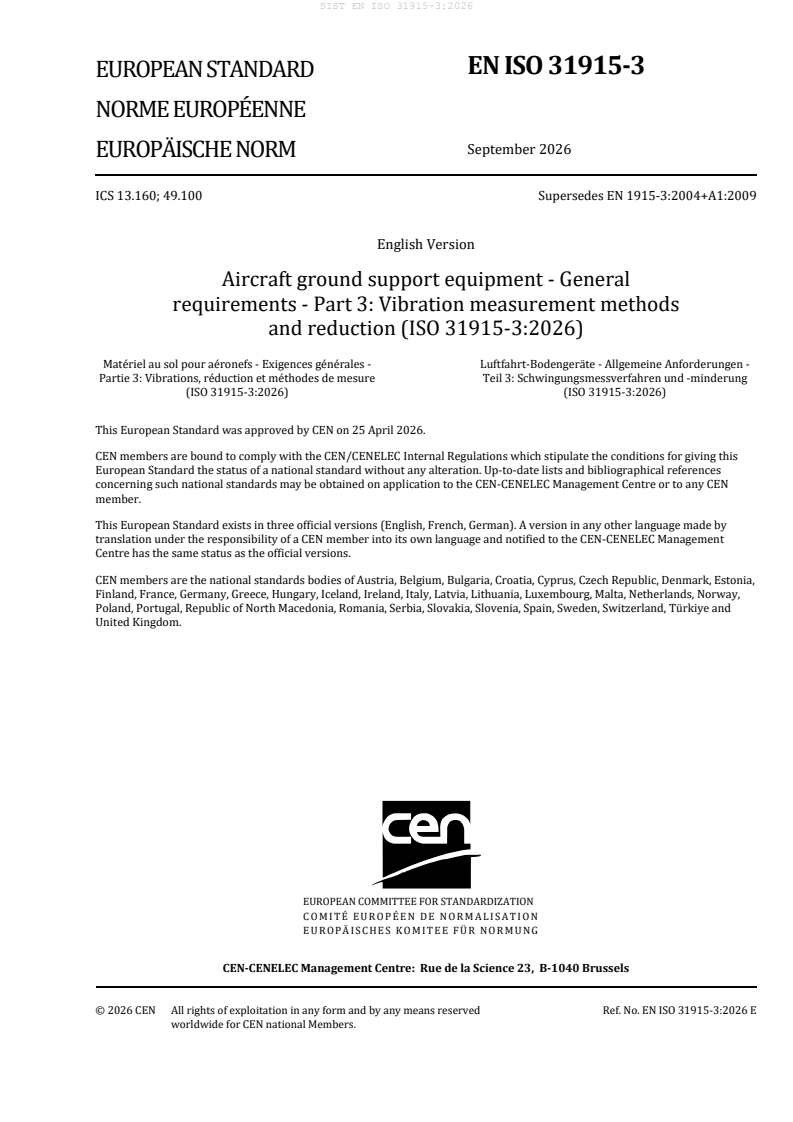

EN ISO 31915-3:2026 is a European Standard published by CEN and identical to ISO 31915-3:2026. It specifies vibration measurement methods and vibration reduction measures for self-powered aircraft ground support equipment (GSE), with a focus on whole body vibration transmitted to drivers when the equipment is driven. The document is used for type evaluation, vibration emission declaration, and verification.
What does EN ISO 31915-3:2026 specify?
EN ISO 31915-3:2026 applies to whole body vibration as a significant hazard for freely moveable, self-powered GSE when drivers are standing or seated. It gives a test method for measuring vibration emission during driving, and it is meant to support declaration and verification of those values.
The scope excludes using the test results to determine a person's actual vibration exposure. The standard is intended to be used together with the relevant parts of the EN 1915 series and the EN 12312 series, and it does not apply to GSE manufactured before the date of publication.
The document is organized into seven clauses, followed by three annexes:
| Annex | What it covers |
|---|---|
| Annex A | Significant hazards linked to vibration |
| Annex B | Guidance for reporting vibration data |
| Annex ZA | Relationship with Regulation (EU) 2023/1230 |
What are the key requirements of EN ISO 31915-3:2026?
EN ISO 31915-3:2026 sets a controlled measurement and reporting method so that vibration values for different GSE can be compared on the same basis. In practice, this means the machine, track, driver, tyres, speed, and measurement setup are all defined closely.
Vibration reduction comes first
Clause 5.2 requires vibration emission to be reduced as far as possible, taking account of technical progress and available vibration-control measures. The document points to measures such as tyre choice, suspension, vibration-isolated cabins, suspension seats, and shock absorbers. For manufacturers, this means vibration is not only measured - it also has to be addressed in design and then described in the instructions for additional user measures.
The measurements are tightly defined
Clause 5.3 specifies what to measure: weighted root mean square (r.m.s.) vertical acceleration, vehicle speed on the test track, pneumatic tyre pressure, and ambient temperature. Horizontal vibration is only included when EN 1032 calls it significant. For standing drivers, the value is measured on the floor of the driving position; for seated drivers, it is measured on the seat base. This matters because the declaration is meant to reflect a repeatable test setup, not an arbitrary field reading.
Instrumentation and sensor placement are standardized
Clause 5.4 requires instrumentation in accordance with EN 1032. Transducers are mounted on the seat pan using a semi-rigid disc, or fixed to rigid floor parts for standing-driver measurements. Frequency weighting follows EN 1032, and each run is integrated over one complete test run. The speed measuring instrument must have an accuracy of ±5 %. In practice, this avoids test-to-test variation caused by different measuring equipment.
The test track and test vehicle condition are controlled
Clause 5.6 defines the test track as straight, 25 m long, level within a stated slope deviation, and fitted with two rigid obstacles of specified width and height. The surface must be hard and smooth enough that vibration without obstacles is much lower than vibration with obstacles. The GSE is tested new, in standard specification, with tyres inflated according to the manufacturer's instructions. If the machine has adjustable cabins, driver stands, tyre types, or seat models, the relevant extremes or variants are tested.
Driver mass, temperature, and speed are part of the method
Clause 5.6 also fixes the driver conditions and the ambient range. Standing-driver tests use one person in the specified mass range, while seated-driver tests use two persons in different mass ranges. Clause 5.7 requires a constant test speed, normally 15 km/h with a tolerance, or the maximum speed if the operating instructions state a lower value. Measurements are made only after warm-up, and only while the front wheel enters and leaves the test section. This matters because speed, driver weight, and temperature can change vibration values.
A valid test series must be statistically stable
Clause 5.7.3 requires repeated runs until the coefficient of variation is below 0.15. The minimum number of runs is five, but more may be needed to obtain a valid series. The reported value is the mean of the valid series, and for seated drivers the final reported value is the average of the two driver means. In practice, this prevents a declaration based on one unusually low or high run.
Reporting, declaration, verification, and use information are mandatory outputs
Clauses 5.8, 5.9, 6, and 7 require a full test report, a vibration emission declaration, verification under the same procedure and driving conditions, and user information in the operating instructions. The declaration must identify the standard used, the measured values, and the tolerance, and it must be supported by checkable documentation. The operating instructions must state wheel and tyre characteristics, the declared vibration values, the reference to this standard, and any vibration-reduction measures that users can apply.
What terms does EN ISO 31915-3:2026 define?
- Ground support equipment (GSE) - Moveable or stationary equipment used for ground handling, servicing, or field maintenance of civil transport aircraft on the ramp area of an airport.
- Wheel mean diameter - The arithmetic mean of the outside diameters of the load-bearing wheels, used in this standard to select obstacle height.
- Seat pan - The seat surface on which the driver is seated, which is the measurement location for seated-driver vibration.
- Root mean square (r.m.s.) acceleration - The weighted vibration quantity used for the declared whole body vibration values.
- Coefficient of variation - The ratio of the standard deviation to the mean value of a measurement series, used to decide whether a test series is valid.
- Whole body vibration - The vibration hazard addressed by the document when it is transmitted to the driver's body during driving.
Who uses EN ISO 31915-3:2026?
EN ISO 31915-3:2026 is mainly used by GSE manufacturers who need a defined method for design checks, type evaluation, and vibration emission declaration. It is also used by test laboratories and conformity assessment bodies that perform measurements and verification.
Health and safety bodies, regulators, and market surveillance authorities use it when checking whether a machine family has been assessed on a common basis. Operators, employers, maintenance providers, and technical buyers use it to compare equipment versions, seats, tyres, and other vibration-related options.
What changed in EN ISO 31915-3:2026 from the previous edition?
EN ISO 31915-3:2026 supersedes EN 1915-3:2004+A1:2009.
Which standards are used with EN ISO 31915-3:2026?
- ISO 12100:2010 - Provides the general principles of risk assessment and risk reduction, and is the safety design basis for hazards not specifically covered here.
- ISO 2041:2018 - Supplies mechanical vibration vocabulary used for terminology consistency.
- ISO 5805:1997 - Supplies vocabulary for human exposure to mechanical vibration and shock.
- EN 1032:2003+A1:2008 - Provides the vibration testing framework used for instrumentation, frequency weighting, and whole-body vibration measurement.
- EN 1915-1:2023 - Gives the basic safety requirements for aircraft ground support equipment.
- EN 12096:1997 - Provides the rules for declaring and verifying vibration emission values, including rounding and tolerance handling.
- EN 1915 (all parts) and EN 12312 (all parts) - The document is intended to be used together with these series for the relevant GSE categories.
- EN 1915-4:2004+A1:2009 - Can share a test track with this document when vibration and noise are measured on the same track.
What does the EN ISO 31915-3:2026 document contain?
EN ISO 31915-3:2026 contains a test track layout, obstacle specification, and measurement procedure for driving tests. It also includes the calculation approach for test validity and the coefficient of variation, so users can decide when a test series is stable enough for reporting.
The annexes add practical support: Annex A links the vibration hazard to the relevant safety clauses, Annex B gives reporting tables for standing and seated drivers, and Annex ZA maps the standard to Regulation (EU) 2023/1230. For users, that means the document is not only a measurement method - it also supports reporting, verification, and EU conformity work.
Relations
- Effective Date
- 08-Apr-2024
- Effective Date
- 17-Sep-2026
- Effective Date
- 17-Sep-2026
- Effective Date
- 17-Sep-2026
- Effective Date
- 17-Sep-2026
- Effective Date
- 17-Sep-2026
- Effective Date
- 17-Sep-2026
- Effective Date
- 17-Sep-2026
- Effective Date
- 17-Sep-2026
- Effective Date
- 17-Sep-2026
- Effective Date
- 17-Sep-2026
- Effective Date
- 17-Sep-2026
- Effective Date
- 17-Sep-2026
- Effective Date
- 17-Sep-2026
- Effective Date
- 17-Sep-2026
Get Certified
Connect with accredited certification bodies for this standard

BUREAU VERITAS Certification Germany
Bureau Veritas certification in Germany.

Element Materials Technology
Materials testing and product certification.

AQMS Ltd.
AQMS provides ISO certification to SMEs across the UK.
Sponsored listings
Frequently Asked Questions
EN ISO 31915-3:2026 is a standard published by the European Committee for Standardization (CEN). Its full title is "Aircraft ground support equipment - General requirements - Part 3: Vibration measurement methods and reduction (ISO 31915-3:2026)". This standard covers: This document is applicable to whole body vibration as a significant hazard. It also specifies the methods for determining the vibration emission transmitted to the whole body of drivers standing or seated on freely moveable ground support equipment (GSE) when driving, for purposes of type evaluation and declaration. This document also specifies methods for verifying vibration emission. This document is applicable to self-powered GSE only. The test results do not apply to the determination of whole body vibration exposure of persons. This document is intended to be used in conjunction with the different parts of the EN 1915 series and the EN 12312 series. This document does not apply to GSE manufactured before the date of its publication.
This document is applicable to whole body vibration as a significant hazard. It also specifies the methods for determining the vibration emission transmitted to the whole body of drivers standing or seated on freely moveable ground support equipment (GSE) when driving, for purposes of type evaluation and declaration. This document also specifies methods for verifying vibration emission. This document is applicable to self-powered GSE only. The test results do not apply to the determination of whole body vibration exposure of persons. This document is intended to be used in conjunction with the different parts of the EN 1915 series and the EN 12312 series. This document does not apply to GSE manufactured before the date of its publication.
EN ISO 31915-3:2026 is classified under the following ICS (International Classification for Standards) categories: 13.160 - Vibration and shock with respect to human beings; 49.100 - Ground service and maintenance equipment. The ICS classification helps identify the subject area and facilitates finding related standards.
EN ISO 31915-3:2026 has the following relationships with other standards: It is inter standard links to EN 1915-3:2004+A1:2009, EN 12312-18:2005+A1:2009, EN 12312-9:2013, EN 12312-12:2017, EN 12312-7:2005+A1:2009, EN 12312-6:2004+A1:2009, EN 12312-10:2005+A1:2009, EN 12312-15:2006+A1:2009, EN 12312-3:2017+A1:2020, EN 12312-19:2005+A1:2009, EN 12312-2:2014, EN 12312-3:2003+A1:2009, EN 12312-6:2017, EN 12312-9:2005+A1:2009, EN 12312-16:2005+A1:2009. Understanding these relationships helps ensure you are using the most current and applicable version of the standard.
EN ISO 31915-3:2026 is associated with the following European legislation: EU Directives/Regulations: 2006/42/EC, 2023/1230; Standardization Mandates: M/396, M/605. When a standard is cited in the Official Journal of the European Union, products manufactured in conformity with it benefit from a presumption of conformity with the essential requirements of the corresponding EU directive or regulation.
EN ISO 31915-3:2026 is available in PDF format for immediate download after purchase. The document can be added to your cart and obtained through the secure checkout process. Digital delivery ensures instant access to the complete standard document.
Standards Content (Sample)
SLOVENSKI STANDARD
01-november-2026
Podporna oprema na tleh za letalski promet - Splošne zahteve - 3. del: Metode
merjenja in zmanjševanje vibracij (ISO 31915-3:2026)
Aircraft ground support equipment - General requirements - Part 3: Vibration
measurement methods and reduction (ISO 31915-3:2026)
Luftfahrtbodengeräte - Allgemeine Anforderungen - Teil 3: Schwingungsmessverfahren
und -minderung (ISO 31915-3:2026)
Matériel au sol pour aéronefs - Exigences générales - Partie 3: Vibrations, réduction et
méthodes de mesure (ISO 31915-3:2026)
Ta slovenski standard je istoveten z: EN ISO 31915-3:2026
ICS:
17.160 Vibracije, meritve udarcev in Vibrations, shock and
vibracij vibration measurements
49.100 Oprema za servis in Ground service and
vzdrževanje na tleh maintenance equipment
2003-01.Slovenski inštitut za standardizacijo. Razmnoževanje celote ali delov tega standarda ni dovoljeno.
EN ISO 31915-3
EUROPEAN STANDARD
NORME EUROPÉENNE
September 2026
EUROPÄISCHE NORM
ICS 13.160; 49.100 Supersedes EN 1915-3:2004+A1:2009
English Version
Aircraft ground support equipment - General
requirements - Part 3: Vibration measurement methods
and reduction (ISO 31915-3:2026)
Matériel au sol pour aéronefs - Exigences générales - Luftfahrt-Bodengeräte - Allgemeine Anforderungen -
Partie 3: Vibrations, réduction et méthodes de mesure Teil 3: Schwingungsmessverfahren und -minderung
(ISO 31915-3:2026) (ISO 31915-3:2026)
This European Standard was approved by CEN on 25 April 2026.
CEN members are bound to comply with the CEN/CENELEC Internal Regulations which stipulate the conditions for giving this
European Standard the status of a national standard without any alteration. Up-to-date lists and bibliographical references
concerning such national standards may be obtained on application to the CEN-CENELEC Management Centre or to any CEN
member.
This European Standard exists in three official versions (English, French, German). A version in any other language made by
translation under the responsibility of a CEN member into its own language and notified to the CEN-CENELEC Management
Centre has the same status as the official versions.
CEN members are the national standards bodies of Austria, Belgium, Bulgaria, Croatia, Cyprus, Czech Republic, Denmark, Estonia,
Finland, France, Germany, Greece, Hungary, Iceland, Ireland, Italy, Latvia, Lithuania, Luxembourg, Malta, Netherlands, Norway,
Poland, Portugal, Republic of North Macedonia, Romania, Serbia, Slovakia, Slovenia, Spain, Sweden, Switzerland, Türkiye and
United Kingdom.
EUROPEAN COMMITTEE FOR STANDARDIZATION
COMITÉ EUROPÉEN DE NORMALISATION
EUROPÄISCHES KOMITEE FÜR NORMUNG
CEN-CENELEC Management Centre: Rue de la Science 23, B-1040 Brussels
© 2026 CEN All rights of exploitation in any form and by any means reserved Ref. No. EN ISO 31915-3:2026 E
worldwide for CEN national Members.
Contents Page
European foreword . 3
Annex ZA (informative) Relationship between this European Standard and the essential
requirements of Regulation (EU) 2023/1230 aimed to be covered . 4
European foreword
This document (EN ISO 31915-3:2026) has been prepared by Technical Committee ISO/TC 20 "Aircraft
and space vehicles" in collaboration with Technical Committee CEN/TC 274 “Aircraft ground support
equipment” the secretariat of which is held by DIN.
This European Standard shall be given the status of a national standard, either by publication of an
identical text or by endorsement, at the latest by March 2027, and conflicting national standards shall
be withdrawn at the latest by March 2027.
Attention is drawn to the possibility that some of the elements of this document may be the subject of
patent rights. CEN shall not be held responsible for identifying any or all such patent rights.
This document supersedes EN 1915-3:2004+A1:2009.
This document has been prepared under a standardization request addressed to CEN by the European
Commission. The Standing Committee of the EFTA States subsequently approves these requests for its
Member States.
For the relationship with EU Legislation, see informative Annex ZA, which is an integral part of this
document.
Any feedback and questions on this document should be directed to the users’ national standards
body/national committee. A complete listing of these bodies can be found on the CEN website.
According to the CEN-CENELEC Internal Regulations, the national standards organizations of the
following countries are bound to implement this European Standard: Austria, Belgium, Bulgaria,
Croatia, Cyprus, Czech Republic, Denmark, Estonia, Finland, France, Germany, Greece, Hungary, Iceland,
Ireland, Italy, Latvia, Lithuania, Luxembourg, Malta, Netherlands, Norway, Poland, Portugal, Republic of
North Macedonia, Romania, Serbia, Slovakia, Slovenia, Spain, Sweden, Switzerland, Türkiye and the
United Kingdom.
Endorsement notice
The text of ISO 31915-3:2026 has been approved by CEN as EN ISO 31915-3:2026 without any
modification.
Annex ZA
(informative)
Relationship between this European Standard and the essential
requirements of Regulation (EU) 2023/1230 aimed to be covered
This European Standard has been prepared under a Commission’s standardization request C(2025)129
final Commission Implementing Decision of 20 January 2025 to the European Committee for
Standardization and to the European Committee for Electrotechnical Standardization as regards
machinery in support of Regulation (EU) 2023/1230 of the European Parliament and of the Council
(M/605) to provide one voluntary means of conforming to essential requirements of Regulation (EU)
2023/1230 of the European Parliament and of the Council of 14 June 2023 on machinery (OJ L 165,
29.6.2023).
Once this standard is cited in the Official Journal of the European Union under that Regulation,
compliance with the normative clauses of this standard given in Table ZA.1 confers, within the limits of
the scope of this standard, a presumption of conformity with the corresponding essential requirements
of that Regulation, and associated EFTA regulations.
Table ZA.1 — Correspondence between this European Standard and Annex III of Regulation (EU)
2023/1230
The relevant Essential Requirements of Clause(s)/sub-clause(s) of Remarks/Notes*
Regulation (EU) 2023/1230 this EN
1.5.9 Vibrations not covered
3.6.3.1 Vibrations 5.8, 5.9, 7
* To cover all the relevant safety requirements for the products(s) in its scope, this standard (providing
general/common requirements for a whole machine family) has to be applied together with one of
those standards as specified in the scope (providing specific requirements for a particular category
of machinery within this family).
WARNING 1 Presumption of conformity stays valid only as long as a reference to this European
Standard is maintained in the list published in the Official Journal of the European Union. Users of this
standard should consult frequently the latest list published in the Official Journal of the European
Union.
WARNING 2 Other Union legislation may be applicable to the product(s) falling within the scope of
this standard.
International
Standard
ISO 31915-3
First edition
Aircraft ground support
2026-06
equipment — General
requirements —
Part 3:
Vibration measurement methods
and reduction
Matériel au sol pour aéronefs — Exigences générales —
Partie 3: Vibrations, réduction et méthodes de mesure
Reference number
ISO 31915-3:2026(en) © ISO 2026
ISO 31915-3:2026(en)
© ISO 2026
All rights reserved. Unless otherwise specified, or required in the context of its implementation, no part of this publication may
be reproduced or utilized otherwise in any form or by any means, electronic or mechanical, including photocopying, or posting on
the internet or an intranet, without prior written permission. Permission can be requested from either ISO at the address below
or ISO’s member body in the country of the requester.
ISO copyright office
CP 401 • Ch. de Blandonnet 8
CH-1214 Vernier, Geneva
Phone: +41 22 749 01 11
Email: copyright@iso.org
Website: www.iso.org
Published in Switzerland
ii
ISO 31915-3:2026(en)
Contents Page
Foreword .iv
Introduction .v
1 Scope . 1
2 Normative references . 1
3 Terms and definitions . 1
4 List of hazards. 2
5 Safety requirements and/or protective risk reduction measures . 2
5.1 General .2
5.2 Vibration reduction .2
5.3 Quantities to be measured .3
5.4 Instrumentation .3
5.4.1 General .3
5.4.2 Transducers .3
5.4.3 Frequency weighting .4
5.4.4 Integration time .4
5.4.5 Speed .4
5.5 Measurement location .4
5.6 Set up and equipment .4
5.6.1 Test track .4
5.6.2 Equipment and condition of the GSE .6
5.6.3 Drivers .6
5.6.4 Environmental parameter .6
5.7 Measurement procedure and validity .6
5.7.1 Speed .6
5.7.2 Test procedure.7
5.7.3 Validity of test .7
5.7.4 Coefficient of variation .7
5.7.5 Reported vibration values .7
5.8 Test report .8
5.9 Declaration of vibration emission values .8
6 Verification of the safety requirements . 9
7 Information for use . 9
Annex A (informative) List of significant hazards . 10
Annex B (informative) Guidance for reporting vibration data .11
Bibliography .12
iii
ISO 31915-3:2026(en)
Foreword
ISO (the International Organization for Standardization) is a worldwide federation of national standards
bodies (ISO member bodies). The work of preparing International Standards is normally carried out through
ISO technical committees. Each member body interested in a subject for which a technical committee
has been established has the right to be represented on that committee. International organizations,
governmental and non-governmental, in liaison with ISO, also take part in the work. ISO collaborates closely
with the International Electrotechnical Commission (IEC) on all matters of electrotechnical standardization.
The procedures used to develop this document and those intended for its further maintenance are described
in the ISO/IEC Directives, Part 1. In particular, the different approval criteria needed for the different types
of ISO document should be noted. This document was drafted in accordance with the editorial rules of the
ISO/IEC Directives, Part 2 (see www.iso.org/directives).
ISO draws attention to the possibility that the implementation of this document may involve the use of (a)
patent(s). ISO takes no position concerning the evidence, validity or applicability of any claimed patent
rights in respect thereof. As of the date of publication of this document, ISO had not received notice of (a)
patent(s) which may be required to implement this document. However, implementers are cautioned that
this may not represent the latest information, which may be obtained from the patent database available at
www.iso.org/patents. ISO shall not be held responsible for identifying any or all such patent rights.
Any trade name used in this document is information given for the convenience of users and does not
constitute an endorsement.
For an explanation of the voluntary nature of standards, the meaning of ISO specific terms and expressions
related to conformity assessment, as well as information about ISO's adherence to the World Trade
Organization (WTO) principles in the Technical Barriers to Trade (TBT), see www.iso.org/iso/foreword.html.
This document was prepared by Technical Committee ISO/TC 20, Aircraft and space vehicles, Subcommittee
SC 9, Air cargo and ground equipment, in collaboration with the European Committee for Standardization
(CEN) Technical Committee CEN/TC 274, Aircraft ground support equipment, in accordance with the
Agreement on technical cooperation between ISO and CEN (Vienna Agreement).
A list of all parts in the ISO 31915 series can be found on the ISO website.
Any feedback or questions on this document should be directed to the user’s national standards body. A
complete listing of these bodies can be found at www.iso.org/members.html.
iv
ISO 31915-3:2026(en)
Introduction
The aim of this document is to deal with vibration as a hazard and to provide methods for the measurement
and reduction of vibration emission transmitted to the whole body of drivers of ground support equipment
(GSE) when driving. See EN 1032:2003+A1:2008 for determining whole body vibrations under stationary
operating conditions and hand-arm vibrations.
The results obtained can also be used to compare GSE of the same category or a given GSE when equipped
with different seats or tyres, etc.
Fitting different seats, changing the tyre specification, etc. can lead to different vibration values. Due to
the specific operation of GSE, however, EN 1032:2003+A1:2008 cannot be applied directly for whole body
vibration under driving conditions, and therefore, the preparation of this document for GSE has become
necessary.
This document cannot be used for field measurements to determine the daily exposure of the driver to
vibration.
This document is a type-C standard as stated in ISO 12100.
This document is of relevance, in particular, for the following stakeholder groups representing the market
players with regard to machinery safety:
— machine manufacturers (small, medium and large enterprises);
— health and safety bodies (regulators, accident prevention organisations, market surveillance etc.)
Others can be affected by the level of machinery safety achieved with the means of the document by the
above-mentioned stakeholder groups:
— machine users/employers (small, medium and large enterprises);
— machine users/employees (e.g. trade unions, organizations for people with special needs);
— service providers, e.g. for maintenance (small, medium and large enterprises);
— consumers (in case of machinery intended for use by consumers).
The above-mentioned stakeholder groups have been given the possibility to participate at the drafting
process of this document.
When requirements of this type-C s
...