

EN 1365-5:2004
(Main)Fire resistance tests for loadbearing elements - Part 5: Balconies and walkways
- Abstract
This Part of EN 1365 specifies a method for determining the fire resistance, in respect with loadbearing capacity and with no separating function, of:
- balconies exposed to the fire from either outside or inside the building; and
- walkways exposed to the fire from either outside or inside the building.
This standard is used in conjunction with EN 1363-1.
- Status
- Published
- Publication Date
- 02-Nov-2004
- Withdrawal Date
- 30-May-2005
- Technical Committee
- CEN/TC 127 - Fire safety in buildings
- Drafting Committee
- CEN/TC 127 - Fire safety in buildings
- Current Stage
- 9093 - Decision to confirm - Review Enquiry
- Start Date
- 18-Jul-2024
- Completion Date
- 14-Oct-2026



Overview
EN 1365-5:2004 - "Fire resistance tests for loadbearing elements - Part 5: Balconies and walkways" (CEN) specifies a standardized method to determine the fire resistance of balconies and walkways with respect to loadbearing capacity (it does not cover separating function). The Part is intended to be used in conjunction with EN 1363-1 (general requirements for fire resistance tests). EN 1365-5 covers assemblies exposed to fire from either the inside or the outside of a building and defines how test specimens should be built, loaded, instrumented and assessed.
Key topics and technical requirements
- Scope: Tests assess loadbearing capacity of balconies and walkways (integrated or free-standing) when exposed to fire; balustrades, beams, columns and tension members are covered as components.
- Test conditions: Heating regime, furnace atmosphere and general conditions follow EN 1363-1. A furnace pressure of 20 Pa is specified at 100 mm below the underside of the furnace cover slab for balcony/walkway tests.
- Specimen size and representation:
- Full-size specimens are required unless furnace capacity is limited.
- Minimum representative sizes when reduced: balconies at least 3 m × 3 m, walkways at least 4 m × 3 m (height 3 m).
- The specimen must include realistic construction details (waterproofing, drainage, joints, connections) and support conditions representative of actual use.
- Loading and restraint: Loads are determined and applied according to EN 1363-1 to produce stress levels representative of practice; distribution may be uniform or point loads where appropriate.
- Instrumentation and measurement:
- Furnace thermocouples / plate thermometers spaced according to exposed surface area (minimum number specified; at least four for small specimens) with additional sensors near tension bars/columns.
- Furnace pressure sensors and vertical deflection measurements (mid-span for simply supported members).
- Performance criteria and reporting: Fire resistance is judged against loadbearing capacity criteria in EN 1363-1. Test reports must reference EN 1365-5 and include load determination, specimen details and instrumentation.
Practical applications and users
- Fire-test laboratories conducting standardized fire resistance testing for balconies, walkways and their components.
- Structural and façade engineers verifying compliance of balcony/walkway designs with fire safety requirements.
- Manufacturers of balcony systems, prefabricated walkways, balustrades and structural components seeking classification or certification.
- Building control authorities and specifiers using test evidence to assess compliance with national/regulatory fire-safety rules and the Construction Products Directive.
- Consultants performing fire performance assessments for retrofits or renovation projects.
Related standards
- EN 1363-1:1999 - Fire resistance tests - Part 1: General requirements (mandatory companion).
- EN 1365 (other parts): Part 1 (walls), Part 2 (floors/roofs), Part 3 (beams), Part 4 (columns), Part 6 (stairs).
- EN ISO 13943 - Fire safety vocabulary.
Keywords: EN 1365-5, fire resistance tests, balconies, walkways, loadbearing elements, EN 1363-1, CEN, fire safety testing, balustrade, furnace pressure, test specimen.
Relations
- Effective Date
- 28-Jan-2026
- Effective Date
- 28-Jan-2026
- Effective Date
- 28-Jan-2026
- Effective Date
- 28-Jan-2026
- Effective Date
- 28-Jan-2026
- Effective Date
- 28-Jan-2026
- Effective Date
- 28-Jan-2026
- Effective Date
- 28-Jan-2026
- Effective Date
- 28-Jan-2026
- Effective Date
- 28-Jan-2026
- Effective Date
- 28-Jan-2026
- Effective Date
- 28-Jan-2026
- Effective Date
- 28-Jan-2026
- Effective Date
- 28-Jan-2026
- Effective Date
- 28-Jan-2026
Get Certified
Connect with accredited certification bodies for this standard

CIS Institut d.o.o.
Personal Protective Equipment (PPE) certification body. Notified Body NB-2890 for EU Regulation 2016/425 PPE.

Kiwa BDA Testing
Building and construction product certification.
Kmetijski inštitut Slovenije
Agricultural Institute of Slovenia. Soil testing, plant health, agricultural product analysis.
Sponsored listings
Frequently Asked Questions
EN 1365-5:2004 is a standard published by the European Committee for Standardization (CEN). Its full title is "Fire resistance tests for loadbearing elements - Part 5: Balconies and walkways". This standard covers: This Part of EN 1365 specifies a method for determining the fire resistance, in respect with loadbearing capacity and with no separating function, of: - balconies exposed to the fire from either outside or inside the building; and - walkways exposed to the fire from either outside or inside the building. This standard is used in conjunction with EN 1363-1.
This Part of EN 1365 specifies a method for determining the fire resistance, in respect with loadbearing capacity and with no separating function, of: - balconies exposed to the fire from either outside or inside the building; and - walkways exposed to the fire from either outside or inside the building. This standard is used in conjunction with EN 1363-1.
EN 1365-5:2004 is classified under the following ICS (International Classification for Standards) categories: 13.220.50 - Fire-resistance of building materials and elements. The ICS classification helps identify the subject area and facilitates finding related standards.
EN 1365-5:2004 has the following relationships with other standards: It is inter standard links to EN 1365-3:1999, EN 1363-2:1999, EN ISO 13943:2000, EN 1365-4:1999, EN 1363-1:1999, EN ISO 140-5:1998, EN 378-3:2016, EN ISO 15667:2000, EN ISO 10848-3:2006, EN 378-3:2008+A1:2012, EN 13501-2:2023, EN ISO 15186-1:2003, EN ISO 15186-3:2010, EN ISO 17624:2004, EN ISO 140-18:2006. Understanding these relationships helps ensure you are using the most current and applicable version of the standard.
EN 1365-5:2004 is associated with the following European legislation: EU Directives/Regulations: 305/2011, 89/106/EEC; Standardization Mandates: M/117. When a standard is cited in the Official Journal of the European Union, products manufactured in conformity with it benefit from a presumption of conformity with the essential requirements of the corresponding EU directive or regulation.
EN 1365-5:2004 is available in PDF format for immediate download after purchase. The document can be added to your cart and obtained through the secure checkout process. Digital delivery ensures instant access to the complete standard document.
Standards Content (Sample)
SLOVENSKI STANDARD
01-maj-2005
Preskusi požarne odpornosti nosilnih elementov – 5. del: Balkoni in hodniki vzdolž
fasade
Fire resistance tests for loadbearing elements - Part 5: Balconies and walkways
Feuerwiderstandsprüfungen für tragende Bauteile - Teil 5: Balkone und Laubengänge
Essais de résistance au feu des éléments porteurs - Partie 5: Balcons et passerelles
Ta slovenski standard je istoveten z: EN 1365-5:2004
ICS:
13.220.50 Požarna odpornost Fire-resistance of building
gradbenih materialov in materials and elements
elementov
91.060.99 Drugi stavbni elementi Other elements of buildings
2003-01.Slovenski inštitut za standardizacijo. Razmnoževanje celote ali delov tega standarda ni dovoljeno.
EUROPEAN STANDARD
EN 1365-5
NORME EUROPÉENNE
EUROPÄISCHE NORM
November 2004
ICS 13.220.50
English version
Fire resistance tests for loadbearing elements - Part 5:
Balconies and walkways
Essais de résistance au feu des éléments porteurs - Partie Feuerwiderstandsprüfungen für tragende Bauteile - Teil 5:
5: Balcons et passerelles Balkone und Laubengänge
This European Standard was approved by CEN on 9 July 2004.
CEN members are bound to comply with the CEN/CENELEC Internal Regulations which stipulate the conditions for giving this European
Standard the status of a national standard without any alteration. Up-to-date lists and bibliographical references concerning such national
standards may be obtained on application to the Central Secretariat or to any CEN member.
This European Standard exists in three official versions (English, French, German). A version in any other language made by translation
under the responsibility of a CEN member into its own language and notified to the Central Secretariat has the same status as the official
versions.
CEN members are the national standards bodies of Austria, Belgium, Cyprus, Czech Republic, Denmark, Estonia, Finland, France,
Germany, Greece, Hungary, Iceland, Ireland, Italy, Latvia, Lithuania, Luxembourg, Malta, Netherlands, Norway, Poland, Portugal, Slovakia,
Slovenia, Spain, Sweden, Switzerland and United Kingdom.
EUROPEAN COMMITTEE FOR STANDARDIZATION
COMITÉ EUROPÉEN DE NORMALISATION
EUROPÄISCHES KOMITEE FÜR NORMUNG
Management Centre: rue de Stassart, 36 B-1050 Brussels
© 2004 CEN All rights of exploitation in any form and by any means reserved Ref. No. EN 1365-5:2004: E
worldwide for CEN national Members.
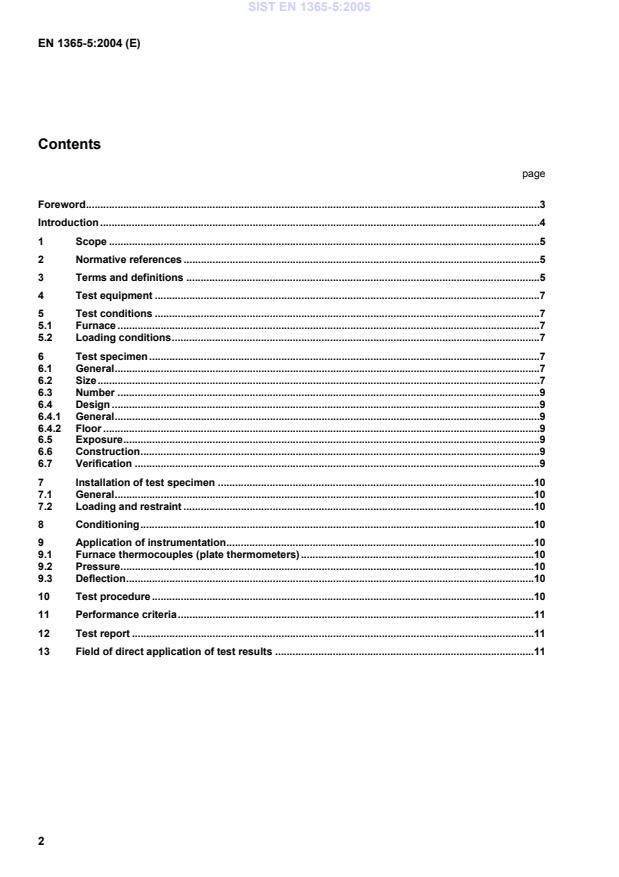
Contents
page
Foreword.3
Introduction .4
1 Scope.5
2 Normative references.5
3 Terms and definitions .5
4 Test equipment.7
5 Test conditions.7
5.1 Furnace.7
5.2 Loading conditions.7
6 Test specimen.7
6.1 General.7
6.2 Size.7
6.3 Number.9
6.4 Design.9
6.4.1 General.9
6.4.2 Floor.9
6.5 Exposure.9
6.6 Construction.9
6.7 Verification.9
7 Installation of test specimen .10
7.1 General.10
7.2 Loading and restraint .10
8 Conditioning.10
9 Application of instrumentation.10
9.1 Furnace thermocouples (plate thermometers) .10
9.2 Pressure.10
9.3 Deflection.10
10 Test procedure.10
11 Performance criteria.11
12 Test report.11
13 Field of direct application of test results .11
Foreword
This document (EN 1365-5:2004) has been prepared by Technical Committee CEN/TC 127 “Fire safety in
buildings”, the secretariat of which is held by BSI.
This European Standard shall be given the status of a national standard, either by publication of an identical
text or by endorsement, at the latest by May 2005, and conflicting national standards shall be withdrawn at the
latest by May 2005.
This document has been prepared under a mandate given to CEN by the European Commission and the
European Free Trade Association, and supports essential requirements of the Construction Products Directive.
EN 1365 ‘Fire resistance tests for loadbearing elements’ consists of the following parts:
Part 1: Walls,
Part 2: Floors and roofs,
Part 3: Beams,
Part 4: Columns,
Part 5: Balconies and walkways,
Part 6: Stairs.
According to the CEN/CENELEC Internal Regulations, the national standards organizations of the following
countries are bound to implement this European Standard: Austria, Belgium, Cyprus, Czech Republic,
Denmark, Estonia, Finland, France, Germany, Greece, Hungary, Iceland, Ireland, Italy, Latvia, Lithuania,
Luxembourg, Malta, Netherlands, Norway, Poland, Portugal, Slovakia, Slovenia, Spain, Sweden, Switzerland
and United Kingdom.
Introduction
The purpose of this test is to measure the ability of a representative specimen of a balcony or walkway or a
part of those to maintain its loadbearing capacity when exposed to fire according to EN 1363-1.
Caution
The attention of all persons concerned with managing and carrying out this fire resistance test is drawn to the
fact that fire testing can be hazardous and that there is a possibility that toxic and/or harmful smoke and gases
can be evolved during the test. Mechanical and operational hazards can also arise during the construction of
the test elements or structures, their testing and disposal of test residues.
An assessment of all potential hazards and risks to health should be made and safety precautions should be
identified and provided. Written safety instructions should be issued. Appropriate training should be given to
relevant personnel. Laboratory personnel should ensure that they follow written safety instructions at all times.
1 Scope
This Part of EN 1365 specifies a method for determining the fire resistance, in respect with loadbearing
capacity and with no separating fun
...