


EN 15954-1:2013
(Main)Railway applications - Track - Trailers and associated equipment - Part 1: Technical requirements for running and working
Railway applications - Track - Trailers and associated equipment - Part 1: Technical requirements for running and working
1.1 General
This European Standard specifies the technical requirements to minimise the specific railway hazards of trailers and associated equipment, which can arise during the commissioning, the operation and the maintenance of trailers when carried out in accordance with the specification given by the manufacturer or his authorised representative. This European Standard applies to trailers that are not intended to interact with operating signalling and control systems. Other machines are dealt with in other European Standards; see Annex E.
These trailers are not designed or intended for operating signalling and control systems and are only intended to work and run under special operating conditions specifically designated by the infrastructure manager.
These trailers are not intended to be vehicles as defined in the Interoperability Directive and are not permitted to run on the railway lines open to normal traffic. If this is required, they will need to be authorised or placed into service as set out in the Interoperability Directive 2008/57/EC.
Part 1 of this European Standard deals with the technical railway requirements; Part 2 deals with requirements for the trailer to be declared conformant by the manufacturer, except in the case of trailers classified in Annex 4 of the Machinery Directive 2006/42/EC which require conformity check in conjunction with a notified body.
Additional requirements can apply for running on infrastructures with narrow gauge or broad gauge lines, lines of tramways, railways utilising other than adhesion between the rail and rail wheels, and underground infrastructures.
This European Standard is also applicable to trailers and associated equipment that in working configuration are partly supported on the ballast or the formation.
Where two or more trailers are used together to transport loads in a fixed formation, e.g. where a metal container is fixed to two small trailers, the whole system is treated as a trailer for the purposes of compliance with the requirements of this European Standard.
This European Standard does not apply to the following:
- requirements for quality of the work or performance of the trailer;
- specific requirements established by the railway infrastructure operator for the use of trailers, which will be the subject of negotiation between the manufacturer and the operator;
- separate machines temporarily mounted on the trailer.
This European Standard does not establish the additional requirements for the following:
- operation subject to special rules, e.g. potentially explosive atmospheres;
- hazards due to natural causes, e.g. earthquake, lightning, flooding, etc;
- working methods;
- operation in severe working conditions requiring special measures, e.g. work in tunnels or in cuttings, extreme environmental conditions (below – 20 °C or above + 40 °C), corrosive environment, contaminating environments, strong magnetic fields;
- hazards due to errors in software;
- hazards occurring when used to handle suspended loads which may swing freely.
The intended use of these trailers may have operational parameters specified by each infrastructure manager; for example the maximum speed allowed for these trailers is likely to be limited by the infrastructure manager
- compliance with the clauses of this standard does not confer permission for trailers to travel at this speed. These trailers will not be allowed on a track open to normal railway traffic.
1.2 Validity of this European Standard
This European Standard applies to all trailers, which are ordered one year after the publication date by CEN of this standard.
Bahnanwendungen - Oberbau - Anhänger und zugehörige Ausstattung - Teil 1: Technische Anforderungen an das Fahren und den Arbeitseinsatz
1.1 Allgemeines
Diese Europäische Norm legt die technischen Anforderungen zur Minimierung eisenbahnspezifischer Gefahren von Anhängern und zugehöriger Ausstattung fest, die bei der Inbetriebnahme, dem Betrieb und der Instandhaltung von Anhängern, den Anweisungen des Herstellers oder seinem berechtigten Vertreter folgend, entstehen können. Diese Europäische Norm gilt für Anhänger, die nicht für das Auslösen von Signal- und Steuerungssystemen vorgesehen sind. Andere Maschinen werden in anderen Europäischen Normen behandelt, siehe Anhang E.
Diese Anhänger sind nicht für das Auslösen von Signal- und Steuerungssystemen konstruiert und vorgesehen. Sie sind nur für den Arbeitseinsatz und das Fahren bei besonderen Betriebsbedingungen, speziell vom Infrastrukturunternehmer festgelegt, vorgesehen.
Diese Anhänger sind keine Fahrzeuge nach der Interoperabilitätsrichtlinie und dürfen nicht auf den Eisenbahnstrecken offen zum normalen Verkehr fahren. Wenn dies verlangt wird, benötigen sie eine Zulassung oder Inbetriebnahme nach der Interoperabilitätsrichtlinie 2008/57/EG.
Teil 1 dieser Europäischen Norm behandelt die technischen Eisenbahnanforderungen. Teil 2 behandelt die Anforderungen an die Anhänger für die Konformität, die der Hersteller bestätigt, mit Ausnahme von Anhängern, die nach der Maschinenrichtlinie 2006/42/EG, Anhang 4, klassifiziert sind und eine Konformitätsprüfung durch eine notifizierte Stelle benötigen.
Zusätzliche Anforderungen können für das Fahren auf Schmal- oder Breitspurstrecken, Straßenbahnstrecken, Bahnen, die Anderes als Haftreibung zwischen Schiene und Schienenrädern nutzen, und unterirdischen Infrastrukturen bestehen.
Diese Europäische Norm gilt auch für Anhänger und zugehörige Ausrüstungen, die sich in Arbeitstellung teilweise auf dem Schotter oder dem Untergrund (Planum) abstützen.
Wenn zwei oder mehrere Anhänger für das Fahren von Lasten in einer bestimmten Anordnung eingesetzt werden, z. B. wenn ein Eisencontainer an zwei schmalen Anhängern befestigt ist, wird das ganze System als ein Anhänger betrachtet, um den Anforderungen dieser Europäischen Norm entsprechen.
Diese Europäische Norm gilt nicht für:
- Anforderungen an die Qualität von Arbeiten oder die Leistung des Anhängers;
- spezielle Anforderungen für die Nutzung der Anhänger, festgelegt von dem Eisenbahn-infrastrukturbetreiber, die der Absprache zwischen Hersteller und Betreiber unterliegen;
- einzelne Maschinen, die zeitweise auf dem Anhänger montiert sind.
Diese Europäische Norm legt keine zusätzlichen Anforderungen für Folgendes fest:
- Einsätze, die besonderen Regeln unterliegen, z. B. explosionsgefährdete Umgebungen;
- Gefahren aufgrund natürlicher Ursachen, z. B. Erdbeben, Blitzschlag, Überschwemmung;
- Arbeitsverfahren;
- Einsätze unter schweren Arbeitsbedingungen, die besondere Maßnahmen erfordern, z. B. bei Arbeiten in Tunneln oder in Streckenabschnitten mit außergewöhnlichen Bedingungen (unter –20 °C oder über +40 °C), korrosiven Umgebungen, kontaminierten Umgebungen, starken Magnetfeldern;
- Gefahren aufgrund von Fehlern in der Software;
- Gefahren durch frei schwingende Lasten.
Der Einsatz dieser Anhänger darf betrieblichen Parametern unterliegen, festgelegt von jedem Infrastrukturunternehmer, z. B. maximal erlaubte Arbeitsgeschwindigkeit ist vom Infrastrukturunternehmer festzulegen. Die Übereinstimmung mit den Abschnitten dieser Norm darf nicht zur Erlaubnis des Fahrens von Anhängern mit dieser Geschwindigkeit führen. Diese Anhänger sind nicht auf Gleisen erlaubt, die dem normalen Eisenbahnverkehr dienen.
EN 15954-1:2014 (D)
7
1.2 Gültigkeit der Norm
Diese Europäische Norm gilt für alle Anhänger, die ein Jahr nach dem Datum der Veröffentlichung von CEN dieser Norm bestellt werden.
Applications ferroviaires - Voie - Remorques et éléments associés - Partie 1 : Prescriptions techniques pour la circulation et le travail
1.1 Généralités
La présente Norme européenne spécifie des prescriptions techniques pour minimiser les risques de danger spécifiques au domaine ferroviaire des remorques et de leurs équipements associés. Ces risques peuvent se produire lors des opérations de mise en service, d’exploitation et de maintenance des remorques lorsqu’elles sont réalisées conformément aux spécifications données par le fabricant ou son mandataire. La présente Norme européenne s’applique aux remorques qui ne sont pas prévues pour interagir avec les systèmes de signalisation et de commande en exploitation. D’autres Normes européennes traitent d’autres machines; voir l’Annexe E.
Ces remorques ne sont pas conçues ou prévues pour faire fonctionner les systèmes de signalisation et de commande en exploitation; elles sont uniquement destinées à se déplacer et à travailler dans des conditions particulières d’exploitation définies par le gestionnaire d’infrastructure.
Ces remorques ne sont pas prévues pour être des véhicules tels que définis dans la Directive Interopérabilité et ne sont pas autorisées à circuler sur les lignes ferroviaires ouvertes à un trafic normal. Si nécessaire, elles devront être autorisées ou mises en service conformément à la directive 2008/57/CE relative à l’interopérabilité.
La Partie 1 de la présente Norme européenne traite des exigences ferroviaires techniques ; la Partie 2 définit les prescriptions relatives à la « déclaration de conformité » d’une remorque par le fabricant, à l’exception de celles classées dans l’Annexe 4 de la Directive Machine (2006/42/CE) qui exige une vérification de la conformité par un organisme autorisé.
Des prescriptions supplémentaires peuvent s’appliquer pour la circulation sur les infrastructures ferroviaires à voies larges ou étroites ; sur des lignes de tramway ; sur des chemins de fer autres que ceux à adhérence rail/roue et sur des infrastructures ferroviaires souterraines.
La présente Norme européenne s’applique aussi aux remorques et à leurs équipements associés qui, en configuration de travail, prennent partiellement appui sur le ballast ou sur la plate-forme.
Lorsque deux ou plusieurs remorques sont utilisées ensemble pour transporter des charges en composition fixe, par exemple lorsqu’un conteneur métallique est fixé à deux petites remorques, l’ensemble du système doit être traité comme une remorque pour satisfaire aux exigences de la présente Norme européenne.
La présente Norme européenne ne s’applique pas:
aux exigences relatives à la qualité du travail ou aux performances de la remorque;
aux exigences spécifiques fixées par chaque exploitant d’infrastructure ferroviaire pour l’emploi des remorques et qui font l’objet de négociations entre le fabricant et l’exploitant;
aux machines séparées montées pour une durée temporaire sur la remorque.
La présente Norme européenne ne tient pas compte des prescriptions supplémentaires suivantes:
mise en œuvre de la machine dans des conditions faisant l’objet de règles spéciales, par exemple atmosphère potentiellement explosive;
risques dus à des causes naturelles, par exemple tremblement de terre, foudre, inondation, etc.;
méthodes de travail;
exploitation dans des conditions de travail sévères nécessitant des mesures particulières, par exemple : travail en tunnels ou en tranchées, conditions climatiques extrêmes (en dessous de - 20 °C ou au-dessus de + 40 °C), environnements corrosifs ou contaminants, champs magnétiques de forte intensité;
risques dus à des erreurs de logiciels;
Železniške naprave - Zgornji ustroj - Vlečena vozila za posebne namene in spremljajoča oprema - 1. del: Tehnične zahteve, ki se nanašajo na vožnjo in na delovanje
Ta evropski standard določa tehnične zahteve za zmanjšanje posebnih železniških nevarnosti vlečenih vozil za posebne namene in spremljajoče opreme, do katerih lahko pride med začetkom delovanja, delovanjem in vzdrževanjem vlečenih vozil za posebne namene, kadar to poteka v skladu s specifikacijo, ki jo zagotovi proizvajalec ali njegov pooblaščeni predstavnik. Ta evropski standard se uporablja za vlečena vozila za posebne namene, ki niso namenjena interakciji z delujočimi signalizacijskimi in nadzornimi sistemi. Drugi stroji so obravnavani v drugih evropskih standardih; glej dodatek E. Ta vlečena vozila za posebne namene niso oblikovana ali namenjena za upravljanje signalizacijskih in nadzornih sistemov ter so namenjena le delovanju in vožnji pod posebnimi obratovalnimi pogoji, ki jih izrecno določi upravitelj infrastrukture.
General Information
- Status
- Withdrawn
- Publication Date
- 23-Apr-2013
- Withdrawal Date
- 22-Sep-2025
- Technical Committee
- CEN/TC 256 - Railway applications
- Drafting Committee
- CEN/TC 256/SC 1/WG 5 - Track construction and maintenance machines
- Current Stage
- 9960 - Withdrawal effective - Withdrawal
- Start Date
- 28-May-2025
- Completion Date
- 23-Sep-2025
Relations
- Effective Date
- 28-Jan-2023
- Effective Date
- 18-Jan-2023



Frequently Asked Questions
EN 15954-1:2013 is a standard published by the European Committee for Standardization (CEN). Its full title is "Railway applications - Track - Trailers and associated equipment - Part 1: Technical requirements for running and working". This standard covers: 1.1 General This European Standard specifies the technical requirements to minimise the specific railway hazards of trailers and associated equipment, which can arise during the commissioning, the operation and the maintenance of trailers when carried out in accordance with the specification given by the manufacturer or his authorised representative. This European Standard applies to trailers that are not intended to interact with operating signalling and control systems. Other machines are dealt with in other European Standards; see Annex E. These trailers are not designed or intended for operating signalling and control systems and are only intended to work and run under special operating conditions specifically designated by the infrastructure manager. These trailers are not intended to be vehicles as defined in the Interoperability Directive and are not permitted to run on the railway lines open to normal traffic. If this is required, they will need to be authorised or placed into service as set out in the Interoperability Directive 2008/57/EC. Part 1 of this European Standard deals with the technical railway requirements; Part 2 deals with requirements for the trailer to be declared conformant by the manufacturer, except in the case of trailers classified in Annex 4 of the Machinery Directive 2006/42/EC which require conformity check in conjunction with a notified body. Additional requirements can apply for running on infrastructures with narrow gauge or broad gauge lines, lines of tramways, railways utilising other than adhesion between the rail and rail wheels, and underground infrastructures. This European Standard is also applicable to trailers and associated equipment that in working configuration are partly supported on the ballast or the formation. Where two or more trailers are used together to transport loads in a fixed formation, e.g. where a metal container is fixed to two small trailers, the whole system is treated as a trailer for the purposes of compliance with the requirements of this European Standard. This European Standard does not apply to the following: - requirements for quality of the work or performance of the trailer; - specific requirements established by the railway infrastructure operator for the use of trailers, which will be the subject of negotiation between the manufacturer and the operator; - separate machines temporarily mounted on the trailer. This European Standard does not establish the additional requirements for the following: - operation subject to special rules, e.g. potentially explosive atmospheres; - hazards due to natural causes, e.g. earthquake, lightning, flooding, etc; - working methods; - operation in severe working conditions requiring special measures, e.g. work in tunnels or in cuttings, extreme environmental conditions (below – 20 °C or above + 40 °C), corrosive environment, contaminating environments, strong magnetic fields; - hazards due to errors in software; - hazards occurring when used to handle suspended loads which may swing freely. The intended use of these trailers may have operational parameters specified by each infrastructure manager; for example the maximum speed allowed for these trailers is likely to be limited by the infrastructure manager - compliance with the clauses of this standard does not confer permission for trailers to travel at this speed. These trailers will not be allowed on a track open to normal railway traffic. 1.2 Validity of this European Standard This European Standard applies to all trailers, which are ordered one year after the publication date by CEN of this standard.
1.1 General This European Standard specifies the technical requirements to minimise the specific railway hazards of trailers and associated equipment, which can arise during the commissioning, the operation and the maintenance of trailers when carried out in accordance with the specification given by the manufacturer or his authorised representative. This European Standard applies to trailers that are not intended to interact with operating signalling and control systems. Other machines are dealt with in other European Standards; see Annex E. These trailers are not designed or intended for operating signalling and control systems and are only intended to work and run under special operating conditions specifically designated by the infrastructure manager. These trailers are not intended to be vehicles as defined in the Interoperability Directive and are not permitted to run on the railway lines open to normal traffic. If this is required, they will need to be authorised or placed into service as set out in the Interoperability Directive 2008/57/EC. Part 1 of this European Standard deals with the technical railway requirements; Part 2 deals with requirements for the trailer to be declared conformant by the manufacturer, except in the case of trailers classified in Annex 4 of the Machinery Directive 2006/42/EC which require conformity check in conjunction with a notified body. Additional requirements can apply for running on infrastructures with narrow gauge or broad gauge lines, lines of tramways, railways utilising other than adhesion between the rail and rail wheels, and underground infrastructures. This European Standard is also applicable to trailers and associated equipment that in working configuration are partly supported on the ballast or the formation. Where two or more trailers are used together to transport loads in a fixed formation, e.g. where a metal container is fixed to two small trailers, the whole system is treated as a trailer for the purposes of compliance with the requirements of this European Standard. This European Standard does not apply to the following: - requirements for quality of the work or performance of the trailer; - specific requirements established by the railway infrastructure operator for the use of trailers, which will be the subject of negotiation between the manufacturer and the operator; - separate machines temporarily mounted on the trailer. This European Standard does not establish the additional requirements for the following: - operation subject to special rules, e.g. potentially explosive atmospheres; - hazards due to natural causes, e.g. earthquake, lightning, flooding, etc; - working methods; - operation in severe working conditions requiring special measures, e.g. work in tunnels or in cuttings, extreme environmental conditions (below – 20 °C or above + 40 °C), corrosive environment, contaminating environments, strong magnetic fields; - hazards due to errors in software; - hazards occurring when used to handle suspended loads which may swing freely. The intended use of these trailers may have operational parameters specified by each infrastructure manager; for example the maximum speed allowed for these trailers is likely to be limited by the infrastructure manager - compliance with the clauses of this standard does not confer permission for trailers to travel at this speed. These trailers will not be allowed on a track open to normal railway traffic. 1.2 Validity of this European Standard This European Standard applies to all trailers, which are ordered one year after the publication date by CEN of this standard.
EN 15954-1:2013 is classified under the following ICS (International Classification for Standards) categories: 45.060.20 - Trailing stock; 45.120 - Equipment for railway/cableway construction and maintenance. The ICS classification helps identify the subject area and facilitates finding related standards.
EN 15954-1:2013 has the following relationships with other standards: It is inter standard links to EN 15955-1:2025, FprEN 15955. Understanding these relationships helps ensure you are using the most current and applicable version of the standard.
EN 15954-1:2013 is associated with the following European legislation: EU Directives/Regulations: 2008/57/EC; Standardization Mandates: M/024, M/483. When a standard is cited in the Official Journal of the European Union, products manufactured in conformity with it benefit from a presumption of conformity with the essential requirements of the corresponding EU directive or regulation.
You can purchase EN 15954-1:2013 directly from iTeh Standards. The document is available in PDF format and is delivered instantly after payment. Add the standard to your cart and complete the secure checkout process. iTeh Standards is an authorized distributor of CEN standards.
Standards Content (Sample)
2003-01.Slovenski inštitut za standardizacijo. Razmnoževanje celote ali delov tega standarda ni dovoljeno.GHORYDQMHBahnanwendungen - Oberbau - Anhänger und zugehörige Ausstattung - Teil 1: Technische Anforderungen an das Fahren und den ArbeitseinsatzApplications ferroviaires - Voie - Remorques et éléments associés - Partie 1 : Prescriptions techniques pour la circulation et le travailRailway applications - Track - Trailers and associated equipment - Part 1: Technical requirements for running and working45.120åLþQLFEquipment for railway/cableway construction and maintenanceICS:Ta slovenski standard je istoveten z:EN 15954-1:2013SIST EN 15954-1:2013en,fr01-junij-2013SIST EN 15954-1:2013SLOVENSKI
STANDARD
EUROPEAN STANDARD NORME EUROPÉENNE EUROPÄISCHE NORM
EN 15954-1
April 2013 ICS 45.060.20; 45.120 English Version
Railway applications - Track - Trailers and associated equipment - Part 1: Technical requirements for running and working
Applications ferroviaires - Voie - Remorques et éléments associés - Partie 1 : Prescriptions techniques pour la circulation et le travail
Bahnanwendungen - Oberbau - Anhänger und zugehörige Ausstattung - Teil 1: Technische Anforderungen an das Fahren und den Arbeitseinsatz This European Standard was approved by CEN on 3 August 2012.
CEN members are bound to comply with the CEN/CENELEC Internal Regulations which stipulate the conditions for giving this European Standard the status of a national standard without any alteration. Up-to-date lists and bibliographical references concerning such national standards may be obtained on application to the CEN-CENELEC Management Centre or to any CEN member.
This European Standard exists in three official versions (English, French, German). A version in any other language made by translation under the responsibility of a CEN member into its own language and notified to the CEN-CENELEC Management Centre has the same status as the official versions.
CEN members are the national standards bodies of Austria, Belgium, Bulgaria, Croatia, Cyprus, Czech Republic, Denmark, Estonia, Finland, Former Yugoslav Republic of Macedonia, France, Germany, Greece, Hungary, Iceland, Ireland, Italy, Latvia, Lithuania, Luxembourg, Malta, Netherlands, Norway, Poland, Portugal, Romania, Slovakia, Slovenia, Spain, Sweden, Switzerland, Turkey and United Kingdom.
EUROPEAN COMMITTEE FOR STANDARDIZATION
COMITÉ EUROPÉEN DE NORMALISATION EUROPÄISCHES KOMITEE FÜR NORMUNG
Management Centre:
Avenue Marnix 17,
B-1000 Brussels © 2013 CEN All rights of exploitation in any form and by any means reserved worldwide for CEN national Members. Ref. No. EN 15954-1:2013: ESIST EN 15954-1:2013
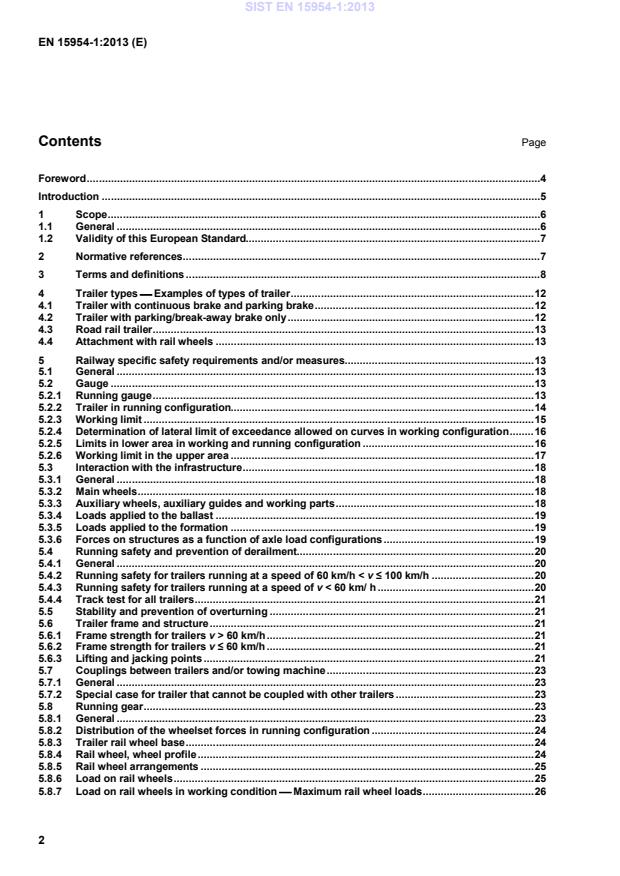
Technical details for buffing and draw gear . 37 A.1 General . 37 A.2 Draw gear constituent parts . 37 A.2.1 Coupling part . 37 A.3 Application. 38 A.4 Technical details for coupling parts . 38 A.5 User information . 39 Annex B (normative)
Special national conditions . 40 Annex C (normative)
Check list for conformity . 44 Annex D (informative)
Trailer identification plate . 48 Annex E (informative)
Structure of European Standards for track construction and maintenance machines . 49 Bibliography . 51
Additional requirements can apply for running on infrastructures with narrow gauge or broad gauge lines, lines of tramways, railways utilising other than adhesion between the rail and rail wheels, and underground infrastructures. This European Standard is also applicable to trailers and associated equipment that in working configuration are partly supported on the ballast or the formation. Where two or more trailers are used together to transport loads in a fixed formation, e.g. where a metal container is fixed to two small trailers, the whole system is treated as a trailer for the purposes of compliance with the requirements of this European Standard. This European Standard does not apply to the following: requirements for quality of the work or performance of the trailer; specific requirements established by the railway infrastructure operator for the use of trailers, which will be the subject of negotiation between the manufacturer and the operator; separate machines temporarily mounted on the trailer. This European Standard does not establish the additional requirements for the following: operation subject to special rules, e.g. potentially explosive atmospheres; hazards due to natural causes, e.g. earthquake, lightning, flooding, etc; working methods; operation in severe working conditions requiring special measures, e.g. work in tunnels or in cuttings, extreme environmental conditions (below – 20 °C or above + 40 °C), corrosive environment, contaminating environments, strong magnetic fields; hazards due to errors in software; SIST EN 15954-1:2013
compliance with the clauses of this standard does not confer permission for trailers to travel at this speed. These trailers will not be allowed on a track open to normal railway traffic. 1.2 Validity of this European Standard This European Standard applies to all trailers, which are ordered one year after the publication date by CEN of this standard. 2 Normative references The following documents, in whole or in part, are normatively referenced in this document and are indispensable for its application. For dated references, only the edition cited applies. For undated references, the latest edition of the referenced document (including any amendments) applies. EN 791, Drill rigs Safety EN 12663-1:2010, Railway applications Structural requirements of railway vehicle bodies Part 1: Locomotives and passenger rolling stock (and alternative method for freight wagons) EN 13309, Construction machinery Electromagnetic compatibility of machines with internal electrical power supply EN 13715, Railway applications Wheelsets and bogies Wheels Tread profile EN 14033-1:2011, Railway applications Track Railbound construction and maintenance machines Part 1: Technical requirements for running EN 14033-2:2008+A1:2011, Railway applications Track Railbound construction and maintenance machines Part 2: Technical requirements for working EN 14363:2005, Railway applications Testing for the acceptance of running characteristics of railway vehicles — Testing of running behaviour and stationary tests EN 14601, Railway applications Straight and angled end cocks for brake pipe and main reservoir pipe EN 15273-2:2013, Railway applications Gauges Part 2: Rolling stock gauge EN 15528, Railway applications Line categories for managing the interface between load limits of vehicles and infrastructure EN 15954-2:2013, Railway applications Track Trailers and associated equipment Part 2: General safety requirements EN 50121-3-1:2006, Railway applications Electromagnetic compatibility Part 3-1: Rolling stock Train and complete vehicle EN 50121-3-2:2006, Railway applications Electromagnetic compatibility Part 3-2: Rolling stock Apparatus EN 50122-1, Railway applications Fixed installations Electrical safety, earthing and the return circuit Part 1: Protective provisions against electric shock SIST EN 15954-1:2013
Note 2 to entry: This includes attachments with rail wheels. 3.2 road-rail trailer trailer with additional road wheels to enable the trailer to be hauled on both rails and ground 3.3 road-rail machine self propelled machine that can run on rails and ground
Note 1 to entry: It is normally a road vehicle adapted for running on rail, but can be a specially designed rail vehicle for running on the ground. Note 2 to entry: It does not imply that the machine is suitable for use on the public road. 3.4 demountable machine self propelled machine that can run and work on rail and which is not intended to operate signalling and control systems Note 1 to entry: Such a machine is designed to get on and off track by its own means or with other lifting equipment. In the case of demounting by its own means these are not intended for running on the ground. Note 2 to entry: Such a machine is permitted to work on the railway only under special operating conditions granted by the infrastructure manager and run under special conditions granted by the authorising body and/or the infrastructure manager. 3.5 railbound machine on-track machine OTM vehicle specially designed for construction and maintenance of the track and infrastructure, and which is used in different modes: working configuration, running configuration as a self-propelling vehicle, running configuration as a hauled vehicle, when: it is running on its own rail wheels, it is designed to have characteristics necessary for the operation of track based train detection systems SIST EN 15954-1:2013
Note 1 to entry: It is designed so that the machine and/or its separate component parts may be manually placed on or off the track.
3.8 mobile elevating work platform MEWP mobile machine that is intended to move persons to working positions where they are carrying out work from the work platform with the intention that persons are getting on and off the work platform at one defined access position and which consists as a minimum of a work platform with controls, an extending structure and a chassis 3.9 host vehicle basic road vehicle or machine which is converted to run on rails 3.10 general attachment components or assembly of components which can be mounted onto the trailer or equipment for a specific use Note 1 to entry: See ISO 6746-1, ISO 6746-2 and ISO 6016. 3.11 railway specific attachment equipment that is capable of being temporarily fixed to and/or powered from a road rail machine or demountable machine but specifically excludes lifting accessories 3.12 lifting accessory loose lifting tackle, i.e. components or equipment not attached to the trailer and placed between the machinery and the load or on the load in order to attach it 3.13 manufacturer body that designs and constructs a trailer, or converts the original machine to a trailer 3.14 running configuration state of trailer when it is on the rail and all movable parts are stowed and secured within the applicable kinematic gauge Note 1 to entry: For the kinematic gauge, see EN 15273-2. SIST EN 15954-1:2013
EXAMPLE An assembly of trailers and/or wagons and/or category 3, 5, 7 machines described in EN 14033-1:2011 attached to a trailer under conditions prescribed by the infrastructure manager. 3.25 working limit contour limit in which a trailer can work without interfering with the kinematic gauge of trains on adjacent tracks Note 1 to entry: For the kinematic gauge, see EN 14033-2:2008+A1:2011, Annex D. SIST EN 15954-1:2013
3.35 methods of examination visual checks, measurements, functional tests, load test(s), specific verification/measurements and other controls 3.36 visual check check that establishes whether all elements on the machine, system or component, e.g. protective devices, visual warning device, marking, are present and that documents and drawings correspond to the requirements 3.37 measurement test test that establishes whether the stated measurable parameters have met the requirements of this standard
Note 1 to entry: Measureable parameters include geometric dimensions, safety distances, insulation resistance of electric circuits, noise and vibration. SIST EN 15954-1:2013
Figure 1 — Example of a box trailer with continuous and parking/break-away brake
Figure 2 — Example of a high speed flat bed trailer with continuous and parking/break-away brake
4.2 Trailer with parking/break-away brake only
Figure 3 — Example of a flat bed trailer with parking/break-away brake only SIST EN 15954-1:2013
Figure 4 — Example of road rail trailer with parking/break-away brake only 4.4 Attachment with rail wheels
Figure 5 — Example of railway specific attachment with parking/break-away brake only 5 Railway specific safety requirements and/or measures 5.1 General Trailers shall comply with the safety requirements and/ or protective measures in accordance with Clauses 5 and 6, and supplied with information in accordance with Clause 7. Trailers shall be designed to work on working track within the geometric limits, see EN 14033-2:2008+A1:2011, Annex F, and shall be designed to work on operating tracks. Trailers that can only work on operating tracks shall display on the identification plate an indication of that restriction. 5.2 Gauge 5.2.1 Running gauge 5.2.1.1 General Except as shown in 5.2.1.2, trailers in running configuration shall meet the dimensional requirements of EN 15273-2. The critical points near the limits of the permissible kinematic gauge, see EN 14033-1:2011, Annex C, shall be recorded in the technical documentation shown in Clause 7. 5.2.1.2 Special cases Trailers intended to travel on infrastructures with more restrictive gauges shall conform to the specific rules of those infrastructures and the corresponding restrictions shall be indicated on their operating permits. SIST EN 15954-1:2013
Key A = rail level B = exceedance of gauge permitted for road-rail trailers C = gauge according to EN 15273-2:2013 Figure 6 — Limits in lower area 5.2.2 Trailer in running configuration 5.2.2.1 Stowing of moveable trailer parts in running configuration When the trailer is in the running configuration, any movable equipment which has the capacity to go outside the gauge shall be capable of being stowed in a manner which prevents inadvertent or unintended movement out of the gauge. All such moveable parts and assemblies forming part of the trailer that are unpacked in order to allow the trailer to work in rail and non-rail configuration shall, in their stowed state, be secured by devices capable of resisting the foreseeable forces encountered during running, which shall not rely upon a power source to retain the locking function. Moveable parts shall be held by either: efficient locks: the visible positive locking components in running configuration shall be painted in red; if the locking mechanism is powered, the control of locking should preferably be possible from inside the trailer gauge; or check valves on hydraulic systems which shall prevent movement and fail safe. It shall be obvious to anyone checking the trailer that these parts of the trailer are locked in their stowed position. 5.2.2.2 Operating controls in running configuration When in running configuration all operating controls not related to running, including locking devices, shall be deactivated automatically. SIST EN 15954-1:2013
5.2.3.2.2 Design of movement limiting devices 5.2.3.2.2.1 General Movement limiting devices shall permit the height and rotation limit to be variable to suit each location. The movement limiting device shall stop the movement when height and lateral limits are reached, or prevent movement commencing in an unsafe direction if the machine is stopped at its limit. All movement limiting devices shall comply with 5.2.3.2.2.2 or 5.2.3.2.2.3 or 5.2.3.2.2.4, as appropriate. 5.2.3.2.2.2 Mechanical limiting devices These devices shall be capable of resisting the foreseeable forces encountered. NOTE This includes resisting static forces (start-up force of the motion) where they are in the form of a lock, and dynamic forces where they are in the form of a stop. 5.2.3.2.2.3 Electric limiting devices The design shall be such that there shall be no predictable credible single point failure that would cause the system to fail unsafe, i.e. allow the corresponding movement to continue. Any fault, including unacceptable differences in signals, shall cause the system to fail to a safe condition. SIST EN 15954-1:2013
This distance shall be taken with the worst case wheel wear and suspension condition. Trailers are permitted to move over live conductor rails providing they meet the requirements of the minimum safety distance given in Table 1. Trailers not meeting these clearances are not permitted to move over live conductor rail and the type approval certificate shall indicate this restriction. 5.2.6 Working limit in the upper area 5.2.6.1 General All metallic parts of the trailer shall be equipotential bonded to rail according to EN 15954-2:2013, 5.16.7. 5.2.6.2 Protection for the operator All work positions at a height greater than that shown in Annex B (line 9 of table) shall be protected such that it is not possible to make contact with live electric traction equipment. This requirement shall be achieved by either: a) The provision of an earthed metallic roof without open holes: where open holes in a metallic roof are necessary they shall be a maximum 25 mm aperture and covered by a conducting structure. It is permissible for non-conducting material to be used providing that the frame provides an earth path in the event of fallen catenary.
or b) The trailer shall be accepted for use with the restriction that it may only be operated under isolated and earthed catenaries (this means the electrical power switched off and the contact cable connected to ground potential). This restriction shall be written in the instruction handbook, see Clause 7, list entry a) 3) i), and a notice provided on the side of the trailer. A warning notice shall be placed on MEWPs which do not have a roof, which states that use under live overhead wires is prohibited; see EN 50122-1. All places on the trailer which allow access to either platforms or working areas without roofs in accordance with a) above shall be marked with a warning pictogram; see EN 14033-2:2008+A1:2011, Figure G.1. 5.2.6.3 Prevention of trailer contact with the
...
The article discusses EN 15954-1:2013, a European Standard that outlines technical requirements for trailers and associated equipment used in railway applications. The standard aims to minimize railway hazards during commissioning, operation, and maintenance of the trailers. It applies to trailers that do not interact with operating signalling and control systems and are only intended to work under special operating conditions specified by the infrastructure manager. The standard does not apply to vehicles that run on railway lines open to normal traffic. Part 1 of the standard covers technical railway requirements, while Part 2 deals with requirements for the trailer to be declared conformant by the manufacturer. Additional requirements may apply for trailers used on narrow gauge or broad gauge lines, tramways, railways with non-adhesion between the rail and rail wheels, and underground infrastructures. The standard also includes specifications for trailers that are partly supported on the ballast or formation. It does not cover the quality or performance of the trailer, specific requirements established by the railway infrastructure operator, separate machines temporarily mounted on the trailer, operation subject to special rules or hazards due to natural causes, working methods, operation in severe working conditions, hazards due to software errors, or hazards when handling suspended loads. The standard also clarifies that compliance with its clauses does not grant permission for trailers to travel at the maximum speed specified by the infrastructure manager. The standard is valid for trailers ordered one year after its publication date by CEN.
기사 제목: EN 15954-1:2013 - 기차 애플리케이션 - 트랙 - 트레일러와 관련 장비 - 제1권: 운행 및 작업을 위한 기술 요구 사항 기사 내용: 1.1.일반 사항 이 유럽 표준은 제조업자 또는 그의 허가 받은 대리인에서 제공한 명세에 따라 개통, 운영 및 트레일러의 유지 보수 중 발생할 수 있는 특정 철도 위험을 최소화하기 위한 기술 요구 사항을 명시합니다. 이 유럽 표준은 운영 신호 및 제어 시스템과 상호 작용하는 것을 의도하지 않는 트레일러에 적용됩니다. 다른 기계들은 다른 유럽 표준에서 처리됩니다.자세한 내용은 부록 E를 참조하십시오. 이러한 트레일러는 운영 신호 및 제어 시스템과 상호 작용하는 것을 디자인하거나 의도하지 않았으며, 인프라 관리자가 지정한 특정 운영 조건에서 작동하고 운행하기 위한 것입니다. 이러한 트레일러는 상호 운영성 지침에 정의된 차량으로 간주되지 않으며, 정상 교통이 개방된 철도 노선에서 운행할 수 없습니다. 이 경우, 2008/57/EC 상호 운영성 지시문에 기재된 내용에 따라 승인되어 서비스에 투입되어야 합니다. 이 유럽 표준의 제1부는 기술적인 철도 요구 사항을 다루고, 제2부는 제조업자에 의해 일체로 선언 준수되도록 하는 요구 사항을 다룹니다. 단, 기계 지침 2006/42/EC의 4부 에 분류된 트레일러는 통보된 기관과의 준수 검사가 필요합니다. 좁은 길이 또는 넓은 길이 라인에서 운영하는 경우, 전차, 레일 및 레일 휠 사이의 접촉 외에 다른 레일웨이 인프라에 대한 추가 요구 사항이 적용될 수 있습니다. 이 유럽 표준은 작업 구성에서 포장이나 기반 위에 부분적으로 받치는 트레일러 및 관련 장비에도 적용됩니다. 금속 컨테이너를 두 개의 작은 트레일러에 고정시키는 등 고정구성에로 하나 이상의 트레일러를 사용하여 하중을 운반하는 경우, 이 시스템 전체는 이 유럽 표준의 요구 사항을 준수하기 위한 트레일러로 취급됩니다. 이 유럽 표준은 다음에 대한 요구 사항을 적용하지 않습니다. - 트레일러의 작업 품질이나 성능 요구 사항 - 철도 인프라 운영자가 트레일러 사용을 위해 설정한 특정 요구 사항. 이는 제조업자와 운영자 간의 협상의 대상이 될 것입니다. - 트레일러에 일시적으로 장착된 별도의 기계 이 유럽 표준은 다음 추가 요구 사항을 설정하지 않습니다. - 특정 규칙에 따른 작동, 예를 들어 잠재적으로 폭발성인 환경 - 천재지변에 따른 위험, 예를 들어 지진, 번개, 홍수 등 - 작업 방법 - 특수 조치가 필요한 심한 작업 조건에서의 작동, 예를 들어 터널 내 작업 또는 절단 작업, 극한 환경 조건(-20°C 이하 또는 +40°C 이상), 부식성 환경, 오염된 환경, 강한 자기장 - 소프트웨어 오류로 인한 위험 - 자유롭게 흔들리는 부하를 다룰 때 발생하는 위험 트레일러의 사용 목적은 각 인프라 관리자에 의해 지정된 운영 매개변수를 가질 수 있습니다. 예를 들어, 이 트레일러의 최대 속도는 인프라 관리자에 의해 제한될 가능성이 큽니다. 이 표준의 조항을 준수하는 것은 트레일러가 이 속도로 운행할 수 있는 권한을 부여하지 않습니다. 이 트레일러는 정상적인 철도 교통이 개방된 트랙에서는 허용되지 않을 것입니다. 1.2. 이 유럽 표준의 유효성 이 유럽 표준은 CEN에서 이 표준 게시일로부터 1년 후에 주문 된 모든 트레일러에 적용됩니다.
記事タイトル:EN 15954-1:2013 - 鉄道応用 - トラック - トレーラーおよび関連する機器 - 部分1:走行および作業のための技術要件 記事内容:1.1.一般 この欧州規格は、製造業者またはその認可代理人が指定した仕様に従って行われるトレーラーの立ち上げ、運用、および保守中に生じる特定の鉄道の危険を最小限に抑えるための技術要件を規定しています。この欧州規格は、運行信号や制御システムと相互作用しないトレーラーに適用されます。他の機械は他の欧州規格によって取り扱われます。詳細については、付属書Eを参照してください。 これらのトレーラーは運行信号や制御システムとの相互作用を設計または意図しておらず、インフラストラクチャーマネージャーによって指定された特定の運用条件でのみ作業および走行することを目的としています。 これらのトレーラーは相互運行指令に定義された車両とみなされず、通常の鉄道交通が開通した路線には走行できません。必要な場合は、相互運行指令2008/57/ECの規定に従って認可されるか、サービスに投入される必要があります。 本欧州規格の第1部は技術要件に関するものであり、第2部は製造業者によって宣言された規定に準拠する要件について取り扱います。ただし、機械指令2006/42/ECの附属書4に分類されるトレーラーについては、通知機関との適合確認が必要です。 狭軌や広軌路線、路面電車、レールと車輪の間の非粘着を利用する鉄道、地下のインフラストラクチャーに対しては、追加の要件が適用される場合があります。 この欧州規格は、作業構成で一部が枕木や路盤に支持されたトレーラーや関連する機器にも適用されます。 金属コンテナが2つの小さなトレーラーに固定された固定形態で輸送荷重を運搬する場合など、2つ以上のトレーラーが固定形態で使用される場合、このシステム全体は本欧州規格の要件に準拠するトレーラーとして扱われます。 本欧州規格は次の要件には適用されません。 - トレーラーの品質や性能に関する要件 - 鉄道インフラ運営者によって設定されたトレーラーの使用に関する特定の要件。これらは製造業者と運営者の間での交渉の対象となります。 - トレーラーに一時的に取り付けられた別々の機械 本欧州規格は以下の追加要件を設定しません。 - 特別なルールに従う運用、例えば潜在的に爆発性のある環境 - 地震、雷、洪水などの自然原因による危険 - 作業方法 - トンネル内や切り通しでの作業、極端な環境条件(-20℃以下または+40℃以上)、腐食性環境、汚染された環境、強い磁界など特別な対策が必要な過酷な作業条件での運用 - ソフトウェアのエラーによる危険 - 自由に揺れる荷物を取り扱う際に生じる危険 これらのトレーラーの使用目的には、各インフラストラクチャーマネージャーが指定する運用パラメータが記載される可能性があります。例えば、これらのトレーラーの最高速度はインフラストラクチャーマネージャーによって制限される可能性が高いです。ただし、この規格の節に準拠していることは、トレーラーがその速度で走行する許可を意味しません。これらのトレーラーは通常の鉄道交通が開通したトラックには許可されません。 1.2. この欧州規格の有効性 この欧州規格は、CENがこの規格を公開した後、1年以内に注文されるすべてのトレーラーに適用されます
Questions, Comments and Discussion
Ask us and Technical Secretary will try to provide an answer. You can facilitate discussion about the standard in here.
Loading comments...