

EN 13001-3-2:2014/FprA1
(Amendment)Cranes - General design - Part 3-2: Limit states and proof of competence of wire ropes in reeving systems
- Abstract
This European Standard is to be used together with EN 13001 1 and EN 13001 2 and as such they specify general conditions, requirements and methods to prevent mechanical hazards of wire ropes of cranes by design and theoretical verification.
NOTE Specific requirements for particular types of cranes are given in the appropriate European Standard for the particular crane type.
The following is a list of significant hazardous situations and hazardous events that could result in risks to persons during intended use and reasonably foreseeable misuse. Clauses 5 to 6 of this standard are necessary to reduce or eliminate risks associated with the following hazard:
− exceeding the limits of strength (yield, ultimate, fatigue).
This European Standard is not applicable to cranes which are manufactured before the date of its publication as EN and serves as reference base for the European Standards for particular crane types (see Annex C).
EN 13001 3 2 deals only with the limit state method in accordance with EN 13001 1.
- Status
- Not Published
- Publication Date
- 06-Mar-2019
- Withdrawal Date
- 08-Sep-2019
- Technical Committee
- CEN/TC 147 - Cranes - Safety
- Drafting Committee
- CEN/TC 147/WG 2 - Design - General
- Current Stage
- 5098 - Decision to abandon - Formal Approval
- Start Date
- 03-Mar-2021
- Completion Date
- 21-Oct-2026

Overview
EN 13001-3-2:2014/FprA1, developed by the European Committee for Standardization (CEN), provides comprehensive requirements and methodologies for the general design of cranes, specifically focusing on the limit states and proof of competence of wire ropes in reeving systems. This standard is intended for use alongside EN 13001-1 and EN 13001-2, forming part of a suite that aims to eliminate or reduce mechanical hazards associated with crane wire ropes through robust design and theoretical verification.
EN 13001-3-2 targets risks involved with wire ropes-such as exceeding yield, ultimate, and fatigue strength-helping to protect both equipment and personnel during crane operation and foreseeable misuse. The standard is a crucial reference for the design, manufacturing, and maintenance of new cranes within the European market, and does not apply retroactively to cranes manufactured prior to its official publication.
Key Topics
- Limit State Design Method: Establishes the framework for assessing the competence of wire ropes, focusing on yield, ultimate, and fatigue limit states.
- Proof of Competence: Details the procedures for verifying wire rope strength and fitness using theoretical calculations and safety factors.
- Load Cases and Dynamic Effects: Addresses regular, occasional, and exceptional loads including test loads, dynamic cut-off, and emergency cut-out scenarios.
- Rope System Variables: Incorporates variables such as rope type, drum and sheave diameters, reeving arrangements, bending cycles, and dynamic load factors.
- Multilayer Drum Requirements: Specifies additional considerations and proof requirements when using multilayer drum designs, accounting for increased wear and mechanical impact.
- Rope Selection and Inspection: Offers guidance on selecting appropriate wire rope types and determining the number of ropes required over the crane’s service life.
- Hazard Identification: Highlights significant hazardous events and situations to be considered throughout the design process.
Applications
EN 13001-3-2 is essential for the design and validation of any crane type utilizing reeving systems with wire ropes, including:
- Tower cranes
- Overhead travelling cranes
- Gantry cranes
- Mobile cranes
- Construction hoisting equipment
The standard is applied by crane designers, engineers, manufacturers, and safety assessors to ensure that wire ropes are selected, installed, and maintained according to robust, harmonized European safety requirements. It is also a key document for compliance with EU directives regarding machinery safety.
By implementing the provisions of EN 13001-3-2, organizations can demonstrate due diligence in addressing the strength and fatigue life of crane wire ropes, reduce the risk of mechanical failure, and foster a safer working environment.
Related Standards
EN 13001-3-2 should be used in conjunction with related standards for a comprehensive approach to crane safety and design, including:
- EN 13001-1: Cranes – General design – Part 1: General principles and requirements
- EN 13001-2: Crane safety – General design – Part 2: Load actions
- EN 13001-3-1: General design – Limit states and proof of competence of steel structures
- EN 13001-3-3: Limit states and proof of competence of wheel/rail contact
- EN 13001-3-4: Limit states and proof of competence of bearings
- EN 13001-3-5: Limit states and proof of competence of forged hooks
- EN 13001-3-6: Limit states and proof of competence of hydraulic cylinders
- EN 13135: Safety requirements for crane equipment
- EN 13411 (parts): Safety requirements for steel wire rope terminations
- EN 13557: Cranes – Controls and control stations
By referencing these and other harmonized European standards, companies and professionals can ensure holistic compliance and promote safety throughout all crane-related operations and equipment lifecycles.
Relations
- Effective Date
- 15-Feb-2017
Frequently Asked Questions
EN 13001-3-2:2014/FprA1 is a draft published by the European Committee for Standardization (CEN). Its full title is "Cranes - General design - Part 3-2: Limit states and proof of competence of wire ropes in reeving systems". This standard covers: This European Standard is to be used together with EN 13001 1 and EN 13001 2 and as such they specify general conditions, requirements and methods to prevent mechanical hazards of wire ropes of cranes by design and theoretical verification. NOTE Specific requirements for particular types of cranes are given in the appropriate European Standard for the particular crane type. The following is a list of significant hazardous situations and hazardous events that could result in risks to persons during intended use and reasonably foreseeable misuse. Clauses 5 to 6 of this standard are necessary to reduce or eliminate risks associated with the following hazard: − exceeding the limits of strength (yield, ultimate, fatigue). This European Standard is not applicable to cranes which are manufactured before the date of its publication as EN and serves as reference base for the European Standards for particular crane types (see Annex C). EN 13001 3 2 deals only with the limit state method in accordance with EN 13001 1.
This European Standard is to be used together with EN 13001 1 and EN 13001 2 and as such they specify general conditions, requirements and methods to prevent mechanical hazards of wire ropes of cranes by design and theoretical verification. NOTE Specific requirements for particular types of cranes are given in the appropriate European Standard for the particular crane type. The following is a list of significant hazardous situations and hazardous events that could result in risks to persons during intended use and reasonably foreseeable misuse. Clauses 5 to 6 of this standard are necessary to reduce or eliminate risks associated with the following hazard: − exceeding the limits of strength (yield, ultimate, fatigue). This European Standard is not applicable to cranes which are manufactured before the date of its publication as EN and serves as reference base for the European Standards for particular crane types (see Annex C). EN 13001 3 2 deals only with the limit state method in accordance with EN 13001 1.
EN 13001-3-2:2014/FprA1 is classified under the following ICS (International Classification for Standards) categories: 21.220.20 - Cable or rope drives and their components; 53.020.20 - Cranes. The ICS classification helps identify the subject area and facilitates finding related standards.
EN 13001-3-2:2014/FprA1 has the following relationships with other standards: It is inter standard links to EN 13001-3-2:2014. Understanding these relationships helps ensure you are using the most current and applicable version of the standard.
EN 13001-3-2:2014/FprA1 is associated with the following European legislation: EU Directives/Regulations: 2006/42/EC; Standardization Mandates: M/396. When a standard is cited in the Official Journal of the European Union, products manufactured in conformity with it benefit from a presumption of conformity with the essential requirements of the corresponding EU directive or regulation.
EN 13001-3-2:2014/FprA1 is available in PDF format for immediate download after purchase. The document can be added to your cart and obtained through the secure checkout process. Digital delivery ensures instant access to the complete standard document.
Standards Content (Sample)
SLOVENSKI STANDARD
SIST EN 13001-3-2:2014/oprA1:2017
01-december-2017
Žerjavi - Konstrukcija, splošno - 3-2. del: Mejna stanja in dokaz varnosti jeklenih
vrvi pri vrvnih pogonih
Cranes - General design - Part 3-2: Limit states and proof of competence of wire ropes in
reeving systems
Krane - Konstruktion allgemein - Teil 3-2: Grenzzustände und Sicherheitsnachweis von
Drahtseilen in Seiltrieben
Appareils de levage à charge suspendue - Conception générale - Partie 3-2 : Etats
limites et vérification d'aptitude des câbles en acier mouflés
Ta slovenski standard je istoveten z: EN 13001-3-2:2014/prA1
ICS:
21.220.20 Vrvni pogoni in njihovi deli Cable or rope drives and
their components
53.020.20 Dvigala Cranes
SIST EN 13001-3-2:2014/oprA1:2017 en,fr,de
2003-01.Slovenski inštitut za standardizacijo. Razmnoževanje celote ali delov tega standarda ni dovoljeno.
SIST EN 13001-3-2:2014/oprA1:2017
SIST EN 13001-3-2:2014/oprA1:2017
DRAFT
EUROPEAN STANDARD
EN 13001-3-2:2014
NORME EUROPÉENNE
EUROPÄISCHE NORM
prA1
September 2017
ICS 21.220.20; 53.020.20
English Version
Cranes - General design - Part 3-2: Limit states and proof
of competence of wire ropes in reeving systems
Appareils de levage à charge suspendue - Conception Krane - Konstruktion allgemein - Teil 3-2:
générale - Partie 3-2 : Etats limites et vérification Grenzzustände und Sicherheitsnachweis von
d'aptitude des câbles en acier mouflés Drahtseilen in Seiltrieben
This draft amendment is submitted to CEN members for enquiry. It has been drawn up by the Technical Committee CEN/TC 147.
This draft amendment A1, if approved, will modify the European Standard EN 13001-3-2:2014. If this draft becomes an
amendment, CEN members are bound to comply with the CEN/CENELEC Internal Regulations which stipulate the conditions for
inclusion of this amendment into the relevant national standard without any alteration.
This draft amendment was established by CEN in three official versions (English, French, German). A version in any other
language made by translation under the responsibility of a CEN member into its own language and notified to the CEN-CENELEC
Management Centre has the same status as the official versions.
CEN members are the national standards bodies of Austria, Belgium, Bulgaria, Croatia, Cyprus, Czech Republic, Denmark, Estonia,
Finland, Former Yugoslav Republic of Macedonia, France, Germany, Greece, Hungary, Iceland, Ireland, Italy, Latvia, Lithuania,
Luxembourg, Malta, Netherlands, Norway, Poland, Portugal, Romania, Serbia, Slovakia, Slovenia, Spain, Sweden, Switzerland,
Turkey and United Kingdom.
Recipients of this draft are invited to submit, with their comments, notification of any relevant patent rights of which they are
aware and to provide supporting documentation.
Warning : This document is not a European Standard. It is distributed for review and comments. It is subject to change without
notice and shall not be referred to as a European Standard.
EUROPEAN COMMITTEE FOR STANDARDIZATION
COMITÉ EUROPÉEN DE NORMALISATION
EUROPÄISCHES KOMITEE FÜR NORMUNG
CEN-CENELEC Management Centre: Avenue Marnix 17, B-1000 Brussels
© 2017 CEN All rights of exploitation in any form and by any means reserved Ref. No. EN 13001-3-2:2014/prA1:2017 E
worldwide for CEN national Members.
SIST EN 13001-3-2:2014/oprA1:2017
EN 13001-3-2:2014/prA1:2017 (E)
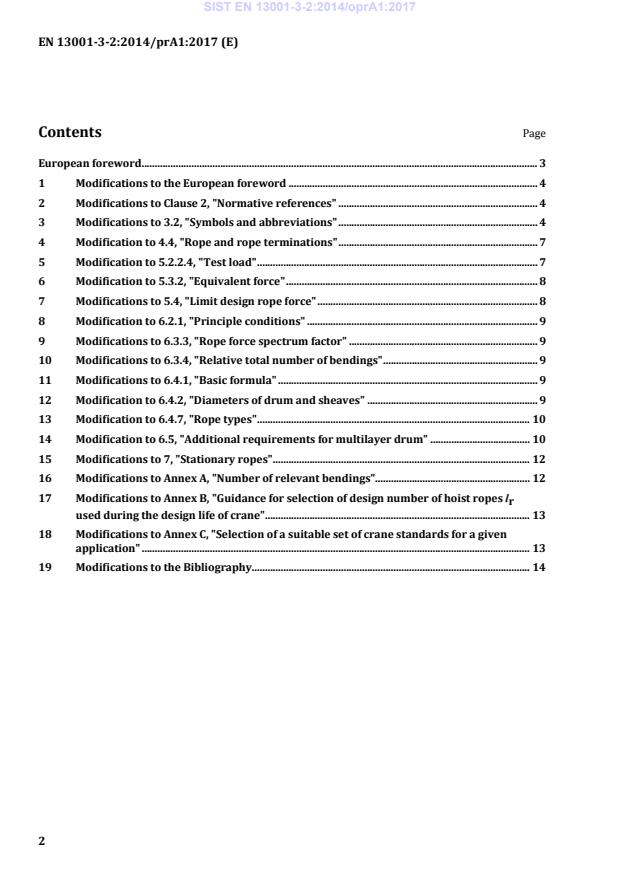
Contents Page
European foreword . 3
1 Modifications to the European foreword . 4
2 Modifications to Clause 2, "Normative references" . 4
3 Modifications to 3.2, "Symbols and abbreviations" . 4
4 Modification to 4.4, "Rope and rope terminations" . 7
5 Modification to 5.2.2.4, "Test load" . 7
6 Modification to 5.3.2, "Equivalent force" . 8
7 Modifications to 5.4, "Limit design rope force" . 8
8 Modification to 6.2.1, "Principle conditions" . 9
9 Modifications to 6.3.3, "Rope force spectrum factor" . 9
10 Modifications to 6.3.4, "Relative total number of bendings" . 9
11 Modifications to 6.4.1, "Basic formula" . 9
12 Modification to 6.4.2, "Diameters of drum and sheaves" . 9
13 Modification to 6.4.7, "Rope types" . 10
14 Modification to 6.5, "Additional requirements for multilayer drum" . 10
15 Modifications to 7, "Stationary ropes" . 12
16 Modifications to Annex A, "Number of relevant bendings". 12
17 Modifications to Annex B, "Guidance for selection of design number of hoist ropes l
r
used during the design life of crane". 13
18 Modifications to Annex C, "Selection of a suitable set of crane standards for a given
application" . 13
19 Modifications to the Bibliography . 14
SIST EN 13001-3-2:2014/oprA1:2017
EN 13001-3-2:2014/prA1:2017 (E)
European foreword
This document (EN 13001-3-2:2014/prA1:2017) has been prepared by Technical Committee
CEN/TC 147 “Cranes — Safety”, the secretariat of which is held by BSI.
This document is currently submitted to the CEN Enquiry.
This document has been prepared under a mandate given to CEN by the European Commission and the
European Free Trade Association, and supports essential requirements of EU Directive(s).
For relationship with EU Directive(s), see informative Annex ZA of EN 13001-3-2:2014.
SIST EN 13001-3-2:2014/oprA1:2017
EN 13001-3-2:2014/prA1:2017 (E)
1 Modifications to the European foreword
After “This document supersedes” replace the following part of the text: “CEN/TS 13001-3-2:2008” with
“EN 13001-3-2:2014”.
After “The major changes in this document are in the following clauses:” replace the first indent with the
following:
"
— 5.2.2.4 Load cases effects of dynamic cut-off and emergency cut-out are added in Table 2;
— 5.4;
— 6.3.3 Relationship between inspection intervals and number of ropes; and
— 6.5;”.
th th
In the 10 paragraph replace the 5 indent with the following:
"
— Part 3-4: Limit states and proof of competence of machinery — Bearings”
th
and after the 6 indent add:
"
— Part 3-6: Limit states and proof of competence of machinery — Hydraulic cylinders”.
2 Modifications to Clause 2, "Normative references"
Delete the following references:
“EN 1990:2002, Eurocode — Basis of structural design”
“EN 13411-1, Terminations for steel wire ropes — Safety — Part 1: Thimbles for steel wire rope slings”
“EN 13411-2, Terminations for steel wire ropes — Safety — Part 2: Splicing of eyes for wire rope slings”
Add the following reference:
“EN 13411-8, Terminations for steel wire ropes — Safety — Part 8: Swage terminals and swaging”
3 Modifications to 3.2, "Symbols and abbreviations"
Replace Table 1 with the following table:
“
Symbols,
Description
abbreviations
a Acceleration
C Total number of working cycles (see EN 13001-1) during design life of crane
D Relevant diameter
D
Minimum pitch diameter of drum
drum
SIST EN 13001-3-2:2014/oprA1:2017
EN 13001-3-2:2014/prA1:2017 (E)
Symbols,
Description
abbreviations
D
Minimum pitch diameter of sheave
sheave
D
Minimum pitch diameter of compensating sheave
comp
d Rope diameter
d
Diameter of bearing or shaft
bearing
F
Equivalent force
equ
F Part of F induced by gravity, exclusive of mass of payload, amplified by γ
gd equ p
F Part of F induced by gravity forces of mass of payload, amplified by γ
gl equ p
F Part of F induced by any other forces, amplified by γ
o equ p
F
Limit design rope force for the proof of static strength
Rd,s
F
Limit design rope force for the proof of fatigue strength
Rd,f
F
Limit design rope force for multilayer drum
Rd,m
F
Design rope force for the proof of static strength
Sd,s
F
Design rope force for multilayer drum
Sd,m
F Part of F induced by resistances, amplified by γ
r equ p
F
Design rope force for the proof of fatigue strength
Sd,f
F Part of F induced by rope tightening forces, amplified by γ
t equ p
F
Minimum rope breaking force
u
F Part of F induced by wind forces, amplified by γ
w equ p
f
Factor of further influences
f
f
Factor of diameter ratio influence
f1
f
Factor tensile strength of wire influence
f2
f
Factor of fleet angle influence
f3
f
Factor of lubrication influence
f4
f
Factor of groove radius influence
f6
f
Factor of rope type influence
f7
f
Rope force increasing factor from rope reeving efficiency
S1
f
Rope force increasing factor from non parallel falls
S2
f
Rope force increasing factor from horizontal acceleration
S3
*
f Rope force increasing factors in fatigue
si
g Acceleration due to gravity
i Index for cycles of lifting and lowering
SIST EN 13001-3-2:2014/oprA1:2017
EN 13001-3-2:2014/prA1:2017 (E)
Symbols,
Description
abbreviations
i
Total number of movements
max
kQ Load spectrum factor (see EN 13001-1)
k
Rope force spectrum factor
r
l
Number of ropes used during design life of the crane
r
q Normalized height distribution
m
Mass of hoist load (see EN 13001-1)
H
m
Mass of hoist load that is acting on the rope falls under consideration
Hr
m
Rotatory rope driven mass
r
m
Translational rope driven mass
t
n
Number of fixed sheave between drum and moving part
s
n
Mechanical advantage
m
n
Number of ropes reeved from a drum
r
R
Minimum tensile strength of the wire used in the rope
R
Reference ratio of rope bending diameter to rope diameter
Dd
R
Tensile strength level of wire
r
r
Groove radius
g
s
Rope force history parameter
r
t Rope type factor
w Number of relevant bendings per movement
w
Bending count
c
w
Number of bendings at reference point
D
w
Calculated total number of bendings
tot
z, z , z , z ,
i min max
Height coordinates
z
ref
α Angle of slope
β, β
Angles between falls and line of acting force
max
Angle between gravity and projected rope in plane of F and g
γ
h
γ
Risk coefficient
n
γ
Partial safety factor
p
γ
Minimum rope resistance factor (static)
rb
γ
Minimum
...