

EN 508-1:2021
(Main)Roofing and cladding products from metal sheet - Specification for self-supporting products of steel, aluminium or stainless steel sheet - Part 1: Steel
- Abstract
This part of EN 508 specifies requirements for self-supporting roofing, covering, wall cladding, lining, liner tray and tile products for discontinuous laying made from metallic coated steel sheet with or without additional organic coatings. Sheets intended to be used with insulation and membranes are also covered.
This document establishes general characteristics, definitions, classifications and labelling for the products, together with requirements for the materials from which the products can be manufactured. It is intended to be used either by manufacturers to ensure that their products comply with the requirements or by purchasers to verify that the products comply when purchased before they are dispatched from the factory. It specifies the requirements for products which enable them to meet all normal service conditions.
This document applies to all discontinuously laid self-supporting external profiled sheets for roofing covering, wall cladding, lining, and liner trays, with the exception of tiles with a surface area less than 1 m2 and produced by stamping. These profiled sheets are designed to keep wind, rain and snow out of the building and to transfer any resultant loads and infrequent maintenance loads to the structure.
This document does not cover products for structural purposes, i.e. it does cover products used in constructions of structural Class III (according to EN 1993-1-3), it does not cover products used in constructions of structural Classes I and II (according to EN 1993-1-3) intended to contribute to the global or partial stability of the building structure by providing racking resistance or resistance to permanent static loads (excluding self-weight of the metal sheet).
No requirements for supporting construction, design of roof, cladding, lining, tile system and execution of connections and flashings are included.
- Status
- Published
- Publication Date
- 12-Oct-2021
- Withdrawal Date
- 29-Apr-2022
- Technical Committee
- CEN/TC 128 - Roof covering products for discontinuous laying and products for wall cladding
- Drafting Committee
- CEN/TC 128/SC 7 - Roofing products from metal sheet
- Current Stage
- 6060 - Definitive text made available (DAV) - Publishing
- Start Date
- 13-Oct-2021
- Due Date
- 18-Aug-2021
- Completion Date
- 13-Oct-2021


Overview
EN 508-1:2021 - published by CEN - is the European product specification for self-supporting roofing and cladding products made from steel sheet. It covers discontinuously laid external profiled sheets used for roofing, wall cladding, lining, liner trays and tiles (excluding stamped tiles < 1 m²). The standard defines materials, classifications, geometries, labelling and minimum performance requirements for metallic coated steel sheet products (with or without organic coatings) intended for normal service conditions.
Key topics and technical requirements
- Scope and product types: Applies to self-supporting, discontinuously laid profiled sheets (trapezoidal, sinusoidal, standing seam, tile profiles) designed to keep out wind, rain and snow and transfer loads to the structure.
- Materials covered: Hot-dip coated steel types (Z, ZA, AZ, ZM, A), organic coated and multilayer coated steel. The 2021 update explicitly adds hot-dip zinc‑magnesium (ZM) and new steel grades (e.g., 390, 420, 450).
- Performance and tests: Establishes material and mechanical property requirements and refers to laboratory test methods (corrosion, humidity, salt spray, mechanical tests) and type tests to demonstrate compliance.
- Definitions and geometry: Standardizes profile definitions, product geometry, symbols and tolerances for consistent manufacturing and inspection.
- Marking, designation and packaging: Specifies labelling, documentation, transport, storage and handling requirements so purchasers and authorities can verify factory compliance prior to dispatch.
- Limits and exclusions: Does not cover products intended for structural Classes I and II (i.e., elements contributing to global/partial stability per EN 1993-1-3); structural Class III applications are within scope. It also excludes design requirements for supporting construction, connections and flashings.
Practical applications
- Ensures manufacturers produce consistent, certifiable steel roofing and cladding products that meet defined corrosion, coating and mechanical performance levels.
- Helps specifiers, architects and contractors select compliant profiled sheets for building envelopes where sheets are discontinuously laid and self-supporting.
- Enables purchasers and quality inspectors to verify material certificates, markings and factory test results before dispatch.
- Useful for building owners seeking durable metal roofing/cladding and for product compliance during procurement and installation planning.
Related standards
Relevant references and complementary standards include: EN 10346, EN 10169, EN 14782, and test standards such as EN ISO 9227, EN ISO 6270‑1 and EN ISO 6988. EN 508 series also includes Part 2 (Aluminium) and Part 3 (Stainless steel).
Keywords: EN 508-1:2021, roofing and cladding products, self-supporting steel sheet, metallic coated steel, zinc‑magnesium (ZM), profiled sheets, product specification, CEN.
Relations
- Effective Date
- 06-Mar-2019
- Effective Date
- 21-Oct-2026
- Effective Date
- 27-May-2026
- Effective Date
- 28-Jan-2026
- Refers
EN ISO 9227:2022 - Corrosion tests in artificial atmospheres - Salt spray tests (ISO 9227:2022) - Effective Date
- 28-Jan-2026
- Effective Date
- 28-Jan-2026
- Effective Date
- 28-Jan-2026
- Effective Date
- 28-Jan-2026
- Effective Date
- 28-Jan-2026
- Effective Date
- 28-Jan-2026
- Effective Date
- 28-Jan-2026
- Effective Date
- 28-Jan-2026
- Effective Date
- 28-Jan-2026
- Effective Date
- 28-Jan-2026
- Effective Date
- 28-Jan-2026
Get Certified
Connect with accredited certification bodies for this standard

DIBt (Deutsches Institut für Bautechnik)
German Institute for Building Technology.
DIN CERTCO
DIN Group product certification.

Aboma Certification B.V.
Specialized in construction, metal, and transport sectors.
Sponsored listings
Frequently Asked Questions
EN 508-1:2021 is a standard published by the European Committee for Standardization (CEN). Its full title is "Roofing and cladding products from metal sheet - Specification for self-supporting products of steel, aluminium or stainless steel sheet - Part 1: Steel". This standard covers: This part of EN 508 specifies requirements for self-supporting roofing, covering, wall cladding, lining, liner tray and tile products for discontinuous laying made from metallic coated steel sheet with or without additional organic coatings. Sheets intended to be used with insulation and membranes are also covered. This document establishes general characteristics, definitions, classifications and labelling for the products, together with requirements for the materials from which the products can be manufactured. It is intended to be used either by manufacturers to ensure that their products comply with the requirements or by purchasers to verify that the products comply when purchased before they are dispatched from the factory. It specifies the requirements for products which enable them to meet all normal service conditions. This document applies to all discontinuously laid self-supporting external profiled sheets for roofing covering, wall cladding, lining, and liner trays, with the exception of tiles with a surface area less than 1 m2 and produced by stamping. These profiled sheets are designed to keep wind, rain and snow out of the building and to transfer any resultant loads and infrequent maintenance loads to the structure. This document does not cover products for structural purposes, i.e. it does cover products used in constructions of structural Class III (according to EN 1993-1-3), it does not cover products used in constructions of structural Classes I and II (according to EN 1993-1-3) intended to contribute to the global or partial stability of the building structure by providing racking resistance or resistance to permanent static loads (excluding self-weight of the metal sheet). No requirements for supporting construction, design of roof, cladding, lining, tile system and execution of connections and flashings are included.
This part of EN 508 specifies requirements for self-supporting roofing, covering, wall cladding, lining, liner tray and tile products for discontinuous laying made from metallic coated steel sheet with or without additional organic coatings. Sheets intended to be used with insulation and membranes are also covered. This document establishes general characteristics, definitions, classifications and labelling for the products, together with requirements for the materials from which the products can be manufactured. It is intended to be used either by manufacturers to ensure that their products comply with the requirements or by purchasers to verify that the products comply when purchased before they are dispatched from the factory. It specifies the requirements for products which enable them to meet all normal service conditions. This document applies to all discontinuously laid self-supporting external profiled sheets for roofing covering, wall cladding, lining, and liner trays, with the exception of tiles with a surface area less than 1 m2 and produced by stamping. These profiled sheets are designed to keep wind, rain and snow out of the building and to transfer any resultant loads and infrequent maintenance loads to the structure. This document does not cover products for structural purposes, i.e. it does cover products used in constructions of structural Class III (according to EN 1993-1-3), it does not cover products used in constructions of structural Classes I and II (according to EN 1993-1-3) intended to contribute to the global or partial stability of the building structure by providing racking resistance or resistance to permanent static loads (excluding self-weight of the metal sheet). No requirements for supporting construction, design of roof, cladding, lining, tile system and execution of connections and flashings are included.
EN 508-1:2021 is classified under the following ICS (International Classification for Standards) categories: 91.060.20 - Roofs. The ICS classification helps identify the subject area and facilitates finding related standards.
EN 508-1:2021 has the following relationships with other standards: It is inter standard links to EN 508-1:2014, EN 10346:2026, EN 1427:2026, EN 10143:2006, EN ISO 9227:2022, EN 10169:2010+A1:2012, EN ISO 6270-1:2018, EN 14782:2006, EN ISO 22479:2022, EN 10346:2015, EN 1427:2015, EN 15101-1:2013+A1:2019, EN 14318-1:2013, CWA 17890:2022, EN 1090-2:2008+A1:2011. Understanding these relationships helps ensure you are using the most current and applicable version of the standard.
EN 508-1:2021 is available in PDF format for immediate download after purchase. The document can be added to your cart and obtained through the secure checkout process. Digital delivery ensures instant access to the complete standard document.
Standards Content (Sample)
SLOVENSKI STANDARD
01-december-2021
Nadomešča:
SIST EN 508-1:2014
Pločevina za pokrivanje streh in oblaganje sten - Specifikacija za samonosilne
proizvode iz jeklene, aluminijeve pločevine ali pločevine iz nerjavnega jekla - 1.
del: Jeklo
Roofing and cladding products from metal sheet - Specification for self-supporting
products of steel, aluminium or stainless steel sheet - Part 1: Steel
Dachdeckungs- und Wandbekleidungsprodukte aus Metallblech - Spezifikation für
selbsttragende Dachdeckungsprodukte aus Stahlblech, Aluminiumblech oder
nichtrostendem Stahlblech - Teil 1: Stahl
Produits de couverture et de bardage en tôle métallique - Spécification pour les produits
autoportants en tôle d'acier, d'aluminium ou d'acier inoxydable - Partie 1 : Acier
Ta slovenski standard je istoveten z: EN 508-1:2021
ICS:
77.140.50 Ploščati jekleni izdelki in Flat steel products and semi-
polizdelki products
91.060.20 Strehe Roofs
2003-01.Slovenski inštitut za standardizacijo. Razmnoževanje celote ali delov tega standarda ni dovoljeno.
EN 508-1
EUROPEAN STANDARD
NORME EUROPÉENNE
October 2021
EUROPÄISCHE NORM
ICS 91.060.20 Supersedes EN 508-1:2014
English Version
Roofing and cladding products from metal sheet -
Specification for self-supporting products of steel,
aluminium or stainless steel sheet - Part 1: Steel
Produits de couverture et de bardage en tôle Dachdeckungs- und Wandbekleidungsprodukte aus
métallique - Spécification pour les produits Metallblech - Spezifikation für selbsttragende
autoportants en tôle d'acier, d'aluminium ou d'acier Dachdeckungsprodukte aus Stahlblech,
inoxydable - Partie 1 : Acier Aluminiumblech oder nichtrostendem Stahlblech - Teil
1: Stahl
This European Standard was approved by CEN on 21 June 2021.
CEN members are bound to comply with the CEN/CENELEC Internal Regulations which stipulate the conditions for giving this
European Standard the status of a national standard without any alteration. Up-to-date lists and bibliographical references
concerning such national standards may be obtained on application to the CEN-CENELEC Management Centre or to any CEN
member.
This European Standard exists in three official versions (English, French, German). A version in any other language made by
translation under the responsibility of a CEN member into its own language and notified to the CEN-CENELEC Management
Centre has the same status as the official versions.
CEN members are the national standards bodies of Austria, Belgium, Bulgaria, Croatia, Cyprus, Czech Republic, Denmark, Estonia,
Finland, France, Germany, Greece, Hungary, Iceland, Ireland, Italy, Latvia, Lithuania, Luxembourg, Malta, Netherlands, Norway,
Poland, Portugal, Republic of North Macedonia, Romania, Serbia, Slovakia, Slovenia, Spain, Sweden, Switzerland, Turkey and
United Kingdom.
EUROPEAN COMMITTEE FOR STANDARDIZATION
COMITÉ EUROPÉEN DE NORMALISATION
EUROPÄISCHES KOMITEE FÜR NORMUNG
CEN-CENELEC Management Centre: Rue de la Science 23, B-1040 Brussels
© 2021 CEN All rights of exploitation in any form and by any means reserved Ref. No. EN 508-1:2021 E
worldwide for CEN national Members.
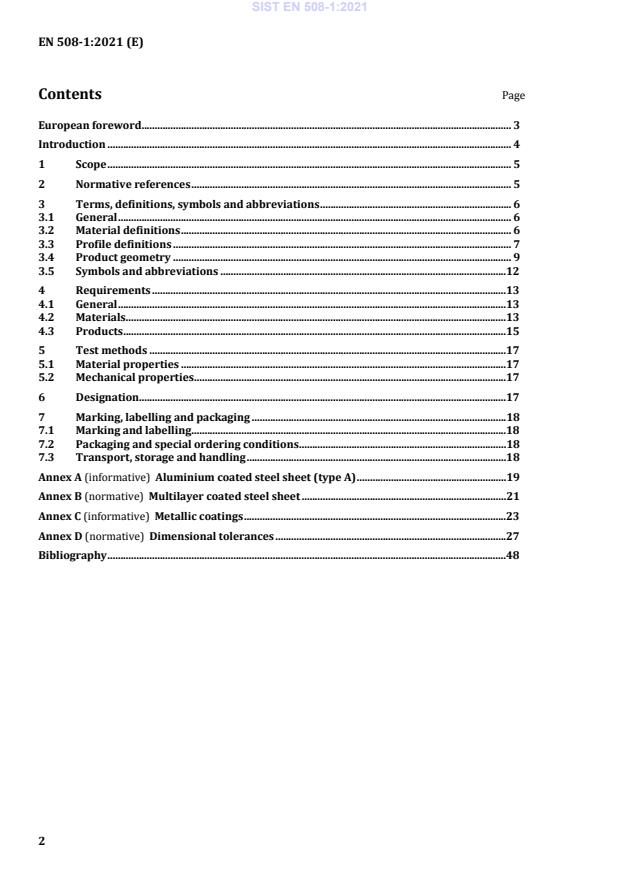
Contents Page
European foreword . 3
Introduction . 4
1 Scope . 5
2 Normative references . 5
3 Terms, definitions, symbols and abbreviations . 6
3.1 General . 6
3.2 Material definitions . 6
3.3 Profile definitions . 7
3.4 Product geometry . 9
3.5 Symbols and abbreviations .12
4 Requirements .13
4.1 General .13
4.2 Materials .13
4.3 Products .15
5 Test methods .17
5.1 Material properties .17
5.2 Mechanical properties .17
6 Designation.17
7 Marking, labelling and packaging .18
7.1 Marking and labelling .18
7.2 Packaging and special ordering conditions .18
7.3 Transport, storage and handling .18
Annex A (informative) Aluminium coated steel sheet (type A) .19
Annex B (normative) Multilayer coated steel sheet .21
Annex C (informative) Metallic coatings .23
Annex D (normative) Dimensional tolerances .27
Bibliography .48
European foreword
This document (EN 508-1:2021) has been prepared by Technical Committee CEN/TC 128 “Roof covering
products for discontinuous laying and products for wall cladding”, the secretariat of which is held by NBN.
This European Standard shall be given the status of a national standard, either by publication of an
identical text or by endorsement, at the latest by April 2022, and conflicting national standards shall be
withdrawn at the latest by April 2022.
Attention is drawn to the possibility that some of the elements of this document may be the subject of
patent rights. CEN shall not be held responsible for identifying any or all such patent rights.
This document supersedes EN 508-1:2014.
In comparison with EN 508-1:2014 the following technical changes have been made:
— the scope of the document has been extended to include cladding products;
— a reference has been added to ZM (hot dip zinc-magnesium) coating;
— the reference AZ with organic coating has been deleted;
— a bending requirement has been added;
— three grades have been added 390, 420 and 450;
— minimum nominal coating masses have been added for exterior applications;
— clarification of the tolerances about liner tray.
These changes or additions can be found in the following Clauses and subclauses: Clause 1; 3.2.4; 3.2.6;
3.2.7; 3.5; 4.1; 4.2.1; 4.2.2; 4.2.3; 4.3.3.1 and Annex C.
EN 508, Roofing and cladding products from metal sheet - Specification for self-supporting products of steel,
aluminium or stainless steel sheet consists of the following parts:
— Part 1: Steel;
— Part 2: Aluminium;
— Part 3: Stainless steel.
Any feedback and questions on this document should be directed to the users’ national standards body.
A complete listing of these bodies can be found on the CEN website.
According to the CEN-CENELEC Internal Regulations, the national standards organisations of the
following countries are bound to implement this European Standard: Austria, Belgium, Bulgaria, Croatia,
Cyprus, Czech Republic, Denmark, Estonia, Finland, France, Germany, Greece, Hungary, Iceland, Ireland,
Italy, Latvia, Lithuania, Luxembourg, Malta, Netherlands, Norway, Poland, Portugal, Republic of North
Macedonia, Romania, Serbia, Slovakia, Slovenia, Spain, Sweden, Switzerland, Turkey and the United
Kingdom.
Introduction
Figure 1 indicates the position of this document in the CEN framework of standards concerning roofing
and cladding products of metal sheet.
Figure 1 — Framework of standards
In this document, the performance of the product has been defined in terms of calculation and a number
of type tests.
The performance of a roof or of the cladding constructed with these products depends not only on the
properties of the product as required by this document, but also on the design, construction and
performance of the roof or the cladding as a whole in relation to the environment and conditions of use.
1 Scope
This part of EN 508 specifies requirements for self-supporting roofing, covering, wall cladding, lining,
liner tray and tile products for discontinuous laying made from metallic coated steel sheet with or without
additional organic coatings. Sheets intended to be used with insulation and membranes are also covered.
This document establishes general characteristics, definitions, classifications and labelling for the
products, together with requirements for the materials from which the products can be manufactured. It
is intended to be used either by manufacturers to ensure that their products comply with the
requirements or by purchasers to verify that the products comply when purchased before they are
dispatched from the factory. It specifies the requirements for products which enable them to meet all
normal service conditions.
This document applies to all discontinuously laid self-supporting external profiled sheets for roofing
covering, wall cladding, lining, and liner trays, with the exception of tiles with a surface area less than
1 m and produced by stamping. These profiled sheets are designed to keep wind, rain and snow out of
the building and to transfer any resultant loads and infrequent maintenance loads to the structure.
This document does not cover products for structural purposes, i.e. it does cover products used in
constructions of structural Class III (according to EN 1993-1-3), it does not cover products used in
constructions of structural Classes I and II (according to EN 1993-1-3) intended to contribute to the
global or partial stability of the building structure by providing racking resistance or resistance to
permanent static loads (excluding self-weight of the metal sheet).
No requirements for supporting construction, design of roof, cladding, lining, tile system and execution
of connections and flashings are included.
2 Normative references
The following documents are referred to in the text in such a way that some or all of their content
constitutes requirements of this document. For dated references, only the edition cited applies. For
undated references, the latest edition of the referenced document (including any amendments) applies.
EN 1427, Bitumen and bituminous binders - Determination of the softening point - Ring and Ball method
EN 10143, Continuously hot-dip coated steel sheet and strip - Tolerances on dimensions and shape
EN 10169:2010+A1:2012, Continuously organic coated (coil coated) steel flat products - Technical delivery
conditions
EN 10346, Continuously hot-dip coated steel flat products for cold forming - Technical delivery conditions
EN 14782, Self-supporting metal sheet for roofing, external cladding and internal lining - Product
specification and requirements
EN ISO 6270-1, Paints and varnishes - Determination of resistance to humidity - Part 1: Condensation
(single-sided exposure) (ISO 6270-1)
EN ISO 6988, Metallic and other non-organic coatings - Sulfur dioxide test with general condensation of
moisture (ISO 6988)
EN ISO 9227, Corrosion tests in artificial atmospheres - Salt spray tests (ISO 9227)
3 Terms, definitions, symbols and abbreviations
3.1 General
For the purposes of this document, the terms and definitions given in EN 10169:2010+A1:2012 and the
following apply.
ISO and IEC maintain terminological databases for use in standardization at the following addresses:
• ISO Online browsing platform: available at https://www.iso.org/obp
• IEC Electropedia: available at https://www.electropedia.org/
3.1.1
self-supporting product
product which will, by virtue of its material and shape, support all applied loadings (e.g. snow, wind, foot
traffic, insulation, membrane) and transmit these loadings to spaced structural supports
3.1.2
wall
if not otherwise specified, a vertical part of the envelop with a maximum inclination between 30° and 45°
3.1.3
roof
all elements of the envelope not covered by definition of a wall
3.2 Material definitions
3.2.1
hot-dip zinc coated steel sheet, type Z
product obtained by continuously hot-dip zinc coating cold reduced strips of either low carbon steel for
cold forming or steel of structural quality
Note 1 to entry: See EN 10346.
3.2.2
hot-dip zinc-aluminum coated steel sheet, type ZA
product obtained by continuously hot-dip coating cold reduced strips of low carbon steel for cold forming
or steel of structural quality on a production line using an alloy consisting of zinc and approximately 5 %
aluminium (nominal percentage by mass)
Note 1 to entry: See EN 10346.
3.2.3
hot-dip aluminum-zinc alloy coated steel sheet, type AZ
product obtained by continuously hot-dip coating cold reduced strips of low carbon steel for cold forming
or steel of structural quality on a production line using an alloy consisting of:
— 55 % aluminium (nominal percentage by mass);
— 1,6 % silicon (nominal percentage by mass);
— the balance zinc.
Note 1 to entry: See EN 10346.
3.2.4
hot dip zinc-magnesium coated steel sheet, type ZM
product obtained by continuously hot-dip coating cold reduced strips of low carbon steel for cold forming
or steel of structural quality on a production line using an alloy of zinc-aluminium-magnesium
Note 1 to entry: The composition of the molten coating alloy is a sum of aluminium and magnesium from 1,5 %
to 8 %, containing a minimum of 0,2 % magnesium and the balance zinc.
Note 2 to entry: For information on chemical composition and density, the manufacturer can be asked for advice.
Note 3 to entry: See EN 10346.
Note 4 to entry: The corrosion performance depends on the ZM composition.
3.2.5
hot-dip aluminium coated steel sheet (type A)
product obtained by continuously hot-dip aluminium coating cold reduced strips of low carbon steel for
cold forming steel or steel of structural quality on a production line
Note 1 to entry: See Annex A.
3.2.6
organic coated steel sheet
product obtained by factory application of paint by roller or spray processes, or factory application of
laminated organic film, on substrates of type Z, type ZA, type ZM, or type A coated steel sheet
Note 1 to entry: EN 10169:2010+A1:2012 refers to this type of coated steel.
3.2.7
multilayer coated steel sheet
product obtained by continuously coating on both sides hot-dip metal coated (type Z, type ZA, type AZ,
type ZM, or type A) cold reduced strips of low carbon steel for cold forming or steel of structural quality
with one or multiple applications of thermoplastic asphalt compounds (minimum thickness 1,5 mm) and
subsequent lamination of a metal foil with or without decorative painting
Note 1 to entry: See Annex B.
3.3 Profile definitions
3.3.1
trapezoidal profiled sheet
self-supporting sheet which is designed to allow it to be side and end lapped, the crowns of which may
be rounded and, in addition, the crowns, webs and valleys may be stiffened
Note 1 to entry: See Figures 2, 3, 4 and 5.
Figure 2 — Part of typical trapezoidal profile
Figure 3 — Part of typical trapezoidal profile with rounded crowns
Figure 4 — Part of typical trapezoidal profile with stiffened crown and web
Figure 5 — Part of typical trapezoidal profile with stiffened valley
3.3.2
sinusoidal profiled sheet
self-supporting sheet which is designed to allow it to be side and end lapped, comprising a series of arc
shaped crowns and valleys interconnected with tangential webs
Note 1 to entry: See Figure 6.
Key
1 depth
2 pitch
3 overlap
4 angle
Figure 6 — Part of typical sinusoidal profiled sheet
3.3.3
standing seam
concealed fix sheet
self-supporting sheet profiled in such a way that the fixings are hidden within the construction and are
not exposed to the weather
Note 1 to entry: The profile shape is designed to allow the formation of side laps on site.
Note 2 to entry: As these types of roof covering or cladding products are used in proprietary roofing or cladding
systems, no structural requirements are given within this part of EN 508.
Note 3 to entry: See Figures 7 and 8.
Note 4 to entry: These products are normally designed by testing.
Figure 7 — Typical standing seam profile
Figure 8 — Typical concealed fix profile
3.3.4
tile profile
part of typical tile profiled sheets that can allow the sheet to be side and/or end lapped
Note 1 to entry: The tile profile can include transverse steps.
Note 2 to entry: As these types of roof covering or cladding products are used in proprietary systems no
structural requirements are given within this part of EN 508.
Note 3 to entry: See Figure 9 a), b) and c).
Note 4 to entry: These products are normally designed by testing.
Figure 9 — Typical tile profiles
3.4 Product geometry
Note 1 to entry: The names for various parts of typical trapezoidal profiled sheets are given in Figures 10 and 11,
with additional definitions for sinusoidal profiles in Figure 6 and tile profiles in Figure 12.
Key
1 cover width 7 depth
2 valley stiffener 8 valley
3 rib 9 pitch
4 web stiffener 10 crown
5 trough 11 drainage groove
6 web 12 crown stiffener
Figure 10 — Definitions of the parts of typical trapezoidal profiled sheets
Key
1 depth
2 pitch
3 overlap
4 angle
5 web angle
6 bend radius
7 side lap in principle the same on tiles
8 end lap
Figure 11 — Definitions of the parts of typical trapezoidal profiled sheets
Key
1 height of the step
2 length of the step
3 number of steps
4 end lap
Figure 12 — Definitions of the parts of typical tile
3.5 Symbols and abbreviations
For the purposes of this document, the following symbols and abbreviations apply.
Z Hot-dip zinc coated steel
ZA Hot-dip zinc-aluminium coated steel
ZM Hot-dip zinc-magnesium coated steel
AZ Hot-dip aluminium-zinc alloy coated steel
A Hot-dip aluminium coated steel
ML Multilayer coated steel
AY Acrylic paint coating
SP Polyester paint coating
SP-PI Silicone-modified polyester paint coating
HDP High durable polyester
PVDF Polyvinylideenfluoride paint coating
PVC(P) Polyvinylchloride (plastisol) coating, applied by coil coating process
PUR Polyurethane paint coating
PUR-PA Polyurethane-modified polyester paint coating
SP-PA Polyamide-modified polyester paint coating
PVC(F) Polyvinylchloride (plastisol) film coating
PVF(F) Polyvinylfluoride film coating
PE(F) Polyethylene film coating
PET(F) Polyethylene terephthalate film coating
PP(F) Polypropylene film coating
EXAMPLES
Z275 PVDF paint coating, applied to steel sheet with continuously hot-dip zinc coating.
PVDF
Nominal coating mass 275 g/m total, both sides.
Z275
Hot-dip zinc coating, nominal coating mass 275 g/m total, both sides.
ZA255
Hot-dip zinc-aluminium -coating, nominal coating mass 255 g/m total, both sides.
AZ185
Hot-dip aluminium-zinc alloy-coating, nominal coating mass 185 g/m total, both
sides.
ZM 120
Hot-dip zinc-magnesium coating, nominal coating mass 120 g/m total, both sides.
4 Requirements
4.1 General
The product shall be manufactured from materials complying with 4.2.
Bending radius should respect forming limits of the material to avoid cracks in the coating layers (metallic
and organic) leading to premature corrosion. By default, internal forming radius should be at least 2 times
the material thickness; others to be agreed with the coil supplier.
The supplier of the materials is responsible for carrying out the tests necessary to verify that the materials
supplied to the manufacturer comply with the requirements and should provide appropriate inspection
documents (according to EN 10204) on request.
NOTE The symbols and abbreviations are to be used to designate the steel grade, the type and mass of the
metallic coating are those of the standards referred to in Clause 2.
Product testing shall be provided to a defined schedule and carried out by the manufacturer or by an
approved body or by independent third party. A permanent quality system shall be adopted by the
manufacturer .
4.2 Materials
4.2.1 Materials for roll formed and brake pressed profiles
Material for self-supporting roll formed and brake pressed profiles shall be one of the grades of steel as
specified in the appropriate material standard EN 10346 given in Table 1.
e.g. quality management system based on EN ISO 9001.
Table 1 — Grades of steel
Standard EN 10346 See 3.2.4
reference
Metallic coating Zinc Zinc/ Aluminium/ Zinc/ Aluminium
Aluminium Zinc Magnesium
a a a a
Permitted grades see Annex A
S220GD+Z S220GD+ZA S220GD+AZ S220GD+ZM
a a a a
S250GD+Z S250GD+ZA S250GD+AZ S250GD+ZM
S280GD+Z S280GD+ZA S280GD+AZ S280GD+ZM
S320GD+Z S320GD+ZA S320GD+AZ S320GD+ZM
S350GD+Z S350GD+ZA S350GD+AZ S350GD+ZM
S390GD+ZA S390GD+AZ
S390GD+Z S390GD+ZM
S420GD+ZA S420GD+AZ
S420GD+Z S420GD+ZM
S450GD+ZA S450GD+AZ
S450GD+ZM
S450GD+Z
S550GD+ZA S550GD+AZ
S550GD+ZM
S550GD+Z
a
Profiled sheets made from these grades may not be permitted for use in some countries.
4.2.2 Materials for tiles
The steel grades shown in Table 2 shall be used for forming tiles when the grades given in Table 1 are not
suitable because the manufacturing process requires specific forming qualities.
Table 2 — Grades of steel
Standard reference EN 10346
Metallic coating Z ZA AZ ZM
Permitted grades DX51D+Z DX51D+ZA DX51D+AZ DX51D+ZM
DX52D+Z DX52D+ZA DX52D+AZ DX52D+ZM
DX53D+Z DX53D+ZA DX53D+AZ DX53D+ZM
DX54D+Z DX54D+ZA DX54D+AZ DX54D+ZM
4.2.3 Nominal metallic coating
The minimum nominal metallic coating mass depends on geographic and climatic conditions and shall be
chosen from the values specified in EN 10346. The metallic coating mass shall be the sum of the coating
masses on both sides, in grams per square metre, measured and with tolerances as specified.
For exterior applications, the minimum nominal metallic coating masses shall be Z350 / AZ185 / ZA255
/ ZM175 without organic coating; and Z200 / ZA 185 / ZM100 with organic coating. Depending on
national regulation, corrosivity and expected lifetime, heavier coating masses may be required.
NOTE The minimum nominal metallic coating masses specified in some countries in their regulations or codes
of practice are listed in Annex C.
4.2.4 Organic coatings
The main external weather resistant organic coatings suitable for application to metallic coated steel
substrates are given in Table 3. AZ with organic coating is no longer produced in Europe.
A country may define for each coating the condition of applications adapted to its national environmental
location.
Table 3 — Factory applied organic coatings
Type of coating Designation
Factory applied coatings Acrylic AY
Polyester SP
High durable polyester HDP
a
SP-SI
Silicone-modified polyester
PVDF
Polyvinylidene fluoride
PVC(P)
Polyvinyl chloride (Plastisol)
PUR
Polyurethane
PUR-PA
Polyurethane-modified polyester
SP-PA
Polyamide-modified polyester
-
Multicoat polyvinylidene fluoride
-
Multicoat polyurethane
Factory applied laminated film Polyvinyl chloride (Plastisol) PVC(F)
Polyvinyl fluoride PVF(F)
a
PE(F)
Polyethylene
a
PET(F)
Polyethylene terephthalate
a PP(F)
Polypropylene
a
These four coatings are not adapted to exterior uses and are not currently used.
The reverse side coating should be chosen as appropriate. This is required for handling, storage and for
corrosion protection in some conditions.
Performance requirements and test methods for organic coil coated steel sheet and profile are given in
EN 10169:2010+A1:2012.
No requirements are given for coatings which are applied after the product is formed. Where appropriate
the tests in EN 10169:2010+A1:2012 may be used.
Special coatings or films may be applied to the reverse side to reduce the dripping of moisture caused by
condensation.
4.3 Products
4.3.1 Mechanical resistance
The manufacturer shall state the cross-sectional, material and member characteristics required for
design.
The product for roof shall resist the design loads from self weight, eventual insulation, eventual
membranes, snow, wind and maintenance loads. These loads shall be factored such that they will not
impair the performance (mechanical stability and serviceability) of the roof.
NOTE 1 The load level, the levels of safety and permissible deflection are defined in national building regulations.
The product for cladding shall resist the design loads from self weight, eventual insulation, and wind.
These loads shall be factored such that they will not impair the performance (mechanical stability and
serviceability) of the cladding.
NOTE 2 The load level, the levels of safety and permissible deflection are defined in national building regulations.
4.3.2 Design (calculation and tests) of mechanical resistance
The provisions applicable shall be observed for the design and ULS and SLS verifications.
The mechanical performance of the product shall be stated by the manufacturer, together with details of
how the values were determined, in accordance with conditions in the place of use.
For calculation and testing either conditions in the place of use or EN 1993-1-3 may be used.
Calculation and test methods referred to in this part of EN 508 mainly deal with trapezoidal sheets. Tiles,
standing seam sheets and concealed fix sheets are used in proprietary roofing and cladding systems; no
structural requirements are given within this document for these products. These products should
normally be designed by testing.
4.3.3 Dimensions
4.3.3.1 General
The dimensions of the product shall be fixed in order that the roof and cladding constructed with these
products can fulfil its functions.
4.3.3.2 Thickness
Measurements of the thickness of manufactured products, such as profiled sheets, shall be made not less
than 40 mm from the edges in accordance with EN 10143.
Products shall be classified according to tolerance on nominal thickness as follows:
— class 1: full minus nominal normal tolerance according to EN 10143;
— class 2: full minus nominal special tolerance according to EN 10143;
— class 3: 1/2 minus nominal normal tolerance in accordance with EN 10143;
— class 4: zero minus tolerance.
NOTE 1 For products of class 3, mechanical resistance is calculated using the minimum thickness of the steel
core guaranteed by the manufacturer.
NOTE 2 National regulations can state the class of product that it will be possible to use.
4.3.4 Dimensional tolerances for the profiled sheets
Tolerances for the profile shape of the product and methods of measurement shall be in accordance with
Annex D.
4.3.5 Safety in case of fire
4.3.5.1 React
...