

EN 17639:2025
(Main)Safety of machinery - Cableway installations designed for the transport of material and specially designated persons - General safety requirements
- Abstract
This Type C standard document is applicable for fixed and electric motor driven cableways operating as monocable or bicable aerial ropeways operating on a single-track or dual-track for the transport
- of goods to supply goods to and dispose of waste from mountain huts and shelters and
- of specially designated persons.
The particular characteristics of these cableways are their low usage (on average 6 trips per operating day), low speed (up to 4 m/s) and the limited group of people using the cableway. There is no transport obligation.
This document is not applicable to:
- cableways primarily designed, constructed or operated mainly for the transport of persons and subject of Regulation (EU) 2016/424;
- portable cableways;
- lifts;
- funicular railways;
- fixed and portable equipment used exclusively for leisure and pleasure purposes and not for the transport of persons;
- water ski lift installations;
- agricultural and forestry installations;
- rope crane installations and crane installations;
- mining installations or other installations set up and used for industrial purposes;
- drilling installations.
This document deals with the significant hazards arising from the construction and operation of the aforementioned cableways and measures to eliminate or reduce these hazards, provided that these cableways are used in accordance with their intended purpose and that the remaining residual risk has been anticipated and accepted by the manufacturer.
In the event that there are changes to the existing cableways, these changes are assessed in terms of their impact on safety in accordance with EN ISO 12100:2010. If this assessment shows that the intended changes do not constitute a significant change pursuant to the Machinery Directive, the requirements under this document are in all cases fulfilled by the assemblies/components.
In the following sections, for reasons of simplification, the term cableway is used on its own to cover the types of equipment covered by this standard.
This document does not cover:
- hazards caused by noise in particular through the release of airborne sound;
- hazards caused by vibration;
- hazards caused by explosion;
- hazards caused by electromagnetic influences (EMC).
NOTE 1 Directive 2014/30/EU regarding electromagnetic compatibility may be used for machinery or components in accordance with this document. This document is not intended as a means of proving compliance with the basic health and safety requirements of the aforementioned directive or the aforementioned hazards.
The requirements of this document do not apply for equipment and systems manufactured or placed on the market before the date of appearance of this document.
- Status
- Published
- Publication Date
- 20-May-2025
- Technical Committee
- CEN/TC 242 - Safety requirements for passenger transportation by rope
- Drafting Committee
- CEN/TC 242 - Safety requirements for passenger transportation by rope
- Current Stage
- 6060 - Definitive text made available (DAV) - Publishing
- Start Date
- 21-May-2025
- Due Date
- 21-Dec-2021
- Completion Date
- 21-May-2025
- Directive
- 2006/42/EC - Directive 2006/42/EC of the European Parliament and of the Council of 17 May 2006 on machinery, and amending Directive 95/16/EC (recast)OJ Ref: OJ L,2026/546 OJ Date: 13-Mar-2026

Overview
EN 17639:2025 - Safety of machinery: Cableway installations designed for the transport of material and specially designated persons - General safety requirements (CEN). This Type C European standard applies to fixed, electric motor‑driven monocable and bicable aerial ropeways (single‑track or dual‑track) used to transport goods (e.g., to/from mountain huts) and a limited, specially designated group of persons. Typical characteristics covered: low usage (≈6 trips/day) and low speed (up to 4 m/s).
The standard was approved by CEN in 2025 and addresses significant hazards from construction and operation, with requirements for design, testing, documentation and user information. It explicitly excludes passenger cableways covered by Regulation (EU) 2016/424, portable cableways, lifts, funiculars, leisure equipment, agricultural/forestry, crane, mining and drilling installations.
Key Topics and Technical Requirements
EN 17639:2025 organizes practical safety requirements around hazard identification, protective measures and verification. Key technical topics include:
- List of significant hazards: mechanical (crushing, shearing, entrapment, structural stability), electrical, thermal, ergonomic and hazards from transported goods.
- General safety measures: prevention of rope derailment, rope position monitoring, prevention of collisions, access and walkway safety.
- Electrical and control systems: requirements for open‑loop/closed‑loop control, start/stop, emergency stop, overspeed and deceleration monitoring, position monitors and safety functions for drives.
- Carriers and ropes: carrier design, carrier trucks, haul/track/tension rope requirements, rope pulleys/reels and damage protection.
- Structures and mechanical equipment: station and track structures, rope sheaves, limit profiles, sway control and stability measures.
- Operational safety: maintenance and rescue provisions, fire prevention, measures for power failure, ergonomic considerations.
- Verification and documentation: load assumptions, tensile safety tables, final on‑site testing, technical documentation scope, user agreement and operating instructions.
Note: changes to existing cableways must be assessed per EN ISO 12100:2010 to determine if modifications are significant under the Machinery Directive. Directive 2014/30/EU (EMC) is referenced for electronic components but EN 17639 is not intended as proof of EMC compliance.
Applications and Who Uses It
This standard is essential for:
- Manufacturers and designers of monocable/bicable cableways for material transport and designated-person transport
- System integrators and installers responsible for commissioning and on‑site testing
- Operators, maintenance and rescue teams for safe operation and servicing
- Notified bodies, conformity assessors and safety managers performing compliance and risk assessments
- Procurement teams and mountain hut operators specifying safe transport equipment
Use EN 17639:2025 to define technical specifications, safety checks, commissioning tests, and user documentation for low‑usage aerial ropeways.
Related Standards
- EN ISO 12100:2010 - Risk assessment and risk reduction principles
- Regulation (EU) 2016/424 - Cableway installations primarily for passenger transport (excluded scope)
- Directive 2014/30/EU - Electromagnetic compatibility (referenced for components)
Keywords: EN 17639:2025, cableway installations, cableway safety, aerial ropeways, monocable, bicable, CEN standard, general safety requirements, ropes, carriers, control systems.
Relations
- Effective Date
- 09-Feb-2026
- Effective Date
- 09-Feb-2026
- Effective Date
- 09-Feb-2026
- Effective Date
- 09-Feb-2026
- Effective Date
- 09-Feb-2026
- Effective Date
- 09-Feb-2026
- Effective Date
- 09-Feb-2026
- Effective Date
- 09-Feb-2026
- Effective Date
- 28-Jan-2026
- Effective Date
- 28-Jan-2026
- Effective Date
- 28-Jan-2026
- Effective Date
- 28-Jan-2026
- Refers
EN 13411-4:2021 - Terminations for steel wire ropes - Safety - Part 4: Metal and resin socketing - Effective Date
- 28-Jan-2026
- Refers
EN 12927:2019 - Safety requirements for cableway installations designed to carry persons - Ropes - Effective Date
- 28-Jan-2026
- Effective Date
- 28-Jan-2026
Get Certified
Connect with accredited certification bodies for this standard

IRIS Certification (UNIFE)
International Railway Industry Standard certification.

TÜV SÜD Rail GmbH
TÜV SÜD railway certification services.

Bureau Veritas Railway Certification
Railway and transportation certification.
Sponsored listings
Frequently Asked Questions
EN 17639:2025 is a standard published by the European Committee for Standardization (CEN). Its full title is "Safety of machinery - Cableway installations designed for the transport of material and specially designated persons - General safety requirements". This standard covers: This Type C standard document is applicable for fixed and electric motor driven cableways operating as monocable or bicable aerial ropeways operating on a single-track or dual-track for the transport - of goods to supply goods to and dispose of waste from mountain huts and shelters and - of specially designated persons. The particular characteristics of these cableways are their low usage (on average 6 trips per operating day), low speed (up to 4 m/s) and the limited group of people using the cableway. There is no transport obligation. This document is not applicable to: - cableways primarily designed, constructed or operated mainly for the transport of persons and subject of Regulation (EU) 2016/424; - portable cableways; - lifts; - funicular railways; - fixed and portable equipment used exclusively for leisure and pleasure purposes and not for the transport of persons; - water ski lift installations; - agricultural and forestry installations; - rope crane installations and crane installations; - mining installations or other installations set up and used for industrial purposes; - drilling installations. This document deals with the significant hazards arising from the construction and operation of the aforementioned cableways and measures to eliminate or reduce these hazards, provided that these cableways are used in accordance with their intended purpose and that the remaining residual risk has been anticipated and accepted by the manufacturer. In the event that there are changes to the existing cableways, these changes are assessed in terms of their impact on safety in accordance with EN ISO 12100:2010. If this assessment shows that the intended changes do not constitute a significant change pursuant to the Machinery Directive, the requirements under this document are in all cases fulfilled by the assemblies/components. In the following sections, for reasons of simplification, the term cableway is used on its own to cover the types of equipment covered by this standard. This document does not cover: - hazards caused by noise in particular through the release of airborne sound; - hazards caused by vibration; - hazards caused by explosion; - hazards caused by electromagnetic influences (EMC). NOTE 1 Directive 2014/30/EU regarding electromagnetic compatibility may be used for machinery or components in accordance with this document. This document is not intended as a means of proving compliance with the basic health and safety requirements of the aforementioned directive or the aforementioned hazards. The requirements of this document do not apply for equipment and systems manufactured or placed on the market before the date of appearance of this document.
This Type C standard document is applicable for fixed and electric motor driven cableways operating as monocable or bicable aerial ropeways operating on a single-track or dual-track for the transport - of goods to supply goods to and dispose of waste from mountain huts and shelters and - of specially designated persons. The particular characteristics of these cableways are their low usage (on average 6 trips per operating day), low speed (up to 4 m/s) and the limited group of people using the cableway. There is no transport obligation. This document is not applicable to: - cableways primarily designed, constructed or operated mainly for the transport of persons and subject of Regulation (EU) 2016/424; - portable cableways; - lifts; - funicular railways; - fixed and portable equipment used exclusively for leisure and pleasure purposes and not for the transport of persons; - water ski lift installations; - agricultural and forestry installations; - rope crane installations and crane installations; - mining installations or other installations set up and used for industrial purposes; - drilling installations. This document deals with the significant hazards arising from the construction and operation of the aforementioned cableways and measures to eliminate or reduce these hazards, provided that these cableways are used in accordance with their intended purpose and that the remaining residual risk has been anticipated and accepted by the manufacturer. In the event that there are changes to the existing cableways, these changes are assessed in terms of their impact on safety in accordance with EN ISO 12100:2010. If this assessment shows that the intended changes do not constitute a significant change pursuant to the Machinery Directive, the requirements under this document are in all cases fulfilled by the assemblies/components. In the following sections, for reasons of simplification, the term cableway is used on its own to cover the types of equipment covered by this standard. This document does not cover: - hazards caused by noise in particular through the release of airborne sound; - hazards caused by vibration; - hazards caused by explosion; - hazards caused by electromagnetic influences (EMC). NOTE 1 Directive 2014/30/EU regarding electromagnetic compatibility may be used for machinery or components in accordance with this document. This document is not intended as a means of proving compliance with the basic health and safety requirements of the aforementioned directive or the aforementioned hazards. The requirements of this document do not apply for equipment and systems manufactured or placed on the market before the date of appearance of this document.
EN 17639:2025 is classified under the following ICS (International Classification for Standards) categories: 45.100 - Cableway equipment. The ICS classification helps identify the subject area and facilitates finding related standards.
EN 17639:2025 has the following relationships with other standards: It is inter standard links to EN 60947-5-1:2017, EN IEC 62061:2021/A1:2024, EN IEC 62305-3:2024, EN IEC 62305-2:2024, EN 60204-1:2018, EN IEC 62061:2021, EN IEC 62305-4:2024, EN IEC 62305-1:2024, EN 12930:2015, EN 1090-2:2018+A1:2024, EN 12385-4:2002+A1:2008, EN 12929-1:2015, EN 13411-4:2021, EN 12927:2019, EN 13411-6:2004+A1:2008. Understanding these relationships helps ensure you are using the most current and applicable version of the standard.
EN 17639:2025 is associated with the following European legislation: EU Directives/Regulations: 2006/42/EC; Standardization Mandates: M/396. When a standard is cited in the Official Journal of the European Union, products manufactured in conformity with it benefit from a presumption of conformity with the essential requirements of the corresponding EU directive or regulation.
EN 17639:2025 is available in PDF format for immediate download after purchase. The document can be added to your cart and obtained through the secure checkout process. Digital delivery ensures instant access to the complete standard document.
Standards Content (Sample)
SLOVENSKI STANDARD
01-november-2025
Varnost strojev - Žičniške naprave za prevoz materiala in posebej določenih oseb -
Splošne varnostne zahteve
Safety of machinery - Cableway installations designed for the transport of material and
specially designated persons - General safety requirements
Sicherheit von Maschinen - Seilbahnen für die Beförderung von Material und eigens
benannten Personen - Allgemeine Sicherheitsanforderungen
Sécurité des machines - Installations à câbles destinées au transport de matériel et
personnes spécialement désignées - Exigences de sécurité générale
Ta slovenski standard je istoveten z: EN 17639:2025
ICS:
45.100 Oprema za žičnice Cableway equipment
2003-01.Slovenski inštitut za standardizacijo. Razmnoževanje celote ali delov tega standarda ni dovoljeno.
EN 17639
EUROPEAN STANDARD
NORME EUROPÉENNE
May 2025
EUROPÄISCHE NORM
ICS 45.100
English Version
Safety of machinery - Cableway installations designed for
the transport of material and specially designated persons
- General safety requirements
Sécurité des machines - Installations à câbles destinées Sicherheit von Maschinen - Seilbahnen für die
au transport de matériel et personnes spécifiquement Beförderung von Material und eigens benannten
désignées - Exigences de sécurité générale Personen - Allgemeine Sicherheitsanforderungen
This European Standard was approved by CEN on 14 March 2025.
CEN members are bound to comply with the CEN/CENELEC Internal Regulations which stipulate the conditions for giving this
European Standard the status of a national standard without any alteration. Up-to-date lists and bibliographical references
concerning such national standards may be obtained on application to the CEN-CENELEC Management Centre or to any CEN
member.
This European Standard exists in three official versions (English, French, German). A version in any other language made by
translation under the responsibility of a CEN member into its own language and notified to the CEN-CENELEC Management
Centre has the same status as the official versions.
CEN members are the national standards bodies of Austria, Belgium, Bulgaria, Croatia, Cyprus, Czech Republic, Denmark, Estonia,
Finland, France, Germany, Greece, Hungary, Iceland, Ireland, Italy, Latvia, Lithuania, Luxembourg, Malta, Netherlands, Norway,
Poland, Portugal, Republic of North Macedonia, Romania, Serbia, Slovakia, Slovenia, Spain, Sweden, Switzerland, Türkiye and
United Kingdom.
EUROPEAN COMMITTEE FOR STANDARDIZATION
COMITÉ EUROPÉEN DE NORMALISATION
EUROPÄISCHES KOMITEE FÜR NORMUNG
CEN-CENELEC Management Centre: Rue de la Science 23, B-1040 Brussels
© 2025 CEN All rights of exploitation in any form and by any means reserved Ref. No. EN 17639:2025 E
worldwide for CEN national Members.
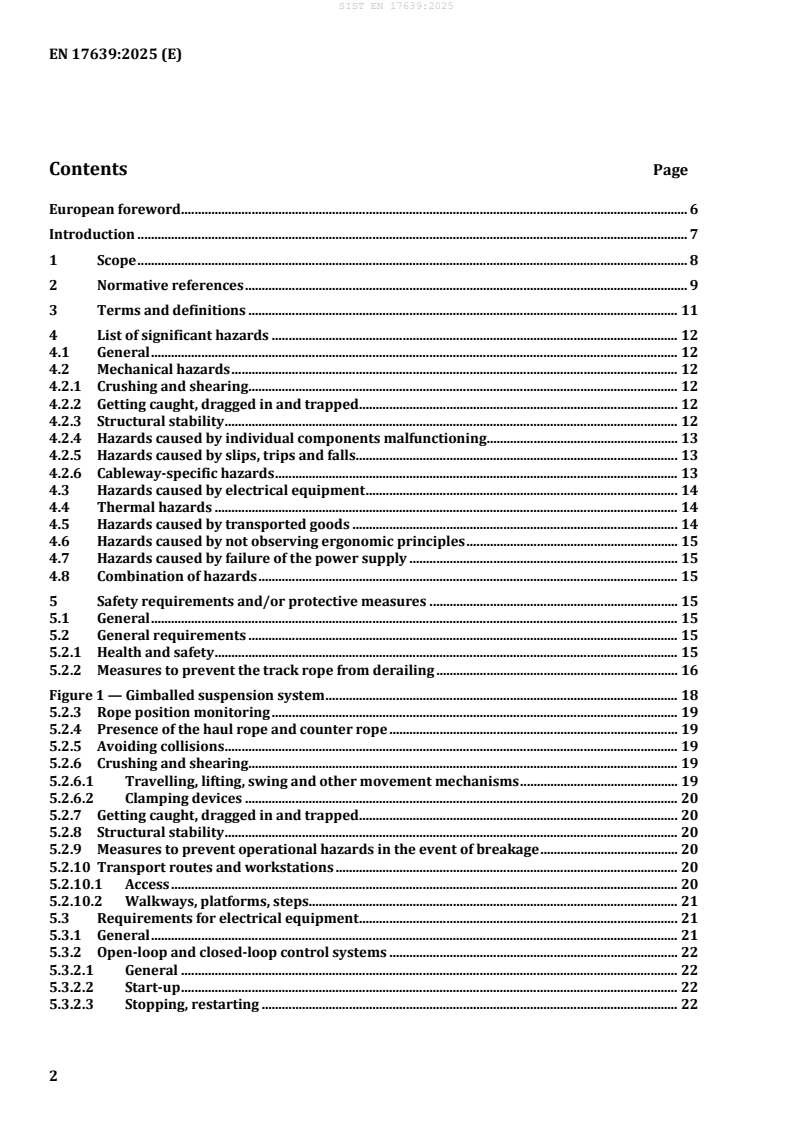
Contents Page
European foreword . 6
Introduction . 7
1 Scope . 8
2 Normative references . 9
3 Terms and definitions . 11
4 List of significant hazards . 12
4.1 General . 12
4.2 Mechanical hazards . 12
4.2.1 Crushing and shearing . 12
4.2.2 Getting caught, dragged in and trapped . 12
4.2.3 Structural stability . 12
4.2.4 Hazards caused by individual components malfunctioning . 13
4.2.5 Hazards caused by slips, trips and falls. 13
4.2.6 Cableway-specific hazards . 13
4.3 Hazards caused by electrical equipment . 14
4.4 Thermal hazards . 14
4.5 Hazards caused by transported goods . 14
4.6 Hazards caused by not observing ergonomic principles . 15
4.7 Hazards caused by failure of the power supply . 15
4.8 Combination of hazards . 15
5 Safety requirements and/or protective measures . 15
5.1 General . 15
5.2 General requirements . 15
5.2.1 Health and safety . 15
5.2.2 Measures to prevent the track rope from derailing . 16
Figure 1 — Gimballed suspension system . 18
5.2.3 Rope position monitoring . 19
5.2.4 Presence of the haul rope and counter rope . 19
5.2.5 Avoiding collisions . 19
5.2.6 Crushing and shearing . 19
5.2.6.1 Travelling, lifting, swing and other movement mechanisms . 19
5.2.6.2 Clamping devices . 20
5.2.7 Getting caught, dragged in and trapped . 20
5.2.8 Structural stability . 20
5.2.9 Measures to prevent operational hazards in the event of breakage . 20
5.2.10 Transport routes and workstations . 20
5.2.10.1 Access . 20
5.2.10.2 Walkways, platforms, steps. 21
5.3 Requirements for electrical equipment . 21
5.3.1 General . 21
5.3.2 Open-loop and closed-loop control systems . 22
5.3.2.1 General . 22
5.3.2.2 Start-up . 22
5.3.2.3 Stopping, restarting . 22
5.3.2.4 Emergency stop . 23
5.3.2.5 Unexpected or unintended start-up . 23
5.3.2.6 Removal of safety functions . 23
5.3.2.7 Controlling speed on the track and on entry into the station . 24
5.3.2.8 Command station and other control stations . 24
5.3.2.9 Position monitor . 24
5.3.2.9.1 General . 24
5.3.2.9.2 Monitoring equipment . 25
5.3.2.9.3 Additional requirements for electronic position switches . 25
5.3.3 Safety functions and devices for the drives . 25
5.3.3.1 Setpoint/actual value monitoring . 25
5.3.3.2 Overspeed trip . 25
5.3.3.3 Standstill monitoring . 25
5.3.3.4 Deceleration monitoring . 26
5.3.3.5 Entry monitoring . 26
5.3.4 Lightning protection and earthing . 26
5.4 Carriers. 27
5.4.1 General . 27
5.4.2 Carrier design . 27
5.4.3 Carrier trucks . 28
5.4.4 Haul rope truck connections . 29
5.4.5 Maintenance and rescue . 30
5.4.5.1 Rescue . 30
5.4.5.2 Maintenance work . 30
5.4.6 Carrier labels and markings . 30
5.5 Ropes . 30
5.5.1 General . 30
5.5.2 Track ropes . 31
5.5.3 Haul ropes and carrying-hauling ropes . 31
5.5.4 Tension ropes . 32
5.6 Special requirements for structures . 32
5.6.1 General . 32
5.6.2 Station structures . 32
5.6.3 Track structures . 32
5.7 Limit profile, track width and safety areas . 32
5.7.1 General . 32
5.7.2 Lateral and vertical displacement of the ropes . 33
5.7.3 Transverse sway of the carriers . 34
5.7.4 Longitudinal sway of the carriers . 34
5.8 Mechanical equipment and drives . 35
5.8.1 Stations . 35
5.8.2 Rope pulleys, rope sheaves and rope reels . 35
Table 1 — Minimum values for diameters of rope pulleys, rope sheaves and rope reels . 36
5.8.3 Track rope saddles . 36
5.8.4 Rope position securing and damage protection . 37
5.9 Fire prevention . 37
5.10 Measures for observing ergonomic principles . 37
5.11 Measures in the event of a power failure . 37
5.12 Measures where there is a combination of hazards . 37
5.13 Other. 37
6 Determining compliance with safety requirements and/or measures prior to putting the
cableway on the market . 38
6.1 Scope of technical documentation . 38
6.2 Load assumptions and securities . 39
Table 2 — Tensile safety . 39
Table 3 — Assumptions for the design of the entire plant . 41
6.3 User agreement between the customer and manufacturer . 41
6.4 Final testing at the installation location prior to putting the cableway on the market . 41
Table 4 — Verification procedures . 42
6.5 Test equipment . 44
7 User information . 45
7.1 General . 45
7.2 Signals and warning devices . 45
7.3 Accompanying documentation (operating instructions) . 45
7.3.1 General . 45
7.3.2 Information about the cableway . 46
7.3.3 Instructions for using the cableway . 47
7.3.4 Information about operating personnel . 48
7.3.5 Instructions for maintenance . 48
Table 5 — Maximum permissible metallic cross-section loss . 50
7.3.6 Instructions for rescue . 50
7.4 Labelling . 51
Annex A (informative)
List of hazards according to EN ISO 12100:2010 and assignment of the
corresponding safety requirements for cableways . 52
Table A.1 — List of hazards according to EN ISO 12100:2010 and assignment of the
corresponding safety requirements for cableways . 52
Annex B (normative)
Effect of safety devices and functions . 56
Table B.1 — Safety devices and functions . 56
Annex C (informative)
Deviation to the EN 13223:2015 defined requirements . 59
Annex D (informative)
User agreements. 60
Annex ZA (informative)
Relationship between this European Standard and the fundamental
requirements of the regulation to be covered, Directive 2006/42/EC . 62
Table ZA.1 — Relationship between this European Standard and Annex I to Directive
2006/42/EC . 62
References . 65
Images
Bild 1 — Kardanische Aufhängung . 18
Tables
Table 1 — Minimum values for diameters of rope pulleys, rope sheaves and rope reels . 36
Table 2 — Tensile safety . 39
Table 3 — Assumptions for the design of the entire plant . 41
Table 4 — Verification procedures . 42
Table 5 — Maximum permissible metallic cross-section loss . 50
Table A.1 — List of hazards according to EN ISO 12100:2010 and assignment of the
corresponding safety requirements for cableways . 52
Table B.1 — Safety devices and functions . 56
Table ZA.1 — Relationship between this European Standard and Annex I to Directive
2006/42/EC. 62
European foreword
This document (EN 17639:2025) has been prepared by Technical Committee CEN/TC 242 "Safety
requirements for cableway installations designed to carry persons", the secretariat of which is held by
AFNOR.
This European Standard shall be awarded the status of a national standard, either through the publication
of an identical text or through endorsement, before November 2025, and any conflicting national
standards must be withdrawn before November 2025.
Attention is drawn to the possibility that some of the elements of this document may be the subject of
patent rights. CEN shall not be held responsible for identifying any or all such patent rights.
This document has been prepared under a mandate given to CEN by the European Commission and the
European Free Trade Association, and supports essential requirements of EU Directive(s).
For relationship with EU Directives, see Annex ZA, which is an integral part of this document.
Feedback or questions regarding this document should be directed to the user's national standards
institute. A complete list of these institutes is available on the CEN website.
In accordance with the CEN CENELEC Rules of Procedure, the national standards institutes of the
following countries are required to adopt this European Standard: Austria, Belgium, Bulgaria, Croatia,
Cyprus, Czech Republic, Denmark, Estonia, Finland, France, Germany, Greece, Hungary, Iceland, Ireland,
Italy, Latvia, Lithuania, Luxembourg, Malta, Netherlands, Norway, Poland, Portugal, the Republic of
Northern Macedonia, Romania, Serbia, Slovakia, Slovenia, Spain, Sweden, Switzerland, Türkiye and the
United Kingdom.
Introduction
This document is a Type-C-standard, as defined in EN ISO 12100:2010.
The affected cableways and the hazards covered are defined within the scope of this document.
In preparing this standard, it was assumed that:
a) negotiations have taken place between the operator and the manufacturer about specific conditions
of use and the place of use of the cableway in terms of health and safety;
b) only qualified individuals operate, clean, check, maintain, inspect and repair cableways;
c) the installation site allows the cableway to be operated safely;
d) no components have specific requirements:
1) have been made from material of adequate strength and durability and of appropriate quality;
2) operate mechanically without any faults;
3) have been measured in line with standard engineering expertise and calculation procedures,
including all types of malfunction and taking into account appropriate safety factors.
e) the geological conditions have been determined and taken into account in accordance with standard
engineering expertise and calculation procedures.
In the event that requirements under this Type C standard differ from those specified in Type A and Type
B standards, the requirements of this Type C standard will take precedence.
This document covers cableways for the transport of material and specially designated persons. These
cableways are intended exclusively to open up the area in order to supply goods and dispose of waste as
well as to sustain operations that are difficult to access. Supplying mountain huts and shelters is an
example of operational concern/how a cableway installation of this kind can be used.
Employees and the immediate family members of the operator, as well as persons connected to the
operator's actual operational activities at the site of the cableway or who need the cableway to be
transported in the public interest may be included in the list for carriage for in-house reasons.
NOTE Transporting a larger group of people is only permitted if cableways in accordance with Regulation (EU)
2016/424 are used.
1 Scope
This Type C standard document is to be used for fixed cableways driven by an electric motor and
operating as single-cable or bi-cable aerial ropeways operating on a single-track or dual-track for
transport
— of goods to supply goods to and dispose of waste from mountain huts and shelters and
— of specially designated persons.
The particular characteristics of these cableways are their low usage (on average 6 trips per operating
day), low speed (up to 4 m/s) and the limited group of people using the cableway. There is no transport
obligation.
This document is not applicable to:
— cableways primarily designed, constructed or operated mainly for the transport of persons and
subject to Regulation (EU) 2016/424;
— portable cableways;
— lifts;
— funicular railways;
— fixed and portable equipment used exclusively for leisure and enjoyment purposes and not for the
transport of persons;
— water ski lifts;
— agricultural and forestry installations;
— rope crane installations and crane installations;
— mining installations or other installations set up and used for industrial purposes;
— drilling equipment.
This document deals with the significant hazards arising from the construction and operation of the
aforementioned cableways and measures to eliminate or reduce these hazards, provided that these
cableways are used in accordance with their intended purpose and that the remaining residual risk has
been anticipated and accepted by the manufacturer.
In the event that there are changes to the existing cableways, these changes shall be assessed in terms of
their impact on safety in accordance with EN ISO 12100:2010. If this assessment shows that the intended
changes do not constitute a significant change pursuant to the Machinery Directive, the requirements
under this document shall apply in all cases to the assemblies/components concerned.
In the following sections, for reasons of simplification, the term cableway is used on its own to cover the
types of equipment covered by this standard.
This document does not cover:
— Hazards caused by noise, in particular by the release of airborne noise;
— Hazards caused by vibration;
— Explosion hazards;
— Hazards caused by electromagnetic influences (EMC).
NOTE 1 Directive 2014/30/EU regarding electromagnetic compatibility may be used for machinery or
components in accordance with this standard. This standard is not intended as a means of proving compliance with
the basic health and safety requirements of the aforementioned directive or the aforementioned hazards.
The requirements under this document do not apply to equipment and systems manufactured or placed
on the market before the date that this document is published.
2 Normative references
The following documents are referred to in the text in such a way that some or all of them are
requirements of this document. For dated references, only the edition cited applies. For undated
references, the latest edition of the referenced document (including any amendments) applies.
EN 795:2012, Personal fall protection equipment — Anchor devices
EN 1090-1:2009+A1:2011, Execution of steel structures and aluminium structures — Part 1: Assessment
and verification of constancy of performance of steel components and aluminium components for structural
use
EN 1090-2:2018+A1:2024, Execution of steel structures and aluminium structures — Part 2: Technical
requirements for the execution of steel structures
EN 1907:2017, Safety requirements for cableway installations designed to carry persons — Terminology
EN 1908:2015, Safety requirements for cableway installations designed to carry persons — Tensioning
devices
EN 12385-4:2002+A1:2008, Steel wire ropes — Safety — Part 4: Stranded ropes for general lifting
EN 12385-8:2002, Steel wire ropes — Safety — Part 8: Stranded hauling and carrying-hauling ropes for
cableway installations designed to carry persons
EN 12385-9:2002, Steel wire ropes — Safety — Part 9: Locked track ropes for cableway installations
designed to carry persons
EN 12927:2019, Safety requirements for cableway installations designed to carry persons — Ropes
EN 12929-1:2015, Safety requirements for cableway installations designed to carry persons — General
requirements — Part 1: Requirements for all installations
EN 12929-2:2015, Safety requirements for cableway installations designed to carry persons — General
requirements — Part 2: Additional requirements for reversible bi-cable aerial ropeways without carrier
truck brakes
EN 12930:2015, Safety requirements for cableway installations designed to carry persons — Calculations
EN 13107:2015, Safety requirements for cableway installations designed to carry persons — Civil
engineering works
EN 13223:2015, Safety requirements for cableway installations designed to carry persons — Drive systems
and other mechanical equipment
EN 13243:2015, Safety requirements for cableway installations designed to carry persons — Electrical
equipment other than for drive systems
EN 13411-4:2021, Terminations for steel wire ropes — Safety — Part 4: Metal and resin socketing
EN 13411-6:2004+A1:2008, Terminations for steel wire ropes — Safety — Part 6: Asymmetric wedge
socket
EN 13796-1:2017, Safety requirements for cableway installations designed to carry persons — Carriers —
Part 1: Grips, carrier trucks, on-board brakes, cabins, chairs, carriages, maintenance carriers, tow hangers
EN 17064:2018, Safety requirements for cableway installations designed to carry persons — Prevention
and fight against fire
EN 60204-1:2018, Safety of machinery — Electrical equipment of machines — Part 1: General
requirements (IEC 60204-1:2016, modified)
EN 60947-5-1:2017, Low-voltage switchgear and control gear — Part 5-1: Control circuit devices and
switching elements — Electromechanical control circuit devices (IEC 60947-5-1:2016)
EN IEC 62061:2021, Safety of machinery — Functional safety of safety-related control systems
(IEC 62061:2021)
EN 62305:2015 (all parts), Protection against lightning
EN ISO 12100:2010, Safety of machinery — General principles for design — Risk assessment and risk
reduction (ISO 12100:2010)
EN ISO 13849-1:2015, Safety of machinery — Safety-related parts of control systems — Part 1: General
principles for design (ISO 13849-1:2015)
EN ISO 13849-2:2012, Safety of machinery — Safety-related parts of control systems — Part 2: Validation
(ISO 13849-2:2012)
EN ISO 13850:2015, Safety of machinery — Emergency stop — Principles for design (ISO 13850:2015)
EN ISO 13854:2019, Safety of machinery — Minimum gaps to avoid crushing of parts of the human body
(ISO 13854:2017)
EN ISO 13857:2019, Safety of machinery — Safety distances to prevent hazard zones from being reached
by upper and lower limbs (ISO 13857:2008)
EN ISO 14118:2018, Safety of machinery — Prevention of unexpected start-up (ISO 14118:2017)
EN ISO 14120:2015, Safety of machinery — Guards — General requirements for the design, construction
and application of fixed and movable guards (ISO 14120:2015)
Amended by EN IEC 62061:2021/A1:2024.
Under revision.
EN ISO 13854 (2019) is the successor to the withdrawn EN 349.
EN ISO 14122:2016 (all parts), Safety of machinery — Permanent means of access to machinery
3 Terms and definitions
For the purposes of this document, the terms and definitions given in EN 1907:2017 and the following
apply.
ISO and IEC provide terminological databases for use in standardisation available from the following
websites:
— ISO Online Browsing Platform: available from https://www.iso.org/obp
— IEC Electropedia: available from https://www.electropedia.org/
3.1
Workstation
Area provided by the manufacturer on which persons work or operate equipment during normal
operation
Note 1 on the term: Maintenance is excluded.
3.2
Specially designated person
Authorised individual who is trained and/or instructed by the operator or manufacturer, and who is
authorised by the owner to operate and/or use a cableway in accordance with the user agreement
3.3
Operations log
Documentation that records all checks and maintenance carried out, and exceptional events that have
occurred with regard to the cableways
3.4
Durability
Fulfilment of the requirements for load bearing safety and suitability for use within the scope of intended
use and the foreseeable impact, without unforeseen expenditure for maintenance and repair
3.5
Limit profile
Space required by the ropes, the carriers, where applicable the space required to allow for easy reach and
for the transported goods
3.6
Ready for operation
Status of the cableway, which is stationary, the carriers are in the stations and in which the functional
and safety requirements for normal operation are met
3.7
Out of service
Status of the cableway, which is at a standstill, the carriers are in the stations and the readiness for
operation has not yet been determined
3.8
In operation
Status of the cableway, which is in motion
3.9
Operational wind speed
Lateral ram pressure caused by wind on which the cableway is designed to operate and up to which the
cableway may operate normally
4 List of significant hazards
4.1 General
Section 4 covers all significant hazards, hazardous situations and circumstances that have been identified
as relevant to the field of application specified in the scope of application as a result of a risk assessment
and which require provisions to eliminate or minimise the risk (see Annex A). The clarifying remarks
form the basis for the safety measures under Section 5.
On the basis of the description of intended use for the cableway in a specification (user agreement,
see 6.4) the conditions to be accepted for the cableway to operate shall be defined. Before this standard
is applied, a risk assessment shall be carried out for the respective cableway, its intended use and location
to ensure that all hazards have been recorded.
Cableways shall be designed, dimensioned and constructed in such a way that they can be operated safely
taking into account the type of cableway, the characteristics of the terrain and the surrounding area, the
atmospheric and meteorological conditions, structures and obstacles on the ground that may be located
in the vicinity and in mid air and the natural hazards (such as avalanches, rockfall).
Assembly and maintenance shall be able to be carried out safely.
There may be exceptions to the requirements under this standard. These exceptions shall be justified by
means of a risk assessment in accordance with EN ISO 12100:2010 and at least an equivalent level of
safety shall be achieved.
4.2 Mechanical hazards
4.2.1 Crushing and shearing
Crushing and shearing can occur where components move towards each other or move close to each
other.
4.2.2 Getting caught, dragged in and trapped
Hazards caused by individuals, body parts or clothing getting caught, dragged in and trapped arise near
rotating ropes, reels, rope sheaves, rope pulleys, shafts and couplings, chains and sprockets or other
revolving or rotating components.
Hazards caused by getting trapped and caught are caused in particular by protruding sharp edges, teeth,
screws, lubricating nipples and other protruding parts or rough surfaces on revolving or rotating
components.
It shall be noted that on cableways where the direction of travel can be reversed, there are points of entry
on each reel, rope sheave, rope pulley or bottleneck.
4.2.3 Structural stability
Loss of structural stability can occur due to:
— overloading;
— operation and maintenance being carried out in an improper manner;
— third party external influences;
— any kind of natural forces;
— inadequate design;
— insufficient materials;
— inadequate assembly.
4.2.4 Hazards caused by individual components malfunctioning
If mechanical components break (such as screws, drive shaft, ropes and their mounts, supports), this can
pose a hazard to system parts or people.
If pressurised hydraulic lines burst, this can endanger system parts or people as well as the environment.
4.2.5 Hazards caused by slips, trips and falls
Hazards in the form of slips, trips and falls can occur (for example, at access points, ladders and
platforms).
4.2.6 Cableway-specific hazards
In particular, the following cableway-specific hazards may occur:
— haul-/carrying-hauling ropes in the incorrect position;
— track rope derailing;
— haul rope breaking;
— haul rope derailing;
— rope clamping force dropping below permitted values;
— rope clamping force increasing above permitted values;
— haul rope miswrap;
— contact with other ropes;
— support system for the haul rope loop malfunctioning;
— impact of aircraft;
— damage to the haul rope due to atmospheric influences (such as lightning, corrosion);
— carrier attachment to the haul rope malfunctioning;
— in-feed monitoring system malfunctioning;
— loss of traction capacity on the drive pulley;
— carrier derailment while stationary in extreme situations;
— obstacle on the track;
— obstacle in the station area;
— carrier moving accidentally
— haul rope twisting;
— difficulty eliminating haul rope miswrap;
— weather conditions with snow and ice overhang.
4.3 Hazards caused by electrical equipment
Hazards caused by electrical system components can occur due to:
— direct contact with live parts of electrical equipment (active parts);
— indirect contact with electrically active parts as a result of damage to insulation, earthing or
wrapping;
— power supply shutting down erroneously;
— electrical safety functions malfunctioning;
— electrical or electronic components malfunctioning;
— reduction in voltage or power failure;
— short circuit, earth fault or interruption occurring;
— electrostatic processes;
— malfunction due to power surges;
— predictable external influences, in particular environmental conditions (such as dirt or moisture
getting into electrical systems, impact of lightning).
4.4 Thermal hazards
Hazards may occur due to:
— heat being generated as a result of faulty components moving;
— heat being generated as a result of relative movement (e. g. slippage) between components;
— heat generated by drive components;
— fire.
4.5 Hazards caused by transported goods
Hazards can arise from improper load securing, overloading, exceeding the designated loading space,
being ejected or falling, as well as easily flammable goods being conveyed and the leakage of corrosive
(e.g. chemicals, cleaning agents) and water-polluting substances (e.g. lubricants and fuels).
4.6 Hazards caused by not observing ergonomic principles
Failure to observe ergonomic principles may result in people not adopting the correct posture when
working on cableways (such as in the command station), experiencing excessive physical exertion or
mental overexertion or underexertion.
4.7 Hazards caused by failure of the power supply
Hazards (such as unwanted movements or changes in movement on cableways) can occur due to:
— failure of the power supply;
— control system failing/malfunctioning.
4.8 Combination of hazards
Hazards can occur through combinations of individual hazards.
5 Safety requirements and/or protective measures
5.1 General
Cableways shall be assessed in terms of relevant hazards in accordance with EN ISO 12100:2010.
Cableways shall also comply with the safety requirements and protective measures under this standard.
For the purposes of Type B standards EN ISO 13857:2019 and EN ISO 13854:2019, the manufacturer
shall carry out a specific risk assessment in accordance with EN ISO 12100:2010 so that the manufacturer
is able to select suitable design guidelines under the aforementioned standards with which an
appropriate level of safety can be achieved.
This specific risk assessment forms part of the general risk assessment, which relates to the haza
...