

EN ISO 17651-1:2024
(Main)Simultaneous interpreting - Interpreters’ working environment - Part 1: Requirements and recommendations for permanent booths (ISO 17651-1:2024)
- Abstract
This document specifies requirements and recommendations for the design of permanent booths for simultaneous interpreting in new or existing buildings. This document also ensures the usability and accessibility of booths for all interpreters.
This document is to be used in conjunction with ISO 20109, which contains requirements and recommendations for the equipment necessary for simultaneous interpreting. For requirements and recommendations for permanent booths which do not have a direct view of the room in which a communicative event takes place, see ISO 17651-3.[1]
[1] Under preparation. Stage at the time of publication: ISO/CD 17651-3-2:2024.
- Status
- Published
- Publication Date
- 23-Jan-2024
- Technical Committee
- CEN/SS A07 - Translation services
- Drafting Committee
- CEN/SS A07 - Translation services
- Current Stage
- 6060 - Definitive text made available (DAV) - Publishing
- Start Date
- 24-Jan-2024
- Completion Date
- 24-Jan-2024

Overview
EN ISO 17651-1:2024 - Simultaneous interpreting - Interpreters’ working environment - Part 1: Requirements and recommendations for permanent booths - specifies design, usability and accessibility principles for permanent interpretation booths in new or existing buildings. It replaces EN ISO 2603:2016 and is intended to be used together with ISO 20109 (equipment requirements) and, for booths without a direct view, the forthcoming ISO 17651-3. The standard was prepared by ISO/TC 37 in collaboration with CEN and is adopted as a European Standard.
Key topics and technical requirements
The standard covers practical, technology-neutral requirements and recommendations across booth lifecycle and fit-out, including:
- Location & siting
- Room characteristics, visibility of the event, accessibility and proximity to technical support.
- Design & dimensions
- General layout principles, recommended booth dimensions, door and window considerations to support sightlines and usability.
- Acoustics
- Sound insulation and sound absorption objectives to protect concentration and ensure audio quality for interpreters and listeners.
- HVAC (Heating, ventilation and air conditioning)
- Air quality, temperature, humidity and airflow guidance plus acoustic treatment of HVAC systems to avoid noise ingress.
- Electrical & data
- Power supply, cable ducts, internet access and electromagnetic radiation limits to support interpreting equipment and digital connectivity.
- Booth interior
- Lighting, colour schemes, work surfaces, furniture, video displays, storage and special requirements for signed language interpreters.
- Amenities
- Provision of toilets and interpreters’ break rooms to support well‑being and shift rotation.
- Accessibility & usability
- Design that ensures booths are accessible to all interpreters (including mobility and visual needs).
Practical applications and target users
EN ISO 17651-1:2024 is practical for:
- Architects and building designers specifying conference and public building spaces
- Acoustic and AV engineers integrating interpretation systems
- Venue owners and facility managers (conference centres, parliaments, courts, international organizations)
- Conference organisers and interpreter service providers setting up booths that meet professional and accessibility standards
- Standards bodies and procurement teams referencing compliance in tenders
Related standards & notes
- Use together with ISO 20109 (interpretation equipment requirements).
- See ISO 17651-3 for booths without direct view (under preparation).
- The document is technology-neutral and reflects recent technological developments in interpreting environments.
Keywords: EN ISO 17651-1:2024, simultaneous interpreting, interpreters’ working environment, permanent booths, booth design requirements, sound insulation, accessibility, HVAC, interpretation booth standards.
Relations
- Replaces
EN ISO 2603:2016 - Simultaneous interpreting - Permanent booths - Requirements (ISO 2603:2016) - Effective Date
- 11-May-2022
- Effective Date
- 25-Aug-2026
- Effective Date
- 25-Aug-2026
- Effective Date
- 25-Aug-2026
- Effective Date
- 25-Aug-2026
- Effective Date
- 25-Aug-2026
- Effective Date
- 25-Aug-2026
- Effective Date
- 25-Aug-2026
- Effective Date
- 09-Feb-2026
- Effective Date
- 09-Feb-2026
- Effective Date
- 09-Feb-2026
- Effective Date
- 09-Feb-2026
- Effective Date
- 28-Jan-2026
- Effective Date
- 28-Jan-2026
- Effective Date
- 28-Jan-2026
Get Certified
Connect with accredited certification bodies for this standard

DIBt (Deutsches Institut für Bautechnik)
German Institute for Building Technology.
DIN CERTCO
DIN Group product certification.

Aboma Certification B.V.
Specialized in construction, metal, and transport sectors.
Sponsored listings
Frequently Asked Questions
EN ISO 17651-1:2024 is a standard published by the European Committee for Standardization (CEN). Its full title is "Simultaneous interpreting - Interpreters’ working environment - Part 1: Requirements and recommendations for permanent booths (ISO 17651-1:2024)". This standard covers: This document specifies requirements and recommendations for the design of permanent booths for simultaneous interpreting in new or existing buildings. This document also ensures the usability and accessibility of booths for all interpreters. This document is to be used in conjunction with ISO 20109, which contains requirements and recommendations for the equipment necessary for simultaneous interpreting. For requirements and recommendations for permanent booths which do not have a direct view of the room in which a communicative event takes place, see ISO 17651-3.[1] [1] Under preparation. Stage at the time of publication: ISO/CD 17651-3-2:2024.
This document specifies requirements and recommendations for the design of permanent booths for simultaneous interpreting in new or existing buildings. This document also ensures the usability and accessibility of booths for all interpreters. This document is to be used in conjunction with ISO 20109, which contains requirements and recommendations for the equipment necessary for simultaneous interpreting. For requirements and recommendations for permanent booths which do not have a direct view of the room in which a communicative event takes place, see ISO 17651-3.[1] [1] Under preparation. Stage at the time of publication: ISO/CD 17651-3-2:2024.
EN ISO 17651-1:2024 is classified under the following ICS (International Classification for Standards) categories: 91.040.10 - Public buildings. The ICS classification helps identify the subject area and facilitates finding related standards.
EN ISO 17651-1:2024 has the following relationships with other standards: It is inter standard links to EN ISO 2603:2016, ISO 7730:2005, ISO 8995-1:2002, ISO 1182:2020, ISO 20109:2016, ISO 11925-3:1997, ISO 3382-2:2008, ISO 21542:2021, ISO 717-2:2020, ISO 717-1:2020, ISO 16283-1:2014, ISO 16283-2:2020, EN ISO 6878:2004, EN 13629:2020, FprEN 16510-2-3. Understanding these relationships helps ensure you are using the most current and applicable version of the standard.
EN ISO 17651-1:2024 is associated with the following European legislation: Standardization Mandates: M/516. When a standard is cited in the Official Journal of the European Union, products manufactured in conformity with it benefit from a presumption of conformity with the essential requirements of the corresponding EU directive or regulation.
EN ISO 17651-1:2024 is available in PDF format for immediate download after purchase. The document can be added to your cart and obtained through the secure checkout process. Digital delivery ensures instant access to the complete standard document.
Standards Content (Sample)
SLOVENSKI STANDARD
01-junij-2024
Nadomešča:
SIST EN ISO 2603:2017
Simultano tolmačenje - Delovno okolje tolmačev - 1. del: Zahteve in priporočila za
vgrajene kabine (ISO 17651-1:2024)
Simultaneous interpreting - Interpreters’ working environment - Part 1: Requirements and
recommendations for permanent booths (ISO 17651-1:2024)
Simultandolmetschen - Arbeitsumfeld des Dolmetschers - Anforderungen an und
Empfehlungen für ortsfeste Kabinen (ISO 17651-1:2024)
Interprétation simultanée - Environnement de travail des interprètes - Partie 1: Exigences
et recommandations pour les cabines permanentes (ISO 17651-1:2024)
Ta slovenski standard je istoveten z: EN ISO 17651-1:2024
ICS:
91.040.10 Javne stavbe Public buildings
2003-01.Slovenski inštitut za standardizacijo. Razmnoževanje celote ali delov tega standarda ni dovoljeno.
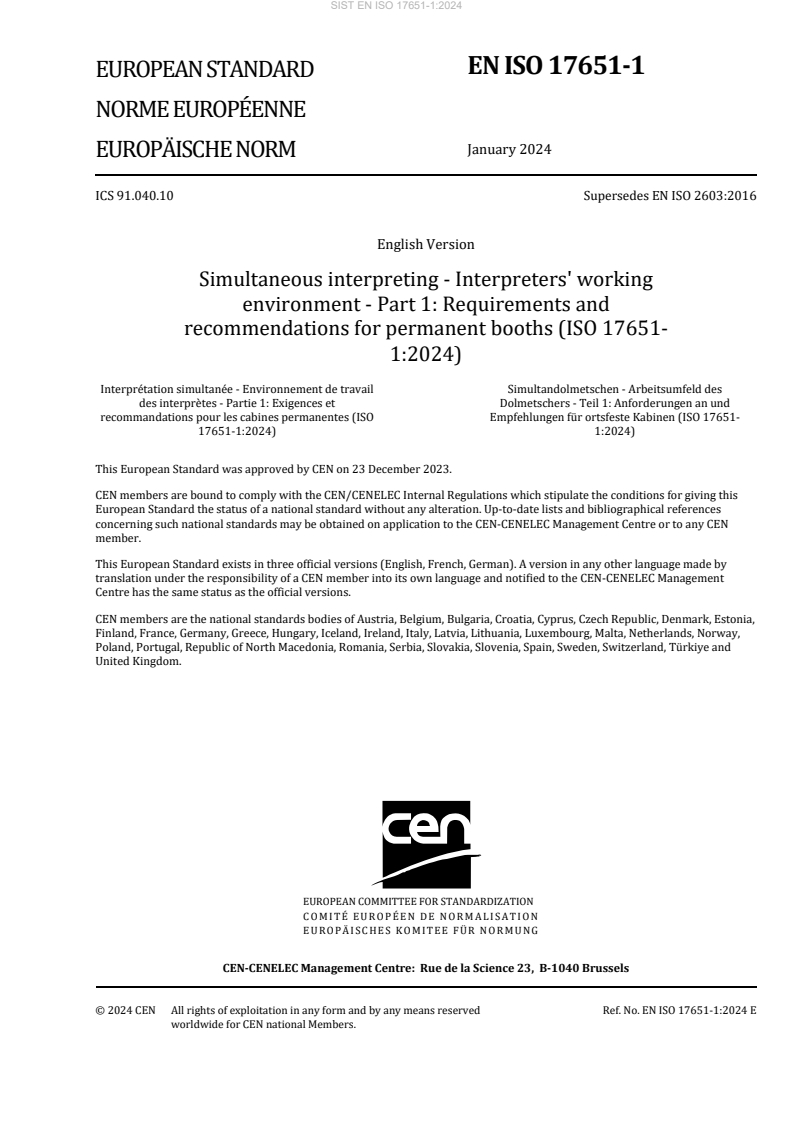
EN ISO 17651-1
EUROPEAN STANDARD
NORME EUROPÉENNE
January 2024
EUROPÄISCHE NORM
ICS 91.040.10 Supersedes EN ISO 2603:2016
English Version
Simultaneous interpreting - Interpreters' working
environment - Part 1: Requirements and
recommendations for permanent booths (ISO 17651-
1:2024)
Interprétation simultanée - Environnement de travail Simultandolmetschen - Arbeitsumfeld des
des interprètes - Partie 1: Exigences et Dolmetschers - Teil 1: Anforderungen an und
recommandations pour les cabines permanentes (ISO Empfehlungen für ortsfeste Kabinen (ISO 17651-
17651-1:2024) 1:2024)
This European Standard was approved by CEN on 23 December 2023.
CEN members are bound to comply with the CEN/CENELEC Internal Regulations which stipulate the conditions for giving this
European Standard the status of a national standard without any alteration. Up-to-date lists and bibliographical references
concerning such national standards may be obtained on application to the CEN-CENELEC Management Centre or to any CEN
member.
This European Standard exists in three official versions (English, French, German). A version in any other language made by
translation under the responsibility of a CEN member into its own language and notified to the CEN-CENELEC Management
Centre has the same status as the official versions.
CEN members are the national standards bodies of Austria, Belgium, Bulgaria, Croatia, Cyprus, Czech Republic, Denmark, Estonia,
Finland, France, Germany, Greece, Hungary, Iceland, Ireland, Italy, Latvia, Lithuania, Luxembourg, Malta, Netherlands, Norway,
Poland, Portugal, Republic of North Macedonia, Romania, Serbia, Slovakia, Slovenia, Spain, Sweden, Switzerland, Türkiye and
United Kingdom.
EUROPEAN COMMITTEE FOR STANDARDIZATION
COMITÉ EUROPÉEN DE NORMALISATION
EUROPÄISCHES KOMITEE FÜR NORMUNG
CEN-CENELEC Management Centre: Rue de la Science 23, B-1040 Brussels
© 2024 CEN All rights of exploitation in any form and by any means reserved Ref. No. EN ISO 17651-1:2024 E
worldwide for CEN national Members.
Contents Page
European foreword . 3
European foreword
This document (EN ISO 17651-1:2024) has been prepared by Technical Committee ISO/TC 37
"Language and terminology" in collaboration with Technical Committee CEN/SS A07 “Translation and
Interpretation services” the secretariat of which is held by CCMC.
This European Standard shall be given the status of a national standard, either by publication of an
identical text or by endorsement, at the latest by July 2024, and conflicting national standards shall be
withdrawn at the latest by July 2024.
Attention is drawn to the possibility that some of the elements of this document may be the subject of
patent rights. CEN shall not be held responsible for identifying any or all such patent rights.
This document supersedes EN ISO 2603:2016.
This document has been prepared under a Standardization Request given to CEN by the European
Commission and the European Free Trade Association.
Any feedback and questions on this document should be directed to the users’ national standards
body/national committee. A complete listing of these bodies can be found on the CEN website.
According to the CEN-CENELEC Internal Regulations, the national standards organizations of the
following countries are bound to implement this European Standard: Austria, Belgium, Bulgaria,
Croatia, Cyprus, Czech Republic, Denmark, Estonia, Finland, France, Germany, Greece, Hungary, Iceland,
Ireland, Italy, Latvia, Lithuania, Luxembourg, Malta, Netherlands, Norway, Poland, Portugal, Republic of
North Macedonia, Romania, Serbia, Slovakia, Slovenia, Spain, Sweden, Switzerland, Türkiye and the
United Kingdom.
Endorsement notice
The text of ISO 17651-1:2024 has been approved by CEN as EN ISO 17651-1:2024 without any
modification.
International
Standard
ISO 17651-1
First edition
Simultaneous interpreting —
2024-01
Interpreters’ working
environment —
Part 1:
Requirements and
recommendations for permanent
booths
Interprétation simultanée — Environnement de travail des
interprètes —
Partie 1: Exigences et recommandations pour les cabines
permanentes
Reference number
ISO 17651-1:2024(en) © ISO 2024
ISO 17651-1:2024(en)
© ISO 2024
All rights reserved. Unless otherwise specified, or required in the context of its implementation, no part of this publication may
be reproduced or utilized otherwise in any form or by any means, electronic or mechanical, including photocopying, or posting on
the internet or an intranet, without prior written permission. Permission can be requested from either ISO at the address below
or ISO’s member body in the country of the requester.
ISO copyright office
CP 401 • Ch. de Blandonnet 8
CH-1214 Vernier, Geneva
Phone: +41 22 749 01 11
Email: copyright@iso.org
Website: www.iso.org
Published in Switzerland
ii
ISO 17651-1:2024(en)
Contents Page
Foreword .iv
Introduction .v
1 Scope . 1
2 Normative references . 1
3 Terms and definitions . 2
4 Location . 3
4.1 Room characteristics .3
4.2 Siting and visibility .3
4.3 Accessibility .4
4.4 Technical control and technical support staff .4
5 Design . 4
5.1 General requirements .4
5.2 Dimensions .5
5.3 Doors .6
5.4 Windows.6
5.5 Acoustics .7
5.5.1 Sound insulation .7
5.5.2 Sound absorption .8
5.6 Heating, ventilation and air conditioning .8
5.6.1 General .8
5.6.2 Air quality . .8
5.6.3 Temperature, humidity and air velocity.9
5.6.4 Soundproofing .9
5.7 Cable ducts .9
5.8 Language displays .9
5.9 Electromagnetic radiation levels .9
6 Booth interior . 10
6.1 General requirements .10
6.2 Colours .10
6.3 Lighting .10
6.4 Work surface .10
6.5 Electricity supply .11
6.6 Internet access .11
6.7 Furniture . 12
6.8 Video displays. 12
6.9 Storage for documents and equipment . 12
6.10 Additional requirements relating to signed language interpreting . 12
7 Amenities for interpreters .13
7.1 Toilets . 13
7.2 Interpreters’ room . 13
Bibliography . 14
iii
ISO 17651-1:2024(en)
Foreword
ISO (the International Organization for Standardization) is a worldwide federation of national standards
bodies (ISO member bodies). The work of preparing International Standards is normally carried out through
ISO technical committees. Each member body interested in a subject for which a technical committee
has been established has the right to be represented on that committee. International organizations,
governmental and non-governmental, in liaison with ISO, also take part in the work. ISO collaborates closely
with the International Electrotechnical Commission (IEC) on all matters of electrotechnical standardization.
The procedures used to develop this document and those intended for its further maintenance are described
in the ISO/IEC Directives, Part 1. In particular, the different approval criteria needed for the different types
of ISO document should be noted. This document was drafted in accordance with the editorial rules of the
ISO/IEC Directives, Part 2 (see www.iso.org/directives).
ISO draws attention to the possibility that the implementation of this document may involve the use of (a)
patent(s). ISO takes no position concerning the evidence, validity or applicability of any claimed patent
rights in respect thereof. As of the date of publication of this document, ISO had not received notice of (a)
patent(s) which may be required to implement this document. However, implementers are cautioned that
this may not represent the latest information, which may be obtained from the patent database available at
www.iso.org/patents. ISO shall not be held responsible for identifying any or all such patent rights.
Any trade name used in this document is information given for the convenience of users and does not
constitute an endorsement.
For an explanation of the voluntary nature of standards, the meaning of ISO specific terms and expressions
related to conformity assessment, as well as information about ISO’s adherence to the World Trade
Organization (WTO) principles in the Technical Barriers to Trade (TBT), see www.iso.org/iso/foreword.html.
This document was prepared by Technical Committee ISO/TC 37, Language and terminology, Subcommittee
SC 5, Translation, interpreting and related technology, in collaboration with the European Committee
for Standardization (CEN) Technical Committee CEN/SS A07, Translation and Interpretation services, in
accordance with the Agreement on technical cooperation between ISO and CEN (Vienna Agreement).
This first edition cancels and replaces the fourth edition of ISO 2603:2016, which has been technically
revised.
The main changes are as follows:
— the document has been generally updated due to technological developments;
— requirements have been formulated in a technology-neutral way;
— the structure of the various parts of the ISO 17651 series has been aligned.
A list of all parts in the ISO 17651 series can be found on the ISO website.
Any feedback or questions on this document should be directed to the user’s national standards body. A
complete listing of these bodies can be found at www.iso.org/members.html.
iv
ISO 17651-1:2024(en)
Introduction
This document concerns permanent booths for simultaneous interpreting which have a direct view of the
room in which the communicative event takes place.
There are a number of things to be taken into account when designing and building permanent booths.
Interpreting is an activity that requires high levels of concentration, therefore the working environment has
to meet the highest standards to minimize stress.
This document addresses the following:
a) workplace setting of interpreters;
b) visual communication between interpreters and participants at an event;
c) sound insulation from the noise transmitted from the booth’s environment to a booth.
v
International Standard ISO 17651-1:2024(en)
Simultaneous interpreting — Interpreters’ working
environment —
Part 1:
Requirements and recommendations for permanent booths
1 Scope
This document specifies requirements and recommendations for the design of permanent booths for
simultaneous interpreting in new or existing buildings. This document also ensures the usability and
accessibility of booths for all interpreters.
This document is to be used in conjunction with ISO 20109, which contains requirements and
recommendations for the equipment necessary for simultaneous interpreting. For requirements
and recommendations for permanent booths which do not have a direct view of the room in which a
1)
communicative event takes place, see ISO 17651-3.
2 Normative references
The following documents are referred to in the text in such a way that some or all of their content constitutes
requirements of this document. For dated references, only the edition cited applies. For undated references,
the latest edition of the referenced document (including any amendments) applies.
ISO 717-1, Acoustics — Rating of sound insulation in buildings and of building elements — Part 1: Airborne
sound insulation
ISO 717-2, Acoustics — Rating of sound insulation in buildings and of building elements — Part 2: Impact sound
insulation
ISO 1182, Reaction to fire tests for products — Non-combustibility test
ISO 3382-2, Acoustics — Measurement of room acoustic parameters — Part 2: Reverberation time in ordinary
rooms
ISO 7730, Ergonomics of the thermal environment — Analytical determination and interpretation of thermal
comfort using calculation of the PMV and PPD indices and local thermal comfort criteria
ISO 8995-1, Lighting of work places — Part 1: Indoor
ISO 11925-3, Reaction to fire tests — Ignitability of building products subjected to direct impingement of flame
— Part 3: Multi-source test
ISO 16283-1, Acoustics — Field measurement of sound insulation in buildings and of building elements — Part 1:
Airborne sound insulation
ISO 16283-2, Acoustics — Field measurement of sound insulation in buildings and of building elements — Part 2:
Impact sound insulation
ISO 20109, Simultaneous interpreting — Equipment — Requirements
ISO 21542:2021, Building construction — Accessibility and usability of the built environment
1) Under preparation. Stage at the time of publication: ISO/CD 17651-3-2:2024.
ISO 17651-1:2024(en)
EN 1335-1, Office furniture — Office work chair — Part 1: Dimensions – Determination of dimensions
3 Terms and definitions
For the purposes of this document, the following terms and definitions apply.
ISO and IEC maintain terminology databases for use in standardization at the following addresses:
— ISO Online browsing platform: available at https:// www .iso .org/ obp
— IEC Electropedia: available at https:// www .electropedia .org/
3.1
interpreter
person who interprets
[SOURCE: ISO 20539:2023, 3.1.13]
3.2
interpreting
interpretation
rendering spoken or signed information from a source language into a target language in spoken or signed
form, conveying both the meaning and language register of the source language content
[SOURCE: ISO 20539:2023, 3.1.11]
3.3
signed language
language which uses a combination of hand shapes, orientation and movement of the hands, arms or body,
and facial expressions
[SOURCE: ISO 20539:2023, 3.1.7]
3.4
signed language interpreting
interpreting (3.2) between two signed languages (3.3) or between a signed language and a spoken language
[SOURCE: ISO 20539:2023, 3.4.3]
3.5
simultaneous interpreting
mode of interpreting (3.2) performed while a speaker or signer is still speaking or signing
[SOURCE: ISO 20539:2023, 3.4.12]
3.6
booth
simultaneous interpreting booth
self-contained unit enclosing the interpreter’s (3.1) workspace
Note 1 to entry: One of the purposes of booths is to provide insulation, both from the noise transmitted from the
booth’s external environment into the booth itself and vice versa, and from noise passing from one booth to another.
[SOURCE: ISO 20539:2023, 3.5.2.1]
3.7
permanent booth
permanent simultaneous interpreting booth
booth (3.6) structurally integrated into a facility
[SOURCE: ISO 20539:2023, 3.5.2.2]
ISO 17651-1:2024(en)
3.9
control booth
room from which technical equipment a
...