

EN 15234-3:2012
(Main)Solid biofuels - Fuel quality assurance - Part 3: Wood briquettes for non-industrial use
- Abstract
This European Standard defines the procedures to fulfil the quality requirements (quality control) and describes measures to ensure adequate confidence that the wood briquette specification described in EN 14961-3 is fulfilled (quality assurance). This European Standard covers the production and delivery chain, from purchasing of raw materials to point of delivery to the end-user.
This European standard covers only quality assurance for wood briquettes produced from the woody biomasses stated in EN 14961-1:2010, Table 1 and EN 14961-3.
- Status
- Published
- Publication Date
- 17-Jan-2012
- Withdrawal Date
- 30-Jul-2012
- Technical Committee
- CEN/TC 335 - Solid biofuels
- Drafting Committee
- CEN/TC 335/WG 2 - Fuel specifications, classes and quality assurance
- Current Stage
- 9060 - Closure of 2 Year Review Enquiry - Review Enquiry
- Start Date
- 02-Sep-2023
- Completion Date
- 02-Sep-2023

Overview
EN 15234-3:2012 is a European Standard developed by CEN (European Committee for Standardization) focusing on solid biofuels, specifically addressing the fuel quality assurance and control processes for wood briquettes intended for non-industrial use. This standard outlines the procedures needed to consistently meet quality requirements throughout the production and delivery chain-from the purchasing of raw materials to delivery to the end-user. It is designed to ensure wood briquettes meet specifications described in EN 14961-3, drawing on raw materials defined by EN 14961-1.
For producers, suppliers, and distributors of wood briquettes, EN 15234-3:2012 is essential to establish traceability, maintain consistent quality, and enhance confidence among customers in the small-scale heating and bioenergy sectors.
Key Topics
Quality Assurance and Quality Control:
- Defines systematic procedures to consistently achieve required product quality.
- Emphasizes both continual monitoring and long-term stability of processes and products.
Traceability:
- Ensures that the origin and source of woody biomass used in briquette production are documented and verifiable throughout the supply chain.
Production and Delivery Chain:
- Covers all key steps from raw material procurement, pretreatment, processing (briquetting), packaging, storage, to final delivery.
- Identifies critical control points during production and distribution where quality-influencing factors are to be monitored.
Handling of Nonconforming Materials:
- Outlines requirements for separate handling, storage, and documentation of raw materials or finished products that do not meet standards.
Product Declaration and Labelling:
- Specifies how product quality should be declared and what information must be included on packaging and delivery documents, helping buyers make informed choices.
Applications
EN 15234-3:2012 applies to a range of stakeholders involved with wood briquettes for non-industrial use:
Producers and Manufacturing Facilities:
- Implement robust quality management systems for raw material selection, processing controls, and finished product evaluation.
- Facilitate efficient trading of wood briquettes in accordance with recognized industry specifications.
Distributors and Retailers:
- Ensure briquettes are stored and transported under suitable conditions to maintain quality and prevent contamination or moisture uptake.
- Use product declarations and standardized labelling to inform end-users about product properties and compliance.
End-Users (Households and Small Commercial Installations):
- Benefit from high confidence in fuel quality, performance, and safety when using biofuel heating systems.
Certification Bodies and Regulators:
- Reference EN 15234-3:2012 when verifying facility or product compliance, enabling consistent application of biofuel quality standards across Europe.
Related Standards
EN 15234-3:2012 is part of a suite of standards supporting quality assurance for solid biofuels. Other important standards in this domain include:
- EN 15234-1: Solid biofuels – Fuel quality assurance – Part 1: General requirements
- EN 14961-1: Solid biofuels – Fuel specifications and classes – Part 1: General requirements
- EN 14961-3: Solid biofuels – Fuel specifications and classes – Part 3: Wood briquettes for non-industrial use
- EN 14588: Solid biofuels – Terminology, definitions, and descriptions
Additional test and analysis standards referenced in quality control documentation include EN 14774-1 (moisture content), EN 14775 (ash content), EN 14918 (calorific value), and EN 15150 (particle density).
Implementing EN 15234-3:2012 ensures consistent quality, improved customer satisfaction, and seamless integration into the broader framework of solid biofuel quality standards for non-industrial applications.
Relations
- Effective Date
- 28-Jan-2026
- Effective Date
- 28-Jan-2026
- Refers
EN 14961-1:2010 - Solid biofuels - Fuel specifications and classes - Part 1: General requirements - Effective Date
- 28-Jan-2026
- Effective Date
- 28-Jan-2026
Get Certified
Connect with accredited certification bodies for this standard

Element Materials Technology
Materials testing and product certification.

ABS Group Brazil
ABS Group certification services in Brazil.

ABS Quality Evaluations Inc.
American Bureau of Shipping quality certification.
Sponsored listings
Frequently Asked Questions
EN 15234-3:2012 is a standard published by the European Committee for Standardization (CEN). Its full title is "Solid biofuels - Fuel quality assurance - Part 3: Wood briquettes for non-industrial use". This standard covers: This European Standard defines the procedures to fulfil the quality requirements (quality control) and describes measures to ensure adequate confidence that the wood briquette specification described in EN 14961-3 is fulfilled (quality assurance). This European Standard covers the production and delivery chain, from purchasing of raw materials to point of delivery to the end-user. This European standard covers only quality assurance for wood briquettes produced from the woody biomasses stated in EN 14961-1:2010, Table 1 and EN 14961-3.
This European Standard defines the procedures to fulfil the quality requirements (quality control) and describes measures to ensure adequate confidence that the wood briquette specification described in EN 14961-3 is fulfilled (quality assurance). This European Standard covers the production and delivery chain, from purchasing of raw materials to point of delivery to the end-user. This European standard covers only quality assurance for wood briquettes produced from the woody biomasses stated in EN 14961-1:2010, Table 1 and EN 14961-3.
EN 15234-3:2012 is classified under the following ICS (International Classification for Standards) categories: 75.160.10 - Solid fuels; 75.160.40 - Biofuels. The ICS classification helps identify the subject area and facilitates finding related standards.
EN 15234-3:2012 has the following relationships with other standards: It is inter standard links to EN 15234-1:2011, EN 14961-3:2011, EN 14961-1:2010, EN 14588:2010. Understanding these relationships helps ensure you are using the most current and applicable version of the standard.
EN 15234-3:2012 is associated with the following European legislation: Standardization Mandates: M/298. When a standard is cited in the Official Journal of the European Union, products manufactured in conformity with it benefit from a presumption of conformity with the essential requirements of the corresponding EU directive or regulation.
EN 15234-3:2012 is available in PDF format for immediate download after purchase. The document can be added to your cart and obtained through the secure checkout process. Digital delivery ensures instant access to the complete standard document.
Standards Content (Sample)
2003-01.Slovenski inštitut za standardizacijo. Razmnoževanje celote ali delov tega standarda ni dovoljeno.Trdna biogoriva - Zagotavljanje kakovosti goriv - 3. del: Lesni briketi za neindustrijsko uporaboFeste Biobrennstoffe - Qualitätssicherung von Brennstoffen - Teil 3: Holzbriketts für nichtindustrielle VerwendungBiocombustibles solides - Assurance qualité relative aux combustibles - Partie 3 : Briquettes de bois à usage non industrielSolid biofuels - Fuel quality assurance - Part 3: Wood briquettes for non-industrial use75.160.10Trda gorivaSolid fuelsICS:Ta slovenski standard je istoveten z:EN 15234-3:2012SIST EN 15234-3:2012en,fr,de01-marec-2012SIST EN 15234-3:2012SLOVENSKI
STANDARD
EUROPEAN STANDARD NORME EUROPÉENNE EUROPÄISCHE NORM
EN 15234-3
January 2012 ICS 75.160.10 English Version
Solid biofuels - Fuel quality assurance - Part 3: Wood briquettes for non-industrial use
Biocombustibles solides - Assurance qualité du combustible - Partie 3 : Briquettes de bois à usage non industriel
Feste Biobrennstoffe - Qualitätssicherung von Brennstoffen - Teil 3: Holzbriketts für nichtindustrielle Verwendung This European Standard was approved by CEN on 27 November 2011.
CEN members are bound to comply with the CEN/CENELEC Internal Regulations which stipulate the conditions for giving this European Standard the status of a national standard without any alteration. Up-to-date lists and bibliographical references concerning such national standards may be obtained on application to the CEN-CENELEC Management Centre or to any CEN member.
This European Standard exists in three official versions (English, French, German). A version in any other language made by translation under the responsibility of a CEN member into its own language and notified to the CEN-CENELEC Management Centre has the same status as the official versions.
CEN members are the national standards bodies of Austria, Belgium, Bulgaria, Croatia, Cyprus, Czech Republic, Denmark, Estonia, Finland, France, Germany, Greece, Hungary, Iceland, Ireland, Italy, Latvia, Lithuania, Luxembourg, Malta, Netherlands, Norway, Poland, Portugal, Romania, Slovakia, Slovenia, Spain, Sweden, Switzerland, Turkey and United Kingdom.
EUROPEAN COMMITTEE FOR STANDARDIZATION
COMITÉ EUROPÉEN DE NORMALISATION EUROPÄISCHES KOMITEE FÜR NORMUNG
Management Centre:
Avenue Marnix 17,
B-1000 Brussels © 2012 CEN All rights of exploitation in any form and by any means reserved worldwide for CEN national Members. Ref. No. EN 15234-3:2012: ESIST EN 15234-3:2012
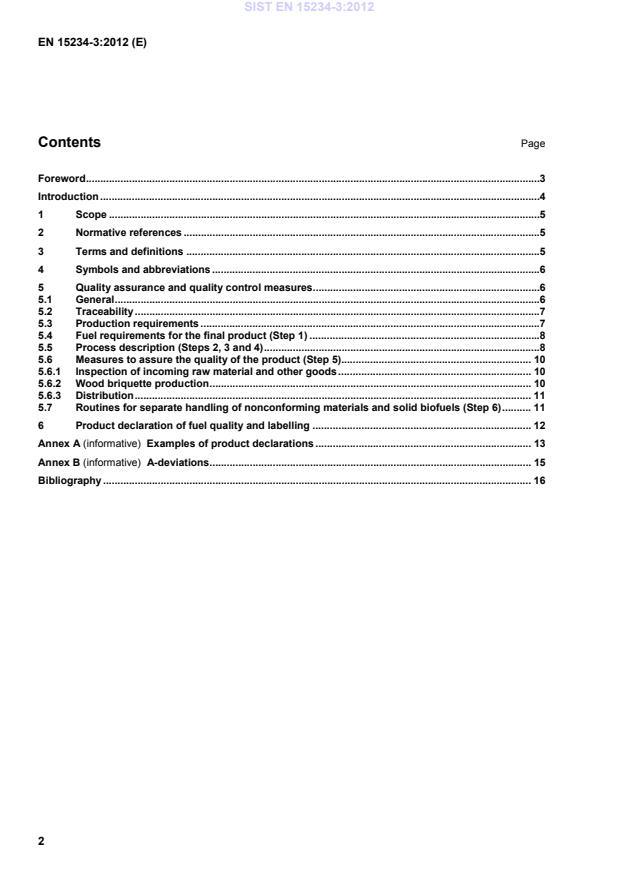
Examples of product declarations . 13Annex B (informative)
A-deviations . 15Bibliography . 16 SIST EN 15234-3:2012
NOTE In these product standards, non-industrial use means - use in smaller scale appliances, such as in households, in small commercial and public sector buildings. According to the CEN/CENELEC Internal Regulations, the national standards organizations of the following countries are bound to implement this European Standard: Austria, Belgium, Bulgaria, Croatia, Cyprus, Czech Republic, Denmark, Estonia, Finland, France, Germany, Greece, Hungary, Iceland, Ireland, Italy, Latvia, Lithuania, Luxembourg, Malta, Netherlands, Norway, Poland, Portugal, Romania, Slovakia, Slovenia, Spain, Sweden, Switzerland, Turkey and United Kingdom. SIST EN 15234-3:2012
The objective of this European Standard is to serve as a tool to enable the efficient trading of wood briquettes. Thereby: 1) the end-user can find a briquette that corresponds to its needs; 2) the producer/supplier can produce a briquette with defined and consistent properties and describe the briquette to the customers. Quality assurance measures should establish confidence in the briquette through systems that are simple to operate and do not cause undue bureaucracy. Wood briquettes are specified according to EN 14961-3, Solid biofuels Fuel specifications and classes Part 3: Wood briquettes for non-industrial use.
NOTE The raw material for wood briquettes is woody biomass in accordance with Table 1 of EN 14961-1:2010. Briquettes are usually manufactured in a die/mould, with total moisture content usually less than 15 % of their mass on wet basis. 3.2 additive material which improves the quality of the fuel (e.g. combustion properties), reduces emissions or makes production more efficient 3.3 chemical treatment treatment with chemicals other than air, water or heat NOTE Examples of chemical treatment are listed in informative Annex C of EN 14961-1:2010. 3.4 impurities material other than the raw material or fuel itself such as soil, stones, metal, plastic, glass SIST EN 15234-3:2012
dry (dry basis) ar as received w-% weight-percentage A designation for ash content, Ad [w-%, dry basis]1) DE designation for particle density as received [g/cm3]1) D designation for diameter as received, D [mm]1) L designation for length as received, L [mm]1 M designation for moisture content as received on wet basis, Mar [w-%]1) Q designation for net calorific value as received, qp,net,ar [MJ/kg or kWh/kg or MWh/t] at constant pressure1) NOTE 1 MJ/kg equals 0,277 8 kWh/kg (1 kWh/kg equals 1 MWh/t and 1 MWh/t is 3,6 MJ/kg). 1 g/cm3 equals 1 kg/dm3. 5 Quality assurance and quality control measures 5.1 General Quality assurance and control aim to provide confidence that a stable quality is continually achieved in accordance with the customer requirements. It means that specified requirements are fulfilled, but it does not necessarily mean a high quality but a steady and continually achieved quality in accordance with the customer´s requirements. The customer is the next operator in the supply chain. Customer requirements include not only the fuel quality, but also the quality of the company’s performance, such as documentation (product declaration, labelling of packaging, etc.), timing and logistics (to provide biofuels in time and to agreed performances criteria). Fuel quality assurance needs to be applied to the entire supply chain. As the supply chains for solid biofuels in the most cases needs to be kept very simple, the same documents are often used for documentation of quality assurance and quality control measures. NOTE When the customer is a supplier, a retailer or end user, the customer requirements are usually written in sales contracts. Quality control is fundamentally about controlling the quality of a product or process to enable the delivery of the product or service within agreed parameters in the most efficient and cost effective way. The consequences of having good quality control will be a cost effective product and process.
1) Designation symbols are used in combination with a number to specify property levels (see for example Table 1, EN 14961-4:2011). For designation of chemical properties chemical symbols like S (sulphur), Cl (chlorine), N (nitrogen) are used and the value is added at the end of the symbol. SIST EN 15234-3:2012
...