

IEC 62276:2016
(Main)Single crystal wafers for surface acoustic wave (SAW) device applications - Specifications and measuring methods
General Information
- Abstract
IEC 62276:2016 applies to the manufacture of synthetic quartz, lithium niobate (LN), lithium tantalate (LT), lithium tetraborate (LBO), and lanthanum gallium silicate (LGS) single crystal wafers intended for use as substrates in the manufacture of surface acoustic wave (SAW) filters and resonators. This edition includes the following significant technical changes with respect to the previous edition:
- Corrections of Euler angle indications in Table 1 and axis directions in Figure 3.
- Definition of "twin" is not explained clearly enough in 3.3.3. Therefore it is revised by a more detailed definition.
- Etch channels maximum number at quartz wafer of seed which do not pass through from surface to back surface are classified for three grades in 4.2.13 a). Users use seed portions of quartz wafers for devices. They request quartz wafers with less etch channels in seeds to reduce defects of devices. The classification of etch channels in seed may prompt a rise in quartz wafer quality.
- Status
- Published
- Publication Date
- 23-Oct-2016
- Technical Committee
- TC 49 - Piezoelectric, dielectric and electrostatic devices and associated materials for frequency control, selection and detection
- Drafting Committee
- WG 5 - TC 49/WG 5
- Current Stage
- DELPUB - Deleted Publication
- Start Date
- 07-Mar-2025
- Completion Date
- 01-Jul-2022
Buy Documents
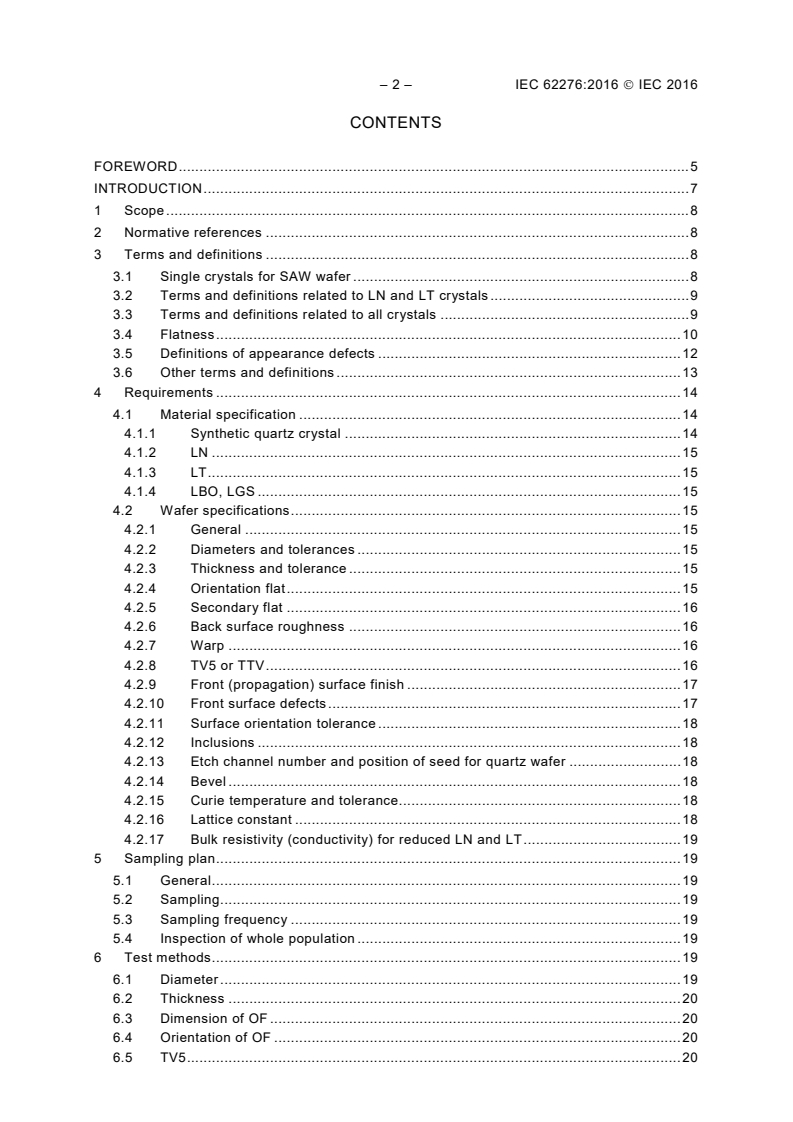
IEC 62276:2016 - Single crystal wafers for surface acoustic wave (SAW) device applications - Specifications and measuring methods Released:10/24/2016
IEC 62276:2016 - Single crystal wafers for surface acoustic wave (SAW) device applications - Specifications and measuring methods Released:1/25/2018
Overview
IEC 62276:2016 is the international standard that specifies requirements and measuring methods for single crystal wafers used as substrates in surface acoustic wave (SAW) filters and resonators. It covers synthetic quartz, lithium niobate (LN), lithium tantalate (LT), lithium tetraborate (LBO) and lanthanum gallium silicate (LGS) wafers. The document defines material specifications, wafer geometries, surface and bulk properties, inspection sampling and test methods used in manufacturing and quality control of SAW wafers.
This edition includes important technical changes: corrections to Euler angle indications and axis directions, a clarified definition of twin defects, and a new classification of etch channels in quartz seed areas to help improve wafer quality.
Key Topics
- Material specification for quartz, LN, LT, LBO and LGS single crystals.
- Wafer dimensional requirements: diameters, tolerances, thickness, orientation flats and secondary flats.
- Surface quality: front (propagation) surface finish, front/back roughness, bevel and mirror polishing.
- Flatness and form parameters: warp, TV5, TTV (total thickness variation).
- Defects and appearance: surface defects, inclusions, twins, and etch channel classification (seed position for quartz).
- Functional properties: Curie temperature, lattice constant (Bond method), and bulk resistivity for reduced LN/LT materials.
- Measurement methods: DTA and dielectric methods for Curie temperature, Bond method and X‑ray for lattice and face angle, electrical techniques for resistivity, and visual inspection procedures.
- Sampling, labelling and packaging requirements and guidance are provided to ensure traceability and delivery condition.
Applications and Users
IEC 62276:2016 is intended for:
- SAW device manufacturers specifying substrate acceptance criteria for filters and resonators.
- Single crystal wafer producers (quartz, LN, LT, LBO, LGS) implementing production and QC processes.
- Test and metrology laboratories performing material and wafer property measurements.
- Procurement and quality engineers creating technical purchase specifications for SAW substrates.
- R&D teams developing new SAW device processes that depend on precise wafer orientation and material properties.
Practical benefits include consistent wafer quality, reduced device defects (by controlling etch channels and twins), and harmonized test methods for supplier-customer communication.
Related Standards
Refer to complementary IEC and international standards on piezoelectric materials, wafer metrology and electrical/electronic component packaging for broader context and harmonized measurement practices.
Relations
- Effective Date
- 05-Sep-2023
- Effective Date
- 05-Sep-2023
Buy Documents
IEC 62276:2016 - Single crystal wafers for surface acoustic wave (SAW) device applications - Specifications and measuring methods Released:10/24/2016
IEC 62276:2016 - Single crystal wafers for surface acoustic wave (SAW) device applications - Specifications and measuring methods Released:1/25/2018
Get Certified
Connect with accredited certification bodies for this standard

IMQ S.p.A. (Certification)
Italian electrical product certification.

SLG Prüf- und Zertifizierungs GmbH
German testing and certification body.

UL Solutions
Global safety science company with testing, inspection and certification.
Sponsored listings
Frequently Asked Questions
IEC 62276:2016 is a standard published by the International Electrotechnical Commission (IEC). Its full title is "Single crystal wafers for surface acoustic wave (SAW) device applications - Specifications and measuring methods". This standard covers: IEC 62276:2016 applies to the manufacture of synthetic quartz, lithium niobate (LN), lithium tantalate (LT), lithium tetraborate (LBO), and lanthanum gallium silicate (LGS) single crystal wafers intended for use as substrates in the manufacture of surface acoustic wave (SAW) filters and resonators. This edition includes the following significant technical changes with respect to the previous edition: - Corrections of Euler angle indications in Table 1 and axis directions in Figure 3. - Definition of "twin" is not explained clearly enough in 3.3.3. Therefore it is revised by a more detailed definition. - Etch channels maximum number at quartz wafer of seed which do not pass through from surface to back surface are classified for three grades in 4.2.13 a). Users use seed portions of quartz wafers for devices. They request quartz wafers with less etch channels in seeds to reduce defects of devices. The classification of etch channels in seed may prompt a rise in quartz wafer quality.
IEC 62276:2016 applies to the manufacture of synthetic quartz, lithium niobate (LN), lithium tantalate (LT), lithium tetraborate (LBO), and lanthanum gallium silicate (LGS) single crystal wafers intended for use as substrates in the manufacture of surface acoustic wave (SAW) filters and resonators. This edition includes the following significant technical changes with respect to the previous edition: - Corrections of Euler angle indications in Table 1 and axis directions in Figure 3. - Definition of "twin" is not explained clearly enough in 3.3.3. Therefore it is revised by a more detailed definition. - Etch channels maximum number at quartz wafer of seed which do not pass through from surface to back surface are classified for three grades in 4.2.13 a). Users use seed portions of quartz wafers for devices. They request quartz wafers with less etch channels in seeds to reduce defects of devices. The classification of etch channels in seed may prompt a rise in quartz wafer quality.
IEC 62276:2016 is classified under the following ICS (International Classification for Standards) categories: 29.060.10 - Wires; 31.140 - Piezoelectric devices. The ICS classification helps identify the subject area and facilitates finding related standards.
IEC 62276:2016 has the following relationships with other standards: It is inter standard links to IEC 62276:2012, IEC 62276:2025. Understanding these relationships helps ensure you are using the most current and applicable version of the standard.
IEC 62276:2016 is available in PDF format for immediate download after purchase. The document can be added to your cart and obtained through the secure checkout process. Digital delivery ensures instant access to the complete standard document.
Standards Content (Sample)
IEC 62276 ®
Edition 3.0 2016-10
INTERNATIONAL
STANDARD
Single crystal wafers for surface acoustic wave (SAW) device applications –
Specifications and measuring methods
All rights reserved. Unless otherwise specified, no part of this publication may be reproduced or utilized in any form
or by any means, electronic or mechanical, including photocopying and microfilm, without permission in writing from
either IEC or IEC's member National Committee in the country of the requester. If you have any questions about IEC
copyright or have an enquiry about obtaining additional rights to this publication, please contact the address below or
your local IEC member National Committee for further information.
IEC Central Office Tel.: +41 22 919 02 11
3, rue de Varembé Fax: +41 22 919 03 00
CH-1211 Geneva 20 info@iec.ch
Switzerland www.iec.ch
About the IEC
The International Electrotechnical Commission (IEC) is the leading global organization that prepares and publishes
International Standards for all electrical, electronic and related technologies.
About IEC publications
The technical content of IEC publications is kept under constant review by the IEC. Please make sure that you have the
latest edition, a corrigenda or an amendment might have been published.
IEC Catalogue - webstore.iec.ch/catalogue Electropedia - www.electropedia.org
The stand-alone application for consulting the entire The world's leading online dictionary of electronic and
bibliographical information on IEC International Standards, electrical terms containing 20 000 terms and definitions in
Technical Specifications, Technical Reports and other English and French, with equivalent terms in 15 additional
documents. Available for PC, Mac OS, Android Tablets and languages. Also known as the International Electrotechnical
iPad. Vocabulary (IEV) online.
IEC publications search - www.iec.ch/searchpub IEC Glossary - std.iec.ch/glossary
The advanced search enables to find IEC publications by a 65 000 electrotechnical terminology entries in English and
variety of criteria (reference number, text, technical French extracted from the Terms and Definitions clause of
committee,…). It also gives information on projects, replaced IEC publications issued since 2002. Some entries have been
and withdrawn publications. collected from earlier publications of IEC TC 37, 77, 86 and
CISPR.
IEC Just Published - webstore.iec.ch/justpublished
Stay up to date on all new IEC publications. Just Published IEC Customer Service Centre - webstore.iec.ch/csc
details all new publications released. Available online and If you wish to give us your feedback on this publication or
also once a month by email. need further assistance, please contact the Customer Service
Centre: csc@iec.ch.
IEC 62276 ®
Edition 3.0 2016-10
INTERNATIONAL
STANDARD
Single crystal wafers for surface acoustic wave (SAW) device applications –
Specifications and measuring methods
INTERNATIONAL
ELECTROTECHNICAL
COMMISSION
ICS 31.140 ISBN 978-2-8322-3691-8
– 2 – IEC 62276:2016 IEC 2016
CONTENTS
FOREWORD . 5
INTRODUCTION . 7
1 Scope . 8
2 Normative references . 8
3 Terms and definitions . 8
3.1 Single crystals for SAW wafer . 8
3.2 Terms and definitions related to LN and LT crystals . 9
3.3 Terms and definitions related to all crystals . 9
3.4 Flatness . 10
3.5 Definitions of appearance defects . 12
3.6 Other terms and definitions . 13
4 Requirements . 14
4.1 Material specification . 14
4.1.1 Synthetic quartz crystal . 14
4.1.2 LN . 15
4.1.3 LT . 15
4.1.4 LBO, LGS . 15
4.2 Wafer specifications . 15
4.2.1 General . 15
4.2.2 Diameters and tolerances . 15
4.2.3 Thickness and tolerance . 15
4.2.4 Orientation flat . 15
4.2.5 Secondary flat . 16
4.2.6 Back surface roughness . 16
4.2.7 Warp . 16
4.2.8 TV5 or TTV . 16
4.2.9 Front (propagation) surface finish . 17
4.2.10 Front surface defects . 17
4.2.11 Surface orientation tolerance . 18
4.2.12 Inclusions . 18
4.2.13 Etch channel number and position of seed for quartz wafer . 18
4.2.14 Bevel . 18
4.2.15 Curie temperature and tolerance. 18
4.2.16 Lattice constant . 18
4.2.17 Bulk resistivity (conductivity) for reduced LN and LT . 19
5 Sampling plan . 19
5.1 General . 19
5.2 Sampling. 19
5.3 Sampling frequency . 19
5.4 Inspection of whole population . 19
6 Test methods . 19
6.1 Diameter . 19
6.2 Thickness . 20
6.3 Dimension of OF . 20
6.4 Orientation of OF . 20
6.5 TV5 . 20
6.6 Warp . 20
6.7 TTV . 20
6.8 Front surface defects . 20
6.9 Inclusions . 20
6.10 Back surface roughness . 20
6.11 Orientation . 20
6.12 Curie temperature . 20
6.13 Lattice constant . 20
6.14 Bulk resistivity . 21
7 Identification, labelling, packaging, delivery condition . 21
7.1 Packaging . 21
7.2 Labelling and identification . 21
7.3 Delivery condition . 21
8 Measurement of Curie temperature . 21
8.1 General . 21
8.2 DTA method . 21
8.3 Dielectric constant method . 22
9 Measurement of lattice constant (Bond method) . 23
10 Measurement of face angle by X-ray. 24
10.1 Measurement principle . 24
10.2 Measurement method . 25
10.3 Measuring surface orientation of wafer. 25
10.4 Measuring OF flat orientation . 25
10.5 Typical wafer orientations and reference planes. 25
11 Measurement of bulk resistivity . 26
11.1 Resistance measurement of a wafer . 26
11.2 Electrode . 27
11.3 Bulk resistivity . 27
12 Visual inspections – Front surface inspection method . 27
Annex A (normative) Expression using Euler angle description for piezoelectric single
crystals . 29
A.1 Wafer orientation using Euler angle description . 29
Annex B (informative) Manufacturing process for SAW wafers . 32
B.1 Crystal growth methods . 32
B.1.1 Czochralski growth method . 32
B.1.2 Vertical Bridgman method . 34
B.2 Standard mechanical wafer manufacturing . 35
B.2.1 Process flow-chart . 35
B.2.2 Cutting both ends and cylindrical grinding . 36
B.2.3 Marking orientation . 37
B.2.4 Slicing . 37
B.2.5 Double-sided lapping . 37
B.2.6 Bevelling (edge rounding) . 37
B.2.7 Mirror polishing . 37
Bibliography . 38
Figure 1 – Wafer sketch and measurement points for TV5 determination . 10
Figure 2 – Schematic diagram of TTV . 11
– 4 – IEC 62276:2016 IEC 2016
Figure 3 – Schematic diagram of warp . 11
Figure 4 – Schematic diagram of Sori . 11
Figure 5 – Example of site distribution for LTV measurement . 12
Figure 6 – LTV value of each site . 12
Figure 7 – Schematic of a DTA system . 22
Figure 8 – Schematic of a dielectric constant measurement system . 22
Figure 9 – The Bond method . 24
Figure 10 – Measurement method by X-ray . 24
Figure 11 – Relationship between cut angle and lattice planes . 25
Figure 12 – Measuring circuit . 26
Figure 13 – Resistance measuring equipment . 26
Figure 14 – Shape of electrode . 27
Figure A.1 – Definition of Euler angles to rotate coordinate system (X, Y, Z) onto
( x , x , x ) . 29
1 2 3
Figure A.2 – SAW wafer coordinate system . 30
Figure A.3 – Relationship between the crystal axes, Euler angles, and SAW orientation
for some wafer orientations . 31
Figure B.1 – Czochralski crystal growth method . 32
Figure B.2 – Example of non-uniformity in crystals grown from different starting melt
compositions . 34
Figure B.3 – Schematic of a Vertical Bridgman furnace and example of temperature
distribution . 35
Figure B.4 – Process flow-chart . 36
Table 1 – Description of wafer orientations . 14
Table 2 – Roughness, warp, TV5 and TTV specification limits . 17
Table 3 – Maximum number of etch channels in seed position . 18
Table 4 – Crystal planes to determine surface and OF orientations . 25
Table 5 – Electrode size . 27
Table A.1 – Selected SAW substrate orientations and corresponding Euler angles . 30
INTERNATIONAL ELECTROTECHNICAL COMMISSION
____________
SINGLE CRYSTAL WAFERS FOR SURFACE
ACOUSTIC WAVE (SAW) DEVICE APPLICATIONS –
SPECIFICATIONS AND MEASURING METHODS
FOREWORD
1) The International Electrotechnical Commission (IEC) is a worldwide organization for standardization comprising
all national electrotechnical committees (IEC National Committees). The object of IEC is to promote
international co-operation on all questions concerning standardization in the electrical and electronic fields. To
this end and in addition to other activities, IEC publishes International Standards, Technical Specifications,
Technical Reports, Publicly Available Specifications (PAS) and Guides (hereafter referred to as “IEC
Publication(s)”). Their preparation is entrusted to technical committees; any IEC National Committee interested
in the subject dealt with may participate in this preparatory work. International, governmental and non-
governmental organizations liaising with the IEC also participate in this preparation. IEC collaborates closely
with the International Organization for Standardization (ISO) in accordance with conditions determined by
agreement between the two organizations.
2) The formal decisions or agreements of IEC on technical matters express, as nearly as possible, an international
consensus of opinion on the relevant subjects since each technical committee has representation from all
interested IEC National Committees.
3) IEC Publications have the form of recommendations for international use and are accepted by IEC National
Committees in that sense. While all reasonable efforts are made to ensure that the technical content of IEC
Publications is accurate, IEC cannot be held responsible for the way in which they are used or for any
misinterpretation by any end user.
4) In order to promote international uniformity, IEC National Committees undertake to apply IEC Publications
transparently to the maximum extent possible in their national and regional publications. Any divergence
between any IEC Publication and the corresponding national or regional publication shall be clearly indicated in
the latter.
5) IEC itself does not provide any attestation of conformity. Independent certification bodies provide conformity
assessment services and, in some areas, access to IEC marks of conformity. IEC is not responsible for any
services carried out by independent certification bodies.
6) All users should ensure that they have the latest edition of this publication.
7) No liability shall attach to IEC or its directors, employees, servants or agents including individual experts and
members of its technical committees and IEC National Committees for any personal injury, property damage or
other damage of any nature whatsoever, whether direct or indirect, or for costs (including legal fees) and
expenses arising out of the publication, use of, or reliance upon, this IEC Publication or any other IEC
Publications.
8) Attention is drawn to the Normative references cited in this publication. Use of the referenced publications is
indispensable for the correct application of this publication.
9) Attention is drawn to the possibility that some of the elements of this IEC Publication may be the subject of
patent rights. IEC shall not be held responsible for identifying any or all such patent rights.
International Standard IEC 62276 has been prepared by IEC technical committee 49:
Piezoelectric, dielectric and electrostatic devices and associated materials for frequency
control, selection and detection.
This third edition cancels and replaces the second edition of IEC 62276 published in 2012. It
constitutes a technical revision.
This edition includes the following significant technical changes with respect to the previous
edition:
– Corrections of Euler angle indications in Table 1 and axis directions in Figure 3.
– Definition of “twin“ is not explained clearly enough in 3.3.3. Therefore it is revised by a
more detailed definition.
– Etch channels maximum number at quartz wafer of seed which do not pass through from
surface to back surface are classified for three grades in 4.2.13 a). Users use seed
portions of quartz wafers for devices. They request quartz wafers with less etch channels
– 6 – IEC 62276:2016 IEC 2016
in seeds to reduce defects of devices. The classification of etch channels in seed may
prompt a rise in quartz wafer quality.
The text of this standard is based on the following documents:
CDV Report on voting
49/1144/CDV 49/1170/RVC
Full information on the voting for the approval of this standard can be found in the report on
voting indicated in the above table.
This publication has been drafted in accordance with the ISO/IEC Directives, Part 2.
The committee has decided that the contents of this publication will remain unchanged until
the stability date indicated on the IEC website under "http://webstore.iec.ch" in the data
related to the specific publication. At this date, the publication will be
• reconfirmed,
• withdrawn,
• replaced by a revised edition, or
• amended.
A bilingual version of this publication may be issued at a later date.
INTRODUCTION
A variety of piezoelectric materials are used for surface acoustic wave (SAW) filter and
resonator applications. Prior to an IEC meeting in 1996 in Rotterdam, wafer specifications
were typically negotiated between users and suppliers. During this meeting, a proposal was
announced to address wafer standardization. This standard has been prepared in order to
provide industry standard technical specifications for manufacturing piezoelectric single
crystal wafers to be used in surface acoustic wave devices.
– 8 – IEC 62276:2016 IEC 2016
SINGLE CRYSTAL WAFERS FOR SURFACE
ACOUSTIC WAVE (SAW) DEVICE APPLICATIONS –
SPECIFICATIONS AND MEASURING METHODS
1 Scope
This document applies to the manufacture of synthetic quartz, lithium niobate (LN), lithium
tantalate (LT), lithium tetraborate (LBO), and lanthanum gallium silicate (LGS) single crystal
wafers intended for use as substrates in the manufacture of surface acoustic wave (SAW)
filters and resonators.
2 Normative references
The following documents are referred to in the text in such a way that some or all of their
content constitutes requirements of this document. For dated references, only the edition
cited applies. For undated references, the latest edition of the referenced document (including
any amendments) applies.
IEC 60758:2016, Synthetic quartz crystal – Specifications and guidelines for use
ISO 2859-1: 1999, Sampling procedures for inspection by attributes – Part 1: Sampling
schemes indexed by acceptance quality limit (AQL) for lot-by-lot inspection
3 Terms and definitions
For the purposes of this document, the following terms and definitions apply.
ISO and IEC maintain terminological databases for use in standardization at the following
addresses:
• IEC Electropedia: available at http://www.electropedia.org/
• ISO Online browsing platform: available at http://www.iso.org/obp
3.1 Single crystals for SAW wafer
3.1.1
as-grown synthetic quartz crystal
right-handed or left-handed single crystal quartz grown hydrothermally
Note 1 to entry: The term “as-grown” indicates a state prior to mechanical fabrication.
Note 2 to entry: See IEC 60758 for further information concerning crystalline quartz.
3.1.2
lithium niobate
LN
single crystals approximately described by chemical formula LiNbO , grown by Czochralski
(crystal pulling from melt) or other growing methods
3.1.3
lithium tantalate
LT
single crystals approximately described by chemical formula LiTaO , grown by Czochralski
(crystal pulling from melt) or other growing methods
3.1.4
lithium tetraborate
LBO
single crystals described by the chemical formula to Li B O , grown by Czochralski (crystal
2 4 7
pulling from melt), vertical Bridgman, or other growing methods
3.1.5
lanthanum gallium silicate
LGS
single crystals described by the chemical formula to La Ga SiO , grown by Czochralski
3 5 14
(crystal pulling from melt) or other growing methods
3.2 Terms and definitions related to LN and LT crystals
3.2.1
Curie temperature
T
c
phase transition temperature between ferroelectric and paraelectric phases measured by
differential thermal analysis (DTA) or dielectric measurement
3.2.2
single domain
ferroelectric crystal with uniform electrical polarization throughout (for LN and LT)
3.2.3
polarization process
electrical process used to establish a single domain crystal
Note 1 to entry: The polarization process is also referred to as “poling”.
3.2.4
reduction process
REDOX reaction to increase conductivity to reduce the harmful effects of pyroelectricity
3.2.5
reduced LN
LN treated with a reduction process
Note 1 to entry: Reduced LN is sometimes referred to as “black LN”.
3.2.6
reduced LT
LT treated with a reduction process
Note 1 to entry: Reduced LT is sometimes referred to as “black LT”.
3.3 Terms and definitions related to all crystals
3.3.1
lattice constant
length of unit cell along a major crystallographic axis measured by X-ray using the Bond
method
3.3.2
congruent composition
chemical composition of a single crystal in a thermodynamic equilibrium with a molten solution
of the same composition during the growth process
– 10 – IEC 62276:2016 IEC 2016
3.3.3
twin
two or more same single crystals which are combined together by the law of symmetrical
plane or axis
Note 1 to entry: Twins exhibit symmetry that may be classified as reflection across a mirror plane (twin plane),
rotation around an axis (twin axis), or inversion through a point (twin center).
Note 2 to entry: Optical twins(growth twins) and electrical twins(transformation twins) are the most relevant
to SAW wafers. Optical twins arise from defects related to growth. Electrical twins may result from extreme
conditions (temperature and pressure, for example) during processing.
3.4 Flatness
3.4.1
fixed quality area
FQA
central area of a wafer surface, defined by a nominal edge exclusion, X, over which the
specified values of a parameter apply
Note 1 to entry: The boundary of the FQA is at all points (e.g. along wafer flats) the distance X away from the
perimeter of the wafer of nominal dimensions.
3.4.2
reference plane
plane depending on the flatness measurement and which can be any of the following:
a) for clamped measurements, the flat chuck surface that contacts the back surface of the
wafer;
b) for without clamped measurememts, three points at specified locations on the front
surface within the FQA;
for without clamped measurememts, the least-squares fit to the front surface using all
measured points within the FQA;
3.4.3
site
square area on the front surface of the wafer with one side parallel to the OF
Note 1 to entry: Flatness parameters are assessed either globally for the FQA, or for each site individually.
3.4.4
thickness variation for five points
TV5
measure of wafer thickness variation defined as the maximum difference between five
thickness measurements
5 mm
Index flat
2 5
Orientation flat
IEC
Figure 1 – Wafer sketch and measurement points for TV5 determination
Note 1 to entry: Thickness is measured at the centre of the wafer and at four peripheral points shown in Figure 1.
3.4.5
total thickness variation
TTV
difference between the maximum thickness and the minimum thickness
Front surface
TTV = |A| – |B|
Reference plane || back surface
IEC
Figure 2 – Schematic diagram of TTV
Note 1 to entry: The maximum thickness is represented by the letter A and the minimum thickness is represented
by the letter B in Figure 2.
Note 2 to entry: Measurement of TTV is performed under clamped conditions with the reference plane as defined
in 3.4.2 a).
3.4.6
warp
maximum difference between a point on the front surface and a reference plane
Warp = |A| + |B|
3 point
B
reference plane
A
Reference
point
IEC
Figure 3 – Schematic diagram of warp
Note 1 to entry: Warp (shown in Figure 3) describes the deformation of an unclamped wafer.
Note 2 to entry: The reference plane is defined by 3-points as described in 3.4.2 b). Warp is a bulk property of a
wafer and not of the exposed surface alone.
3.4.7
Sori
maximum difference between a point on the front surface and a reference plane
Sori = |A| + |B|
A least squares fit
B
reference plane
A
Reference
point
IEC
Figure 4 – Schematic diagram of Sori
Note 1 to entry: Sori describes the deformation of an unclamped wafer, as shown in Figure 4.
Note 2 to entry: In contrast to warp, in this case the reference plane is defined by a least-squares fit to the front
surface (3.4.2 c)).
3.4.8
local thickness variation
LTV
variation determined by a measurement of a matrix of sites with defined edge dimensions
A
B
– 12 – IEC 62276:2016 IEC 2016
Site 2 Site 3
Site 1
Site n
1 2 3 ….
…. ….
n
IEC
Note 1 to entry: All sites have their centres within the FQA.
Figure 5 – Example of site distribution for LTV measurement
LTV
Back surface
Site 1 Site 2 Site 3 . Site n
IEC
Figure 6 – LTV value of each site
Note 2 to entry: Measurement is performed on a clamped wafer with the reference plane as defined in 3.4.2 a). A
site map example is shown in Figure 5. The value is always a positive number and is defined for each site as the
difference between the highest and lowest points within each site, as shown in Figure 6. For a wafer to meet an
LTV specification, all sites shall have LTV values less than the specified value.
3.4.9
percent local thickness variation
PLTV
percentage of sites that fall within the specified values for LTV
Note 1 to entry: As with the LTV measurement, this is a clamped measurement.
3.4.10
focal plane deviation
FPD
deviation measured relative to the 3-point reference plane
Note 1 to entry: The 3-point reference plane is defined in 3.4.2 b).
Note 2 to entry: The value obtained indicates the maximum distance between a point on the wafer surface (within
the FQA) and the focal plane. If that point is above the reference, the FPD is positive. If that point is below the
reference plane, the FPD is negative.
3.5 Definitions of appearance defects
3.5.1
contamination
foreign matter on a surface of wafer which cannot be removed after cleaning
3.5.2
crack
fracture that extends to the surface and may or may not penetrate the entire thickness of the
wafer
3.5.3
scratch
shallow groove or cut below the established plane of the surface, with a length to width ratio
greater than 5:1
3.5.4
chip
region where material has been removed from the surface or edge of the wafer
Note 1 to entry: The size can be expressed by its maximum radial depth and peripheral chord length.
3.5.5
dimple
smooth surface depression larger than 3 mm diameter
3.5.6
pit
non-removable surface anomaly
EXAMPLE A hollow, typically resulting from a bulk defect or faulty manufacturing process.
3.5.7
orange peel
large featured, roughened surface visible to the unaided eye under diffuse illumination
Note 1 to entry: This is also called pear skin.
3.6 Other terms and definitions
3.6.1
manufacturing lot
lot established by agreement between the customer and the supplier
3.6.2
orientation flat
OF
flat portion of wafer perimeter indicating the crystal orientation
Note 1 to entry: Generally, the orientation flat corresponds to the SAW propagation direction.
Note 2 to entry: Orientation flat is also referred to as the “primary flat” (see Figure 1).
3.6.3
secondary flat
SF
flat portion of wafer perimeter shorter than the OF
Note 1 to entry: When present, the SF indicates wafer polarity and can serve to distinguish different wafer cuts.
Note 2 to entry: Secondary flat is also referred to as the “suborientation flat” (see Figure 1).
3.6.4
back surface roughness
roughness which scatters and suppresses bulk wave spurious at back surface
– 14 – IEC 62276:2016 IEC 2016
3.6.5
surface orientation
crystallographic orientation of the axis perpendicular to the polished surface of wafer
3.6.6
description of orientation and SAW propagation
indication of the surface orientation and the SAW propagation direction, separated by the
symbol “-“
Note 1 to entry: Specification of a 0° orientation is normally omitted.
Note 2 to entry: Typical examples for these expressions are shown in Table 1.
Note 3 to entry: Description of wafer orientation rule is shown at Annex A.
Table 1 – Description of wafer orientations
Material LT LN LT Quartz crystal LBO LGS
Quartz
Expression 128° Y-X X-112° Y ST-X 45° X-Z yxlt/48,5°/26,6°
Y-Z 36° Y-X
64° Y-X
3.6.7
ST-cut
cut direction of quartz to achieve zero temperature coefficient
3.6.8
tolerance of surface orientation
acceptable difference between specified surface orientation and measured orientation,
measured by X-ray diffraction
3.6.9
bevel
slope or rounding of the wafer perimeter
Note 1 to entry: Bevel is also referred to as “edge profile”.
Note 2 to entry: The process of creating a bevel is called “bevelling” or “edge rounding”.
Note 3 to entry: The profile and its tolerances should be specified by the supplier.
3.6.10
diameter of wafer
diameter of circular portion of wafer excluding the OF and SF regions
3.6.11
wafer thickness
thickness measured at the centre of the wafer
4 Requirements
4.1 Material specification
4.1.1 Synthetic quartz crystal
A synthetic quartz crystal grown from Z-cut seed shall have an orientation within +5° of arc,
and the wafer should consist of Z,+X,s growth region and seed (excepting –X growth region).
The quality of a synthetic quartz crystal conforms to or exceeds the following grades in
accordance with IEC 60758.
– Infrared absorption coefficient α value Grade D
– Inclusion density (pieces/cm ) Grade II
– Etch channel density (pieces/cm ) Grade 2
4.1.2 LN
LN is a single domain material having a Curie temperature within the specified range.
4.1.3 LT
LT is a single domain material having a Curie temperature or lattice constant within the
specified range.
4.1.4 LBO, LGS
Material not including twins.
4.2 Wafer specifications
4.2.1 General
The specifications listed in 4.2 apply in the absence of superseding agreements between user
and supplier. These specifications are expected to evolve and change as existing processes
are refined and new ones are developed. For wafers that are typically used in conjunction with
a photolithographic stepper equipment, LTV is typically specified as one of the flatness
criteria. When using projection lithography for full wafer exposure, FPD is often more relevant
than TTV, as the system will perform a tilt correction referenced off the front surface. Sori is
often more meaningful than warp since the least-squares derived reference plane used in that
measurement typically provides a more accurate representation of the wafer surface.
4.2.2 Diameters and tolerances
– 76,2 mm ± 0,25 mm (Henceforth referred to as 76,2 mm wafer,commonly referred to as a
“3 inch” wafer)
– 100,0 mm ± 0,5 mm (Henceforth referred to as 100 mm wafer)
– 125,0 mm ± 0,5 mm (Henceforth referred to as 125 mm wafer)
– 150,0 mm ± 0,5 mm (Henceforth referred to as 150 mm wafer)
4.2.3 Thickness and tolerance
Thickness is 0,18 mm to 0,80 mm. Tolerance for diameter of up to 100 mm is ± 0,03 mm. For
diameter greater than 100 mm, thickness tolerance is to be agreed between the buyer and the
manufacturer.
4.2.4 Orientation flat
a) Dimensions of OF and tolerances
22,0 mm ± 3,0 mm (for a 76,2 mm wafer)
32,5 mm ± 3,0 mm (for a 100 mm wafer)
42,5 mm ± 3,0 mm (for a 125 mm wafer)
47,5 mm ± 3,0 mm (for a 150 mm wafer)
57,5 mm ± 3,0 mm (for a 150 mm wafer)
b) Orientation tolerance
– 16 – IEC 62276:2016 IEC 2016
Orientation tolerance: ± 30’
Orientation of the OF shall be perpendicular to SAW propagation unless otherwise agreed
upon by the user and the supplier. Orientation of the OF for quartz crystal wafers is X-
plane (1 1-2 1) and an arrow pointing from the wafer centre to the OF is in the –X direction.
4.2.5 Secondary flat
The dimensions and tolerances are as listed below:
a) Dimensions of SF and tolerances
Dimensions and these tolerances of the SF are specified as reference values.
11,2 mm ± 4 mm unless otherwise agreed upon (for 76,2 mm wafer)
18,0 mm ± 4 mm unless otherwise agreed upon (for 100 mm wafer)
27,5 mm ± 4 mm unless otherwise agreed upon (for 125 mm wafer)
37,5 mm ± 4,5 mm unless otherwise agreed upon (for 150 mm wafer)
b) Orientation tolerance of SF
Orientation tolerances of the SF are measured with respect to the OF and are agreed on
by the user and the supplier with a typical value being ± 1,0°.
Laser marking can be used as an alternative method to indicate the front surface.
4.2.6 Back surface roughness
As agreed upon by the user and the supplier (see Table 2).
4.2.7 Warp
As specified in Table 2.
4.2.8 TV5 or TTV
As specified in Table 2.
Table 2 – Roughness, warp, TV5 and TTV specification limits
Material Diameter of wafer Roughness of Warp TV5 TTV
back surface specified specified specified
value value value
(Ra)
µm µm µm
0,5 µm or greater 30 10 10
76,2 mm (3 inch)
20 10 10
Less than 0,5 µm
Quartz crystal
0,5 µm or greater 40 10 10
100 mm
Less than 0,5 µm 30 10 10
50 15 15
2,0 µm or greater
76,2 mm (3 inch) 2,0 µm to 0,5 µm 40 15 15
Less than 0,5 µm 40 10 10
50 20 20
2,0 µm or greater
100 mm 2,0 µm to 0,5 µm 40 15 15
Less than 0,5 µm 40 10 10
LN, LT
2,0 µm or greater 60 20 20
125 mm 50 15 15
2,0 µm to 0,5 µm
Less than 0,5 µm 40 10 10
2,0 µm or greater 60 20 20
150 mm 50 15 15
2,0 µm to 0,5 µm
Less than 0,5 µm 40 10 10
0,5 µm or greater 40 15 15
76,2 mm (3 inch)
40 10 15
Less than 0,5 µm
LBO
0,5 µm or greater 40 10 10
100 mm
Less than 0,5 µm 40 10 10
0,5 µm or greater 40 15 15
76,2 mm (3 inch)
40 10 10
Less than 0,5 µm
LGS
0,5 µm or greater 40 20 20
100 mm
Less than 0,5 µm 40 10 10
4.2.9 Front (propagation) surface finish
The front surface shall be mirror polished. Surface finishing details are subject to agreement
between the user and the supplier.
4.2.10 Front surface defects
a) Scratches
No scratches on visual inspection
b) Chips
1) Edge chips:
Radial depth: less than 0,5 mm
Peripheral chord length: less than 1,0 mm
2) Surface:
No chips on visual inspection
c) Cracks
– 18 – IEC 62276:2016 IEC 2016
No cracks on visual inspection
d) Contamination
No contamination on visual inspection
e) Others
Other defects such as dimples, pits, and orange peel: no such defects on visual inspection
4.2.11 Surface orientation tolerance
Surface orientation shall be specified by the user and the supplier.
Quartz crystal: ± 10’
LN, LT, LBO: ± 20’
LGS crystal: ± 10’
4.2.12 Inclusions
LN/LT/LBO/LGS: No visible inclusions on naked eye inspection.
Synthetic quartz: material satisfies the specification Grade II of IEC 60758:2016, 4.1.3.
4.2.13 Etch channel number and position of seed for quartz wafer
The etch channel number and the position of the seed are described below:
a) Etch channel within seed portion for a quartz crystal wafer
The number of the etch channel in a seed of not passing through from front surface to
back surface is as shown in Table 3.
Table 3 – Maximum number of etch channels in seed position
Grade 76,2 mm wafer 100 mm wafer
1 6 8
2 12 16
3 36 47
b) Position of seed
The seed shall be included within ± 3,5 mm centre width of the Z’ direction and parallel to
the X-direction of the centre of the wafer.
4.2.14 Bevel
The bevel shall be as agreed upon by the user and the supplier.
4.2.15 Curie temperature and tolerance
NOTE Only applies to LN/LT. The centre value for the specification is as agreed upon by the user and the
supplier. Alternatively, the lattice constant can be specified.
LN: centre value within 1 133 °C and 1 145 °C. Tolerance ± 3 °C.
LT: centre value within 598 °C and 608 °C. Tolerance ± 3 °C.
4.2.16 Lattice constant
NOTE Alternatively, the Curie temperature can be specified.
LT: 0,515 40 nm ± 0,000 02 nm for an axis measured at 25 °C.
4.2.17 Bulk resistivity (conductivity) for reduced LN and LT
8 12 -12 -8
LN: 1,0 x 10 Ω·cm < BR< 1,0 x 10 Ω·cm (1,0 x 10 Ω/cm
10 13 -13 -10
LT: 1,0 x 10 Ω·cm < BR< 1,0 x 10 Ω·cm (1,0 x 10 Ω/cm
5 Sampling plan
5.1 General
A statistically significant sampling plan shall be agreed upon by the user and the supplier.
Sampled wafers shall be randomly selected and representative of the production population,
and shall satisfy the quality assurance criteria using the prescribed test methods.
5.2 Sampling
Unless otherwise specified, sampling shall be in accordance with AQL 2,5 %, single sampling
as defined in ISO 2859-1. The specified AQL applies to the listed groups of defects
considered collectively.
5.3 Sampling frequency
Appropriate statistical methods shall be applied to determine adequate sample size and
acce
...
IEC 62276 ®
Edition 3.0 2016-10
INTERNATIONAL
STANDARD
NORME
INTERNATIONALE
Single crystal wafers for surface acoustic wave (SAW) device applications –
Specifications and measuring methods
Tranches monocristallines pour applications utilisant des dispositifs à ondes
acoustiques de surface (OAS) – Spécifications et méthodes de mesure
All rights reserved. Unless otherwise specified, no part of this publication may be reproduced or utilized in any form
or by any means, electronic or mechanical, including photocopying and microfilm, without permission in writing from
either IEC or IEC's member National Committee in the country of the requester. If you have any questions about IEC
copyright or have an enquiry about obtaining additional rights to this publication, please contact the address below or
your local IEC member National Committee for further information.
Droits de reproduction réservés. Sauf indication contraire, aucune partie de cette publication ne peut être reproduite
ni utilisée sous quelque forme que ce soit et par aucun procédé, électronique ou mécanique, y compris la photocopie
et les microfilms, sans l'accord écrit de l'IEC ou du Comité national de l'IEC du pays du demandeur. Si vous avez des
questions sur le copyright de l'IEC ou si vous désirez obtenir des droits supplémentaires sur cette publication, utilisez
les coordonnées ci-après ou contactez le Comité national de l'IEC de votre pays de résidence.
IEC Central Office Tel.: +41 22 919 02 11
3, rue de Varembé info@iec.ch
CH-1211 Geneva 20 www.iec.ch
Switzerland
About the IEC
The International Electrotechnical Commission (IEC) is the leading global organization that prepares and publishes
International Standards for all electrical, electronic and related technologies.
About IEC publications
The technical content of IEC publications is kept under constant review by the IEC. Please make sure that you have the
latest edition, a corrigenda or an amendment might have been published.
IEC Catalogue - webstore.iec.ch/catalogue Electropedia - www.electropedia.org
The stand-alone application for consulting the entire The world's leading online dictionary of electronic and
bibliographical information on IEC International Standards, electrical terms containing 21 000 terms and definitions in
Technical Specifications, Technical Reports and other English and French, with equivalent terms in 16 additional
documents. Available for PC, Mac OS, Android Tablets and languages. Also known as the International Electrotechnical
iPad. Vocabulary (IEV) online.
IEC publications search - webstore.iec.ch/advsearchform IEC Glossary - std.iec.ch/glossary
The advanced search enables to find IEC publications by a 67 000 electrotechnical terminology entries in English and
variety of criteria (reference number, text, technical French extracted from the Terms and Definitions clause of
committee,…). It also gives information on projects, replaced IEC publications issued since 2002. Some entries have been
and withdrawn publications. collected from earlier publications of IEC TC 37, 77, 86 and
CISPR.
IEC Just Published - webstore.iec.ch/justpublished
Stay up to date on all new IEC publications. Just Published IEC Customer Service Centre - webstore.iec.ch/csc
details all new publications released. Available online and If you wish to give us your feedback on this publication or
also once a month by email. need further assistance, please contact the Customer Service
Centre: sales@iec.ch.
A propos de l'IEC
La Commission Electrotechnique Internationale (IEC) est la première organisation mondiale qui élabore et publie des
Normes internationales pour tout ce qui a trait à l'électricité, à l'électronique et aux technologies apparentées.
A propos des publications IEC
Le contenu technique des publications IEC est constamment revu. Veuillez vous assurer que vous possédez l’édition la
plus récente, un corrigendum ou amendement peut avoir été publié.
Catalogue IEC - webstore.iec.ch/catalogue Electropedia - www.electropedia.org
Application autonome pour consulter tous les renseignements
Le premier dictionnaire en ligne de termes électroniques et
bibliographiques sur les Normes internationales,
électriques. Il contient 21 000 termes et définitions en anglais
Spécifications techniques, Rapports techniques et autres
et en français, ainsi que les termes équivalents dans 16
documents de l'IEC. Disponible pour PC, Mac OS, tablettes
langues additionnelles. Egalement appelé Vocabulaire
Android et iPad.
Electrotechnique International (IEV) en ligne.
Recherche de publications IEC -
Glossaire IEC - std.iec.ch/glossary
webstore.iec.ch/advsearchform
67 000 entrées terminologiques électrotechniques, en anglais
La recherche avancée permet de trouver des publications IEC et en français, extraites des articles Termes et Définitions des
en utilisant différents critères (numéro de référence, texte, publications IEC parues depuis 2002. Plus certaines entrées
comité d’études,…). Elle donne aussi des informations sur les antérieures extraites des publications des CE 37, 77, 86 et
projets et les publications remplacées ou retirées. CISPR de l'IEC.
IEC Just Published - webstore.iec.ch/justpublished Service Clients - webstore.iec.ch/csc
Restez informé sur les nouvelles publications IEC. Just Si vous désirez nous donner des commentaires sur cette
Published détaille les nouvelles publications parues. publication ou si vous avez des questions contactez-nous:
Disponible en ligne et aussi une fois par mois par email. sales@iec.ch.
IEC 62276 ®
Edition 3.0 2016-10
INTERNATIONAL
STANDARD
NORME
INTERNATIONALE
Single crystal wafers for surface acoustic wave (SAW) device applications –
Specifications and measuring methods
Tranches monocristallines pour applications utilisant des dispositifs à ondes
acoustiques de surface (OAS) – Spécifications et méthodes de mesure
INTERNATIONAL
ELECTROTECHNICAL
COMMISSION
COMMISSION
ELECTROTECHNIQUE
INTERNATIONALE
ICS 31.140 ISBN 978-2-8322-5271-00
– 2 – IEC 62276:2016 © IEC 2016
CONTENTS
CONTENTS . 2
FOREWORD . 5
INTRODUCTION . 7
1 Scope . 8
2 Normative references . 8
3 Terms and definitions . 8
3.1 Single crystals for SAW wafer . 8
3.2 Terms and definitions related to LN and LT crystals . 9
3.3 Terms and definitions related to all crystals . 9
3.4 Flatness . 10
3.5 Definitions of appearance defects . 12
3.6 Other terms and definitions . 13
4 Requirements . 14
4.1 Material specification . 14
4.1.1 Synthetic quartz crystal . 14
4.1.2 LN . 15
4.1.3 LT . 15
4.1.4 LBO, LGS . 15
4.2 Wafer specifications . 15
4.2.1 General . 15
4.2.2 Diameters and tolerances . 15
4.2.3 Thickness and tolerance . 15
4.2.4 Orientation flat . 15
4.2.5 Secondary flat . 16
4.2.6 Back surface roughness . 16
4.2.7 Warp . 16
4.2.8 TV5 or TTV . 16
4.2.9 Front (propagation) surface finish . 17
4.2.10 Front surface defects . 17
4.2.11 Surface orientation tolerance . 18
4.2.12 Inclusions . 18
4.2.13 Etch channel number and position of seed for quartz wafer . 18
4.2.14 Bevel . 18
4.2.15 Curie temperature and tolerance. 18
4.2.16 Lattice constant . 18
4.2.17 Bulk resistivity (conductivity) for reduced LN and LT . 19
5 Sampling plan . 19
5.1 General . 19
5.2 Sampling. 19
5.3 Sampling frequency . 19
5.4 Inspection of whole population . 19
6 Test methods . 19
6.1 Diameter . 19
6.2 Thickness . 20
6.3 Dimension of OF . 20
6.4 Orientation of OF . 20
6.5 TV5 . 20
6.6 Warp . 20
6.7 TTV . 20
6.8 Front surface defects . 20
6.9 Inclusions . 20
6.10 Back surface roughness . 20
6.11 Orientation . 20
6.12 Curie temperature . 20
6.13 Lattice constant . 20
6.14 Bulk resistivity . 21
7 Identification, labelling, packaging, delivery condition . 21
7.1 Packaging . 21
7.2 Labelling and identification . 21
7.3 Delivery condition . 21
8 Measurement of Curie temperature . 21
8.1 General . 21
8.2 DTA method . 21
8.3 Dielectric constant method . 22
9 Measurement of lattice constant (Bond method) . 23
10 Measurement of face angle by X-ray. 24
10.1 Measurement principle . 24
10.2 Measurement method . 25
10.3 Measuring surface orientation of wafer. 25
10.4 Measuring OF flat orientation . 25
10.5 Typical wafer orientations and reference planes. 25
11 Measurement of bulk resistivity . 26
11.1 Resistance measurement of a wafer . 26
11.2 Electrode . 27
11.3 Bulk resistivity . 28
12 Visual inspections – Front surface inspection method . 28
Annex A (normative) Expression using Euler angle description for piezoelectric single
crystals . 29
A.1 Wafer orientation using Euler angle description . 29
Annex B (informative) Manufacturing process for SAW wafers . 32
B.1 Crystal growth methods . 32
B.1.1 Czochralski growth method . 32
B.1.2 Vertical Bridgman method . 34
B.2 Standard mechanical wafer manufacturing . 35
B.2.1 Process flow-chart . 35
B.2.2 Cutting both ends and cylindrical grinding . 36
B.2.3 Marking orientation . 37
B.2.4 Slicing . 37
B.2.5 Double-sided lapping . 37
B.2.6 Bevelling (edge rounding) . 37
B.2.7 Mirror polishing . 37
Bibliography . 38
– 4 – IEC 62276:2016 © IEC 2016
Figure 1 – Wafer sketch and measurement points for TV5 determination . 10
Figure 2 – Schematic diagram of TTV . 11
Figure 3 – Schematic diagram of warp . 11
Figure 4 – Schematic diagram of Sori . 11
Figure 5 – Example of site distribution for LTV measurement . 12
Figure 6 – LTV value of each site . 12
Figure 7 – Schematic of a DTA system . 22
Figure 8 – Schematic of a dielectric constant measurement system . 22
Figure 9 – The Bond method . 24
Figure 10 – Measurement method by X-ray . 24
Figure 11 – Relationship between cut angle and lattice planes . 25
Figure 12 – Measuring circuit . 26
Figure 13 – Resistance measuring equipment . 27
Figure 14 – Shape of electrode . 27
Figure A.1 – Definition of Euler angles to rotate coordinate system (X, Y, Z) onto
( x , x , x ) . 29
1 2 3
Figure A.2 – SAW wafer coordinate system . 30
Figure A.3 – Relationship between the crystal axes, Euler angles, and SAW orientation
for some wafer orientations . 31
Figure B.1 – Czochralski crystal growth method . 32
Figure B.2 – Example of non-uniformity in crystals grown from different starting melt
compositions . 34
Figure B.3 – Schematic of a Vertical Bridgman furnace and example of temperature
distribution . 35
Figure B.4 – Process flow-chart . 36
Table 1 – Description of wafer orientations . 14
Table 2 – Roughness, warp, TV5 and TTV specification limits . 17
Table 3 – Maximum number of etch channels in seed position . 18
Table 4 – Crystal planes to determine surface and OF orientations . 26
Table 5 – Electrode size . 27
Table A.1 – Selected SAW substrate orientations and corresponding Euler angles . 30
INTERNATIONAL ELECTROTECHNICAL COMMISSION
____________
SINGLE CRYSTAL WAFERS FOR SURFACE
ACOUSTIC WAVE (SAW) DEVICE APPLICATIONS –
SPECIFICATIONS AND MEASURING METHODS
FOREWORD
1) The International Electrotechnical Commission (IEC) is a worldwide organization for standardization comprising
all national electrotechnical committees (IEC National Committees). The object of IEC is to promote
international co-operation on all questions concerning standardization in the electrical and electronic fields. To
this end and in addition to other activities, IEC publishes International Standards, Technical Specifications,
Technical Reports, Publicly Available Specifications (PAS) and Guides (hereafter referred to as “IEC
Publication(s)”). Their preparation is entrusted to technical committees; any IEC National Committee interested
in the subject dealt with may participate in this preparatory work. International, governmental and non-
governmental organizations liaising with the IEC also participate in this preparation. IEC collaborates closely
with the International Organization for Standardization (ISO) in accordance with conditions determined by
agreement between the two organizations.
2) The formal decisions or agreements of IEC on technical matters express, as nearly as possible, an international
consensus of opinion on the relevant subjects since each technical committee has representation from all
interested IEC National Committees.
3) IEC Publications have the form of recommendations for international use and are accepted by IEC National
Committees in that sense. While all reasonable efforts are made to ensure that the technical content of IEC
Publications is accurate, IEC cannot be held responsible for the way in which they are used or for any
misinterpretation by any end user.
4) In order to promote international uniformity, IEC National Committees undertake to apply IEC Publications
transparently to the maximum extent possible in their national and regional publications. Any divergence
between any IEC Publication and the corresponding national or regional publication shall be clearly indicated in
the latter.
5) IEC itself does not provide any attestation of conformity. Independent certification bodies provide conformity
assessment services and, in some areas, access to IEC marks of conformity. IEC is not responsible for any
services carried out by independent certification bodies.
6) All users should ensure that they have the latest edition of this publication.
7) No liability shall attach to IEC or its directors, employees, servants or agents including individual experts and
members of its technical committees and IEC National Committees for any personal injury, property damage or
other damage of any nature whatsoever, whether direct or indirect, or for costs (including legal fees) and
expenses arising out of the publication, use of, or reliance upon, this IEC Publication or any other IEC
Publications.
8) Attention is drawn to the Normative references cited in this publication. Use of the referenced publications is
indispensable for the correct application of this publication.
9) Attention is drawn to the possibility that some of the elements of this IEC Publication may be the subject of
patent rights. IEC shall not be held responsible for identifying any or all such patent rights.
International Standard IEC 62276 has been prepared by IEC technical committee 49:
Piezoelectric, dielectric and electrostatic devices and associated materials for frequency
control, selection and detection.
This bilingual version (2018-01) corresponds to the monolingual English version, published in
2016-10.
This third edition cancels and replaces the second edition of IEC 62276 published in 2012. It
constitutes a technical revision.
This edition includes the following significant technical changes with respect to the previous
edition:
– Corrections of Euler angle indications in Table 1 and axis directions in Figure 3.
– Definition of “twin“ is not explained clearly enough in 3.3.3. Therefore it is revised by a
more detailed definition.
– 6 – IEC 62276:2016 © IEC 2016
– Etch channels maximum number at quartz wafer of seed which do not pass through from
surface to back surface are classified for three grades in 4.2.13 a). Users use seed
portions of quartz wafers for devices. They request quartz wafers with less etch channels
in seeds to reduce defects of devices. The classification of etch channels in seed may
prompt a rise in quartz wafer quality.
The text of this standard is based on the following documents:
CDV Report on voting
49/1144/CDV 49/1170/RVC
Full information on the voting for the approval of this standard can be found in the report on
voting indicated in the above table.
The French version of this standard has not been voted upon.
This publication has been drafted in accordance with the ISO/IEC Directives, Part 2.
The committee has decided that the contents of this publication will remain unchanged until
the stability date indicated on the IEC website under "http://webstore.iec.ch" in the data
related to the specific publication. At this date, the publication will be
• reconfirmed,
• withdrawn,
• replaced by a revised edition, or
• amended.
INTRODUCTION
A variety of piezoelectric materials are used for surface acoustic wave (SAW) filter and
resonator applications. Prior to an IEC meeting in 1996 in Rotterdam, wafer specifications
were typically negotiated between users and suppliers. During this meeting, a proposal was
announced to address wafer standardization. This standard has been prepared in order to
provide industry standard technical specifications for manufacturing piezoelectric single
crystal wafers to be used in surface acoustic wave devices.
– 8 – IEC 62276:2016 © IEC 2016
SINGLE CRYSTAL WAFERS FOR SURFACE
ACOUSTIC WAVE (SAW) DEVICE APPLICATIONS –
SPECIFICATIONS AND MEASURING METHODS
1 Scope
This document applies to the manufacture of synthetic quartz, lithium niobate (LN), lithium
tantalate (LT), lithium tetraborate (LBO), and lanthanum gallium silicate (LGS) single crystal
wafers intended for use as substrates in the manufacture of surface acoustic wave (SAW)
filters and resonators.
2 Normative references
The following documents are referred to in the text in such a way that some or all of their
content constitutes requirements of this document. For dated references, only the edition
cited applies. For undated references, the latest edition of the referenced document (including
any amendments) applies.
IEC 60758:2016, Synthetic quartz crystal – Specifications and guidelines for use
ISO 2859-1: 1999, Sampling procedures for inspection by attributes – Part 1: Sampling
schemes indexed by acceptance quality limit (AQL) for lot-by-lot inspection
3 Terms and definitions
For the purposes of this document, the following terms and definitions apply.
ISO and IEC maintain terminological databases for use in standardization at the following
addresses:
• IEC Electropedia: available at http://www.electropedia.org/
• ISO Online browsing platform: available at http://www.iso.org/obp
3.1 Single crystals for SAW wafer
3.1.1
as-grown synthetic quartz crystal
right-handed or left-handed single crystal quartz grown hydrothermally
Note 1 to entry: The term “as-grown” indicates a state prior to mechanical fabrication.
Note 2 to entry: See IEC 60758 for further information concerning crystalline quartz.
3.1.2
lithium niobate
LN
single crystals approximately described by chemical formula LiNbO , grown by Czochralski
(crystal pulling from melt) or other growing methods
3.1.3
lithium tantalate
LT
single crystals approximately described by chemical formula LiTaO , grown by Czochralski
(crystal pulling from melt) or other growing methods
3.1.4
lithium tetraborate
LBO
single crystals described by the chemical formula to Li B O , grown by Czochralski (crystal
2 4 7
pulling from melt), vertical Bridgman, or other growing methods
3.1.5
lanthanum gallium silicate
LGS
single crystals described by the chemical formula to La Ga SiO , grown by Czochralski
3 5 14
(crystal pulling from melt) or other growing methods
3.2 Terms and definitions related to LN and LT crystals
3.2.1
Curie temperature
T
c
phase transition temperature between ferroelectric and paraelectric phases measured by
differential thermal analysis (DTA) or dielectric measurement
3.2.2
single domain
ferroelectric crystal with uniform electrical polarization throughout (for LN and LT)
3.2.3
polarization process
electrical process used to establish a single domain crystal
Note 1 to entry: The polarization process is also referred to as “poling”.
3.2.4
reduction process
REDOX reaction to increase conductivity to reduce the harmful effects of pyroelectricity
3.2.5
reduced LN
LN treated with a reduction process
Note 1 to entry: Reduced LN is sometimes referred to as “black LN”.
3.2.6
reduced LT
LT treated with a reduction process
Note 1 to entry: Reduced LT is sometimes referred to as “black LT”.
3.3 Terms and definitions related to all crystals
3.3.1
lattice constant
length of unit cell along a major crystallographic axis measured by X-ray using the Bond
method
3.3.2
congruent composition
chemical composition of a single crystal in a thermodynamic equilibrium with a molten solution
of the same composition during the growth process
– 10 – IEC 62276:2016 © IEC 2016
3.3.3
twin
two or more same single crystals which are combined together by the law of symmetrical
plane or axis
Note 1 to entry: Twins exhibit symmetry that may be classified as reflection across a mirror plane (twin plane),
rotation around an axis (twin axis), or inversion through a point (twin center).
Note 2 to entry: Optical twins(growth twins) and electrical twins(transformation twins) are the most relevant
to SAW wafers. Optical twins arise from defects related to growth. Electrical twins may result from extreme
conditions (temperature and pressure, for example) during processing.
3.4 Flatness
3.4.1
fixed quality area
FQA
central area of a wafer surface, defined by a nominal edge exclusion, X, over which the
specified values of a parameter apply
Note 1 to entry: The boundary of the FQA is at all points (e.g. along wafer flats) the distance X away from the
perimeter of the wafer of nominal dimensions.
3.4.2
reference plane
plane depending on the flatness measurement and which can be any of the following:
a) for clamped measurements, the flat chuck surface that contacts the back surface of the
wafer;
b) for without clamped measurememts, three points at specified locations on the front
surface within the FQA;
for without clamped measurememts, the least-squares fit to the front surface using all
measured points within the FQA;
3.4.3
site
square area on the front surface of the wafer with one side parallel to the OF
Note 1 to entry: Flatness parameters are assessed either globally for the FQA, or for each site individually.
3.4.4
thickness variation for five points
TV5
measure of wafer thickness variation defined as the maximum difference between five
thickness measurements
5 mm
Index flat
2 5
Orientation flat
IEC
Figure 1 – Wafer sketch and measurement points for TV5 determination
Note 1 to entry: Thickness is measured at the centre of the wafer and at four peripheral points shown in Figure 1.
3.4.5
total thickness variation
TTV
difference between the maximum thickness and the minimum thickness
Front surface
TTV = |A| – |B|
Reference plane || back surface
IEC
Figure 2 – Schematic diagram of TTV
Note 1 to entry: The maximum thickness is represented by the letter A and the minimum thickness is represented
by the letter B in Figure 2.
Note 2 to entry: Measurement of TTV is performed under clamped conditions with the reference plane as defined
in 3.4.2 a).
3.4.6
warp
maximum difference between a point on the front surface and a reference plane
Warp = |A| + |B|
3 point
B
reference plane
A
Reference
point
IEC
Figure 3 – Schematic diagram of warp
Note 1 to entry: Warp (shown in Figure 3) describes the deformation of an unclamped wafer.
Note 2 to entry: The reference plane is defined by 3-points as described in 3.4.2 b). Warp is a bulk property of a
wafer and not of the exposed surface alone.
3.4.7
Sori
maximum difference between a point on the front surface and a reference plane
Sori = |A| + |B|
A least squares fit
B
reference plane
A
Reference
point
IEC
Figure 4 – Schematic diagram of Sori
Note 1 to entry: Sori describes the deformation of an unclamped wafer, as shown in Figure 4.
Note 2 to entry: In contrast to warp, in this case the reference plane is defined by a least-squares fit to the front
surface (3.4.2 c)).
3.4.8
local thickness variation
LTV
variation determined by a measurement of a matrix of sites with defined edge dimensions
A
B
– 12 – IEC 62276:2016 © IEC 2016
Site 2 Site 3
Site 1
Site n
1 2 3 ….
…. ….
n
IEC
Note 1 to entry: All sites have their centres within the FQA.
Figure 5 – Example of site distribution for LTV measurement
LTV
Back surface
Site 1 Site 2 Site 3 . Site n
IEC
Figure 6 – LTV value of each site
Note 2 to entry: Measurement is performed on a clamped wafer with the reference plane as defined in 3.4.2 a). A
site map example is shown in Figure 5. The value is always a positive number and is defined for each site as the
difference between the highest and lowest points within each site, as shown in Figure 6. For a wafer to meet an
LTV specification, all sites shall have LTV values less than the specified value.
3.4.9
percent local thickness variation
PLTV
percentage of sites that fall within the specified values for LTV
Note 1 to entry: As with the LTV measurement, this is a clamped measurement.
3.4.10
focal plane deviation
FPD
deviation measured relative to the 3-point reference plane
Note 1 to entry: The 3-point reference plane is defined in 3.4.2 b).
Note 2 to entry: The value obtained indicates the maximum distance between a point on the wafer surface (within
the FQA) and the focal plane. If that point is above the reference, the FPD is positive. If that point is below the
reference plane, the FPD is negative.
3.5 Definitions of appearance defects
3.5.1
contamination
foreign matter on a surface of wafer which cannot be removed after cleaning
3.5.2
crack
fracture that extends to the surface and may or may not penetrate the entire thickness of the
wafer
3.5.3
scratch
shallow groove or cut below the established plane of the surface, with a length to width ratio
greater than 5:1
3.5.4
chip
region where material has been removed from the surface or edge of the wafer
Note 1 to entry: The size can be expressed by its maximum radial depth and peripheral chord length.
3.5.5
dimple
smooth surface depression larger than 3 mm diameter
3.5.6
pit
non-removable surface anomaly
EXAMPLE A hollow, typically resulting from a bulk defect or faulty manufacturing process.
3.5.7
orange peel
large featured, roughened surface visible to the unaided eye under diffuse illumination
Note 1 to entry: This is also called pear skin.
3.6 Other terms and definitions
3.6.1
manufacturing lot
lot established by agreement between the customer and the supplier
3.6.2
orientation flat
OF
flat portion of wafer perimeter indicating the crystal orientation
Note 1 to entry: Generally, the orientation flat corresponds to the SAW propagation direction.
Note 2 to entry: Orientation flat is also referred to as the “primary flat” (see Figure 1).
3.6.3
secondary flat
SF
flat portion of wafer perimeter shorter than the OF
Note 1 to entry: When present, the SF indicates wafer polarity and can serve to distinguish different wafer cuts.
Note 2 to entry: Secondary flat is also referred to as the “suborientation flat” (see Figure 1).
3.6.4
back surface roughness
roughness which scatters and suppresses bulk wave spurious at back surface
– 14 – IEC 62276:2016 © IEC 2016
3.6.5
surface orientation
crystallographic orientation of the axis perpendicular to the polished surface of wafer
3.6.6
description of orientation and SAW propagation
indication of the surface orientation and the SAW propagation direction, separated by the
symbol “-“
Note 1 to entry: Specification of a 0° orientation is normally omitted.
Note 2 to entry: Typical examples for these expressions are shown in Table 1.
Note 3 to entry: Description of wafer orientation rule is shown at Annex A.
Table 1 – Description of wafer orientations
Material LT LN LT Quartz crystal LBO LGS
Quartz
Expression 128° Y-X X-112° Y ST-X 45° X-Z yxlt/48,5°/26,6°
Y-Z 36° Y-X
64° Y-X
3.6.7
ST-cut
cut direction of quartz to achieve zero temperature coefficient
3.6.8
tolerance of surface orientation
acceptable difference between specified surface orientation and measured orientation,
measured by X-ray diffraction
3.6.9
bevel
slope or rounding of the wafer perimeter
Note 1 to entry: Bevel is also referred to as “edge profile”.
Note 2 to entry: The process of creating a bevel is called “bevelling” or “edge rounding”.
Note 3 to entry: The profile and its tolerances should be specified by the supplier.
3.6.10
diameter of wafer
diameter of circular portion of wafer excluding the OF and SF regions
3.6.11
wafer thickness
thickness measured at the centre of the wafer
4 Requirements
4.1 Material specification
4.1.1 Synthetic quartz crystal
A synthetic quartz crystal grown from Z-cut seed shall have an orientation within +5° of arc,
and the wafer should consist of Z,+X,s growth region and seed (excepting –X growth region).
The quality of a synthetic quartz crystal conforms to or exceeds the following grades in
accordance with IEC 60758.
– Infrared absorption coefficient α value Grade D
– Inclusion density (pieces/cm ) Grade II
– Etch channel density (pieces/cm ) Grade 2
4.1.2 LN
LN is a single domain material having a Curie temperature within the specified range.
4.1.3 LT
LT is a single domain material having a Curie temperature or lattice constant within the
specified range.
4.1.4 LBO, LGS
Material not including twins.
4.2 Wafer specifications
4.2.1 General
The specifications listed in 4.2 apply in the absence of superseding agreements between user
and supplier. These specifications are expected to evolve and change as existing processes
are refined and new ones are developed. For wafers that are typically used in conjunction with
a photolithographic stepper equipment, LTV is typically specified as one of the flatness
criteria. When using projection lithography for full wafer exposure, FPD is often more relevant
than TTV, as the system will perform a tilt correction referenced off the front surface. Sori is
often more meaningful than warp since the least-squares derived reference plane used in that
measurement typically provides a more accurate representation of the wafer surface.
4.2.2 Diameters and tolerances
– 76,2 mm ± 0,25 mm (Henceforth referred to as 76,2 mm wafer,commonly referred to as a
“3 inch” wafer)
– 100,0 mm ± 0,5 mm (Henceforth referred to as 100 mm wafer)
– 125,0 mm ± 0,5 mm (Henceforth referred to as 125 mm wafer)
– 150,0 mm ± 0,5 mm (Henceforth referred to as 150 mm wafer)
4.2.3 Thickness and tolerance
Thickness is 0,18 mm to 0,80 mm. Tolerance for diameter of up to 100 mm is ± 0,03 mm. For
diameter greater than 100 mm, thickness tolerance is to be agreed between the buyer and the
manufacturer.
4.2.4 Orientation flat
a) Dimensions of OF and tolerances
22,0 mm ± 3,0 mm (for a 76,2 mm wafer)
32,5 mm ± 3,0 mm (for a 100 mm wafer)
42,5 mm ± 3,0 mm (for a 125 mm wafer)
47,5 mm ± 3,0 mm (for a 150 mm wafer)
57,5 mm ± 3,0 mm (for a 150 mm wafer)
b) Orientation tolerance
– 16 – IEC 62276:2016 © IEC 2016
Orientation tolerance: ± 30’
Orientation of the OF shall be perpendicular to SAW propagation unless otherwise agreed
upon by the user and the supplier. Orientation of the OF for quartz crystal wafers is X-
plane (1 1-2 1) and an arrow pointing from the wafer centre to the OF is in the –X direction.
4.2.5 Secondary flat
The dimensions and tolerances are as listed below:
a) Dimensions of SF and tolerances
Dimensions and these tolerances of the SF are specified as reference values.
11,2 mm ± 4 mm unless otherwise agreed upon (for 76,2 mm wafer)
18,0 mm ± 4 mm unless otherwise agreed upon (for 100 mm wafer)
27,5 mm ± 4 mm unless otherwise agreed upon (for 125 mm wafer)
37,5 mm ± 4,5 mm unless otherwise agreed upon (for 150 mm wafer)
b) Orientation tolerance of SF
Orientation tolerances of the SF are measured with respect to the OF and are agreed on
by the user and the supplier with a typical value being ± 1,0°.
Laser marking can be used as an alternative method to indicate the front surface.
4.2.6 Back surface roughness
As agreed upon by the user and the supplier (see Table 2).
4.2.7 Warp
As specified in Table 2.
4.2.8 TV5 or TTV
As specified in Table 2.
Table 2 – Roughness, warp, TV5 and TTV specification limits
Material Diameter of wafer Roughness of Warp TV5 TTV
back surface specified specified specified
value value value
(Ra)
µm µm µm
0,5 µm or greater 30 10 10
76,2 mm (3 inch)
20 10 10
Less than 0,5 µm
Quartz crystal
0,5 µm or greater 40 10 10
100 mm
Less than 0,5 µm 30 10 10
50 15 15
2,0 µm or greater
76,2 mm (3 inch) 2,0 µm to 0,5 µm 40 15 15
Less than 0,5 µm 40 10 10
50 20 20
2,0 µm or greater
100 mm 2,0 µm to 0,5 µm 40 15 15
Less than 0,5 µm 40 10 10
LN, LT
2,0 µm or greater 60 20 20
125 mm 50 15 15
2,0 µm to 0,5 µm
Less than 0,5 µm 40 10 10
2,0 µm or greater 60 20 20
150 mm 50 15 15
2,0 µm to 0,5 µm
Less than 0,5 µm 40 10 10
0,5 µm or greater 40 15 15
76,2 mm (3 inch)
40 10 15
...