

IEC 62356-3:2003
(Main)Video recording - 12,65 mm type D-11 format - Part 3: Data mapping over SDTI
General Information
- Abstract
IEC 62356-3:2003 specifies the mapping of type D-11 compressed picture data stream into the SDTI payload area (SMPTE 305.2M) together with the mapping of four channels of AES3 data and time-code data into H-ANC packets. Type D-11 compressed picture data-stream mapping is defined for source-coded picture rates of 24/1,001/P, 24/P, 25/P, 50-I, 30/1,001/P and 60/1,001. For the transmission of compressed picture data coded at source picture rates of 25/P and 50/I, the SDTI interface operates at a frame rate of 25 Hz. For the transmission of compressed picture data coded at source picture rates of 30/1,001P and 60/1,001I, the SDTI interface operates at a frame rate of 30/1,001 Hz.
- Status
- Published
- Publication Date
- 06-Nov-2003
- Technical Committee
- TA 6 - Storage media, storage data structures, storage systems and equipment
- Drafting Committee
- PT 62356-3 - TC 100/PT 62356-3
- Current Stage
- PPUB - Publication issued
- Start Date
- 07-Nov-2003
- Completion Date
- 31-Dec-2003
Buy Documents

IEC 62356-3:2003 - Video recording - 12,65 mm type D-11 format - Part 3: Data mapping over SDTI Released:11/7/2003


IEC 62356-3:2003 - Video recording - 12,65 mm type D-11 format - Part 3: Data mapping over SDTI Released:11/7/2003
Overview
IEC 62356-3:2003 - "Video recording - 12,65 mm type D-11 format - Part 3: Data mapping over SDTI" defines how type D-11 compressed picture data is transported over the Serial Data Transport Interface (SDTI, SMPTE 305.2M). The standard specifies header and payload mapping, placement of auxiliary data, and embedding of up to four AES3 audio channels and time-code (VITC) into H‑ANC packets. It covers SDTI operation at the supported interface frame rates (24/1,001 Hz, 24 Hz, 25 Hz, 30/1,001 Hz and 30/1,001/60/1,001 variants) and references detailed payload and header structures used for interoperable video-data transport.
Key topics and technical requirements
- Payload mapping: Type D-11 data-stream packets (compressed picture + auxiliary data) are mapped into the SDTI payload space; each field contains three equal data segments (total six segments per frame) so packets 0–2 map to field 1 and 3–5 to field 2.
- Header data: Header words are carried in H‑ANC immediately after EAV per SMPTE 305.2M; header content is defined (53 words total) including DID/SDID, data count, block type and CRC fields.
- Basic block formatting: D-11 compressed picture basic blocks conform to IEC 62356-2. For SDTI transport, each basic block is extended by a 1‑byte reserved word (default 00h) and four bytes of Reed‑Solomon ECC, and payload CRCs are included.
- AES3 and VITC in H‑ANC: Up to four 24‑bit AES3 channels and Vertical Interval Time Code (VITC) can be mapped into ancillary packet space (H‑ANC) following SMPTE 272M and related SMPTE practices.
- Interface timing and sizing: The standard specifies total lines and samples per line for each interface frame rate and exact horizontal/vertical mapping regions for compressed picture data (per SMPTE 259M line numbering).
Applications and practical value
- Ensures interoperable transport of D‑11 compressed video over SDTI links in broadcast and professional video systems.
- Enables equipment manufacturers (tape decks, recorders, SDTI interface cards), systems integrators and post‑production facilities to implement a consistent mapping for compressed video plus embedded audio/time‑code.
- Useful for archival workflows and high‑quality contribution links where D‑11 compression (IEC 62356-2) must be carried over standard SDTI/SDI infrastructures.
Who should use this standard
- Broadcast engineers and system designers implementing SDTI video transport.
- Hardware and software vendors building D‑11 recorders, SDTI transmitters/receivers, and ancillary-data processors.
- Archive specialists and post‑production studios requiring precise mapping rules for compressed picture and audio/time‑code transport.
Related standards
- IEC 62356-2 (D‑11 picture compression and data stream)
- SMPTE 305.2M (SDTI)
- SMPTE 259M, 272M, 291M (SDI/ANC formatting)
- AES3 (digital audio format)
Keywords: IEC 62356-3, SDTI, type D-11, D‑11 mapping, SMPTE 305.2M, AES3, VITC, Reed‑Solomon ECC, SDI, video recording standard.
Buy Documents
IEC 62356-3:2003 - Video recording - 12,65 mm type D-11 format - Part 3: Data mapping over SDTI Released:11/7/2003
IEC 62356-3:2003 - Video recording - 12,65 mm type D-11 format - Part 3: Data mapping over SDTI Released:11/7/2003
Get Certified
Connect with accredited certification bodies for this standard

ANCE
Mexican certification and testing association.

Intertek Slovenia
Intertek testing, inspection, and certification services in Slovenia.

LNE (Laboratoire National de Métrologie et d'Essais)
French national laboratory for metrology and testing.
Sponsored listings
Frequently Asked Questions
IEC 62356-3:2003 is a standard published by the International Electrotechnical Commission (IEC). Its full title is "Video recording - 12,65 mm type D-11 format - Part 3: Data mapping over SDTI". This standard covers: IEC 62356-3:2003 specifies the mapping of type D-11 compressed picture data stream into the SDTI payload area (SMPTE 305.2M) together with the mapping of four channels of AES3 data and time-code data into H-ANC packets. Type D-11 compressed picture data-stream mapping is defined for source-coded picture rates of 24/1,001/P, 24/P, 25/P, 50-I, 30/1,001/P and 60/1,001. For the transmission of compressed picture data coded at source picture rates of 25/P and 50/I, the SDTI interface operates at a frame rate of 25 Hz. For the transmission of compressed picture data coded at source picture rates of 30/1,001P and 60/1,001I, the SDTI interface operates at a frame rate of 30/1,001 Hz.
IEC 62356-3:2003 specifies the mapping of type D-11 compressed picture data stream into the SDTI payload area (SMPTE 305.2M) together with the mapping of four channels of AES3 data and time-code data into H-ANC packets. Type D-11 compressed picture data-stream mapping is defined for source-coded picture rates of 24/1,001/P, 24/P, 25/P, 50-I, 30/1,001/P and 60/1,001. For the transmission of compressed picture data coded at source picture rates of 25/P and 50/I, the SDTI interface operates at a frame rate of 25 Hz. For the transmission of compressed picture data coded at source picture rates of 30/1,001P and 60/1,001I, the SDTI interface operates at a frame rate of 30/1,001 Hz.
IEC 62356-3:2003 is classified under the following ICS (International Classification for Standards) categories: 01 - GENERALITIES. TERMINOLOGY. STANDARDIZATION. DOCUMENTATION; 33.160.40 - Video systems. The ICS classification helps identify the subject area and facilitates finding related standards.
IEC 62356-3:2003 is available in PDF format for immediate download after purchase. The document can be added to your cart and obtained through the secure checkout process. Digital delivery ensures instant access to the complete standard document.
Standards Content (Sample)
INTERNATIONAL IEC
STANDARD
62356-3
First edition
2003-11
Video recording –
12,65 mm type D-11 format –
Part 3:
Data mapping over SDTI
Reference number
Publication numbering
As from 1 January 1997 all IEC publications are issued with a designation in the
60000 series. For example, IEC 34-1 is now referred to as IEC 60034-1.
Consolidated editions
The IEC is now publishing consolidated versions of its publications. For example,
edition numbers 1.0, 1.1 and 1.2 refer, respectively, to the base publication, the
base publication incorporating amendment 1 and the base publication incorporating
amendments 1 and 2.
Further information on IEC publications
The technical content of IEC publications is kept under constant review by the IEC,
thus ensuring that the content reflects current technology. Information relating to
this publication, including its validity, is available in the IEC Catalogue of
publications (see below) in addition to new editions, amendments and corrigenda.
Information on the subjects under consideration and work in progress undertaken
by the technical committee which has prepared this publication, as well as the list
of publications issued, is also available from the following:
• IEC Web Site (www.iec.ch)
• Catalogue of IEC publications
The on-line catalogue on the IEC web site (www.iec.ch/searchpub) enables you to
search by a variety of criteria including text searches, technical committees
and date of publication. On-line information is also available on recently issued
publications, withdrawn and replaced publications, as well as corrigenda.
• IEC Just Published
This summary of recently issued publications (www.iec.ch/online_news/ justpub)
is also available by email. Please contact the Customer Service Centre (see
below) for further information.
• Customer Service Centre
If you have any questions regarding this publication or need further assistance,
please contact the Customer Service Centre:
Email: custserv@iec.ch
Tel: +41 22 919 02 11
Fax: +41 22 919 03 00
INTERNATIONAL IEC
STANDARD
62356-3
First edition
2003-11
Video recording –
12,65 mm type D-11 format –
Part 3:
Data mapping over SDTI
IEC 2003 Copyright - all rights reserved
No part of this publication may be reproduced or utilized in any form or by any means, electronic or
mechanical, including photocopying and microfilm, without permission in writing from the publisher.
International Electrotechnical Commission, 3, rue de Varembé, PO Box 131, CH-1211 Geneva 20, Switzerland
Telephone: +41 22 919 02 11 Telefax: +41 22 919 03 00 E-mail: inmail@iec.ch Web: www.iec.ch
PRICE CODE
Commission Electrotechnique Internationale
P
International Electrotechnical Commission
Международная Электротехническая Комиссия
For price, see current catalogue
– 2 – 62356-3 IEC:2003(E)
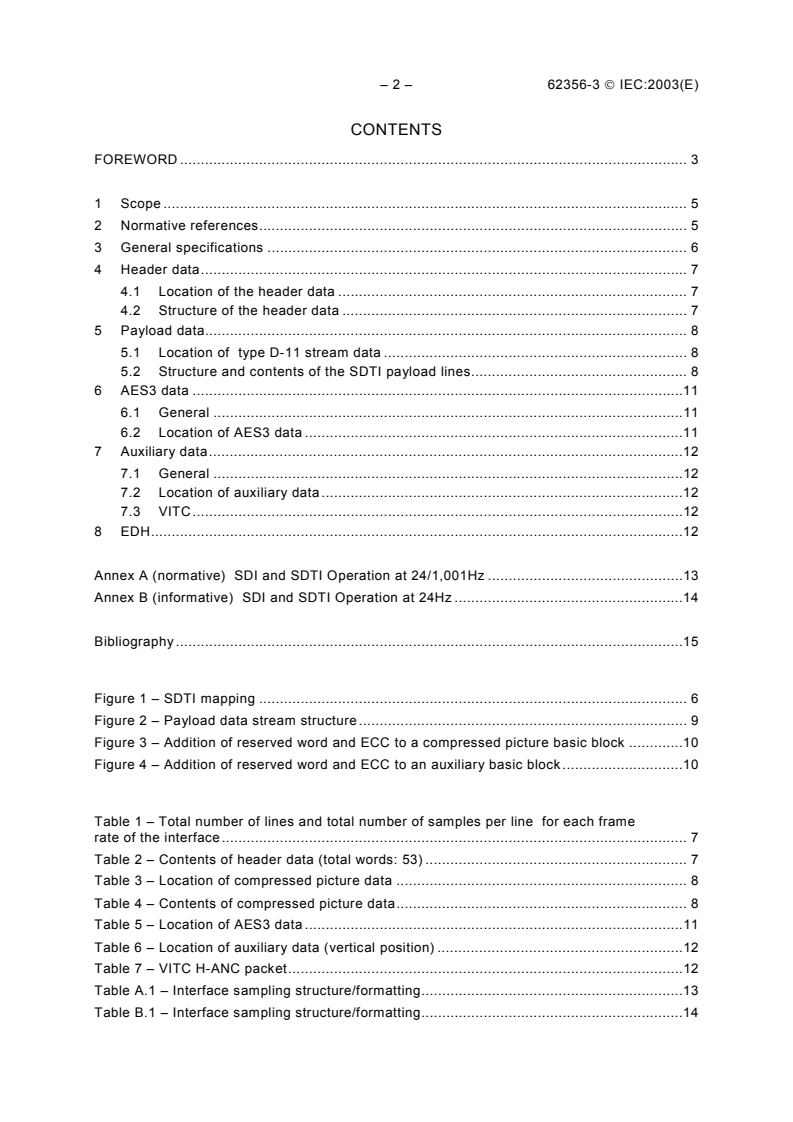
CONTENTS
FOREWORD . 3
1 Scope . 5
2 Normative references. 5
3 General specifications . 6
4 Header data. 7
4.1 Location of the header data . 7
4.2 Structure of the header data . 7
5 Payload data. 8
5.1 Location of type D-11 stream data . 8
5.2 Structure and contents of the SDTI payload lines. 8
6 AES3 data .11
6.1 General .11
6.2 Location of AES3 data .11
7 Auxiliary data.12
7.1 General .12
7.2 Location of auxiliary data.12
7.3 VITC.12
8 EDH.12
Annex A (normative) SDI and SDTI Operation at 24/1,001Hz .13
Annex B (informative) SDI and SDTI Operation at 24Hz .14
Bibliography.15
Figure 1 – SDTI mapping . 6
Figure 2 – Payload data stream structure . 9
Figure 3 – Addition of reserved word and ECC to a compressed picture basic block .10
Figure 4 – Addition of reserved word and ECC to an auxiliary basic block .10
Table 1 – Total number of lines and total number of samples per line for each frame
rate of the interface. 7
Table 2 – Contents of header data (total words: 53) . 7
Table 3 – Location of compressed picture data . 8
Table 4 – Contents of compressed picture data. 8
Table 5 – Location of AES3 data .11
Table 6 – Location of auxiliary data (vertical position) .12
Table 7 – VITC H-ANC packet.12
Table A.1 – Interface sampling structure/formatting.13
Table B.1 – Interface sampling structure/formatting.14
62356-3 IEC:2003(E) – 3 –
INTERNATIONAL ELECTROTECHNICAL COMMISSION
____________
VIDEO RECORDING – 12,65 mm TYPE D-11 FORMAT −−−−
Part 3: Data mapping over SDTI
FOREWORD
1) The International Electrotechnical Commission (IEC) is a worldwide organization for standardization comprising
all national electrotechnical committees (IEC National Committees). The object of IEC is to promote
international co-operation on all questions concerning standardization in the electrical and electronic fields. To
this end and in addition to other activities, IEC publishes International Standards, Technical Specifications,
Technical Reports, Publicly Available Specifications (PAS) and Guides (hereafter referred to as “IEC
Publication(s)”). Their preparation is entrusted to technical committees; any IEC National Committee interested
in the subject dealt with may participate in this preparatory work. International, governmental and non-
governmental organizations liaising with the IEC also participate in this preparation. IEC collaborates closely
with the International Organization for Standardization (ISO) in accordance with conditions determined by
agreement between the two organizations.
2) The formal decisions or agreements of IEC on technical matters express, as nearly as possible, an international
consensus of opinion on the relevant subjects since each technical committee has representation from all
interested IEC National Committees.
3) IEC Publications have the form of recommendations for international use and are accepted by IEC National
Committees in that sense. While all reasonable efforts are made to ensure that the technical content of IEC
Publications is accurate, IEC cannot be held responsible for the way in which they are used or for any
misinterpretation by any end user.
4) In order to promote international uniformity, IEC National Committees undertake to apply IEC Publications
transparently to the maximum extent possible in their national and regional publications. Any divergence
between any IEC Publication and the corresponding national or regional publication shall be clearly indicated in
the latter.
5) IEC provides no marking procedure to indicate its approval and cannot be rendered responsible for any
equipment declared to be in conformity with an IEC Publication.
6) All users should ensure that they have the latest edition of this publication.
7) No liability shall attach to IEC or its directors, employees, servants or agents including individual experts and
members of its technical committees and IEC National Committees for any personal injury, property damage or
other damage of any nature whatsoever, whether direct or indirect, or for costs (including legal fees) and
expenses arising out of the publication, use of, or reliance upon, this IEC Publication or any other IEC
Publications.
8) Attention is drawn to the Normative references cited in this publication. Use of the referenced publications is
indispensable for the correct application of this publication.
9) Attention is drawn to the possibility that some of the elements of this IEC Publication may be the subject of
patent rights. IEC shall not be held responsible for identifying any or all such patent rights.
International Standard IEC 62356-3 has been prepared by IEC technical committee 100:
Audio, video and multimedia systems and equipment.
It was submitted to the ntional committees for voting under the Fast Track Procedure as the
following documents:
CDV Report on voting
100/631/CDV 100/701/RVC
Full information on the voting for the approval of this standard can be found in the report on
voting indicated in the above table.
This publication has been drafted in accordance with the ISO/IEC Directives, Part 2.
– 4 – 62356-3 IEC:2003(E)
The committee has decided that the contents of this publication will remain unchanged until
2008-11. At this date, the publication will be
• reconfirmed;
• withdrawn;
• replaced by a revised edition, or
• amended.
62356-3 IEC:2003(E) – 5 –
VIDEO RECORDING – 12,65 mm TYPE D-11 FORMAT −−
−−
Part 3: Data mapping over SDTI
1 Scope
This International Standard specifies the mapping of type D-11 compressed picture data
stream into the SDTI payload area (SMPTE 305.2M) together with the mapping of four
channels of AES3 data and time-code data into H-ANC packets. Type D-11 compressed
picture data-stream mapping is defined for source-coded picture rates of 24/1,001/P,24/P,
25/P, 50-I, 30/1,001/P and 60/1,001. For the transmission of compressed picture data coded
at source picture rates of 25/P and 50/I, the SDTI interface operates at a frame rate of 25 Hz.
For the transmission of compressed picture data coded at source picture rates of 30/1,001P
and 60/1,001I, the SDTI interface operates at a frame rate of 30/1,001 Hz.
The transmission of compressed picture data coded at the source picture rates of 24/1, 001/P
and 24/P require the SDTI interface to operate at frame rates of 24/1, 001Hz and 24 Hz with
the parameters defined in Annexes A and B of this standard.
2 Normative references
The following referenced documents are indispensable for the application of this document.
For dated references, only the edition cited applies. For undated references, the latest edition
of the referenced document (including any amendments) applies.
IEC 62356-2: Video recording – 12,65 mm type D-11 format – Part 2: Picture compression
and data stream
SMPTE 259M:1997, Television – 10-Bit 4:2:2 Component and 4fsc Composite Digital signals
– Serial Digital Interface
SMPTE 272M:1994, Television – Formatting AES/EBU Audio and Auxiliary Data into Digital
Video Ancillary Data Space
SMPTE 291M:1998, Television – Ancillary Data Packet and Space Formatting
SMPTE 305.2M:2000, Television – Serial Data Transport Interface (SDTI)
SMPTE RP165:1994, Error Detection Check words and Status Flags for Use in Bit-Serial
Digital Interfaces for Television
SMPTE RP188:1999, Transmission of Time Code and Control Code in the Ancillary Data
Space of a Digital Television Data Stream
AES3:1992, Serial transmission format for two-channel linearly represented digital audio data
___________
To be published.
– 6 – 62356-3 IEC:2003(E)
3 General specifications
This standard specifies the mapping of type D-11 data stream packets over SMPTE 305.2M
(SDTI). Type D-11 data stream comprises packets of basic blocks containing compressed
pic
...
IEC 62356-3 ®
Edition 1.0 2003-11
INTERNATIONAL
STANDARD
NORME
INTERNATIONALE
Video recording – 12,65 mm type D-11 format –
Part 3: Data mapping over SDTI
Enregistrement vidéo – Format de type D-11 12,65 mm –
Partie 3: Mappage de données à travers l'interface de transport de données
série (SDTI)
All rights reserved. Unless otherwise specified, no part of this publication may be reproduced or utilized in any form
or by any means, electronic or mechanical, including photocopying and microfilm, without permission in writing from
either IEC or IEC's member National Committee in the country of the requester.
If you have any questions about IEC copyright or have an enquiry about obtaining additional rights to this publication,
please contact the address below or your local IEC member National Committee for further information.
Droits de reproduction réservés. Sauf indication contraire, aucune partie de cette publication ne peut être reproduite ni
utilisée sous quelque forme que ce soit et par aucun procédé, électronique ou mécanique, y compris la photocopie et les
microfilms, sans l'accord écrit de la CEI ou du Comité national de la CEI du pays du demandeur.
Si vous avez des questions sur le copyright de la CEI ou si vous désirez obtenir des droits supplémentaires sur cette
publication, utilisez les coordonnées ci-après ou contactez le Comité national de la CEI de votre pays de résidence.
IEC Central Office Tel.: +41 22 919 02 11
3, rue de Varembé Fax: +41 22 919 03 00
CH-1211 Geneva 20 info@iec.ch
Switzerland www.iec.ch
About the IEC
The International Electrotechnical Commission (IEC) is the leading global organization that prepares and publishes
International Standards for all electrical, electronic and related technologies.
About IEC publications
The technical content of IEC publications is kept under constant review by the IEC. Please make sure that you have the
latest edition, a corrigenda or an amendment might have been published.
Useful links:
IEC publications search - www.iec.ch/searchpub Electropedia - www.electropedia.org
The advanced search enables you to find IEC publications The world's leading online dictionary of electronic and
by a variety of criteria (reference number, text, technical electrical terms containing more than 30 000 terms and
committee,…). definitions in English and French, with equivalent terms in
It also gives information on projects, replaced and additional languages. Also known as the International
withdrawn publications. Electrotechnical Vocabulary (IEV) on-line.
IEC Just Published - webstore.iec.ch/justpublished Customer Service Centre - webstore.iec.ch/csc
Stay up to date on all new IEC publications. Just Published If you wish to give us your feedback on this publication
details all new publications released. Available on-line and or need further assistance, please contact the
also once a month by email. Customer Service Centre: csc@iec.ch.
A propos de la CEI
La Commission Electrotechnique Internationale (CEI) est la première organisation mondiale qui élabore et publie des
Normes internationales pour tout ce qui a trait à l'électricité, à l'électronique et aux technologies apparentées.
A propos des publications CEI
Le contenu technique des publications de la CEI est constamment revu. Veuillez vous assurer que vous possédez
l’édition la plus récente, un corrigendum ou amendement peut avoir été publié.
Liens utiles:
Recherche de publications CEI - www.iec.ch/searchpub Electropedia - www.electropedia.org
La recherche avancée vous permet de trouver des Le premier dictionnaire en ligne au monde de termes
publications CEI en utilisant différents critères (numéro de électroniques et électriques. Il contient plus de 30 000
référence, texte, comité d’études,…). termes et définitions en anglais et en français, ainsi que
Elle donne aussi des informations sur les projets et les les termes équivalents dans les langues additionnelles.
publications remplacées ou retirées. Egalement appelé Vocabulaire Electrotechnique
International (VEI) en ligne.
Just Published CEI - webstore.iec.ch/justpublished
Service Clients - webstore.iec.ch/csc
Restez informé sur les nouvelles publications de la CEI.
Just Published détaille les nouvelles publications parues. Si vous désirez nous donner des commentaires sur
Disponible en ligne et aussi une fois par mois par email. cette publication ou si vous avez des questions
contactez-nous: csc@iec.ch.
IEC 62356-3 ®
Edition 1.0 2003-11
INTERNATIONAL
STANDARD
NORME
INTERNATIONALE
Video recording – 12,65 mm type D-11 format –
Part 3: Data mapping over SDTI
Enregistrement vidéo – Format de type D-11 12,65 mm –
Partie 3: Mappage de données à travers l'interface de transport de données
série (SDTI)
INTERNATIONAL
ELECTROTECHNICAL
COMMISSION
COMMISSION
ELECTROTECHNIQUE
PRICE CODE
INTERNATIONALE
CODE PRIX P
ICS 33.160.40 ISBN 978-2-83220-368-2
– 2 – 62356-3 IEC:2003
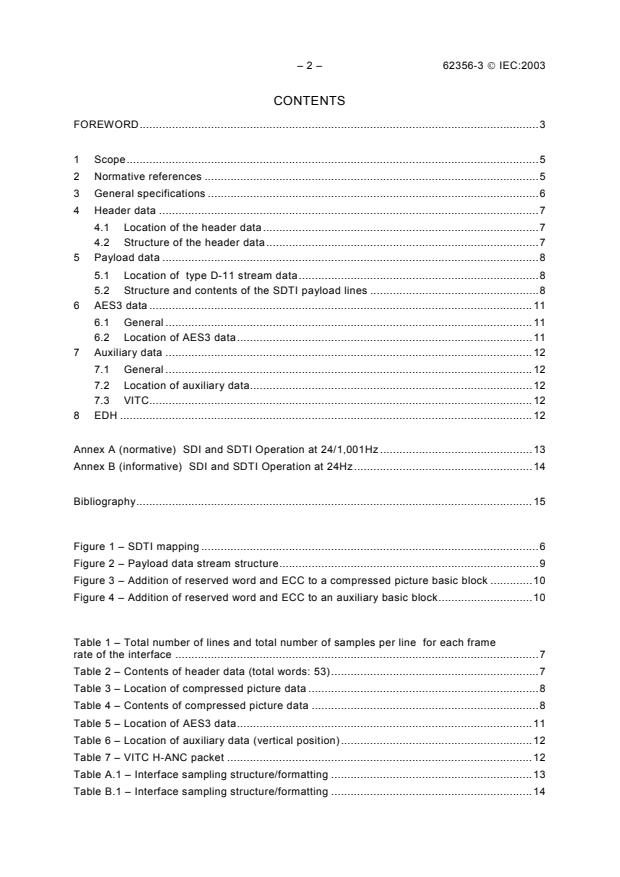
CONTENTS
FOREWORD . 3
1 Scope . 5
2 Normative references . 5
3 General specifications . 6
4 Header data . 7
4.1 Location of the header data . 7
4.2 Structure of the header data . 7
5 Payload data . 8
5.1 Location of type D-11 stream data . 8
5.2 Structure and contents of the SDTI payload lines . 8
6 AES3 data . 11
6.1 General . 11
6.2 Location of AES3 data . 11
7 Auxiliary data . 12
7.1 General . 12
7.2 Location of auxiliary data. 12
7.3 VITC. 12
8 EDH . 12
Annex A (normative) SDI and SDTI Operation at 24/1,001Hz . 13
Annex B (informative) SDI and SDTI Operation at 24Hz . 14
Bibliography . 15
Figure 1 – SDTI mapping . 6
Figure 2 – Payload data stream structure . 9
Figure 3 – Addition of reserved word and ECC to a compressed picture basic block . 10
Figure 4 – Addition of reserved word and ECC to an auxiliary basic block . 10
Table 1 – Total number of lines and total number of samples per line for each frame
rate of the interface . 7
Table 2 – Contents of header data (total words: 53) . 7
Table 3 – Location of compressed picture data . 8
Table 4 – Contents of compressed picture data . 8
Table 5 – Location of AES3 data . 11
Table 6 – Location of auxiliary data (vertical position) . 12
Table 7 – VITC H-ANC packet . 12
Table A.1 – Interface sampling structure/formatting . 13
Table B.1 – Interface sampling structure/formatting . 14
62356-3 IEC:2003 – 3 –
INTERNATIONAL ELECTROTECHNICAL COMMISSION
____________
VIDEO RECORDING – 12,65 mm TYPE D-11 FORMAT –
Part 3: Data mapping over SDTI
FOREWORD
1) The International Electrotechnical Commission (IEC) is a worldwide organization for standardization comprising
all national electrotechnical committees (IEC National Committees). The object of IEC is to promote
international co-operation on all questions concerning standardization in the electrical and electronic fields. To
this end and in addition to other activities, IEC publishes International Standards, Technical Specifications,
Technical Reports, Publicly Available Specifications (PAS) and Guides (hereafter referred to as “IEC
Publication(s)”). Their preparation is entrusted to technical committees; any IEC National Committee interested
in the subject dealt with may participate in this preparatory work. International, governmental and non-
governmental organizations liaising with the IEC also participate in this preparation. IEC collaborates closely
with the International Organization for Standardization (ISO) in accordance with conditions determined by
agreement between the two organizations.
2) The formal decisions or agreements of IEC on technical matters express, as nearly as possible, an international
consensus of opinion on the relevant subjects since each technical committee has representation from all
interested IEC National Committees.
3) IEC Publications have the form of recommendations for international use and are accepted by IEC National
Committees in that sense. While all reasonable efforts are made to ensure that the technical content of IEC
Publications is accurate, IEC cannot be held responsible for the way in which they are used or for any
misinterpretation by any end user.
4) In order to promote international uniformity, IEC National Committees undertake to apply IEC Publications
transparently to the maximum extent possible in their national and regional publications. Any divergence
between any IEC Publication and the corresponding national or regional publication shall be clearly indicated in
the latter.
5) IEC provides no marking procedure to indicate its approval and cannot be rendered responsible for any
equipment declared to be in conformity with an IEC Publication.
6) All users should ensure that they have the latest edition of this publication.
7) No liability shall attach to IEC or its directors, employees, servants or agents including individual experts and
members of its technical committees and IEC National Committees for any personal injury, property damage or
other damage of any nature whatsoever, whether direct or indirect, or for costs (including legal fees) and
expenses arising out of the publication, use of, or reliance upon, this IEC Publication or any other IEC
Publications.
8) Attention is drawn to the Normative references cited in this publication. Use of the referenced publications is
indispensable for the correct application of this publication.
9) Attention is drawn to the possibility that some of the elements of this IEC Publication may be the subject of
patent rights. IEC shall not be held responsible for identifying any or all such patent rights.
International Standard IEC 62356-3 has been prepared by IEC technical committee 100:
Audio, video and multimedia systems and equipment.
This bilingual version (2012-11) corresponds to the monolingual English version, published in
2003-11.
It was submitted to the national committees for voting under the Fast Track Procedure as the
following documents:
CDV Report on voting
100/631/CDV 100/701/RVC
Full information on the voting for the approval of this standard can be found in the report on
voting indicated in the above table.
The French version of this standard has not been voted upon.
– 4 – 62356-3 IEC:2003
This publication has been drafted in accordance with the ISO/IEC Directives, Part 2.
The committee has decided that the contents of this publication will remain unchanged until
2008-11. At this date, the publication will be
• reconfirmed;
• withdrawn;
• replaced by a revised edition, or
• amended.
62356-3 IEC:2003 – 5 –
VIDEO RECORDING – 12,65 mm TYPE D-11 FORMAT –
Part 3: Data mapping over SDTI
1 Scope
This International Standard specifies the mapping of type D-11 compressed picture data
stream into the SDTI payload area (SMPTE 305.2M) together with the mapping of four
channels of AES3 data and time-code data into H-ANC packets. Type D-11 compressed
picture data-stream mapping is defined for source-coded picture rates of 24/1,001/P, 24/P,
25/P, 50-I, 30/1,001/P and 60/1,001. For the transmission of compressed picture data coded
at source picture rates of 25/P and 50/I, the SDTI interface operates at a frame rate of 25 Hz.
For the transmission of compressed picture data coded at source picture rates of 30/1,001P
and 60/1,001I, the SDTI interface operates at a frame rate of 30/1,001 Hz.
The transmission of compressed picture data coded at the source picture rates of 24/1, 001/P
and 24/P require the SDTI interface to operate at frame rates of 24/1, 001Hz and 24 Hz with
the parameters defined in Annexes A and B of this standard.
2 Normative references
The following referenced documents are indispensable for the application of this document.
For dated references, only the edition cited applies. For undated references, the latest edition
of the referenced document (including any amendments) applies.
IEC 62356-2: Video recording – 12,65 mm type D-11 format – Part 2: Picture compression
and data stream
SMPTE 259M:1997, Television – 10-Bit 4:2:2 Component and 4fsc Composite Digital signals
– Serial Digital Interface
SMPTE 272M:1994, Television – Formatting AES/EBU Audio and Auxiliary Data into Digital
Video Ancillary Data Space
SMPTE 291M:1998, Television – Ancillary Data Packet and Space Formatting
SMPTE 305.2M:2000, Television – Serial Data Transport Interface (SDTI)
SMPTE RP165:1994, Error Detection Check words and Status Flags for Use in Bit-Serial
Digital Interfaces for Television
SMPTE RP188:1999, Transmission of Time Code and Control Code in the Ancillary Data
Space of a Digital Television Data Stream
AES3:1992, Serial transmission format for two-channel linearly represented digital audio data
___________
To be published.
– 6 – 62356-3 IEC:2003
3 General specifications
This standard specifies the mapping of type D-11 data stream packets over SMPTE 305.2M
(SDTI). Type D-11 data stream comprises packets of basic blocks containing compressed
picture data and auxiliary picture data as specified in IEC 62356-2.
Four channels of 24-bit AES3 data are optionally mapped into the H-ANC space of the
interface according to SMPTE 272M. In addition, VITC may also be mapped into the H-ANC
space.
Type D-11 data-stream packets are grouped into six equal data segments of which the first
three data segments are mapped onto the first field of the SDTI and the last three data
segments are mapped onto the second field of the SDTI, as shown in Figure 1 and Table 1.
Figure 1 also includes the optional four channels of 24-bit AES3 data mapped into the H-ANC
space. VITC data may also be mapped into the H-ANC space.
Header
EAV data Audio data
1440 1444 SAV
1497-1609 (625)
-1443 -1496 1497-1637 (525)
Switchingpoint area
Auxiliary
First field
data
E
S
Compressed picture data
A
A
V
V
Switchingpoint area
Auxiliary
Second field
data
E S
A A
Compressed picture data
V V
Figure 1 – SDTI mapping
62356-3 IEC:2003 – 7 –
Table 1 – Total number of lines and total number of samples per line
for each frame rate of the interface
Frame rate of the interface 24/1,001Hz 24Hz 25Hz 30/1,001Hz
Total number of lines 525 625 625 525
Total number of samples per line 2 145 1 800 1 728 1 716
NOTE The 24/1,001 Hz and 24 Hz interface details are contained in Annexes A and B.
4 Header data
4.1 Location of the header data
Header data shall be placed in H-ANC space and shall be located immediately following the
EAV as shown in Figure 1 and as defined by SMPTE 305.2M.
4.2 Structure of the header data
The structure of the header data shall conform to SMPTE 305.2M and the contents shall be as
shown in Table 2.
Table 2 – Contents of header data (total words: 53)
Word No. Data name Value Comment
0 ADF 000h
1 ADF 3FFh
2 ADF 3FFh
3 DID 140h
4 SDID 101h
5 Data count 22Eh Data: 46 words
6 Line No.0 XXX
7 Line No.1 XXX
8 Line No. CRC 0 XXX
9 Line No. CRC 1 XXX
10 CODE & AAI 101h Payload: 1440 words, AAI: Unspecified
11 – 26 Destination address 200h
27 – 42 Source address 200h
43 Block type 241h Fixed block size with ECC: 1438 words
44 CRC flag 101h Payload CRC
45 Reserved 0 XXX
46 Reserved 1 XXX
47 Reserved 2 XXX
48 Reserved 3 XXX
49 Reserved 4 XXX
50 Header CRC 0 XXX
51 Header CRC 1 XXX
52 Check sum XXX
– 8 – 62356-3 IEC:2003
5 Payload data
5.1 Location of type D-11 stream data
Type D-11 data-stream packets (comprising compressed picture and auxiliary data) shall be
mapped into the payload space of the SDTI and shall be located as defined in Table 3 and
shown in Figure 1.
Table 3 – Location of compressed picture data
SDTI frame rate 24/1,001 Hz and 30/1,001
24 Hz and 25 Hz
Hz
Total number of interface lines 525 625
Horizontal mapping location Samples 0 to 1 439
Vertical mapping location
First field Lines 50 to 261 Lines 59 to 270
Second field Lines 313 to 524 Lines 372 to 583
NOTE The line numbering of the vertical mapping location is the same as that defined in SMPTE 259M.
Each compressed picture data stream is divided into six equal segments, numbered 0 to 5, as
defined in IEC 62356-2.
All the packets from segments 0 to 2 shall be mapped into the first field of the SDTI. All the
packets from segments 3 to 5 shall be mapped into the second field of the SDTI.
Figure 2 defines how the data packets are mapped into each field of the SDTI.
5.2 Structure and contents of the SDTI payload lines
5.2.1 Payload line formatting
The SDTI payload lines shall contain the information defined in Table 4 and Figure 2.
Table 4 – Contents of compressed picture data
Word No. Data name Value Comment
0 Data type 248h Data type of type D-11
1 User data 200h Valid data not exist
or 1FEh Valid data start line
or 1FDh Valid data line
2 to 1 437 User data XXX Type D-11 compressed picture data
1 438 Payload CRC 0 XXX
1 439 Payload CRC 1 XXX
62356-3 IEC:2003 – 9 –
Compressed picture data Basic block
= 224 W x 678 x 2/Field BID Even data RVD ECC
2 W 217 W 1 W 4 W
Even data 678 Even data/field
1 sync = 224 W 8 bit … …
Basic block
BID Odd data RVD ECC
2 W 217 W 1 W 4 W
Odd data 678 Odd data/field
1 sync = 224 W 8 bit … …
Multiplexed odd and even b9: Compliment of b8
2 bit
1 packet (= 2 sync) b8: Parity for b0–b7
= 448 W
8 bit …
Payload data 1436 W x 212 lines
1st line … …
2 W 1 packet = 448 W 2 W
Payload = 1440 W
2nd line … …
212th line … … … … … … … … …
Figure 2 – Payload data-stream structure
For each field of the SDTI, 1 356 basic blocks of type D-11 compressed picture data shall be
mapped into the SDTI payload area on contiguous lines. In each SDTI field, 678 odd and 678
even data blocks are respectively selected from channel 0 and channel 1 as specified in IEC
62356-2.
5.2.2 Basic block formatting
The compressed picture and auxiliary basic block format of type D-11 compressed data shall
conform to IEC 62356-2.
For the purpose of transporting the basic blocks over SDTI, four bytes of Reed-Solomon ECC
shall be added to each basic block. Between the end of each basic block and the start of the
ECC a 1-byte reserved word shall be added.
The default value of the reserved word is zero.
SAV 3FF SAV 3FF SAV 3FF
SAV 000 SAV 000 SAV 000
SAV 000 SAV 000 SAV 000
SAV XYZ SAV XYZ SAV XYZ
Type 248 Type 248 Type 248 E BID O BID E BID
0 0 0
FLAG1FD FLAG1FD FLAG1FE O BID O BID E BID
0 0 1
E D44 E BID E BID O D0 E D0
0 1
O D44 O BID O BID O D1 E D1
0 1
E D45 E BID E D0 O D2 E D2
O D45 O BID O D0
E D0 E D1
E ECC O D0 O D1 O D216 E D216
E ECC O ECC E D2 RVD RVD
O ECC E BID E ECC O D2 O ECC E ECC
E ECC O BID O ECC O ECC E ECC
O ECC E BID E BID E D216 O ECC E ECC
1 0
00h O BID O BID O D216 O ECC E ECC
1 0
00h E D0 E BID RVD
00h O D0 O BID RVD
00h E D0 E ECC
E D87 O D0 O ECC
O D87 E ECC
E D88 E D42 O ECC
00h O D88 OD42 E ECC
00h E D89 E D43 O ECC
00h O D89 OD43 E ECC
CRC0 CRC0 CRC0 O ECC
CRC1 CRC1 CRC1
EAV 3FF EAV 3FF EAV 3FF
EAV 000 EAV 000 EAV 000
EAV 000 EAV 000 EAV 000
EAV XYZ EAV XYZ EAV XYZ
– 10 – 62356-3 IEC:2003
Figure 3 illustrates the addition of the reserved word and the 4-byte RS ECC to a compressed
picture basic block.
224 W
219 W
1 1 1 162 54 1 4
BID BID B B B B B B
K K
8 bit HD RVD
0 1 215 214 54 53 1 0 3 0
Luminance Chrominance ECC
ECC calculation range
Figure 3 – Addition of reserved word and ECC to a compressed picture basic block
Figure 4 illustrates the addition of the reserved word and the 4-byte RS ECC to an auxiliary
basic block
224 W
219 W
1 63 154 1 4
BID
K K
8 bit Auxiliary Data RVD
0 BID 3 0
Reserved
ECC
ECC calculation range
Figure 4 – Addition of reserved word and ECC to an auxiliary basic block
5.2.3 Error correction code (Reed-Solomon ECC)
Four words of Reed-Solomon ECC shall be added immediately after the reserved word (RVD).
The field generator polynomial of Reed-Solomon (RS) Error Correction Code shall be as
follows:
Galois Field: GF(256)
8 4 3 2
Field generator polynomial: X + X + X + X + 1
i
where X are place-keeping variables in GF(2), the binary field. Note that the ‘+’ sign for this
and the following equations indicates modulo 256 addition.
62356-3 IEC:2003 – 11 –
The code generator polynomial (GF(256)) is defined as:
2 3
G(X) = (X+1)(X+α)(X+α )(X+α )
where α is given by 02 in GF(256).
h
The RS check characters are defined as K K K K in
3, 2, 1, 0
3 2 1
K(X) = K X + K X + K X + K ,
3 2 1 0
obtained as the remainder after dividing polynomial X D(X) by G(X),
where K is shown in Figures 3 and 4, and D(X) is the polynomial given by the following
i
equation:
219 218 217 216 215 2 1
D(X) = BID X + BID X + HD X +B X + B X + . + B X + B X + RVD
0 1 215 214 1 0
The equation of the full RS ECC code block ( C(X) ) is expressed as follows:
C(X)= X D(X) + K(X)
6 AES3 data
6.1 General
AES 3 data, if present, shall contain four audio channels in a single group and conform to the
following mapping parameters.
6.2 Location of AES3 data
Mapping of AES3 data onto the serial digital interface shall comply with SMPTE 272M-C.
AES3 data comprises 24-bit words. The contents of the AES3 data stream is not part of this
standard.
Table 5 – Location of AES3 Data
Frame rate 24/1,001 Hz and 30/1,001 24 Hz and 25 Hz
Hz
Total number of lines of the interface 525 625
Samples Samples
Horizontal sample count
1 497 to 1 637 1 497 to 1 609
Lines 1 to 525 Lines 1 to 625
except for except for
Mapping of AES3 data
lines 10, 11, lines 6, 7,
273 and 274 319 and 320
NOTE This standard does not support the optional audio control data defined in SMPTE 272M.
– 12 – 62356-3 IEC:2003
7 Auxiliary data
7.1 General
Auxiliary data packet may be used to map time code data (VITC). If present, the mapping
shall comply with the following parameters.
7.2 Location of auxiliary data
Auxiliary data shall be located in the H-ANC space immediately following the extended data
packet. The vertical position of each auxiliary data line shall be as shown in Table 6. The
structure and location of the H-ANC auxiliary data packets shall conform to SMPTE 291M.
Table 6 – Location of auxiliary data (vertical position)
Frame rate 24/1,001 Hz and 30/1,001 Hz 24 Hz and 25 Hz
Total lines 525 625
VITC Line 14 and 277 Lines 10 and 323
.
7.3 VITC
If present, mapping of VITC data on to the serial digital interface shall comply with SMPTE
RP188 and shall be as specified in Table 7.
This VITC data shall have the same time-code value as the VITC carried in the auxiliary data
packets of IEC 62356-2.
Table 7 – VITC H-ANC packet
Word No. Name Value Comment
0 – 2 ADF 000h
3FFh
3FFh
3 DID 260h
4 DBN 260h
5 Data count 110h
6 – 21 UDW 0-15 XXX
22 Checksum XXX
8 EDH
EDH checkwords may be added in H-ANC space and be located as defined by SMPTE RP165.
62356-3 IEC:2003 – 13 –
Annex A
(normative)
SDI and SDTI Operation at 24/1,001Hz
A.1 Scope
The scope of this annex is to provide information and specifications for an interface based on
SMPTE 259M and SMPTE 305.2M using a frame rate of 24/1,001 frames/s.
A.2 General
Based upon the introduction of 1 920 × 1 080 television equipment having a progressive
capture frame rate of 24/1,001 frames/s, there is a need to define an interface for transporting
and monitoring of the compressed signal over SDTI.
For the transporting of compressed signals coded at a source picture rate of 24/1,001
frames/s and formatted according to IEC 62356-2, the SDTI interface shall operate at
24/1,001 frames/s, interlaced, with parameters as defined in Table A.1.
Table A.1 – Interface sampling structure/formatting
Parameter Value Comments
Frame rate 24/1,001 Per second
Total number of lines 525 (As per SMPTE 125M)
EAV/SAV structure 3FF,000,000,XYZ As per SMPTE 125M/259M
Signal levels As per SMPTE 259M
Serial bit rate 270Mb/s
Total number of words per line 2 145
User data words 1 440 (As per SMPTE 305.2M)
Ancillary data words 697 Total line length minus user data and EAV/SAV words
AES3 data formatting 1 497 – 1 637 (As per SMPTE 272M)
Auxiliary data formatting (As per SMPTE 291M/RP188)
EDH (As per SMPTE RP 165)
Switching Line 10 As this is a segmented frame payload, switching must only
be on the frame boundary
Compressed picture data mapping Lines 50 – 261 Segments 0 to 2
Lines 313 – 524 Segments 3 to 5
Auxiliary data 1 638 – 2 141 The auxiliary data space of this format is greater than
SMPTE 259M
– 14 – 62356-3 IEC:2003
Annex B
(informative)
SDI and SDTI Operation at 24 Hz
B.1 Scope
The scope of this annex is to provide information and specifications for an interface based on
SMPTE 259M and SMPTE 305.2M using a frame rate of 24 frames/s.
B.2 General
Based upon the introduction of 1 920 × 1 080 television equipment having a progressive
capture frame rate of 24,00 frames/s, there is a need to define an interface for transporting
and monitoring of the compressed signal over SDTI.
For the transporting of compressed signals coded at a source picture rate of 24 frames/s and
formatted according to IEC 62356-2, the SDTI interface should operate at 24 frames/s,
interlaced, with parameters as defined in Table B.1.
Table B.1 – Interface sampling structure/formatting
Parameter Value Comments
Frame rate 24 Per second
Total number of lines 625 (As per SMPTE 125M)
EAV/SAV structure 3FF,000,000,XYZ As per SMPTE 125M/259M
Signal levels As per SMPTE 259M
Serial bit rate 270Mb/s
Total number of words per line 1 800
User data words 1 440 (As per SMPTE 305M)
Ancillary data words 352 Total line length minus user data and EAV/SAV words
AES3 data formatting 1 497 – 1 609 (As per SMPTE 272M)
Auxiliary data formatting (As per SMPTE 291M/RP188)
EDH (As per SMPTE RP 165)
Switching Line 10 As this is a segmented frame interface, switching must
only be on the frame boundary
Compressed picture data mapping Lines 50 – 261 Segments 0 to 2
Lines 313 – 524 Segments 3 to 5
Auxiliary data 1 610 – 1 796 The auxiliary data space of this format is greater than
SMPTE 259M
62356-3 IEC:2003 – 15 –
Bibliography
SMPTE 125M:1995, Television – Component Video Signal 4:2:2 – Bit-Parallel Interface
SMPTE 12M:1999, Television – Audio a
...