

IEC 61069-5:2016
(Main)Industrial-process measurement, control and automation - Evaluation of system properties for the purpose of system assessment - Part 5: Assessment of system dependability
General Information
- Abstract
IEC 61069-5:2016 specifies the detailed method of the assessment of dependability of a basic control system (BCS) based on the basic concepts of IEC 61069-1 and methodology of IEC 61069-2, defines basic categorization of dependability properties, describes the factors that influence dependability and which need to be taken into account when evaluating dependability, and provides guidance in selecting techniques from a set of options (with references) for evaluating the dependability. This second edition cancels and replaces the first edition published in 1994. This edition constitutes a technical revision. This edition includes the following significant technical changes with respect to the previous edition:
- reorganization of the material of IEC 61069-5:1994 to make the overall set of standards more organized and consistent;
- IEC TS 62603-1 has been incorporated into this edition.
- Status
- Published
- Publication Date
- 14-Jun-2016
- Technical Committee
- SC 65A - System aspects
- Drafting Committee
- WG 16 - TC 65/SC 65A/WG 16
- Current Stage
- PPUB - Publication issued
- Start Date
- 15-Jun-2016
- Completion Date
- 15-Jul-2016
Buy Documents
IEC 61069-5:2016 - Industrial-process measurement, control and automation - Evaluation of system properties for the purpose of system assessment - Part 5: Assessment of system dependability Released:6/15/2016
Overview
IEC 61069-5:2016 is an international standard developed by the International Electrotechnical Commission (IEC) that focuses on the assessment of system dependability within industrial-process measurement, control, and automation systems. It provides a detailed methodology for evaluating the dependability of Basic Control Systems (BCS), building on foundational concepts from IEC 61069-1 and IEC 61069-2.
Originally published in 1994, the 2016 edition reorganizes and updates the content to enhance consistency and integrate the technical specifications from IEC TS 62603-1. This standard is essential for stakeholders seeking to ensure robust, reliable, and secure control systems in industrial environments.
Key Topics
IEC 61069-5:2016 addresses critical dependability properties necessary for system evaluation, including:
- Availability – The degree to which a system is operational and accessible when required.
- Reliability – The probability that the system performs without failure over a specific period.
- Maintainability – How easily and quickly a system can be restored after a failure.
- Credibility – The trustworthiness of the system to perform under expected conditions.
- Security – Protection against unauthorized access and threats, including cyber and physical aspects.
- Integrity – Maintaining data and functional correctness, with features such as input validation, fault tolerance, and monitoring.
The standard defines factors influencing these dependability aspects and guides the selection of appropriate evaluation techniques, including:
- Analytical methods: Inductive, deductive, and predictive assessments.
- Empirical methods: Fault-injection tests and environmental perturbation trials.
Supplementary annexes provide checklists, assessment item examples, security considerations, recommended failure rate databases, and credibility test methodologies.
Applications
IEC 61069-5:2016 is vital for companies and engineers involved in:
- Designing and implementing industrial control systems for manufacturing, energy, chemical, and process industries.
- Assessing system dependability during the design phase to reduce downtime and enhance reliability.
- Conducting system audits and validation to comply with international safety and quality requirements.
- Improving maintainability and fault tolerance to optimize operational efficiency.
- Enhancing cybersecurity and physical security measures in control and automation environments.
- Supporting risk management and decision-making for automation system investments.
By applying IEC 61069-5, organizations ensure that control systems meet rigorous dependability criteria, which helps minimize operational risks and supports regulatory compliance.
Related Standards
- IEC 61069-1 – Provides the basic concepts for system property evaluation in industrial-process control systems.
- IEC 61069-2 – Describes methods of evaluation relevant to system assessment.
- IEC TS 62603-1 – Offers technical specifications related to system dependability, now incorporated into IEC 61069-5.
- IEC 61508 – Functional safety standard for electrical/electronic safety-related systems.
- ISO/IEC 27001 – Information security management applicable to control systems cybersecurity.
Keywords: IEC 61069-5, system dependability, basic control system, industrial automation standards, system reliability, availability, maintainability, cybersecurity, fault tolerance, industrial process control, IEC standards.
Buy Documents
IEC 61069-5:2016 - Industrial-process measurement, control and automation - Evaluation of system properties for the purpose of system assessment - Part 5: Assessment of system dependability Released:6/15/2016
Get Certified
Connect with accredited certification bodies for this standard

DVS-ZERT GmbH
German welding certification society.
CARES (UK Certification Authority for Reinforcing Steels)
UK certification for reinforcing steels and construction.
EWF/IIW (European/International Welding Federation)
International welding personnel certification.
Sponsored listings
Frequently Asked Questions
IEC 61069-5:2016 is a standard published by the International Electrotechnical Commission (IEC). Its full title is "Industrial-process measurement, control and automation - Evaluation of system properties for the purpose of system assessment - Part 5: Assessment of system dependability". This standard covers: IEC 61069-5:2016 specifies the detailed method of the assessment of dependability of a basic control system (BCS) based on the basic concepts of IEC 61069-1 and methodology of IEC 61069-2, defines basic categorization of dependability properties, describes the factors that influence dependability and which need to be taken into account when evaluating dependability, and provides guidance in selecting techniques from a set of options (with references) for evaluating the dependability. This second edition cancels and replaces the first edition published in 1994. This edition constitutes a technical revision. This edition includes the following significant technical changes with respect to the previous edition: - reorganization of the material of IEC 61069-5:1994 to make the overall set of standards more organized and consistent; - IEC TS 62603-1 has been incorporated into this edition.
IEC 61069-5:2016 specifies the detailed method of the assessment of dependability of a basic control system (BCS) based on the basic concepts of IEC 61069-1 and methodology of IEC 61069-2, defines basic categorization of dependability properties, describes the factors that influence dependability and which need to be taken into account when evaluating dependability, and provides guidance in selecting techniques from a set of options (with references) for evaluating the dependability. This second edition cancels and replaces the first edition published in 1994. This edition constitutes a technical revision. This edition includes the following significant technical changes with respect to the previous edition: - reorganization of the material of IEC 61069-5:1994 to make the overall set of standards more organized and consistent; - IEC TS 62603-1 has been incorporated into this edition.
IEC 61069-5:2016 is classified under the following ICS (International Classification for Standards) categories: 25.040.40 - Industrial process measurement and control; 31.080.01 - Semiconductor devices in general. The ICS classification helps identify the subject area and facilitates finding related standards.
IEC 61069-5:2016 is available in PDF format for immediate download after purchase. The document can be added to your cart and obtained through the secure checkout process. Digital delivery ensures instant access to the complete standard document.
Standards Content (Sample)
IEC 61069-5 ®
Edition 2.0 2016-06
INTERNATIONAL
STANDARD
NORME
INTERNATIONALE
colour
inside
Industrial-process measurement, control and automation – Evaluation of system
properties for the purpose of system assessment –
Part 5: Assessment of system dependability
Mesure, commande et automation dans les processus industriels – Appréciation
des propriétés d'un système en vue de son évaluation –
Partie 5: Évaluation de la sûreté de fonctionnement d’un système
All rights reserved. Unless otherwise specified, no part of this publication may be reproduced or utilized in any form
or by any means, electronic or mechanical, including photocopying and microfilm, without permission in writing from
either IEC or IEC's member National Committee in the country of the requester. If you have any questions about IEC
copyright or have an enquiry about obtaining additional rights to this publication, please contact the address below or
your local IEC member National Committee for further information.
Droits de reproduction réservés. Sauf indication contraire, aucune partie de cette publication ne peut être reproduite
ni utilisée sous quelque forme que ce soit et par aucun procédé, électronique ou mécanique, y compris la photocopie
et les microfilms, sans l'accord écrit de l'IEC ou du Comité national de l'IEC du pays du demandeur. Si vous avez des
questions sur le copyright de l'IEC ou si vous désirez obtenir des droits supplémentaires sur cette publication, utilisez
les coordonnées ci-après ou contactez le Comité national de l'IEC de votre pays de résidence.
IEC Central Office Tel.: +41 22 919 02 11
3, rue de Varembé Fax: +41 22 919 03 00
CH-1211 Geneva 20 info@iec.ch
Switzerland www.iec.ch
About the IEC
The International Electrotechnical Commission (IEC) is the leading global organization that prepares and publishes
International Standards for all electrical, electronic and related technologies.
About IEC publications
The technical content of IEC publications is kept under constant review by the IEC. Please make sure that you have the
latest edition, a corrigenda or an amendment might have been published.
IEC Catalogue - webstore.iec.ch/catalogue Electropedia - www.electropedia.org
The stand-alone application for consulting the entire The world's leading online dictionary of electronic and
bibliographical information on IEC International Standards, electrical terms containing 20 000 terms and definitions in
Technical Specifications, Technical Reports and other English and French, with equivalent terms in 15 additional
documents. Available for PC, Mac OS, Android Tablets and languages. Also known as the International Electrotechnical
iPad. Vocabulary (IEV) online.
IEC publications search - www.iec.ch/searchpub IEC Glossary - std.iec.ch/glossary
The advanced search enables to find IEC publications by a 65 000 electrotechnical terminology entries in English and
variety of criteria (reference number, text, technical French extracted from the Terms and Definitions clause of
committee,…). It also gives information on projects, replaced IEC publications issued since 2002. Some entries have been
and withdrawn publications. collected from earlier publications of IEC TC 37, 77, 86 and
CISPR.
IEC Just Published - webstore.iec.ch/justpublished
Stay up to date on all new IEC publications. Just Published IEC Customer Service Centre - webstore.iec.ch/csc
details all new publications released. Available online and If you wish to give us your feedback on this publication or
also once a month by email. need further assistance, please contact the Customer Service
Centre: csc@iec.ch.
A propos de l'IEC
La Commission Electrotechnique Internationale (IEC) est la première organisation mondiale qui élabore et publie des
Normes internationales pour tout ce qui a trait à l'électricité, à l'électronique et aux technologies apparentées.
A propos des publications IEC
Le contenu technique des publications IEC est constamment revu. Veuillez vous assurer que vous possédez l’édition la
plus récente, un corrigendum ou amendement peut avoir été publié.
Catalogue IEC - webstore.iec.ch/catalogue Electropedia - www.electropedia.org
Application autonome pour consulter tous les renseignements
Le premier dictionnaire en ligne de termes électroniques et
bibliographiques sur les Normes internationales,
électriques. Il contient 20 000 termes et définitions en anglais
Spécifications techniques, Rapports techniques et autres
et en français, ainsi que les termes équivalents dans 15
documents de l'IEC. Disponible pour PC, Mac OS, tablettes
langues additionnelles. Egalement appelé Vocabulaire
Android et iPad.
Electrotechnique International (IEV) en ligne.
Recherche de publications IEC - www.iec.ch/searchpub
Glossaire IEC - std.iec.ch/glossary
La recherche avancée permet de trouver des publications IEC 65 000 entrées terminologiques électrotechniques, en anglais
en utilisant différents critères (numéro de référence, texte, et en français, extraites des articles Termes et Définitions des
comité d’études,…). Elle donne aussi des informations sur les publications IEC parues depuis 2002. Plus certaines entrées
projets et les publications remplacées ou retirées. antérieures extraites des publications des CE 37, 77, 86 et
CISPR de l'IEC.
IEC Just Published - webstore.iec.ch/justpublished
Service Clients - webstore.iec.ch/csc
Restez informé sur les nouvelles publications IEC. Just
Published détaille les nouvelles publications parues. Si vous désirez nous donner des commentaires sur cette
Disponible en ligne et aussi une fois par mois par email. publication ou si vous avez des questions contactez-nous:
csc@iec.ch.
IEC 61069-5 ®
Edition 2.0 2016-06
INTERNATIONAL
STANDARD
NORME
INTERNATIONALE
colour
inside
Industrial-process measurement, control and automation – Evaluation of system
properties for the purpose of system assessment –
Part 5: Assessment of system dependability
Mesure, commande et automation dans les processus industriels – Appréciation
des propriétés d'un système en vue de son évaluation –
Partie 5: Évaluation de la sûreté de fonctionnement d’un système
INTERNATIONAL
ELECTROTECHNICAL
COMMISSION
COMMISSION
ELECTROTECHNIQUE
INTERNATIONALE
ICS 25.040.40 ISBN 978-2-8322-3447-1
– 2 – IEC 61069-5:2016 IEC 2016
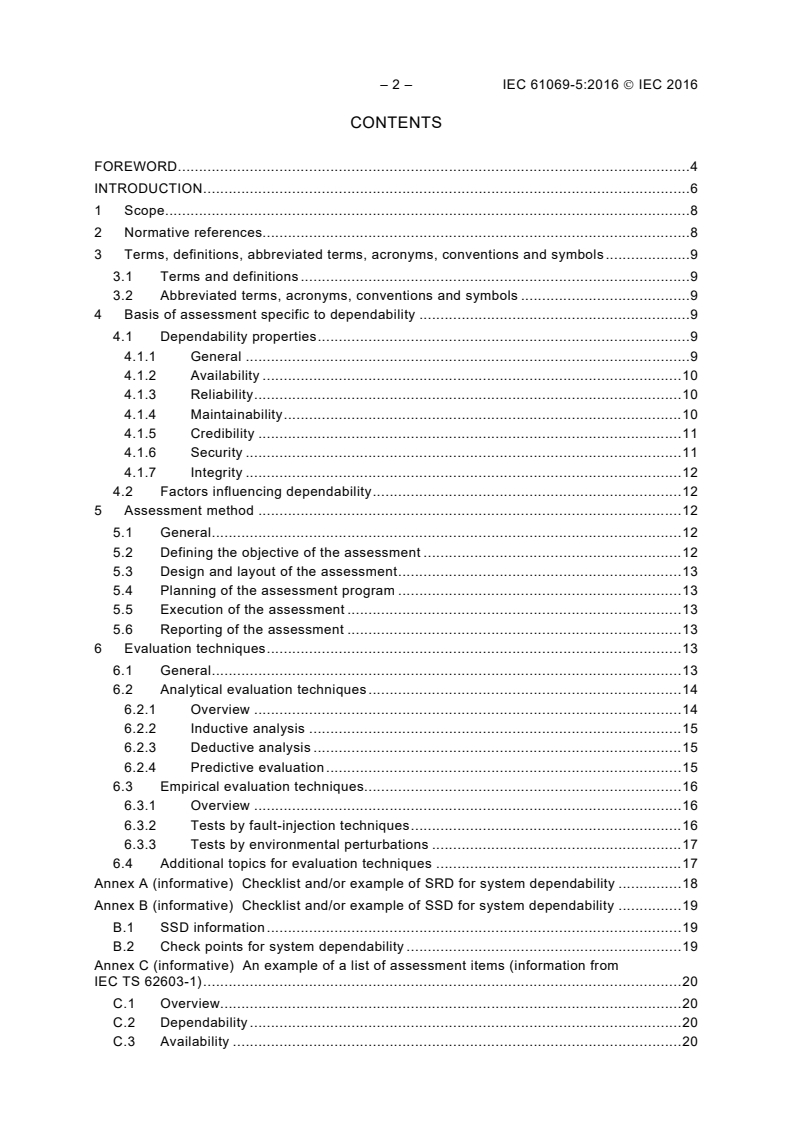
CONTENTS
FOREWORD . 4
INTRODUCTION . 6
1 Scope . 8
2 Normative references. 8
3 Terms, definitions, abbreviated terms, acronyms, conventions and symbols . 9
3.1 Terms and definitions . 9
3.2 Abbreviated terms, acronyms, conventions and symbols . 9
4 Basis of assessment specific to dependability . 9
4.1 Dependability properties . 9
4.1.1 General . 9
4.1.2 Availability . 10
4.1.3 Reliability . 10
4.1.4 Maintainability . 10
4.1.5 Credibility . 11
4.1.6 Security . 11
4.1.7 Integrity . 12
4.2 Factors influencing dependability . 12
5 Assessment method . 12
5.1 General . 12
5.2 Defining the objective of the assessment . 12
5.3 Design and layout of the assessment . 13
5.4 Planning of the assessment program . 13
5.5 Execution of the assessment . 13
5.6 Reporting of the assessment . 13
6 Evaluation techniques . 13
6.1 General . 13
6.2 Analytical evaluation techniques . 14
6.2.1 Overview . 14
6.2.2 Inductive analysis . 15
6.2.3 Deductive analysis . 15
6.2.4 Predictive evaluation . 15
6.3 Empirical evaluation techniques. 16
6.3.1 Overview . 16
6.3.2 Tests by fault-injection techniques . 16
6.3.3 Tests by environmental perturbations . 17
6.4 Additional topics for evaluation techniques . 17
Annex A (informative) Checklist and/or example of SRD for system dependability . 18
Annex B (informative) Checklist and/or example of SSD for system dependability . 19
B.1 SSD information . 19
B.2 Check points for system dependability . 19
Annex C (informative) An example of a list of assessment items (information from
IEC TS 62603-1) . 20
C.1 Overview. 20
C.2 Dependability . 20
C.3 Availability . 20
C.3.1 System self-diagnostics . 20
C.3.2 Single component fault tolerance and redundancy . 20
C.3.3 Redundancy methods . 21
C.4 Reliability . 22
C.5 Maintainability . 23
C.5.1 General . 23
C.5.2 Generation of maintenance requests . 23
C.5.3 Strategies for maintenance . 23
C.5.4 System software maintenance . 23
C.6 Credibility . 23
C.7 Security . 24
C.8 Integrity . 24
C.8.1 General . 24
C.8.2 Hot-swap . 24
C.8.3 Module diagnostic . 24
C.8.4 Input validation . 24
C.8.5 Read-back function . 24
C.8.6 Forced output . 24
C.8.7 Monitoring functions . 24
C.8.8 Controllers . 24
C.8.9 Networks . 25
C.8.10 Workstations and servers . 25
Annex D (informative) Credibility tests . 26
D.1 Overview. 26
D.2 Injected faults . 27
D.2.1 General . 27
D.2.2 System failures due to a faulty module, element or component . 27
D.2.3 System failures due to human errors . 27
D.2.4 System failures resulting from incorrect or unauthorized inputs into the
system through the man-machine interface . 27
D.3 Observations . 28
D.4 Interpretation of the results . 28
Annex E (informative) Available failure rate databases . 29
E.1 Databases . 29
E.2 Helpful standards concerning component failure . 30
Annex F (informative) Security considerations . 31
F.1 Physical security . 31
F.2 Cyber-security . 31
F.2.1 General . 31
F.2.2 Security policy . 31
F.2.3 Other considerations . 31
Bibliography . 33
Figure 1 – General layout of IEC 61069 . 7
Figure 2 – Dependability . 9
– 4 – IEC 61069-5:2016 IEC 2016
INTERNATIONAL ELECTROTECHNICAL COMMISSION
____________
INDUSTRIAL-PROCESS MEASUREMENT, CONTROL AND AUTOMATION –
EVALUATION OF SYSTEM PROPERTIES FOR
THE PURPOSE OF SYSTEM ASSESSMENT –
Part 5: Assessment of system dependability
FOREWORD
1) The International Electrotechnical Commission (IEC) is a worldwide organization for standardization comprising
all national electrotechnical committees (IEC National Committees). The object of IEC is to promote
international co-operation on all questions concerning standardization in the electrical and electronic fields. To
this end and in addition to other activities, IEC publishes International Standards, Technical Specifications,
Technical Reports, Publicly Available Specifications (PAS) and Guides (hereafter referred to as “IEC
Publication(s)”). Their preparation is entrusted to technical committees; any IEC National Committee interested
in the subject dealt with may participate in this preparatory work. International, governmental and non-
governmental organizations liaising with the IEC also participate in this preparation. IEC collaborates closely
with the International Organization for Standardization (ISO) in accordance with conditions determined by
agreement between the two organizations.
2) The formal decisions or agreements of IEC on technical matters express, as nearly as possible, an international
consensus of opinion on the relevant subjects since each technical committee has representation from all
interested IEC National Committees.
3) IEC Publications have the form of recommendations for international use and are accepted by IEC National
Committees in that sense. While all reasonable efforts are made to ensure that the technical content of IEC
Publications is accurate, IEC cannot be held responsible for the way in which they are used or for any
misinterpretation by any end user.
4) In order to promote international uniformity, IEC National Committees undertake to apply IEC Publications
transparently to the maximum extent possible in their national and regional publications. Any divergence
between any IEC Publication and the corresponding national or regional publication shall be clearly indicated in
the latter.
5) IEC itself does not provide any attestation of conformity. Independent certification bodies provide conformity
assessment services and, in some areas, access to IEC marks of conformity. IEC is not responsible for any
services carried out by independent certification bodies.
6) All users should ensure that they have the latest edition of this publication.
7) No liability shall attach to IEC or its directors, employees, servants or agents including individual experts and
members of its technical committees and IEC National Committees for any personal injury, property damage or
other damage of any nature whatsoever, whether direct or indirect, or for costs (including legal fees) and
expenses arising out of the publication, use of, or reliance upon, this IEC Publication or any other IEC
Publications.
8) Attention is drawn to the Normative references cited in this publication. Use of the referenced publications is
indispensable for the correct application of this publication.
9) Attention is drawn to the possibility that some of the elements of this IEC Publication may be the subject of
patent rights. IEC shall not be held responsible for identifying any or all such patent rights.
International Standard IEC 61069-5 has been prepared by subcommittee 65A: System
aspects, of IEC technical committee 65: Industrial-process measurement, control and
automation.
This second edition cancels and replaces the first edition published in 1994. This edition
constitutes a technical revision.
This edition includes the following significant technical changes with respect to the previous
edition:
a) reorganization of the material of IEC 61069-5:1994 to make the overall set of standards
more organized and consistent;
b) IEC TS 62603-1 has been incorporated into this edition.
The text of this standard is based on the following documents:
FDIS Report on voting
65A/793/FDIS 65A/803/RVD
Full information on the voting for the approval of this standard can be found in the report on
voting indicated in the above table.
This publication has been drafted in accordance with the ISO/IEC Directives, Part 2.
A list of all parts in the IEC 61069 series, published under the general title Industrial-process
measurement, control and automation – Evaluation of system properties for the purpose of
system assessment, can be found on the IEC website.
The committee has decided that the contents of this publication will remain unchanged until
the stability date indicated on the IEC web site under "http://webstore.iec.ch" in the data
related to the specific publication. At this date, the publication will be
• reconfirmed,
• withdrawn,
• replaced by a revised edition, or
• amended.
IMPORTANT – The 'colour inside' logo on the cover page of this publication indicates
that it contains colours which are considered to be useful for the correct
understanding of its contents. Users should therefore print this document using a
colour printer.
– 6 – IEC 61069-5:2016 IEC 2016
INTRODUCTION
IEC 61069 deals with the method which should be used to assess system properties of a
basic control system (BCS). IEC 61069 consists of the following parts.
Part 1: Terminology and basic concepts
Part 2: Assessment methodology
Part 3: Assessment of system functionality
Part 4: Assessment of system performance
Part 5: Assessment of system dependability
Part 6: Assessment of system operability
Part 7: Assessment of system safety
Part 8: Assessment of other system properties
Assessment of a system is the judgement, based on evidence, of the suitability of the system
for a specific mission or class of missions.
To obtain total evidence would require complete evaluation (for example under all influencing
factors) of all system properties relevant to the specific mission or class of missions.
Since this is rarely practical, the rationale on which an assessment of a system should be
based is:
– the identification of the importance of each of the relevant system properties,
– the planning for evaluation of the relevant system properties with a cost-effective
dedication of effort to the various system properties.
In conducting an assessment of a system, it is crucial to bear in mind the need to gain a
maximum increase in confidence in the suitability of a system within practical cost and time
constraints.
An assessment can only be carried out if a mission has been stated (or given), or if any
mission can be hypothesized. In the absence of a mission, no assessment can be made;
however, evaluations can still be specified and carried out for use in assessments performed
by others. In such cases, IEC 61069 can be used as a guide for planning an evaluation and it
provides methods for performing evaluations, since evaluations are an integral part of
assessment.
In preparing the assessment, it can be discovered that the definition of the system is too
narrow. For example, a facility with two or more revisions of the control systems sharing
resources, for example a network, should consider issues of co-existence and inter-operability.
In this case, the system to be investigated should not be limited to the “new” BCS; it should
include both. That is, it should change the boundaries of the system to include enough of the
other system to address these concerns.
The series structure and the relationship among the parts of IEC 61069 are shown in Figure 1.
IEC 61069: Industrial-process measurement, control and automation –
Evaluation of system properties for the purpose of system assessment
Part 1: Terminology and basic concepts
• Basic concept
• Terminology ‐ Objective
‐ Common terms ‐ Description of system
‐ Terms for particular part
‐ System properties
‐ Influencing factors
Part 2: Assessment methodology
• Generic requirements of procedure of assessment
‐ Overview, approach and phases
‐ Requirements for each phase
‐ General description of evaluation techniques
Parts 3 to 8: Assessment of each system property
• Basics of assessment specific to each property
‐ Properties and influencing factors
• Assessment method for each property
• Evaluation techniques for each property
IEC
Figure 1 – General layout of IEC 61069
Some example assessment items are integrated in Annex C.
– 8 – IEC 61069-5:2016 IEC 2016
INDUSTRIAL-PROCESS MEASUREMENT, CONTROL AND AUTOMATION –
EVALUATION OF SYSTEM PROPERTIES FOR
THE PURPOSE OF SYSTEM ASSESSMENT –
Part 5: Assessment of system dependability
1 Scope
This part of IEC 61069:
– specifies the detailed method of the assessment of dependability of a basic control system
(BCS) based on the basic concepts of IEC 61069-1 and methodology of IEC 61069-2,
– defines basic categorization of dependability properties,
– describes the factors that influence dependability and which need to be taken into account
when evaluating dependability, and
– provides guidance in selecting techniques from a set of options (with references) for
evaluating the dependability.
2 Normative references
The following documents, in whole or in part, are normatively referenced in this document and
are indispensable for its application. For dated references, only the edition cited applies. For
undated references, the latest edition of the referenced document (including any
amendments) applies.
IEC 60300-3-2, Dependability management – Part 3-2: Application guide – Collection of
dependability data from the field
IEC 60319, Presentation and specification of reliability data for electronic components
IEC 61069-1:2016, Industrial-process measurement, control and automation – Evaluation of
system properties for the purpose of system assessment – Part 1: Terminology and basic
concepts
IEC 61069-2:2016, Industrial-process measurement, control and automation – Evaluation of
system properties for the purpose of system assessment – Part 2: Assessment methodology
IEC 61070, Compliance test procedures tor steady-state availability
IEC 61709:2011, Electric components – Reliability – Reference conditions for failure rates and
stress models for conversion
ISO IEC 25010, Systems and software engineering – Systems and software Quality
Requirements and Evaluation (SQuaRE) – System and software quality models
ISO IEC 27001:2013, Information technology – Security techniques – Information security
management systems – Requirements
ISO IEC 27002, Information technology – Security techniques – Code of practice for
information security controls
3 Terms, definitions, abbreviated terms, acronyms, conventions and symbols
3.1 Terms and definitions
For the purposes of this document, the terms and definitions given in IEC 61069-1 apply.
3.2 Abbreviated terms, acronyms, conventions and symbols
For the purposes of this document, the abbreviated terms, acronyms, conventions and
symbols given in IEC 61069-1 apply.
4 Basis of assessment specific to dependability
4.1 Dependability properties
4.1.1 General
To fully assess the dependability, the system properties are categorised in a hierarchical way.
For a system to be dependable it is necessary that it is ready to perform its functions.
However, in practice, when the system is ready to perform its function, this does not mean
that it is sure that the functions are performed correctly. In order to cover these two aspects,
dependability properties are categorised into the groups and subgroups shown in Figure 2.
Dependability
Availability Credibility
Reliability Maintainability Integrity Security
IEC
Figure 2 – Dependability
Dependability cannot be assessed directly and cannot be described by a single property.
Dependability can only be determined by analysis and testing of each of its properties
individually.
The relationship between the dependability properties of the system and its modules is
sometimes very complex.
For example:
– if the system configuration includes redundancy, availability property of the system is
dependent upon the integrity properties of the redundant modules;
– if the system configuration includes system security mechanisms, security property of the
system is dependent upon the availability properties of modules that perform the security
mechanism;
– if the system configuration includes modules that check data transferred internally from
other parts of the system, then integrity property of the system is dependent upon the
security properties of these modules.
When a system performs several tasks of the system, its dependability can vary across those
tasks. For each of these tasks, a separate analysis is required.
– 10 – IEC 61069-5:2016 IEC 2016
4.1.2 Availability
Availability of the system is dependent upon the availabilities of the individual modules of the
system and the way in which these modules cooperate in performing tasks of the system. The
way in which modules of the system cooperate can include functional redundancy
(homogeneous or diverse), functional fall-back and degradation. Availability is dependent in
practice upon the procedures used and the resources available for maintaining the system.
The availability of the system can differ with respect to each of its tasks.
Availability of the system for each task can be quantified in two ways:
A system’s availability can be predicted as:
Availability = mean_time_to_failure / (mean_time_to_failure + mean_time_to_restoration)
where:
• "availability" is the availability of the system for the given task;
• "mean_time_to_failure" is the mean of the time from restoration of a system into a
state of performing its given task(s) to the time the system fails to do so;
• "mean-time_to_restoration" is the mean of the total time required to restore
performance of the given task from the time the system failed to perform that task.
For a system in operation, the availability can be calculated as:
Availability = total_time_the_system_has_been_able_to_perform_the_task /
Total_time_the_system_has_been_expected_to_perform_the_task
4.1.3 Reliability
Reliability of a system is dependent upon the reliability of the individual modules of the
system and the way in which these modules cooperate in performing task(s) of the system.
The way in which these modules cooperate can include functional redundancy (homogeneous
or diverse), functional fall-back and degradation.
Reliability of the system can differ with respect to each of its tasks. Reliability can be
quantified for individual tasks, with varying degrees of predictive confidence.
The reliability of the individual elements of the system can be predicted using the parts count
method (see IEC 62380 and IEC 61069-6). Reliability of the system can then be predicted by
synthesis. It should be noted, that for the software modules of systems, there are no reliability
prediction methods available that provide high levels of confidence.
Mechanisms to analyse software reliability are described in ISO IEC 25010.
Reliability can be represented by mean time to failure (MTTF) or failure rate.
4.1.4 Maintainability
The maintainability of a system is dependent upon the maintainability of individual
elements and structure of elements and modules of the system. The physical structure
affects ease of access, replaceability, etc. The functional structure affects ease of
diagnosis, etc.
When quantifying the maintainability of a system, all actions required to restore the
system to the state where it is fully capable of performing its tasks should be included.
This should include actions such as the time necessary to detect the fault, to notify
maintenance, to diagnose and remedy the cause, to adjust and check, etc.
The quantification of maintainability should be augmented with qualitative statements by
checking the provision for and the coverage of the following items:
The quantification of maintainability should be augmented with qualitative statements by
checking the provision for and the coverage of the following items:
– notification of the occurrence of the failures: lights, alert messages, reports, etc.;
– access: ease of access for personnel and for connecting measuring instruments,
modularity, etc.;
– diagnostics: direct fault identification, diagnostic tools which have no influence on the
system by itself, remote maintenance support facilities, statistical error checking and
reporting;
– repairability/replaceability: few restrictions on the replacement of modules while
operating (“hot swap” support), modularity, unambiguous identification of modules
and elements, minimum need for special tools, minimum repercussions on other
elements or modules, when elements or modules are replaced;
– check-out: guided maintenance procedures, minimum check-out requirements.
Maintainability can be represented by mean time to repair (MTTR).
4.1.5 Credibility
The credibility of a system is dependent upon the integrity and security mechanisms
implemented as functions performed by the modules of the system.
Credibility mechanisms include:
– a check on
• correct performance of functions (for example by watchdog, using known data);
and/or
• correct data (for example validity check, parity check, readback, input validation, etc.);
– an action, such as:
• self-correction;
• confinement;
• notification of action, etc.
These mechanisms can be used to provide integrity and/or security.
To analyse the credibility mechanisms, the fault injection techniques described in 6.1
c an be used.
Credibility is deterministic and some aspects can be quantified.
4.1.6 Security
The security of a system is dependent upon mechanisms implemented at the boundary of the
system to detect and prevent incorrect inputs and unauthorized access. These boundaries
can be physical or virtual. See:
– Annex F for more considerations on security, and
– IEC 62443 series.
A security mechanism can be implemented by an element checking the inputs to other
elements.
– 12 – IEC 61069-5:2016 IEC 2016
4.1.7 Integrity
The integrity is dependent upon mechanisms implemented at the output elements of the
system to check for correct outputs. It also depends upon mechanisms implemented within
the system to detect and prevent incorrect transitions of signals or data between parts of the
system.
An integrity mechanism is implemented by an element checking the outputs of other
elements.
4.2 Factors influencing dependability
The dependability of a system can be affected by the following influencing factors listed in
IEC 61069-1:2016, 5.3.
For each of the system properties listed in 4.1, the primary influencing factors are as
follows:
– Reliability is influenced by the influencing factors;
• utilities, the influence is partly predictable using IEC 61709,
• environment, the influence is partly predictable using IEC 61709,
• services, due to the handling, storage of parts, etc.
– Maintainability; for the purpose of this standard, maintainability is considered as an
intrinsic property of the system itself and is only affected in an indirect way, for example
restricted access due to hazardous conditions.
– Availability; when taking into account the human activities necessary to retain the
system in, or restore the system to, a state in which the system is capable of
performing task(s) of the system, availability is influenced by human behaviour and
service conditions (delays in delivery of spare parts, training, documentation, etc.).
– Credibility; the mechanisms (security and integrity) can be affected by intentional or
unintentional human actions and by infestations of pests and if these mechanisms
share common facilities, such as buses or multitasking processors, they can be
influenced by task(s) of the system, the process due to a sudden increase in process
activity (for example an alarm burst), etc. and external systems.
In general, any deviations from the reference conditions in which the system is supposed
to operate can affect the correct working of the system.
When specifying tests to evaluate the effects of influencing factors, the following
standards should be consulted:
– IEC 60068,
– IEC 60801,
– IEC 61000, and
– IEC 61326.
5 Assessment method
5.1 General
The assessment shall follow the method as laid down in IEC 61069-2:2016, Clause 5.
5.2 Defining the objective of the assessment
Defining the objective of the assessment shall follow the method as laid down in IEC 61069-
2:2016, 5.2.
5.3 Design and layout of the assessment
Design and layout of the assessment shall follow the method as laid down in IEC 61069-
2:2016, 5.3.
Defining the scope of assessment shall follow the method laid down in IEC 61069-2:2016,
5.3.1.
Collation of documented information shall be conducted in accordance with IEC 61069-2:2016,
5.3.3.
The statements compiled in accordance with IEC 61069-2:2016, 5.3.3 should include the
following in addition to the items listed in IEC 61069-2:2016, 5.3.3.
– No additional items are noted
Documenting collated information shall follow the method in IEC 61069-2:2016, 5.3.4.
Selecting assessment items shall follow IEC 61069-2:2016, 5.3.5.
Assessment specification should be developed in accordance with IEC 61069-2:2016, 5.3.6.
Comparison of the SRD and the SSD shall follow IEC 61069-2:2016, 5.3.
NOTE 1 A checklist of SRD for system dependability is provided in Annex A.
NOTE 2 A checklist of SSD for system dependability is provided in Annex B.
5.4 Planning of the assessment program
Planning the assessment program shall follow the method as laid down in IEC 61069-2:2016,
5.4.
Assessment activities shall be developed in accordance with IEC 61069-2:2016, 5.4.2.
The final assessment program should specify points specified in IEC 61069-2:2016, 5.4.3.
5.5 Execution of the assessment
The execution of the assessment shall be in accordance with IEC 61069-2:2016, 5.5.
5.6 Reporting of the assessment
The reporting of the assessment shall be in accordance with IEC 61069-2:2016, 5.6.
The report shall include information specified in IEC 61069-2:2016, 5.6. Additionally, the
assessment report should address the following points:
– No additional items are noted.
6 Evaluation techniques
6.1 General
Within this standard, several evaluation techniques are suggested. Other methods may be
applied but, in all cases, the assessment report should provide references to documents
describing the techniques used.
Those evaluation techniques are categorized as described in IEC 61069-2:2016, Clause 6.
– 14 – IEC 61069-5:2016 IEC 2016
Factors influencing dependability properties of the system as per 4.2 shall be taken into
account.
The techniques given in 6.2, 6.3 and 6.4 are recommended to assess dependability properties.
Quantitative evaluation can be based on a predictive analysis, calculations, or on tests.
To start the evaluation it is first necessary to analyse the functional and physical structure of
the system. Once this is accomplished an analysis of how the tasks are performed by the
system should be done.
The structure of the system can be described using functional and physical block diagrams,
signal flow diagrams, state graphs, tables, etc.
Failure modes are considered for all elements (hardware and software). Their effects on the
dependability of the task(s) of the system, together with the influence of the requirements for
maintainability, are determined.
Quantitative evaluations can be performed using one of, or a combination of, the available
methods described in 6.2 and 6.3.
The analysis shall include an examination of the manner in which alternative paths through
the system are initiated, i.e.:
– in a static manner by changing the system configuration; or
– dynamically, either automatically, for example, by credibility mechanisms or manually,
for example, by a keyboard action.
A list of items that shall be considered for the assessment can be found in IEC 60319 and IEC
61709. The analytical techniques, described below, are based on models. Such models can
rarely represent the real system exactly, and, even if they can, there can never be 100 %
certainty that they do. The evaluation results based on analytical techniques should therefore
also state their confidence level.
The dependability of a system is also influenced by errors introduced into the system during
the design, specification and manufacturing stages. This holds equally well for the hardware
and software of the system. These errors can only be discovered by meticulously checking
the proper execution of each function.
In addition, injecting hypothetical faults or errors is a valuable technique in providing an
increase in the degree of confidence in the final dependability of the system, as achieved
during all stages of the design, specification and manufacturing. These fault injection
techniques can be accomplished by using hardware and/or specially designed software. They
are used to discover what the overall consequence, to the task(s) of the system, will be.
It should however be recognized that, in practice, the increase in confidence is limited since
the number of tests that can be designed and carried out will be constrained by the number of
all possible errors and faults that can be thought of and injected.
NOTE An example of a list of assessment items is provided in Annex C.
6.2 Analytical evaluation techniques
6.2.1 Overview
This subclause discusses common analytical evaluation techniques: logical analysis
(inductive and deductive) and predictive evaluation.
6.2.2 Inductive analysis
At the component or element level the failure modes are identified and for each of these
modes the corresponding effect on the dependability of the system task(s) at the next higher
level is analysed. The resulting failure effects become the failure modes at the next higher
level.
This "bottom-up" approach is a tedious method which finally results in the identifi
...