

IEC 62801:2020
(Main)Measurement method of a half-wavelength voltage for Mach-Zehnder optical modulator in wireless communication and broadcasting systems
General Information
- Abstract
IEC 62801:2020 specifies a measurement method of half-wavelength voltage applicable to Mach-Zehnder optical modulators in wireless communication and broadcasting systems. In addition, this method is also effective for the estimation of the intermodulation distortion of Mach-Zehnder optical modulators. The method applies for the following:
– frequency range: 10 MHz to 30 GHz;
– wavelength band: 0,8 µm to 2,0 µm;
– electro-optic material based Mach-Zehnder optical modulators and their modules.
- Status
- Published
- Publication Date
- 23-Sep-2020
- Technical Committee
- TC 103 - Transmitting and receiving equipment for radiocommunication
- Drafting Committee
- WG 6 - TC 103/WG 6
- Current Stage
- PPUB - Publication issued
- Start Date
- 24-Sep-2020
- Completion Date
- 14-Sep-2020
Overview
IEC 62801:2020 provides an internationally recognized measurement method for determining the half-wavelength voltage (Vπ) in Mach-Zehnder optical modulators, specifically for use in wireless communication and broadcasting systems. This standard, developed by the International Electrotechnical Commission (IEC), also supports the estimation of intermodulation distortion (IMD) in Mach-Zehnder modulators. Covering electro-optic material-based devices over a frequency range of 10 MHz to 30 GHz and a wavelength band from 0.8 µm to 2.0 µm, IEC 62801:2020 facilitates consistent performance assessment and product quality across industry applications.
Key Topics
- Half-Wavelength Voltage Measurement: Defines the procedure for accurately measuring the half-wavelength voltage in electro-optic Mach-Zehnder modulators, a crucial parameter for efficient electro-optic modulation.
- Intermodulation Distortion Evaluation: Enables estimation of second-order (IM2) and third-order (IM3) intermodulation distortions, which are vital for preserving signal integrity in high-frequency applications.
- Device and Module Coverage: Applies to both standalone Mach-Zehnder optical modulators and their integrated modules, provided they are based on electro-optic materials such as LiNbO3, GaAs, and related compounds.
- Applicable Frequency and Wavelength Ranges: Standardizes methods across a broad operational spectrum (10 MHz to 30 GHz; 0.8 µm to 2.0 µm), ensuring relevance in modern wireless and broadcasting systems.
- Sampling and Quality Control: Recommends statistically significant sampling strategies for manufacturing quality assurance, promoting consistent and reliable device performance.
- Measurement Setup Guidance: Specifies wiring diagrams, environmental conditions, and equipment preparation to maintain reproducibility and minimize measurement uncertainty.
Applications
IEC 62801:2020 is essential for organizations involved in the design, production, and maintenance of wireless communication and broadcasting infrastructure. Key application areas include:
- Radio-over-Fibre (RoF) Systems: Supports the measurement and optimization of optical modulators that serve as the interface between radio frequency (RF) and optical signals, a critical component in high-speed data transmission networks.
- Wireless and Broadcast Equipment Manufacturing: Ensures component conformity and performance standards in modulator modules used in base stations, headends, microwave photonics, and broadcast transmission equipment.
- System Integration and Maintenance: Provides standardized testing procedures for modulator modules during system integration, troubleshooting, and periodic maintenance, enhancing overall network reliability.
- Product Development and Research: Establishes internationally accepted benchmarks for product development, helping accelerate innovation and adoption of new technologies in next-generation wireless and broadcasting networks.
Related Standards
Organizations implementing IEC 62801:2020 may also benefit from referencing the following international standards:
- IEC 62007-1: Defines essential ratings and characteristics for semiconductor optoelectronic devices in fibre optic system applications.
- IEC 62007-2: Describes measurement methods for semiconductor optoelectronic devices used in fibre optics, providing valuable background to procedures specified in IEC 62801.
- IEC Electropedia: An online dictionary for electrotechnical terminology, useful for clarifying terms and abbreviations found in IEC 62801 and related standards.
Practical Value
By standardizing the measurement of half-wavelength voltage and intermodulation distortion, IEC 62801:2020 helps manufacturers, integrators, and operators of wireless communication and broadcasting systems ensure product quality, system performance, and global compatibility. Adopting this standard results in:
- Improved Measurement Accuracy and Consistency
- Faster Product Qualification and Compliance
- Reduced Risk of Signal Degradation from Nonlinear Effects
- Streamlined Global Procurement and Sourcing
With the growing importance of high-frequency, wide-bandwidth systems, IEC 62801:2020 provides a crucial foundation for quality assurance and innovation in next-generation wireless and broadcasting technologies.
Get Certified
Connect with accredited certification bodies for this standard

ANCE
Mexican certification and testing association.

Intertek Slovenia
Intertek testing, inspection, and certification services in Slovenia.

LNE (Laboratoire National de Métrologie et d'Essais)
French national laboratory for metrology and testing.
Sponsored listings
Frequently Asked Questions
IEC 62801:2020 is a standard published by the International Electrotechnical Commission (IEC). Its full title is "Measurement method of a half-wavelength voltage for Mach-Zehnder optical modulator in wireless communication and broadcasting systems". This standard covers: IEC 62801:2020 specifies a measurement method of half-wavelength voltage applicable to Mach-Zehnder optical modulators in wireless communication and broadcasting systems. In addition, this method is also effective for the estimation of the intermodulation distortion of Mach-Zehnder optical modulators. The method applies for the following: – frequency range: 10 MHz to 30 GHz; – wavelength band: 0,8 µm to 2,0 µm; – electro-optic material based Mach-Zehnder optical modulators and their modules.
IEC 62801:2020 specifies a measurement method of half-wavelength voltage applicable to Mach-Zehnder optical modulators in wireless communication and broadcasting systems. In addition, this method is also effective for the estimation of the intermodulation distortion of Mach-Zehnder optical modulators. The method applies for the following: – frequency range: 10 MHz to 30 GHz; – wavelength band: 0,8 µm to 2,0 µm; – electro-optic material based Mach-Zehnder optical modulators and their modules.
IEC 62801:2020 is classified under the following ICS (International Classification for Standards) categories: 01 - GENERALITIES. TERMINOLOGY. STANDARDIZATION. DOCUMENTATION; 33.060.20 - Receiving and transmitting equipment; 33.180.99 - Other fibre optic equipment. The ICS classification helps identify the subject area and facilitates finding related standards.
IEC 62801:2020 is available in PDF format for immediate download after purchase. The document can be added to your cart and obtained through the secure checkout process. Digital delivery ensures instant access to the complete standard document.
Standards Content (Sample)
IEC 62801 ®
Edition 1.0 2020-09
INTERNATIONAL
STANDARD
NORME
INTERNATIONALE
colour
inside
Measurement method of half-wavelength voltage for Mach-Zehnder optical
modulator in wireless communication and broadcasting systems
Méthode de mesure de la tension à une demi-longueur d’onde relative aux
modulateurs optiques Mach-Zehnder dans les systèmes de communication
et transmission radiofréquence
All rights reserved. Unless otherwise specified, no part of this publication may be reproduced or utilized in any form
or by any means, electronic or mechanical, including photocopying and microfilm, without permission in writing from
either IEC or IEC's member National Committee in the country of the requester. If you have any questions about IEC
copyright or have an enquiry about obtaining additional rights to this publication, please contact the address below or
your local IEC member National Committee for further information.
Droits de reproduction réservés. Sauf indication contraire, aucune partie de cette publication ne peut être reproduite
ni utilisée sous quelque forme que ce soit et par aucun procédé, électronique ou mécanique, y compris la photocopie
et les microfilms, sans l'accord écrit de l'IEC ou du Comité national de l'IEC du pays du demandeur. Si vous avez des
questions sur le copyright de l'IEC ou si vous désirez obtenir des droits supplémentaires sur cette publication, utilisez
les coordonnées ci-après ou contactez le Comité national de l'IEC de votre pays de résidence.
IEC Central Office Tel.: +41 22 919 02 11
3, rue de Varembé info@iec.ch
CH-1211 Geneva 20 www.iec.ch
Switzerland
About the IEC
The International Electrotechnical Commission (IEC) is the leading global organization that prepares and publishes
International Standards for all electrical, electronic and related technologies.
About IEC publications
The technical content of IEC publications is kept under constant review by the IEC. Please make sure that you have the
latest edition, a corrigendum or an amendment might have been published.
IEC publications search - webstore.iec.ch/advsearchform Electropedia - www.electropedia.org
The advanced search enables to find IEC publications by a The world's leading online dictionary on electrotechnology,
variety of criteria (reference number, text, technical containing more than 22 000 terminological entries in English
committee,…). It also gives information on projects, replaced and French, with equivalent terms in 16 additional languages.
and withdrawn publications. Also known as the International Electrotechnical Vocabulary
(IEV) online.
IEC Just Published - webstore.iec.ch/justpublished
Stay up to date on all new IEC publications. Just Published IEC Glossary - std.iec.ch/glossary
details all new publications released. Available online and 67 000 electrotechnical terminology entries in English and
once a month by email. French extracted from the Terms and Definitions clause of
IEC publications issued since 2002. Some entries have been
IEC Customer Service Centre - webstore.iec.ch/csc collected from earlier publications of IEC TC 37, 77, 86 and
If you wish to give us your feedback on this publication or CISPR.
need further assistance, please contact the Customer Service
Centre: sales@iec.ch.
A propos de l'IEC
La Commission Electrotechnique Internationale (IEC) est la première organisation mondiale qui élabore et publie des
Normes internationales pour tout ce qui a trait à l'électricité, à l'électronique et aux technologies apparentées.
A propos des publications IEC
Le contenu technique des publications IEC est constamment revu. Veuillez vous assurer que vous possédez l’édition la
plus récente, un corrigendum ou amendement peut avoir été publié.
Recherche de publications IEC - Electropedia - www.electropedia.org
webstore.iec.ch/advsearchform Le premier dictionnaire d'électrotechnologie en ligne au
La recherche avancée permet de trouver des publications IEC monde, avec plus de 22 000 articles terminologiques en
en utilisant différents critères (numéro de référence, texte, anglais et en français, ainsi que les termes équivalents dans
comité d’études,…). Elle donne aussi des informations sur les 16 langues additionnelles. Egalement appelé Vocabulaire
projets et les publications remplacées ou retirées. Electrotechnique International (IEV) en ligne.
IEC Just Published - webstore.iec.ch/justpublished Glossaire IEC - std.iec.ch/glossary
Restez informé sur les nouvelles publications IEC. Just 67 000 entrées terminologiques électrotechniques, en anglais
Published détaille les nouvelles publications parues. et en français, extraites des articles Termes et Définitions des
Disponible en ligne et une fois par mois par email. publications IEC parues depuis 2002. Plus certaines entrées
antérieures extraites des publications des CE 37, 77, 86 et
Service Clients - webstore.iec.ch/csc CISPR de l'IEC.
Si vous désirez nous donner des commentaires sur cette
publication ou si vous avez des questions contactez-nous:
sales@iec.ch.
IEC 62801 ®
Edition 1.0 2020-09
INTERNATIONAL
STANDARD
NORME
INTERNATIONALE
colour
inside
Measurement method of half-wavelength voltage for Mach-Zehnder optical
modulator in wireless communication and broadcasting systems
Méthode de mesure de la tension à une demi-longueur d’onde relative aux
modulateurs optiques Mach-Zehnder dans les systèmes de communication
et transmission radiofréquence
INTERNATIONAL
ELECTROTECHNICAL
COMMISSION
COMMISSION
ELECTROTECHNIQUE
INTERNATIONALE
ICS 33.060.20; 33.180.99 ISBN 978-2-8322-8761-3
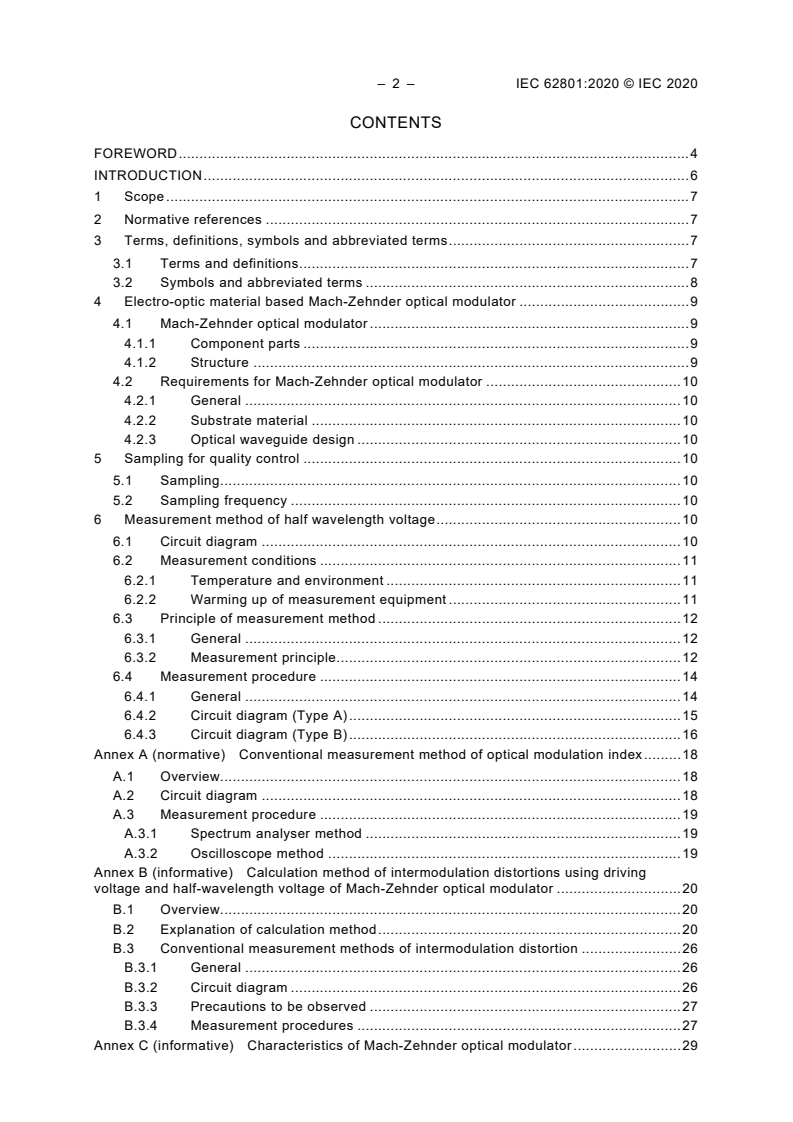
– 2 – IEC 62801:2020 © IEC 2020
CONTENTS
FOREWORD . 4
INTRODUCTION . 6
1 Scope . 7
2 Normative references . 7
3 Terms, definitions, symbols and abbreviated terms . 7
3.1 Terms and definitions . 7
3.2 Symbols and abbreviated terms . 8
4 Electro-optic material based Mach-Zehnder optical modulator . 9
4.1 Mach-Zehnder optical modulator . 9
4.1.1 Component parts . 9
4.1.2 Structure . 9
4.2 Requirements for Mach-Zehnder optical modulator . 10
4.2.1 General . 10
4.2.2 Substrate material . 10
4.2.3 Optical waveguide design . 10
5 Sampling for quality control . 10
5.1 Sampling. 10
5.2 Sampling frequency . 10
6 Measurement method of half wavelength voltage . 10
6.1 Circuit diagram . 10
6.2 Measurement conditions . 11
6.2.1 Temperature and environment . 11
6.2.2 Warming up of measurement equipment . 11
6.3 Principle of measurement method . 12
6.3.1 General . 12
6.3.2 Measurement principle. 12
6.4 Measurement procedure . 14
6.4.1 General . 14
6.4.2 Circuit diagram (Type A) . 15
6.4.3 Circuit diagram (Type B) . 16
Annex A (normative) Conventional measurement method of optical modulation index . 18
A.1 Overview. 18
A.2 Circuit diagram . 18
A.3 Measurement procedure . 19
A.3.1 Spectrum analyser method . 19
A.3.2 Oscilloscope method . 19
Annex B (informative) Calculation method of intermodulation distortions using driving
voltage and half-wavelength voltage of Mach-Zehnder optical modulator . 20
B.1 Overview. 20
B.2 Explanation of calculation method . 20
B.3 Conventional measurement methods of intermodulation distortion . 26
B.3.1 General . 26
B.3.2 Circuit diagram . 26
B.3.3 Precautions to be observed . 27
B.3.4 Measurement procedures . 27
Annex C (informative) Characteristics of Mach-Zehnder optical modulator . 29
C.1 Electrical and optical characteristics of Mach-Zehnder optical modulator . 29
C.2 Mechanical and environmental characteristics . 29
Annex D (informative) Notes on measurement . 31
D.1 Factors of measurement uncertainty . 31
D.1.1 Measurement equipment . 31
D.1.2 Measurement range . 32
D.2 RF power source . 33
D.2.1 Limitation from resolution of applied RF power . 33
D.2.2 Limitation from the resolution of oscilloscope screen . 34
D.3 Examples of measurement results . 34
Bibliography . 37
Figure 1 – Transfer curve of a Mach-Zehnder optical modulator . 8
Figure 2 – Structure of Mach-Zehnder interferometer type optical modulator . 9
Figure 3 – Schematic block diagram of the measurement setup . 11
Figure 4 – Zero-order Bessel function . 13
Figure 5 – Waveform change on the oscilloscope screen . 13
Figure 6 – Driving voltage measurement setup . 15
Figure 7 – Driving voltage measurement setup using a power divider . 16
Figure 8 – Waveforms on the oscilloscope . 17
Figure A.1 – Measurement setup referred in IEC 62007-2 . 18
Figure A.2 – Time variation of photo current . 19
Figure B.1 – Mach-Zehnder interferometer type optical modulator . 20
Figure B.2 – Quadrature points of a transfer curve for a Mach-Zehnder optical modulator . 25
Figure B.3 – Dependency of IM2 on NOMI and bias voltage of a Mach-Zehnder optical
modulator . 25
Figure B.4 – Relation between IM3 and OMI of a Mach-Zehnder optical modulator . 26
Figure B.5 – Conventional intermodulation method . 27
Figure B.6 – IMD2 and IMD3 . 28
Figure D.1 – Errors of half-wavelength voltage measurements caused by limitations from
the resolution of RF power . 33
Figure D.2 – Relative errors of half-wavelength voltage measurement caused by
limitations from the resolution of RF power . 34
Figure D.3 – Relation between NOMI and IM3 for the Mach-Zehnder modulator
(sample #1) . 35
Figure D.4 – Relation between NOMI and IM3 for the Mach-Zehnder modulator
(sample #2) . 36
Figure D.5 – Relation between NOMI and IM2 for the Mach-Zehnder modulator
(sample #1) . 36
Table 1 – Symbols and abbreviated terms . 9
Table C.1 – Characteristics of optical modulator . 29
Table C.2 – Mechanical and environmental characteristics . 30
Table D.1 – Spectrum analyser uncertainty . 31
Table D.2 – Uncertainty budget of power meter at only 2 GHz . 32
Table D.3 – Measurement results of half-wave voltages for Mach-Zehnder modulators . 35
– 4 – IEC 62801:2020 © IEC 2020
INTERNATIONAL ELECTROTECHNICAL COMMISSION
____________
MEASUREMENT METHOD OF HALF-WAVELENGTH VOLTAGE
FOR MACH-ZEHNDER OPTICAL MODULATOR IN WIRELESS
COMMUNICATION AND BROADCASTING SYSTEMS
FOREWORD
1) The International Electrotechnical Commission (IEC) is a worldwide organization for standardization comprising
all national electrotechnical committees (IEC National Committees). The object of IEC is to promote international
co-operation on all questions concerning standardization in the electrical and electronic fields. To this end and in
addition to other activities, IEC publishes International Standards, Technical Specifications, Technical Reports,
Publicly Available Specifications (PAS) and Guides (hereafter referred to as “IEC Publication(s)”). Their
preparation is entrusted to technical committees; any IEC National Committee interested in the subject dealt with
may participate in this preparatory work. International, governmental and non-governmental organizations liaising
with the IEC also participate in this preparation. IEC collaborates closely with the International Organization for
Standardization (ISO) in accordance with conditions determined by agreement between the two organizations.
2) The formal decisions or agreements of IEC on technical matters express, as nearly as possible, an international
consensus of opinion on the relevant subjects since each technical committee has representation from all
interested IEC National Committees.
3) IEC Publications have the form of recommendations for international use and are accepted by IEC National
Committees in that sense. While all reasonable efforts are made to ensure that the technical content of IEC
Publications is accurate, IEC cannot be held responsible for the way in which they are used or for any
misinterpretation by any end user.
4) In order to promote international uniformity, IEC National Committees undertake to apply IEC Publications
transparently to the maximum extent possible in their national and regional publications. Any divergence between
any IEC Publication and the corresponding national or regional publication shall be clearly indicated in the latter.
5) IEC itself does not provide any attestation of conformity. Independent certification bodies provide conformity
assessment services and, in some areas, access to IEC marks of conformity. IEC is not responsible for any
services carried out by independent certification bodies.
6) All users should ensure that they have the latest edition of this publication.
7) No liability shall attach to IEC or its directors, employees, servants or agents including individual experts and
members of its technical committees and IEC National Committees for any personal injury, property damage or
other damage of any nature whatsoever, whether direct or indirect, or for costs (including legal fees) and expenses
arising out of the publication, use of, or reliance upon, this IEC Publication or any other IEC Publications.
8) Attention is drawn to the Normative references cited in this publication. Use of the referenced publications is
indispensable for the correct application of this publication.
9) Attention is drawn to the possibility that some of the elements of this IEC Publication may be the subject of patent
rights. IEC shall not be held responsible for identifying any or all such patent rights.
International Standard IEC 62801 has been prepared by IEC technical committee 103:
Transmitting equipment for radiocommunication.
The text of this International Standard is based on the following documents:
CDV Report on voting
103/120/CDV 103/133/RVC
Full information on the voting for the approval of this International Standard can be found in the
report on voting indicated in the above table.
This document has been drafted in accordance with the ISO/IEC Directives, Part 2.
The committee has decided that the contents of this document will remain unchanged until the
stability date indicated on the IEC website under "http://webstore.iec.ch" in the data related to
the specific document. At this date, the document will be
• reconfirmed,
• withdrawn,
• replaced by a revised edition, or
• amended.
IMPORTANT – The 'colour inside' logo on the cover page of this publication indicates
that it contains colours which are considered to be useful for the correct
understanding of its contents. Users should therefore print this document using a
colour printer.
– 6 – IEC 62801:2020 © IEC 2020
INTRODUCTION
A variety of microwave-photonic devices may be used in wireless communication and
broadcasting systems. An optical modulator is an interface which converts an electronic signal
to an optical signal. In the field of optical fibre communication systems, the first editions of the
IEC 62007 series "Semiconductor optoelectronic devices for fibre optic system applications"
were published in 1997. In the field of wireless systems, specifications of intermodulation and
composite distortion of modulators have been the important issue and have been typically
negotiated between users and suppliers. During the International Meeting on Microwave
Photonics, a proposal was announced to address standardizations for key devices for
radio-over-fibre (RoF) systems.
An RoF system is comprised mainly of two parts; one is the RF to photonic converter (E/O), and
the other is the photonic to RF converter (O/E). Radio waves are converted into an optical signal
at E/O, and the signal is transferred through the optical fibre, and then the radio waves are
regenerated at O/E. The nonlinear distortion characteristics of both E/O and O/E are important
for the performance of the system. Semiconductor photodiodes are commonly used for O/E.
Several types of optical modulator are used for E/O, such as Mach-Zehnder modulators (MZM),
electro-absorption modulators and directly modulated laser diodes (LDs).
This document has been prepared to provide industry standard measurement methods for
evaluating electro-optic material based Mach-Zehnder optical modulators, to be used in wireless
communication and broadcasting systems. The nonlinear distortion characteristics are also
important for the performance of the systems. The intermodulation distortion of the MZM is
calculated from the driving voltage and the half-wavelength voltage. The details of calculations
of the second-order intermodulation distortion (IM2) and the third-order intermodulation
distortion (IM3) are described in Annex B. General characteristics of Mach-Zehnder optical
modulators in wireless communication and broadcasting systems are described in Annex C.
Notes on measurement of the half-wavelength voltage are described in Annex D.
The International Electrotechnical Commission (IEC) draws attention to the fact that it is claimed
that compliance with this document may involve the use of a patent. IEC takes no position
concerning the evidence, validity, and scope of this patent right.
The holder of this patent right has assured IEC that s/he is willing to negotiate licences under
reasonable and non-discriminatory terms and conditions with applicants throughout the world. In
this respect, the statement of the holder of this patent right is registered with IEC. Information
may be obtained from the patent database available at http://patents.iec.ch.
Attention is drawn to the possibility that some of the elements of this document may be the
subject of patent rights other than those in the patent database. IEC shall not be held
responsible for identifying any or all such patent rights.
MEASUREMENT METHOD OF HALF-WAVELENGTH VOLTAGE
FOR MACH-ZEHNDER OPTICAL MODULATOR IN WIRELESS
COMMUNICATION AND BROADCASTING SYSTEMS
1 Scope
This document specifies a measurement method of half-wavelength voltage applicable to
Mach-Zehnder optical modulators in wireless communication and broadcasting systems. In
addition, this method is also effective for the estimation of the intermodulation distortion of
Mach-Zehnder optical modulators. The method applies for the following:
– frequency range: 10 MHz to 30 GHz;
– wavelength band: 0,8 µm to 2,0 µm;
– electro-optic material based Mach-Zehnder optical modulators and their modules.
2 Normative references
The following documents are referred to in the text in such a way that some or all of their content
constitutes requirements of this document. For dated references, only the edition cited applies.
For undated references, the latest edition of the referenced document (including any
amendments) applies.
IEC 62007-1, Semiconductor optoelectronic devices for fibre optic system applications – Part 1:
Essential ratings and characteristics
IEC 62007-2, Semiconductor optoelectronic devices for fibre optic system applications – Part 2:
Measurement methods
3 Terms, definitions, symbols and abbreviated terms
3.1 Terms and definitions
For the purposes of this document, the terms and definitions given in IEC 62007-1 and
IEC 62007-2 and the following apply.
ISO and IEC maintain terminological databases for use in standardization at the following
addresses:
• IEC Electropedia: available at http://www.electropedia.org/
• ISO Online browsing platform: available at http://www.iso.org/obp
3.1.1
half-wavelength voltage
V
π
voltage required for a Pockels effect material based Mach-Zehnder optical modulator to induce
a phase shift of one-half a wavelength between the lightwaves of two arms of the Mach-Zehnder
interferometer
Note 1 to entry: It corresponds to an ON/OFF voltage of the Mach-Zehnder optical modulator as shown in Figure 1
– 8 – IEC 62801:2020 © IEC 2020
Figure 1 – Transfer curve of a Mach-Zehnder optical modulator
3.1.2
normalized optical modulation index
NOMI
for the Mach-Zehnder optical modulator, ratio of driving voltage and half-wavelength voltage of
the modulator, defined as
NOMI = (V / V ) × 100 [%] (1)
pp π
where
V is the driving voltage (peak to peak voltage);
pp
V is the half-wavelength voltage
π
Note 1 to entry: NOMI does not denote actual optical modulation index (OMI), defined as the ratio of the optical
modulated signal power and the average optical power. Detailed explanations of OMI including measurement methods
are described in Annex A.
Note 2 to entry: This note applies to the French language only.
3.1.3
extinction ratio
R
ext
ratio of two optical power levels of the optical signal generated by the optical modulator, defined
as
R = 10log(P /P ) (2)
ext 1 2
where
P is the optical power level generated when the output power is "on";
P is the power level generated when the output power is "off"
3.2 Symbols and abbreviated terms
The symbols and abbreviated terms used in this document are shown in Table 1.
Table 1 – Symbols and abbreviated terms
R extinction ratio
ext
V half-wavelength voltage
π
CSO composite second-order distortion
CTB composite triple-beats distortion
DUT device under test
ESA electrical spectrum analyser
IMD intermodulation distortion
IM2 second-order intermodulation distortion
IM3 third-order intermodulation distortion
LD laser diode
MZM Mach-Zehnder modulator
NOMI normalized OMI
OMI optical modulation index
PD photodiode
RoF radio-over-fibre
4 Electro-optic material based Mach-Zehnder optical modulator
4.1 Mach-Zehnder optical modulator
4.1.1 Component parts
The optical modulators and their modules consist of basic parts as follows:
– Mach-Zehnder interferometer type optical modulator;
– input and output fibre pigtails (where appropriate);
– bias control port (where appropriate);
– photodiode for bias monitoring (where appropriate);
– laser diode for light source (where appropriate);
– thermal sensor (where appropriate);
– Peltier element (where appropriate).
4.1.2 Structure
A basic structure of the Mach-Zehnder interferometer type optical modulators is shown in
Figure 2. The modulators are grouped by electrode types and options.
– Electrode: lumped type, traveling-wave type, etc.
– Options: optical isolator, photodiode, half-mirror, laser diode, etc.
Figure 2 – Structure of Mach-Zehnder interferometer type optical modulator
– 10 – IEC 62801:2020 © IEC 2020
4.2 Requirements for Mach-Zehnder optical modulator
4.2.1 General
This method is based on the theoretical transfer curve of the electro-optic material based
Mach-Zehnder interferometer, where the phase shift of traveling light on each arm of the
interferometer should be proportional to the applied voltage, and the power of traveling
lightwaves in each arm are almost the same. Requirements for this measurement method and
applicable for the modulator are given in 4.2.2 and 4.2.3.
4.2.2 Substrate material
The main substrate materials of the modulator shall be materials such as LiNbO , LiTaO ,
3 3
KH PO , PZT, PLZT, InP, GaAs, InGaAs, InAlAs, InGaAsP, CLD type chromophore containing
2 4
polymer, FTC type chromophore containing polymer, etc., which realize an electro-optic effect
(Pockels effect). If strictly considered, semiconductor materials do not possess a pure electro
optic effect, however, the semiconductor Mach-Zehnder modulators can be adjudged as
electro-optic material based Mach-Zehnder modulators.
4.2.3 Optical waveguide design
The optical waveguide shall be designed as a single Mach-Zehnder interferometer type
comprised of two Y-junctions or symmetric directional couplers and parallel waveguides.
Reflection type Mach-Zehnder optical modulators are included.
5 Sampling for quality control
5.1 Sampling
A statistically significant sampling plan shall be agreed upon by the user and supplier. Sampled
devices shall be randomly selected and representative of production population, and shall
satisfy the quality assurance criteria using the proposed test methods.
5.2 Sampling frequency
Appropriate statistical methods shall be applied to determine adequate sample size and
acceptance criteria for the considered lot size. In the absence of more detailed statistical
analysis, the following sampling plan can be employed.
Half wavelength voltage: two units at least per manufacturing lot.
6 Measurement method of half wavelength voltage
6.1 Circuit diagram
See Figure 3 for the circuit description and requirements.
Key
1 Laser diode
2 Polarization controller
3 Device under test
4 Photodiode
5 Oscilloscope
6 Monitor signal Source (SG2)
7 Bias tee
8 (Step) attenuator
9 Microwave amplifier
10 Microwave signal source (SG1)
11 Power meter or spectrum analyser (during measurement)
Figure 3 – Schematic block diagram of the measurement setup
6.2 Measurement conditions
6.2.1 Temperature and environment
The measurement should be carried out in a room with a temperature ranging from 5 °C to 35 °C.
If the operation temperature ranges of the measurement apparatuses are narrower than the
above range, the specifications of the measurement apparatuses should be followed. It is
desirable to control the measurement temperature within ±5 °C in order to suppress the
influence of the temperature drift of measurement apparatuses to a minimum. The temperature
of the DUT can be changed using a temperature controller, as necessary, to verify the
temperature dependence of the measured parameters, for example.
6.2.2 Warming up of measurement equipment
The warming-up time shall be kept to typically 60 min, or the time written in the specifications of
the measurement equipment or systems. Moreover, the warming up time should be taken to be
the longest among all of the measurement equipment.
– 12 – IEC 62801:2020 © IEC 2020
6.3 Principle of measurement method
6.3.1 General
The method for measuring the half-wavelength voltage (AC half-wavelength voltage) of a
Mach-Zehnder type optical modulator is described here. In this method, the half-wavelength
voltages of Mach-Zehnder type optical modulators can be measured accurately without
depending on the bias voltage of an optical modulator. When the input RF signal to the
modulator is set to such a specific level that the zero-order Bessel functions can be zero, the
average optical output power of the modulator becomes constant regardless of the bias voltage.
By measuring the input RF power or voltage at this condition, the half-wavelength voltage, V ,
π
is determined. This measurement can be achieved through a wide frequency range, though it
needs a high-voltage signal source (of about 1,5 times V ).
π
6.3.2 Measurement principle
The optical output power of MZ modulators is given by
I
I = [1+ cos(Φ + Φ )] (3)
1 2
πV
pp
Φ = sin(2πft) (4)
2V
π
Φ.= const (5)
where Φ and Φ are the phase change caused by the high-frequency RF signal and that due to
1 2
the bias voltage, respectively. V is the half-wavelength voltage at the RF signal frequency f,
π
V is the peak to peak voltage amplitude of the high-frequency wave, and I is the maximum
pp 0
optical output power. The time average power of I, I’ is calculated by
1/ f
I
I'= f [1+ cos(Φ + Φ )]dt
1 2
∫
0 2
1/ f
I
= f [1+ cosΦ cosΦ − sinΦ sinΦ ]dt (6)
1 2 1 2
∫
0 2
After some calculation from Equation (6), we obtain:
1/ f πV πV
I
pp pp
I' = f 1+ cos sin(2πft) cosΦ − sin sin(2πft) sinΦ dt
2 2
∫
0 2 2V 2V
π π
∞ ∞
1/ f πV πV
I
pp pp
(7)
( ) {( ) }
= f 1+ ε cos 2n ⋅ 2πft J cosΦ − 2sin 2n +1 2πft J sinΦ dt
∑ n 2n 2 ∑ 2n+1 2
∫
2 2V 2V
π π
n=0 n=0
πV
I
pp
= 1+ J cosΦ
0 2
2 2V
π
where
1n = 0
ε =
n
2n ≠ 0
When the input RF signal is tuned so that the relation πV /(2 V ) = 2,405 can be satisfied,
pp min π
the zero-order Bessel term in Equation (7) becomes zero, and the time average of the optical
output power becomes constant. As shown in Figure 4, there are many voltage amplitudes at
which the AC component of I' goes to zero. V denotes the lowest one of them.
pp min
Figure 4 – Zero-order Bessel function
The schematic block diagram of the measurement setup is shown in Figure 3. In order to find
easily the state where the optical output is constant, a low frequency signal for monitor (SG2) is
superimposed on the RF signal. By adjusting the RF voltage amplitude of the high-frequency
signal (SG1), the condition can be observed where the monitor signal (SG2) amplitude shows
the minimum value. At this condition, the wave form of the monitor signal is observed as a flat
line on the screen of the oscilloscope. V at the frequency of SG1 can be calculated from the
π
using the following relation.
measured result of V
pp min
(P_S1/10-3) 1/2
πV
π ⋅20(10 )
pp min
V (8)
π
2××2,,405 2 2 405
According to this method, the half-wavelength voltage V of a Mach-Zehnder type optical
π
modulator can be measured easily by measuring the minimum value V of the voltage
pp min
amplitude of the high-frequency AC signal when the intensity change of an output lightwave
related to the monitoring low-frequency AC signal is almost zero, as shown in Figure 5. In
addition, if the frequency for testing is a high frequency, because there is no need to observe
the high-frequency waveform directly, accurate measurement is possible, and at the same time,
because this is not a measurement method which depends on a bias point, there is no need to
adjust the bias point, and there is no effect from bias point variation of the optical modulator.
Figure 5 – Waveform change on the oscilloscope screen
==
– 14 – IEC 62801:2020 © IEC 2020
6.4 Measurement procedure
6.4.1 General
STEP 1) The measurement setup is prepared as shown in Figure 6.
, the output signals of SG1 and SG2
STEP 2) For measuring the minimum value V
pp min
(abbreviated to S1 and S2, respectively) are set as follows:
S1 (initial setting conditions);
Frequency: measurement frequency of driving voltage (800 MHz, 801 MHz, etc);
Output power: ≤ 0 dBm (0,6 V ) at Point a;
pp
S2 (initial setting conditions);
Frequency: 1-tone to be selected from the range of 1 kHz to 2 MHz;
Output power: ≤ 1 V to 5 V at Point a.
pp pp
STEP 3) The DC voltage applied to the LN modulator can be controlled both manually and
automatically (it is not necessary to adjust the DC voltage).
STEP 4) The waveform of Ch2 detected by the PD is displayed in the oscilloscope. The
overlapped waveform of Ch1 is also simultaneously displayed.
STEP 5) When the power of S1 is continuously increased, the amplitude of Ch2 modulated
by the S2 element periodically becomes almost zero (see Figure 8). The first S1
power (at Point a) to make the amplitude almost zero is measured by the power
is calculated.
meter and V
π
The half wavelength voltage can be obtained from the measured S1 power (at
Point a), P_S1, by using the following formula.
(P_S1/10-3) 1/2
πV
π ⋅20(10 )
pp min
V
π
2××2,,405 2 2 405
NOTE The modified circuit diagram is shown in Figure 7. In this case, a power divider is used instead of an attenuator
and re-connection to the modulator and to the power meter is not required for measurement of the RF-power of Point
a. The power of Point a is calibrated according to the power ratio between Point a and Point b.
==
6.4.2 Circuit diagram (Type A)
Key
1 Laser diode
2 Polarization controller
3 Device under test
4 Photodiode
5 Oscilloscope
6 Signal source (LF)
7 Bias tee
8 Step attenuator
9 Microwave amplifier
10 Microwave signal source
11 Power meter (during measurement)
Figure 6 – Driving voltage measurement setup
– 16 – IEC 62801:2020 © IEC 2020
6.4.3 Circuit diagram (Type B)
Key
1 Laser diode
2 Polarization controller
3 Device under test
4 Photodiode
5 Oscilloscope
6 Signal source (LF)
7 Bias tee
8 Power divider
9 Microwave amplifier
10 Microwave signal source
11 Attenuator (if necessary)
12 Power meter
Figure 7 – Driving voltage measurement setup using a power divider
a) Amplitude of the optical signal almost zero
b) Optical signal modulated in phase with S2 element
c) Optical signal modulated in opposite phase with S2 element
Figure 8 – Waveforms on the oscilloscope
– 18 – IEC 62801:2020 © IEC 2020
Annex A
(normative)
Conventional measurement method of optical modulation index
A.1 Overview
Annex A describes generic measurement methods of the optical modulation index (OMI) of an
analogue optical modulator under specified modulation conditions. Detailed information is
included in IEC 62007-2.
For the Mach-Zehnder optical modulator, normalized OMI (NOMI) is defined in the following
formula:
NOMI = (V / V ) × 100 [%]
pp π
and easily obtained by calculation from the measurement result of the half-wavelength voltage.
A.2 Circuit diagram
See Figure A.1 for the circuit description and requirements.
Key
1 Laser diode
2 Polarization controller
3 Device under test
4 Photodiode
5 DC block
6 Oscilloscope
7 Power meter
8 Bias tee
9 (Step) attenuator
10 Microwave amplifier
11 Microwave signal source (RF1)
(12 DC bias source)
Figure A.1 – Measurement setup referred in IEC 62007-2
A.3 Measurement procedure
A.3.1 Spectrum analyser method
A device under test is modulated with a single RF frequency by signal source, S . The optical
k
output is coupled to the detector input. The detector is appropriately biased with the DC source.
A current meter is used to measure the average photocurrent I . The detector is impedance
ph
matched to the measurement equipment. The signal current amplitude can be determined from
the power P at one of the modulation frequencies detected by the spectrum analyser or at the RF
power meter.
The optical modulation index can be calculated with:
1/2
OMI = (2 P / R) / I (A.1)
w ph
where
P is the detected electrical power in watts;
w
R is the load resistor in ohm (matched to the impedance of the spectrum analyser or power
meter);
I is the average photocurrent in amperes.
ph
A.3.2 Oscilloscope method
. The
An optical modulator is modulated with a single RF frequency by signal source, S
k
impedance matched photodiode (PD) is now DC-coupled to an oscilloscope through R. As
illustrated in Figure A.2, The transfer curve of the modulator can be observed. The optical
modulation index can be calculated by Formula (A.2).
OMI = (i – i ) / (i + i ) = i / i (A.2)
max min max min av
where
i is the maximum signal current (per carrier);
max
i is the minimum signal current;
min
i is the signal current amplitude;
i is the average signal current.
av
Figure A.2 – Time variation of photo current
In this method, an oscilloscope corresponding to the signal frequency is required. The
photodiode (PD) should correspond to the signal frequency. The input optical power to the PD
should be kept within the linear response range of the PD.
– 20 – IEC 62801:2020 © IEC 2020
Annex B
(informative)
Calculation method of intermodulation distortions using driving voltage
and half-wavelength voltage of Mach-Zehnder optical modulator
B.1 Overview
Annex B shows the method of calculating the amount of intermodulation from the optical
modulation index defined as the ratio of driving voltage and half-wavelength voltage for the
Mach-Zehnder optical modulator. For reference, conventional measurement methods of the
second-order intermodulation distortion (IM2) and the third-order intermodulation distortion (IM3)
of optical modulators under specified modulation conditions are shown.
B.2 Explanation of calculation method
When the amount of optical modulation index (OMI) is calculated from the half-wavelength
voltage measurement results, the intermodulation distortion (IMD) of the Mach-Zehnder optical
modulator can be obtained. The details of calculations of second-order intermodulation
distortion (IM2) and third-order intermodulation distortion (IM3) are described hereafter.
The multi carrier signals are input to a Mach-Zehnder optical modulator as shown in Figure B.1.
Figure B.1 – Mach-Zehnder interferometer type optical modulator
The signal voltages, V and V , are expressed as;
1 2
N
V = V + v sin(ω t + φ ) (B.1)
1 DC1 ∑ RF k RF1
k =1
N
( ) (B.2)
V = V + v sin ω t + φ
2 DC2 ∑ RF k RF2
'
k =1
( k = 1,2,N )
where V V are the input DC voltage to optical modulator, v is a magnitude of input RF
,
DC1 DC2 RF
th
signal, ω is an angular frequency of k channel in the FDM signal, and φ φ are the initial
,
k RF1 RF2
phase of input RF signal. φ and φ have the following relationship:
RF1 RF2
φ φπ+
(B.3)
RF2 RF1
The input optical carrier to optical modulator is assumed as
=
j(ω t)
E (t) = 2P e (B.4)
in in
where P is the optical input power to
...