


IEC 61334-4-511:2000
(Main)Distribution automation using distribution line carrier systems - Part 4-511: Data communication protocols - Systems management - CIASE protocol
Distribution automation using distribution line carrier systems - Part 4-511: Data communication protocols - Systems management - CIASE protocol
Specifies the data communication protocol (DCP) management requirements. Describes the management services in an abstract way as well as the underlying protocol.
This publication is of high relevance for Smart Grid.
Automatisation de la distribution à l'aide de systèmes de communication à courants porteurs - Partie 4-511: Protocoles de communication de données - Administration de systèmes - Protocole CIASE
Spécifie les prescriptions relatives à l'administration ACP (Protocole de communication de données). Décrit les services d'administration de manière abstraite ainsi que le protocole correspondant.
General Information
- Status
- Published
- Publication Date
- 17-Apr-2000
- Technical Committee
- TC 57 - Power systems management and associated information exchange
- Drafting Committee
- WG 9 - TC 57/WG 9
- Current Stage
- PPUB - Publication issued
- Start Date
- 18-Apr-2000
- Completion Date
- 31-May-2000
Overview
IEC 61334-4-511:2000 is an international standard developed by the International Electrotechnical Commission (IEC) addressing distribution automation using distribution line carrier (DLC) systems, primarily relevant for Smart Grid initiatives. This standard specifies requirements for the management of data communication protocols (DCP) within automation systems, focusing on systems management and particularly the Configuration Initiation Application Service Element (CIASE) protocol. It describes essential management services and the underlying protocol in an abstract manner, supporting robust operation and integration of distributed automation components within substations and power distribution networks.
The standard provides a framework for terminology, management concepts, activities, and facilities related to DCP in distribution line carrier environments, facilitating interoperability and scalable automation for utilities worldwide.
Key Topics
- Data Communication Protocol (DCP) Management: The standard outlines key aspects of data communication protocol management for automation systems that utilize distribution line carrier technology.
- Systems Management Concepts: It details fundamental systems management principles, such as managed objects, management information bases (MIB), client/server relationships, and systems management application entities (SMAE).
- CIASE Protocol: Specification and abstract description of the Configuration Initiation Application Service Element (CIASE), enabling automated configuration and registration of devices in the network.
- Service and Protocol Specification: Identification and definition of key services and message structures, such as Discover and Register services, enabling devices to announce themselves and be configured.
- Terminology and Definitions: Provides a comprehensive set of relevant definitions and abbreviations to support consistent deployment and documentation of distribution automation systems.
- Annexes and Examples: Includes informative annexes illustrating vocabulary, practical use of the CIASE protocol, and calculation examples for protocol operations.
Applications
IEC 61334-4-511 is sharply focused on practical applications in the modernization and automation of power distribution systems, particularly in the context of Smart Grids:
- Smart Grid Integration: Facilitates reliable device management and protocol configuration, laying groundwork for scalable, secure, and interoperable smart grid deployments.
- Substation Automation: Supports automated configuration, monitoring, and management of devices within substations and along distribution lines, ensuring efficient fault detection, isolation, and service restoration.
- Interoperability: Promotes compatibility among different manufacturers’ devices and management systems by adhering to standardized protocol management requirements.
- Device Lifecycle Management: Enables utilities to manage the lifecycle of field equipment – from initial discovery and registration to ongoing configuration changes or systematic upgrades.
- Remote Monitoring and Control: Supports actionable system management services that are critical for remote monitoring, status reporting, and coordinated control of distributed assets.
Related Standards
Implementation of IEC 61334-4-511 generally assumes familiarity and compliance with the following related standards that provide foundational principles or complementary functionalities:
- IEC 61334-4-1: Data communication protocols – Reference model of the communication system.
- IEC 61334-4-32: Data link layer – Logical link control (LLC).
- IEC 61334-4-41: Application protocols – Distribution line message specification.
- IEC 61334-4-42: Application protocols – Application layer structures.
- IEC 61334-4-512: Systems management using profile 61334-5-1-MIB (under development).
- IEC 61334-5-1: Lower layer profiles – S-FSK (Spread Frequency Shift Keying).
- ISO/IEC 7498: Open Systems Interconnection – Basic reference model (including parts on naming, addressing, and management).
- ISO/IEC/TR 8509: Open Systems Interconnection – Service conventions.
- ISO/IEC 9545: Application layer structure.
IEC 61334-4-511:2000 is an essential resource for engineers, standards developers, and utility professionals responsible for designing and maintaining automated, communication-intensive distribution networks in the energy sector.
Buy Documents
IEC 61334-4-511:2000 - Distribution automation using distribution line carrier systems - Part 4-511: Data communication protocols - Systems management - CIASE protocol Released:4/18/2000
Get Certified
Connect with accredited certification bodies for this standard

ANCE
Mexican certification and testing association.

Intertek Slovenia
Intertek testing, inspection, and certification services in Slovenia.

LNE (Laboratoire National de Métrologie et d'Essais)
French national laboratory for metrology and testing.
Sponsored listings
Frequently Asked Questions
IEC 61334-4-511:2000 is a standard published by the International Electrotechnical Commission (IEC). Its full title is "Distribution automation using distribution line carrier systems - Part 4-511: Data communication protocols - Systems management - CIASE protocol". This standard covers: Specifies the data communication protocol (DCP) management requirements. Describes the management services in an abstract way as well as the underlying protocol. This publication is of high relevance for Smart Grid.
Specifies the data communication protocol (DCP) management requirements. Describes the management services in an abstract way as well as the underlying protocol. This publication is of high relevance for Smart Grid.
IEC 61334-4-511:2000 is classified under the following ICS (International Classification for Standards) categories: 33.040.40 - Data communication networks; 33.200 - Telecontrol. Telemetering. The ICS classification helps identify the subject area and facilitates finding related standards.
IEC 61334-4-511:2000 is available in PDF format for immediate download after purchase. The document can be added to your cart and obtained through the secure checkout process. Digital delivery ensures instant access to the complete standard document.
Standards Content (Sample)
NORME CEI
INTERNATIONALE IEC
61334-4-511
INTERNATIONAL
Première édition
STANDARD
First edition
2000-04
Automatisation de la distribution à l'aide de
systèmes de communication à courants porteurs –
Partie 4-511:
Protocoles de communication de données –
Administration de systèmes – Protocole CIASE
Distribution automation using distribution line
carrier systems –
Part 4-511:
Data communication protocols –
Systems management – CIASE protocol
Numéro de référence
Reference number
CEI/IEC 61334-4-511:2000
Numéros des publications Numbering
Depuis le 1er janvier 1997, les publications de la CEI As from 1 January 1997 all IEC publications are
sont numérotées à partir de 60000. issued with a designation in the 60000 series.
Publications consolidées Consolidated publications
Les versions consolidées de certaines publications de Consolidated versions of some IEC publications
la CEI incorporant les amendements sont disponibles. including amendments are available. For example,
Par exemple, les numéros d’édition 1.0, 1.1 et 1.2 edition numbers 1.0, 1.1 and 1.2 refer, respectively, to
indiquent respectivement la publication de base, la the base publication, the base publication incor-
publication de base incorporant l’amendement 1, et la porating amendment 1 and the base publication
publication de base incorporant les amendements 1 incorporating amendments 1 and 2.
et 2.
Validité de la présente publication Validity of this publication
Le contenu technique des publications de la CEI est The technical content of IEC publications is kept
constamment revu par la CEI afin qu'il reflète l'état under constant review by the IEC, thus ensuring that
actuel de la technique. the content reflects current technology.
Des renseignements relatifs à la date de reconfir- Information relating to the date of the reconfirmation
mation de la publication sont disponibles dans le of the publication is available in the IEC catalogue.
Catalogue de la CEI.
Les renseignements relatifs à des questions à l’étude et Information on the subjects under consideration and
des travaux en cours entrepris par le comité technique work in progress undertaken by the technical
qui a établi cette publication, ainsi que la liste des committee which has prepared this publication, as well
publications établies, se trouvent dans les documents ci- as the list of publications issued, is to be found at the
dessous: following IEC sources:
• «Site web» de la CEI* • IEC web site*
• Catalogue des publications de la CEI • Catalogue of IEC publications
Publié annuellement et mis à jour Published yearly with regular updates
régulièrement (On-line catalogue)*
(Catalogue en ligne)*
• Bulletin de la CEI
• IEC Bulletin
Disponible à la fois au «site web» de la CEI*
Available both at the IEC web site* and
et comme périodique imprimé
as a printed periodical
Terminologie, symboles graphiques
Terminology, graphical and letter
et littéraux
symbols
En ce qui concerne la terminologie générale, le lecteur
For general terminology, readers are referred to
se reportera à la CEI 60050: Vocabulaire Electro-
IEC 60050: International Electrotechnical Vocabulary
technique International (VEI).
(IEV).
Pour les symboles graphiques, les symboles littéraux
For graphical symbols, and letter symbols and signs
et les signes d'usage général approuvés par la CEI, le
approved by the IEC for general use, readers are
lecteur consultera la CEI 60027: Symboles littéraux à
referred to publications IEC 60027: Letter symbols to
utiliser en électrotechnique, la CEI 60417: Symboles
be used in electrical technology, IEC 60417: Graphical
graphiques utilisables sur le matériel. Index, relevé et
symbols for use on equipment. Index, survey and
compilation des feuilles individuelles, et la CEI 60617:
compilation of the single sheets and IEC 60617:
Symboles graphiques pour schémas.
Graphical symbols for diagrams.
* Voir adresse «site web» sur la page de titre.
* See web site address on title page.
NORME CEI
INTERNATIONALE IEC
61334-4-511
INTERNATIONAL
Première édition
STANDARD
First edition
2000-04
Automatisation de la distribution à l'aide de
systèmes de communication à courants porteurs –
Partie 4-511:
Protocoles de communication de données –
Administration de systèmes – Protocole CIASE
Distribution automation using distribution line
carrier systems –
Part 4-511:
Data communication protocols –
Systems management – CIASE protocol
IEC 2000 Droits de reproduction réservés Copyright - all rights reserved
Aucune partie de cette publication ne peut être reproduite ni No part of this publication may be reproduced or utilized in
utilisée sous quelque forme que ce soit et par aucun procédé, any form or by any means, electronic or mechanical,
électronique ou mécanique, y compris la photocopie et les including photocopying and microfilm, without permission in
microfilms, sans l'accord écrit de l'éditeur. writing from the publisher.
International Electrotechnical Commission 3, rue de Varembé Geneva, Switzerland
Telefax: +41 22 919 0300 e-mail: inmail@iec.ch IEC web site http://www.iec.ch
CODE PRIX
Commission Electrotechnique Internationale
V
PRICE CODE
International Electrotechnical Commission
Pour prix, voir catalogue en vigueur
For price, see current catalogue
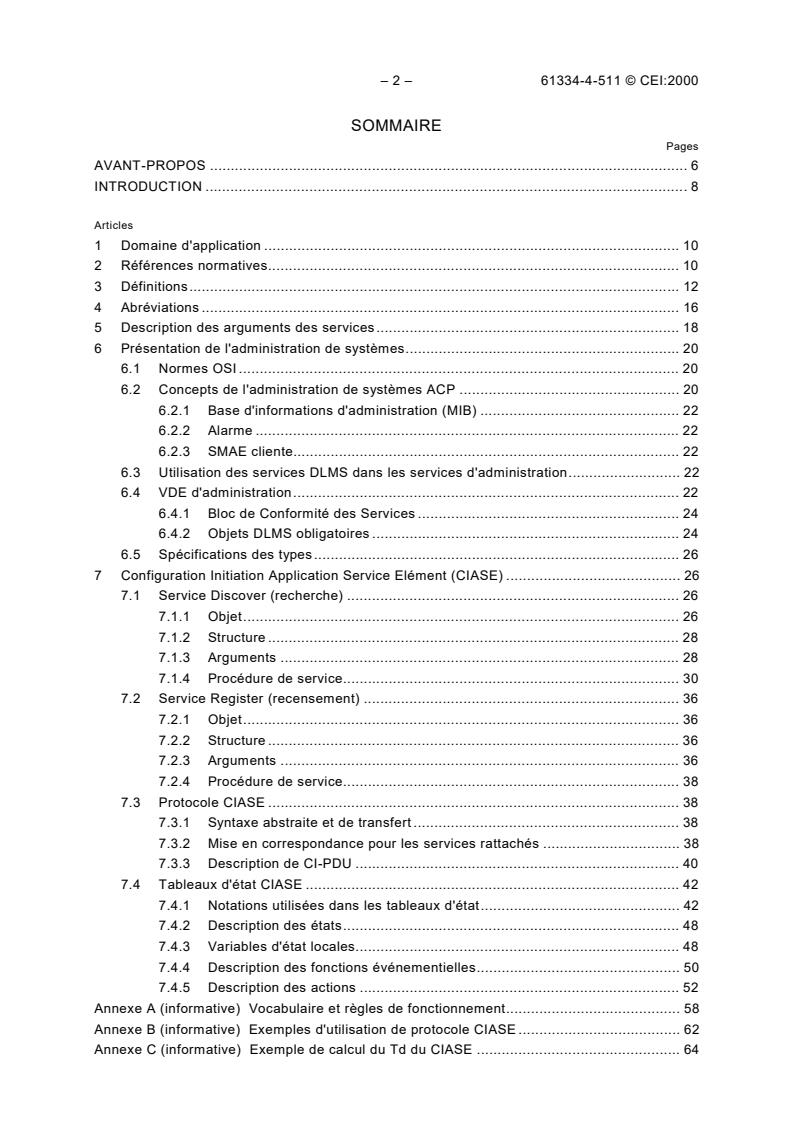
– 2 – 61334-4-511 © CEI:2000
SOMMAIRE
Pages
AVANT-PROPOS . 6
INTRODUCTION .8
Articles
1 Domaine d'application . 10
2 Références normatives. 10
3 Définitions. 12
4 Abréviations .16
5 Description des arguments des services. 18
6 Présentation de l'administration de systèmes. 20
6.1 Normes OSI . 20
6.2 Concepts de l'administration de systèmes ACP . 20
6.2.1 Base d'informations d'administration (MIB) . 22
6.2.2 Alarme . 22
6.2.3 SMAE cliente. 22
6.3 Utilisation des services DLMS dans les services d'administration. 22
6.4 VDE d'administration. 22
6.4.1 Bloc de Conformité des Services . 24
6.4.2 Objets DLMS obligatoires . 24
6.5 Spécifications des types. 26
7 Configuration Initiation Application Service Elément (CIASE) . 26
7.1 Service Discover (recherche) . 26
7.1.1 Objet. 26
7.1.2 Structure . 28
7.1.3 Arguments . 28
7.1.4 Procédure de service. 30
7.2 Service Register (recensement) . 36
7.2.1 Objet. 36
7.2.2 Structure . 36
7.2.3 Arguments . 36
7.2.4 Procédure de service. 38
7.3 Protocole CIASE . 38
7.3.1 Syntaxe abstraite et de transfert . 38
7.3.2 Mise en correspondance pour les services rattachés . 38
7.3.3 Description de CI-PDU . 40
7.4 Tableaux d'état CIASE . 42
7.4.1 Notations utilisées dans les tableaux d'état. 42
7.4.2 Description des états. 48
7.4.3 Variables d'état locales. 48
7.4.4 Description des fonctions événementielles. 50
7.4.5 Description des actions . 52
Annexe A (informative) Vocabulaire et règles de fonctionnement. 58
Annexe B (informative) Exemples d'utilisation de protocole CIASE . 62
Annexe C (informative) Exemple de calcul du Td du CIASE . 64
61334-4-511 © IEC:2000 – 3 –
CONTENTS
Page
FOREWORD . 7
INTRODUCTION .9
Clause
1 Scope . 11
2 Normative references . 11
3 Definitions. 13
4 Abbreviations . 17
5 Service argument description . 19
6 Systems management overview. 21
6.1 OSI standards. 21
6.2 DCP systems management concepts. 21
6.2.1 MIB . 23
6.2.2 Alarm . 23
6.2.3 Client SMAE. 23
6.3 Use of DLMS services in management services. 23
6.4 Management VDE . 23
6.4.1 Service Conformance Block. 25
6.4.2 Mandatory DLMS Objects . 25
6.5 Specifications of types . 27
7 Configuration Initiation Application Service Element. 27
7.1 Discover service. 27
7.1.1 Purpose . 27
7.1.2 Structure . 29
7.1.3 Arguments . 29
7.1.4 Service procedure . 31
7.2 Register service . 37
7.2.1 Purpose . 37
7.2.2 Structure . 37
7.2.3 Arguments . 37
7.2.4 Service Procedure. 39
7.3 CIASE protocol . 39
7.3.1 Abstract and transfer syntax . 39
7.3.2 Mapping to underlying services. 39
7.3.3 CI-PDU description. 41
7.4 CIASE state tables . 43
7.4.1 Notations used in state tables. 43
7.4.2 States description. 49
7.4.3 Local state variables. 49
7.4.4 Event functions description. 51
7.4.5 Actions description . 53
Annex A (informative) Vocabulary and operating rules. 59
Annex B (informative) Examples of CIASE protocol use . 63
Annex C (informative) Example of CIASE Td calculation . 65
– 4 – 61334-4-511 © CEI:2000
Pages
Figure 1 – Processus d'application de l'administration de systèmes. 20
Tableau 1 – Le service Discover . 28
Tableau 2 – Le service Register. 36
Tableau 3 – Tableau d'état du CIASE client . 44
Tableau 4 – Tableau d'état du CIASE serveur . 46
61334-4-511 © IEC:2000 – 5 –
Page
Figure 1 – The Systems Management Application Process. 21
Table 1 – The Discover service. 29
Table 2 – The Register service . 37
Table 3 – The Client CIASE state table . 45
Table 4 – The Server CIASE state table. 47
– 6 – 61334-4-511 © CEI:2000
COMMISSION ÉLECTROTECHNIQUE INTERNATIONALE
____________
AUTOMATISATION DE LA DISTRIBUTION À L'AIDE DE
SYSTÈMES DE COMMUNICATION À COURANTS PORTEURS –
Partie 4-511: Protocoles de communication de données –
Administration de systèmes – Protocole CIASE
AVANT-PROPOS
1) La CEI (Commission Électrotechnique Internationale) est une organisation mondiale de normalisation composée
de l'ensemble des comités électrotechniques nationaux (Comités nationaux de la CEI). La CEI a pour objet de
favoriser la coopération internationale pour toutes les questions de normalisation dans les domaines de
l'électricité et de l'électronique. A cet effet, la CEI, entre autres activités, publie des Normes internationales.
Leur élaboration est confiée à des comités d'études, aux travaux desquels tout Comité national intéressé par le
sujet traité peut participer. Les organisations internationales, gouvernementales et non gouvernementales, en
liaison avec la CEI, participent également aux travaux. La CEI collabore étroitement avec l'Organisation
Internationale de Normalisation (ISO), selon des conditions fixées par accord entre les deux organisations.
2) Les décisions ou accords officiels de la CEI concernant les questions techniques représentent, dans la mesure
du possible, un accord international sur les sujets étudiés, étant donné que les Comités nationaux intéressés
sont représentés dans chaque comité d’études.
3) Les documents produits se présentent sous la forme de recommandations internationales. Ils sont publiés
comme normes, spécifications techniques, rapports techniques ou guides et agréés comme tels par les Comités
nationaux.
4) Dans le but d'encourager l'unification internationale, les Comités nationaux de la CEI s'engagent à appliquer de
façon transparente, dans toute la mesure possible, les Normes internationales de la CEI dans leurs normes
nationales et régionales. Toute divergence entre la norme de la CEI et la norme nationale ou régionale
correspondante doit être indiquée en termes clairs dans cette dernière.
5) La CEI n’a fixé aucune procédure concernant le marquage comme indication d’approbation et sa responsabilité
n’est pas engagée quand un matériel est déclaré conforme à l’une de ses normes.
6) L’attention est attirée sur le fait que certains des éléments de la présente Norme internationale peuvent faire
l’objet de droits de propriété intellectuelle ou de droits analogues. La CEI ne saurait être tenue pour
responsable de ne pas avoir identifié de tels droits de propriété et de ne pas avoir signalé leur existence.
La Norme internationale CEI 61334-4-511 a été établie par le comité d'études 57 de la CEI:
Conduite des systèmes de puissance et communications associées.
Le texte de cette norme est issu des documents suivants:
FDIS Rapport de vote
57/446/FDIS 57/460/RVD
Le rapport de vote indiqué dans le tableau ci-dessus donne toute information sur le vote ayant
abouti à l'approbation de cette norme.
Cette publication a été rédigée selon les Directives ISO/CEI, Partie 3.
Les annexes A, B et C sont données uniquement à titre d'information.
Le comité a décidé que le contenu de cette publication ne sera pas modifié avant 2004. A cette
date, la publication sera
• reconduite;
• supprimée;
• remplacée par une édition révisée, ou
• amendée.
61334-4-511 © IEC:2000 – 7 –
INTERNATIONAL ELECTROTECHNICAL COMMISSION
____________
DISTRIBUTION AUTOMATION USING
DISTRIBUTION LINE CARRIER SYSTEMS –
Part 4-511: Data communication protocols –
Systems management – CIASE protocol
FOREWORD
1) The IEC (International Electrotechnical Commission) is a worldwide organization for standardization comprising
all national electrotechnical committees (IEC National Committees). The object of the IEC is to promote
international co-operation on all questions concerning standardization in the electrical and electronic fields. To
this end and in addition to other activities, the IEC publishes International Standards. Their preparation is
entrusted to technical committees; any IEC National Committee interested in the subject dealt with may
participate in this preparatory work. International, governmental and non-governmental organizations liaising
with the IEC also participate in this preparation. The IEC collaborates closely with the International Organization
for Standardization (ISO) in accordance with conditions determined by agreement between the two
organizations.
2) The formal decisions or agreements of the IEC on technical matters express, as nearly as possible, an
international consensus of opinion on the relevant subjects since each technical committee has representation
from all interested National Committees.
3) The documents produced have the form of recommendations for international use and are published in the form
of standards, technical specifications, technical reports or guides and they are accepted by the National
Committees in that sense.
4) In order to promote international unification, IEC National Committees undertake to apply IEC International
Standards transparently to the maximum extent possible in their national and regional standards. Any
divergence between the IEC Standard and the corresponding national or regional standard shall be clearly
indicated in the latter.
5) The IEC provides no marking procedure to indicate its approval and cannot be rendered responsible for any
equipment declared to be in conformity with one of its standards.
6) Attention is drawn to the possibility that some of the elements of this International Standard may be the subject
of patent rights. The IEC shall not be held responsible for identifying any or all such patent rights.
International Standard IEC 61334-4-511 has been prepared by IEC technical committee 57:
Power system control and associated communications.
The text of this standard is based on the following documents:
FDIS Report on voting
57/446/FDIS 57/460/RVD
Full information on the voting for the approval of this standard can be found in the report on
voting indicated in the above table.
This publication has been drafted in accordance with the ISO/IEC Directives, Part 3.
Annexes A, B and C are for information only.
The committee has decided that the contents of this publication will remain unchanged until 2004.
At this date, the publication will be
• reconfirmed;
• withdrawn;
• replaced by a revised edition, or
• amended.
– 8 – 61334-4-511 © CEI:2000
INTRODUCTION
La description de l'administration de systèmes ACP (Protocole de communication de données)
donnée dans cette partie de la CEI 61334 est développée dans les articles suivants:
L'article 1 définit le domaine d'application de la présente Norme internationale.
L'article 2 énumère les normes ISO/CEI associées.
L'article 3 définit les termes utilisés dans cette norme.
L'article 4 définit les abréviations utilisées dans cette norme.
L'article 5 spécifie les conventions utilisées pour la description des primitives.
L'article 6 introduit les concepts généraux relatifs à l'administration de systèmes ACP.
L'article 7 spécifie le CIASE (Elément de service d'application de l'initiation de la configuration).
61334-4-511 © IEC:2000 – 9 –
INTRODUCTION
The description of the DCP systems management given in this part of IEC 61334 is developed
in the following clauses:
Clause 1 defines the scope of this International Standard.
Clause 2 lists related ISO/IEC standards.
Clause 3 defines the terms used in this standard.
Clause 4 defines the abbreviations used in this standard.
Clause 5 specifies the conventions taken for the description of the primitives.
Clause 6 introduces general concepts related to DCP systems management.
Clause 7 specifies the Configuration Initiation Application Service Element (CIASE).
– 10 – 61334-4-511 © CEI:2000
AUTOMATISATION DE LA DISTRIBUTION À L'AIDE DE
SYSTÈMES DE COMMUNICATION À COURANTS PORTEURS –
Partie 4-511: Protocoles de communication de données –
Administration de systèmes – Protocole CIASE
1 Domaine d'application
La présente partie de la CEI 61334 spécifie les prescriptions relatives à l'administration ACP
(Protocole de communication de données). Elle décrit les services d'administration de manière
abstraite ainsi que le protocole correspondant.
Elle définit la terminologie et décrit les concepts d'administration de systèmes ACP; elle décrit
les activités et les installations d'administration de systèmes ACP et spécifie les services et le
protocole ACP.
2 Références normatives
Les documents normatifs suivants contiennent des dispositions qui, par suite de la référence
qui y est faite, constituent des dispositions valables pour la présente partie de la CEI 61334.
Pour les références datées, les amendements ultérieurs ou les révisions de ces publications ne
s’appliquent pas. Toutefois, les parties prenantes aux accords fondés sur la présente partie de
la CEI 61334 sont invitées à rechercher la possibilité d'appliquer les éditions les plus récentes
des documents normatifs indiqués ci-après. Pour les références non datées, la dernière édition
du document normatif en référence s’applique. Les membres de la CEI et de l'ISO possèdent
le registre des Normes internationales en vigueur.
CEI 61334-4-1:1996, Automatisation de la distribution à l'aide de systèmes de communication à
courants porteurs – Partie 4: Protocoles de communication de données – Section 1: Modèle de
référence du système de communication
CEI 61334-4-32:1996, Automatisation de la distribution à l'aide de systèmes de communication
à courants porteurs – Partie 4: Protocoles de communication de données – Section 32: Couche
liaison de données – Contrôle de liaison logique (LLC)
CEI 61334-4-41:1996, Automatisation de la distribution à l'aide de systèmes de communication
à courants porteurs – Partie 4: Protocoles de communication de données – Section 41:
Protocoles d'application – Spécification des messages de lignes de distribution
CEI 61334-4-42:1996, Automatisation de la distribution à l'aide de systèmes de communication
à courants porteurs – Partie 4: Protocoles de communication de données – Section 42:
Protocoles d'application – Couche application
CEI 61334-4-512, Automatisation de la distribution à l'aide de systèmes de communication à
courants porteurs – Partie 4-512: Protocoles de communication de données – Administration
1)
de systèmes à l'aide du profil 61334-5-1 – MIB (Base d'informations d'administration)
CEI 61334-5-1:1996, Automatisation de la distribution à l'aide de systèmes de communication à
courants porteurs – Partie 5: Profils des couches basses – Section 1: Le profil S-FSK (Spread
Frequency Shift Keying)
___________
1)
A l'étude.
61334-4-511 © IEC:2000 – 11 –
DISTRIBUTION AUTOMATION USING
DISTRIBUTION LINE CARRIER SYSTEMS –
Part 4-511: Data communication protocols –
Systems management – CIASE protocol
1 Scope
This part of IEC 61334 specifies the DCP management requirements. It describes the manage-
ment services in an abstract way as well as the underlying protocol.
It defines terminology and describes concepts for DCP systems management, describes DCP
systems management activities and facilities, and specifies DCP services and protocol.
2 Normative references
The following normative documents contain provisions which, through reference in this text,
constitute provisions of this part of IEC 61334. For dated references, subsequent amendments
to, or revisions of, any of these publications do not apply. However, parties to agreements
based on this part of IEC 61334 are encouraged to investigate the possibility of applying the
most recent editions of the normative documents indicated below. For undated references, the
latest edition of the normative document referred to applies. Members of IEC and ISO maintain
registers of currently valid International Standards.
IEC 61334-4-1:1996, Distribution automation using distribution line carrier systems – Part 4:
Data communication protocols – Section 1: Reference model of the communication system
IEC 61334-4-32:1996, Distribution automation using distribution line carrier systems – Part 4:
Data communication protocols – Section 32: Data link layer – Logical link control (LLC)
IEC 61334-4-41:1996, Distribution automation using distribution line carrier systems – Part 4:
Data communication protocols – Section 41: Application protocols – Distribution line message
specification
IEC 61334-4-42:1996, Distribution automation using distribution line carrier systems – Part 4:
Data communication protocols – Section 42: Application protocols – Application layer
IEC 61334-4-512, Distribution automation using distribution line carrier systems – Part 4-512:
1)
Data communication protocols – Systems management using profile 61334-5-1-MIB
IEC 61334-5-1:1996, Distribution automation using distribution line carrier systems – Part 5:
Lower layer profiles – Section 1: The spread frequency shift keying (S-FSK) profile
___________
1)
Under consideration.
– 12 – 61334-4-511 © CEI:2000
ISO/CEI 7498 (toutes les parties), Technologies de l'information – Interconnexion de systèmes
ouverts – Modèle de référence de base
ISO/CEI 7498-1:1994, Technologies de l'information – Interconnexion de systèmes ouverts
(OSI) – Modèle de référence de base: Le modèle de base
ISO/CEI 7498-3:1997, Technologies de l'information – Interconnexion de systèmes ouverts
(OSI) – Modèle de référence de base – Partie 3: Dénomination et adressage
ISO/CEI 7498-4:1989, Systèmes de traitement de l'information – Interconnexion de systèmes
ouverts – Modèle de référence de base – Partie 4: Cadre général de gestion
ISO/CEI/TR 8509:1987, Systèmes de traitement de l'information – Interconnexion de systèmes
ouverts – Conventions de service
ISO/CEI 9545:1994, Technologies de l'information – Interconnexion de systèmes ouverts (OSI)
– Structure de la couche application
3 Définitions
3.1 Pour les besoins de la présente partie de la CEI 61334, les termes suivants, tels qu'ils
sont définis dans l'ISO/CEI 7498, s'appliquent:
a) système ouvert,
b) application-process: processus d'application,
c) (N)-layer: couche (N),
d) (N)-sublayer: sous-couche (N),
e) (N)-service: service (N),
f) (N)-service-access-point: point d'accès au service (N),
g) (N)-protocol: protocole (N),
h) (N)-protocol-data-unit: unité de données du protocole (N),
i) (N)-service-data-unit: unité de données du service (N),
j) systems-management: administration de systèmes,
k) application-entity: entité d'application,
l) application-service-element: élément de service d'application,
m) user-element: élément utilisateur.
3.2 Pour les besoins de la présente partie de la CEI 61334, les termes suivants, tels qu'ils
sont définis dans l'ISO/CEI 7498-3, s'appliquent:
a) (N)-address: adresse (N),
b) (N)-selector: sélecteur (N),
c) (N)-association: association (N),
d) (N)-directory-function: fonction répertoire (N),
e) (N)-entity: entité (N),
f) (N)-entity-title: titre de l'entité (N),
g) system-title: titre du système.
61334-4-511 © IEC:2000 – 13 –
ISO/IEC 7498 (all parts), Information technology – Open systems interconnection – Basic
reference model
ISO/IEC 7498-1:1994, Information technology – Open systems interconnection – Basic
reference models – The basic model
ISO/IEC 7498-3:1997, Information technology – Open systems interconnection – Basic
reference model – Part 3: Naming and addressing
ISO/IEC 7498-4:1989, Information processing systems – Open systems interconnection – Basic
reference model – Part 4: Management framework
ISO/IEC/TR 8509:1987, Information processing systems – Open systems interconnection –
Service conventions
ISO/IEC 9545:1994, Information technology – Open systems interconnection – Application
layer structure
3 Definitions
3.1 For the purposes of this part of IEC 61334, the following terms as defined in ISO/IEC 7498
apply:
a) open system,
b) application-process,
c) (N)-layer,
d) (N)-sublayer,
e) (N)-service,
f) (N)-service-access-point,
g) (N)-protocol,
h) (N)-protocol-data-unit,
i) (N)-service-data-unit,
j) systems-management,
k) application-entity,
l) application-service-element,
m) user-element.
3.2 For the purposes of this part of IEC 61334, the following terms as defined in ISO/IEC 7498-3
apply:
a) (N)-address,
b) (N)-selector,
c) (N)-association,
d) (N)-directory-function,
e) (N)-entity,
f) (N)-entity-title,
g) system-title.
– 14 – 61334-4-511 © CEI:2000
3.3 Pour les besoins de la présente partie de la CEI 61334, les termes suivants, tels qu'ils
sont définis dans l'ISO/CEI 7498-4, s'appliquent:
a) Systems management application-entity: entité d'application de l'administration de
systèmes,
b) OSI Management: Administration OSI,
c) Managed Object: Objet d'administration,
d) Management Information Base: Base d'informations d'administration.
3.4 Pour les besoins de la présente partie de la CEI 61334, les termes suivants, tels qu'ils
sont définis dans l'ISO/CEI/TR 8509, s'appliquent:
a) primitive (primitive),
b) request (demande),
c) indication (indication),
d) response (réponse),
e) confirm (confirmation),
f) service provider (prestataire de service),
g) service user (utilisateur d'un service).
3.5 Pour les besoins de la présente partie de la CEI 61334, le terme suivant, tel qu'il est
défini dans l'ISO/CEI 9545, s'applique:
a) application-context: contexte d'application.
3.6 Pour les besoins de la présente partie de la CEI 61334, les termes suivants, tels qu'ils
sont définis dans la CEI 61334-4-1, s'appliquent:
a) NEW-address: adresse NEW,
b) AllNew-Title: titre AllNew,
c) Source-Title: titre Source,
d) AllSMAE-Title: titre AllSMAE,
e) AllCIASE-Title: titre AllCIASE.
3.7 Pour les besoins de la présente partie de la CEI 61334, les termes suivants, tels qu'ils
sont définis dans la CEI 61334-4-41, s'appliquent:
a) client (client),
b) server (serveur),
c) Virtual Distributing Equipment, VDE (Equipement virtuel de distribution),
d) Task Invocation (Invocation de Tâche),
e) Data Set (Ensemble de données),
f) conformance (conformité).
3.8 Pour les besoins de la présente partie de la CEI 61334, le terme «initiateur» n'est pas
utilisé selon la définition de l'ISO/CEI 7498-3. Il est redéfini comme suit:
3.8.1
initiateur
élément utilisateur d'une SMAE client (il utilise les ASE de CIASE et de DLMS et est identifié
par son titre de système)
61334-4-511 © IEC:2000 – 15 –
3.3 For the purposes of this part of IEC 61334, the following terms as defined in ISO/IEC 7498-4
apply:
a) Systems management application-entity,
b) OSI Management,
c) Managed Object,
d) Management Information Base.
3.4 For the purposes of this part of IEC 61334, the following terms as defined in ISO/IEC/
TR 8509 apply:
a) primitive,
b) request,
c) indication,
d) response,
e) confirm,
f) service provider,
g) service user.
3.5 For the purposes of this part of IEC 61334, the following term as defined in ISO/IEC 9545
applies:
a) application-context.
3.6 For the purposes of this part of IEC 61334, the following terms as defined in IEC 61334-4-1
apply:
a) NEW-address,
b) AllNew-Title,
c) Source-Title,
d) AllSMAE-Title,
e) AllCIASE-Title.
3.7 For the purposes of this part of IEC 61334, the following terms as defined in IEC 61334-4-41
apply:
a) client,
b) server,
c) Virtual Distributing Equipment (VDE),
d) Task Invocation,
e) Data Set,
f) conformance.
3.8 For the purposes of this part of IEC 61334, the term "initiator" is not used as defined in
ISO/IEC 7498-3. It is redefined thus:
3.8.1
initiator
user-element of a client SMAE (it uses the CIASE and DLMS ASE and is identified by its
system title)
– 16 – 61334-4-511 © CEI:2000
3.9 Pour les besoins de la présente partie de la CEI 61334, les définitions suivantes
s'appliquent:
3.9.1
initiateur actif
initiateur qui émet ou vient d'émettre une demande Register (recensement) CIASE lorsque le
serveur est en état non configuré
3.9.2
administrateur
élément utilisateur des ASE de CIASE et DLMS appartenant à l'unique SMAE de chaque
système serveur
3.9.3
nouveau système
système serveur en état non configuré: son adresse MAC correspond à l'adresse NEW
3.9.4
titre de nouveau système
titre de système d'un nouveau système
3.9.5
système recensé
système serveur ayant une adresse MAC valide individuelle (donc différente de l'adresse NEW,
voir la CEI 61334-5-1: Medium Access Control, Contrôle d'Accès Moyen)
3.9.6
système de notification
système serveur qui émet une demande DiscoverReport (notification de recherche)
3.9.7
système
synonyme de système réel ouvert
4 Abréviations
ACSE Elément de service de contrôle d'association
APDU Unité de données de protocole d'application
ASE Elément de service d'application
CEI Commission Electrotechnique Internationale
CIASE Elément de service d'application de l'initiation de la configuration
Conf Confirmation
CRC Code de redondance cyclique (voir la CEI 61334-5-1)
DASE Elément de service d'application DLMS
ACP Protocole de communication de données
DLMS Spécification des messages de ligne de distribution
Ind Indication
ISO Organisation Internationale de Normalisation
LLC Contrôle de liaison logique
L-SAP Point d'accès de la liaison de service
MAC Contrôle d'accès moyen
61334-4-511 © IEC:2000 – 17 –
3.9 For the purposes of this part of IEC 61334, the following definitions apply.
3.9.1
active initiator
initiator which issues or has last issued a CIASE Register request when the server is in the
unconfigured state
3.9.2
manager
user-element of the CIASE and DLMS ASEs that belongs to the sole SMAE of each server
system
3.9.3
new system
server system which is in the unconfigured state: its MAC address equals "NEW-address"
3.9.4
new system title
system-title of a new system
3.9.5
registered system
server system which has an individual valid MAC address (therefore, different from "NEW-
Address", see IEC 61334-5-1: Medium Access Control)
3.9.6
reporting system
server system which issues a DiscoverReport request
3.9.7
system
synonymous for real open system
4 Abbreviations
ACSE Association Control Service Element
APDU Application Protocol Data Unit
ASE Application Service Element
CIASE Configuration Initiation ASE
Conf Confirm
CRC Cyclic Redundancy Code (see IEC 61334-5-1)
DASE DLMS Application Service Element
DCP Data Communication Protocols
DLMS Distribution Line Message Specification
Ind Indication
IEC International Electrotechnical Commission
ISO International Organization for Standardization
LLC Logical Link Control
L-SAP Link Service Access Point
MAC Medium Access Control
– 18 – 61334-4-511 © CEI:2000
MIB Base d'informations d'administration
OSI Interconnexion de systèmes ouverts
OSIE Environnement d'interconnexion de systèmes ouverts
PDU Unité de données de protocole
Req Demande
SAP Point d'accès au service
SDU Unité de données de service
SMAE Entité d'application de l'administration de systèmes
SMAP Processus d'application de l'administration de systèmes
VAA Association virtuelle d'applications
VDE Equipement virtuel de distribution
Les initiales suivantes sont utilisées pour indiquer le type de couche ou de sous-couche:
a) PHY – Couche physique,
b) DL – Couche liaison de données,
c) MA – Sous-couche MAC,
d) L – Sous-couche LLC,
e) CI – Sous-couche CIASE (couche application).
5 Description des arguments des services
La présente norme décrit sous la forme de tableaux les arguments composant les primitives
des services de CIASE. Chaque tableau peut contenir une ou deux colonnes décrivant les
arguments des services et les primitives de demande («Req»), de confirmation («Conf»). La
colonne «Conf» est absente lorsque le service n'est pas un service confirmé. L'initiateur (qui
est un utilisateur de CIASE) utilise les services de CIASE.
Dans chaque tableau, un argument (ou une de ses parties) figure sur chaque ligne horizontale.
Dans la colonne de primitive de service appropriée, on utilise un code pour spécifier le type
d'utilisation de cet argument.
Les codes utilisés sont les suivants:
a) M – cet argument est obligatoire pour la primitive;
b) U – cet argument est une option de l'Utilisateur; il peut ne pas être fourni en fonction de
l'usage dynamique qui en est fait par l'utilisateur CIASE;
c) S – cet argument est Sélectionné parmi d'autres arguments S;
d) C – cet argument dépend d'autres arguments ou de l'environnement de l'utilisateur CIASE;
e) (blanc) – cet argument n'est jamais utilisé.
Le code «(=)» suivant un des codes M, U, C ou S indique que cet argument est
sémantiquement équivalent à l'argument de la primitive de service située immédiatement à sa
gauche dans le tableau. (Par exemple, un code «M(=)» dans la colonne de la primitive du
service «indication» et un «M» dans la colonne de la primitive de service «request» signifie que
cet argument dans la primitive «indication» est sémantiquement équivalent à celui de la
primitive «request»).
61334-4-511 © IEC:2000 – 19 –
MIB Management Information Base
OSI Open Systems Interconnection
OSIE Open Systems Interconnection Environment
PDU Protocol Data Unit
Req Request
SAP Service Access Point
SDU Service Data Unit
SMAE Systems Management Application Entity
SMAP Systems Management Application Process
VAA Virtual Application Association
VDE Virtual Distribution Equipment
The following initials are used to specify the layers or sublayers:
a) PHY – Physical layer,
b) DL – Data_Link layer,
c) MA – MAC sublayer,
d) L – LLC sublayer,
e) CI – CIASE sublayer (application layer).
5 Service argument description
This standard uses a tabular format to describe the component arguments of the CIASE
service primitives. Each table consists of one to two columns describing the service arguments
and the request ("Req"), and confirm ("Conf") primitives. The "Conf" column is absent when the
service is not a confirmed service. The initiator (which is a CIASE-user) uses the CIASE
services.
In each table, one argument (or a part of it) is listed on each horizontal line. Under the appro-
priate service primitive columns, a code is used to specify the type of usage of the argument.
The codes used are listed below:
a) M – the argument is Mandatory for the primitive;
b) U – the argument is a User option, and may or may not be provided depending on dynamic
usage by the CIASE user;
c) S – the argument is Selected among other S-arguments;
d) C – the argument is Conditional upon other arguments or the environment of the CIASE
user;
e) (blank) – the argument is never present.
The "(=)" code following one of the M, U, C or S codes indicates that the argument is
semantically equivalent to the argument in the service primitive to its immediate left in the
table. (For instance, an "M(=)" code in the indication service primitive column and an "M" in
the request service primitive column means that the argument in the indication primitive is
semantically equivalent to the one in the request primitive.)
– 22 – 61334-4-511 © CEI:2000
Par conséquent, la SMAE de ACP minimal contient trois ASE, représentés à la figure 1:
– le CIASE pour configurer le système,
– l'ACSE (élément de service de contrôle d'association) pour assurer l'association
d'application nécessaire à l'environnement DLMS,
– l'ASE de DLMS pour supporter l'environnement DLMS.
L'élément utilisateur d'un serveur unique de SMAE est appelé «administrateur». Un élément
utilisateur client d'une SMAE est appelé «initiateur». Ces deux éléments utilisent les services
CIASE et DLMS.
6.2.1 Base d'informations d'administration (MIB)
Sur un système serveur, une ressource qui peut être gér
...
Questions, Comments and Discussion
Ask us and Technical Secretary will try to provide an answer. You can facilitate discussion about the standard in here.
Loading comments...