

IEC 62196-3:2014
(Main)Plugs, socket-outlets, vehicle connectors and vehicle inlets - Conductive charging of electric vehicles - Part 3: Dimensional compatibility and interchangeability requirements for d.c. and a.c./d.c. pin and contact-tube vehicle couplers
General Information
- Abstract
IEC 62196-3:2014 is applicable to vehicle couplers with pins and contact-tubes of standardized configuration, herein also referred to as "accessories", intended for use in electric vehicle conductive charging systems which incorporate control means, with rated operating voltage up to 1 500 V d.c. and rated current up to 250 A, and 1 000 V a.c. and rated current up to 250 A. This part of IEC 62196 applies to high power d.c. interfaces and combined a.c./d.c. interfaces of vehicle couplers specified in IEC 62196-1:2014, and intended for use in conductive charging systems for circuits specified in IEC 61851-1:2010, and IEC 61851-23:2014.
This publication is to be read in conjunction with IEC 62196-1:2014.
- Status
- Published
- Publication Date
- 18-Jun-2014
- Technical Committee
- SC 23H - Plugs, Socket-outlets and Couplers for industrial and similar applications, and for Electric Vehicles
- Drafting Committee
- MT 8 - TC 23/SC 23H/MT 8
- Current Stage
- DELPUB - Deleted Publication
- Start Date
- 19-Oct-2022
- Completion Date
- 31-Jul-2017
Buy Documents
IEC 62196-3:2014 - Plugs, socket-outlets, vehicle connectors and vehicle inlets - Conductive charging of electric vehicles - Part 3: Dimensional compatibility and interchangeability requirements for d.c. and a.c./d.c. pin and contact-tube vehicle couplers Released:6/19/2014
Overview
IEC 62196-3:2014 is an international standard published by the International Electrotechnical Commission (IEC) that defines the dimensional compatibility and interchangeability requirements for direct current (d.c.) and combined alternating/direct current (a.c./d.c.) pin and contact-tube vehicle couplers used in the conductive charging of electric vehicles (EVs). This standard is a critical part of the IEC 62196 series, which focuses on plugs, socket-outlets, vehicle connectors, and vehicle inlets for EV charging. Specifically, Part 3 targets high power d.c. interfaces and combined a.c./d.c. interfaces, providing standardized configurations for vehicle couplers rated up to 1500 V d.c. and 1000 V a.c., with currents up to 250 A.
The standard supports the widespread adoption of electric and plug-in hybrid vehicles by ensuring interoperable and safe charging connectivity between vehicles and charging stations. It complements related standards such as IEC 62196-1 and IEC 61851, facilitating a uniform framework for EV conductive charging systems.
Key Topics
Dimensional Compatibility and Interchangeability
IEC 62196-3 establishes the exact physical dimensions and interface configurations for vehicle couplers, ensuring that connectors and inlets fit correctly across different manufacturers and charging equipment.Rated Electrical Characteristics
The standard covers vehicle couplers designed for high-power charging applications - up to 1500 V d.c. and 250 A, and 1000 V a.c. and 250 A - enabling fast and efficient electric vehicle charging.Safety and Control Integration
It specifies requirements for incorporating control means within conductive charging systems, enhancing safety against electric shock and ensuring reliable power delivery.Design and Construction Requirements
The document includes specifications on materials, mechanical strength, resistance to environmental factors, and electrical parameters such as insulation resistance and dielectric strength.Interlocks and Protection
The standard mandates interlock features to prevent accidental disconnection under load and mandates procedures to protect against electric shocks, ensuring user safety.Markings and Identification
Clear marking requirements are specified to facilitate proper identification, usage, and maintenance of vehicle couplers.Compatibility with Other Standards
IEC 62196-3 is intended to be read in conjunction with IEC 62196-1 (general requirements) and aligns with charging circuit specifications outlined in IEC 61851-1 and IEC 61851-23.
Applications
IEC 62196-3:2014 is directly applicable to manufacturers, designers, and engineers involved in:
Electric Vehicle Manufacturing
Ensuring EVs are equipped with standardized vehicle inlets that accept compliant charging connectors, enabling seamless charging.Charging Infrastructure Development
Guiding design and production of high-power charging stations that reliably interface with standardized vehicle connectors.Global EV Market Expansion
Facilitating international interoperability of conductive charging equipment, reducing market fragmentation and enhancing user convenience.Safety Compliance and Certification
Assisting certification bodies and industry stakeholders in conformance testing for high-power EV conductive charging systems.Component Suppliers
Assisting suppliers in manufacturing plugs, socket-outlets, and connectors that meet stringent international dimensional and electrical specifications.
Related Standards
IEC 62196-1: General requirements for plugs, socket-outlets, vehicle connectors, and vehicle inlets for conductive charging of EVs - serves as the foundation for Part 3.
IEC 62196-2: Specifies dimensional compatibility and interchangeability for a.c. pin and contact-tube accessories, focusing on lower power and alternating current charging systems.
IEC 61851-1: Standard for electric vehicle conductive charging system general requirements, closely linked to operational control and safety.
IEC 61851-23: Focuses on d.c. electric vehicle charging station requirements, aligning with the high-power interface specifications of IEC 62196-3.
ISO/IEC Directives, Part 2: Governs the drafting and presentation of international standards, referenced in the development of IEC 62196-3.
Practical Value
Adherence to IEC 62196-3:2014 strengthens EV charging ecosystem consistency by enabling:
Universal Charging Connectivity: Standardized coupler dimensions facilitate interchangeability, reducing compatibility issues for EV users.
Enhanced Safety: Mandatory protective features including interlocks and insulation requirements minimize electrical hazards during charging.
Support for High-Power Charging: Couplers capable of supporting up to 250 A at high voltages enable rapid charging solutions critical for widespread EV adoption.
Global Market Integration: Harmonized technical specifications simplify cross-border trade and usage of EV charging components and equipment.
Quality and Reliability: Standardized materials and construction criteria improve durability and performance under diverse environmental conditions.
By implementing IEC 62196-3, the industry can advance reliable, safe, and efficient conductive charging systems that facilitate the transition towards cleaner mobility solutions.
Relations
- Effective Date
- 25-Aug-2026
- Effective Date
- 13-May-2026
- Effective Date
- 05-Sep-2023
Buy Documents
IEC 62196-3:2014 - Plugs, socket-outlets, vehicle connectors and vehicle inlets - Conductive charging of electric vehicles - Part 3: Dimensional compatibility and interchangeability requirements for d.c. and a.c./d.c. pin and contact-tube vehicle couplers Released:6/19/2014
Get Certified
Connect with accredited certification bodies for this standard

TÜV Rheinland
TÜV Rheinland is a leading international provider of technical services.

TÜV SÜD
TÜV SÜD is a trusted partner of choice for safety, security and sustainability solutions.

DEKRA Certification Inc.
DEKRA US certification services.
Sponsored listings
Frequently Asked Questions
IEC 62196-3:2014 is a standard published by the International Electrotechnical Commission (IEC). Its full title is "Plugs, socket-outlets, vehicle connectors and vehicle inlets - Conductive charging of electric vehicles - Part 3: Dimensional compatibility and interchangeability requirements for d.c. and a.c./d.c. pin and contact-tube vehicle couplers". This standard covers: IEC 62196-3:2014 is applicable to vehicle couplers with pins and contact-tubes of standardized configuration, herein also referred to as "accessories", intended for use in electric vehicle conductive charging systems which incorporate control means, with rated operating voltage up to 1 500 V d.c. and rated current up to 250 A, and 1 000 V a.c. and rated current up to 250 A. This part of IEC 62196 applies to high power d.c. interfaces and combined a.c./d.c. interfaces of vehicle couplers specified in IEC 62196-1:2014, and intended for use in conductive charging systems for circuits specified in IEC 61851-1:2010, and IEC 61851-23:2014. This publication is to be read in conjunction with IEC 62196-1:2014.
IEC 62196-3:2014 is applicable to vehicle couplers with pins and contact-tubes of standardized configuration, herein also referred to as "accessories", intended for use in electric vehicle conductive charging systems which incorporate control means, with rated operating voltage up to 1 500 V d.c. and rated current up to 250 A, and 1 000 V a.c. and rated current up to 250 A. This part of IEC 62196 applies to high power d.c. interfaces and combined a.c./d.c. interfaces of vehicle couplers specified in IEC 62196-1:2014, and intended for use in conductive charging systems for circuits specified in IEC 61851-1:2010, and IEC 61851-23:2014. This publication is to be read in conjunction with IEC 62196-1:2014.
IEC 62196-3:2014 is classified under the following ICS (International Classification for Standards) categories: 01.040.33 - Telecommunications. Audio and video engineering (Vocabularies); 29.120.30 - Plugs, socket-outlets, couplers; 33.080 - Integrated Services Digital Network (ISDN); 43.120 - Electric road vehicles. The ICS classification helps identify the subject area and facilitates finding related standards.
IEC 62196-3:2014 has the following relationships with other standards: It is inter standard links to EN ISO 17409:2017, EN ISO 17409:2020, IEC 62196-3:2022. Understanding these relationships helps ensure you are using the most current and applicable version of the standard.
IEC 62196-3:2014 is available in PDF format for immediate download after purchase. The document can be added to your cart and obtained through the secure checkout process. Digital delivery ensures instant access to the complete standard document.
Standards Content (Sample)
IEC 62196-3 ®
Edition 1.0 2014-06
INTERNATIONAL
STANDARD
NORME
INTERNATIONALE
Plugs, socket-outlets, vehicle connectors and vehicle inlets – Conductive
charging of electric vehicles –
Part 3: Dimensional compatibility and interchangeability requirements for d.c.
and a.c./d.c. pin and contact-tube vehicle couplers
Fiches, socles de prise de courant, prises mobiles de véhicule et socles de
connecteur de véhicule – Charge conductive des véhicules électriques –
Partie 3: Exigences dimensionnelles de compatibilité et d’interchangeabilité
pour les connecteurs de véhicule à broches et alvéoles pour courant continu et
pour courants alternatif et continu
All rights reserved. Unless otherwise specified, no part of this publication may be reproduced or utilized in any form
or by any means, electronic or mechanical, including photocopying and microfilm, without permission in writing from
either IEC or IEC's member National Committee in the country of the requester. If you have any questions about IEC
copyright or have an enquiry about obtaining additional rights to this publication, please contact the address below or
your local IEC member National Committee for further information.
Droits de reproduction réservés. Sauf indication contraire, aucune partie de cette publication ne peut être reproduite
ni utilisée sous quelque forme que ce soit et par aucun procédé, électronique ou mécanique, y compris la photocopie
et les microfilms, sans l'accord écrit de l'IEC ou du Comité national de l'IEC du pays du demandeur. Si vous avez des
questions sur le copyright de l'IEC ou si vous désirez obtenir des droits supplémentaires sur cette publication, utilisez
les coordonnées ci-après ou contactez le Comité national de l'IEC de votre pays de résidence.
IEC Central Office Tel.: +41 22 919 02 11
3, rue de Varembé Fax: +41 22 919 03 00
CH-1211 Geneva 20 info@iec.ch
Switzerland www.iec.ch
About the IEC
The International Electrotechnical Commission (IEC) is the leading global organization that prepares and publishes
International Standards for all electrical, electronic and related technologies.
About IEC publications
The technical content of IEC publications is kept under constant review by the IEC. Please make sure that you have the
latest edition, a corrigenda or an amendment might have been published.
IEC Catalogue - webstore.iec.ch/catalogue Electropedia - www.electropedia.org
The stand-alone application for consulting the entire The world's leading online dictionary of electronic and
bibliographical information on IEC International Standards, electrical terms containing more than 30 000 terms and
Technical Specifications, Technical Reports and other definitions in English and French, with equivalent terms in 14
documents. Available for PC, Mac OS, Android Tablets and additional languages. Also known as the International
iPad. Electrotechnical Vocabulary (IEV) online.
IEC publications search - www.iec.ch/searchpub IEC Glossary - std.iec.ch/glossary
The advanced search enables to find IEC publications by a More than 55 000 electrotechnical terminology entries in
variety of criteria (reference number, text, technical English and French extracted from the Terms and Definitions
committee,…). It also gives information on projects, replaced clause of IEC publications issued since 2002. Some entries
and withdrawn publications. have been collected from earlier publications of IEC TC 37,
77, 86 and CISPR.
IEC Just Published - webstore.iec.ch/justpublished
Stay up to date on all new IEC publications. Just Published IEC Customer Service Centre - webstore.iec.ch/csc
details all new publications released. Available online and If you wish to give us your feedback on this publication or
also once a month by email. need further assistance, please contact the Customer Service
Centre: csc@iec.ch.
A propos de l'IEC
La Commission Electrotechnique Internationale (IEC) est la première organisation mondiale qui élabore et publie des
Normes internationales pour tout ce qui a trait à l'électricité, à l'électronique et aux technologies apparentées.
A propos des publications IEC
Le contenu technique des publications IEC est constamment revu. Veuillez vous assurer que vous possédez l’édition la
plus récente, un corrigendum ou amendement peut avoir été publié.
Catalogue IEC - webstore.iec.ch/catalogue Electropedia - www.electropedia.org
Application autonome pour consulter tous les renseignements
Le premier dictionnaire en ligne de termes électroniques et
bibliographiques sur les Normes internationales,
électriques. Il contient plus de 30 000 termes et définitions en
Spécifications techniques, Rapports techniques et autres
anglais et en français, ainsi que les termes équivalents dans
documents de l'IEC. Disponible pour PC, Mac OS, tablettes
14 langues additionnelles. Egalement appelé Vocabulaire
Android et iPad.
Electrotechnique International (IEV) en ligne.
Recherche de publications IEC - www.iec.ch/searchpub
Glossaire IEC - std.iec.ch/glossary
La recherche avancée permet de trouver des publications IEC Plus de 55 000 entrées terminologiques électrotechniques, en
en utilisant différents critères (numéro de référence, texte, anglais et en français, extraites des articles Termes et
comité d’études,…). Elle donne aussi des informations sur les Définitions des publications IEC parues depuis 2002. Plus
projets et les publications remplacées ou retirées. certaines entrées antérieures extraites des publications des
CE 37, 77, 86 et CISPR de l'IEC.
IEC Just Published - webstore.iec.ch/justpublished
Service Clients - webstore.iec.ch/csc
Restez informé sur les nouvelles publications IEC. Just
Published détaille les nouvelles publications parues. Si vous désirez nous donner des commentaires sur cette
Disponible en ligne et aussi une fois par mois par email. publication ou si vous avez des questions contactez-nous:
csc@iec.ch.
IEC 62196-3 ®
Edition 1.0 2014-06
INTERNATIONAL
STANDARD
NORME
INTERNATIONALE
Plugs, socket-outlets, vehicle connectors and vehicle inlets – Conductive
charging of electric vehicles –
Part 3: Dimensional compatibility and interchangeability requirements for d.c.
and a.c./d.c. pin and contact-tube vehicle couplers
Fiches, socles de prise de courant, prises mobiles de véhicule et socles de
connecteur de véhicule – Charge conductive des véhicules électriques –
Partie 3: Exigences dimensionnelles de compatibilité et d’interchangeabilité
pour les connecteurs de véhicule à broches et alvéoles pour courant continu et
pour courants alternatif et continu
INTERNATIONAL
ELECTROTECHNICAL
COMMISSION
COMMISSION
ELECTROTECHNIQUE
PRICE CODE
INTERNATIONALE
CODE PRIX W
ICS 29.120.30, 43.120 ISBN 978-2-8322-1668-2
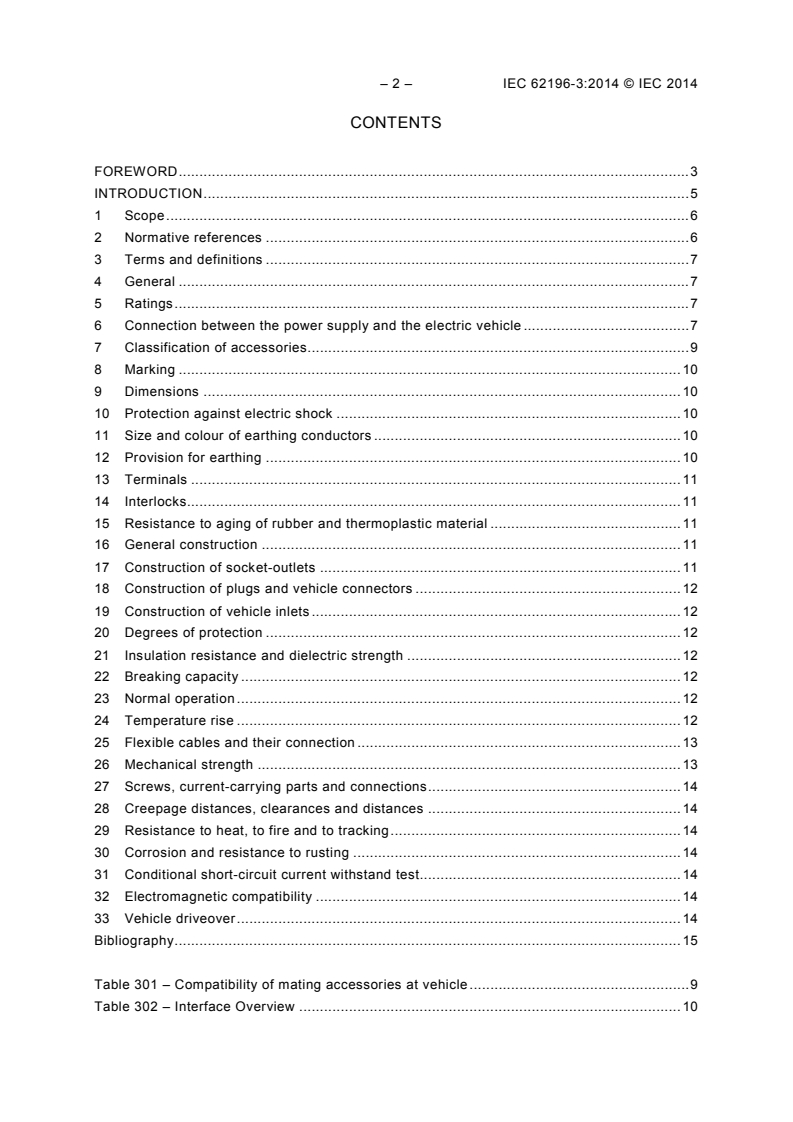
– 2 – IEC 62196-3:2014 © IEC 2014
CONTENTS
FOREWORD . 3
INTRODUCTION . 5
1 Scope . 6
2 Normative references . 6
3 Terms and definitions . 7
4 General . 7
5 Ratings . 7
6 Connection between the power supply and the electric vehicle . 7
7 Classification of accessories. 9
8 Marking . 10
9 Dimensions . 10
10 Protection against electric shock . 10
11 Size and colour of earthing conductors . 10
12 Provision for earthing . 10
13 Terminals . 11
14 Interlocks. 11
15 Resistance to aging of rubber and thermoplastic material . 11
16 General construction . 11
17 Construction of socket-outlets . 11
18 Construction of plugs and vehicle connectors . 12
19 Construction of vehicle inlets . 12
20 Degrees of protection . 12
21 Insulation resistance and dielectric strength . 12
22 Breaking capacity . 12
23 Normal operation . 12
24 Temperature rise . 12
25 Flexible cables and their connection . 13
26 Mechanical strength . 13
27 Screws, current-carrying parts and connections . 14
28 Creepage distances, clearances and distances . 14
29 Resistance to heat, to fire and to tracking . 14
30 Corrosion and resistance to rusting . 14
31 Conditional short-circuit current withstand test. 14
32 Electromagnetic compatibility . 14
33 Vehicle driveover . 14
Bibliography . 15
Table 301 – Compatibility of mating accessories at vehicle . 9
Table 302 – Interface Overview . 10
INTERNATIONAL ELECTROTECHNICAL COMMISSION
____________
PLUGS, SOCKET-OUTLETS, VEHICLE
CONNECTORS AND VEHICLE INLETS –
CONDUCTIVE CHARGING OF ELECTRIC VEHICLES –
Part 3: Dimensional compatibility and interchangeability requirements
for d.c. and a.c./d.c. pin and contact-tube vehicle couplers
FOREWORD
1) The International Electrotechnical Commission (IEC) is a worldwide organization for standardization comprising
all national electrotechnical committees (IEC National Committees). The object of IEC is to promote
international co-operation on all questions concerning standardization in the electrical and electronic fields. To
this end and in addition to other activities, IEC publishes International Standards, Technical Specifications,
Technical Reports, Publicly Available Specifications (PAS) and Guides (hereafter referred to as “IEC
Publication(s)”). Their preparation is entrusted to technical committees; any IEC National Committee interested
in the subject dealt with may participate in this preparatory work. International, governmental and non-
governmental organizations liaising with the IEC also participate in this preparation. IEC collaborates closely
with the International Organization for Standardization (ISO) in accordance with conditions determined by
agreement between the two organizations.
2) The formal decisions or agreements of IEC on technical matters express, as nearly as possible, an international
consensus of opinion on the relevant subjects since each technical committee has representation from all
interested IEC National Committees.
3) IEC Publications have the form of recommendations for international use and are accepted by IEC National
Committees in that sense. While all reasonable efforts are made to ensure that the technical content of IEC
Publications is accurate, IEC cannot be held responsible for the way in which they are used or for any
misinterpretation by any end user.
4) In order to promote international uniformity, IEC National Committees undertake to apply IEC Publications
transparently to the maximum extent possible in their national and regional publications. Any divergence
between any IEC Publication and the corresponding national or regional publication shall be clearly indicated in
the latter.
5) IEC itself does not provide any attestation of conformity. Independent certification bodies provide conformity
assessment services and, in some areas, access to IEC marks of conformity. IEC is not responsible for any
services carried out by independent certification bodies.
6) All users should ensure that they have the latest edition of this publication.
7) No liability shall attach to IEC or its directors, employees, servants or agents including individual experts and
members of its technical committees and IEC National Committees for any personal injury, property damage or
other damage of any nature whatsoever, whether direct or indirect, or for costs (including legal fees) and
expenses arising out of the publication, use of, or reliance upon, this IEC Publication or any other IEC
Publications.
8) Attention is drawn to the Normative references cited in this publication. Use of the referenced publications is
indispensable for the correct application of this publication.
9) Attention is drawn to the possibility that some of the elements of this IEC Publication may be the subject of
patent rights. IEC shall not be held responsible for identifying any or all such patent rights.
International Standard IEC 62196-3 has been prepared by subcommittee 23H: Plugs, socket-
outlets and couplers foe industrial and similar applications, and for electric vehicles, of IEC
technical committee 23: Electrical accessories.
The text of this standard is based on the following documents:
FDIS Report on voting
23H/303/FDIS 23H/306/RVD
Full information on the voting for the approval of this standard can be found in the report on
voting indicated in the above table.
– 4 – IEC 62196-3:2014 © IEC 2014
This publication has been drafted in accordance with the ISO/IEC Directives, Part 2.
A list of all the parts in the IEC 62196 series, under the general title Plugs, socket-outlets,
vehicle connectors and vehicle inlets – Conductive charging of electric vehicles, can be found
on the IEC website.
This part of IEC 62196 is to be read in conjunction with IEC 62196-1. The clauses of the
particular requirements in Part 3 supplement or modify the corresponding clauses in Part 1.
Where the text indicates an "addition" to or a "replacement" of the relevant requirement, test
specification or explanation of Part 1, these changes are made to the relevant text of Part 1,
which then becomes part of the standard.
Subclauses, figures, tables or notes which are additional to those in IEC 62196-1 are
numbered starting from 301.
In this standard, the following print types are used:
– requirements proper: in roman type;
– test specifications: in italic type;
– notes: in smaller roman type.
The committee has decided that the contents of this publication will remain unchanged until
the stability date indicated on the IEC web site under "http://webstore.iec.ch" in the data
related to the specific publication. At this date, the publication will be
• reconfirmed,
• withdrawn,
• replaced by a revised edition, or
• amended.
INTRODUCTION
Responding to global challenges of CO reduction and energy security, the automobile
industries have been accelerating the development and commercialization of electric vehicles
and hybrid electric vehicles.
In addition to the prevailing hybrid electric vehicles, battery electric vehicles including plug-in
hybrid electric vehicles are going to be mass-marketed.
To support the diffusion of such vehicles, this standard provides the standard interface
configurations of vehicle couplers to be used in conductive charging of electric vehicles,
taking the most frequent charging situations into consideration.
IEC 62196 is divided into several parts as follows:
– Part 1: General requirements, comprising clauses of a general character.
– Part 2: Dimensional compatibility and interchangeability requirements for a.c. pin and
contact-tube accessories.
– Part 3: Dimensional compatibility and interchangeability requirements for d.c. and a.c./d.c.
pin and contact-tube vehicle couplers.
– 6 – IEC 62196-3:2014 © IEC 2014
PLUGS, SOCKET-OUTLETS, VEHICLE
CONNECTORS AND VEHICLE INLETS –
CONDUCTIVE CHARGING OF ELECTRIC VEHICLES –
Part 3: Dimensional compatibility and interchangeability requirements
for d.c. and a.c./d.c. pin and contact-tube vehicle couplers
1 Scope
This part of IEC 62196 is applicable to vehicle couplers with pins and contact-tubes of
standardized configuration, herein also referred to as “accessories”, intended for use in
electric vehicle conductive charging systems which incorporate control means, with rated
operating voltage up to 1 500 V d.c. and rated current up to 250 A, and 1 000 V a.c. and rated
current up to 250 A.
This part of IEC 62196 applies to high power d.c. interfaces and combined a.c./d.c. interfaces
of vehicle couplers specified in IEC 62196-1:2014, and intended for use in conductive
charging systems for circuits specified in IEC 61851-1:2010, and IEC 61851-23:2014.
The d.c. vehicle connectors covered by this part of the standard are used only in charging
mode 4, according to Case C in Clause 6.2 of IEC 61851-1:2010, Figure 3 in Clause 6.3.1 of
IEC 61851-1:2010 and IEC 62196-2:2011.
The d.c. vehicle inlets covered by this part of the standard are used only in charging mode 4,
according to Case C in Clause 6.2 of IEC 61851-1:2010, Figure 3 in Clause 6.3.1 of
IEC 61851-1:2010.
These vehicle couplers are intended to be used for circuits similar to those specified in
IEC 61851-23 which operate at different voltages and which may include ELV and
communication signals.
This part of IEC 62196 applies to the vehicle couplers to be used in an ambient temperature
of between –30 °C and +50 °C.
NOTE 1 In some countries, other requirements may apply.
NOTE 2 In the following country, –35 °C applies: SE.
These vehicle couplers are intended to be connected only to cables with copper or copper-
alloy conductors.
2 Normative references
Clause 2 of IEC 62196-1:2014 applies, except as follows.
Additional normative reference:
IEC 62196-2:2011, Plugs, socket-outlets, vehicle connectors and vehicle inlets – Conductive
charging of electric vehicles – Part 2: Dimensional compatibility and interchangeability
requirements for a.c. pin and contact-tube accessories
3 Terms and definitions
Clause 3 of IEC 62196-1:2014 applies.
4 General
Clause 4 of IEC 62196-1:2014 applies.
5 Ratings
Clause 5 of IEC 62196-1:2014 applies.
6 Connection between the power supply and the electric vehicle
Clause 6 of IEC 62196-1:2014 applies, except as follows:
6.4 Universal interface
Not applicable.
6.5 Basic interface
Not applicable.
6.6 D.C. configurations
Replacement:
For all d.c. configurations, the d.c. interface may contain up to 12 power or signal contacts,
with only one physical configuration of contact positions. The electrical ratings and their
function are described in Table 4 of 62196-1. They shall be used in a system according to
IEC 61851-23:2014, Annex AA “D.C. electric vehicle charging station of System A” or Annex
BB “D.C. Electric vehicle charging station of System B” respectively. See the corresponding
standard sheets for additional interface details.
6.7 Contact sequencing
Addition:
For all d.c. interfaces, the contact sequence during the connection process shall be:
– Protective Earth (if any)
– d.c. power contacts
– Isolation monitor contacts:
NOTE 1 if provided, isolation monitor contacts shall mate before or simultaneously with the control pilot contact.
– Proximity detection or connection switch contact
NOTE 2 if provided, proximity detection or connection switch contacts shall mate before or simultaneously with
the control pilot contact.
– Control pilot contact
During disconnection the order shall be reversed.
– 8 – IEC 62196-3:2014 © IEC 2014
Additional subclause:
6.301 Configuration EE and FF combined interface
A combined interface extends the use of a basic interface for a.c. and d.c charging. D.C.
charging can be achieved by providing additional d.c. power contacts to supply d.c. energy to
the electric vehicle.
The basic portion of the combined vehicle inlet can be used with a basic connector for a.c.
charging only or a combined vehicle connector for d.c. charging.
Combined couplers shall only be used for d.c. charging with the “d.c. electric vehicle charging
station of System C” described in IEC 61851-23:2014, Annex CC.
General requirements and ratings for all contacts are given in IEC 62196-1:2014, Table 5.
If the a.c. or d.c ratings of a mating connector and inlet differ, the coupler (mating pair) shall
be used at the lower rating of either the vehicle connector or vehicle inlet of the mating
accessory.
Ratings and requirements for the use of the combined interface with a.c. are defined in
IEC 62196-2:2011.
Electric vehicles with a combined vehicle inlet shall withstand a.c. voltage at the power
contacts of the basic portion.
NOTE This requirement will be withdrawn when an equivalent update is included in ISO 17409.
Table 301 – Compatibility of mating accessories at vehicle
Vehicle connector
Type 1 Yes - - - - - - - -
Type 2 - Yes - - - - - - -
Type 3 - - Yes - - - - - -
Configuration AA - - - Yes - - - - -
Configuration BB - - - - Yes - - - -
Configuration EE
Yes - - - - Yes - - -
Configuration FF - Yes - - - - Yes - -
Universal, high power
- - - - - - - Yes -
a.c.
Universal, high power
- - - - - - - - Yes
d.c.
NOTE 1 For Type 1, Type 2 and Type 3 refer to the corresponding standard sheets in IEC 62196-2:2011.
NOTE 2 For Configurations AA, BB, EE, and FF, refer to the corresponding standards sheets.
NOTE 3 For Universal high power a.c. and Universal high power d.c., refer to IEC 62196-1:2014.
7 Classification of accessories
Clause 7 of IEC 62196-1:2014 applies, except as follows:
7.1 Replacement:
– Vehicle connectors,
– Vehicle inlets.
7.5 Replacement:
As specified in Clause 6 and IEC 61851-1:2010:
– Combined interface
Additional subclause:
7.301 According to the standard sheets used:
– Configuration AA
– Configuration BB
– Configuration EE
a.c. corresponding to Type 1 in IEC 62196-2:2011 and d.c.
– Configuration FF
Vehicle inlet
Type 1
Type 2
Type 3
Configuration AA
Configuration BB
Configuration EE
Configuration FF
Universal, high
power a.c.
Universal, high
power d.c.
– 10 – IEC 62196-3:2014 © IEC 2014
a.c. corresponding to Type 2 in IEC 62196-2:2011 and d.c.
8 Marking
Clause 8 of IEC 62196-1:2014 applies.
9 Dimensions
Clause 9 of IEC 62196-1:2014 applies, except as follows:
9.1 Replacement:
The vehicle connector and vehicle inlet shall comply with the relevant configuration shown in
Table 302:
Table 302 – Interface Overview
Max. Rated Max. Rated
Dimensions Shall only be used with d.c.
Configuration Voltage Current
described in charging station according to
V d.c. A
AA Standard Sheets 3-I 600 200 IEC 61851-23:2014, Annex AA
BB Standard Sheets 3-II 750 250 IEC 61851-23:2014, Annex BB
EE Standard Sheets 3-III 600 200 IEC 61851-23:2014, Annex CC
FF Standard Sheets 3-IV 1 000 200 IEC 61851-23:2014, Annex CC
10 Protection against electric shock
Clause 10 of IEC 62196-1:2014 applies, except as follows:
Additional subclauses:
10.301 For configuration AA, vehicle couplers shall be used only with the isolated d.c.
electric vehicle charging station as specified in IEC 61851-23.
10.302 For configuration BB, vehicle couplers shall be used only with either isolated or non-
isolated d.c. electric vehicle charging station as specified in IEC 61851-23.
10.303 For configurations EE and FF, vehicle couplers shall be used with either isolated or
non-isolated d.c. electric vehicle charging station as specified in IEC 61851-23.
11 Size and colour of earthing conductors
Clause 11 of IEC 62196-1:2014 applies.
12 Provision for earthing
Clause 12 of IEC 62196-1:2014 applies, except as follows:
12.1 Replacement:
Accessories shall be provided with a protective earthing contact and earthing terminal in case
that the vehicle is connected galvanically to the mains through this accessory. Protective
earthing contacts shall be directly and reliably connected to the protective earthing terminals.
NOTE if the vehicle is connected to the electric vehicle charging station with the insulating device between the
vehicle and the mains (e.g. insulating transformer), the vehicle is deemed not to be galvanically connected.
13 Terminals
Clause 13 of IEC 62196-1:2014 applies.
14 Interlocks
Clause 14 of IEC 62196-1:2014 applies, except as follows:
Additional subclause:
14.301 Latching function
Accessories shall be provided with a latching device to prevent the connection to be
separated unintentionally or by unauthorized persons.
The interlock function shall be performed by the proper functioning of the latching device.
A means shall be provided to indicate that the interlock is properly engaged.
Compliance is checked by inspection and manual test.
15 Resistance to aging of rubber and thermoplastic material
Clause 15 of IEC 62196-1:2014 applies.
16 General construction
Clause 16 of IEC 62196-1:2014 applies, except as follows.
16.15 Replacement of the first paragraph by:
The force to insert and withdraw a vehicle connector shall be less than 100 N. Means to
facilitate the insertion and withdrawal of the vehicle connector from the vehicle inlet may be
provided. If a vehicle coupler is equipped with an assist device to reduce this force (e.g.
mechanical assist device), the operating force of assist device shall be less than 100 N.
17 Construction of socket-outlets
Clause 17 of IEC 62196-1:2014 does not apply.
– 12 – IEC 62196-3:2014 © IEC 2014
18 Construction of plugs and vehicle connectors
Clause 18 of IEC 62196-1:2014 applies.
19 Construction of vehicle inlets
Clause 19 of IEC 62196-1:2014 applies.
20 Degrees of protection
Clause 20 of IEC 62196-1:2014 applies.
21 Insulation resistance and dielectric strength
Clause 21 of IEC 62196-1:2014 applies.
22 Breaking capacity
Clause 22 of IEC 62196-1:2014 applies, except as follows:
22.3 Replacement:
D.C. accessories or the d.c. portions of combined a.c./d.c. accessories are not required to be
tested in accordance with 22.3 of 62196-1:2014.
23 Normal operation
Clause 23 of IEC 62196-1:2014 applies, except as follows:
23.2 Addition:
For d.c. vehicle inlets and vehicle connectors the maximum number of operation cycles is
10 000 with no electrical load. In case d.c. vehicle inlets contain an a.c. part, these shall be
tested separately with new accessories.
24 Temperature rise
Clause 24 of IEC 62196-1:2014 applies, except as follows:
24.1 Addition, after the first paragraph:
A thermal cut-out in the vehicle connector is optional for d.c. charging.
Replacement of the fourth paragraph by:
The test current is a direct or alternating current of the value shown in Table 18 of
IEC 62196-1:2014. For the purposes of the temperature rise test, any thermal cut-out device
shall be short circuited (i.e. the test results shall be acceptable without relying on the thermal
cut-out).
25 Flexible cables and their connection
Clause 25 of IEC 62196-1:2014 applies except as follows:
Additional subclause:
25.301 Accessories not suitable for making and breaking an electric circuit under
load
Accessories that are not suitable for making and breaking under load shall be submitted to the
additional following test:
Non-rewirable accessories are tested as delivered.
Rewirable accessories are tested with the maximum and minimum size cables recommended
by the manufacturer.
Conductors of the cable of rewirable accessories are introduced into the terminals, the
terminal screws being tightened just sufficiently to prevent the conductors from easily
changing their position.
The cable anchorage is used in the normal way, clamping screws being tightened with a
torque equal to two-thirds of that specified in IEC 62196-1:2014 Clause 27.1. After
reassembly of the sample, with cable glands, if any, in position, the component parts shall fit
snugly and it shall not be possible to push the cable into the sample to any appreciable
extent.
The sample is fixed in the test apparatus so that the axis of the cable is vertical where it
enters the sample.
The cable is then subjected once to a pull of 750 N. The pull is applied without jerks for a
duration of 1 min.
Immediately afterwards, the cable is subjected to a torque, of the value specified in
IEC 62196-1:2014 Table 19, for 1 min.
During the tests, the cable shall not be damaged.
After the tests, the cable shall not have been displaced by more than the values indicated in
IEC 62196-1:2014 Table 19. For rewirable accessories, the ends of the conductors shall not
have moved noticeably in the terminals; for non-rewirable accessories, there shall be no
break in the electrical connections.
For the measurement of the longitudinal displacement, a mark is made on the cable at a
distance of approximately 2 cm from the end of the sample or the cable anchorage before
starting the tests. If, for non-rewirable accessories, there is no definite end to the sample, an
additional mark is made on the body of the sample.
After the tests, the displacement of the mark on the cable in relation to the sample or the
cable anchorage is measured.
26 Mechanical strength
Clause 26 of IEC 62196-1:2014 applies.
– 14 – IEC 62196-3:2014 © IEC 2014
27 Screws, current-carrying parts and connections
Clause 27 of IEC 62196-1:2014 applies.
28 Creepage distances, clearances and distances
Clause 28 of IEC 62196-1:2014 applies.
29 Resistance to heat, to fire and to tracking
Clause 29 of IEC 62196-1:2014 applies.
30 Corrosion and resistance to rusting
Clause 30 of IEC 62196-1:2014 applies.
31 Conditional short-circuit current withstand test
Clause 31 of IEC 62196-1:2014 does not apply.
32 Electromagnetic compatibility
Clause 32 of IEC 62196-1:2014 applies.
33 Vehicle driveover
Clause 33 of IEC 62196-1:2014 applies, except as follows:
33.3 Not applicable.
33.4 Not applicable.
Bibliography
ISO 17409, Electrically propelled road vehicles – Connection to an external electric power
supply – Safety specifications
_____________
– 16 – IEC 62196-3:2014 © IEC 2014
SOMMAIRE
AVANT-PROPOS . 17
INTRODUCTION . 19
1 Domaine d’application . 20
2 Références normatives . 20
3 Termes et définitions . 21
4 Généralités . 21
5 Caractéristiques assignées . 21
6 Connexion entre l'alimentation électrique et le véhicule électrique . 21
7 Classification des appareils . 23
8 Marquage . 24
9 Dimensions. 24
10 Protection contre les chocs électriques . 24
11 Section et couleur des conducteurs de terre . 24
12 Dispositions pour la mise à la terre . 24
13 Bornes . 25
14 Dispositifs de verrouillage . 25
15 Résistance au vieillissement du caoutchouc et des matériaux thermoplastiques . 25
16 Construction générale. 25
17 Construction des socles de prise de courant . 25
18 Construction des fiches et des prises mobiles de véhicule . 26
19 Construction des socles de connecteur de véhicule . 26
20 Degrés de protection . 26
21 Résistance d'isolement et rigidité diélectrique . 26
22 Pouvoir de coupure . 26
23 Fonctionnement normal . 26
24 Echauffement . 26
25 Câbles souples et leur connexion . 27
26 Résistance mécanique . 27
27 Vis, parties transportant le courant et connexions . 28
28 Lignes de fuite, distances dans l'air et distances . 28
29 Résistance à la chaleur, au feu et aux courants de cheminement . 28
30 Corrosion et résistance à la rouille . 28
31 Essai de tenue au courant de court-circuit potentiel . 28
32 Compatibilité électromagnétique (CEM) . 28
33 Ecrasement par véhicule . 28
Bibliographie . 29
Tableau 301 – Compatibilité des appareils complémentaires sur véhicule . 23
Tableau 302 – Aperçu des interfaces . 24
COMMISSION ÉLECTROTECHNIQUE INTERNATIONALE
____________
FICHES, SOCLES DE PRISE DE COURANT,
PRISES MOBILES DE VEHICULE ET SOCLES
DE CONNECTEURS DE VEHICULE –
CHARGE CONDUCTIVE DES VÉHICULES ÉLECTRIQUES –
Partie 3: Exigences dimensionnelles de compatibilité et
d’interchangeabilité pour les connecteurs de véhicule à broches
et alvéoles pour courant continu et pour courants alternatif et continu
AVANT-PROPOS
1) La Commission Électrotechnique Internationale (CEI) est une organisation mondiale de normalisation
composée de l'ensemble des comités électrotechniques nationaux (Comités nationaux de l'IEC). L'IEC a pour
objet de favoriser la coopération internationale pour toutes les questions de normalisation dans les domaines
de l'électricité et de l'électronique. A cet effet, l'IEC – entre autres activités – publie des Normes
internationales, des Spécifications techniques, des Rapports techniques, des Spécifications accessibles au
public (PAS) et des Guides (ci-après dénommés "Publication(s) de l'IEC"). Leur élaboration est confiée à des
comités d'études, aux travaux desquels tout Comité national intéressé par le sujet traité peut participer. Les
organisations internationales, gouvernementales et non gouvernementales, en liaison avec l'IEC, participent
également aux travaux. L'IEC collabore étroitement avec l'Organisation Internationale de Normalisation (ISO),
selon des conditions fixées par accord entre les deux organisations.
2) Les décisions ou accords officiels de l'IEC concernant les questions techniques représentent, dans la mesure
du possible, un accord international sur les sujets étudiés, étant donné que les Comités nationaux de l'IEC
intéressés sont représentés dans chaque comité d’études.
3) Les Publications de l'IEC se présentent sous la forme de recommandations internationales et sont agréées
comme telles par les Comités nationaux de l'IEC. Tous les efforts raisonnables sont entrepris afin que l'IEC
s'assure de l'exactitude du contenu technique de ses publications; l'IEC ne peut pas être tenue responsable de
l'éventuelle mauvaise utilisation ou interprétation qui en est faite par un quelconque utilisateur final.
4) Dans le but d'encourager l'uniformité internationale, les Comités nationaux de l'IEC s'engagent, dans toute la
mesure possible, à appliquer de façon transparente les Publications de l'IEC dans leurs publications nationales
et régionales. Toutes divergences entre toutes Publications de l'IEC et toutes publications nationales ou
régionales correspondantes doivent être indiquées en termes clairs dans ces dernières.
5) L'IEC elle-même ne fournit aucune attestation de conformité. Des organismes de certification indépendants
fournissent des services d'évaluation de conformité et, dans certains secteurs, accèdent aux marques de
conformité de l'IEC. L'IEC n'est responsable d'aucun des services effectués par les organismes de certification
indépendants.
6) Tous les utilisateurs doivent s'assurer qu'ils sont en possession de la dernière édition de cette publication.
7) Aucune responsabilité ne doit être imputée à l'IEC, à ses administrateurs, employés, auxiliaires ou
mandataires, y compris ses experts particuliers et les membres de ses comités d'études et des Comités
nationaux de l'IEC, pour tout préjudice causé en cas de dommages corporels et matériels, ou de tout autre
dommage de quelque nature que ce soit, directe ou indirecte, ou pour supporter les coûts (y compris les frais
de justice) et les dépenses découlant de la publication ou de l'utilisation de cette Publication de l'IEC ou de
toute autre Publication de l'IEC, ou au crédit qui lui est accordé.
8) L'attention est attirée sur les références normatives citées dans cette publication. L'utilisation de publications
référencées est obligatoire pour une application correcte de la présente publication.
9) L’attention est attirée sur le fait que certains des éléments de la présente Publication de l'IEC peuvent faire
l’objet de droits de brevet. L'IEC ne saurait être tenue pour responsable de ne pas avoir identifié de tels droits
de brevets et de ne pas avoir signalé leur existence.
La Norme Internationale CEI 62196-3 a été établie par le sous-comité 23H: Prises de courant
à usages industriels et assimilés et pour véhicules électriques, du comité d'études 23 de
l'IEC: Petit appareillage.
– 18 – IEC 62196-3:2014 © IEC 2014
Le texte de cette norme est issu des documents suivants:
FDIS Rapport de vote
23H/303/FDIS 23H/306/RVD
Le rapport de vote indiqué dans le tableau ci-dessus donne toute information sur le vote ayant
abouti à l'approbation de cette norme.
Cette publication a été rédigée selon les Directives ISO/IEC, Partie 2.
Une liste de toutes les parties de la série IEC 62196, publiées sous le titre général Fiches,
socles de prises de courant, prises mobiles et socles de connecteur de véhicule – charge
conductive des véhicules électriques, peut être consultée sur le site web de l'IEC.
La présente partie de la CEI 62196 doit être lue conjointement avec la CEI 62196-1. Les
clauses des exigences particulières dans la partie 2 complètent ou modifient les articles
correspondants de la partie 1. Lorsque le texte indique une "addition" ou un "remplacement"
de la prescription, la spécification d’essai ou d'explication de la partie 1, ces modifications
sont apportées au texte de la partie 1 correspondant, qui devient alors partie de la norme.
Les paragraphes, figures, tableaux ou notes complémentaires à celles dans l'IEC 62196-1
sont numérotées à partir de 301.
Dans cette norme, les caractères suivants sont utilisés:
– Les exigences en caractères romains;
– les requêtes de conformité: en italique;
– les notes en petits caractères romain.
Le comité a décidé que le contenu de cette publication
...