

ISO/IEC FDIS 80079-41
(Main)Explosive atmospheres — Part 41: Reciprocating internal combustion engines
- Status
- Not Published
- Technical Committee
- ISO/TMBG - Technical Management Board - groups
- Drafting Committee
- ISO/TMBG - Technical Management Board - groups
- Current Stage
- 5020 - FDIS ballot initiated: 2 months. Proof sent to secretariat
- Start Date
- 31-Aug-2026
- Completion Date
- 31-Aug-2026

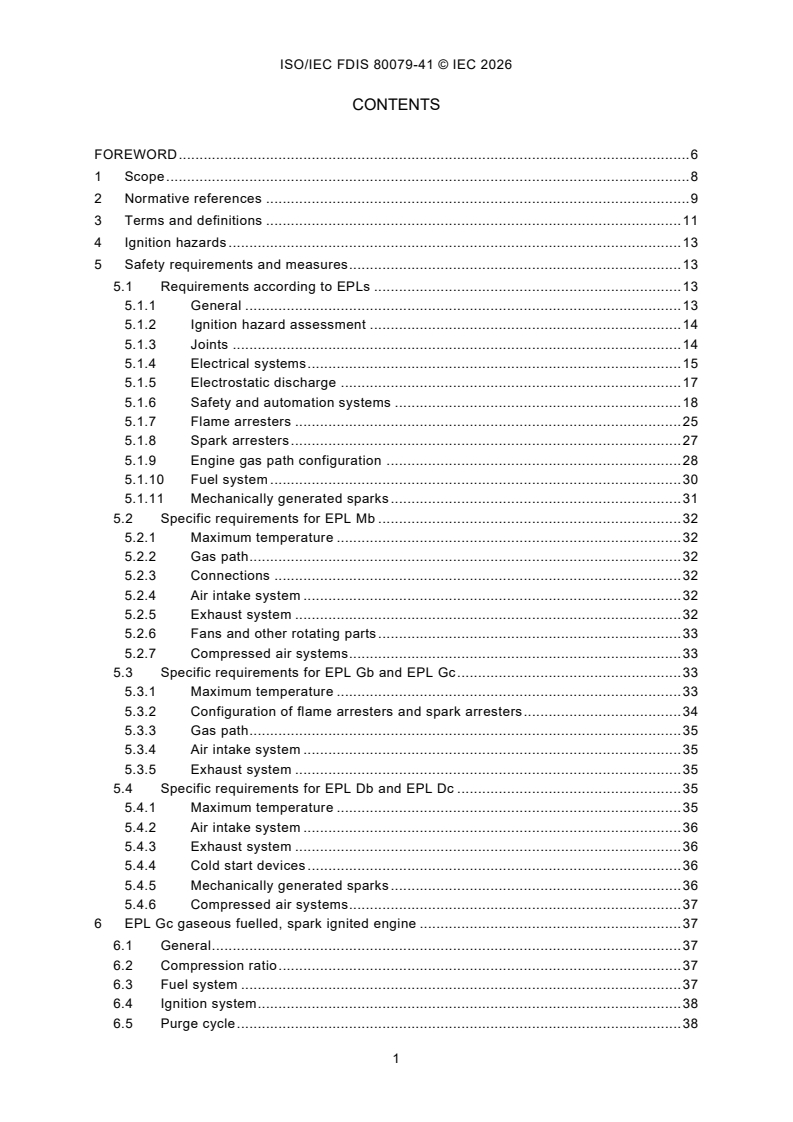
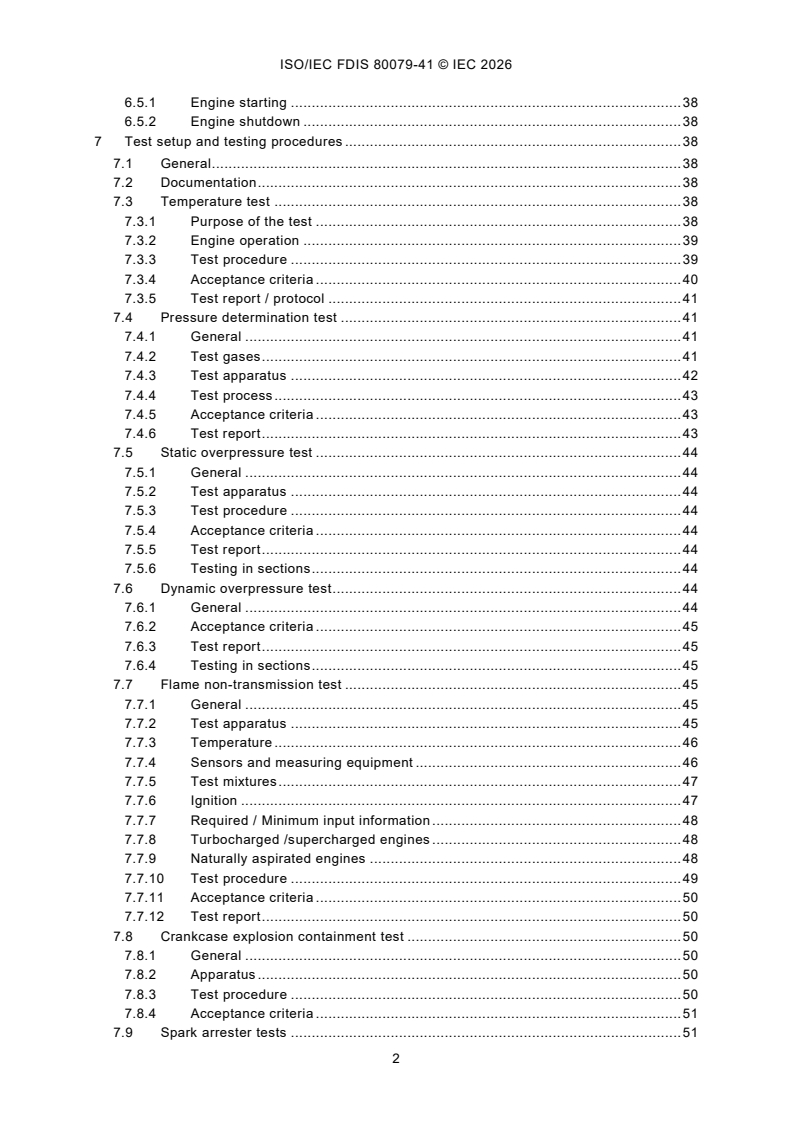
ISO/IEC FDIS 80079-41 is an ISO and IEC Final Draft International Standard for reciprocating internal combustion engines intended for explosive atmospheres. It specifies how these engines are designed, built, tested, marked, and documented so they can reduce ignition risk in Group I mining, Group II gas and vapour atmospheres, and Group III combustible dust atmospheres.
What does ISO/IEC FDIS 80079-41 specify?
ISO/IEC FDIS 80079-41 specifies the technical requirements for reciprocating internal combustion engines used in explosive atmospheres, together with the tests and user information needed to show that the engine meets those requirements. It covers design, construction, conversion, testing, marking, and instructions for use.
The document applies to compression ignition engines for EPL Mb, Gb, Gc, Db and Dc, and to gaseous fuelled, spark ignition engines for EPL Gc. For EPL Gc and Dc engines, only normal operating conditions are considered, so malfunctions do not need to be assessed for those cases.
The standard is organized into clauses for scope, normative references, terms and definitions, ignition hazards, safety requirements and measures, the special case of EPL Gc gaseous fuelled spark ignited engines, test setup and testing procedures, instructions, and marking. It also includes informative and normative annexes that support hazard assessment, test reporting, and test set-up design.
| Annex | What it covers |
|---|---|
| Annex A | Engine conditions and ignition sources for Group I equipment |
| Annex B | Engine conditions and ignition sources for Group II and Group III equipment |
| Annex C | Procedure and reporting for ignition hazard assessment |
| Annex D | Identification of ignition hazards |
| Annex E | Test report templates |
| Annex F | Normative test set-up schematics |
| Annex G | Engine types |
What are the key requirements of ISO/IEC FDIS 80079-41?
ISO/IEC FDIS 80079-41 ties the engine design to the intended explosive atmosphere, the EPL, and the relevant ignition hazards. In practice, this means the manufacturer must identify likely ignition sources, apply protective measures, verify them by test, and tell the user how the engine is to be installed and maintained.
1. The design basis is ignition hazard control
Clause 4 lists the main ignition hazards for engine applications: hot surfaces, flames and hot gases, mechanically generated sparks, electrically generated arcs and sparks, static electricity, stray electric currents, and adiabatic compression. Clause 5 then requires the design to control these hazards according to the chosen EPL and the application.
For the reader, this means the engine is not treated as a generic machine. Its configuration has to be matched to the hazardous area and the ignition risks created by its own operation.
2. The document requires an ignition hazard assessment
Clause 5.1.2 requires ignition hazard assessment, and Annex C gives the procedure and report content. Annex D supports that work with examples of possible ignition sources and assessment tables.
In practice, the assessment is the basis for the protection concept. It is where the designer shows which hazards were identified, what measures were chosen, and why the remaining risk is acceptable for the intended EPL.
3. Protective measures are organized by engine construction features
Clause 5 covers joints, electrical systems, electrostatic discharge, safety and automation systems, flame arresters, spark arresters, the engine gas path, the fuel system, and mechanically generated sparks. It also sets specific requirements for EPL Mb, Gb, Gc, Db and Dc.
That matters because the standard is not only about one barrier or one test. It expects a complete protective package - for example suitable joints, protected wiring, controlled ignition sources, and safe gas path configuration.
4. Safety and automation functions must be effective and documented
Clause 5.1.6 and Tables 1 and 2 address safety devices, minimum integrity for ignition source control, alarms, and shutdown. The document requires the effectiveness of control, alarm, and shutdown functions to be demonstrated and documented.
In practice, the manufacturer must show that the engine reacts correctly when conditions move toward an unsafe state. This is especially important where monitoring, alarm, or shutdown is used as part of the explosion protection concept.
5. Different EPLs have different temperature and configuration rules
Clause 5.2 covers EPL Mb, clause 5.3 covers EPL Gb and Gc, and clause 5.4 covers EPL Db and Dc. These clauses set specific requirements for maximum temperature, air intake systems, exhaust systems, cold start devices, fans and other rotating parts, and compressed air systems. Table 3 classifies maximum temperatures, and Table 4 sets the configuration of Gb and Gc flame arresters and spark arresters.
For users and integrators, this means the same engine architecture may need different limits and protection details depending on whether it is used in mines, gas atmospheres, or dust atmospheres.
6. Gc gaseous fuelled spark ignited engines have extra rules
Clause 6 adds requirements unique to EPL Gc gaseous fuelled spark ignited engines. It addresses compression ratio, the fuel system, the ignition system, and the purge cycle during starting and shutdown.
A minimum gas fuel system includes a normally closed gas shutoff valve (GSOV), over-pressure protection, a fuel pressure regulator, a gas filter or strainer, and a gas isolation valve. The ignition system must meet IEC 60079-45. For users, this means gas-fuelled spark ignited engines need their own dedicated protection checks, not just the compression ignition engine rules.
7. Testing is used to validate the protection concept
Clause 7 includes temperature testing, pressure determination, static overpressure, dynamic overpressure, flame non-transmission, crankcase explosion containment, spark arrester tests, static charge of non-metallic material, verification of engine control/alarms/shutdown, leak testing for ducts, and conductivity testing.
In practice, these tests are the evidence that the design works as intended. Annex F provides the set-up schematics, and Annex E provides report templates for recording the test data.
8. Marking and instructions are part of the safety information
Clause 8 requires instructions that cover installation, operation, maintenance, and use limitations. Clause 9 requires permanent marking, including manufacturer identification, certificate reference, type designation, EPL, temperature code or maximum surface temperature, application and rating, year of manufacture, document reference, serial number or batch number, and any X marking for specific conditions of use.
This matters because the user needs the protection conditions at the point of installation and maintenance, not only in the design file. The marking tells them what the engine is approved for and what constraints still apply.
What terms does ISO/IEC FDIS 80079-41 define?
- maximum surface temperature - the highest temperature reached by any relevant engine part or surface under the most adverse operating conditions.
- maximum exhaust gas temperature - the highest exhaust-gas temperature measured where the gas first meets the surrounding atmosphere.
- gas path - the parts of the engine through which air and exhaust gas pass when the engine is running.
- FA - a flame arrester fitted to an enclosure opening or connecting pipework to allow flow but prevent flame transmission.
- closed joint - a joint intended to be gas tight, dust tight, or both.
- open joint - a joint designed to reduce explosion heat so it will not ignite an external explosive atmosphere.
- engine control module (ECM) - the electronic processor that manages data transfer between engine sensors, actuators, control elements, and storage or display units.
- explosion-protected engine - an engine built with measures that prevent it becoming an ignition source in an explosive atmosphere.
Who uses ISO/IEC FDIS 80079-41?
ISO/IEC FDIS 80079-41 is used by engine manufacturers, explosion protection engineers, certification bodies, test laboratories, and equipment integrators that place reciprocating internal combustion engines into hazardous locations. It is also relevant for quality managers and technical buyers who need to check whether an engine is suitable for a defined EPL and atmosphere.
In practice, it is used for design reviews, ignition hazard assessments, type testing, documentation checks, marking decisions, and installation or maintenance planning. It is particularly relevant for mining applications, explosive gas atmospheres, and combustible dust environments.
Which standards are used with ISO/IEC FDIS 80079-41?
| Standard(s) | What they contribute |
|---|---|
| IEC 60079-0 and ISO 80079-36 | The general Ex-equipment framework that this part supplements and modifies |
| IEC 60079-1 | Flameproof enclosure "d" principles |
| IEC 60079-10-1 and IEC 60079-10-2 | Area classification for gas and dust atmospheres |
| IEC 60079-14:2024 | Electrical installation design, selection, installation, and initial inspection |
| IEC 60079-29-2 and IEC 60079-29-3 | Selection and functional safety guidance for gas detection systems |
| IEC TS 60079-32-1 and IEC 60079-32-2 | Electrostatic hazard guidance and test methods |
| IEC 60079-45 | Electrical ignition systems for internal combustion engines |
| IEC TS 60079-46 | Equipment assemblies in explosive atmospheres |
| IEC 60204-1:2016 and IEC 60529 | Machine electrical equipment and enclosure IP protection |
| IEC 61508 and IEC 61511 | Functional safety for safety-related and process safety systems |
| ISO 12100 | Risk assessment and risk reduction method |
| ISO 2710-1 and ISO 7967 series | Engine vocabulary used throughout the document |
| ISO/IEC 80079-38 and ISO/IEC 80079-49 | Underground-mine equipment and flame arrester performance requirements |
| ISO/IEC 80079-20-1 and ISO 3046-3 | Material characteristics for gas/vapour classification and engine performance measurements |
| ISO 17025 | Laboratory competence for the testing work |
| ISO 15510, ISO 29463, ISO 1813, ISO 9563:2015, IEC 61340-2-3 | Materials, filtration, belt conductivity, and electrostatic test methods used in supporting checks |
What does the ISO/IEC FDIS 80079-41 document contain?
ISO/IEC FDIS 80079-41 contains detailed design rules, protection measures, and validation tests for reciprocating internal combustion engines in explosive atmospheres. It also includes figures of basic gas path configurations and normative test set-up schematics for pressure and flame-transmission testing.
The annexes add practical support material: ignition hazard identification tables, a formal ignition hazard assessment procedure, and structured test report forms. Those report forms are set up for temperature tests, explosion pressure tests, overpressure tests, and flame transmission tests.
The document also contains the marking content and user-information requirements needed to pass the protection concept to the installer and maintainer. That makes it useful not only for design approval, but also for certification, production verification, and site documentation.
Relations
- Effective Date
- 12-Feb-2026
Get Certified
Connect with accredited certification bodies for this standard

DNV
DNV is an independent assurance and risk management provider.

Lloyd's Register
Lloyd's Register is a global professional services organisation specialising in engineering and technology.
DNV Energy Systems
Energy and renewable energy certification.
Sponsored listings
Frequently Asked Questions
ISO/IEC FDIS 80079-41 is a draft published by the International Organization for Standardization (ISO). Its full title is "Explosive atmospheres — Part 41: Reciprocating internal combustion engines". This standard covers: Explosive atmospheres — Part 41: Reciprocating internal combustion engines
Explosive atmospheres — Part 41: Reciprocating internal combustion engines
ISO/IEC FDIS 80079-41 is classified under the following ICS (International Classification for Standards) categories: 27.020 - Internal combustion engines; 29.260.20 - Electrical apparatus for explosive atmospheres. The ICS classification helps identify the subject area and facilitates finding related standards.
ISO/IEC FDIS 80079-41 has the following relationships with other standards: It is inter standard links to FprEN ISO/IEC 80079-41. Understanding these relationships helps ensure you are using the most current and applicable version of the standard.
ISO/IEC FDIS 80079-41 is available in PDF format for immediate download after purchase. The document can be added to your cart and obtained through the secure checkout process. Digital delivery ensures instant access to the complete standard document.
Standards Content (Sample)
FINAL DRAFT
International
Standard
ISO/IEC
FDIS
80079-41
ISO/TMBG
Explosive atmospheres —
Secretariat: ISO
Part 41:
Voting begins on:
2026-08-31
Reciprocating internal combustion
engines
Voting terminates on:
2026-10-26
Atmosphères explosives —
Partie 41: Moteurs alternatifs à combustion interne
RECIPIENTS OF THIS DRAFT ARE INVITED TO SUBMIT,
This draft is submitted to a parallel vote in ISO and in IEC.
WITH THEIR COMMENTS, NOTIFICATION OF ANY
RELEVANT PATENT RIGHTS OF WHICH THEY ARE AWARE
AND TO PROVIDE SUPPOR TING DOCUMENTATION.
IN ADDITION TO THEIR EVALUATION AS
BEING ACCEPTABLE FOR INDUSTRIAL, TECHNO
ISO/CEN PARALLEL PROCESSING LOGICAL, COMMERCIAL AND USER PURPOSES, DRAFT
INTERNATIONAL STANDARDS MAY ON OCCASION HAVE
TO BE CONSIDERED IN THE LIGHT OF THEIR POTENTIAL
TO BECOME STAN DARDS TO WHICH REFERENCE MAY BE
MADE IN NATIONAL REGULATIONS.
Reference number
ISO/IEC FDIS 8007941:2026(en) © ISO/IEC 2026
FINAL DRAFT
International
Standard
ISO/IEC
FDIS
80079-41
ISO/TMBG
Explosive atmospheres —
Secretariat: ISO
Part 41:
Voting begins on:
Reciprocating internal combustion
2026-08-31
engines
Voting terminates
on: 2026-10-26
Atmosphères explosives —
Partie 41: Moteurs alternatifs à combustion interne
RECIPIENTS OF THIS DRAFT ARE INVITED TO SUBMIT,
This draft is submitted to a parallel vote in ISO and in IEC.
WITH THEIR COMMENTS, NOTIFICATION OF ANY
RELEVANT PATENT RIGHTS OF WHICH THEY ARE AWARE
AND TO PROVIDE SUPPOR TING DOCUMENTATION.
© ISO/IEC 2026
IN ADDITION TO THEIR EVALUATION AS
All rights reserved. Unless otherwise specified, or required in the context of its implementation, no part of this publication may
BEING ACCEPTABLE FOR INDUSTRIAL, TECHNO
ISO/CEN PARALLEL PROCESSING
LOGICAL, COMMERCIAL AND USER PURPOSES, DRAFT
be reproduced or utilized otherwise in any form or by any means, electronic or mechanical, including photocopying, or posting on
INTERNATIONAL STANDARDS MAY ON OCCASION HAVE
the internet or an intranet, without prior written permission. Permission can be requested from either ISO at the address below
TO BE CONSIDERED IN THE LIGHT OF THEIR POTENTIAL
or ISO’s member body in the country of the requester.
TO BECOME STAN DARDS TO WHICH REFERENCE MAY BE
MADE IN NATIONAL REGULATIONS.
ISO copyright office
CP 401 • Ch. de Blandonnet 8
CH-1214 Vernier, Geneva
Phone: +41 22 749 01 11
Email: copyright@iso.org
Website: www.iso.org
Published in Switzerland Reference number
ISO/IEC FDIS 8007941:2026(en) © ISO/IEC 2026
© ISO/IEC 2026 – All rights reserved
ii
CONTENTS
FOREWORD . 6
1 Scope . 8
2 Normative references . 9
3 Terms and definitions . 11
4 Ignition hazards . 13
5 Safety requirements and measures. 13
5.1 Requirements according to EPLs . 13
5.1.1 General . 13
5.1.2 Ignition hazard assessment . 14
5.1.3 Joints . 14
5.1.4 Electrical systems . 15
5.1.5 Electrostatic discharge . 17
5.1.6 Safety and automation systems . 18
5.1.7 Flame arresters . 25
5.1.8 Spark arresters . 27
5.1.9 Engine gas path configuration . 28
5.1.10 Fuel system . 30
5.1.11 Mechanically generated sparks . 31
5.2 Specific requirements for EPL Mb . 32
5.2.1 Maximum temperature . 32
5.2.2 Gas path . 32
5.2.3 Connections . 32
5.2.4 Air intake system . 32
5.2.5 Exhaust system . 32
5.2.6 Fans and other rotating parts . 33
5.2.7 Compressed air systems. 33
5.3 Specific requirements for EPL Gb and EPL Gc . 33
5.3.1 Maximum temperature . 33
5.3.2 Configuration of flame arresters and spark arresters. 34
5.3.3 Gas path . 35
5.3.4 Air intake system . 35
5.3.5 Exhaust system . 35
5.4 Specific requirements for EPL Db and EPL Dc . 35
5.4.1 Maximum temperature . 35
5.4.2 Air intake system . 36
5.4.3 Exhaust system . 36
5.4.4 Cold start devices . 36
5.4.5 Mechanically generated sparks . 36
5.4.6 Compressed air systems. 37
6 EPL Gc gaseous fuelled, spark ignited engine . 37
6.1 General . 37
6.2 Compression ratio . 37
6.3 Fuel system . 37
6.4 Ignition system . 38
6.5 Purge cycle . 38
6.5.1 Engine starting . 38
6.5.2 Engine shutdown . 38
7 Test setup and testing procedures . 38
7.1 General . 38
7.2 Documentation . 38
7.3 Temperature test . 38
7.3.1 Purpose of the test . 38
7.3.2 Engine operation . 39
7.3.3 Test procedure . 39
7.3.4 Acceptance criteria . 40
7.3.5 Test report / protocol . 41
7.4 Pressure determination test . 41
7.4.1 General . 41
7.4.2 Test gases . 41
7.4.3 Test apparatus . 42
7.4.4 Test process . 43
7.4.5 Acceptance criteria . 43
7.4.6 Test report . 43
7.5 Static overpressure test . 44
7.5.1 General . 44
7.5.2 Test apparatus . 44
7.5.3 Test procedure . 44
7.5.4 Acceptance criteria . 44
7.5.5 Test report . 44
7.5.6 Testing in sections . 44
7.6 Dynamic overpressure test . 44
7.6.1 General . 44
7.6.2 Acceptance criteria . 45
7.6.3 Test report . 45
7.6.4 Testing in sections . 45
7.7 Flame non-transmission test . 45
7.7.1 General . 45
7.7.2 Test apparatus . 45
7.7.3 Temperature . 46
7.7.4 Sensors and measuring equipment . 46
7.7.5 Test mixtures . 47
7.7.6 Ignition . 47
7.7.7 Required / Minimum input information . 48
7.7.8 Turbocharged /supercharged engines . 48
7.7.9 Naturally aspirated engines . 48
7.7.10 Test procedure . 49
7.7.11 Acceptance criteria . 50
7.7.12 Test report . 50
7.8 Crankcase explosion containment test . 50
7.8.1 General . 50
7.8.2 Apparatus . 50
7.8.3 Test procedure . 50
7.8.4 Acceptance criteria . 51
7.9 Spark arrester tests . 51
7.9.1 Dry type . 51
7.9.2 Liquid type . 51
7.10 Static charge of non-metallic material . 51
7.11 Verification of engine control, alarms and shutdown . 52
7.12 Leak test for ducts . 52
7.13 Conductivity test . 52
7.13.1 Test process . 52
7.13.2 Acceptance criteria . 52
8 Instructions . 52
8.1 General . 52
8.2 Accompanying documents . 53
8.2.1 Group I Mining . 53
8.2.2 Group II Flammable gas and vapours . 53
8.2.3 Group III Combustible dust . 53
8.3 Maintenance inspections . 53
8.3.1 Group I Mining . 53
8.3.2 Group II Flammable gas and vapours . 54
8.3.3 Group III Combustible dust . 54
9 Marking . 55
9.1 General . 55
9.2 EPL Mb . 55
9.3 EPL Gb and EPL Gc . 56
9.4 EPL Db and EPL Dc . 56
Annex A (informative) Engine conditions and ignition sources – Group I equipment . 57
A.1 Engine conditions . 57
A.1.1 Normal operating conditions . 57
A.1.2 Expected malfunctions . 57
A.1.3 Rare malfunctions . 57
A.2 Ignition sources . 58
A.2.1 Hot surfaces . 58
A.2.2 Flames and hot gases . 58
A.2.3 Sparks . 58
A.2.4 Adiabatic compression . 58
Annex B (informative) Engine conditions and ignition sources – Group II and Group III
equipment – Flammable gas, vapour and combustible dust atmospheres . 59
B.1 General . 59
B.2 Engine conditions . 59
B.2.1 Normal operating conditions . 59
B.2.2 Expected malfunctions . 59
B.2.3 Rare malfunctions . 59
B.3 Ignition sources . 60
B.3.1 Hot surfaces . 60
B.3.2 Flame and hot gases . 60
B.3.3 Sparks . 60
B.3.4 Adiabatic compression . 60
Annex C (informative) Ignition hazard assessment for reciprocating internal
combustion engines . 61
C.1 General . 61
C.2 Procedure of ignition hazard assessment . 61
C.2.1 Formal Ignition hazard identification and assessment . 61
C.2.2 Assessment with malfunctions . 62
C.2.3 Basic information necessary for the ignition hazard assessment . 62
C.3 Ignition hazard assessment report . 62
Annex D (informative) Identification of ignition hazards . 63
Annex E (informative) Test reports . 121
Annex F (normative) Test set up schematics . 134
Annex G (informative) Engine types . 146
Bibliography . 148
Figure 1 – Basic gas path configurations . 29
Figure 2 – Pressure determination test . 43
Figure 3 – Non-transmission test . 46
Figure F.1 – Explosion pressure on the exhaust side under atmospheric condition in a
pressure resistant chamber . 134
Figure F.2 – Explosion pressure on the exhaust side under atmospheric condition in a
closed pipe . 135
Figure F.3 – Flame transmission on the exhaust side under atmospheric conditions in a
plastic bag and heated flame arresters . 136
Figure F.4 – Flame transmission on the exhaust side under atmospheric conditions in
an explosion proof chamber and heated flame arresters . 137
Figure F.5 – Flame transmission on the exhaust side under atmospheric conditions
with plastic bags . 138
Figure F.6 – Explosion pressure on the Intake side under atmospheric conditions . 139
Figure F.7 – Explosion pressure on the intake side under overpressure conditions in a
plastic bag . 140
Figure F.8 – Explosion pressure on the intake side under overpressure conditions in an
explosion proof chamber . 141
Figure F.9 – Explosion pressure on the intake side under overpressure conditions in a
closed pipe . 142
Figure F.10 – Flame transmission on the intake side under atmospheric conditions in a
plastic bag . 143
Figure F.11 – Flame transmission on the intake side under overpressure conditions in
an explosion proof chamber . 144
Figure F.12 – Flame transmission on the intake side under overpressure conditions in
a closed pipe . 145
Figure G.1 – Engine types . 146
Figure G.2 – Engine types – Fuels used . 147
Table 1 – Minimum integrity for a safety system for ignition source control . 21
Table 2 – Alarms and shutdown . 21
Table 3 – Classification of maximum temperatures . 34
Table 4 – Configuration of Gb and Gc flame arresters and spark arresters. 34
Table 5 – Test gas mixture for the determination of maximum explosion pressures . 41
Table 6 – Test gas mixtures for propagation tests . 47
Table D.1 – Possible ignition sources . 63
Table D.2 – Ignition hazard assessment for EPL Gc or Dc . 64
Table D.3 – Ignition hazard assessment for EPL Mb or Gb or Db . 92
Table E.1 – Temperature type test report – Relevant data for protocolling . 121
Table E.2 – Maximum explosion pressure test - Relevant data for protocolling . 125
Table E.3 – Static overpressure test - Relevant data for protocolling . 127
Table E.4 – Dynamic overpressure test - Relevant data for protocolling . 129
Table E.5 – Flame transmission test - Relevant data for protocolling . 131
INTERNATIONAL ELECTROTECHNICAL COMMISSION
____________
Explosive atmospheres -
Part 41: Reciprocating internal combustion engines
FOREWORD
1) The International Electrotechnical Commission (IEC) is a worldwide organization for standardization comprising
all national electrotechnical committees (IEC National Committees). The object of IEC is to promote international
co-operation on all questions concerning standardization in the electrical and electronic fields. To this end and
in addition to other activities, IEC publishes International Standards, Technical Specifications, Technical Reports,
Publicly Available Specifications (PAS) and Guides (hereafter referred to as “IEC Publication(s)”). Their
preparation is entrusted to technical committees; any IEC National Committee interested in the subject dealt with
may participate in this preparatory work. International, governmental and non-governmental organizations liaising
with the IEC also participate in this preparation. IEC collaborates closely with the International Organization for
Standardization (ISO) in accordance with conditions determined by agreement between the two organizations.
2) The formal decisions or agreements of IEC on technical matters express, as nearly as possible, an international
consensus of opinion on the relevant subjects since each technical committee has representation from all
interested IEC National Committees.
3) IEC Publications have the form of recommendations for international use and are accepted by IEC National
Committees in that sense. While all reasonable efforts are made to ensure that the technical content of IEC
Publications is accurate, IEC cannot be held responsible for the way in which they are used or for any
misinterpretation by any end user.
4) In order to promote international uniformity, IEC National Committees undertake to apply IEC Publications
transparently to the maximum extent possible in their national and regional publications. Any divergence between
any IEC Publication and the corresponding national or regional publication shall be clearly indicated in the latter.
5) IEC itself does not provide any attestation of conformity. Independent certification bodies provide conformity
assessment services and, in some areas, access to IEC marks of conformity. IEC is not responsible for any
services carried out by independent certification bodies.
6) All users should ensure that they have the latest edition of this publication.
7) No liability shall attach to IEC or its directors, employees, servants or agents including individual experts and
members of its technical committees and IEC National Committees for any personal injury, property damage or
other damage of any nature whatsoever, whether direct or indirect, or for costs (including legal fees) and
expenses arising out of the publication, use of, or reliance upon, this IEC Publication or any other IEC
Publications.
8) Attention is drawn to the Normative references cited in this publication. Use of the referenced publications is
indispensable for the correct application of this publication.
9) IEC draws attention to the possibility that the implementation of this document may involve the use of (a)
patent(s). IEC takes no position concerning the evidence, validity or applicability of any claimed patent rights in
respect thereof. As of the date of publication of this document, IEC had not received notice of (a) patent(s), which
may be required to implement this document. However, implementers are cautioned that this may not represent
the latest information, which may be obtained from the patent database available at https://patents.iec.ch. IEC
shall not be held responsible for identifying any or all such patent rights.
ISO/IEC 80079-41 has been prepared by ISO/IEC subcommittee 31M: Non-electrical equipment
and protective systems for explosive atmospheres, of IEC technical committee 3: Equipment
for explosive atmospheres. It is an International Standard.
It is published as a double logo International Standard.
The text of this International Standard is based on the following documents:
Draft Report on voting
31M/XX/FDIS 31M/XX/RVD
Full information on the voting for its approval can be found in the report on voting indicated in
the above table. In ISO, the document was approved by XXX P members out of YYY having
cast a vote.
The language used for the development of this International Standard is English.
This document was drafted in accordance with ISO/IEC Directives, Part 2, and developed in
accordance with ISO/IEC Directives, Part 1 and ISO/IEC Directives, IEC Supplement, available
at www.iec.ch/members_experts/refdocs. The main document types developed by IEC are
described in greater detail at www.iec.ch/publications.
A list of all parts in the ISO/IEC 80079 series, published under the general title Explosive
atmospheres, can be found on the IEC website.
The committee has decided that the contents of this document will remain unchanged until the
stability date indicated on the IEC website under webstore.iec.ch in the data related to the
specific document. At this date, the document will be
– reconfirmed,
– withdrawn, or
– revised.
1 Scope
This part of ISO/IEC 80079 specifies the technical requirements for design, construction,
conversion, testing, marking, and the information required for use to avoid or minimise the
possibility of ignition which could result from a reciprocating internal combustion engine
intended for use in explosive atmospheres including:
– Group I EPL Mb for use in mines susceptible to firedamp,
– Group II EPL Gb and EPL Gc for use in explosive gas atmospheres, and
– Group III EPL Db and EPL Dc for use in explosive dust atmospheres.
For EPL Gc and Dc engines, only normal operating conditions are to be considered. There is
no need to consider malfunctions (see B.2.1).
This document includes those tests of the engine and its ancillary devices that are required to
verify compliance with this document.
This document applies to reciprocating internal combustion engines with compression ignition
for EPL Mb, Gb, Gc, Db, Dc and gaseous fuelled, spark ignition, engines for EPL Gc. (see
Annex G.)
This document does not define requirements relating to the driven machinery and equipment.
This document does not apply to
– explosive mixtures of vapours and gases, which tend to self-decompose (for example carbon
disulphide (CS ), ethylene oxide (C H O), acetylene (C H ) or which are chemically
2 2 4 2 2
unstable;
– hydrogen fuelled engines;
– engines used in areas for the processing, manufacture or storage of explosives;
– gasoline and other spark ignited engines where the fuel is injected into the combustion
chamber as a liquid; or
– electrical ignition spark systems.
NOTE 1 Spark ignition systems used with equipment included in ISO/IEC 80079-41 are covered by IEC 60079-45.
This document solely deals with explosion protection requirements. Requirements on gaseous
or particulate exhaust emissions are not covered by this document.
General safety requirements are not included in this document.
NOTE 2 General safety requirements for compression ignition engines are covered, for the EU, in
EN 1679-1:1998-A1:2011.
This document does not specify requirements for safety, other than those directly related to the
possibility of ignition of flammable mixtures in the surrounding atmosphere, which can lead to
an explosion.
This document supplements and modifies the general requirements of IEC 60079-0 and
ISO 80079-36. Where a requirement of this document conflicts with a requirement of
IEC 60079-0 and ISO 80079-36 as is applicable for Ex engines, the requirement of this
document takes precedence.
The standard atmospheric conditions (relating to the explosion characteristics of the
atmosphere) under which the engine can be operated are:
– temperature –20 C to +60 C
– pressure 80kPa (0,8bar) to 110kPa (1,1bar); and
– air with normal oxygen content, typically a volume fraction of 21%.
Additional consideration and additional testing are necessary for Ex engines operating outside
the standard atmospheric conditions. The ignition hazard assessment, ignition protection
provided, additional testing (if necessary), manufacturer’s technical documentation and
instructions to the user are intended to clearly demonstrate the engine’s suitability for the
conditions.
NOTE 3 Changes in temperature and pressure have an influence on the characteristics of the explosive
atmosphere, including ignitability.
NOTE 4 IEC TS 60079-43 gives information for equipment used in explosive atmospheres in environmental
conditions which include ambient temperatures below –20 °C and additional adverse conditions, including maritime
applications.
NOTE 5 Reciprocating internal combustion engines are not considered to be pressure vessels.
NOTE 6 Ongoing inspection, maintenance and repair aspects play an important role in control of hazardous area
installations and the user’s attention is drawn to IEC 60079-17, IEC 60079-19 and IEC 60079-14 and manufacturer’s
instructions for further information concerning these aspects.
2 Normative references
The following documents are referred to in the text in such a way that some or all of their content
constitutes requirements of this document. For dated references, only the edition cited applies.
For undated references, the latest edition of the referenced document (including any
amendments) applies.
IEC 60034-5, Rotating electrical machines - Part 5: Degrees of protection provided by the
integral design of rotating electrical machines (IP code) - Classification
IEC 60079-0, Explosive atmospheres - Part 0: Equipment - General requirements
IEC 60079-1, Explosive atmospheres - Part 1: Equipment protection by flameproof enclosures
"d"
IEC 60079-10-1, Explosive atmospheres - Part 10-1: Classification of areas - Explosive gas
atmospheres
IEC 60079-10-2, Explosive atmospheres - Part 10-2: Classification of areas - Explosive dust
atmospheres
IEC 60079-14:2024, Explosive atmospheres - Part 14: Electrical installation design, selection
and installation of equipment, including initial inspection
IEC 60079-29-2, Explosive atmospheres - Part 29-2: Gas detectors - Selection, installation, use
and maintenance of detectors for flammable gases and oxygen
IEC 60079-29-3, Explosive atmospheres - Part 29-3: Gas detectors - Guidance on functional
safety of fixed gas detection systems
IEC TS 60079-32-1, Explosive atmospheres - Part 32-1: Electrostatic hazards, guidance
IEC 60079-32-2, Explosive atmospheres - Part 32-2: Electrostatics hazards - Tests
IEC 60079-45, Electrical ignition systems for internal combustion engines
IEC TS 60079-46, Explosive atmospheres - Part 46: Equipment assemblies
IEC 60204-1:2016, Safety of machinery - Electrical equipment of machines - Part 1: General
requirements
IEC 60529, Degrees of protection provided by enclosures (IP Code)
IEC 61340-2-3, Electrostatics - Part 2-3: Methods of test for determining the resistance and
resistivity of solid materials used to avoid electrostatic charge accumulation
IEC 61508 (all parts), Functional safety of electrical/electronic/programmable electronic
safety-related systems
IEC 61511 (all parts), Functional safety - Safety instrumented systems for the process industry
sector
ISO 1813, Belt drives - V-ribbed belts, joined V-belts and V-belts including wide section belts
and hexagonal belts - Electrical conductivity of antistatic belts: Characteristics and methods of
test
ISO 2710-1, Reciprocating internal combustion engines - Vocabulary - Part 1: Terms for engine
design and operation
ISO 7967-1, Reciprocating internal combustion engines - Vocabulary - Part 1: Terms for engine
design and operation
ISO 7967-2, Reciprocating internal combustion engines – Vocabulary of components and
systems - Part 1: Structure and external covers
ISO 7967-3, Reciprocating internal combustion engines – Vocabulary of components and
systems – Part 2: Main running gear
ISO 7967-4, Reciprocating internal combustion engines – Vocabulary of components and
systems – Part 4: Pressure changes and air/exhaust gas ducting systems
ISO 7967-8, Reciprocating internal combustion engines – Vocabulary of components and
systems – Part 8: Starting systems
ISO 9563:2015, Belt drives - Electrical conductivity of antistatic endless synchronous belts -
Characteristics and test method
ISO 12100, Safety of machinery - General principles for design - Risk assessment and risk
reduction
ISO 15510, Stainless steels - Chemical composition
ISO 29463 (all parts), High efficiency filters and filter media for removing particles in air
ISO 80079-36, Explosive atmospheres - Part 36: Non-electrical equipment for explosive
atmospheres - Basic method and requirements
ISO 80079-37, Explosive atmospheres - Part 37: Non-electrical equipment for explosive
atmospheres - Non-electrical type of protection constructional safety "c", control of ignition
source "b", liquid immersion "k"
ISO/IEC 80079-38, Explosive atmospheres - Part 38: Equipment and components in explosive
atmospheres in underground mines
ISO/IEC 80079-49, Explosive atmospheres - Part 49: Flame arresters - Performance
requirements, test methods and limits for use
3 Terms and definitions
For the purposes of this document, the terms and definitions given in ISO 2710-1, ISO 7967-1,
ISO 7967-2, ISO 7967-3, ISO 7967-4, ISO 7967-8, IEC 60079-0, IEC 60079-10-1,
IEC 60079-10-2, ISO 80079-36, ISO 80079-37, ISO/IEC 80079-38 and the following apply.
ISO and IEC maintain terminology databases for use in standardization at the following
addresses:
– IEC Electropedia: available at https://www.electropedia.org/
– ISO Online browsing platform: available at https://www.iso.org/obp
3.1
maximum surface temperature
highest temperature which is attained in service under the most adverse operating conditions
(but within the recognized tolerance) by any relevant part or surface of the Ex equipment
Note 1 to entry: The maximum surface temperature marked on the equipment includes safety margins depending
on the EPL of the equipment.
Note 2 to entry: The surface temperature which is relevant can be internal or external depending upon the Type of
Protection concerned.
Note 3 to entry: For Ex equipment in an explosive dust atmosphere, this temperature occurs on the external surface
of the enclosure and can include a defined dust layer condition.
Note 4 to entry: This includes exhaust gas temperature and other fluid temperatures that may come in contact with
explosive atmospheres.
[SOURCE: IEC 60079-0:2026, 3.62, modified – definition modified and Notes to entry added]
3.2
maximum exhaust gas temperature
highest temperature under the most adverse operating conditions measured at the point where
the gas stream first meets the surrounding atmosphere
3.3
gas path
parts of an engine through which air and exhaust gas passes when the engine is running
3.4
flame arrester
FA
device fitted to the opening of an enclosure, or to the connecting pipe work of a system of
enclosures, and whose intended function is to allow fluid flow but prevent the transmission of
flame
3.5
closed joint
assembly between two parts which is intended to be gas or dust tight or both
3.6
open joint
joint between two parts designed to reduce the heat energy from a gas explosion to the point
where it will not ignite an external explosive atmosphere
3.7
spark arrester
device, system, or method which controls the emission from an engine exhaust of particles
potentially capable of igniting combustible material in the vicinity by virtue of their size and
temperature
3.8
engine control module
ECM
electronic processor managing the transfer of data between engine sensors, actuators, control
elements, and information-storage and display units
3.9
safety devices
devices intended for use on, or associated with, an explosion protected engine that are required
for, or contribute to, the safe functioning of equipment and protective systems with respect to
the risks of explosion
Note 1 to entry: Safety devices differ from the term devices used in the IEC 61508 and IEC 61511 series. Safety
devices are comparable to the terms like "safety-related system (IEC 61508)" or "safety instrumented system
(IEC 61511)".
Note 2 to entry: In this document the safety devices are intended to reduce the likelihood of a potential ignition
source becoming effective.
[SOURCE: ISO 80079-37:2016, modified – "on the engine" and Notes 1 and 2 to entry have
been added]
3.10
performance requirements
verifiable requirements related to properties of safety devices and shutdown systems to ensure
that the safety function is effective
Note 1 to entry: IEC TS 60079-42 includes information for diagnostics, capacity, functionality, response,
effectiveness, integrity, reliability, availability, ability to withstand loads and robustness .
3.11
abnormal combustion
unintended or uncontrolled combustion in the engine
3.12
explosion protection
application of one or more types of protection to minimise the risk of a piece of equipment,
apparatus, component, fitting or device causing an ignition of a surrounding explosive gas,
vapour, mist or dust atmosphere
3.13
explosion-protected engine
engine with measures applied to the construction to prevent it becoming an ignition source
when in an explosive atmosphere
4 Ignition hazards
Some hazards for engine applications in potentially explosive atmospheres according to
ISO 80079-36 are listed below.
The main sources of ignition are:
– hot surfaces;
– flames and hot gases;
– mechanically generated sparks;
– electrically generated arcs and sparks;
– static electricity;
– stray electric currents;
– adiabatic compression.
The design specifications for the engine necessary to minimise the likelihood of the ignition of
an external potential atmosphere depend on the application and are characterised by:
– temperature classification,
– presence of flammable gases, or
– presence of combustib
...