

ISO/PRF 12231-1
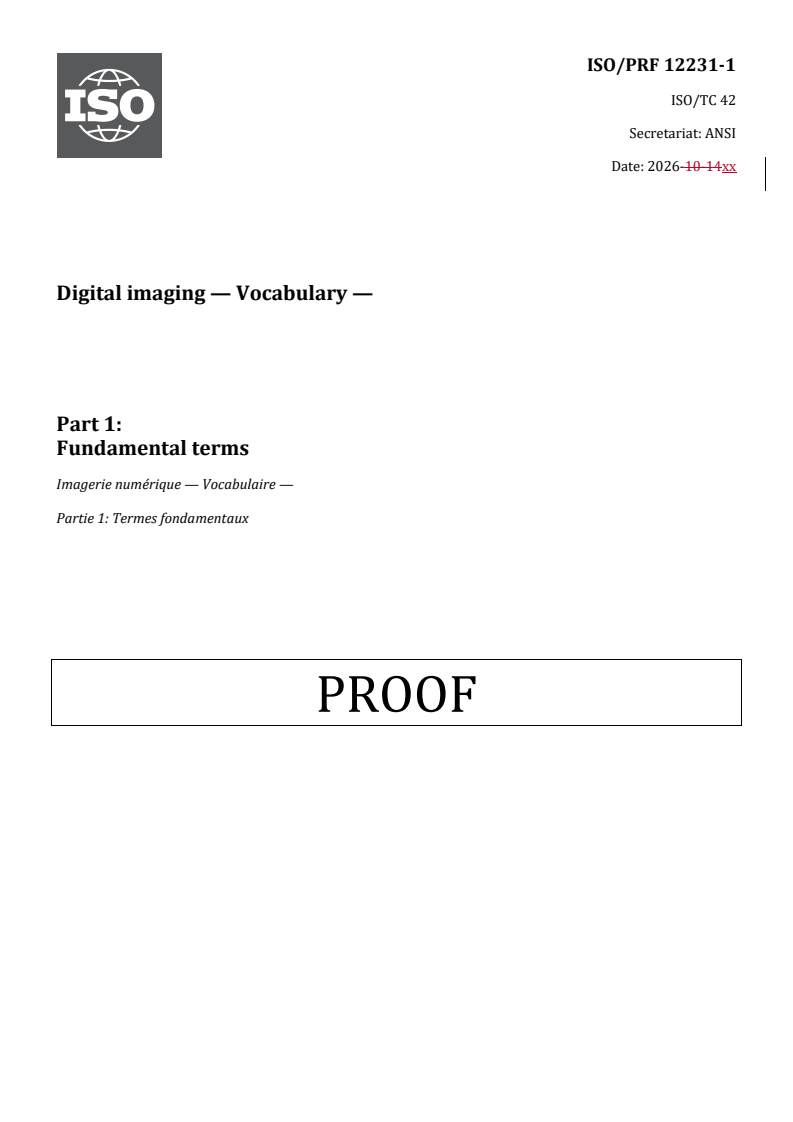
(Main)Digital imaging — Vocabulary — Part 1: Fundamental terms
- Abstract
This document defines terms used in digital imaging.
- Status
- Not Published
- Technical Committee
- ISO/TC 42 - Photography
- Drafting Committee
- ISO/TC 42/WG 18 - Electronic still picture imaging
- Current Stage
- 5020 - FDIS ballot initiated: 2 months. Proof sent to secretariat
- Start Date
- 10-Nov-2026
- Completion Date
- 14-Nov-2026
Buy Documents
ISO/PRF 12231-1 - Digital imaging — Vocabulary — Part 1: Fundamental terms
REDLINE ISO/PRF 12231-1 - Digital imaging — Vocabulary — Part 1: Fundamental terms
Relations
- Effective Date
- 16-Aug-2025
Buy Documents
ISO/PRF 12231-1 - Digital imaging — Vocabulary — Part 1: Fundamental terms
REDLINE ISO/PRF 12231-1 - Digital imaging — Vocabulary — Part 1: Fundamental terms
Frequently Asked Questions
ISO/PRF 12231-1 is a draft published by the International Organization for Standardization (ISO). Its full title is "Digital imaging — Vocabulary — Part 1: Fundamental terms". This standard covers: This document defines terms used in digital imaging.
This document defines terms used in digital imaging.
ISO/PRF 12231-1 is classified under the following ICS (International Classification for Standards) categories: 01.040.37 - Image technology (Vocabularies); 37.040.10 - Photographic equipment. Projectors. The ICS classification helps identify the subject area and facilitates finding related standards.
ISO/PRF 12231-1 has the following relationships with other standards: It is inter standard links to ISO 12231-1:2025. Understanding these relationships helps ensure you are using the most current and applicable version of the standard.
ISO/PRF 12231-1 is available in PDF format for immediate download after purchase. The document can be added to your cart and obtained through the secure checkout process. Digital delivery ensures instant access to the complete standard document.
Standards Content (Sample)
International
Standard
ISO 12231-1
Third edition
Digital imaging — Vocabulary —
Part 1:
Fundamental terms
Imagerie numérique — Vocabulaire —
Partie 1: Termes fondamentaux
PROOF/ÉPREUVE
Reference number
ISO 12231-1:2026(en) © ISO 2026
ISO 12231-1:2026(en)
© ISO 2026
All rights reserved.
This ISO publication is protected by copyright and is owned by ISO and/or its licensors.
The content of this ISO publication is provided under licence, not sold. Use is subject to the applicable licence terms issued by ISO,
an ISO member body, or an authorized third-party distributor.
Except as required for implementation or expressly permitted by a separate licence, no part of this ISO publication may be
reproduced, distributed, modified, used, or made available in any form or by any means - electronic or mechanical, including
photocopying, scanning, recording, or posting on internal or external digital platforms.
Any use beyond the scope of the granted rights is prohibited and may result in legal action.
ISO copyright office
CP 401 • CH-1214 Vernier, Geneva
Phone: +41 22 749 01 11
Email: copyright@iso.org
Website: www.iso.org
Published in Switzerland
PROOF/ÉPREUVE
ii
ISO 12231-1:2026(en)
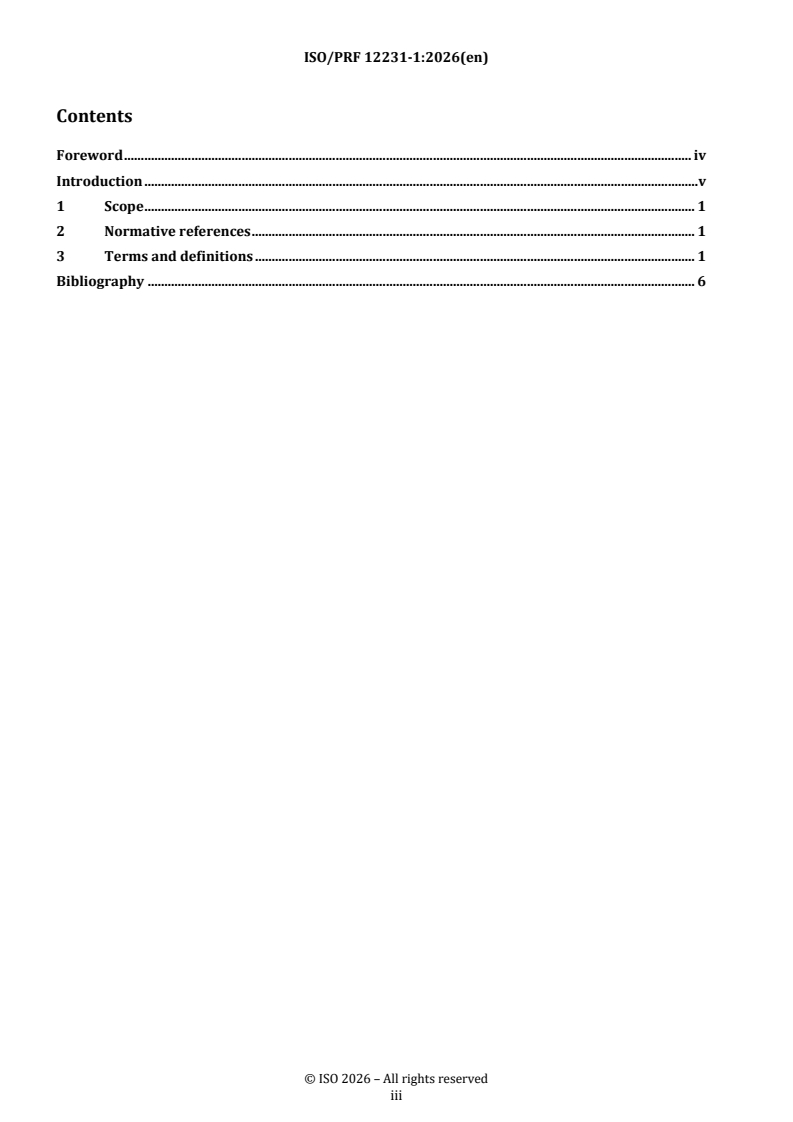
Contents Page
Foreword .iv
Introduction .v
1 Scope . 1
2 Normative references . 1
3 Terms and definitions . 1
Bibliography . 3
PROOF/ÉPREUVE
iii
ISO 12231-1:2026(en)
Foreword
ISO (the International Organization for Standardization) is a worldwide federation of national standards
bodies (ISO member bodies). The work of preparing International Standards is normally carried out through
ISO technical committees. Each member body interested in a subject for which a technical committee
has been established has the right to be represented on that committee. International organizations,
governmental and non-governmental, in liaison with ISO, also take part in the work. ISO collaborates closely
with the International Electrotechnical Commission (IEC) on all matters of electrotechnical standardization.
The procedures used to develop this document and those intended for its further maintenance are described
in the ISO/IEC Directives, Part 1. In particular, the different approval criteria needed for the different types
of ISO document should be noted. This document was drafted in accordance with the editorial rules of the
ISO/IEC Directives, Part 2 (see www.iso.org/directives).
ISO draws attention to the possibility that the implementation of this document may involve the use of (a)
patent(s). ISO takes no position concerning the evidence, validity or applicability of any claimed patent
rights in respect thereof. As of the date of publication of this document, ISO had not received notice of (a)
patent(s) which may be required to implement this document. However, implementers are cautioned that
this may not represent the latest information, which may be obtained from the patent database available at
www.iso.org/patents. ISO shall not be held responsible for identifying any or all such patent rights.
Any trade name used in this document is information given for the convenience of users and does not
constitute an endorsement.
For an explanation of the voluntary nature of standards, the meaning of ISO specific terms and expressions
related to conformity assessment, as well as information about ISO's adherence to the World Trade
Organization (WTO) principles in the Technical Barriers to Trade (TBT), see www.iso.org/iso/foreword.html.
This document was prepared by Technical Committee ISO/TC 42, Photography.
This third edition cancels and replaces the second edition (ISO 12231-1:2025), which has been technically
revised.
The main changes are as follows:
— fundamental terms that are commonly-used in digital imaging were added;
— obsolete terms were deleted.
A list of all parts in the ISO 12231 series can be found on the ISO website.
Any feedback or questions on this document should be directed to the user’s national standards body. A
comple
...
ISO/TC 42
Secretariat: ANSI
Date: 2026-10-14xx
Digital imaging — Vocabulary —
Part 1:
Fundamental terms
Imagerie numérique — Vocabulaire —
Partie 1: Termes fondamentaux
PROOF
All rights reserved.
This ISO publication is protected by copyright and is owned by ISO and/or its licensors.
The content of this ISO publication is provided under licence, not sold. Use is subject to the applicable licence terms issued
by ISO, an ISO member body, or an authorized third-party distributor.
Except as required for implementation or expressly permitted by a separate licence, no part of this ISO publication may
be reproduced, distributed, modified, used, or made available in any form or by any means – electronic or mechanical,
including photocopying, scanning, recording, or posting on internal or external digital platforms.
Any use beyond the scope of the granted rights is prohibited and may result in legal action.
ISO copyright office
CP 401 • CH-1214 Vernier, Geneva
Phone: + 41 22 749 01 11
Email: copyright@iso.org
Website: www.iso.org
Published in Switzerland
ii
Contents
Foreword . iv
Introduction . v
1 Scope . 1
2 Normative references . 1
3 Terms and definitions . 1
Bibliography . 6
iii
Foreword
ISO (the International Organization for Standardization) is a worldwide federation of national standards
bodies (ISO member bodies). The work of preparing International Standards is normally carried out through
ISO technical committees. Each member body interested in a subject for which a technical committee has been
established has the right to be represented on that committee. International organizations, governmental and
non-governmental, in liaison with ISO, also take part in the work. ISO collaborates closely with the
International Electrotechnical Commission (IEC) on all matters of electrotechnical standardization.
The procedures used to develop this document and those intended for its further maintenance are described
in the ISO/IEC Directives, Part 1. In particular, the different approval criteria needed for the different types of
ISO document should be noted. This document was drafted in accordance with the editorial rules of the
ISO/IEC Directives, Part 2 (see www.iso.org/directives).
ISO draws attention to the possibility that the implementation of this document may involve the use of (a)
patent(s). ISO takes no position concerning the evidence, validity or applicability of any claimed patent rights
in respect thereof. As of the date of publication of this document, ISO had not received notice of (a) patent(s)
which may be required to implement this document. However, implementers are cautioned that this may not
represent the latest information, which may be obtained from the patent database available at
www.iso.org/patents. ISO shall not be held responsible for identifying any or all such patent rights.
Any trade name used in this document is information given for the convenience of users and does not
constitute an endorsement.
For an explanation of the voluntary nature of standards, the meaning of ISO specific terms and expressions
related to conformity assessment, as well as information about ISO's adherence to the World Trade
Organization (WTO) principles in the Technical Barriers to Trade (TBT), see www.iso.org/iso/foreword.html.
This document was prepared by Technical Committee ISO/TC 42, Photography.
This third edition cancels and replaces the second edition (ISO 12231-1:2025), which has been technically
revised.
The main changes are as follows:
— fundamental terms that are commonly-used in digital imaging were added;
— obsolete terms were deleted.
A list of all parts in the ISO 12231 series can be found on the ISO website.
Any feedback or questions on this document should be directed to the user’s national standards body. A
complete listing of these bodies can be found at www.iso.org/members.html.
iv
Introduction
Digital imaging concepts are drawn from traditional photography, electronics, video, and information
technology. In some cases, the concepts are redefined to apply to digital imaging. For example, unlike
traditional photography, measurements cannot be defined in terms of “film” or “sensitised material”, since
images acquired by digital image capture devices are stored electronically and are not immediately exposed
on film. The meaning of shutter and exposure time is also different for digital image capture devices, because
an electronic imaging sensor typically has image acquisition characteristics that are different from those of
film.
This document provides a vocabulary which standardizes the use and meaning of terms associated with digital
imaging that were not defined by other ISO/TC 42 deliverables (see https://standards.iso.org/iso/12231/-
1/ed-3/en for a list of related WGs and documents). It is organized alphabetically and follows natural (English)
word order wherever possible.
v
Digital imaging — Vocabulary —
Part 1:
Fundamental terms
1 Scope
This document defines terms used in digital imaging in photography.
2 Normative references
There are no normative references in this document.
3 Terms and definitions
For the purposes of this document, the following terms and definitions apply.
ISO and IEC maintain terminology databases for use in standardization at the following addresses:
— ISO Online browsing platform: available at https://www.iso.org/obp
— IEC Electropedia: available at https://www.electropedia.org/
3.1
aliasing
output image artefacts that occur in a sampled imaging system due to insufficient sampling
Note 1 to entry: These artefacts usually manifest themselves as moiré patterns in repetitive image features or as jagged
stair-stepping at edge transitions.
3.2
digital still camera
DSC
device which incorporates an image sensor and produces a digital signal representing a still picture
Note 1 to entry: A digital still camera is typically a portable, hand-held device. The digital signal is usually recorded on a
removable or an internal memory.
3.3
flare
light falling on an image medium, in an imaging system, which does not emanate from the
corresponding subject point
3.4
image aspect ratio
ratio of the image width to the image height
3.5
HDR
High Dynamic Range
high dynamic range
dynamic range with the contrast ratio larger than SDR
[1]
Note 1 to entry: For example, use cases based on ISO 22028-5 can achieve dynamic range much greater than 1000:1.
3.6
image quality
impression of the overall merit or excellence of an im
...