

ISO/IEC TS 25005-3
(Main)Information technology — Data use in smart cities — Part 3: Measurement, evaluation and reporting
- Abstract
This document provides indicators, indicators descriptions, measurement, evaluation and reporting concerns about data use in smart cities. The document is intended for those who are responsible for mapping, building, and operating, assessing and continuous improvement of data use in ICT development and applications, investment, procurement, monitoring, auditing and performance assessment city wide.
- Status
- Not Published
- Technical Committee
- ISO/IEC JTC 1 - Information technology
- Drafting Committee
- ISO/IEC JTC 1/WG 11 - Smart cities
- Current Stage
- 6000 - International Standard under publication - 60 Publication
- Start Date
- 31-Oct-2026
Buy Documents

ISO/IEC DTS 25005-3 - Information technology — Data use in smart cities — Part 3: Measurement, evaluation and reporting

REDLINE ISO/IEC DTS 25005-3 - Information technology — Data use in smart cities — Part 3: Measurement, evaluation and reporting
ISO/IEC TS 25005-3 is an ISO/IEC technical specification on data use in smart cities. It specifies indicators, measurement, evaluation, and reporting for citywide data use in ICT development and applications. It is written for people who plan, build, operate, assess, and improve smart city data use, including work on investment, procurement, monitoring, auditing, and performance assessment.
What does ISO/IEC TS 25005-3 specify?
ISO/IEC TS 25005-3 gives a structure for measuring and reporting how data is used in smart cities. Its scope covers indicators, indicator descriptions, measurement, evaluation, and reporting concerns for citywide data use.
The document is organized into clauses on scope, normative references, terms and definitions, abbreviations, general principles, indicators and measurement methods, evaluation, and reporting. It also includes three informative annexes that provide maturity models, process assessment references, and example evaluation processes.
| Annex | What it covers |
|---|---|
| Annex A | Reference measurement maturity models in smart cities, including a five-level model, the TM Forum Smart City Maturity and Benchmark Model, and IDC Government Insights’ Smart City Maturity Model |
| Annex B | A reference table for particular process assessment models, using examples from ISO 8000-63:2019 |
| Annex C | Processes for evaluation of data use in smart cities, including the relationship between inspection plans, maturity models, and processes |
What are the key requirements of ISO/IEC TS 25005-3?
ISO/IEC TS 25005-3 organizes smart city data use around five indicator groups and three measurement scales. In practice, it gives cities a common way to describe data use, score it, compare it over time, and report it to different stakeholders.
1. Apply the five general principles in Clause 5
ISO/IEC TS 25005-3 says indicators should be comparable, comprehensive, adaptable, inclusive, and operational. That means the measures should work across time and place, cover the full set of core data-use concerns, reflect changing city scenarios, include multiple stakeholders, and be easy to observe, measure, and audit.
2. Use the five indicator groups in Clause 6.1
ISO/IEC TS 25005-3 identifies five dimensional indicator groups and 31 sub-dimensional indicators. The groups are:
- data availability - 9 sub-indicators
- data quality assurance - 7 sub-indicators
- ease of data use - 6 sub-indicators
- data use security - 5 sub-indicators
- data-enabled innovation - 3 sub-indicators
This matters because it shows what the evaluation should cover. A city can use the group structure to avoid focusing only on technical access and missing quality, security, usability, or innovation outcomes.
3. Choose a measurement method that fits the indicator in Clause 6.2
ISO/IEC TS 25005-3 uses three measurement types:
- ordinal measurement - ranks conditions in order
- interval measurement - compares differences between categories
- ratio measurement - supports full arithmetic when an absolute zero is meaningful
This matters because not every indicator can be measured the same way. For example, some concerns are best expressed as yes/no or ranked maturity, while others can be expressed as percentages or ratios.
4. Use the example indicators and methods in Tables 1 to 5
ISO/IEC TS 25005-3 gives example indicators and typical calculation approaches for each main group:
- Table 1 - data availability
- Table 2 - data quality assurance
- Table 3 - ease of data use
- Table 4 - data use security
- Table 5 - data-enabled innovation
These examples matter because they show what can be measured in practice, such as accessibility, completeness, interoperability, authentication control, monitoring, and responsible data-driven innovation. The document also allows cities to vary the examples according to purpose.
5. Evaluate against targets in Clause 7
ISO/IEC TS 25005-3 says evaluation should be carried out against targeted values for the chosen characteristics and sub-characteristics. Clause 7 also states that evaluation can be periodic, such as yearly, quarterly, monthly, daily, or hourly, depending on the city’s needs.
This matters because data use changes over time. A city can use the same framework for a strategic review, an operational check, or a continuous improvement cycle.
6. Use maturity models and process models where needed
ISO/IEC TS 25005-3 points to Annex A for maturity models and Annexes B and C for process assessment references. Annex A includes a five-level maturity approach and two external maturity models, while Annex C explains how inspection plans, maturity models, and processes relate.
This matters when a city needs a staged view rather than a single score. It helps teams translate measurement results into development levels and improvement plans.
7. Report for planning, procurement, operations, and audits in Clause 8
ISO/IEC TS 25005-3 says reporting should support mapping, building, operating, assessing, and continuous improvement. Clause 8 and Table 6 show use cases such as planning, investment analysis, project approval, procurement, acceptance, OM project approval, monitoring, performance assessment, and audit.
This matters because the report is not only descriptive. It is intended to support decisions, approvals, and follow-up actions across the city data lifecycle.
What terms does ISO/IEC TS 25005-3 define?
ISO/IEC TS 25005-3 defines three core terms in Clause 3 and uses several abbreviations in Clause 4.
- Data availability - the property of being accessible and usable on demand by an authorized entity.
- Data quality - the degree to which inherent characteristics of data fulfill requirements.
- Data security - the preservation of data to guarantee availability, confidentiality, and integrity.
- API (Application Programming Interface) - a standard way for software systems to exchange data and functions.
- ICT (Information and Communication Technology) - the technology environment addressed by the standard.
- IDC (International Data Corporation) - cited in the annexed maturity model examples.
- IoT (Internet of Things) - used in the innovation and monitoring examples.
- OM (Operation and maintenance) - used in reporting and lifecycle application examples.
Who uses ISO/IEC TS 25005-3?
ISO/IEC TS 25005-3 is intended for people responsible for planning, building, operating, assessing, and improving smart city data use. It is also relevant to those involved in investment, procurement, monitoring, auditing, and performance assessment.
In practice, that includes city authorities, ICT project teams, data governance teams, procurement staff, auditors, and operators of urban data resources. The reporting examples in Clause 8 also show use by initiators, purchasers, bidders, acceptance teams, financial departments, and OM teams.
Which standards are used with ISO/IEC TS 25005-3?
ISO/IEC TS 25005-3 is built around and used with several named standards and companion documents.
- ISO/IEC DIS 25005-1 - the normative reference; it provides the framework that Part 3 measures against.
- ISO/IEC 25005-1:2026 - referenced throughout the document as the framework for the characteristics and sub-characteristics used here.
- ISO/IEC TR 25005-2:2025 - provides use case analysis and common considerations that complement the indicators in Part 3.
- ISO/IEC 30146:2019 - provides guiding principles for ICT indicators for smart cities and is cited as complementary in the introduction.
- ISO 8000-63:2019 - provides process measurement references used in Annexes B and C.
- ISO 37122:2019, ISO 37166:2022, ISO/IEC 25024:2015, ISO/IEC 29182-2:2013, ISO 8000-2:2022 - used as sources for definitions and example indicators.
What does the ISO/IEC TS 25005-3 document contain?
ISO/IEC TS 25005-3 contains example indicators, measurement approaches, evaluation guidance, and reporting applications for data use in smart cities. Tables 1 to 5 give indicator examples and typical calculation methods for availability, quality assurance, ease of use, security, and innovation.
It also includes a reporting table in Clause 8 that maps reporting uses to lifecycle phases and stakeholder roles. Annex A adds maturity models and scoring logic, Annex B compares process assessment models, and Annex C explains the relationship between inspection plans, maturity models, and processes.
Buy Documents
ISO/IEC DTS 25005-3 - Information technology — Data use in smart cities — Part 3: Measurement, evaluation and reporting
REDLINE ISO/IEC DTS 25005-3 - Information technology — Data use in smart cities — Part 3: Measurement, evaluation and reporting
Get Certified
Connect with accredited certification bodies for this standard

BSI Group
BSI (British Standards Institution) is the business standards company that helps organizations make excellence a habit.

Bureau Veritas
Bureau Veritas is a world leader in laboratory testing, inspection and certification services.

DNV
DNV is an independent assurance and risk management provider.
Sponsored listings
Frequently Asked Questions
ISO/IEC TS 25005-3 is a draft published by the International Organization for Standardization (ISO). Its full title is "Information technology — Data use in smart cities — Part 3: Measurement, evaluation and reporting". This standard covers: This document provides indicators, indicators descriptions, measurement, evaluation and reporting concerns about data use in smart cities. The document is intended for those who are responsible for mapping, building, and operating, assessing and continuous improvement of data use in ICT development and applications, investment, procurement, monitoring, auditing and performance assessment city wide.
This document provides indicators, indicators descriptions, measurement, evaluation and reporting concerns about data use in smart cities. The document is intended for those who are responsible for mapping, building, and operating, assessing and continuous improvement of data use in ICT development and applications, investment, procurement, monitoring, auditing and performance assessment city wide.
ISO/IEC TS 25005-3 is classified under the following ICS (International Classification for Standards) categories: 13.020.20 - Environmental economics. Sustainability; 35.240.01 - Application of information technology in general. The ICS classification helps identify the subject area and facilitates finding related standards.
ISO/IEC TS 25005-3 is available in PDF format for immediate download after purchase. The document can be added to your cart and obtained through the secure checkout process. Digital delivery ensures instant access to the complete standard document.
Standards Content (Sample)
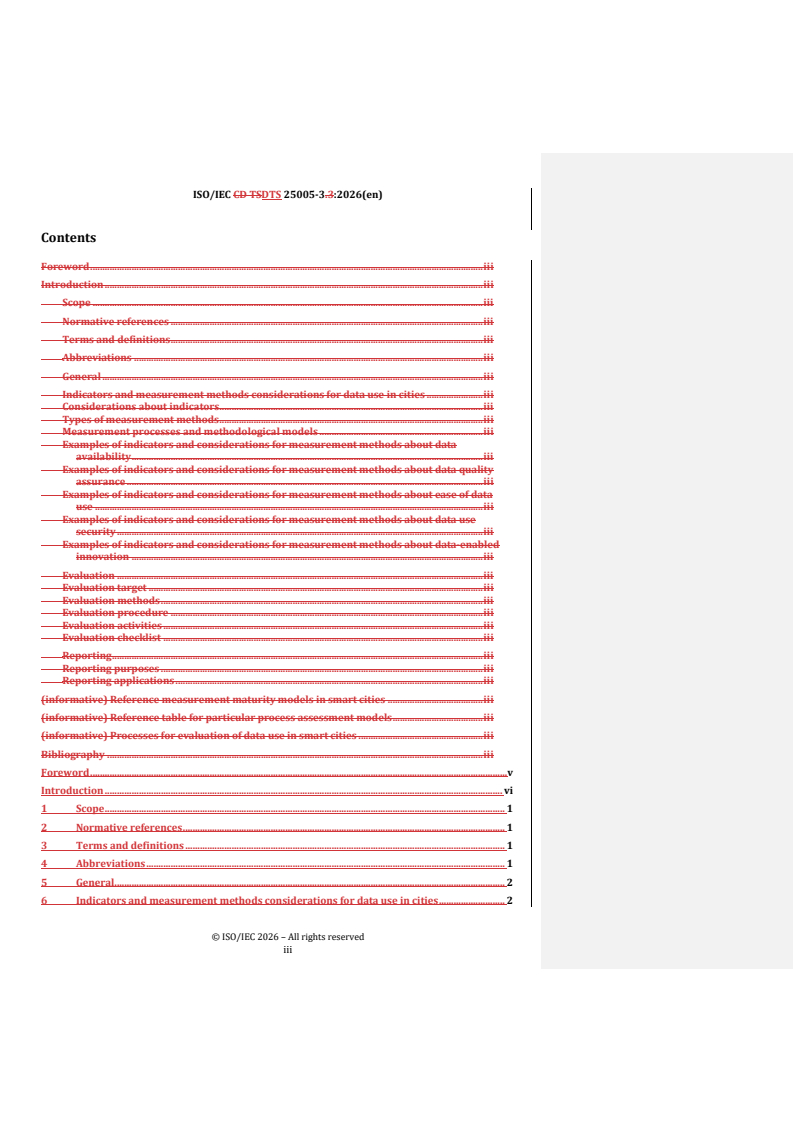
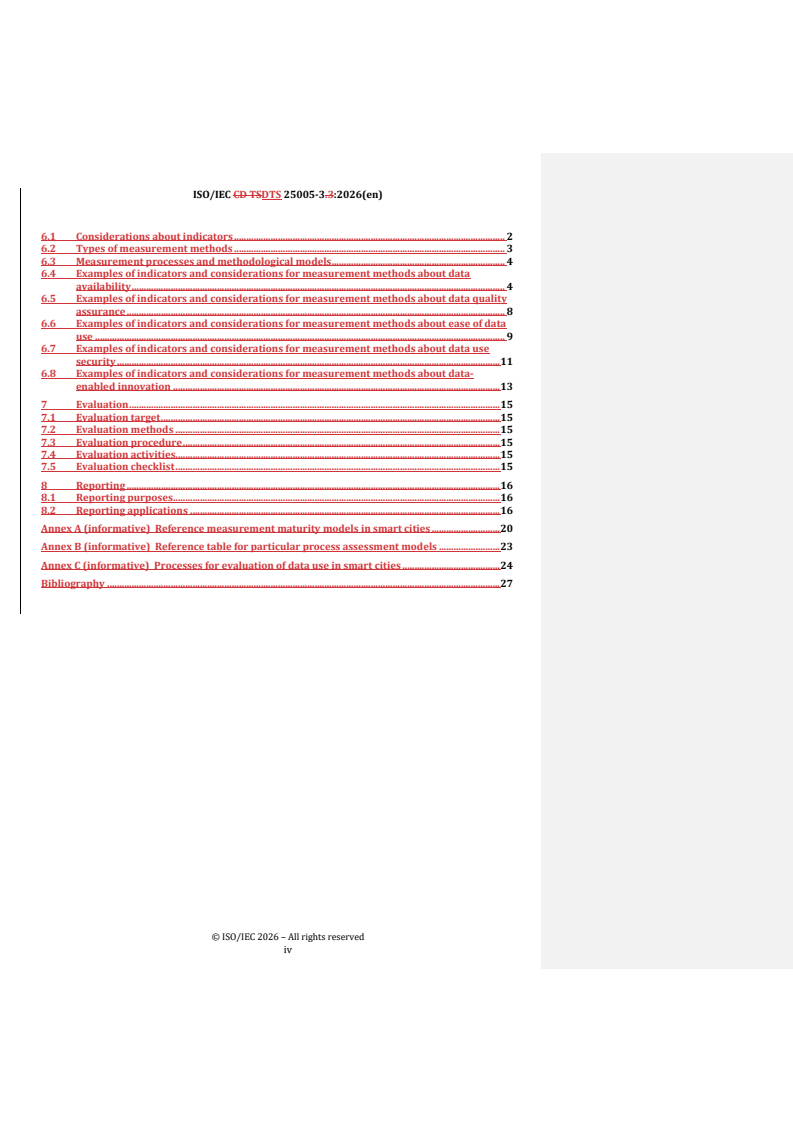
Contents
- Introduction
- 1 Scope
- 2 Normative references
- 3 Terms and definitions
- 3.1 data availability
- 3.2 data quality
- 3.3 data security
- 4 Abbreviations
- 5 General
- 6 Indicators and measurement methods considerations for data use in cities
- 6.1 Considerations about indicators
- 6.2 Types of measurement methods
- 6.3 Measurement processes and methodological models
- 6.4 Examples of indicators and considerations for measurement methods about data
- 6.5 Examples of indicators and considerations for measurement methods about data
- 6.6 Examples of indicators and considerations for measurement methods about ease of
- 6.7 Examples of indicators and considerations for measurement methods about data use
- 6.8 Examples of indicators and considerations for measurement methods about data-
- 7 Evaluation
- 7.1 Evaluation target
- 7.2 Evaluation methods
- 7.3 Evaluation procedure
- 7.4 Evaluation activities
- 7.5 Evaluation checklist
- 8 Reporting
- 8.1 Reporting purposes
- 8.2 Reporting applications
- Annex A
- 1 Informal. There are exploratory steps taken towards
- 2 Documented. An objective has been formulated in work-
- 4 Deployed. A solution delivering against the objective has
- 5 Measurable impact. There is measurable impact and
- Annex B
- Annex C
- Bibliography
Introduction
This document fills in the gaps in standards collaboration to measurement, evaluation and reporting of data [1] use in the ICT development and applications in smart cities, and it is complementary to ISO/IEC 30146 that provides guiding principles for the development of ICT indicators for smart cities. This document provides alternative indicators on data use in smart cities.
This document can also be applied for planning, building, operating, assessing and continuous improvement of data use in smart cities applications, investment, procurement, monitoring, auditing and performance assessment in smart city.
Data use in smart cities standard series consists of three parts. This document is the part 3 of data use in [2] smart cities standard series, which is in alignment with ISO/IEC 25005-1 , regarding data as strategic resources and asset of city from many views and various dimensions, bringing multiple stakeholders interests and considerations about demands for data use together as a complementary whole to deal with problems in data use including data are not available, data are not useful, data are not easy to use, data are not used securely, data are not used for enabling intelligent predictions and actions due to lack of comprehensive guarantees about data use in data management and governance. Special attentions are paid to demands for standardization collaboration to enable comprehensive data use to guarantee the data-based, data-driven and data-enabled city-wide ICT development and applications in smart cities to enable data that are available, data that are useful, data that are easy to use, data that are used securely, and data that are used for enabling intelligent predictions and actions. Figure 1 provides the relations among ISO/IEC 25005-1 [2] [3] [4] , ISO/IEC TR 25005-2 and ISO/IEC DTS 25005-3 , describing guiding principles for data use in smart cities, core issues and considerations of data use in smart cities which are the basis for data use in smart cities standard series.
Figure 1 — Data use in smart cities standard series This document brings existing considerations about indicators, indicator description, measurement, evaluation and reporting of data use together for continuous improvement of total capabilities of data use in smart cities to support data-based, data-driven, and data-enabled ICT development and applications in smart cities.
The evaluation methods depend on different interests of stakeholders for different purposes, a variety of evaluation methods like maturity models are listed in Annex A, Annex B, and Annex C for references.
FINAL DRAFT Technical Specification ISO/IEC DTS 25005-3:2026(en) Information technology — Data use in smart cities — Part 3:
Measurement, evaluation and reporting
1 Scope
This document provides indicators, measurement, evaluation, and reporting about data use in smart cities. The document is intended for those who are responsible for planning, building, and operating, assessing and continuous improvement of data use in smart cities applications, as well as for related investment, procurement, monitoring, auditing and performance assessment.
2 Normative references
The following documents are referred to in the text in such a way that some or all of their content constitutes requirements of this document. For dated references, only the edition cited applies. For undated references, the latest edition of the referenced document (including any amendments) applies. ISO/IEC DIS 25005-1, Information technology — Data use in smart cities — Part 1: Framework
3 Terms and definitions
For the purposes of this document, the terms and definitions given in the ISO/IEC 25005-1 and the following apply.
ISO and IEC maintain terminological databases for use in standardization at the following addresses:
- IEC Electropedia: available at http:// www .electropedia .org/
- ISO Online browsing platform: available at http:// www .iso .org/ obp
3.1 data availability
property of being accessible and usable upon demand by an authorized entity [5] [SOURCE: ISO 37166:2022 , 3.2]
3.2 data quality
degree to which a set of inherent characteristics of data fulfil requirements [6] [SOURCE: ISO/IEC 25024:2015 , 4.11]
3.3 data security
preservation of data to guarantee availability, confidentiality and data integrity [7] [SOURCE: ISO/IEC 29182-2:2013 , 2.6.6]
ISO/IEC DTS 25005-3:2026(en)
4 Abbreviations
API Application programming interface ICT Information and communication technology IDC International data corporation IoT Internet of things OM Operation and maintenance
5 General
The general principles of considerations about indicators, measurement, evaluation and reporting of data [2] use in smart cities are provided in and associated with ISO/IEC 25005-1 :
a) Comparable 1) The indicators should reflect the common characteristics of the data use in smart cities. 2) The indicators should be defined in a way that data use can be comparable over time, space and event.
b) Comprehensive 1) The indicators cover all the core considerations of the data use in smart cities identified in iso: proj:
88765ISO/ IEC FDIS 25005-1.
c) Adaptable 1) The indicators should be continuously updated adaptable to scenarios of data use in smart cities. d) Inclusiveness 1) The indicators are comprehensive to reflect the multiple stakeholders’ considerations about data use.
e) Operational 1) The indicators should be easily observable, measurable and auditable. 2) The historic and current data should be either available or easy to collect to connect past to present and present to future.
6 Indicators and measurement methods considerations for data use in cities
6.1 Considerations about indicators
This document identifies five dimensional indicators and thirty one sub-dimensional indicators. The selection considerations are as follows:
a) Applicable to multiple scenarios of measurement of data use citywide. The selected indicators should take into account the use of multiple scenarios in smart cities. For example, it can be used for investment, procurement, monitoring, auditing, and performance assessment of ICT projects, it can also be used for the conceptual design of smart city infrastructure, and it can also be used for measuring and auditing data-driven smart city services.
b) Cover the entire process of data processing, management and governance as well as its conditions and regulatory environments e.g. time, places, events and scenarios.
ISO/IEC DTS 25005-3:2026(en) c) The interests of different stakeholders from many and various types of demands along data value chain and data ecosystem are taken into account, e.g. data owners, data custodians, data providers, data users, data managers, data products and service producers, data administrative monitors in smart cities. d) Indicators relevant to data use from existing standards are taken into account and brought together for harmonized, consistent, coherent and standardized use.
e) Consider appropriate technological foresight. The indicators should cover the measurement and evaluation of structured data as well as multimodal data such as text, audio, video, and images data. The indicators should cover artificial intelligence scenarios such as large models that will be widely used in the future.
The five dimensional indicator groups and their thirty one sub-dimensional indicators are as following:
f) The indicators about data availability, including nine sub-dimensional indicators, namely network infrastructure accessibility, inclusiveness, data accessibility, coverage of data use in city administration data resources holdings, the contribution of government in data use, government-enterprise cooperation on data opening and use, government-citizen cooperation on data opening and use, enterprise-citizen cooperation on data opening and use, data laws, regulations and policies; g) The indicators about data quality assurance, including seven sub-dimensional indicators, namely completeness, authenticity, reliability, timeliness, accuracy, consistency, traceability, and service impact; h) The indicators about ease of data use, including six sub-dimensional indicators, namely data sharing measures, data opening measures, interoperability, linkability, user experience of convenience and user satisfaction; i) The indicators about data use security, including five sub-dimensional indicators, namely data use authentication control schemes, data use security and privacy control schemes, data use monitoring and early warning schemes, personal data operation schemes, and consent sovereignty and revocability. j) The indicators about data-enabled innovation, including three sub-dimensional indicators, namely dataenabled monitoring applications, data-enabled early warning and prediction applications, data-enabled intelligent decision-making applications and responsible data-driven innovation.
6.2 Types of measurement methods
The methods of measurement primarily encompass three categories: ordinal measurement, interval measurement, and ratio measurement. The selection of methods of measurement for data use citywide depends on city needs and characteristics of considerations and sub-considerations about data use identified [2] in ISO/IEC 25005-1 that can be observed and measured.
a) Ordinal measurement, not only classifies but also ranks objects in a logical order, indicating their grade or sequence without permitting arithmetic operations, e.g. Interoperability. b) Interval measurement further allows for the determination of intervals and quantitative differences between categories, enabling addition and subtraction but not multiplication or division. The zero point in interval measurement is arbitrary rather than absolute; a common example is time (timeliness), where a zero value does not represent the complete absence of the measured attribute but merely a conventional reference point.
c) Ratio measurement, the highest level, incorporates all properties of the previous two scales, it permits all arithmetic operations (addition, subtraction, multiplication, and division) and providing results with meaningful practical interpretation. A defining feature is that its zero point represents an absolute zero—meaning a complete absence of the attribute being measured. Using accuracy as an example, a zero value indicates no accuracy at all (i.e. completely incorrect or no correct results), which allows for meaningful ratio comparisons such as “one measurement is twice as accurate as another.”
ISO/IEC DTS 25005-3:2026(en)
6.3 Measurement processes and methodological models
Measurement processes and the tools are different according to different purposes for measurement, evaluation and reporting. This document provides following references:
Annex A provides examples of reference measurement maturity models for measuring performance of data use in smart cities.
Clause A.1 provides a five-level maturity model for measuring data use performance in smart cites which covers: level 1: informal, level 2: documented, Level 3: planned, Level 4: deployed, Level 5: impact. Clause A.2 provides TM Forum Smart City Maturity and Benchmark Model which gives common rating criteria, including 0: Not started, 2. Documented, 3 Planned, 4. Deployed, 5. Measurable impact. Clause A.3 provides IDC Government Insights’ Smart City Model which defines key characteristics, goals and outcomes of Ad Hoc, Opportunistic, Repeatable, Managed, Optimized. [8] Annex B provides examples of process assessment models specified in ISO 8000-63 which gives different considerations about indicators, metric, measured indicator value and converted indicator value in different standards and scenarios.
[8] Annex C provides example processes for different process assessment models in ISO 8000-63 .
6.4 Examples of indicators and considerations for measurement methods about data
availability Examples of indicators and measurement methods for data availability are provided in Table 1. These indicators are aligned with the sub-characteristics of data use considerations defined in ISO/IEC 25005-1:2026 [9] , 6.2.
NOTE “L1.8 Enterprise-citizen cooperation on data opening and use” is newly added with considerations of national bodies consulting recommendations.
Examples can be varied from citiy to citiy, according to intended purposes of data use. The measurement methods provided in Table 1 represent typical calculation formulas. Users may apply alternative mathematical models or data sources provided they maintain consistency with the indicator’s objective.
Table 1 — Examples of indicators and considerations for measurement methods about data availability Indicator Description Example measurement methods a) Percentage of the city population a) (Number of people in the city with with access to pre-defined fast broad- access to sufficiently fast broadband / band. city's total population) ×100%.
[10] [SOURCE: ISO 37122:2019 , 18.1, modified Change "sufficiently" to "pre-defined"] L1.1 Network infrastructure accessi- b) Percentage of the city area covered b) (Land area of the city serviced bility by municipally provided Internet with Internet connectivity in square connectivity. kilometres /city's total land area in square kilometres)×100%.
c) Percentage of department facilities c) (Number of department facilities connected to city service provisions that are connected with city service provisions/total number of department facilities) ×100%.
ISO/IEC DTS 25005-3:2026(en) TTabablele 1 1 ((ccoonnttiinnueuedd)) a) Percentage of e-record coverage for a) (Number of low-income houselow-income households. holds with e-records/total number of [11] low-income households) × 100%.
[SOURCE: ISO/IEC 30146:2019 , L 1.8.1] b) Performance of Internet accessibil- b) (Number of municipal government L1.2 Inclusiveness ity for disabled people. main portals that provide Internet [11] accessibility for disabled people in [SOURCE: ISO/IEC 30146:2019 , L smart cities / total number of munici- 1.8.2] pal government main portals in smart cities) × 100%.
a) Existence of central portal access. a) (Yes/no) whether there is a central/federal open government data portal.
b) Accessibility of digital public b) Percentage of digital smart-city services beyond government portals, services meeting internationally recincluding mobile applications, dash- ognized accessibility standards. boards and real-time information services.
c) Existence of requirements to pro- c) (Yes/no) whether there are revide data in open, reusable formats. quirements on machine-readable and open formats.
d) Existence of service free of charge d) (Yes/no) whether there are reor with open license. quirements to provide open data free of charge and with open license.
e) Existence of requirements to e) (Yes/no) whether there are reprovide data through Application quirements to provide data through Programming Interfaces (s). standard APIs.
L1.3 Data accessibility f) Usability of data portals, including f) User-centered accessibility and clarity of structure and ease of find- navigation evaluation using measuraing high-value datasets. ble indicators, such as:
- task completion rate for key user journeys,
- average time-on-task for finding high-value datasets,
- number of navigation errors per task,
- proportion of accessibility criteria met (e.g. WCAG compliance),
- user satisfaction ratings from structured usability tests.
ISO/IEC DTS 25005-3:2026(en) TTabablele 1 1 ((ccoonnttiinnueuedd)) a) Public information resources open- a) (Number of city administration ness ratio. data sets open to public according to the local policy/total number of city administration data required to open to public according to local policy) × 100%.
b) Information sharing ratio among b) (Number of city administration government sectors. data resources shared across government sectors according to the local L1.4 Coverage of data use in city adpolicy/total number of city adminisministration data resources holdings tration data required to share across government sectors according to local policy) × 100%.
c) Percentage of high value datasets c) (Number of High value datasets that are available as open data. that are available as open data according to the local policy / total number of city administration data resources open to public according to the local policy) × 100%.
a) Data use promotion initiatives in a) (Yes/no) whether there are specific smart cities. events (e.g. information sessions, co-creation events) organized by government to support data use in smart cities.
L1.5 Contribution of government in b) Data use literacy programmes in b) (Yes/no) whether there are traindata use smart cities. ing events to improve data awareness and support data use in smart cities.
c) Monitoring impact of data use in c) (Yes/no) whether there is a monsmart cities. itoring impact of data use in smart cities conducted by the government.
a) Consultations on data opening and a) (Yes/no) whether enterprises were data use with enterprises. consulted to identify data opening and data use demands.
b) Existence of formal partnerships. b) (Yes/no) whether there is a formal partnership between the government and enterprises to promote data use L1.6 Government-enterprise cooperain smart cities.
tion on data opening and use c) Service or application made by en- c) (Yes/no) whether there are servicterprises with government data. es or applications made by enterprises with government data. d) Service or application made by the d) (Yes/no) whether there are sergovernment with enterprise data. vices or applications made by the government with enterprise data.
a) Consultations on data opening and a) (Yes/no) whether citizens were data use with citizens. consulted to identify data opening and data use demands.
L1.7 Government-citizen cooperation b) Citizen Engagement for city use b) (Yes/no) where there are channels on data opening and use services. provided by government for citizens to provide an opinion on city data use services.
ISO/IEC DTS 25005-3:2026(en) TTabablele 1 1 ((ccoonnttiinnueuedd)) a) Completeness of the data govern- a) (yes/no) whether businesses (utilance ecosystem. ities, telecommunications, fintech, logistics, etc) as custodians of vast volume of personal and collective data are in cooperation with citizens to build transparency and trust on data opening and use for cities.
b) Social responsibility and business b) (yes/no) Whether the business ethics in the digital age. can provide documented information L1.8 Enterprise-citizen cooperation regarding its social responsibilities, on data opening and use including the ethical governance of data, the protection of citizens’ digital rights (privacy, data portability, right to rectification, non-discrimination, and avoidance of unwanted bias), and commitments to business models that prioritize informed consent, auditability, and the collective public good over the unilateral extraction of value.
a) Coordinated state and condition a) (Yes/no) whether there are coorof good practice of data use, e.g. dinated good practices of data use, leadership, awarding and punishment e.g. leadership, regulation, standardapproaches to promote data use and ization, champaign, awarding and reuse for better city services. punishment approaches to promote the data use and reuse for better city services.
...
Contents
- Introduction
- 1 Scope
- 2 Normative references
- 3 Terms and definitions
- 3.1 data availability
- 3.2 data quality
- 3.3 data security
- 4 Abbreviations
- 5 General
- 6 Indicators and measurement methods considerations for data use in cities
- 6.1 Considerations about indicators
- 6.2 Types of measurement methods
- 6.3 Measurement processes and methodological models
- 6.4 Examples of indicators and considerations for measurement methods about data
- 6.5 Examples of indicators and considerations for measurement methods about data
- 6.6 Examples of indicators and considerations for measurement methods about ease of
- 6.7 Examples of indicators and considerations for measurement methods about data use
- 6.8 Examples of indicators and considerations for measurement methods about data-
- 7 Evaluation
- 7.1 Evaluation target
- 7.2 Evaluation methods
- 7.3 Evaluation procedure
- 7.4 Evaluation activities
- 7.5 Evaluation checklist
- 8 Reporting
- 8.1 Reporting purposes
- 8.2 Reporting applications
- Annex A
- 1 Informal. There are exploratory steps taken towards
- 2 Documented. An objective has been formulated in
- 4 Deployed. A solution delivering against the objective has
- 5 Measurable impact. There is measurable impact and
- Annex B
- Annex C
- Bibliography
Introduction
This document fills in the gaps in standards collaboration to measurement, evaluation and reporting of data use in the ICT development and applications in smart cities, and it is complementary to ISO/IEC [11] 30146:2019ISO/IEC 30146 that provides guiding principles for the development of ICT indicators for smart cities. This document provides alternative indicators on data use in smart cities. This document can also be applied for planning, building, operating, assessing and continuous improvement of data use in smart cities applications, investment, procurement, monitoring, auditing and performance assessment in smart city.
Data use in smart cities standard series consists of three parts. This document is the part 3 of data use in smart [9] cities standard series, which is in alignment with ISO/IEC FDIS 25005-1,ISO/IEC 25005-1 , regarding data as strategic resources and asset of city from many views and various dimensions, bringing multiple stakeholders interests and considerations about demands for data use together as a complementary whole to deal with problems in data use including data are not available, data are not useful, data are not easy to use, data are not used securely, data are not used for enabling intelligent predictions and actions due to lack of comprehensive guarantees about data use in data management and governance. Special attentions are paid to demands for standardization collaboration to enable comprehensive data use to guarantee the data-based, data-driven and data-enabled city-wide ICT development and applications in smart cities to enable data that are available, data that are useful, data that are easy to use, data that are used securely, and data that are used for enabling intelligent predictions and actions. Figure 1 provides the relations among ISO/IEC FDIS 25005-1 [9] [3] , ISO/IEC TR 25005-2:2025ISO/IEC 25005-1 , ISO/IEC TR 25005-2 and ISO/IEC TS 25005-3,ISO/IEC DTS [4] 25005-3 , describing guiding principles for data use in smart cities, core issues and considerations of data use in smart cities which are the basis for data use in smart cities standard series.
ISO/IEC CD TSDTS 25005-3.3:2026(en)
Figure 1 — Data use in smart cities standard series Formatted: Default Paragraph Font This document brings existing considerations about indicators, indicator description, measurement, evaluation and reporting of data use together for continuous improvement of total capabilities of data use in smart cities to support data-based, data-driven, and data-enabled ICT development and applications in smart cities.
The evaluation methods depend on different interests of stakeholders for different purposes, a variety of evaluation methods like maturity models are listed in Annex A, Annex B, and Annex C for references.
ISO/IEC CD TSDTS 25005-3.3:2026(en) Information technology — Data use in smart cities — Part 3:
Measurement, evaluation and reporting
1 Scope
This document provides indicators, measurement, evaluation, and reporting about data use in smart cities. The document is intended for those who are responsible for planning, building, and operating, assessing and continuous improvement of data use in smart cities applications, as well as for related investment, procurement, monitoring, auditing and performance assessment.
2 Normative references
The following documents are referred to in the text in such a way that some or all of their content constitutes requirements of this document. For dated references, only the edition cited applies. For undated references, the latest edition of the referenced document (including any amendments) applies. ISO/IEC DIS 25005-1, Information technology — Data use in smart cities — Part 1: Framework
3 Terms and definitions
For the purposes of this document, the terms and definitions given in the ISO/IEC FDIS 25005-1 and the following apply.
ISO and IEC maintain terminological databases for use in standardization at the following addresses:
- IEC Electropedia: available at http://www.electropedia.org/
- ISO Online browsing platform: available at http://www.iso.org/obp
3.1 data availability
Formatted: Default Paragraph Font property of being accessible and usable upon. demand by an authorized entity [5] [SOURCE: ISO 37166:2022,ISO 37166:2022 , 3.2]
3.2 data quality
degree to which a set of inherent characteristics of data fulfil requirements [6] [SOURCE: ISO/IEC 25024:2015 ,ISO/IEC 25024:2015 , 4.11]
3.3 data security
preservation of data to guarantee availability, confidentiality and data integrity [7] [SOURCE: ISO/IEC 29182-2:2013,ISO/IEC 29182-2:2013 , 2.6.6]
4 Abbreviations
API applicationApplication programming interface
ISO/IEC CD TSDTS 25005-3.3:2026(en) ICT informationInformation and communication technology IDC internationalInternational data corporation IoT internetInternet of things OM operationOperation and maintenance
5 General
The general principles of considerations about indicators, measurement, evaluation and reporting of data use [9] in smart cities are provided in and associated with ISO/IEC FDIS 25005-1:ISO/IEC 25005-1 :
a) Comparable 1) ⎯ The indicators should reflect the common characteristics of the data use in smart cities. 2) ⎯ The indicators should be defined in a way that data use can be comparable over time, space and event.
b) Comprehensive 1) ⎯ The indicators cover all the core considerations of the data use in smart cities identified in ISOiso:proj:88765ISO/IEC FDIS 25005-1 and ISO/IEC TR 25005-2:2025 . c) Adaptable 1) ⎯ The indicators should be continuously updated adaptable to scenarios of data use in smart cities.
d) Inclusiveness 1) ⎯ The indicators are comprehensive to reflect the multiple stakeholders’ considerations about data use.
e) Operational 1) ⎯ The indicators should be easily observable, measurable and auditable. 2) ⎯ The historic and current data should be either available or easy to collect to connect past to present and present to future.
6 Indicators and measurement methods considerations for data use in cities
6.1 Considerations about indicators
This document identifies five dimensional indicators and thirty one sub-dimensional indicators. The selection considerations are as follows:
a) a) Applicable to multiple scenarios of measurement of data use citywide. The selected indicators should take into account the use of multiple scenarios in smart cities. For example, it can be used for investment, procurement, monitoring, auditing, and performance assessment of ICTICT projects, it can also be used
ISO/IEC CD TSDTS 25005-3.3:2026(en) for the conceptual design of smart city infrastructure, and it can also be used for measuring and auditing data-driven smart city services.
b) b) Cover the entire process of data processing, management and governance as well as its conditions and regulatory environments e.g. time, places, events and scenarios. c) c) The interests of different stakeholders from many and various types of demands along data value chain and data ecosystem are taken into account, e.g. data owners, data custodians, data providers, data users, data managers, data products and service producers, data administrative monitors in smart cities. d) d) Indicators relevant to data use from existing standards are taken into account and brought together for harmonized, consistent, coherent and standardized use.
e) e) Consider appropriate technological foresight. The indicators should cover the measurement and evaluation of structured data as well as multimodal data such as text, audio, video, and images data. The indicators should cover artificial intelligence scenarios such as large models that will be widely used in the future.
The five dimensional indicator groups and their thirty one sub-dimensional indicators are as following:
f) f) The indicators about data availability, including nine sub-dimensional indicators, namely network infrastructure accessibility, inclusiveness, data accessibility, coverage of data use in city administration data resources holdings, the contribution of government in data use, government-enterprise cooperation on data opening and use, government-citizen cooperation on data opening and use, enterprise-citizen cooperation on data opening and use, data laws, regulations and policies; g) g) The indicators about data quality assurance, including seven sub-dimensional indicators, namely completeness, authenticity, reliability, timeliness, accuracy, consistency, traceability, and service impact; h) h) The indicators about ease of data use, including six sub-dimensional indicators, namely data sharing measures, data opening measures, interoperability, linkability, user experience of convenience and user satisfaction; i) i) The indicators about data use security, including five sub-dimensional indicators, namely data use authentication control schemes, data use security and privacy control schemes, data use monitoring and early warning schemes, personal data operation schemes, and consent sovereignty and revocability. j) j) The indicators about data-enabled innovation, including three sub-dimensional indicators, namely dataenabled monitoring applications, data-enabled early warning and prediction applications, data-enabled intelligent decision-making applications and responsible data-driven innovation.
6.2 Types of measurement methods
The methods of measurement primarily encompass three categories: ordinal measurement, interval measurement, and ratio measurement. The selection of methods of measurement for data use citywide depends on city needs and characteristics of considerations and sub-considerations about data use identified [9] in ISO/IEC FDIS 25005-1ISO/IEC 25005-1 that can be observed and measured. a) Ordinal measurement, not only classifies but also ranks objects in a logical order, indicating their grade or sequence without permitting arithmetic operations, e.g. Interoperability. b) Interval measurement further allows for the determination of intervals and quantitative differences between categories, enabling addition and subtraction but not multiplication or division. The zero point in interval measurement is arbitrary rather than absolute; a common example is time (timeliness), where
ISO/IEC CD TSDTS 25005-3.3:2026(en) a zero value does not represent the complete absence of the measured attribute but merely a conventional reference point.
c) Ratio measurement, the highest level, incorporates all properties of the previous two scales, it permits all arithmetic operations (addition, subtraction, multiplication, and division) and providing results with meaningful practical interpretation. A defining feature is that its zero point represents an absolute zero— meaning a complete absence of the attribute being measured. Using accuracy as an example, a zero value indicates no accuracy at all (i.e. completely incorrect or no correct results), which allows for meaningful ratio comparisons such as “one measurement is twice as accurate as another.”
6.3 Measurement processes and methodological models
Measurement processes and the tools are different according to different purposes for measurement, evaluation and reporting. This document provides following references:
Annex A provides examples of reference measurement maturity models for measuring performance of data use in smart cities.
Annex A.1Clause A.1 provides a five-level maturity model for measuring data use performance in smart cites which covers: level 1: informal, level 2: documented, Level 3: planned, Level 4: deployed, Level 5: impact. Annex A.2Clause A.2 provides TM Forum Smart City Maturity and Benchmark Model which gives common rating criteria, including 0: Not started, 2. Documented, 3 Planned, 4. Deployed, 5. Measurable impact. Annex A.3 provides IDCClause A.3 provides IDC Government Insights’ Smart City Model which defines key characteristics, goals and outcomes of Ad Hoc, Opportunistic, Repeatable, Managed, Optimized. [13] Annex B provides examples of process assessment models specified in ISO 8000-63:2019ISO 8000-63 which gives different considerations about indicators, metric, measured indicator value and converted indicator value in different standards and scenarios.
Annex C provides example processes for different process assessment models in ISO 8000-63:2019 .ISO 8000- [13] 63 .
6.4 Examples of indicators and considerations for measurement methods about data
availability Examples of indicators and measurement methods for data availability are provided in Table 1 .. These indicators are aligned with the sub-characteristics of data use considerations defined in ISO/IEC FDIS 25005- [9] 1 ClauseISO/IEC 25005-1:2026 , 6.2.
NOTE “L1.8 Enterprise-citizen cooperation on data opening and use” is newly added with considerations of national bodies consulting recommendations.
Examples can be varied from citiescitiy to citiescitiy, according to intended purposes of data use. The measurement methods provided in Table 1 represent typical calculation formulas. Users may apply alternative mathematical models or data sources provided they maintain consistency with the indicator’s objective.
Table 1 — Examples of indicators and considerations for measurement methods about data availability Example measurement Indicator Description methods
ISO/IEC CD TSDTS 25005-3.3:2026(en) a) Percentage of the city population a) (Number of people in the city with with access to pre-defined fast access to sufficiently fast broadband broadband. /city's total population) ×100%.
[SOURCE: ISO 37122:2019,ISO [10] 37122:2019 , 18.1, modified Change "sufficiently" to "predefined"] L1.1 Network infrastructure b) Percentage of the city area b) (Land area of the city serviced accessibility covered by municipally provided with Internet connectivity in square Internet connectivity. kilometres /city's total land area in square kilometres)×100%.
c) Percentage of department c) (Number of department facilities facilities connected to city service that are connected with city service provisions provisions/total number of department facilities) ×100%.
a) Percentage of e-record coverage a) (Number of low-income for low-income households. households with e-records/total number of low-income households) [SOURCE: ISO/IEC [11] × 100%.
30146:2019ISO/IEC 30146:2019 , L 1.8.1] L1.2 Inclusiveness b) Performance of Internet b) (Number of municipal accessibility for disabled people. government main portals that provide Internet accessibility for [SOURCE: ISO/IEC disabled people in smart cities / total [11] 30146:2019ISO/IEC 30146:2019 number of municipal government , L 1.8.2] main portals in smart cities) × 100%.
a) Existence of central portal access. a) (Yes/no) whether there is a central/federal open government data portal.
b) Accessibility of digital public b) Percentage of digital smart-city services beyond government portals, services meeting internationally including mobile applications, recognized accessibility standards. dashboards and real-time information services.
c) Existence of requirements to c) (Yes/no) whether there are provide data in open, reusable requirements on machine-readable formats. and open formats.
d) Existence of service free of charge d) (Yes/no) whether there are or with open license. requirements to provide open data L1.3 Data accessibility free of charge and with open license.
e) Existence of requirements to e) (Yes/no) whether there are provide data through Application requirements to provide data Programming Interfaces (APIs). through standard APIs.
f) Usability of data portals, including f) User-centered accessibility and clarity of structure and ease of navigation evaluation using finding high-value datasets. measurable indicators, such as:
- task completion rate for key user journeys,
- average time-on-task for finding high-value datasets,
ISO/IEC CD TSDTS 25005-3.3:2026(en) - number of navigation errors per task, - proportion of accessibility criteria met (e.g. WCAG compliance), - user satisfaction ratings from structured usability tests.
a) Public information resources a) (Number of city administration openness ratio. data sets open to public according to the local policy/total number of city administration data required to open to public according to local policy) × 100%.
b) Information sharing ratio among b) (Number of city administration government sectors. data resources shared across L1.4 Coverage of data use in city government sectors according to the administration data resources local policy/total number of city holdings administration data required to share across government sectors according to local policy) × 100%.
c) Percentage of high value datasets c) (Number of High value datasets that are available as open data. that are available as open data according to the local policy / total number of city administration data resources open to public according to the local policy) × 100%.
a) Data use promotion initiatives in a) (Yes/no) whether there are smart cities. specific events (e.g. information sessions, co-creation events) organized by government to support data use in smart cities.
b) Data use literacy programmes in b) (Yes/no) whether there are L1.5 Contribution of government in smart cities. training events to improve data data use awareness and support data use in smart cities.
c) Monitoring impact of data use in c) (Yes/no) whether there is a smart cities. monitoring impact of data use in smart cities conducted by the government.
a) Consultations on data opening and a) (Yes/no) whether enterprises data use with enterprises. were consulted to identify data opening and data use demands.
b) Existence of formal partnerships. b) (Yes/no) whether there is a L1.6 Government-enterprise formal partnership between the cooperation on data opening and use government and enterprises to promote data use in smart cities.
c) Service or application made by c) (Yes/no) whether there are enterprises with government data. services or applications made by enterprises with government data.
ISO/IEC CD TSDTS 25005-3.3:2026(en) d) Service or application made by d) (Yes/no) whether there are the government with enterprise services or applications made by the data. government with enterprise data.
a) Consultations on data opening and a) (Yes/no) whether citizens were data use with citizens. consulted to identify data opening and data use demands.
L1.7 Government-citizen b) Citizen Engagement for city use b) (Yes/no) where there are cooperation on data opening and use services. channels provided by government for citizens to provide an opinion on city data use services.
a) Completeness of the data a) (yes/no) whether businesses governance ecosystem. (utilities, telecommunications, fintech, logistics, etc) as custodians of vast volume of personal and collective data are in cooperation with citizens to build transparency and trust on data opening and use for cities.
b) Social responsibility and business b) (yes/no) Whether the business ethics in the digital age. can provide documented L1.8 Enterprise-citizen cooperation information regarding its social on data opening and use responsibilities, including the ethical governance of data, the protection of citizens’ digital rights (privacy, data portability, right to rectification, non-discrimination, and avoidance of unwanted bias), and commitments to business models that prioritize informed consent, auditability, and the collective public good over the unilateral extraction of value.
a) Coordinated state and condition of a) (Yes/no) whether there are good practice of data use, e.g. coordinated good practices of data leadership, awarding and use, e.g. leadership, regulation, punishment approaches to promote standardization, champaign, data use and reuse for better city awarding and punishment services. approaches to promote the data use and reuse for better city services.
...