

ISO 2624:1990
(Main)Copper and copper alloys — Estimation of average grain size
General Information
- Abstract
Specifies three procedures for estimating, and rules for expressing, the average grain size of copper and copper alloys consisting principally of a single phase. The comparison procedure (comparing the specimen with a standard chart) is most convenient and is sufficiently accurate for most commercial purposes. In cases of dispute the use of the Heyn or Jeffries procedures (intercept procedure and planimetric procedure, respectively) having higher degrees of accuracy is recommended.
- Status
- Published
- Publication Date
- 17-Jan-1990
- Technical Committee
- ISO/TC 26 - Copper and copper alloys
- Drafting Committee
- ISO/TC 26 - Copper and copper alloys
- Current Stage
- 9093 - International Standard confirmed
- Start Date
- 31-Dec-2024
- Completion Date
- 29-Aug-2026
Buy Documents
ISO 2624:1990 - Copper and copper alloys -- Estimation of average grain size

ISO 2624:1990 - Copper and copper alloys — Estimation of average grain size/18/1990
ISO 2624:1990 - Cuivre et alliages de cuivre -- Évaluation de la dimension moyenne du grain
ISO 2624:1990 - Cuivre et alliages de cuivre -- Évaluation de la dimension moyenne du grain
ISO 2624:1990 - Cuivre et alliages de cuivre — Évaluation de la dimension moyenne du grain/18/1990
ISO 2624:1990 - Cuivre et alliages de cuivre — Évaluation de la dimension moyenne du grain/18/1990
Overview
ISO 2624:1990 - "Copper and copper alloys - Estimation of average grain size" specifies standardized procedures and reporting rules for estimating the average grain size of copper and copper alloys that consist principally of a single phase. The standard defines three accepted methods (comparison, intercept/Heyn, planimetric/Jeffries), specimen-preparation requirements, counting rules and recommended reporting formats. Annex A provides the normative standard grain-size charts (reproduced at ×75).
Key topics and technical requirements
- Scope: Applies to single‑phase copper and copper alloys; sub‑grains, minor phases and inclusions are ignored for grain-size estimation.
- Specimen preparation: Sections must be prepared to reveal grain boundaries (contrast etch) and representative fields chosen.
- Three procedures
- Comparison procedure: Project a photomicrograph and compare visually with the standard chart (most convenient and adequate for commercial use). Charts reproduced at ×75; Table 2 gives equivalent grain diameters for other magnifications.
- Intercept procedure (Heyn): Count grains intercepted by straight lines on an image. Recommended when higher accuracy or non‑equiaxial structures are present. Lines should yield at least 10 intercepts per line, with a minimum total of 50 intercepts for normal testing and 200 for referee purposes. Grains touched by the end of a line count as half.
- Planimetric procedure (Jeffries): Count whole and partial grains within a known area (commonly 5 000 mm²). Use the Jeffries multiplier f (Table 1) and the relation given in the standard (d = 1/f for average grain “diameter” as expressed in the document) to calculate equivalent grain diameter.
- Non-equiaxial materials: Prepare three sections at right angles; use intercept method and report results per principal direction.
- Reporting: Report per-field results or the median of fields. Mixed grain sizes should be expressed as area percentages of constituent sizes.
Applications and who uses this standard
- Metallurgists and materials scientists use ISO 2624 to quantify microstructure for process control and research.
- Quality control and inspection labs apply the methods to verify annealing, recrystallization and grain‑size requirements in supplied copper products.
- Manufacturers of copper alloys rely on these procedures for specification compliance, production monitoring and supplier acceptance.
- Failure analysis and R&D teams use standardized grain‑size data to correlate microstructure with mechanical and electrical properties.
Related standards and notes
- Annex A reproduces standard grain‑size photomicrographs (×75) - derived from ASTM E112 reference plates noted in the document.
- For contractual disputes, ISO 2624 recommends using the intercept (Heyn) or planimetric (Jeffries) procedures because they provide higher accuracy than the comparison method.
Keywords: ISO 2624, grain size, copper alloys, metallography, Heyn intercept, Jeffries planimetric, comparison procedure, standard grain size charts, microstructure, photomicrograph.
Relations
- Consolidated By
ISO 10942:1998/Cor 1:1998 - Ophthalmic instruments — Direct ophthalmoscopes — Technical Corrigendum 1 - Effective Date
- 06-Jun-2022
- Effective Date
- 15-Apr-2008
Buy Documents
ISO 2624:1990 - Copper and copper alloys -- Estimation of average grain size
ISO 2624:1990 - Copper and copper alloys — Estimation of average grain size/18/1990
ISO 2624:1990 - Cuivre et alliages de cuivre -- Évaluation de la dimension moyenne du grain
ISO 2624:1990 - Cuivre et alliages de cuivre -- Évaluation de la dimension moyenne du grain
ISO 2624:1990 - Cuivre et alliages de cuivre — Évaluation de la dimension moyenne du grain/18/1990
ISO 2624:1990 - Cuivre et alliages de cuivre — Évaluation de la dimension moyenne du grain/18/1990
Get Certified
Connect with accredited certification bodies for this standard

Element Materials Technology
Materials testing and product certification.

Inštitut za kovinske materiale in tehnologije
Institute of Metals and Technology. Materials testing, metallurgical analysis, NDT.
Sponsored listings
Frequently Asked Questions
ISO 2624:1990 is a standard published by the International Organization for Standardization (ISO). Its full title is "Copper and copper alloys — Estimation of average grain size". This standard covers: Specifies three procedures for estimating, and rules for expressing, the average grain size of copper and copper alloys consisting principally of a single phase. The comparison procedure (comparing the specimen with a standard chart) is most convenient and is sufficiently accurate for most commercial purposes. In cases of dispute the use of the Heyn or Jeffries procedures (intercept procedure and planimetric procedure, respectively) having higher degrees of accuracy is recommended.
Specifies three procedures for estimating, and rules for expressing, the average grain size of copper and copper alloys consisting principally of a single phase. The comparison procedure (comparing the specimen with a standard chart) is most convenient and is sufficiently accurate for most commercial purposes. In cases of dispute the use of the Heyn or Jeffries procedures (intercept procedure and planimetric procedure, respectively) having higher degrees of accuracy is recommended.
ISO 2624:1990 is classified under the following ICS (International Classification for Standards) categories: 77.040.99 - Other methods of testing of metals; 77.120.30 - Copper and copper alloys. The ICS classification helps identify the subject area and facilitates finding related standards.
ISO 2624:1990 has the following relationships with other standards: It is inter standard links to ISO 10942:1998/Cor 1:1998, ISO 2624:1973. Understanding these relationships helps ensure you are using the most current and applicable version of the standard.
ISO 2624:1990 is available in PDF format for immediate download after purchase. The document can be added to your cart and obtained through the secure checkout process. Digital delivery ensures instant access to the complete standard document.
Standards Content (Sample)
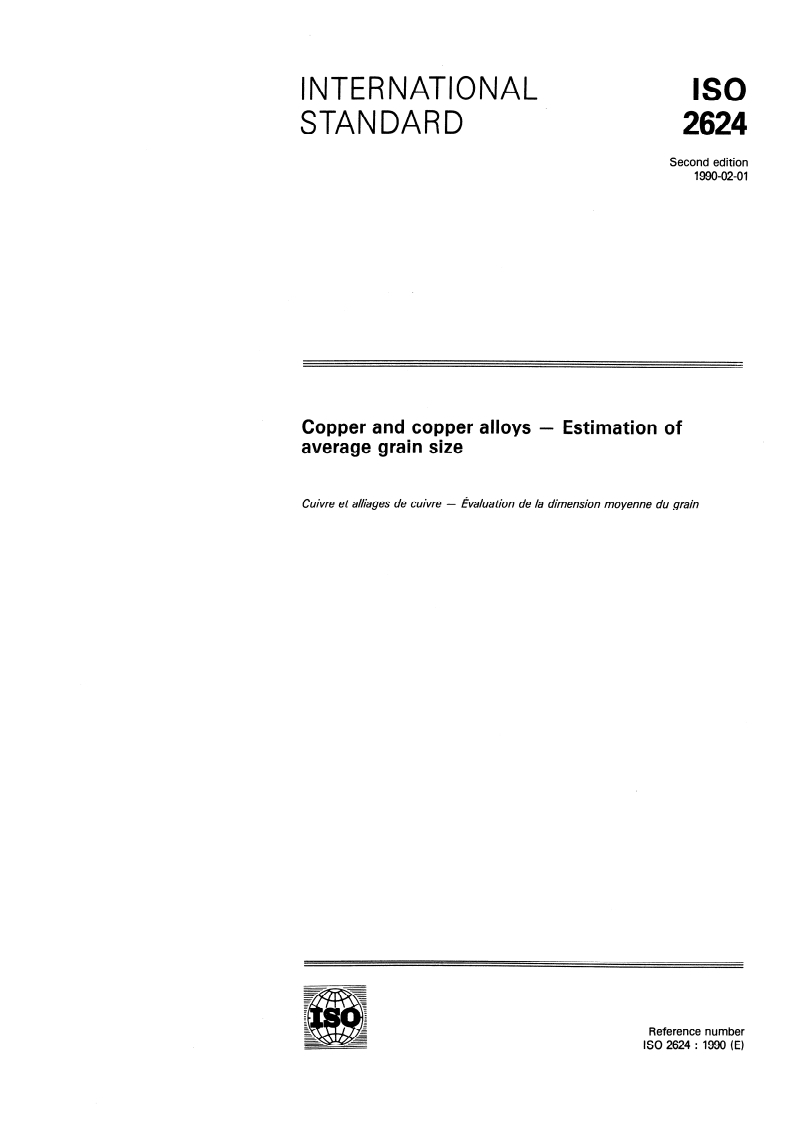
INTERNATIONAL ISO
STANDARD
Second edition
1990-02-01
Copper and topper alloys - Estimation of
awerage grain size
Evaluation de Ia dimension moyenne du grain
Cuivre et alliages de cuivre -
Reference number
ISO 2624 : 1990 (E)
ISO 2624 : 1990 (E)
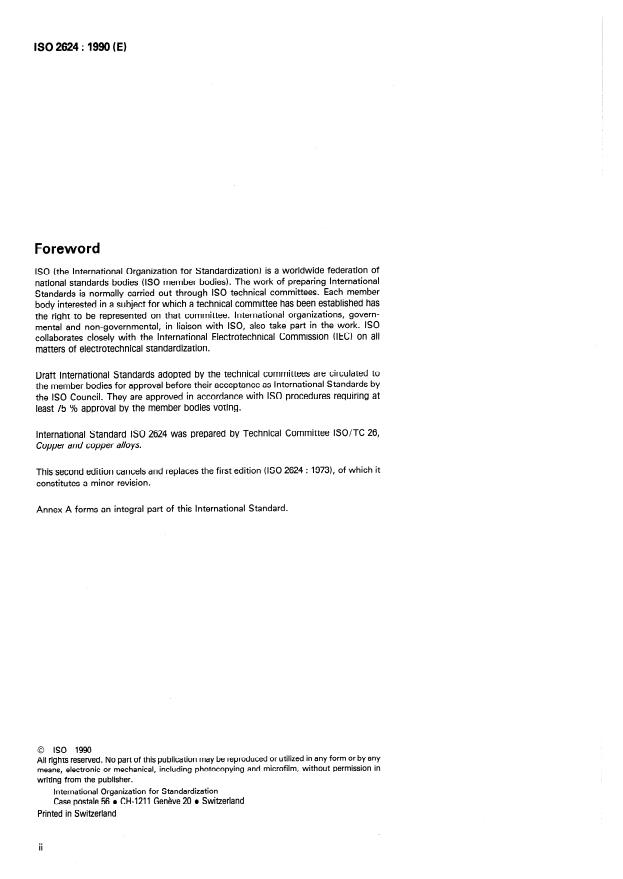
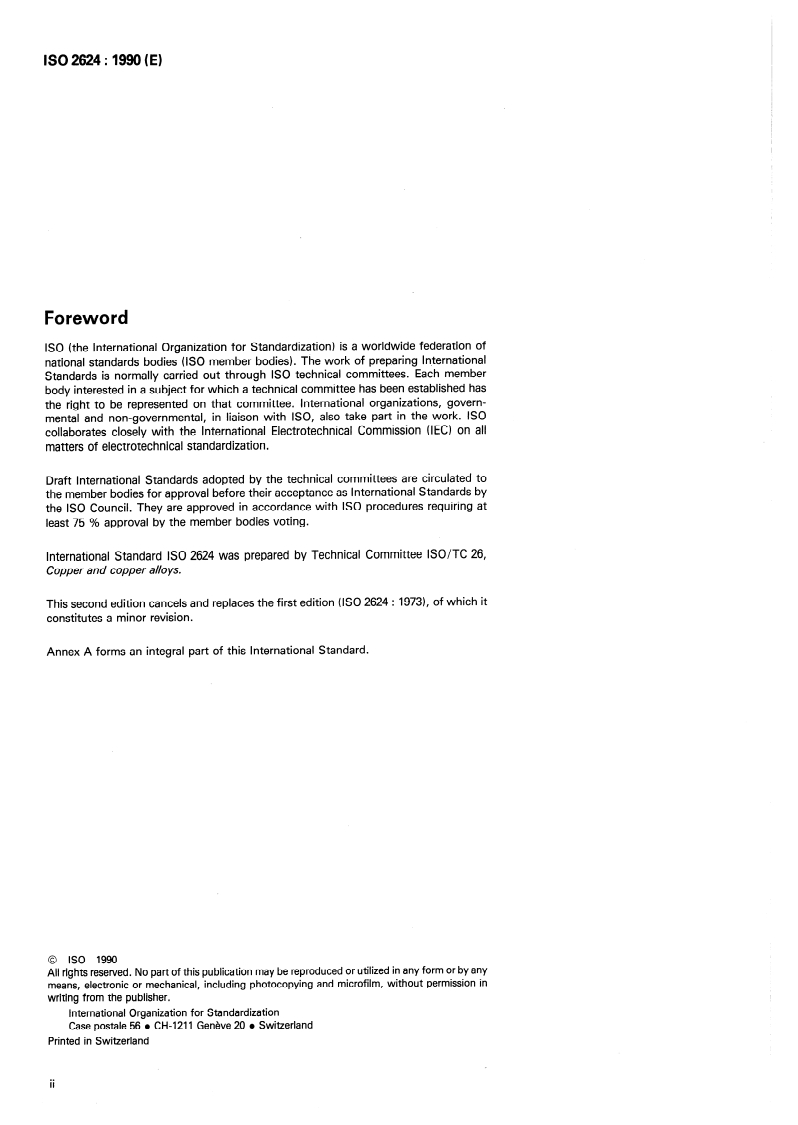
Foreword
ISO (the International Organization for Standardization) is a worldwide federation of
national Standards bodies (ISO member bodies). The work of preparing International
Standards is normally carried out through ISO technicai committees. Esch member
body interested in a subject for which a technical committee has been established has
the right to be represented on that committee. International organizations, govern-
mental and non-governmental, in liaison with ISO, also take part in the work. ISO
collaborates closely with the International Electrotechnical Commission (IEC) on all
matters of electrotechnical standardization.
Draft International Standards adopted by the technical committees are circulated to
the member bodies for approval before their acceptance as International Standards by
the ISO Council. They are approved in accordance with ISO procedures requiring at
least 75 % approval by the member bodies voting.
International Standard ISO 2624 was prepared by Technical Committee ISO/TC 26,
Copper and topper alloys.
This second edition cancels and replaces the first edition (ISO 2624 : 19731, of which it
constitutes a minor revision.
Annex A forms an integral part of this International Standard.
0 ISO 1990
All rights reserved. No part of this publication may be reproduced or utilized in any form or by any
means, electronie or mechanical, including photocopying and microfilm, without Permission in
writing from the publisher.
International Organkation for Standardization
Case postale 56 l CH-1211 Geneve 20 l Switzerland
Printed in Switzerland
ii
ISO2624:199O(E)
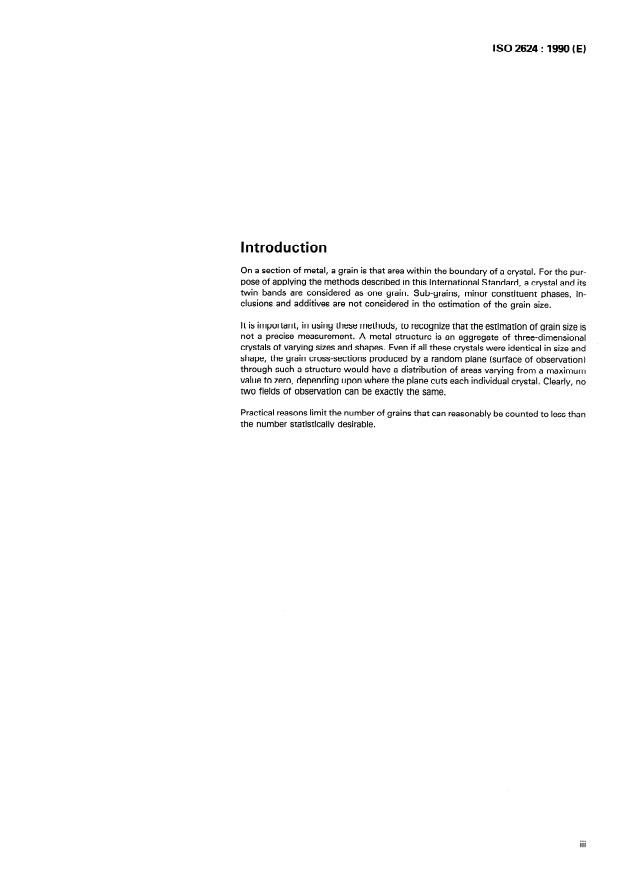
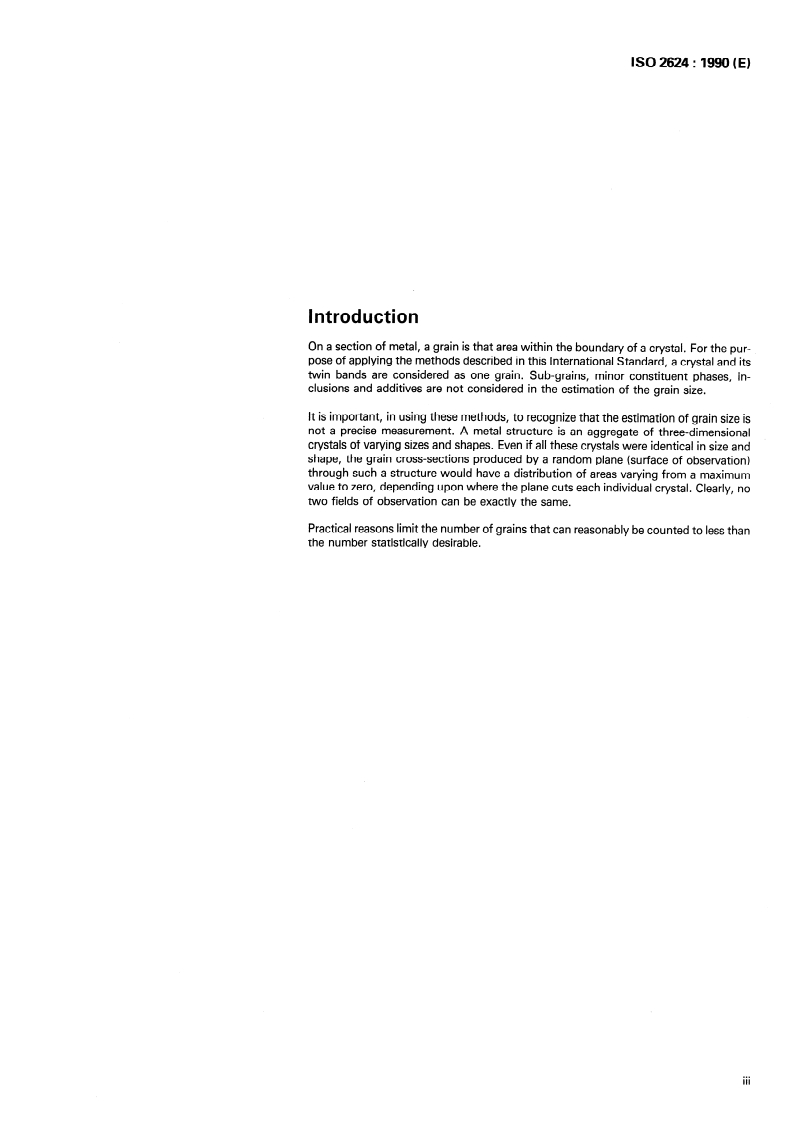
Intra-duction
On a section of metal, a grain is that area within the boundary of a crystal. For the pur-
pose of applying the methods described in this International Standard, a crystal and its
twin bands are considered as one grain. Sub-grains, minor constituent phases, in-
clusions and additives are not considered in the estimation of the grain size.
lt is important, in using these methods, to recognize that the estimation of grain size is
not a precise measurement. A metal structure is an aggregate of three-dimensional
crystals of varying sizes and shapes. Even if all these crystals were identical in size and
shape, the grain Cross-sections produced by a random plane (surface of Observation)
through such a structure would have a distribution of areas varying from a maximum
value to Zero, depending upon where the plane cuts each individual crystal. Clearly, no
two fields of Observation tan be exactly the Same.
Practical reasons limit the number of grains that tan reasona b counted to less
ily be than
the number statistically desirable.
. . .
Ill
This page intentionally left blank
ISO 2624 : 1990 (E)
INTERNATIONAL STANDARD
Estimation of average
Copper and topper alloys -
grain size
3.2 The specimen shall be carefully prepared to reveal the
1 Scope
grain boundaries using a contrast etch to match the Standard
Charts.
This International Standard specifies three procedures for
estimating, and rules for expressing, the average grain size of
topper and topper alloys consisting principally of a Single
Phase. The respective procedures are termed the comparison
4 Procedures
procedure, the intercept procedure and the planimetric pro-
cedure.
4.1 Comparison procedure
The comparison procedure (comparing the specimen with a
Standard Chart) is most convenient and is sufficiently accurate
The estimation of grain size is made by direct comparison of a
for most commercial purposes.
projected image of a photomicrograph of a representative field
of the test specimen, either with the photomicrographs of the
Higher degreees of accuracy in estimating grain size are ob-
Standard grain size series or with suitable reproductions of
tainable by using the intercept (Heyn) or planimetric (Jeffries)
them (for Standard grain size Charts, see annex AI; when a pro-
procedures. In cases of dispute, it is recommended that the use
jection microscope is not available a bench microscope may be
of one of these procedures be agreed between the Parties.
used. lt is recommended that, to facilitate comparison,
mechanical arrangements be made to permit bringing the stan-
For material with non-equiaxial structures it is recommended
dard photomicrographs successively into juxtaposition with the
that the intercept procedure be used.
projected image.
4.2 Intercept procedure
2 Symbols and designations
4.2.1 The grain size is estimated by counting, on the ground
Symbol Designation
glass Screen of a projection microscope, on the image in a
Jeffries’ multiplier used to obtain number
f
bench microscope fitted with a graticule, on a photo-
of grains per Square millimetre by
micrograph of a representative field of the specimen, or on the
planimetric method
specimen itself, the number of grains intercepted by one or
Number of grains per Square millimetre
more straight lines sufficiently long to yield at least 10 inter-
Average grain “diameter” in millimetres; an cepts per line and at least 50 intercepts for all lines for normal
arbitrary measure defined as 1 /fi
purposes and at least 200 intercepts for referee purposes.
Grains touched by the end of the line count only as half grains.
Average intercept length
The length of the line or lines in millimetres at the surface of the
Magnification
section, divided by the number of grains intersected by it, gives
the average intercept length 1. For practical purposes, the ave-
rage intercept length, I, may be r
...
INTERNATIONAL ISO
STANDARD
Second edition
1990-02-01
Copper and topper alloys - Estimation of
awerage grain size
Evaluation de Ia dimension moyenne du grain
Cuivre et alliages de cuivre -
Reference number
ISO 2624 : 1990 (E)
ISO 2624 : 1990 (E)
Foreword
ISO (the International Organization for Standardization) is a worldwide federation of
national Standards bodies (ISO member bodies). The work of preparing International
Standards is normally carried out through ISO technicai committees. Esch member
body interested in a subject for which a technical committee has been established has
the right to be represented on that committee. International organizations, govern-
mental and non-governmental, in liaison with ISO, also take part in the work. ISO
collaborates closely with the International Electrotechnical Commission (IEC) on all
matters of electrotechnical standardization.
Draft International Standards adopted by the technical committees are circulated to
the member bodies for approval before their acceptance as International Standards by
the ISO Council. They are approved in accordance with ISO procedures requiring at
least 75 % approval by the member bodies voting.
International Standard ISO 2624 was prepared by Technical Committee ISO/TC 26,
Copper and topper alloys.
This second edition cancels and replaces the first edition (ISO 2624 : 19731, of which it
constitutes a minor revision.
Annex A forms an integral part of this International Standard.
0 ISO 1990
All rights reserved. No part of this publication may be reproduced or utilized in any form or by any
means, electronie or mechanical, including photocopying and microfilm, without Permission in
writing from the publisher.
International Organkation for Standardization
Case postale 56 l CH-1211 Geneve 20 l Switzerland
Printed in Switzerland
ii
ISO2624:199O(E)
Intra-duction
On a section of metal, a grain is that area within the boundary of a crystal. For the pur-
pose of applying the methods described in this International Standard, a crystal and its
twin bands are considered as one grain. Sub-grains, minor constituent phases, in-
clusions and additives are not considered in the estimation of the grain size.
lt is important, in using these methods, to recognize that the estimation of grain size is
not a precise measurement. A metal structure is an aggregate of three-dimensional
crystals of varying sizes and shapes. Even if all these crystals were identical in size and
shape, the grain Cross-sections produced by a random plane (surface of Observation)
through such a structure would have a distribution of areas varying from a maximum
value to Zero, depending upon where the plane cuts each individual crystal. Clearly, no
two fields of Observation tan be exactly the Same.
Practical reasons limit the number of grains that tan reasona b counted to less
ily be than
the number statistically desirable.
. . .
Ill
This page intentionally left blank
ISO 2624 : 1990 (E)
INTERNATIONAL STANDARD
Estimation of average
Copper and topper alloys -
grain size
3.2 The specimen shall be carefully prepared to reveal the
1 Scope
grain boundaries using a contrast etch to match the Standard
Charts.
This International Standard specifies three procedures for
estimating, and rules for expressing, the average grain size of
topper and topper alloys consisting principally of a Single
Phase. The respective procedures are termed the comparison
4 Procedures
procedure, the intercept procedure and the planimetric pro-
cedure.
4.1 Comparison procedure
The comparison procedure (comparing the specimen with a
Standard Chart) is most convenient and is sufficiently accurate
The estimation of grain size is made by direct comparison of a
for most commercial purposes.
projected image of a photomicrograph of a representative field
of the test specimen, either with the photomicrographs of the
Higher degreees of accuracy in estimating grain size are ob-
Standard grain size series or with suitable reproductions of
tainable by using the intercept (Heyn) or planimetric (Jeffries)
them (for Standard grain size Charts, see annex AI; when a pro-
procedures. In cases of dispute, it is recommended that the use
jection microscope is not available a bench microscope may be
of one of these procedures be agreed between the Parties.
used. lt is recommended that, to facilitate comparison,
mechanical arrangements be made to permit bringing the stan-
For material with non-equiaxial structures it is recommended
dard photomicrographs successively into juxtaposition with the
that the intercept procedure be used.
projected image.
4.2 Intercept procedure
2 Symbols and designations
4.2.1 The grain size is estimated by counting, on the ground
Symbol Designation
glass Screen of a projection microscope, on the image in a
Jeffries’ multiplier used to obtain number
f
bench microscope fitted with a graticule, on a photo-
of grains per Square millimetre by
micrograph of a representative field of the specimen, or on the
planimetric method
specimen itself, the number of grains intercepted by one or
Number of grains per Square millimetre
more straight lines sufficiently long to yield at least 10 inter-
Average grain “diameter” in millimetres; an cepts per line and at least 50 intercepts for all lines for normal
arbitrary measure defined as 1 /fi
purposes and at least 200 intercepts for referee purposes.
Grains touched by the end of the line count only as half grains.
Average intercept length
The length of the line or lines in millimetres at the surface of the
Magnification
section, divided by the number of grains intersected by it, gives
the average intercept length 1. For practical purposes, the ave-
rage intercept length, I, may be r
...
NORME
ISO
INTERNATIONALE
Deuxième édition
1990-02-01
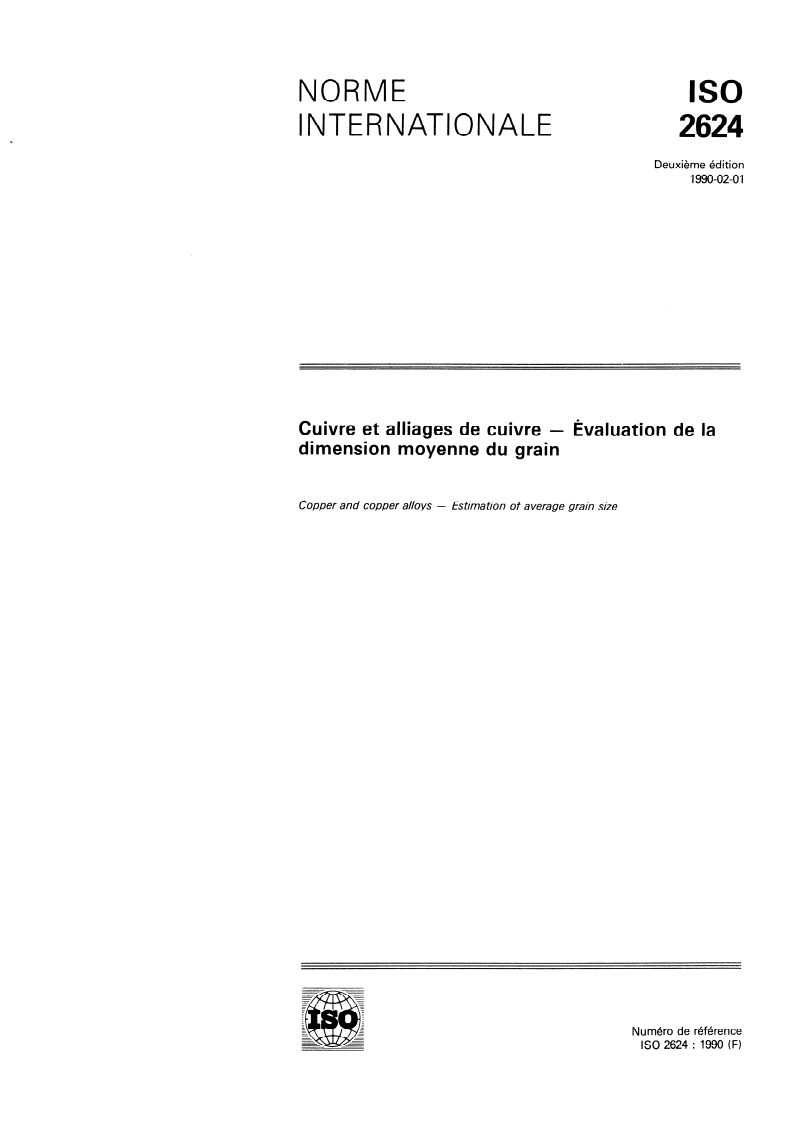
Cuivre et alliages de cuivre - Évaluation de la
dimension moyenne du grain
Copper and copper alloys -
Estimation of average grain size
Numéro de référence
ISO 2624 : 1990 (FI
ISO 2624 : 1990 (FI ’
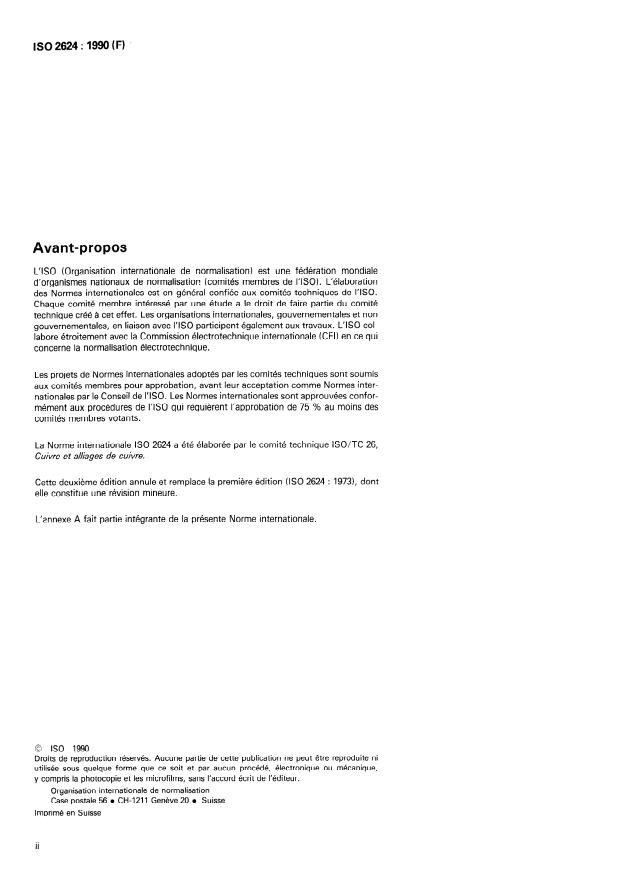
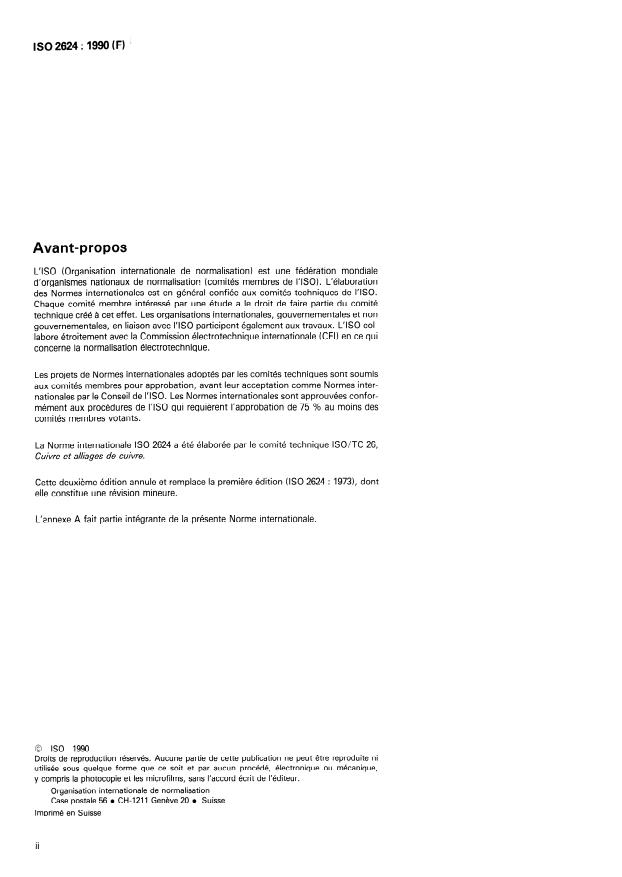
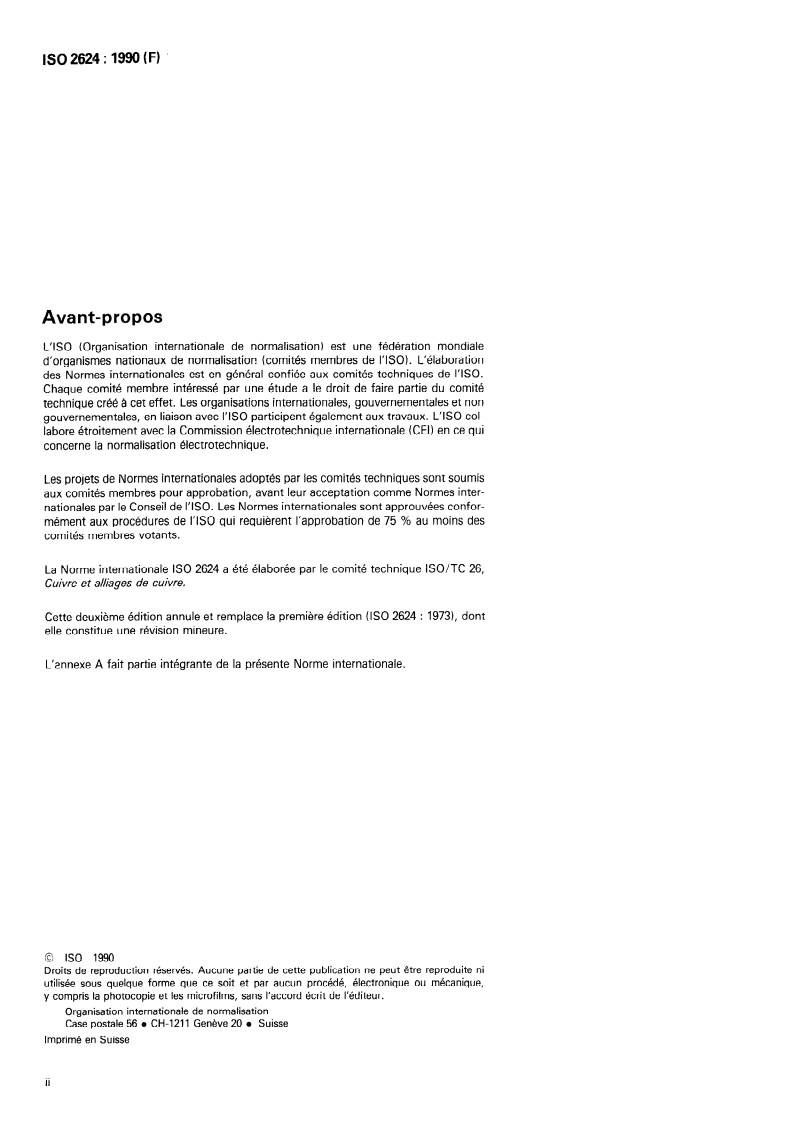
Avant-propos
LIS0 (Organisation internationale de normalisation) est une fédération mondiale
d’organismes nationaux de normalisation (comités membres de I’ISO). L’élaboration
des Normes internationales est en général confiée aux comités techniques de I’ISO.
Chaque comité membre intéressé par une étude a le droit de faire partie du comité
technique créé à cet effet. Les organisations internationales, gouvernementales et non
gouvernementales, en liaison avec I’ISO participent également aux travaux. L’ISO col-
labore étroitement avec la Commission électrotechnique internationale (CEI) en ce qui
concerne la normalisation électrotechnique.
Les projets de Normes internationales adoptés par les comités techniques sont soumis
aux comités membres pour approbation, avant leur acceptation comme Normes inter-
nationales par le Conseil de I’ISO. Les Normes internationales sont approuvées confor-
mément aux procédures de I’ISO qui requièrent l’approbation de 75 % au moins des
comités membres votants.
La Norme internationale ISO 2624 a été élaborée par le comité technique ISO/TC 26,
Cuivre et alliages de cuivre.
Cette deuxième édition annule et remplace la première édition (ISO 2624 : 1973), dont
elle constitue une révision mineure.
L’annexe A fait partie intégrante de la présente Norme internationale.
0 ISO 1990
Droits de reproduction réservés. Aucune partie de cette publication ne peut être reproduite ni
utilisée sous quelque forme que ce soit et par aucun procédé, électronique ou mécanique,
y compris la photocopie et les microfilms, sans l’accord écrit de l’éditeur.
Organisation internationale de normalisation
56 l CH-1211
Case posta le Genéve 20 l Suisse
Imprimé en Suisse
ii
ISO 2624 : 1990 (FI
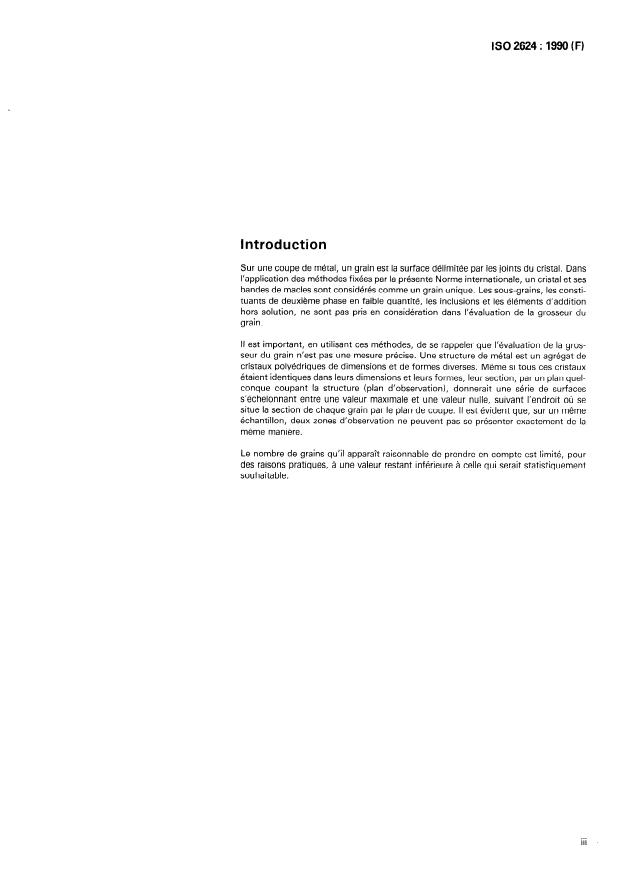
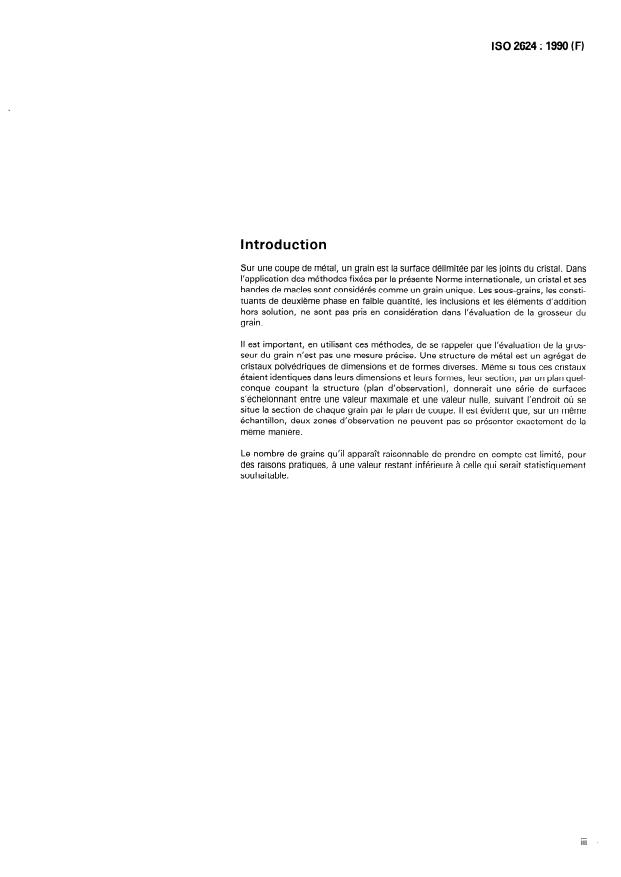
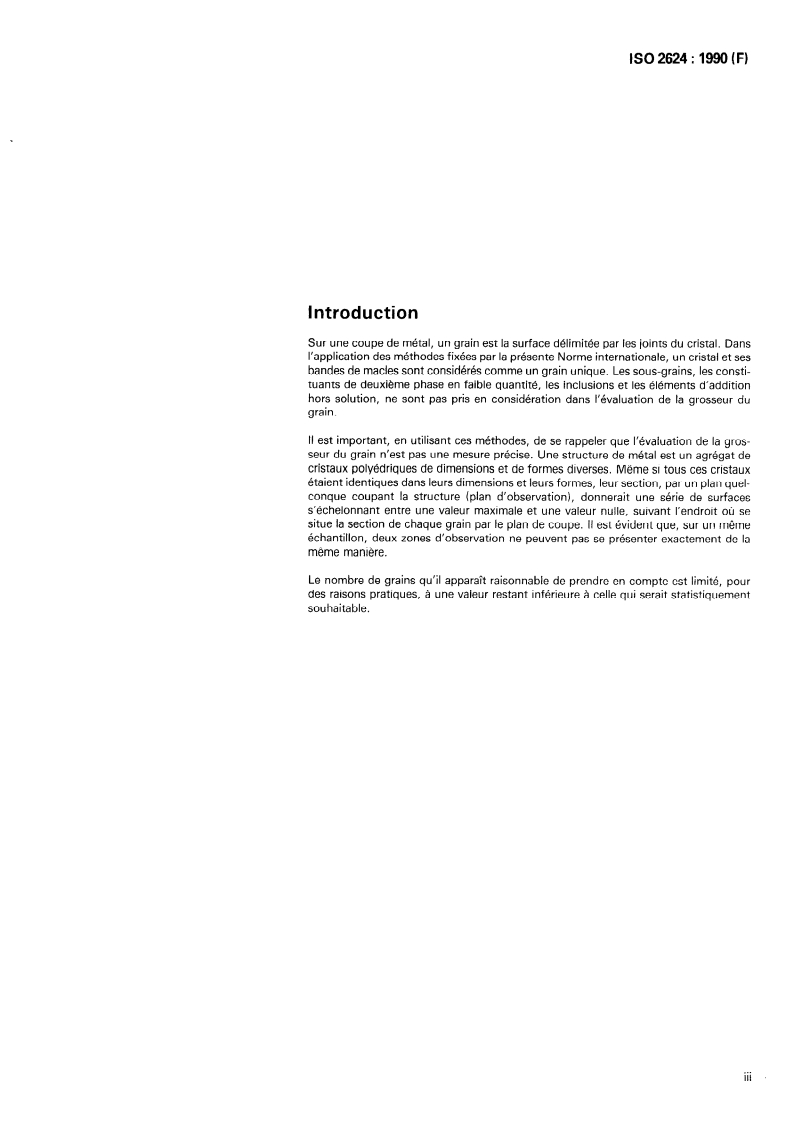
Introduction
Sur une coupe de métal, un grain est la surface délimitée par les joints du cristal. Dans
l’application des méthodes fixées par la présente Norme internationale, un cristal et ses
bandes de macles sont considérés comme un grain unique. Les sous-grains, les consti-
tuants de deuxième phase en faible quantité, les inclusions et les éléments d’addition
hors solution, ne sont pas pris en considération dans l’évaluation de la grosseur du
grain.
II est important, en utilisant ces méthodes, de se rappeler que l’évaluation de la gros-
seur du grain n’est pas une mesure précise. Une structure de métal est un agrégat de
cristaux polyédriques de dimensions et de formes diverses. Même si tous ces cristaux
étaient identiques dans leurs dimensions et leurs formes, leur section, par un plan quel-
conque coupant la structure (plan d’observation), donnerait une série de surfaces
s’échelonnant entre une valeur maximale et une valeur nulle, suivant l’endroit où se
situe la section de chaque grain par le plan de coupe. II est évident que, sur un même
échantillon, deux zones d’observation ne peuvent pas se présenter exactement de la
même manière.
Le nombre de grains qu’il apparaît raisonnable de prendre en compte est limité, pour
des raisons pratiques, à une valeur restant inférieure à celle qui serait statistiquement
souhaitable.
. . .
III .
Page blanche
NORME INTERNATIONALE ISO 2624 : 1990 (FI
Cuivre et alliages de cuivre - Évaluation de la dimension
moyenne du grain
1 Domaine d’application 3.2 L’échantillon doit être préparé soigneusement, de facon à
mettre des joints de grains en évidence, par une attaque conve-
La présente Norme internationale spécifie trois méthodes
nable permettant la comparaison avec les images types.
d’évaluation et modes d’expression de la dimension moyenne
du grain, dans le cuivre et les alliages de cuivre constitués prin-
cipalement par une phase unique. Ces méthodes sont appe-
4 Modes opératoires
lées, respectivement, méthode par comparaison, méthode par
interception, et méthode planimétrique.
4.1 Méthode par comparaison
La méthode par comparaison (de l’échantillon avec des images
L’évaluation de la dimension du grain doit être faite par compa-
type) est la plus commode, et elle est suffisamment précise
raison directe de l’image projetée d’une microphotographie
pour la plupart des besoins commerciaux.
d’une zone représentative de l’échantillon, soit avec les micro-
photographies des images types, soit avec des reproductions
La méthode par interception (Heyn), comme la méthode plani-
convenables de celles-ci (pour l’image type, voir annexe A);
métrique (Jeffries), permet d’obtenir une précision supérieure
lorsqu’on ne dispose pas d’un microscope à projection, un
d’évaluation de la dimension du grain. En cas de litige, il est
microscope à vision directe peut être utilisé. II est recommandé,
recommandé d’utiliser l’une de ces méthodes, après accord
pour faciliter cette comparaison, d’employer des dispositifs
entre les parties intéressées.
mécaniques permettant la juxtaposition successive des micro-
photographies types avec image projetée.
Pour les matériaux à structures non équiaxiales, il est recom-
mandé d’utiliser la méthode d’interception.
4.2 Méthode par interception
2 Symboles et désignations
4.2.1 La dimension du grain est évaluée, soit sur le verre
dépoli d’un microscope à projection, soit sur l’image donnée
Symbole Désignation
par un microscope à vision directe équipé d’un réticule, ou sur
Facteur de Jeffries, servant au calcul du une microphotographie d’une zone représentative de I’échantil-
f
nombre de grains par millimètre carré, dans
Ion ou sur l’échantillon lui-même, par comptage du nombre de
la méthode planimétrique
grains interceptés par une ou plusieurs lignes droites suffisam-
ment longues pour donner, au minimum 10 interceptions par
Nombre de grains par millimètre carré
ligne et au minimum 50 interceptions pour l’ensemble des
«Diamètre» moyen du grain en milimètres,
lignes dans le cas normal, et, en cas d’arbitrage, au moins
évalué d’après une mesure arbitraire, défi-
200 interceptions. Le grain situé à chacune des extrémités de la
nie par l’expression 1 /fi
ligne compte pour un demi-grain. La longueur de la ligne ou des
Longueur moyenne d’interception
lignes sur la surface de coupe, exprimée en millimètres et divi-
Grossissement
sée par le nombre de grains interceptés, donne la longueur
moyenne d’interception, 1. D’un point de vue pratique, la lon-
gueur moyenne d’interception, 1, peut être considérée comme
3 Échantillons pour essai égale au diamètre moyen du grain, 0.
3.1 Les évaluations de gros
...
NORME
ISO
INTERNATIONALE
Deuxième édition
1990-02-01
Cuivre et alliages de cuivre - Évaluation de la
dimension moyenne du grain
Copper and copper alloys -
Estimation of average grain size
Numéro de référence
ISO 2624 : 1990 (FI
ISO 2624 : 1990 (FI ’
Avant-propos
LIS0 (Organisation internationale de normalisation) est une fédération mondiale
d’organismes nationaux de normalisation (comités membres de I’ISO). L’élaboration
des Normes internationales est en général confiée aux comités techniques de I’ISO.
Chaque comité membre intéressé par une étude a le droit de faire partie du comité
technique créé à cet effet. Les organisations internationales, gouvernementales et non
gouvernementales, en liaison avec I’ISO participent également aux travaux. L’ISO col-
labore étroitement avec la Commission électrotechnique internationale (CEI) en ce qui
concerne la normalisation électrotechnique.
Les projets de Normes internationales adoptés par les comités techniques sont soumis
aux comités membres pour approbation, avant leur acceptation comme Normes inter-
nationales par le Conseil de I’ISO. Les Normes internationales sont approuvées confor-
mément aux procédures de I’ISO qui requièrent l’approbation de 75 % au moins des
comités membres votants.
La Norme internationale ISO 2624 a été élaborée par le comité technique ISO/TC 26,
Cuivre et alliages de cuivre.
Cette deuxième édition annule et remplace la première édition (ISO 2624 : 1973), dont
elle constitue une révision mineure.
L’annexe A fait partie intégrante de la présente Norme internationale.
0 ISO 1990
Droits de reproduction réservés. Aucune partie de cette publication ne peut être reproduite ni
utilisée sous quelque forme que ce soit et par aucun procédé, électronique ou mécanique,
y compris la photocopie et les microfilms, sans l’accord écrit de l’éditeur.
Organisation internationale de normalisation
56 l CH-1211
Case posta le Genéve 20 l Suisse
Imprimé en Suisse
ii
ISO 2624 : 1990 (FI
Introduction
Sur une coupe de métal, un grain est la surface délimitée par les joints du cristal. Dans
l’application des méthodes fixées par la présente Norme internationale, un cristal et ses
bandes de macles sont considérés comme un grain unique. Les sous-grains, les consti-
tuants de deuxième phase en faible quantité, les inclusions et les éléments d’addition
hors solution, ne sont pas pris en considération dans l’évaluation de la grosseur du
grain.
II est important, en utilisant ces méthodes, de se rappeler que l’évaluation de la gros-
seur du grain n’est pas une mesure précise. Une structure de métal est un agrégat de
cristaux polyédriques de dimensions et de formes diverses. Même si tous ces cristaux
étaient identiques dans leurs dimensions et leurs formes, leur section, par un plan quel-
conque coupant la structure (plan d’observation), donnerait une série de surfaces
s’échelonnant entre une valeur maximale et une valeur nulle, suivant l’endroit où se
situe la section de chaque grain par le plan de coupe. II est évident que, sur un même
échantillon, deux zones d’observation ne peuvent pas se présenter exactement de la
même manière.
Le nombre de grains qu’il apparaît raisonnable de prendre en compte est limité, pour
des raisons pratiques, à une valeur restant inférieure à celle qui serait statistiquement
souhaitable.
. . .
III .
Page blanche
NORME INTERNATIONALE ISO 2624 : 1990 (FI
Cuivre et alliages de cuivre - Évaluation de la dimension
moyenne du grain
1 Domaine d’application 3.2 L’échantillon doit être préparé soigneusement, de facon à
mettre des joints de grains en évidence, par une attaque conve-
La présente Norme internationale spécifie trois méthodes
nable permettant la comparaison avec les images types.
d’évaluation et modes d’expression de la dimension moyenne
du grain, dans le cuivre et les alliages de cuivre constitués prin-
cipalement par une phase unique. Ces méthodes sont appe-
4 Modes opératoires
lées, respectivement, méthode par comparaison, méthode par
interception, et méthode planimétrique.
4.1 Méthode par comparaison
La méthode par comparaison (de l’échantillon avec des images
L’évaluation de la dimension du grain doit être faite par compa-
type) est la plus commode, et elle est suffisamment précise
raison directe de l’image projetée d’une microphotographie
pour la plupart des besoins commerciaux.
d’une zone représentative de l’échantillon, soit avec les micro-
photographies des images types, soit avec des reproductions
La méthode par interception (Heyn), comme la méthode plani-
convenables de celles-ci (pour l’image type, voir annexe A);
métrique (Jeffries), permet d’obtenir une précision supérieure
lorsqu’on ne dispose pas d’un microscope à projection, un
d’évaluation de la dimension du grain. En cas de litige, il est
microscope à vision directe peut être utilisé. II est recommandé,
recommandé d’utiliser l’une de ces méthodes, après accord
pour faciliter cette comparaison, d’employer des dispositifs
entre les parties intéressées.
mécaniques permettant la juxtaposition successive des micro-
photographies types avec image projetée.
Pour les matériaux à structures non équiaxiales, il est recom-
mandé d’utiliser la méthode d’interception.
4.2 Méthode par interception
2 Symboles et désignations
4.2.1 La dimension du grain est évaluée, soit sur le verre
dépoli d’un microscope à projection, soit sur l’image donnée
Symbole Désignation
par un microscope à vision directe équipé d’un réticule, ou sur
Facteur de Jeffries, servant au calcul du une microphotographie d’une zone représentative de I’échantil-
f
nombre de grains par millimètre carré, dans
Ion ou sur l’échantillon lui-même, par comptage du nombre de
la méthode planimétrique
grains interceptés par une ou plusieurs lignes droites suffisam-
ment longues pour donner, au minimum 10 interceptions par
Nombre de grains par millimètre carré
ligne et au minimum 50 interceptions pour l’ensemble des
«Diamètre» moyen du grain en milimètres,
lignes dans le cas normal, et, en cas d’arbitrage, au moins
évalué d’après une mesure arbitraire, défi-
200 interceptions. Le grain situé à chacune des extrémités de la
nie par l’expression 1 /fi
ligne compte pour un demi-grain. La longueur de la ligne ou des
Longueur moyenne d’interception
lignes sur la surface de coupe, exprimée en millimètres et divi-
Grossissement
sée par le nombre de grains interceptés, donne la longueur
moyenne d’interception, 1. D’un point de vue pratique, la lon-
gueur moyenne d’interception, 1, peut être considérée comme
3 Échantillons pour essai égale au diamètre moyen du grain, 0.
3.1 Les évaluations de gros
...
NORME
ISO
INTERNATIONALE
Deuxième édition
1990-02-01
Cuivre et alliages de cuivre - Évaluation de la
dimension moyenne du grain
Copper and copper alloys -
Estimation of average grain size
Numéro de référence
ISO 2624 : 1990 (FI
ISO 2624 : 1990 (FI ’
Avant-propos
LIS0 (Organisation internationale de normalisation) est une fédération mondiale
d’organismes nationaux de normalisation (comités membres de I’ISO). L’élaboration
des Normes internationales est en général confiée aux comités techniques de I’ISO.
Chaque comité membre intéressé par une étude a le droit de faire partie du comité
technique créé à cet effet. Les organisations internationales, gouvernementales et non
gouvernementales, en liaison avec I’ISO participent également aux travaux. L’ISO col-
labore étroitement avec la Commission électrotechnique internationale (CEI) en ce qui
concerne la normalisation électrotechnique.
Les projets de Normes internationales adoptés par les comités techniques sont soumis
aux comités membres pour approbation, avant leur acceptation comme Normes inter-
nationales par le Conseil de I’ISO. Les Normes internationales sont approuvées confor-
mément aux procédures de I’ISO qui requièrent l’approbation de 75 % au moins des
comités membres votants.
La Norme internationale ISO 2624 a été élaborée par le comité technique ISO/TC 26,
Cuivre et alliages de cuivre.
Cette deuxième édition annule et remplace la première édition (ISO 2624 : 1973), dont
elle constitue une révision mineure.
L’annexe A fait partie intégrante de la présente Norme internationale.
0 ISO 1990
Droits de reproduction réservés. Aucune partie de cette publication ne peut être reproduite ni
utilisée sous quelque forme que ce soit et par aucun procédé, électronique ou mécanique,
y compris la photocopie et les microfilms, sans l’accord écrit de l’éditeur.
Organisation internationale de normalisation
56 l CH-1211
Case posta le Genéve 20 l Suisse
Imprimé en Suisse
ii
ISO 2624 : 1990 (FI
Introduction
Sur une coupe de métal, un grain est la surface délimitée par les joints du cristal. Dans
l’application des méthodes fixées par la présente Norme internationale, un cristal et ses
bandes de macles sont considérés comme un grain unique. Les sous-grains, les consti-
tuants de deuxième phase en faible quantité, les inclusions et les éléments d’addition
hors solution, ne sont pas pris en considération dans l’évaluation de la grosseur du
grain.
II est important, en utilisant ces méthodes, de se rappeler que l’évaluation de la gros-
seur du grain n’est pas une mesure précise. Une structure de métal est un agrégat de
cristaux polyédriques de dimensions et de formes diverses. Même si tous ces cristaux
étaient identiques dans leurs dimensions et leurs formes, leur section, par un plan quel-
conque coupant la structure (plan d’observation), donnerait une série de surfaces
s’échelonnant entre une valeur maximale et une valeur nulle, suivant l’endroit où se
situe la section de chaque grain par le plan de coupe. II est évident que, sur un même
échantillon, deux zones d’observation ne peuvent pas se présenter exactement de la
même manière.
Le nombre de grains qu’il apparaît raisonnable de prendre en compte est limité, pour
des raisons pratiques, à une valeur restant inférieure à celle qui serait statistiquement
souhaitable.
. . .
III .
Page blanche
NORME INTERNATIONALE ISO 2624 : 1990 (FI
Cuivre et alliages de cuivre - Évaluation de la dimension
moyenne du grain
1 Domaine d’application 3.2 L’échantillon doit être préparé soigneusement, de facon à
mettre des joints de grains en évidence, par une attaque conve-
La présente Norme internationale spécifie trois méthodes
nable permettant la comparaison avec les images types.
d’évaluation et modes d’expression de la dimension moyenne
du grain, dans le cuivre et les alliages de cuivre constitués prin-
cipalement par une phase unique. Ces méthodes sont appe-
4 Modes opératoires
lées, respectivement, méthode par comparaison, méthode par
interception, et méthode planimétrique.
4.1 Méthode par comparaison
La méthode par comparaison (de l’échantillon avec des images
L’évaluation de la dimension du grain doit être faite par compa-
type) est la plus commode, et elle est suffisamment précise
raison directe de l’image projetée d’une microphotographie
pour la plupart des besoins commerciaux.
d’une zone représentative de l’échantillon, soit avec les micro-
photographies des images types, soit avec des reproductions
La méthode par interception (Heyn), comme la méthode plani-
convenables de celles-ci (pour l’image type, voir annexe A);
métrique (Jeffries), permet d’obtenir une précision supérieure
lorsqu’on ne dispose pas d’un microscope à projection, un
d’évaluation de la dimension du grain. En cas de litige, il est
microscope à vision directe peut être utilisé. II est recommandé,
recommandé d’utiliser l’une de ces méthodes, après accord
pour faciliter cette comparaison, d’employer des dispositifs
entre les parties intéressées.
mécaniques permettant la juxtaposition successive des micro-
photographies types avec image projetée.
Pour les matériaux à structures non équiaxiales, il est recom-
mandé d’utiliser la méthode d’interception.
4.2 Méthode par interception
2 Symboles et désignations
4.2.1 La dimension du grain est évaluée, soit sur le verre
dépoli d’un microscope à projection, soit sur l’image donnée
Symbole Désignation
par un microscope à vision directe équipé d’un réticule, ou sur
Facteur de Jeffries, servant au calcul du une microphotographie d’une zone représentative de I’échantil-
f
nombre de grains par millimètre carré, dans
Ion ou sur l’échantillon lui-même, par comptage du nombre de
la méthode planimétrique
grains interceptés par une ou plusieurs lignes droites suffisam-
ment longues pour donner, au minimum 10 interceptions par
Nombre de grains par millimètre carré
ligne et au minimum 50 interceptions pour l’ensemble des
«Diamètre» moyen du grain en milimètres,
lignes dans le cas normal, et, en cas d’arbitrage, au moins
évalué d’après une mesure arbitraire, défi-
200 interceptions. Le grain situé à chacune des extrémités de la
nie par l’expression 1 /fi
ligne compte pour un demi-grain. La longueur de la ligne ou des
Longueur moyenne d’interception
lignes sur la surface de coupe, exprimée en millimètres et divi-
Grossissement
sée par le nombre de grains interceptés, donne la longueur
moyenne d’interception, 1. D’un point de vue pratique, la lon-
gueur moyenne d’interception, 1, peut être considérée comme
3 Échantillons pour essai égale au diamètre moyen du grain, 0.
3.1 Les évaluations de gros
...
NORME
ISO
INTERNATIONALE
Deuxième édition
1990-02-01
Cuivre et alliages de cuivre - Évaluation de la
dimension moyenne du grain
Copper and copper alloys -
Estimation of average grain size
Numéro de référence
ISO 2624 : 1990 (FI
ISO 2624 : 1990 (FI ’
Avant-propos
LIS0 (Organisation internationale de normalisation) est une fédération mondiale
d’organismes nationaux de normalisation (comités membres de I’ISO). L’élaboration
des Normes internationales est en général confiée aux comités techniques de I’ISO.
Chaque comité membre intéressé par une étude a le droit de faire partie du comité
technique créé à cet effet. Les organisations internationales, gouvernementales et non
gouvernementales, en liaison avec I’ISO participent également aux travaux. L’ISO col-
labore étroitement avec la Commission électrotechnique internationale (CEI) en ce qui
concerne la normalisation électrotechnique.
Les projets de Normes internationales adoptés par les comités techniques sont soumis
aux comités membres pour approbation, avant leur acceptation comme Normes inter-
nationales par le Conseil de I’ISO. Les Normes internationales sont approuvées confor-
mément aux procédures de I’ISO qui requièrent l’approbation de 75 % au moins des
comités membres votants.
La Norme internationale ISO 2624 a été élaborée par le comité technique ISO/TC 26,
Cuivre et alliages de cuivre.
Cette deuxième édition annule et remplace la première édition (ISO 2624 : 1973), dont
elle constitue une révision mineure.
L’annexe A fait partie intégrante de la présente Norme internationale.
0 ISO 1990
Droits de reproduction réservés. Aucune partie de cette publication ne peut être reproduite ni
utilisée sous quelque forme que ce soit et par aucun procédé, électronique ou mécanique,
y compris la photocopie et les microfilms, sans l’accord écrit de l’éditeur.
Organisation internationale de normalisation
56 l CH-1211
Case posta le Genéve 20 l Suisse
Imprimé en Suisse
ii
ISO 2624 : 1990 (FI
Introduction
Sur une coupe de métal, un grain est la surface délimitée par les joints du cristal. Dans
l’application des méthodes fixées par la présente Norme internationale, un cristal et ses
bandes de macles sont considérés comme un grain unique. Les sous-grains, les consti-
tuants de deuxième phase en faible quantité, les inclusions et les éléments d’addition
hors solution, ne sont pas pris en considération dans l’évaluation de la grosseur du
grain.
II est important, en utilisant ces méthodes, de se rappeler que l’évaluation de la gros-
seur du grain n’est pas une mesure précise. Une structure de métal est un agrégat de
cristaux polyédriques de dimensions et de formes diverses. Même si tous ces cristaux
étaient identiques dans leurs dimensions et leurs formes, leur section, par un plan quel-
conque coupant la structure (plan d’observation), donnerait une série de surfaces
s’échelonnant entre une valeur maximale et une valeur nulle, suivant l’endroit où se
situe la section de chaque grain par le plan de coupe. II est évident que, sur un même
échantillon, deux zones d’observation ne peuvent pas se présenter exactement de la
même manière.
Le nombre de grains qu’il apparaît raisonnable de prendre en compte est limité, pour
des raisons pratiques, à une valeur restant inférieure à celle qui serait statistiquement
souhaitable.
. . .
III .
Page blanche
NORME INTERNATIONALE ISO 2624 : 1990 (FI
Cuivre et alliages de cuivre - Évaluation de la dimension
moyenne du grain
1 Domaine d’application 3.2 L’échantillon doit être préparé soigneusement, de facon à
mettre des joints de grains en évidence, par une attaque conve-
La présente Norme internationale spécifie trois méthodes
nable permettant la comparaison avec les images types.
d’évaluation et modes d’expression de la dimension moyenne
du grain, dans le cuivre et les alliages de cuivre constitués prin-
cipalement par une phase unique. Ces méthodes sont appe-
4 Modes opératoires
lées, respectivement, méthode par comparaison, méthode par
interception, et méthode planimétrique.
4.1 Méthode par comparaison
La méthode par comparaison (de l’échantillon avec des images
L’évaluation de la dimension du grain doit être faite par compa-
type) est la plus commode, et elle est suffisamment précise
raison directe de l’image projetée d’une microphotographie
pour la plupart des besoins commerciaux.
d’une zone représentative de l’échantillon, soit avec les micro-
photographies des images types, soit avec des reproductions
La méthode par interception (Heyn), comme la méthode plani-
convenables de celles-ci (pour l’image type, voir annexe A);
métrique (Jeffries), permet d’obtenir une précision supérieure
lorsqu’on ne dispose pas d’un microscope à projection, un
d’évaluation de la dimension du grain. En cas de litige, il est
microscope à vision directe peut être utilisé. II est recommandé,
recommandé d’utiliser l’une de ces méthodes, après accord
pour faciliter cette comparaison, d’employer des dispositifs
entre les parties intéressées.
mécaniques permettant la juxtaposition successive des micro-
photographies types avec image projetée.
Pour les matériaux à structures non équiaxiales, il est recom-
mandé d’utiliser la méthode d’interception.
4.2 Méthode par interception
2 Symboles et désignations
4.2.1 La dimension du grain est évaluée, soit sur le verre
dépoli d’un microscope à projection, soit sur l’image donnée
Symbole Désignation
par un microscope à vision directe équipé d’un réticule, ou sur
Facteur de Jeffries, servant au calcul du une microphotographie d’une zone représentative de I’échantil-
f
nombre de grains par millimètre carré, dans
Ion ou sur l’échantillon lui-même, par comptage du nombre de
la méthode planimétrique
grains interceptés par une ou plusieurs lignes droites suffisam-
ment longues pour donner, au minimum 10 interceptions par
Nombre de grains par millimètre carré
ligne et au minimum 50 interceptions pour l’ensemble des
«Diamètre» moyen du grain en milimètres,
lignes dans le cas normal, et, en cas d’arbitrage, au moins
évalué d’après une mesure arbitraire, défi-
200 interceptions. Le grain situé à chacune des extrémités de la
nie par l’expression 1 /fi
ligne compte pour un demi-grain. La longueur de la ligne ou des
Longueur moyenne d’interception
lignes sur la surface de coupe, exprimée en millimètres et divi-
Grossissement
sée par le nombre de grains interceptés, donne la longueur
moyenne d’interception, 1. D’un point de vue pratique, la lon-
gueur moyenne d’interception, 1, peut être considérée comme
3 Échantillons pour essai égale au diamètre moyen du grain, 0.
3.1 Les évaluations de gros
...