


ISO/FDIS 20846
(Main)Petroleum and related products — Determination of sulfur content of automotive fuels — Ultraviolet fluorescence method
Petroleum and related products — Determination of sulfur content of automotive fuels — Ultraviolet fluorescence method
This document specifies an ultraviolet (UV) fluorescence test method for the determination of the sulfur content of the following products: — having sulfur contents in the range 3 mg/kg to 500 mg/kg, — motor gasolines containing up to 3,7 % (m/m) oxygen [including those blended with ethanol up to about 10 % (V/V)], — diesel fuels, including those containing up to about 30 % (V/V) fatty acid methyl ester (FAME), — having sulfur contents in the range of 3 mg/kg to 45 mg/kg, — synthetic fuels, such as hydrotreated vegetable oil (HVO) and gas to liquid (GTL). Other products can be analysed and other sulfur contents can be determined according to this test method, however, no precision data for products other than automotive fuels and for results outside the specified range have been established for this document. Halogens interfere with this detection technique at concentrations above approximately 3 500 mg/kg. NOTE 1 Some process catalysts used in petroleum and chemical refining can be poisoned when trace amounts of sulfur-bearing materials are contained in the feedstocks. NOTE 2 This test method can be used to determine sulfur in process feeds and can also be used to control sulfur in effluents. NOTE 3 For the purposes of this document, "% (m/m)" and "% (V/V)" are used to represent the mass fraction, w, and the volume fraction, φ, of a material respectively. NOTE 4 Sulfate species in ethanol do not have the same conversion factor of organic sulfur in ethanol. Nevertheless, sulfates have a conversion factor close to that of organic sulfur. NOTE 5 Nitrogen interference can occur, see 6.5 for further guidance.
Produits pétroliers et connexes — Détermination de la teneur en soufre des carburants pour automobiles — Méthode par fluorescence ultraviolette
Le présent document spécifie une méthode par fluorescence ultra-violette (FUV) pour le dosage du soufre dans les produits suivants: — ceux dont la teneur en soufre est comprise dans l'intervalle de 3 à 500 mg/kg: — les essences automobiles contenant jusqu'à 3,7 % (m/m) en oxygène [les mélanges avec de l'éthanol jusqu'à environ 10 % (V/V) inclus], — les carburants diesel, dont ceux contenant jusqu'à 30 % (V/V) d'esters méthyliques d'acides gras. — ceux dont la teneur en soufre est comprise dans l'intervalle de 3 à 45 mg/kg: — les carburants synthétiques, tels que les huiles végétales hydrogénées (HVO) et les carburants liquides produits à partir de gaz («gas to liquid», GTL). D'autres produits peuvent être analysés et d'autres teneurs en soufre peuvent être déterminées suivant cette méthode, cependant, il n'a pas été établi de données de fidélité pour des produits autres que les carburants pour automobiles et pour des résultats en dehors de la gamme spécifiée pour le présent document. Les halogènes, à des concentrations supérieures à environ 3 500 mg/kg, interfèrent. NOTE 1 Certains catalyseurs utilisés dans le raffinage chimique et pétrolier peuvent être pollués lorsque des composés soufrés sont présents en trace dans les charges. NOTE 2 Cette méthode peut être utilisée pour déterminer la teneur en soufre des charges et peut aussi être utilisée pour contrôler la teneur en soufre des effluents. NOTE 3 Pour les besoins du présent document, «% (m/m)» et «% (V/V)» sont utilisés pour désigner respectivement la fraction massique, w, et la fraction volumique, φ, d'un produit. NOTE 4 Le facteur de conversion des sulfates dans l'éthanol n'est pas le même que celui des composés organiques sulfurés dans l'éthanol. Ils sont cependant proches. NOTE 5 Une interférence avec l'azote peut avoir lieu, voir 6.5 pour plus de précisions.
General Information
- Status
- Not Published
- Current Stage
- 5020 - FDIS ballot initiated: 2 months. Proof sent to secretariat
- Start Date
- 03-Apr-2026
- Completion Date
- 03-Apr-2026
Relations
- Effective Date
- 12-Feb-2026
- Effective Date
- 22-Jul-2023
Overview
ISO/FDIS 20846:2026 establishes a standardized ultraviolet (UV) fluorescence test method for determining the sulfur content in a wide range of automotive fuels and related petroleum products. Developed by the International Organization for Standardization (ISO), this standard supports global efforts to monitor and control sulfur content as part of environmental and product quality initiatives. The method applies to:
- Motor gasolines (including those blended with up to 10% ethanol)
- Diesel fuels (including those with biodiesel blends up to 50% and pure FAME)
- Synthetic fuels such as hydrotreated vegetable oil (HVO) and gas-to-liquid (GTL) products
The UV fluorescence approach ensures reliable sulfur analysis in samples with sulfur content ranging from 3 mg/kg to 500 mg/kg, supporting regulatory compliance and quality assurance within the petroleum sector.
Key Topics
ISO/FDIS 20846 addresses several essential areas for laboratories and fuel producers:
- Sampling and sample handling: Guidance for obtaining, preserving, and preparing representative samples to ensure accurate measurement.
- Apparatus and calibration: Requirements for UV fluorescence detectors, combustion tubes, syringes, flow controllers, and calibration methods to achieve precise sulfur quantification.
- Reagents and standards: Preparation and use of high-purity gases, solvents such as toluene or isooctane, and traceable sulfur compounds for stock and calibration solutions.
- Test method principles: Combustion of samples in an oxygen-rich environment to convert sulfur to SO₂, followed by detection using UV fluorescence emission.
- Quality control: Recommendations for quality control samples and traceable reference materials to confirm system performance and data accuracy.
- Interferences and limitations: Acknowledgement of factors such as halogens, nitrogen, and specific solvent or sample characteristics that may impact measurement.
- Reporting and precision: Procedures for data calculation, reporting results, and understanding the repeatability and reproducibility of test outcomes.
Applications
The UV fluorescence method defined by ISO/FDIS 20846 is essential for:
- Regulatory compliance: Meeting government and environmental agency requirements for fuel sulfur content, supporting cleaner emissions and improved air quality.
- Product quality control: Verifying sulfur concentrations in finished fuels, process feeds, and fuel blends, including ethanol-containing gasolines and high-biodiesel diesel blends.
- Process monitoring: Tracking sulfur levels in refinery streams and process effluents to safeguard catalysts, optimize refining operations, and minimize contamination risk.
- Research and development: Enabling manufacturers and laboratories to analyze new fuel types, including synthetic and renewable fuels, with confidence in sulfur content data.
This standard is widely adopted in refineries, independent testing labs, fuel distribution networks, and research institutions focused on petroleum quality assurance.
Related Standards
ISO/FDIS 20846 complements and references several key international standards:
- ISO 1042: Laboratory glassware - One-mark volumetric flasks
- ISO 3170: Hydrocarbon liquids - Manual sampling
- ISO 3171: Petroleum liquids - Automatic pipeline sampling
- ISO 3675: Crude petroleum and liquid petroleum products - Laboratory determination of density
- ISO 12185: Crude petroleum, petroleum products and related products - Determination of density by oscillating U-tube
Organizations implementing ISO/FDIS 20846 may also utilize these companion standards to ensure robust sampling, preparation, and analytical procedures for sulfur content determination and fuel quality control.
By following this standard, stakeholders in the petroleum and fuel industries ensure consistent, accurate, and internationally recognized measurement of sulfur content using the advanced UV fluorescence method. This supports product quality, regulatory adherence, and the transition to cleaner fuel technologies.
Buy Documents


ISO/FDIS 20846 - Petroleum and related products — Determination of sulfur content of automotive fuels — Ultraviolet fluorescence method
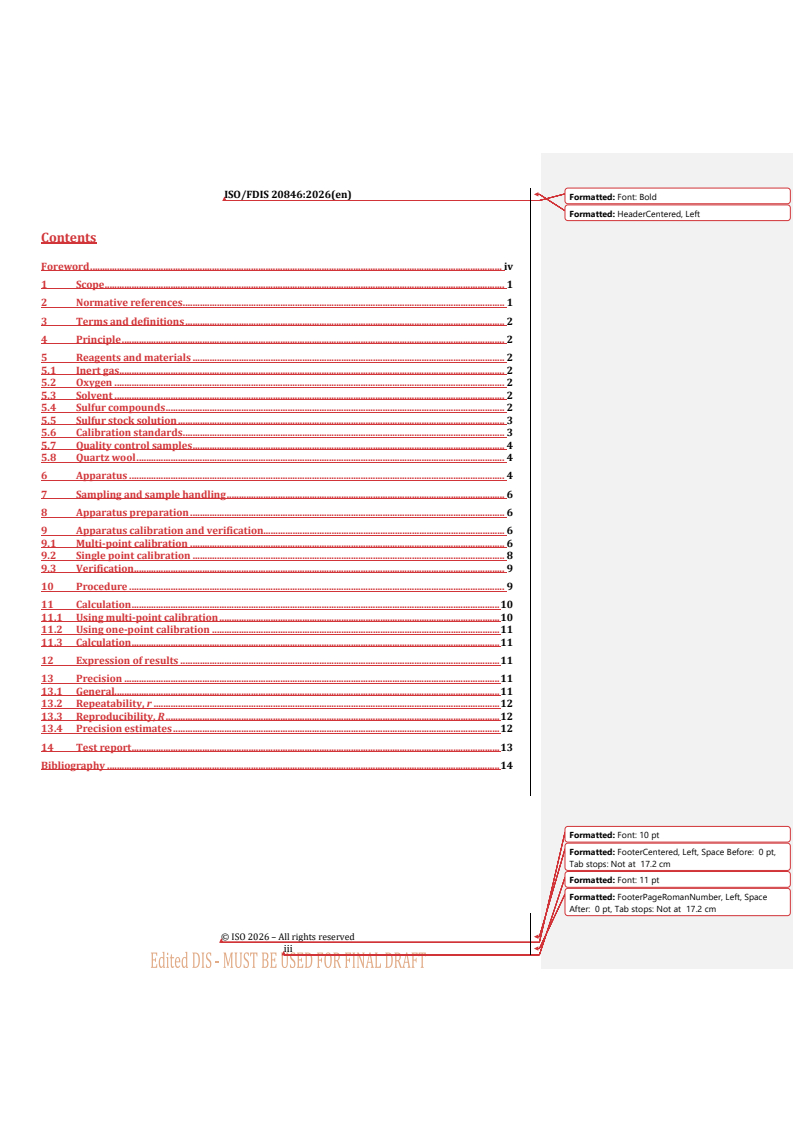
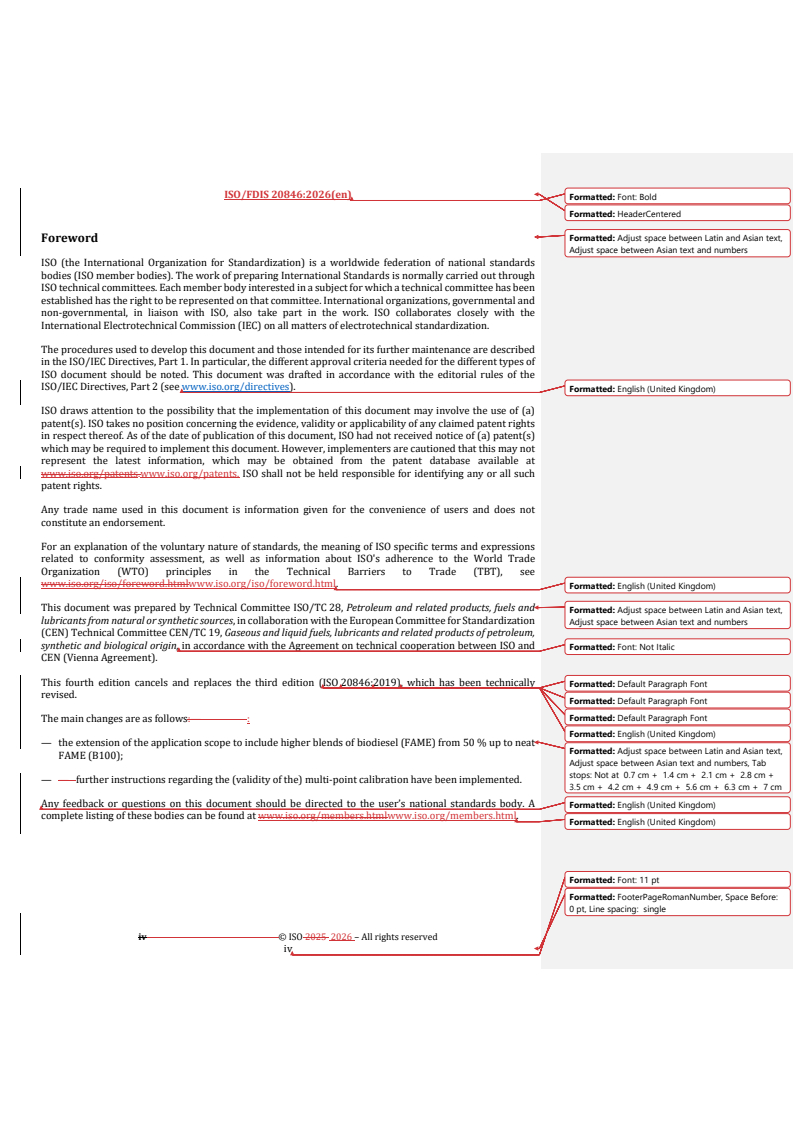
REDLINE ISO/FDIS 20846 - Petroleum and related products — Determination of sulfur content of automotive fuels — Ultraviolet fluorescence method
ISO/FDIS 20846 - Produits pétroliers et connexes — Détermination de la teneur en soufre des carburants pour automobiles — Méthode par fluorescence ultraviolette
Get Certified
Connect with accredited certification bodies for this standard

ABS Quality Evaluations Inc.
American Bureau of Shipping quality certification.

Element Materials Technology
Materials testing and product certification.

ABS Group Brazil
ABS Group certification services in Brazil.
Sponsored listings
Frequently Asked Questions
ISO/FDIS 20846 is a draft published by the International Organization for Standardization (ISO). Its full title is "Petroleum and related products — Determination of sulfur content of automotive fuels — Ultraviolet fluorescence method". This standard covers: This document specifies an ultraviolet (UV) fluorescence test method for the determination of the sulfur content of the following products: — having sulfur contents in the range 3 mg/kg to 500 mg/kg, — motor gasolines containing up to 3,7 % (m/m) oxygen [including those blended with ethanol up to about 10 % (V/V)], — diesel fuels, including those containing up to about 30 % (V/V) fatty acid methyl ester (FAME), — having sulfur contents in the range of 3 mg/kg to 45 mg/kg, — synthetic fuels, such as hydrotreated vegetable oil (HVO) and gas to liquid (GTL). Other products can be analysed and other sulfur contents can be determined according to this test method, however, no precision data for products other than automotive fuels and for results outside the specified range have been established for this document. Halogens interfere with this detection technique at concentrations above approximately 3 500 mg/kg. NOTE 1 Some process catalysts used in petroleum and chemical refining can be poisoned when trace amounts of sulfur-bearing materials are contained in the feedstocks. NOTE 2 This test method can be used to determine sulfur in process feeds and can also be used to control sulfur in effluents. NOTE 3 For the purposes of this document, "% (m/m)" and "% (V/V)" are used to represent the mass fraction, w, and the volume fraction, φ, of a material respectively. NOTE 4 Sulfate species in ethanol do not have the same conversion factor of organic sulfur in ethanol. Nevertheless, sulfates have a conversion factor close to that of organic sulfur. NOTE 5 Nitrogen interference can occur, see 6.5 for further guidance.
This document specifies an ultraviolet (UV) fluorescence test method for the determination of the sulfur content of the following products: — having sulfur contents in the range 3 mg/kg to 500 mg/kg, — motor gasolines containing up to 3,7 % (m/m) oxygen [including those blended with ethanol up to about 10 % (V/V)], — diesel fuels, including those containing up to about 30 % (V/V) fatty acid methyl ester (FAME), — having sulfur contents in the range of 3 mg/kg to 45 mg/kg, — synthetic fuels, such as hydrotreated vegetable oil (HVO) and gas to liquid (GTL). Other products can be analysed and other sulfur contents can be determined according to this test method, however, no precision data for products other than automotive fuels and for results outside the specified range have been established for this document. Halogens interfere with this detection technique at concentrations above approximately 3 500 mg/kg. NOTE 1 Some process catalysts used in petroleum and chemical refining can be poisoned when trace amounts of sulfur-bearing materials are contained in the feedstocks. NOTE 2 This test method can be used to determine sulfur in process feeds and can also be used to control sulfur in effluents. NOTE 3 For the purposes of this document, "% (m/m)" and "% (V/V)" are used to represent the mass fraction, w, and the volume fraction, φ, of a material respectively. NOTE 4 Sulfate species in ethanol do not have the same conversion factor of organic sulfur in ethanol. Nevertheless, sulfates have a conversion factor close to that of organic sulfur. NOTE 5 Nitrogen interference can occur, see 6.5 for further guidance.
ISO/FDIS 20846 is classified under the following ICS (International Classification for Standards) categories: 75.160.20 - Liquid fuels; 75.160.30 - Gaseous fuels. The ICS classification helps identify the subject area and facilitates finding related standards.
ISO/FDIS 20846 has the following relationships with other standards: It is inter standard links to FprEN ISO 20846, ISO 20846:2019. Understanding these relationships helps ensure you are using the most current and applicable version of the standard.
ISO/FDIS 20846 is available in PDF format for immediate download after purchase. The document can be added to your cart and obtained through the secure checkout process. Digital delivery ensures instant access to the complete standard document.
Standards Content (Sample)
FINAL DRAFT
International
Standard
ISO/TC 28
Petroleum and related products —
Secretariat: NEN
Determination of sulfur content
Voting begins on:
of automotive fuels — Ultraviolet
2026-04-03
fluorescence method
Voting terminates on:
2026-05-29
Produits pétroliers et connexes — Détermination de la teneur
en soufre des carburants pour automobiles — Méthode par
fluorescence ultraviolette
RECIPIENTS OF THIS DRAFT ARE INVITED TO SUBMIT,
WITH THEIR COMMENTS, NOTIFICATION OF ANY
RELEVANT PATENT RIGHTS OF WHICH THEY ARE AWARE
AND TO PROVIDE SUPPOR TING DOCUMENTATION.
IN ADDITION TO THEIR EVALUATION AS
BEING ACCEPTABLE FOR INDUSTRIAL, TECHNO
ISO/CEN PARALLEL PROCESSING LOGICAL, COMMERCIAL AND USER PURPOSES, DRAFT
INTERNATIONAL STANDARDS MAY ON OCCASION HAVE
TO BE CONSIDERED IN THE LIGHT OF THEIR POTENTIAL
TO BECOME STAN DARDS TO WHICH REFERENCE MAY BE
MADE IN NATIONAL REGULATIONS.
Reference number
FINAL DRAFT
International
Standard
ISO/TC 28
Petroleum and related products —
Secretariat: NEN
Determination of sulfur content
Voting begins on:
of automotive fuels — Ultraviolet
fluorescence method
Voting terminates on:
Produits pétroliers et connexes — Détermination de la teneur
en soufre des carburants pour automobiles — Méthode par
fluorescence ultraviolette
RECIPIENTS OF THIS DRAFT ARE INVITED TO SUBMIT,
WITH THEIR COMMENTS, NOTIFICATION OF ANY
© ISO 2026
RELEVANT PATENT RIGHTS OF WHICH THEY ARE AWARE
AND TO PROVIDE SUPPOR TING DOCUMENTATION.
All rights reserved. Unless otherwise specified, or required in the context of its implementation, no part of this publication may
IN ADDITION TO THEIR EVALUATION AS
be reproduced or utilized otherwise in any fo
...
Formatted
...
Style Definition
...
Style Definition
...
Style Definition
...
Style Definition
...
Style Definition
...
ISO /TC 28
Style Definition
...
Style Definition
...
Secretariat: NEN
Style Definition
...
Date: 2026-02-1603-19
Style Definition
...
Style Definition
...
Style Definition
...
Style Definition
...
Style Definition
...
Style Definition
...
Petroleum and related products — Determination of sulfur content
Style Definition
...
of automotive fuels — Ultraviolet fluorescence method
Style Definition
...
Produits pétroliers et produits connexes — Détermination de la teneur en soufre des carburants pour
Style Definition
...
automobiles — Méthode par fluorescence ultraviolette
Style Definition
...
Style Definition
...
Style Definition
...
Style Definition
...
Style Definition
...
Style Definition
...
Style Definition
...
Style Definition
...
FDIS stage
Style Definition
...
Style Definition
...
Style Definition
...
Style Definition
...
Style Definition
...
Style Definition
...
Style Definition
...
Style Definition
...
Style Definition
...
Style Definition
...
TThhiiss d drraftaft i iss s suubbmmiitttteded t too a pa pararallel vallel vootte e iinn I ISSOO,, C CEENN.
Style Definition
...
Style Definition
...
Style Definition
...
Style Definition
...
Style Definition
...
Style Definition
...
Style Definition
...
Style Definition
...
Style Definition
...
Style Definition
...
Style Definition
...
Style Definition
...
Style Definition
...
Style Definition
...
Style Definition
...
Style Definition
...
Style Definition
...
Style Definition
...
Style Definition
...
Style Definition
...
Style Definition
...
St l D fi iti
Formatted: Font: Bold
Formatted: HeaderCentered
Formatted: Default Paragraph Font
Formatted: Default Paragraph Font
All rights reserved. Unless otherwise specified, or required in the context of its implementation, no part of this publication
may be reproduced or utilized otherwise in any form or by any means, electronic or mechanical, including photocopying,
Formatted: Left: 1.5 cm, Right: 1.5 cm, Header
or posting on the internet or an intranet, without prior written permission. Permission can be requested from either ISO
distance from edge: 1.27 cm, Footer distance from
at the address below or ISO'sISO’s member body in the country of the requester.
ISO Copyright Officecopyright office
CP 401 • Ch. de Blandonnet 8
CH-1214 Vernier, Geneva
Formatted: zzCopyright address, Adjust space between
Phone: + 41 22 749 01 11
Latin and Asian text, Adjust space between Asian text
and numbers
Email: copyright@iso.org
E-mail: copyright@iso.org
Website: www.iso.orgwww.iso.org
Formatted: German (Germany)
Formatted: German (Germany)
Published in Switzerland.
Formatted: zzCopyright address, Adjust space between
Latin and Asian text, Adjust space between Asian text
and numbers
Formatted: Font: 11 pt
Formatted: FooterPageRomanNumber, Space Before:
0 pt, Line spacing: single
ii © ISO 2025 2026 – All rights reserved
ii
Formatted: Font: Bold
Formatted: HeaderCentered, Left
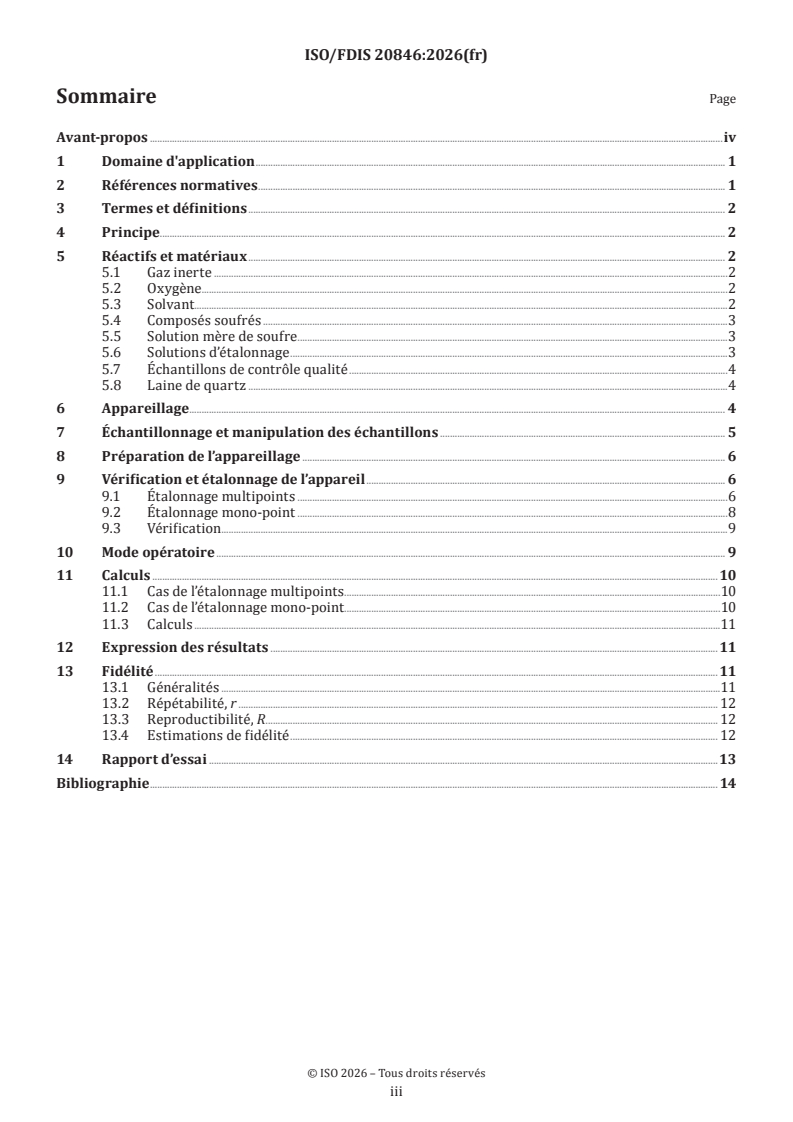
Contents
Foreword . iv
1 Scope . 1
2 Normative references . 1
3 Terms and definitions . 2
4 Principle . 2
5 Reagents and materials . 2
5.1 Inert gas . 2
5.2 Oxygen . 2
5.3 Solvent . 2
5.4 Sulfur compounds . 2
5.5 Sulfur stock solution . 3
5.6 Calibration standards . 3
5.7 Quality control samples . 4
5.8 Quartz wool . 4
6 Apparatus . 4
7 Sampling and sample handling . 6
8 Apparatus preparation . 6
9 Apparatus calibration and verification. 6
9.1 Multi-point calibration . 6
9.2 Single point calibration . 8
9.3 Verification . 9
10 Procedure . 9
11 Calculation . 10
11.1 Using multi-point calibration . 10
11.2 Using one-point calibration . 11
11.3 Calculation . 11
12 Expression of results . 11
13 Precision . 11
13.1 General. 11
13.2 Repeatability, r . 12
13.3 Reproducibility, R . 12
13.4 Precision estimates . 12
14 Test report . 13
Bibliography . 14
Formatted: Font: 10 pt
Formatted: FooterCentered, Left, Space Before: 0 pt,
Tab stops: Not at 17.2 cm
Formatted: Font: 11 pt
Formatted: FooterPageRomanNumber, Left, Space
After: 0 pt, Tab stops: Not at 17.2 cm
iii
Formatted: Font: Bold
Formatted: HeaderCentered
Foreword Formatted: Adjust space between Latin and Asian text,
Adjust space between Asian text and numbers
ISO (the International Organization for Standardization) is a worldwide federation of national standards
bodies (ISO member bodies). The work of preparing International Standards is normally carried out through
ISO technical committees. Each member body interested in a subject for which a technical committee has been
established has the right to be represented on that committee. International organizations, governmental and
non-governmental, in liaison with ISO, also take part in the work. ISO collaborates closely with the
International Electrotechnical Commission (IEC) on all matters of electrotechnical standardization.
The procedures used to develop this document and those intended for its further maintenance are described
in the ISO/IEC Directives, Part 1. In particular, the different approval criteria needed for the different types of
ISO document should be noted. This document was drafted in accordance with the editorial rules of the
ISO/IEC Directives, Part 2 (see www.iso.org/directives).
Formatted: English (United Kingdom)
ISO draws attention to the possibility that the implementation of this document may involve the use of (a)
patent(s). ISO takes no position concerning the evidence, validity or applicability of any claimed patent rights
in respect thereof. As of the date of publication of this document, ISO had not received notice of (a) patent(s)
which may be required to implement this document. However, implementers are cautioned that this may not
represent the latest information, which may be obtained from the patent database available at
www.iso.org/patents.www.iso.org/patents. ISO shall not be held responsible for identifying any or all such
patent rights.
Any trade name used in this document is information given for the convenience of users and does not
constitute an endorsement.
For an explanation of the voluntary nature of standards, the meaning of ISO specific terms and expressions
related to conformity assessment, as well as information about ISO's adherence to the World Trade
Organization (WTO) principles in the Technical Barriers to Trade (TBT), see
www.iso.org/iso/foreword.htmlwww.iso.org/iso/foreword.html.
Formatted: English (United Kingdom)
This document was prepared by Technical Committee ISO/TC 28, Petroleum and related products, fuels and
Formatted: Adjust space between Latin and Asian text,
lubricants from natural or synthetic sources, in collaboration with the European Committee for Standardization Adjust space between Asian text and numbers
(CEN) Technical Committee CEN/TC 19, Gaseous and liquid fuels, lubricants and related products of petroleum,
synthetic and biological origin, in accordance with the Agreement on technical cooperation between ISO and
Formatted: Font: Not Italic
CEN (Vienna Agreement).
This fourth edition cancels and replaces the third edition (ISO 20846:2019), which has been technically
Formatted: Default Paragraph Font
revised.
Formatted: Default Paragraph Font
Formatted: Default Paragraph Font
The main changes are as follows:— :
Formatted: English (United Kingdom)
— the extension of the application scope to include higher blends of biodiesel (FAME) from 50 % up to neat
Formatted: Adjust space between Latin and Asian text,
FAME (B100);
Adjust space between Asian text and numbers, Tab
stops: Not at 0.7 cm + 1.4 cm + 2.1 cm + 2.8 cm +
— — further instructions regarding the (validity of the) multi-point calibration have been implemented.
3.5 cm + 4.2 cm + 4.9 cm + 5.6 cm + 6.3 cm + 7 cm
Any feedback or questions on this document should be directed to the user’s national standards body. A
Formatted: English (United Kingdom)
complete listing of these bodies can be found at www.iso.org/members.htmlwww.iso.org/members.html.
Formatted: English (United Kingdom)
Formatted: Font: 11 pt
Formatted: FooterPageRomanNumber, Space Before:
0 pt, Line spacing: single
iv © ISO 2025 2026 – All rights reserved
iv
Final DRAFT International Standard ISO/FDIS 20846:2026(en)
Formatted: Left
Petroleum and related products — Determination of sulfur content of
automotive fuels — Ultraviolet fluorescence method
WARNING — The use of this document can involve hazardous materials, operations and equipment.
Formatted: Left: 1.5 cm, Right: 1.5 cm, Header
This document does not purport to address all of the safety problems associated with its use. It is the
distance from edge: 1.27 cm, Footer distance from
responsibility of users of this document to take appropriate measures to ensure the safety and health
of personnel prior to application of the document and fulfil other applicable requirements for this
purpose.
1 Scope
This document specifies an ultraviolet (UV) fluorescence test method for the determination of the sulfur
content of the following products:
— — having sulfur contents in the range 3 mg/kg to 500 mg/kg:
Formatted: Adjust space between Latin and Asian text,
Adjust space between Asian text and numbers, Tab
— — motor gasolines containing up to a mass fraction of 3,7 % (3,7 % (m/m) ))) of oxygen
stops: Not at 0.7 cm + 1.4 cm + 2.1 cm + 2.8 cm +
[including those blended with a volume fraction of ethanol up to about 10 % (10 % (V/V) )],))]; 3.5 cm + 4.2 cm + 4.9 cm + 5.6 cm + 6.3 cm + 7 cm
Formatted: Font: Italic
— — diesel fuels, including those containing up to a volume fraction of about 50 % of fatty acid
Formatted: Font: Italic
methyl ester (FAME),);
— — having sulfur contents in the range of 3 mg/kg to 45 mg/kg:
— — synthetic fuels, such as hydrotreated vegetable oil (HVO) and gas to liquid (GTL);
Formatted: Adjust space between Latin and Asian text,
— — having sulfur contents in the range of 3 mg/kg to 30 mg/kg:
Adjust space between Asian text and numbers
Formatted: Default Paragraph Font
— — neat FAME (B100) and diesel fuels containing volume fraction of more than 50 % of FAME.
Formatted: Default Paragraph Font
Other products (for example process feeds and effluents) can be analysed and other sulfur contents can be
Formatted: Default Paragraph Font
determined according to this test method, however, no precision data for products other than automotive
Formatted: Adjust space between Latin and Asian text,
fuels and for results outside the specified range have been established for this document. Halogens interfere
Adjust space between Asian text and numbers, Tab
with this detection technique at concentrations above approximately 3 500 mg/kg.
stops: Not at 0.7 cm + 1.4 cm + 2.1 cm + 2.8 cm +
3.5 cm + 4.2 cm + 4.9 cm + 5.6 cm + 6.3 cm + 7 cm
2 Normative references
Formatted: Default Paragraph Font
The following documents are referred to in the text in such a way that some or all of their content constitutes
Formatted: Default Paragraph Font
requirements of this document. For dated references, only the edition cited applies. For undated references,
Formatted: Default Paragraph Font
the latest edition of the referenced document (including any amendments) applies.
Formatted: Default Paragraph Font
ISO 1042, Laboratory glassware — One-mark volumetric flasks
Formatted: Default Paragraph Font
Formatted: Default Paragraph Font
ISO 3170, Hydrocarbon Liquids — Manual sampling
Formatted: Default Paragraph Font
ISO 3171, Petroleum liquids — Automatic pipeline sampling
Formatted: Default Paragraph Font
Formatted: Default Paragraph Font
ISO 3675, Crude petroleum and liquid petroleum products — Laboratory determination of density —
Hydrometer method
Formatted: Footer, Left, Space After: 0 pt, Tab stops:
Not at 17.2 cm
Formatted: Font: Bold
Formatted: HeaderCentered
ISO 12185, Crude petroleum, petroleum products and related products — Determination of density —
Formatted: Default Paragraph Font
Laboratory density meter with an oscillating U-tube sensor
Formatted: Default Paragraph Font
Formatted: Default Paragraph Font
3 Terms and definitions
Formatted: Adjust space between Latin and Asian text,
No terms and definitions are listed in this document. Adjust space between Asian text and numbers
ISO and IEC maintain terminology databases for use in standardization at the following addresses:
Formatted: English (United Kingdom)
Formatted: Font: Cambria, 11 pt, English (United
— — ISO Online browsing platform: available at https://www.iso.org/obphttps://www.iso.org/obp
Kingdom)
Formatted: English (United Kingdom)
— — IEC Electropedia: available at https://www.electropedia.org/https://www.electropedia.org/
Formatted: Default Paragraph Font, English (United
4 Principle
Kingdom)
Formatted: English (United Kingdom)
A hydrocarbon sample is either directly injected or placed in a sample boat. Then, it enters a high temperature
Formatted: Default Paragraph Font, English (United
combustion tube (1 000 °C to 1 100 °C), where the sulfur is oxidized to sulfur dioxide (SO ) in an oxygen-rich
Kingdom)
atmosphere. Water produced during the sample combustion is removed and the sample combustion gases are
exposed to UV light. The SO2 absorbs the energy from the UV light and is converted to excited sulfur dioxide Formatted: Adjust space between Latin and Asian text,
(SO *). The fluorescence emitted from the excited SO * as it returns to a stable state SO is detected by a Adjust space between Asian text and numbers
2 2 2
photomultiplier tube and the resulting signal is a measure of the sulfur contained in the sample.
5 Reagents and materials
5.1 5.1 Inert gas
Formatted: Heading 2, Adjust space between Latin and
Asian text, Adjust space between Asian text and
Use argon or helium, high purity grade with a minimum purity of 99,998 % by volume.
numbers, Tab stops: Not at 0.7 cm + 1.4 cm + 2.1 cm
+ 2.8 cm + 3.5 cm + 4.2 cm + 4.9 cm + 5.6 cm + 6.3
5.2 5.2 Oxygen
cm + 7 cm
Use high purity grade with a minimum purity of 99,75 % by volume.
Formatted: Adjust space between Latin and Asian text,
Adjust space between Asian text and numbers
WARNING — Oxygen vigorously accelerates combustion.
Formatted: Heading 2, Adjust space between Latin and
Asian text, Adjust space between Asian text and
5.3 5.3 Solvent
numbers, Tab stops: Not at 0.7 cm + 1.4 cm + 2.1 cm
+ 2.8 cm + 3.5 cm + 4.2 cm + 4.9 cm + 5.6 cm + 6.3
Use either that specified in a) or b), or a solvent similar to that occurring in the sample under analysis.
cm + 7 cm
Correction for sulfur contribution from solvents used in standard preparation and sample dilution is required.
Formatted: Default Paragraph Font
Alternatively, a solvent with non-detectable sulfur contamination relative to the unknown sample can be used,
making the blank correction unnecessary. Formatted: Adjust space between Latin and Asian text,
Adjust space between Asian text and numbers
NOTE Non-detectable is in general considered to be below 0,5 mg/kg for regular samples, though solvents with
Formatted: Adjust space between Latin and Asian text,
< < 0,05 mg/kg of sulfur are readily available.
Adjust space between Asian text and numbers, Tab
stops: Not at 0.7 cm + 1.4 cm + 2.1 cm + 2.8 cm +
a) a) Toluene, reagent grade.
3.5 cm + 4.2 cm + 4.9 cm + 5.6 cm + 6.3 cm + 7 cm
Formatted: Font: Not Bold, English (United Kingdom)
b) b) Isooctane, reagent grade.
Formatted: Font: Not Bold, English (United Kingdom)
WARNING — Flammable solvents.
Formatted: Adjust space between Latin and Asian text,
Adjust space between Asian text and numbers
5.4 5.4 Sulfur compounds
Formatted
...
Compounds with a minimum purity of 99 % by mass shall be used. Examples are given in a) to d). Where the
Formatted
...
purity of these compounds is less than 99 % by mass, the concentrations and nature of all impurities shall be
Formatted: Font: 11 pt
established.
Formatted
...
2 © ISO 2025 2026 – All rights reserved
Formatted: Font: 11 pt, Bold
Formatted: Font: Bold
Formatted: HeaderCentered, Left
NOTE 1 A correction for chemical impurity can be applied when the sulfur content is known with accuracy.
Formatted: Adjust space between Latin and Asian text,
[3][3]
NOTE 2 Certified reference materials (CRM) produced in accordance with ISO 17034 are suitable alternatives to Adjust space between Asian text and numbers, Tab
the compounds listed in a) to d). stops: Not at 0.7 cm + 1.4 cm + 2.1 cm + 2.8 cm +
3.5 cm + 4.2 cm + 4.9 cm + 5.6 cm + 6.3 cm + 7 cm
a) a) Dibenzothiophene (DBT), of molar mass 184,26 g/mol, with a nominal sulfur content of 17,399 % mass
Formatted: Default Paragraph Font
fraction.
Formatted: Default Paragraph Font
b) b) Dibutyl sulfide (DBS), of molar mass 146,29 g/mol, with a nominal sulfur content of 21,915 % mass
Formatted: Font: Not Bold, English (United Kingdom)
fraction.
Formatted: Font: Not Bold, English (United Kingdom)
c) c) Dibutyl disulfide (DBDS), of molar mass 178,36 g/mol, with a nominal sulfur content of 35,950 % mass
Formatted: Font: Not Bold, English (United Kingdom)
fraction.
d) d) Thionaphthene (benzothiophene) (TNA), of molar mass 134,20 g/mol, with a nominal sulfur content
Formatted: Font: Not Bold, English (United Kingdom)
of 23,890 % mass fraction.
5.5 5.5 Sulfur stock solution
Prepare a stock solution of approximately 1 000 mg/l sulfur content by accurately weighing the appropriate
Formatted: Adjust space between Latin and Asian text,
quantity of sulfur compound (5.4)(5.4) in a volumetric flask (6.9).(6.9). Ensure complete dissolution with
Adjust space between Asian text and numbers
solvent (5.3).(5.3). Calculate the exact sulfur concentration of the stock solution to the nearest 1 mg/l. This
stock solution is used for the preparation of calibration standards. As an alternative procedure, a sulfur stock
solution of approximately 1 000 mg/kg can be prepared by accurately weighing the appropriate quantity of
sulfur compound (5.4)(5.4) in a volumetric flask (6.9)(6.9) and reweighing the volumetric flask once it has
been filled to the mark with the solvent (5.3).(5.3). Take precautions to ensure that evaporation of either the
solvent or the sulfur compounds, or both, are not causing weighing errors.
The appropriate mass of sulfur compound described in 5.4.25.4 a) to 5.4.5 to addd) that shall be added to the
Formatted: Default Paragraph Font
100 ml flask is :
— 0,574 8 g (DBT),
— 0,456 3 g (DBS),
— 0,2781278 1 g (DBDS) and ),
— 0,418 6 g (TNA).
Formatted: List Continue 1, Adjust space between Latin
and Asian text, Adjust space between Asian text and
NOTE The shelf life of the stock solution is approximately three months when stored at low temperature, typically
numbers
in a refrigerator.
Formatted: Adjust space between Latin and Asian text,
Adjust space between Asian text and numbers, Tab
5.6 5.6 Calibration standards
stops: Not at 0.7 cm + 1.4 cm + 2.1 cm + 2.8 cm +
3.5 cm + 4.2 cm + 4.9 cm + 5.6 cm + 6.3 cm + 7 cm
Prepare the calibration standards by dilution of the stock solution (5.5)(5.5) with the selected solvent
Formatted: Adjust space between Latin and Asian text,
(5.3).(5.3).
Adjust space between Asian text and numbers
Calculate the exact sulfur content of each calibration standard.
Calibration standards with a known sulfur concentration, in milligrams per litre, (or content, in milligrams per
Formatted: Font: 10 pt
kilogram) can be obtained with a volume/volume dilution (or mass/mass by volume (dilution by mass,
respectively) of the stock solution at 1 000 mg/l (or 1 000 mg/kg respectively). Other practices are possible, Formatted: FooterCentered, Left, Space Before: 0 pt,
Tab stops: Not at 17.2 cm
but those mentioned above avoid any density correction.
Formatted: Font: 11 pt
New calibration standards should be prepared on a regular basis, depending upon the frequency of use and
Formatted: FooterPageNumber, Left, Space After: 0 pt,
age. When stored at low temperature, typically in a refrigerator, the calibration standards with a sulfur content
Tab stops: Not at 17.2 cm
Formatted: Font: Bold
Formatted: HeaderCentered
above 30 mg/kg (or mg/l) have a shelf life of at least one month. Below this sulfur content (30 mg/kg), the
shelf life should be reduced.
5.7 5.7 Quality control samples
Formatted: Heading 2, Adjust space between Latin and
Asian text, Adjust space between Asian text and
Quality control samples are stable samples representative of the materials being analysed, which have a sulfur
numbers, Tab stops: Not at 0.7 cm + 1.4 cm + 2.1 cm
content that is known by this test method over a substantial period of time. Alternatively, there are standard
+ 2.8 cm + 3.5 cm + 4.2 cm + 4.9 cm + 5.6 cm + 6.3
materials with a certified value commercially available. Prior to use, ensure that the material is within its shelf
cm + 7 cm
life.
Formatted: Adjust space between Latin and Asian text,
Adjust space between Asian text and numbers
5.8 5.8 Quartz wool
Formatted: Heading 2, Adjust space between Latin and
Asian text, Adjust space between Asian text and
Follow the manufacturer's recommendations.
numbers, Tab stops: Not at 0.7 cm + 1.4 cm + 2.1 cm
+ 2.8 cm + 3.5 cm + 4.2 cm + 4.9 cm + 5.6 cm + 6.3
6 Apparatus
cm + 7 cm
Formatted: Adjust space between Latin and Asian text,
Figure 1Figure 1 illustrates the basic pieces of the ultraviolet fluorescence equipment.
Adjust space between Asian text and numbers
Formatted: Key Title, Adjust space between Latin and
Asian text, Adjust space between Asian text and
numbers
Key
Formatted: Adjust space between Latin and Asian text,
1 UV source
Adjust space between Asian text and numbers, Tab
2 photomultiplier stops: Not at 0.7 cm + 1.4 cm + 2.8 cm + 3.5 cm +
4.2 cm + 4.9 cm + 5.6 cm + 6.3 cm + 7 cm
3 output signal
4 furnace (6.1)(6.1)
Formatted: English (United Kingdom)
5 oxygen input
Formatted: Font: 11 pt
6 inert gas input
Formatted: FooterPageNumber, Space Before: 0 pt,
7 gases output
Line spacing: single
4 © ISO 2025 2026 – All rights reserved
Formatted
...
Formatted
...
Formatted
...
8 vapour drier (6.4)(6.4)
9 quartz tube
10 microlitre syringe
Formatted
...
Figure 1 — Synopsis of the apparatus Formatted
...
Formatted
...
6.1 6.1 Furnace, comprising a device capable of maintaining a temperature sufficient to pyrolyze all
Formatted
...
of the sample and oxidize all sulfur to sulfur dioxide (SO2).
Formatted
...
It can be set either in a horizontal or vertical position.
Formatted
...
Formatted
...
6.2 6.2 Combustion tube, of quartz, constructed to allow the direct injection of the sample into the
Formatted
heated oxidation zone of the furnace (6.1).(6.1).
...
Formatted
...
The combustion tube shall have side arms for the introduction of oxygen and carrier gas. The oxidation section
Formatted
...
shall be large enough to ensure complete combustion of the sample. It can be set either in a horizontal or
vertical position. Formatted
...
Formatted
...
6.3 6.3 Flow controllers, capable of maintaining a constant supply of oxygen and carrier gas.
Formatted
...
6.4 6.4 Vapour drier, capable of removing water vapour formed during combustion prior to
Formatted
...
measurement by the detector (6.5).(6.5).
Formatted
...
6.5 6.5 UV fluorescence detector, selective and quantitative, capable of measuring light emitted
Formatted
...
from the fluorescence of sulfur dioxide by UV light.
Formatted
...
Formatted
WARNING — Exposure to excessive quantities of UV light is injurious to health. Operators should avoid
...
exposing any part of their body, especially his/herthe eyes, not only to direct UV light, but also to
Formatted
...
secondary or scattered radiation that can be present.
Formatted
...
It is recommended to verify that the nitrogen interference has been compensated for. If in doubt check with Formatted
...
the manufacturer.
Formatted
...
Formatted
NOTE For example, alkyl nitrate, as 2 ethyl hexyl nitrate (EHN), added as cetane improver to diesel fuel shows an .
enhancing effect on sulfur content that can range from (0 to 1,7) mg/kg when 2 000 mg/kg EHN is added to diesel fuel
Formatted
...
containing 10 mg/kg of sulfur.
Formatted
...
6.6 6.6 Microlitre syringe, capable of accurately delivering between 5 µl to 50 µl quantities.
Formatted
...
Formatted
...
Follow the manufacturer’s instructions for determining the length of the needle required. For vertical
injection, syringes with a polytetrafluoroethylene (PTFE) plunger are recommended. Formatted
...
Formatted
...
6.7 6.7 Sample inlet system, either positioned vertically or horizontally.
Formatted
...
It shall consist of a direct injection inlet system capable of allowing the quantitative delivery of the material to
Formatted
...
be analysed into an inlet carrier stream which directs the sample into the oxidation zone at a controlled and
Formatted
...
repeatable rate. A syringe drive mechanism, which discharges the sample from the microlitre syringe
Formatted
(6.6)(6.6) at a constant rate of approximately 1 µl/s maximum, is required. .
Formatted
...
Boat injection systems may be used if they meet the performance requirements of Clause 13.Clause 13.
Formatted
...
6.8 6.8 Balance, capable of weighing to the nearest 0,1 mg.
Formatted
...
Formatted
...
6.9 6.9 Volumetric flasks, Class A one-mark volumetric flasks, which shall conform to ISO 1042, of
Formatted
appropriate capacities, including 100 ml, for the preparation of sulfur stock solution (5.5)(5.5) and .
calibration standards (5.6).(5.6).
Formatted
...
Formatted
...
Formatted
...
Formatted
7 Sampling and sample handling .
Formatted
...
7.1 7.1 Unless otherwise specified, obtain the laboratory sample by the procedures described in
Formatted
...
ISO 3170 for manual sampling, or ISO 3171 for automatic pipeline sampling. To preserve volatile
components found in some samples, keep samples at as low a temperature as is practicable and do not Formatted
...
uncover samples any longer than necessary.
Formatted
...
Formatted
Samples should be analy
...
PROJET FINAL
Norme
internationale
ISO/TC 28
Produits pétroliers et connexes —
Secrétariat: NEN
Détermination de la teneur
Début de vote:
en soufre des carburants pour
2026-04-03
automobiles — Méthode par
Vote clos le:
fluorescence ultraviolette
2026-05-29
Petroleum and related products — Determination of sulfur
content of automotive fuels — Ultraviolet fluorescence method
LES DESTINATAIRES DU PRÉSENT PROJET SONT
INVITÉS À PRÉSENTER, AVEC LEURS OBSERVATIONS,
NOTIFICATION DES DROITS DE PROPRIÉTÉ DONT ILS
AURAIENT ÉVENTUELLEMENT CONNAISSANCE ET À
FOURNIR UNE DOCUMENTATION EXPLICATIVE.
OUTRE LE FAIT D’ÊTRE EXAMINÉS POUR
ÉTABLIR S’ILS SONT ACCEPTABLES À DES FINS
INDUSTRIELLES, TECHNOLOGIQUES ET COM-MERCIALES,
AINSI QUE DU POINT DE VUE DES UTILISATEURS, LES
PROJETS DE NORMES
TRAITEMENT PARALLÈLE ISO/CEN
INTERNATIONALES DOIVENT PARFOIS ÊTRE CONSIDÉRÉS
DU POINT DE VUE DE LEUR POSSI BILITÉ DE DEVENIR DES
NORMES POUVANT
SERVIR DE RÉFÉRENCE DANS LA RÉGLEMENTATION
NATIONALE.
Numéro de référence
PROJET FINAL
Norme
internationale
ISO/TC 28
Produits pétroliers et connexes —
Secrétariat: NEN
Détermination de la teneur
Début de vote:
en soufre des carburants pour
2026-04-03
automobiles — Méthode par
Vote clos le:
fluorescence ultraviolette
2026-05-29
Petroleum and related products — Determination of sulfur
content of automotive fuels — Ultraviolet fluorescence method
LES DESTINATAIRES DU PRÉSENT PROJET SONT
INVITÉS À PRÉSENTER, AVEC LEURS OBSERVATIONS,
NOTIFICATION DES DROITS DE PROPRIÉTÉ DONT ILS
AURAIENT ÉVENTUELLEMENT CONNAISSANCE ET À
FOURNIR UNE DOCUMENTATION EXPLICATIVE.
DOCUMENT PROTÉGÉ PAR COPYRIGHT
OUTRE LE FAIT D’ÊTRE EXAMINÉS POUR
ÉTABLIR S’ILS SONT ACCEPTABLES À DES FINS
© ISO 2026 INDUSTRIELLES, TECHNOLOGIQUES ET COM-MERCIALES,
AINSI QUE DU POINT DE VUE DES UTILISATEURS, LES
Tous droits réservés. Sauf prescription différente ou nécessité dans le contexte de sa mise en œuvre, aucune partie de cette
PROJETS DE NORMES
TRAITEMENT PARALLÈLE ISO/CEN
INTERNATIONALES DOIVENT PARFOIS ÊTRE CONSIDÉRÉS
publication ne peut être reproduite ni utilisée sous quelque forme que ce soit et par aucun procédé, électronique ou mécanique,
DU POINT DE VUE DE LEUR POSSI BILITÉ DE DEVENIR DES
y compris la photocopie, ou la diffusion sur l’internet ou sur un intranet, sans autorisation écrite préalable. Une autorisation peut
NORMES POUVANT
être demandée à l’ISO à l’adresse ci-après ou au comité membre de l’ISO dans le pays du demandeur.
SERVIR DE RÉFÉRENCE DANS LA RÉGLEMENTATION
NATIONALE.
ISO copyright office
Case postale 401 • Ch. de Blandonnet 8
CH-1214 Vernier, Genève
Tél.: +41 22 749 01 11
E-mail: copyright@iso.org
Web: www.iso.org
Publié en Suisse Numéro de référence
ii
Sommaire Page
Avant-propos .iv
1 Domaine d'application . 1
2 Références normatives . 1
3 Termes et définitions . 2
4 Principe. 2
5 Réactifs et matériaux . 2
5.1 Gaz inerte .2
5.2 Oxygène.2
5.3 Solvant.2
5.4 Composés soufrés .3
5.5 Solution mère de soufre .3
5.6 Solutions d’étalonnage .3
5.7 Échantillons de contrôle qualité .4
5.8 Laine de quartz .4
6 Appareillage . 4
7 Échantillonnage et manipulation des échantillons . 5
8 Préparation de l’appareillage . 6
9 Vérification et étalonnage de l’appareil . 6
9.1 Étalonnage multipoints .6
9.2 Étalonnage mono-point .8
9.3 Vérification . .9
10 Mode opératoire . 9
11 Calculs . 10
11.1 Cas de l’étalonnage multipoints . .10
11.2 Cas de l’étalonnage mono-point . .10
11.3 Calculs .11
12 Expression des résultats .11
13 Fidélité .11
13.1 Généralités .11
13.2 Répétabilité, r . 12
13.3 Reproductibilité, R . . 12
13.4 Estimations de fidélité . 12
14 Rapport d’essai .13
Bibliographie . 14
iii
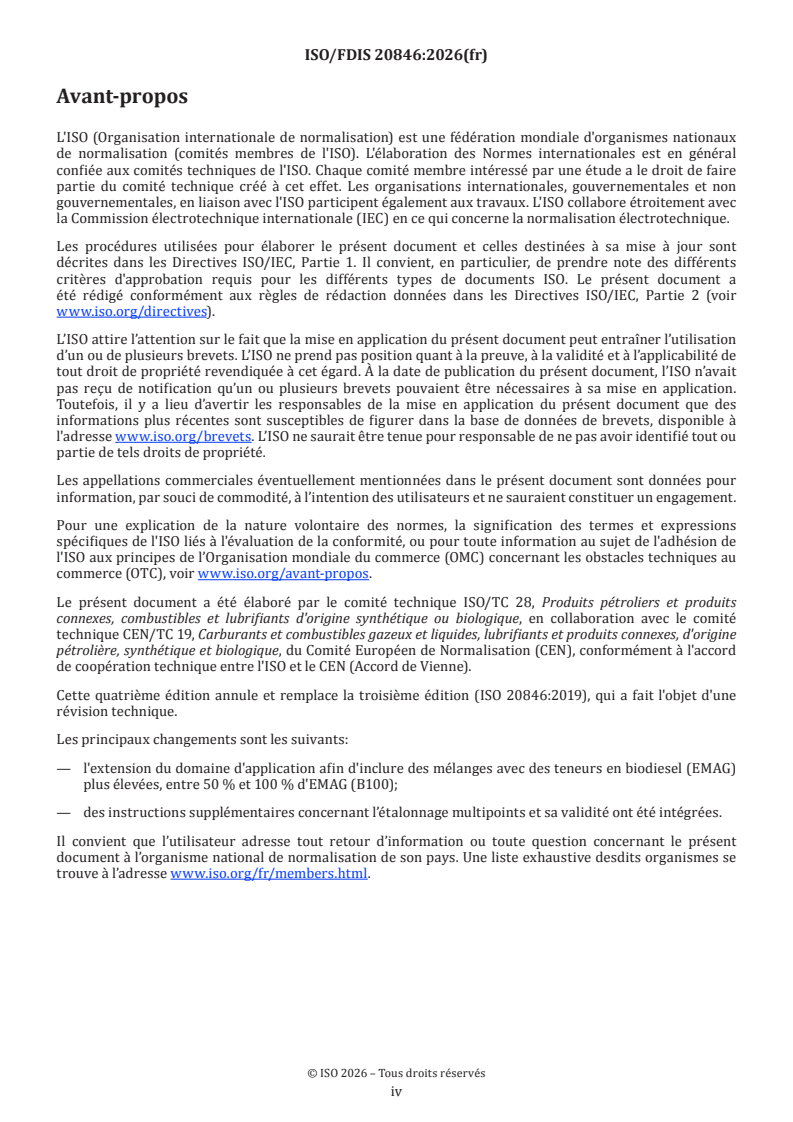
Avant-propos
L'ISO (Organisation internationale de normalisation) est une fédération mondiale d'organismes nationaux
de normalisation (comités membres de l'ISO). L'élaboration des Normes internationales est en général
confiée aux comités techniques de l'ISO. Chaque comité membre intéressé par une étude a le droit de faire
partie du comité technique créé à cet effet. Les organisations internationales, gouvernementales et non
gouvernementales, en liaison avec l'ISO participent également aux travaux. L'ISO collabore étroitement avec
la Commission électrotechnique internationale (IEC) en ce qui concerne la normalisation électrotechnique.
Les procédures utilisées pour élaborer le présent document et celles destinées à sa mise à jour sont
décrites dans les Directives ISO/IEC, Partie 1. Il convient, en particulier, de prendre note des différents
critères d'approbation requis pour les différents types de documents ISO. Le présent document a
été rédigé conformément aux règles de rédaction données dans les Directives ISO/IEC, Partie 2 (voir
www.iso.org/directives).
L’ISO attire l’attention sur le fait que la mise en application du présent document peut entraîner l’utilisation
d’un ou de plusieurs brevets. L’ISO ne prend pas position quant à la preuve, à la validité et à l’applicabilité de
tout droit de propriété revendiquée à cet égard. À la date de publication du présent document, l’ISO n’avait
pas reçu de notification qu’un ou plusieurs brevets pouvaient être nécessaires à sa mise en application.
Toutefois, il y a lieu d’avertir les responsables de la mise en application du présent document que des
informations plus récentes sont susceptibles de figurer dans la base de données de brevets, disponible à
l'adresse www.iso.org/brevets. L’ISO ne saurait être tenue pour responsable de ne pas avoir identifié tout ou
partie de tels droits de propriété.
Les appellations commerciales éventuellement mentionnées dans le présent document sont données pour
information, par souci de commodité, à l’intention des utilisateurs et ne sauraient constituer un engagement.
Pour une explication de la nature volontaire des normes, la signification des termes et expressions
spécifiques de l'ISO liés à l'évaluation de la conformité, ou pour toute information au sujet de l'adhésion de
l'ISO aux principes de l’Organisation mondiale du commerce (OMC) concernant les obstacles techniques au
commerce (OTC), voir www.iso.org/avant-propos.
Le présent document a été élaboré par le comité technique ISO/TC 28, Produits pétroliers et produits
connexes, combustibles et lubrifiants d'origine synthétique ou biologique, en collaboration avec le comité
technique CEN/TC 19, Carburants et combustibles gazeux et liquides, lubrifiants et produits connexes, d'origine
pétrolière, synthétique et biologique, du Comité Européen de Normalisation (CEN), conformément à l'accord
de coopération technique entre l'ISO et le CEN (Accord de Vienne).
Cette quatrième édition annule et remplace la troisième édition (ISO 20846:2019), qui a fait l'objet d'une
révision technique.
Les principaux changements sont les suivants:
— l'extension du domaine d'application afin d'inclure des mélanges avec des teneurs en biodiesel (EMAG)
plus élevées, entre 50 % et 100 % d'EMAG (B100);
— des instructions supplémentaires concernant l’étalonnage multipoints et sa validité ont été intégrées.
Il convient que l’utilisateur adresse tout retour d’information ou toute question concernant le présent
document à l’organisme national de normalisation de son pays. Une liste exhaustive desdits organismes se
trouve à l’adresse www.iso.org/fr/members.html.
iv
PROJET FINAL Norme internationale ISO/FDIS 20846:2026(fr)
Produits pétroliers et connexes — Détermination de la teneur
en soufre des carburants pour automobiles — Méthode par
fluorescence ultraviolette
AVERTISSEMENT — L'utilisation du présent document implique l'intervention de produits,
d'opérations et d'équipements à caractères dangereux. Le présent document n'a pas vocation à
aborder tous les problèmes de sécurité associés à son utilisation. Il est de la responsabilité de
l'utilisateur du présent document de prendre les mesures appropriées pour assurer la sécurité et
préserver la santé du personnel avant l’application du document et de respecter les autres exigences
applicables à cette fin.
1 Domaine d'application
Le présent document spécifie une méthode par fluorescence ultraviolette (UV) pour le dosage du soufre
dans les produits suivants:
— ayant une teneur en soufre comprise dans l’intervalle de 3 mg/kg à 500 mg/kg:
— les essences automobiles contenant jusqu’à 3,7 % en fraction massique (3,7 % (m/m)) d’oxygène [les
mélanges contenant jusqu’à environ 10 % en fraction volumique (10 % (V/V)) d’éthanol inclus];
— les carburants diesel, dont ceux contenant jusqu’à 50 % en fraction volumique d’esters méthyliques
d’acides gras (EMAG);
— ayant une teneur en soufre comprise dans l’intervalle de 3 mg/kg à 45 mg/kg:
— les carburants synthétiques, tels que les huiles végétales hydrogénées (HVO) et les carburants
liquides produits à partir de gaz («gas to liquid», GTL);
— ayant une teneur en soufre comprise dans l’intervalle de 3 mg/kg à 30 mg/kg:
— les EMAG purs (B100) et les carburants diesel contenant une fraction volumique d'EMAG supérieure
à 50 %.
D’autres produits (par exemple les charges et les effluents) peuvent être analysés et d’autres teneurs en
soufre peuvent être déterminées suivant cette méthode d’essai, cependant, il n’a pas été établi de données
de fidélité pour des produits autres que les carburants pour automobiles et pour des résultats en dehors de
la gamme spécifiée pour le présent document. Les halogènes, à des concentrations supérieures à environ
3 500 mg/kg, interfèrent avec cette technique de détection.
2 Références normatives
Les documents suivants sont cités dans le texte de sorte qu’ils constituent, pour tout ou partie de leur
contenu, des exigences du présent document. Pour les références datées, seule l’édition citée s’applique. Pour
les références non datées, la dernière édition du document de référence s'applique (y compris les éventuels
amendements).
ISO 1042, Verrerie de laboratoire — Fioles jaugées à un trait
ISO 3170, Hydrocarbures liquides — Échantillonnage manuel
ISO 3171, Produits pétroliers liquides — Échantillonnage automatique en oléoduc
ISO 3675, Pétrole brut et produits pétroliers liquides — Détermination en laboratoire de la masse volumique —
Méthode à l'aréomètre
ISO 12185, Pétroles bruts, produits pétroliers et produits connexes — Détermination de la masse volumique —
Appareil de masse volumique de laboratoire à capteur à tube en U oscillant
3 Termes et définitions
Le présent document ne contient pas de liste de termes et définitions.
L’ISO et l’IEC tiennent à jour des bases de données terminologiques destinées à être utilisées en normalisation,
consultables aux adresses suivantes:
— ISO Online browsing platform: disponible à l’adresse https:// www .iso .org/ obp
— IEC Electropedia: disponible à l’adresse https:// www .electropedia .org/
4 Principe
Un échantillon d’hydrocarbure est soit injecté directement soit placé dans une nacelle à échantillon. Puis,
l’échantillon entre dans un tube de combustion à haute température (1 000 °C à 1 100 °C) où le soufre est
oxydé en dioxyde de soufre (SO ) dans une atmosphère riche en oxygène. L’eau produite lors de la combustion
de l’échantillon est extraite et les gaz de combustion de l’échantillon sont exposés aux rayonnements
ultraviolets (UV). Le SO absorbe l’énergie dégagée par le rayonnement UV et passe ainsi à l’état de dioxyde
de soufre excité (SO *). La fluorescence émise lors du retour à l’état fondamental du SO * excité est détectée
2 2
par un tube photomultiplicateur et le signal obtenu est une mesure de la teneur en soufre présent dans
l’échantillon.
5 Réactifs et matériaux
5.1 Gaz inerte
Utiliser de l’argon ou de l’hélium, de pureté élevée, supérieure à 99,998 % en volume.
5.2 Oxygène
Utiliser une pureté élevée, supérieure à 99,75 % en volume.
AVERTISSEMENT — L’oxygène accélère vigoureusement la combustion.
5.3 Solvant
Utiliser soit un des solvants spécifiés en a) ou b), soit un solvant de composition chimique proche de celle de
l’échantillon à analyser. Une correction due à la contribution du soufre apporté par le solvant est nécessaire
lors de la préparation des étalons et de la dilution des échantillons. De manière alternative, un solvant dont
la contamination en soufre est non-détectable par rapport à l'échantillon inconnu peut être utilisé, rendant
la correction de blanc inutile.
NOTE En général, est considérée comme non-détectable une concentration inférieure à 0,5 mg/kg pour les
échantillons courants, bien qu'il existe des solvants contenant moins de 0,05 mg/kg de soufre.
a) Toluène, de qualité analytique.
b) Isooctane, de qualité analytique.
AVERTISSEMENT — Solvants inflammables.
5.4 Composés soufrés
Des composés d’une pureté minimum de 99 % en masse doivent être utilisés. Des exemples sont donnés de
a) à d). Lorsque la pureté de ces composés est inférieure à 99 % en masse, la concentration et la nature de
toutes les impuretés présentes doivent être établies.
NOTE 1 Une correction relative aux impuretés chimiques peut être appliquée lorsque la teneur en soufre est connue
avec précision.
[3]
NOTE 2 Les matériaux de référence certifiés (MRC) produits conformément à l’ISO 17034 constituent des
alternatives appropriées aux composés énumérés de a) à d).
a) Dibenzothiophène (DBT), de masse molaire 184,26 g/mol, avec une teneur en soufre nominale de
17,399 % en masse.
b) Di-n-butylsulfure (DBS), de masse molaire 146,29 g/mol, avec une teneur en soufre nominale de
21,915 % en masse.
c) Di-n-butyle disulfure (DBDS), de masse molaire 178,36 g/mol, avec une teneur en soufre nominale de
35,950 % en masse.
d) Thionaphtène (benzothiophène) (TNA), de masse molaire 134,20 g/mol, avec une teneur en soufre
nominale de 23,890 % en masse.
5.5 Solution mère de soufre
Préparer une solution mère à environ 1 000 mg/l de soufre, en pesant avec précision la quantité appropriée
de composé soufré (5.4) dans une fiole jaugée (6.9). S’assurer que la dissolution dans le solvant (5.3) est
complète. Calculer la concentration exacte en soufre de la solution mère, à 1 mg/l près. Cette solution mère
est utilisée pour la préparation des solutions d’étalonnage. En tant que mode opératoire alternatif, une
solution mère à environ 1 000 mg/kg de soufre peut être préparée en pesant avec précision la quantité
appropriée de composé soufré (5.4) dans une fiole jaugée (6.9) et en repesant la fiole jaugée une fois qu'elle
aura été complétée jusqu'au trait avec le solvant (5.3). S’assurer que l’évaporation du solvant ou des composés
soufrés, ou des deux, ne cause pas d’erreurs de pesée.
La masse appropriée des composés soufrés décrits de 5.4 a) à d) qui doit être ajoutée à la fiole de 100 ml est:
— 0,574 8 g (DBT),
— 0,456 3 g (DBS),
— 0,278 1 g (DBDS),
— 0,418 6 g (TNA).
NOTE Lorsqu’elle est conservée à basse température, typiquement au réfrigérateur, la durée de validité de la
solution mère est d’environ trois mois.
5.6 Solutions d’étalonnage
Préparer les solutions d’étalonnage par dilution de la solution mère (5.5) dans le solvant choisi (5.3).
Calculer la teneur exacte en soufre de chaque solution d’étalonnage.
Des solutions d’étalonnage avec une teneur en soufre connue en milligrammes par litre (ou en milligrammes
par kilogramme) peuvent être obtenues avec une dilution volumique (ou massique respectivement) de la
solution mère à 1 000 mg/l (ou 1 000 mg/kg respectivement). D'autres pratiques sont envisageables, mais
celles présentées ci-dessus évitent le recours à une correction de masse volumique.
Il convient de préparer régulièrement de nouvelles solutions d’étalonnage en fonction de la fréquence
d’utilisation et de l’âge. Lorsqu’elles sont conservées à basse température, typiquement au réfrigérateur,
les solutions d’étalonnage dont la teneur en soufre est supérieure à 30 mg/kg (ou mg/l) ont une durée de
validité d’au moins un mois. En dessous de cette teneur en soufre (30 mg/kg), il convient de diminuer la
durée de conservation.
5.7 Échantillons de contrôle qualité
Les échantillons de contrôle qualité sont soit des échantillons stables représentatifs des produits à analyser,
ayant une teneur en soufre contrôlée périodiquement par la présente méthode d’essai, soit des produits
étalon, avec une valeur certifiée, disponibles commercialement. S’assurer, avant son utilisation, que la date
de validité du produit n’est pas dépassée.
5.8 Laine de quartz
Suivre les recommandations du fabricant.
6 Appareillage
La Figure 1 représente les pièces de base de l’équipement pour la méthode par fluorescence ultraviolette.
Légende
1 source UV
2 photomultiplicateur
3 signal de sortie
4 four (6.1)
5 arrivée d'oxygène
6 arrivée de gaz inerte
7 sortie des gaz
8 sécheur (6.4)
9 tube en quartz
10 seringue microlitre
Figure 1 — Schéma de l'appareil
6.1 Four, comprenant un dispositif capable de maintenir une température suffisante pour pyrolyser tous
les échantillons et oxyder toutes les espèces soufrées en dioxyde de soufre (SO ).
Il peut être placé en position horizontale ou verticale.
6.2 Tube de combustion, en quartz, conçu pour permettre l’injection directe de l’échantillon dans la zone
de pyrolyse du four (6.1).
Le tube de combustion doit être équipé d’entrées latérales, afin de permettre l’introduction de l’oxygène et
du gaz vecteur. La zone d’oxydation doit être suffisamment grande pour permettre une combustion complète
de l’échantillon. Il peut être placé en position horizontale ou verticale.
6.3 Régulateurs de débit, pouvant
...
Questions, Comments and Discussion
Ask us and Technical Secretary will try to provide an answer. You can facilitate discussion about the standard in here.
Loading comments...