


ISO/FDIS 21388-1
(Main)Acoustics — Hearing aid fitting management (HAFM) — Part 1: General process
General Information
- Abstract
This document applies to hearing aid fitting management (HAFM) services offered by hearing aid professionals (HAP) when providing benefit for their clients. The provision of hearing aids relies on the knowledge and practices of a hearing aid professional, to ensure the proper fitting and adequate service in the interest of the client with hearing loss. This document specifies general processes of HAFM from the client profile to the follow-up through administering, organising and controlling hearing aid fitting through all stages. It also specifies important preconditions such as education, facilities and systems that are required to ensure proper services. The focus of this document is the services offered to the majority of adult clients with hearing impairment. It is recognized that certain populations with hearing loss such as children, persons with other disabilities or persons with implantable devices can require services outside the scope of this document. This document generally applies to air conduction hearing aids and for the most part also to bone conduction devices. Hearing loss can be a consequence of serious medical conditions. Hearing aid professionals are not in a position to diagnose or treat such conditions. When assisting clients seeking hearing rehabilitation without prior medical examination, hearing aid professionals are expected to be observant of symptoms of such conditions and refer to proper medical care. Further to the main body of the document, which specifies the HAFM requirements and processes, several informative annexes are provided. Appropriate education of hearing aid professionals is vital for exercising HAFM. Annex A defines the competencies required for the HAFM processes. Annex B offers a recommended curriculum for the education of hearing aid professionals. Annex C is an example of an appropriate fitting room. Annex D gives guidance on the referral of clients for medical or other specialist examination and treatment. Annex E is a recommendation for important information to be exchanged with the client during the process of HAFM. Annex F is a comprehensive terminology list offering definitions of the most current terms related to HAFM. It is the intention that these annexes be helpful to those who wish to deliver HAFM of the highest quality.
- Status
- Not Published
- Technical Committee
- ISO/TC 43 - Acoustics
- Drafting Committee
- ISO/TC 43/WG 10 - Hearing aid fitting management
- Current Stage
- 5020 - FDIS ballot initiated: 2 months. Proof sent to secretariat
- Start Date
- 18-Jun-2026
- Completion Date
- 18-Jun-2026
Buy Documents

ISO/FDIS 21388-1 - Acoustics — Hearing aid fitting management (HAFM) — Part 1: General process
REDLINE ISO/FDIS 21388-1 - Acoustics — Hearing aid fitting management (HAFM) — Part 1: General process

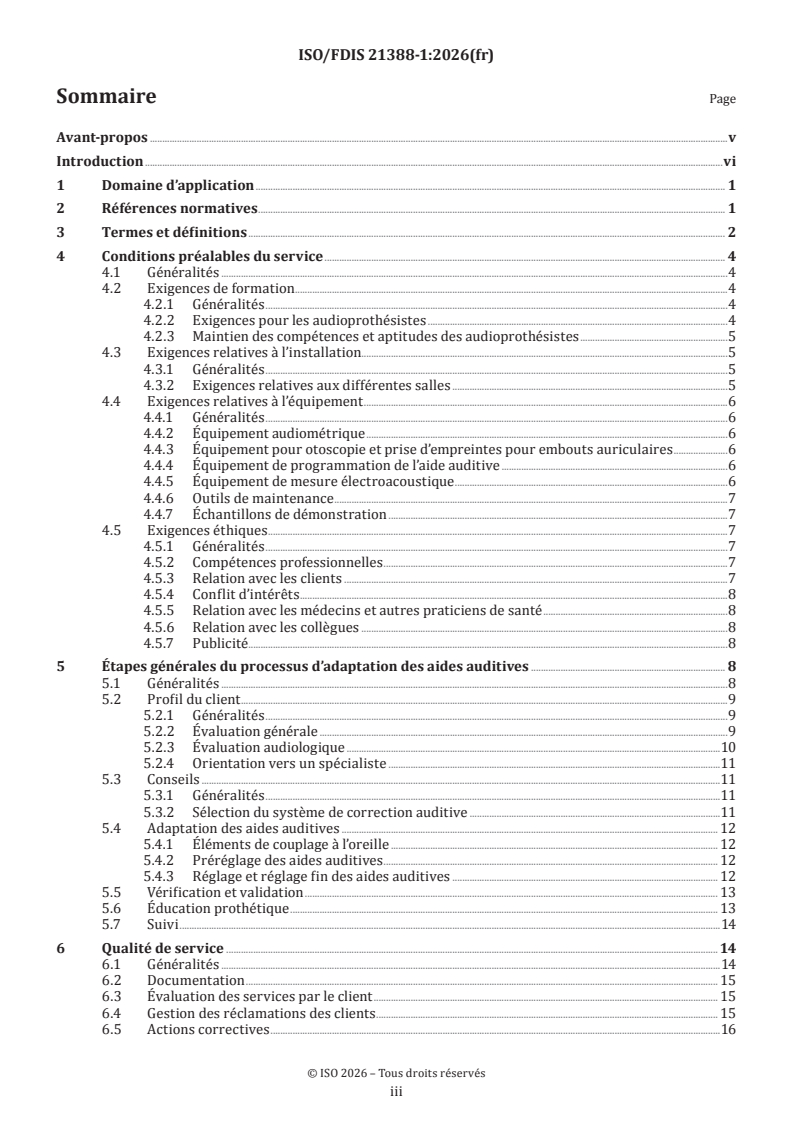

ISO/FDIS 21388-1 - Acoustique — Processus d’adaptation des aides auditives — Partie 1: Processus général
Overview
ISO/FDIS 21388-1:2026 establishes the general process for Hearing Aid Fitting Management (HAFM) within the field of acoustics. Developed by the International Organization for Standardization (ISO), this standard supports hearing aid professionals (HAPs) in providing structured, high-quality services to adult clients with hearing loss. It outlines best practices from initial client assessment to long-term follow-up, aiming to optimize functional outcomes, user satisfaction, and efficiency in hearing aid provision.
HAFM encompasses the systematic administration, organization, and control of hearing aid fitting for adults, mostly for air and bone conduction devices. The standard also addresses key requirements for education, facilities, and supporting systems, ensuring consistent service quality across regions.
Key Topics
Structured Fitting Process: ISO/FDIS 21388-1 defines a clear, client-centered process for HAFM, including six primary stages:
- Client profile assessment
- Counselling
- Hearing aid fitting
- Verification and validation
- Post-fitting counselling
- Ongoing follow-up
Service Preconditions: The standard emphasizes several prerequisites for effective hearing aid fitting:
- Education: HAPs must have relevant qualifications and ongoing training, with a recommended curriculum provided for minimum competency.
- Facilities: Suitable, accessible, and hygienic environments are required, including private consultation and acoustically controlled rooms.
- Equipment: Essential audiometric, programming, and maintenance tools are detailed to support accurate hearing assessment and device customization.
- Ethics: Professional guidelines on client interaction, confidentiality, conflict of interest, and collaboration with other healthcare professionals are highlighted.
Documentation and Quality Management: Proper recordkeeping, evaluation of services, client feedback, complaint handling, and corrective actions are integral to continuous improvement.
Medical Referrals: HAPs are instructed to be vigilant for indications of underlying medical conditions and to refer clients for further medical or specialist assessment when appropriate.
Applications
The ISO/FDIS 21388-1 standard is vital for:
- Hearing Aid Clinics & Audiology Practices: Ensuring a unified, evidence-based approach to hearing aid fitting for adults, resulting in enhanced client outcomes and satisfaction.
- Hearing Aid Professionals: Providing guidance for competency, ethical practice, ongoing education, and client-centered care.
- Training & Curriculum Development: Supporting educational institutions in preparing future HAPs with recommended knowledge and practical skills.
- Health Regulators & Insurers: Encouraging consistent, high-quality services and facilitating cost-assessment and planning in hearing healthcare.
- Quality Assurance: Serving as a benchmark for service audits and continual improvement initiatives.
The process outlined in this standard primarily covers adults with hearing loss but may inform best practices for related services. Other populations, such as children or those with implantable devices, may require different or additional care.
Related Standards
Implementing ISO/FDIS 21388-1 may involve reference to several related standards and guidelines, such as:
- ISO 8253 Series: Acoustics - Audiometric test methods (Parts 1–3)
- IEC 60118-7: Measurement of performance characteristics of hearing aids
- IEC 60645 Series: Electroacoustics - Audiometric equipment
- IEC 61669: Real-ear measurement of hearing aids’ acoustic performance
These standards ensure consistent, reliable assessment and adjustment of hearing aids in accordance with international best practices in hearing aid fitting management.
Keywords: hearing aid fitting management, HAFM, ISO 21388-1, acoustics standard, hearing aid professional, audiology, hearing loss, hearing aid fitting process, audiometric equipment, adult hearing care, quality in hearing aid services, ISCED curriculum, professional competency, hearing healthcare standards.
Relations
- Effective Date
- 12-Feb-2026
- Effective Date
- 07-Jan-2025
- Effective Date
- 02-Nov-2024
Buy Documents
ISO/FDIS 21388-1 - Acoustics — Hearing aid fitting management (HAFM) — Part 1: General process
REDLINE ISO/FDIS 21388-1 - Acoustics — Hearing aid fitting management (HAFM) — Part 1: General process
ISO/FDIS 21388-1 - Acoustique — Processus d’adaptation des aides auditives — Partie 1: Processus général
Get Certified
Connect with accredited certification bodies for this standard

BSI Group
BSI (British Standards Institution) is the business standards company that helps organizations make excellence a habit.

TÜV Rheinland
TÜV Rheinland is a leading international provider of technical services.

TÜV SÜD
TÜV SÜD is a trusted partner of choice for safety, security and sustainability solutions.
Sponsored listings
Frequently Asked Questions
ISO/FDIS 21388-1 is a draft published by the International Organization for Standardization (ISO). Its full title is "Acoustics — Hearing aid fitting management (HAFM) — Part 1: General process". This standard covers: This document applies to hearing aid fitting management (HAFM) services offered by hearing aid professionals (HAP) when providing benefit for their clients. The provision of hearing aids relies on the knowledge and practices of a hearing aid professional, to ensure the proper fitting and adequate service in the interest of the client with hearing loss. This document specifies general processes of HAFM from the client profile to the follow-up through administering, organising and controlling hearing aid fitting through all stages. It also specifies important preconditions such as education, facilities and systems that are required to ensure proper services. The focus of this document is the services offered to the majority of adult clients with hearing impairment. It is recognized that certain populations with hearing loss such as children, persons with other disabilities or persons with implantable devices can require services outside the scope of this document. This document generally applies to air conduction hearing aids and for the most part also to bone conduction devices. Hearing loss can be a consequence of serious medical conditions. Hearing aid professionals are not in a position to diagnose or treat such conditions. When assisting clients seeking hearing rehabilitation without prior medical examination, hearing aid professionals are expected to be observant of symptoms of such conditions and refer to proper medical care. Further to the main body of the document, which specifies the HAFM requirements and processes, several informative annexes are provided. Appropriate education of hearing aid professionals is vital for exercising HAFM. Annex A defines the competencies required for the HAFM processes. Annex B offers a recommended curriculum for the education of hearing aid professionals. Annex C is an example of an appropriate fitting room. Annex D gives guidance on the referral of clients for medical or other specialist examination and treatment. Annex E is a recommendation for important information to be exchanged with the client during the process of HAFM. Annex F is a comprehensive terminology list offering definitions of the most current terms related to HAFM. It is the intention that these annexes be helpful to those who wish to deliver HAFM of the highest quality.
This document applies to hearing aid fitting management (HAFM) services offered by hearing aid professionals (HAP) when providing benefit for their clients. The provision of hearing aids relies on the knowledge and practices of a hearing aid professional, to ensure the proper fitting and adequate service in the interest of the client with hearing loss. This document specifies general processes of HAFM from the client profile to the follow-up through administering, organising and controlling hearing aid fitting through all stages. It also specifies important preconditions such as education, facilities and systems that are required to ensure proper services. The focus of this document is the services offered to the majority of adult clients with hearing impairment. It is recognized that certain populations with hearing loss such as children, persons with other disabilities or persons with implantable devices can require services outside the scope of this document. This document generally applies to air conduction hearing aids and for the most part also to bone conduction devices. Hearing loss can be a consequence of serious medical conditions. Hearing aid professionals are not in a position to diagnose or treat such conditions. When assisting clients seeking hearing rehabilitation without prior medical examination, hearing aid professionals are expected to be observant of symptoms of such conditions and refer to proper medical care. Further to the main body of the document, which specifies the HAFM requirements and processes, several informative annexes are provided. Appropriate education of hearing aid professionals is vital for exercising HAFM. Annex A defines the competencies required for the HAFM processes. Annex B offers a recommended curriculum for the education of hearing aid professionals. Annex C is an example of an appropriate fitting room. Annex D gives guidance on the referral of clients for medical or other specialist examination and treatment. Annex E is a recommendation for important information to be exchanged with the client during the process of HAFM. Annex F is a comprehensive terminology list offering definitions of the most current terms related to HAFM. It is the intention that these annexes be helpful to those who wish to deliver HAFM of the highest quality.
ISO/FDIS 21388-1 is classified under the following ICS (International Classification for Standards) categories: 11.020.10 - Health care services in general; 11.180.15 - Aids for deaf and hearing impaired people; 17.140.01 - Acoustic measurements and noise abatement in general. The ICS classification helps identify the subject area and facilitates finding related standards.
ISO/FDIS 21388-1 has the following relationships with other standards: It is inter standard links to FprEN ISO 21388-1, ISO/IEC 23090-14:2023, ISO 21388:2020. Understanding these relationships helps ensure you are using the most current and applicable version of the standard.
ISO/FDIS 21388-1 is available in PDF format for immediate download after purchase. The document can be added to your cart and obtained through the secure checkout process. Digital delivery ensures instant access to the complete standard document.
Standards Content (Sample)
FINAL DRAFT
International
Standard
ISO/TC 43
Acoustics — Hearing aid fitting
Secretariat: DIN
management (HAFM) —
Voting begins on:
2026-06-18
Part 1:
General process
Voting terminates on:
2026-08-13
Acoustique — Gestion des appareils d'aide auditive (HAFM) —
Partie 1: Processus général
RECIPIENTS OF THIS DRAFT ARE INVITED TO SUBMIT,
WITH THEIR COMMENTS, NOTIFICATION OF ANY
RELEVANT PATENT RIGHTS OF WHICH THEY ARE AWARE
AND TO PROVIDE SUPPOR TING DOCUMENTATION.
IN ADDITION TO THEIR EVALUATION AS
BEING ACCEPTABLE FOR INDUSTRIAL, TECHNO-
ISO/CEN PARALLEL PROCESSING LOGICAL, COMMERCIAL AND USER PURPOSES, DRAFT
INTERNATIONAL STANDARDS MAY ON OCCASION HAVE
TO BE CONSIDERED IN THE LIGHT OF THEIR POTENTIAL
TO BECOME STAN DARDS TO WHICH REFERENCE MAY BE
MADE IN NATIONAL REGULATIONS.
Reference number
FINAL DRAFT
International
Standard
ISO/TC 43
Acoustics — Hearing aid fitting
Secretariat: DIN
management (HAFM) —
Voting begins on:
Part 1:
General process
Voting terminates on:
Acoustique — Gestion des appareils d'aide auditive (HAFM) —
Partie 1: Processus général
RECIPIENTS OF THIS DRAFT ARE INVITED TO SUBMIT,
WITH THEIR COMMENTS, NOTIFICATION OF ANY
RELEVANT PATENT RIGHTS OF WHICH THEY ARE AWARE
AND TO PROVIDE SUPPOR TING DOCUMENTATION.
© ISO 2026
IN ADDITION TO THEIR EVALUATION AS
All rights reserved. Unless otherwise specified, or required in the context of its implementation, no part of this publication may
BEING ACCEPTABLE FOR INDUSTRIAL, TECHNO-
ISO/CEN PARALLEL PROCESSING
LOGICAL, COMMERCIAL AND USER PURPOSES, DRAFT
be reproduced or utilized otherwise in any form or by any means, electronic or mechanical, including photocopying, or posting on
INTERNATIONAL STANDARDS MAY ON OCCASION HAVE
the internet or an intranet, without prior written permission. Permission can be requested from either ISO at the address below
TO BE CONSIDERED IN THE LIGHT OF THEIR POTENTIAL
or ISO’s member body in the country of the requester.
TO BECOME STAN DARDS TO WHICH REFERENCE MAY BE
MADE IN NATIONAL REGULATIONS.
ISO copyright office
CP 401 • Ch. de Blandonnet 8
CH-1214 Vernier, Geneva
Phone: +41 22 749 01 11
Email: copyright@iso.org
Website: www.iso.org
Published in Switzerland Reference number
ii
Contents Page
Foreword .v
Introduction .vi
1 Scope . 1
2 Normative references . 1
3 Terms and definitions . 2
4 Service preconditions . 4
4.1 General .4
4.2 Educational requirements .4
4.2.1 General .4
4.2.2 Requirements for hearing aid professionals .4
4.2.3 Maintenance of competencies and skills of hearing aid professionals .4
4.3 Facility requirements .5
4.3.1 General .5
4.3.2 Room requirements .5
4.4 Equipment requirements .5
4.4.1 General .5
4.4.2 Audiometric equipment .5
4.4.3 Equipment for otoscopy and earmould impressions .6
4.4.4 Hearing aid programming equipment .6
4.4.5 Electroacoustic measurement equipment .6
4.4.6 Maintenance tools .6
4.4.7 Demonstration samples .7
4.5 Ethical requirements .7
4.5.1 General .7
4.5.2 Professional competence .7
4.5.3 Relationship with clients .7
4.5.4 Conflict of interest .7
4.5.5 Relationship with medical and other health practitioners .7
4.5.6 Relationship with colleagues .8
4.5.7 Advertising .8
5 General stages of HAFM . 8
5.1 General .8
5.2 Client profile .9
5.2.1 General .9
5.2.2 General assessment.9
5.2.3 Audiological assessment.10
5.2.4 Medical referral .11
5.3 Counselling.11
5.3.1 General .11
5.3.2 Selection of hearing aid system .11
5.4 Hearing aid fitting .11
5.4.1 Ear coupling elements .11
5.4.2 Pre-setting of hearing aids .11
5.4.3 Setting and fine-tuning of hearing aids . 12
5.5 Verification and validation . 12
5.6 Post-fitting counselling . 13
5.7 Follow-up . 13
6 Quality of service . 14
6.1 General .14
6.2 Documentation .14
6.3 Client evaluation of services . . 15
6.4 Customer complaint handling . 15
6.5 Corrective actions . . 15
iii
Annex A (informative) Minimum competencies of the hearing aid professional (HAP) .16
Annex B (informative) Recommendation for organisation of education and training for hearing
aid professionals (ISCED level 5) . 19
Annex C (informative) Fitting room example .21
Annex D (informative) Recommendation on the referral of clients for medical
or other specialist examination and treatment .23
Annex E (informative) Informational counselling to support hearing aid fitting management .24
Annex F (informative) Comprehensive list of additional terms related to HAFM .27
Bibliography .40
iv
Foreword
ISO (the International Organization for Standardization) is a worldwide federation of national standards
bodies (ISO member bodies). The work of preparing International Standards is normally carried out through
ISO technical committees. Each member body interested in a subject for which a technical committee
has been established has the right to be represented on that committee. International organizations,
governmental and non-governmental, in liaison with ISO, also take part in the work. ISO collaborates closely
with the International Electrotechnical Commission (IEC) on all matters of electrotechnical standardization.
The procedures used to develop this document and those intended for its further maintenance are described
in the ISO/IEC Directives, Part 1. In particular, the different approval criteria needed for the different types
of ISO document should be noted. This document was drafted in accordance with the editorial rules of the
ISO/IEC Directives, Part 2 (see www.iso.org/directives).
ISO draws attention to the possibility that the implementation of this document may involve the use of (a)
patent(s). ISO takes no position concerning the evidence, validity or applicability of any claimed patent
rights in respect thereof. As of the date of publication of this document, ISO had not received notice of (a)
patent(s) which may be required to implement this document. However, implementers are cautioned that
this may not represent the latest information, which may be obtained from the patent database available at
www.iso.org/patents. ISO shall not be held responsible for identifying any or all such patent rights.
Any trade name used in this document is information given for the convenience of users and does not
constitute an endorsement.
For an explanation of the voluntary nature of standards, the meaning of ISO specific terms and expressions
related to conformity assessment, as well as information about ISO's adherence to the World Trade
Organization (WTO) principles in the Technical Barriers to Trade (TBT), see www.iso.org/iso/foreword.html.
This document was prepared by Technical Committee TC 43, Acoustics, in collaboration with the European
Committee for Standardization (CEN) Technical Committee CEN/TC 211, Acoustics, in accordance with the
Agreement on technical cooperation between ISO and CEN (Vienna Agreement).
A list of all parts in the ISO 21388 series can be found on the ISO website.
Any feedback or questions on this document should be directed to the user’s national standards body. A
complete listing of these bodies can be found at www.iso.org/members.html.
v
Introduction
The World Health Organisation (WHO) estimates that there are 360 million people with hearing
[22]
impairment, approximately 5,3 % of the world population . Hearing aids (HAs) are one of the most widely-
[39][40]
used treatment options for people with a hearing loss . For the proper use of HAs, hearing aid fitting
management (HAFM) is a crucial issue for manufacturers, practitioners, hearing aid professionals and
[39][42][43]
especially for HA users . Individually optimized outcome of HA use is supported by comprehensive
[42] [43]
HA fitting protocols and the impact of “poor fit and comfort” can lead to non-compliance, HA return
and additional hearing loss with over-amplification. Accordingly, the whole process of HA fitting should be
optimized to achieve functional benefits, user satisfaction and cost-effectiveness.
Two observations are important to take into account when developing an HAFM standard. Firstly, the term
[16][44][45][46]
"hearing aid fitting" is widely used among service providers and industry sectors. Secondly, it
has potentially conflicting interpretations: while guidelines for HA fitting have been written to tackle these
[17][18][23]to[32][34]to[37][47][48]
issues by various national and professional bodies , many jurisdictions are still
not covered worldwide and there is a need to promote a more common understanding of the HA fitting
process. It is likely that different understanding of fitting has led to non-uniform care, outcome variability
and, in many cases, dissatisfaction with the use of HAs.
The main purpose of this document is thus to provide a general framework for HAFM including the pre- and
post-fitting stages to make it more explicit and transparent so that all related tasks, including professional
services, administration and financial aspects can be systematized. The overall objective is to achieve the
best possible hearing rehabilitation, which can only be accomplished through adequate knowledge, training
and skills of the professional and a systematic approach to HA fitting in close collaboration with the client.
The general framework of HAFM in this document is divided into six stages (client profile, counselling,
hearing aid fitting, verification and validation, post-fitting counseling, and follow-up) based on the common
practices of hearing aid professionals, and as recommended by various pre-existing guidelines.
By dividing the hearing aid fitting process into stages, HAFM service providers can systematically identify
and administer the service components needed for high service quality, user satisfaction, client-centered
services, client self-efficacy and compliance rates with HAs (e.g. consistently using HAs and attending follow-
up appointments). The stages focus on the components of the framework to achieve high rehabilitation
outcomes such as communication skills, speech intelligibility, perception of the acoustic environment,
comfort for the HA users and sound quality. In addition, this document can be a basis for making cost
assessments for each stage or component, which can help improve public health funding systems. Another
possible application is to use this document as a minimum basis for the development of professional training
programs in HAFM.
vi
FINAL DRAFT International Standard ISO/FDIS 21388-1:2026(en)
Acoustics — Hearing aid fitting management (HAFM) —
Part 1:
General process
1 Scope
This document applies to hearing aid fitting management (HAFM) services offered by hearing aid
professionals (HAP) when providing benefit for their clients. The provision of hearing aids relies on the
knowledge and practices of a hearing aid professional, to ensure the proper fitting and adequate service in
the interest of the client with hearing loss.
This document specifies general processes of HAFM from the client profile to the follow-up through
administering, organising and controlling hearing aid fitting through all stages. It also specifies important
preconditions such as education, facilities and systems that are required to ensure proper services.
The focus of this document is the services offered to the majority of adult clients with hearing impairment.
It is recognized that certain populations with hearing loss such as children, persons with other disabilities
or persons with implantable devices can require services outside the scope of this document. This document
generally applies to air conduction hearing aids and for the most part also to bone conduction devices.
Hearing loss can be a consequence of serious medical conditions. Hearing aid professionals are not in a
position to diagnose or treat such conditions. When assisting clients seeking hearing rehabilitation without
prior medical examination, hearing aid professionals are expected to be observant of symptoms of such
conditions and refer to proper medical care.
Further to the main body of the document, which specifies the HAFM requirements and processes, several
informative annexes are provided. Appropriate education of hearing aid professionals is vital for exercising
HAFM. Annex A defines the competencies required for the HAFM processes. Annex B offers a recommended
curriculum for the education of hearing aid professionals. Annex C is an example of an appropriate fitting
room. Annex D gives guidance on the referral of clients for medical or other specialist examination and
treatment. Annex E is a recommendation for important information to be exchanged with the client during
the process of HAFM. Annex F is a comprehensive terminology list offering definitions of the most current
terms related to HAFM.
It is the intention that these annexes be helpful to those who wish to deliver HAFM of the highest quality.
2 Normative references
The following documents are referred to in the text in such a way that some or all of their content constitutes
requirements of this document. For dated references, only the edition cited applies. For undated references,
the latest edition of the referenced document (including any amendments) applies.
ISO 8253-1, Acoustics — Audiometric test methods — Part 1: Pure-tone air and bone conduction audiometry
ISO 8253-2, Acoustics — Audiometric test methods — Part 2: Sound field audiometry with pure-tone and
narrow-band test signals
ISO 8253-3, Acoustics — Audiometric test methods — Part 3: Speech audiometry
IEC 60118-7, Electroacoustics — Hearing aids — Part 7: Measurement of the performance characteristics of
hearing aids for production, supply and delivery quality assurance purposes
IEC 60645-1:2017, Electroacoustics — Audiometric equipment — Part 1: Equipment for pure-tone and speech
audiometry
IEC 60645-5, Electroacoustics — Audiometric equipment — Part 5: Instruments for the measurement of aural
acoustic impedance/admittance
IEC 61669, Electroacoustics — Measurement of real-ear acoustic performance characteristics of hearing aids
3 Terms and definitions
For the purposes of this document, the following terms and definitions apply.
ISO and IEC maintain terminology databases for use in standardization at the following addresses:
— ISO Online browsing platform: available at https:// www .iso .org/ obp
— IEC Electropedia: available at https:// www .electropedia .org/
3.1
auditory dynamic range
difference between the hearing (3.7) threshold and the uncomfortable loudness level (UCL)
3.2
client
person with hearing loss (3.8) being serviced by a HAP (3.13)
3.3
client profile
comprehensive record of a client's (3.2) auditory functionality, social situation, activity opportunities, needs
and expectations as well as a client’s audiological and medical history
3.4
ear impression
representation of the three-dimensional geometry of the relevant part of the concha and ear canal
3.5
fine-tuning
adjustment of the hearing aid system (3.10) to best match the needs and preferences of the client (3.2)
3.6
fitting system
set of devices typically comprising a computer, fitting software and a programming interface used to adjust
hearing aids (3.9)
3.7
hearing
manner in which a person detects, discriminates, identifies and cognitively processes sounds
3.8
hearing loss
reduction of the hearing (3.7) ability
3.9
hearing aid
wearable electroacoustic instrument intended to process sounds in order to compensate for hearing loss
(3.8)
Note 1 to entry: Hearing aids are medical devices and comply with the requirements of IEC 60601-2-66.
3.10
hearing aid system
customized structure consisting of one or two hearing aids (3.9), earmoulds and related components such as
a remote control or interfaces to other information or communication systems
3.11
hearing aid fitting
systematic procedure for individualizing and optimizing a hearing aid system (3.10) to compensate for
hearing loss (3.8)
3.12
hearing aid fitting management
HAFM
systematic process to administer, organise and control hearing aid fitting (3.11) through all stages
3.13
hearing aid professional
HAP
person who is appropriately trained and has proven competency in professionally assessing hearing,
selecting, fitting and delivering hearing aid systems (3.10) and rehabilitation services to persons with
hearing loss (3.8)
3.14
hearing rehabilitation
systematic process for improving functional hearing abilities and communication skills through hearing aid
fitting (3.11), counselling, instruction, education, training and developing listening skills
Note 1 to entry: The term “habilitation” includes all rehabilitation processes with additional interventions to develop
listening, speech and language skills for prelingually deafened individuals such as children which are outside the
scope of this document.
3.15
maximum output
maximum sound pressure level at the output of a hearing aid (3.9) as adjusted by the HAP (3.13)
3.16
pre-setting of hearing aids
configuration and adjustment of a hearing aid (3.9) using a prescriptive rule and relevant audiological data
3.17
verification
provision of objective evidence that a given item fulfils specified requirements
Note 1 to entry: In the field of hearing aid fitting (3.11), the verification usually means evaluating physical,
electroacoustic and psycho-acoustic aspects of a hearing aid fitting by presenting signals to hearing aids (3.9) in a
hearing aid test box or a real-ear or by using functional gain measurement in accordance with ISO 8253-2.
[SOURCE: ISO/IEC Guide 99:2007, 2.44, modified — Examples have been removed and original Notes to
entries have been replaced with Note 1 to entry.]
3.18
validation
verification (3.17), where the specified requirements are adequate for an intended use
Note 1 to entry: In the field of hearing aid fitting (3.11), the verification usually means a comprehensive evaluation
of the user benefits of a hearing aid fitting using methods which include speech audiometry and subjective response
questionnaires.
[SOURCE: ISO/IEC Guide 99:2007, 2.45, modified — Example has been removed and Note 1 to entry has been
added.]
4 Service preconditions
4.1 General
For quality service provision, the following preconditions shall be fulfilled:
— educational requirements;
— facility requirements;
— equipment requirements;
— ethical requirements.
Further preconditions are governed by local applicable laws and regulations.
4.2 Educational requirements
4.2.1 General
The competencies of persons delivering the service are essential to the quality of service and should be
rooted in appropriate education from recognized educational institutions and organisations as well as
relevant practical skills obtained in a structured process. Ongoing education is required as it is vital to
maintaining the competencies, skill levels and knowledge needed for best practice.
In general, delegation of tasks to staff without the required education should not be permitted. More than
one type of staff can perform certain tasks in accordance with their specific educational background
following national or regional regulations. The overall responsibility of the service provision shall rest with
a HAP with the education specified in 4.2.2.
In order to facilitate the acquisition of practical skills, practices may include trainees from educational
programs in their staff. Services performed by trainees shall take place under the supervision of a qualified
HAP who shall be present at the facilities and who remains responsible for all activities carried out by the
trainee.
4.2.2 Requirements for hearing aid professionals
A minimum education level 5 according to the International Standard Classification of Education, ISCED, or
equivalent is required in order to perform all stages of hearing aid fitting management. A level 6 education
is recommended.
It is recommended that the educational program includes the following academic topics: basic mathematics
and science including acoustics, anatomy and physiology, psychology and linguistics, audiology, hearing aid
technology, hearing rehabilitation processes, hearing aid fitting.
The following practical skills should be obtained through training: client interaction, audiometric
measurements, earmould management, hearing aid programming, fitting verification and validation,
hearing aid modification and repair.
Suggestions for minimum competencies of the HAP and a suitable education program are given in Annexes A
and B, respectively.
Any HAP shall have proven minimal competencies through testing in order to practice independently.
NOTE It is recognized that developing countries sometimes do not readily have access to this level of education.
4.2.3 Maintenance of competencies and skills of hearing aid professionals
Hearing aid professionals shall receive ongoing education to maintain the competencies and increase skill
levels. 10 h annually is the minimum, 20 h or more is recommended.
Ongoing education can be acquired in multiple ways such as: in-class training, conferences, manufacturer’s
courses, e-learning, webinars and other recognized sources.
4.3 Facility requirements
4.3.1 General
Facilities for hearing aid provision should be of sufficient size to facilitate reception of clients, hearing
assessment, hearing aid provision, and maintenance of hearing devices. The facilities shall have a size that
can accommodate the clinician, the client and at least one accompanying person. Facilities shall be clean,
safe and readily accessible for persons with disabilities. Facilities should also have access to running water
and toilets. The practice should be clearly identifiable and provide access to contact via telephone, SMS, fax,
website or email. Hours of operation should be publicly accessible.
Facilities for the cleaning and disinfection of equipment shall be available. Moreover, hand washing facilities
and containers for the disposal of single use (and potentially contaminated) items should also be provided.
4.3.2 Room requirements
Any consultation area shall be sufficiently private so that any other persons within the facility are not able
to overhear conversations taking place. In addition, an appropriate ventilation and temperature control
should be considered, since sound treated rooms can become warm and unpleasant.
Audiometric testing rooms/areas shall comply with maximum ambient noise levels in accordance with
ISO 8253-1 and ISO 8253-3, to allow threshold levels to be measurable down to 20 dB HL for air conduction,
and 30 dB HL for bone conduction. If it is desired to do sound field audiometry, the ambient noise levels
shall be in accordance with ISO 8253-2 for measurable threshold levels down to 20 dB HL. Fitting areas also
require a controlled acoustic environment where:
— the reverberation time should be less than 0,5 s at 500 Hz;
— the equivalent A-weighted sound pressure level of the ambient noise shall be less than 45 dB under usual
operating conditions averaged over at least 30 s;
The 30 s measurement period shall be representative of the steady-state ambient noise in the fitting
area. If a longer measurement period leads to a different result, the averaging time shall be increased.
— no dominant pure-tone components are in the ambient noise;
2 3
— the minimum floor surface area is 10 m and the minimum volume is 25 m .
An example of a fitting room is shown in Annex C.
4.4 Equipment requirements
4.4.1 General
In order to provide quality services, a range of equipment is required. The equipment cited below is
considered the minimum requirement. All equipment shall be specific to the functions required and fit for
purpose.
4.4.2 Audiometric equipment
For pure-tone audiometry, an audiometer shall be used for testing of air-conduction and bone-conduction
thresholds using masking when required. The audiometer can be part of an integrated system with multiple
functional modes. A pure-tone audiometer can also be used for measurement of the most comfortable
loudness level (MCL) and uncomfortable loudness level (UCL).
The audiometer shall be a pure-tone audiometer of Type 1 or Type 2 as specified in IEC 60645-1.
The performance of this equipment shall be checked and calibrated in accordance with ISO 8253-1.
For speech audiometry, equipment fulfilling the requirements of IEC 60645-1 shall be available. Power
amplifier and loudspeaker shall be available if sound field speech audiometry is performed. The performance
of this equipment shall be checked and calibrated in accordance with ISO 8253-3.
The maximum interval between objective periodical checks of the audiometric equipment shall not exceed
12 months. National or regional legislation can call for more frequent checks.
A tympanometer is recommended for impedance measurements to identify possible causes of conductive
hearing loss and possible reasons for referral. The performance of this equipment shall be checked and
calibrated in accordance with IEC 60645-5.
4.4.3 Equipment for otoscopy and earmould impressions
For inspection of the ear-canal and tympanic membrane, an otoscope with ear specula of different sizes shall
be available. Equipment for taking ear impressions shall also be available. For impression taking by moulding
techniques the following shall be available: moulding syringes or moulding gun with suitable compounds
for making earmould impressions; otoblock/cotton dam; hygiene products for hands and equipment. Ear
impressions can also be taken by means of ear scanning systems.
4.4.4 Hearing aid programming equipment
A computer system with suitable hardware and software for hearing aid programming and storing of
relevant client and fitting data shall be available.
4.4.5 Electroacoustic measurement equipment
Electroacoustic equipment for measuring hearing aid characteristics on an acoustic coupler or ear simulator
(gain, output level, distortion, induction pick-up coil sensitivity, etc.) in accordance with IEC 60118-7 shall be
available.
Equipment for in-situ measurement of real-ear acoustical characteristics of hearing aids fulfilling the
requirements of IEC 61669 shall be available. The International Speech Test Signal (ISTS) as defined by
IEC 60118-15 should be available for in-situ measurements. Other speech materials may also be applied.
A sound calibrator can be useful for in-practice calibration and checks of acoustic equipment.
It is recommended that the intervals between calibrations of electroacoustic measurement equipment do
not exceed twelve months.
4.4.6 Maintenance tools
Tools and accessories required depend on the services offered. The following equipment is recommended
for maintenance of hearing aid systems:
— tools for drilling and polishing;
— ultrasonic bath;
— set of screwdrivers, pliers and scalpel;
— scissors, forceps, disinfectant and sound tubes;
— picks and brushes;
— stethoscopic listening device;
— binocular magnifying glass or illuminated magnifying glass;
— vacuum pump, compressor or aerosol.
4.4.7 Demonstration samples
For demonstration of products, a selection of hearing aids, accessories and other assistive hearing devices
should be available. Wireless connectivity devices such as wireless remote microphone systems (WRMS),
TV-streamers, etc. should be part of the selection of accessories. An induction loop can also be useful for
demonstration of telecoils.
4.5 Ethical requirements
4.5.1 General
The HAP shall always work with the goal of achieving the best possible solution for the client.
4.5.2 Professional competence
HAPs shall practice only within their scope of training, experience and competence. They should engage in
the provision of hearing health care that represents the prevailing standard of practice and shall participate
in a regular program of ongoing education.
Annex A gives a detailed suggestion for minimum competencies of the HAP.
4.5.3 Relationship with clients
In all dealings with clients, the HAP shall be respectful and keep all personal information gathered private
and confidential.
The HAP shall treat clients with respect, honesty and not abuse or exploit the client psychologically, sexually,
physically or financially.
4.5.4 Conflict of interest
The HAP is entitled to reasonable compensation for services to or on behalf of clients. The HAP shall not
engage in practices and financial arrangements influencing decisions in the best interest of the clients. The
HAP shall receive compensation only for services actually rendered to the client and not receive or pay a fee
for making a referral. The HAP shall refrain from competition adverse arrangements that infringe the ethics
of the profession. This includes collusion with medical practitioners, hearing aid manufacturers or other
third-party health care professionals resulting in circumvention of normal competitive conditions.
When a HAP makes a written or oral public statement concerning a product of a company from which they
receive compensation, or a company which holds a significant equity position in the practice or a company
which they hold a significant equity position in, the HAP shall disclose the financial relationship with that
company.
4.5.5 Relationship with medical and other health practitioners
Hearing aid professionals shall represent themselves and their credentials to the public in a truthful and
honest fashion. A HAP should cooperate and communicate with other health care professionals in order to
provide the best care possible to clients.
When a HAP recognises that communication and/or hearing problems can be caused by medical conditions
that require medical treatment, they shall refer to an appropriate medical practitioner. Annex D gives
guidance on indications that lead to a medical referral and how to interact with clients in these situations.
The HAP shall undertake to make available to the physician and other involved service providers all
necessary and relevant documentation with consent of the client.
4.5.6 Relationship with colleagues
A HAP shall refrain from unjustifiable criticism of colleagues' judgement, training, knowledge or skills.
A HAP shall not knowingly ignore professional misconduct or incompetence and shall report it to their
superior, professional college or applicable authority.
4.5.7 Advertising
A HAP often advertises their services. The requirements related to such advertising are given in applicable
national or regional directives and legislation.
5 General stages of HAFM
5.1 General
The stages of HAFM shall be performed by a hearing aid professional, to ensure the best possible outcome
and adequate service in the interest of the client. These stages cover assessment of the client's needs and
degree of hearing loss followed by the selection and fitting of suitable hearing aids, rehabilitation and short
and long-term monitoring and support.
Hearing aid fitting shall consist of the delivery of the hearing aids, the fitting process and the related care.
The efficacy of the hearing aid system depends on the type of device chosen, its fitting, the counselling and
the follow-up.
Initially, the general process of HAFM shall be explained to the client, including the financial aspects. During
the entire fitting process, decisions shall be made in a close dialogue with the client after counselling by the
HAP (informed consent).
Annex E gives a comprehensive set of suggestions for how to communicate with the client in accordance
with the principles of person centered care.
The HAP shall pay particular attention to clients with no previous experience in using hearing aids.
The general framework of HAFM consists of six stages, as depicted in Figure 1: client profile, counselling,
hearing aid fitting, verification and validation, post-fitting counselling and follow-up. This general framework
includes all the necessary activities for best practice HAFM. The stages are listed in non-chronological order.
The client may pass through these stages in a different order, with an overlapping with other stages, or
multiple times due to an iterative approach.
Figure 1 — General stage of HAFM
5.2 Client profile
5.2.1 General
The HAP shall make a client profile assessment that establishes an account for the client's auditory
functionality, social situation, activity limitations, needs and expectations. All test results of the client
profile assessment shall be recorded in the client file.
5.2.2 General assessment
The following conditions shall be considered for the client profile and properly documented:
— self-reported type, degree and history of the hearing loss;
— communication and hearing challenges, social consequences;
— relevant living conditions, and the need for assistive listening devices, hearing expectations and
individual hearing situations;
— relevant medical history, including allergies, family history, medication, otalgia, otorrhoea, operations;
— history of excessive noise exposure, including occupational, leisure noise or acoustic trauma, etc;
— fine motor skill/dexterity, visual capabilities or other challenges;
— tinnitus, dizziness and hyperacusis;
— previous use of a hearing aid and other assistive devices.
The client profile should use the terminology of ICF (International Classification of Functioning, Disability
[33]
and Health) o
...
ISO/TC 43
Date: 2026-04-11
ISO/TC 43
Secretariat: DIN
Date: 2026-xx
Acoustics — Hearing aid fitting management (HAFM) — —
Part 1:
General process
Acoustique — Gestion des appareils d'aide auditive (HAFM) —
Partie 1: Processus général
FDIS stage
TTTTTThhhhhhiiiiiissssss dr d dr dr dr drraaaaafaffffftttttt i i i i iissssss susususussuubbbbbbmmmmmmiiiiiitttttttttttteeeeeedd d d d d ttttttoooooo a aaaaa ppppppaaaaaarrrrrraaaaaallellellellellellel l l l l l vvvvvvooooootttttteeeeee i i i i iinnnnnn IIIIIISSSSSSOOOOOO,,,,,, CCCCCCEEEEEEN.N.N.N.N.N.
All rights reserved. Unless otherwise specified, or required in the context of its implementation, no part of this publication
may be reproduced or utilized otherwise in any form or by any means, electronic or mechanical, including photocopying
and microfilm, or posting on the internet or an intranet, without prior written permission in writing. Permission can be
requested from either ISO at the address below or ISO'sISO’s member body in the country of the requester.
ISO copyright office
Case postale 56 • CP 401 • Ch. de Blandonnet 8
CH-12111214 Vernier, Geneva 20
Tel.Phone: + 41 22 749 01 11
Fax + 41 22 734 10 79
E-mail : copyright@iso.org
WebWebsite: www.iso.chorg
Field Code Changed
PrintedPublished in Switzerland
ii
Contents Page
Foreword . iv
Introduction . v
1 Scope . 1
2 Normative references . 1
3 Terms and definitions . 2
4 Service preconditions . 4
4.1 General . 4
4.2 Educational requirements . 4
4.3 Facility requirements . 5
4.4 Equipment requirements . 6
4.5 Ethical requirements . 7
5 General stages of HAFM . 8
5.1 General . 8
5.2 Client profile . 9
5.3 Counselling . 11
5.4 Hearing aid fitting . 12
5.5 Verification and validation . 13
5.6 Post-fitting counselling . 13
5.7 Follow-up . 14
6 Quality of service . 14
6.1 General . 14
6.2 Documentation . 15
6.3 Client evaluation of services . 15
6.4 Customer complaint handling . 16
6.5 Corrective actions . 16
Annex A (informative) Minimum competencies of the hearing aid professional (HAP) . 17
Annex B (informative) Recommendation for organisation of education and training for hearing
aid professionals (ISCED level 5) . 20
Annex C (informative) Fitting room example . 22
Annex D (informative) Recommendation on the referral of clients for medical
or other specialist examination and treatment . 24
Annex E (informative) Informational counselling to support hearing aid fitting management . 26
Annex F (informative) Comprehensive list of additional terms related to HAFM . 30
Bibliography . 45
iii
Foreword
ISO (the International Organization for Standardization) is a worldwide federation of national standards
bodies (ISO member bodies). The work of preparing International Standards is normally carried out through
ISO technical committees. Each member body interested in a subject for which a technical committee has been
established has the right to be represented on that committee. International organizations, governmental and
non-governmental, in liaison with ISO, also take part in the work. ISO collaborates closely with the
International Electrotechnical Commission (IEC) on all matters of electrotechnical standardization.
The procedures used to develop this document and those intended for its further maintenance are described
in the ISO/IEC Directives, Part 1. In particular, the different approval criteria needed for the different types of
ISO document should be noted. This document was drafted in accordance with the editorial rules of the
ISO/IEC Directives, Part 2 (see www.iso.org/directives).
ISO draws attention to the possibility that the implementation of this document may involve the use of (a)
patent(s). ISO takes no position concerning the evidence, validity or applicability of any claimed patent rights
in respect thereof. As of the date of publication of this document, ISO had not received notice of (a) patent(s)
which may be required to implement this document. However, implementers are cautioned that this may not
represent the latest information, which may be obtained from the patent database available at
www.iso.org/patents. ISO shall not be held responsible for identifying any or all such patent rights.
Any trade name used in this document is information given for the convenience of users and does not
constitute an endorsement.
For an explanation of the voluntary nature of standards, the meaning of ISO specific terms and expressions
related to conformity assessment, as well as information about ISO's adherence to the World Trade
Organization (WTO) principles in the Technical Barriers to Trade (TBT), see www.iso.org/iso/foreword.html.
This document was prepared by Technical Committee TC 43, Acoustics, in collaboration with the European
Committee for Standardization (CEN) Technical Committee CEN/TC 211, Acoustics, in accordance with the
Agreement on technical cooperation between ISO and CEN (Vienna Agreement).
A list of all parts in the ISO 21388 series can be found on the ISO website.
Any feedback or questions on this document should be directed to the user’s national standards body. A
complete listing of these bodies can be found at www.iso.org/members.html.
iv
Introduction
The World Health Organisation (WHO) estimates that there are 360 million people with hearing impairment,
[22][22]
approximately 5,3 % of the world population . Hearing aids (HAs) are one of the most widely-used
[39][40][39][40]
treatment options for people with a hearing loss . For the proper use of HAs, hearing aid fitting
management (HAFM) is a crucial issue for manufacturers, practitioners, hearing aid professionals and
[39][42][43][39][42][43]
especially for HA users . Individually optimized outcome of HA use is supported by
[42][42]
comprehensive HA fitting protocols and the impact of “poor fit and comfort” can lead to non-compliance,
[43][43]
HA return and additional hearing loss with over-amplification. Accordingly, the whole process of HA
fitting should be optimized to achieve functional benefits, user satisfaction and cost-effectiveness.
Two observations are important to take into account when developing an HAFM standard. Firstly, the term
[16][44][45][46][16][44][45][46]
"hearing aid fitting" is widely used among service providers and industry sectors.
Secondly, it has potentially conflicting interpretations: while guidelines for HA fitting have been written to
[17][18][23]]to[[32][34]]to[[37][47][48][17][18][23]–[32][34]–
tackle these issues by various national and professional bodies
[37][47][48]
,, many jurisdictions are still not covered worldwide and there is a need to promote a more common
understanding of the HA fitting process. It is likely that different understanding of fitting has led to non-
uniform care, outcome variability and, in many cases, dissatisfaction with the use of HAs.
The main purpose of this document is thus to provide a general framework for HAFM including the pre- and
post-fitting stages to make it more explicit and transparent so that all related tasks, including professional
services, administration and financial aspects can be systematized. The overall objective is to achieve the best
possible hearing rehabilitation, which can only be accomplished through adequate knowledge, training and
skills of the professional and a systematic approach to HA fitting in close collaboration with the client. The
general framework of HAFM in this document is divided into six stages (client profile, counselling, hearing aid
fitting, verification and validation, post-fitting counseling, and follow-up) based on the common practices of
hearing aid professionals, and as recommended by various pre-existing guidelines.
By dividing the hearing aid fitting process into stages, HAFM service providers can systematically identify and
administer the service components needed for high service quality, user satisfaction, client-centered services,
client self-efficacy and compliance rates with HAs (e.g. consistently using HAs and attending follow-up
appointments). The stages focus on the components of the framework to achieve high rehabilitation outcomes
such as communication skills, speech intelligibility, perception of the acoustic environment, comfort for the
HA users and sound quality. In addition, this document can be a basis for making cost assessments for each
stage or component, which can help improve public health funding systems. Another possible application is to
use this document as a minimum basis for the development of professional training programs in HAFM.
v
Acoustics — Hearing aid fitting management (HAFM) — —
Part 1:
General process
1 Scope
This document applies to hearing aid fitting management (HAFM) services offered by hearing aid
professionals (HAP) when providing benefit for their clients. The provision of hearing aids relies on the
knowledge and practices of a hearing aid professional, to ensure the proper fitting and adequate service in the
interest of the client with hearing loss.
This document specifies general processes of HAFM from the client profile to the follow-up through
administering, organising and controlling hearing aid fitting through all stages. It also specifies important
preconditions such as education, facilities and systems that are required to ensure proper services.
The focus of this document is the services offered to the majority of adult clients with hearing impairment. It
is recognized that certain populations with hearing loss such as children, persons with other disabilities or
persons with implantable devices can require services outside the scope of this document. This document
generally applies to air conduction hearing aids and for the most part also to bone conduction devices.
Hearing loss can be a consequence of serious medical conditions. Hearing aid professionals are not in a
position to diagnose or treat such conditions. When assisting clients seeking hearing rehabilitation without
prior medical examination, hearing aid professionals are expected to be observant of symptoms of such
conditions and refer to proper medical care.
Further to the main body of the document, which specifies the HAFM requirements and processes, several
informative annexes are provided. Appropriate education of hearing aid professionals is vital for exercising
HAFM. Annex AAnnex A defines the competencies required for the HAFM processes. Annex BAnnex B offers a
recommended curriculum for the education of hearing aid professionals. Annex CAnnex C is an example of an
appropriate fitting room. Annex DAnnex D gives guidance on the referral of clients for medical or other
specialist examination and treatment. Annex EAnnex E is a recommendation for important information to be
exchanged with the client during the process of HAFM. Annex FAnnex F is a comprehensive terminology list
offering definitions of the most current terms related to HAFM.
It is the intention that these annexes be helpful to those who wish to deliver HAFM of the highest quality.
2 Normative references
The following documents are referred to in the text in such a way that some or all of their content constitutes
requirements of this document. For dated references, only the edition cited applies. For undated references,
the latest edition of the referenced document (including any amendments) applies.
ISO 8253--1, Acoustics — Audiometric test methods — Part 1: Pure-tone air and bone conduction audiometry
ISO 8253--2, Acoustics — Audiometric test methods — Part 2: Sound field audiometry with pure-tone and
narrow-band test signals
ISO 8253--3, Acoustics — Audiometric test methods — Part 3: Speech audiometry
IEC 60118--7, Electroacoustics — Hearing aids — Part 7: Measurement of the performance characteristics of
hearing aids for production, supply and delivery quality assurance purposes
IEC 60645--1:2017, Electroacoustics — Audiometric equipment — Part 1: Equipment for pure-tone and speech
audiometry
IEC 60645--5, Electroacoustics — Audiometric equipment — Part 5: Instruments for the measurement of aural
acoustic impedance/admittance
IEC 61669, Electroacoustics — Measurement of real-ear acoustic performance characteristics of hearing aids
3 Terms and definitions
For the purposes of this document, the following terms and definitions apply.
ISO and IEC maintain terminologicalterminology databases for use in standardization at the following
addresses:
— — ISO Online browsing platform: available at https://www.iso.org/obp
— — IEC Electropedia: available at https://www.electropedia.org/
3.1 3.1
auditory dynamic range
difference between the hearing (3.7(3.7)) threshold and the uncomfortable loudness level (UCL)
3.2 3.2
client
person with hearing loss (3.8(3.8)) being serviced by a HAP (3.13(3.13))
3.3 3.3
client profile
comprehensive record of a client's (3.2(3.2)) auditory functionality, social situation, activity opportunities,
needs and expectations as well as a client’s audiological and medical history
3.4 3.4
ear impression
representation of the three-dimensional geometry of the relevant part of the concha and ear canal
3.5 3.5
fine-tuning
adjustment of the hearing aid system (3.10(3.10)) to best match the needs and preferences of the client
(3.2(3.2))
3.6 3.6
fitting system
set of devices typically comprising a computer, fitting software and a programming interface used to adjust
hearing aids (3.9(3.9))
3.7 3.7
hearing
manner in which a person detects, discriminates, identifies and cognitively processes sounds
3.8 3.8
hearing loss
reduction of the hearing (3.7(3.7)) ability
3.9 3.9
hearing aid
wearable electroacoustic instrument intended to process sounds in order to compensate for hearing loss
(3.8(3.8))
Note 1 to entry: Hearing aids are medical devices and comply with the requirements of IEC 60601-2-66.
3.10 3.10
hearing aid system
customized structure consisting of one or two hearing aids (3.9(3.9),), earmoulds and related components
such as a remote control or interfaces to other information or communication systems
3.11 3.11
hearing aid fitting
systematic procedure for individualizing and optimizing a hearing aid system (3.10(3.10)) to compensate for
hearing loss (3.8(3.8))
3.12 3.12
hearing aid fitting management
HAFM
systematic process to administer, organise and control hearing aid fitting (3.11(3.11)) through all stages
3.13 3.13
hearing aid professional
HAP
person who is appropriately trained and has proven competency in professionally assessing hearing, selecting,
fitting and delivering hearing aid systems (3.10(3.10)) and rehabilitation services to persons with hearing loss
(3.8(3.8))
3.14 3.14
hearing rehabilitation
systematic process for improving functional hearing abilities and communication skills through hearing aid
fitting (3.11(3.11),), counselling, instruction, education, training and developing listening skills
Note 1 to entry: The term “habilitation” includes all rehabilitation processes with additional interventions to develop
listening, speech and language skills for prelingually deafened individuals such as children which are outside the scope
of this document.
3.15 3.15
maximum output
maximum sound pressure level at the output of a hearing aid (3.9(3.9)) as adjusted by the HAP (3.13(3.13))
3.16 3.16
pre-setting of hearing aids
configuration and adjustment of a hearing aid (3.9(3.9)) using a prescriptive rule and relevant audiological
data
3.17 3.17
verification
provision of objective evidence that a given item fulfils specified requirements
Note 1 to entry: In the field of hearing aid fitting (3.11(3.11),), the verification usually means evaluating physical,
electroacoustic and psycho-acoustic aspects of a hearing aid fitting by presenting signals to hearing aids (3.9(3.9)) in a
hearing aid test box or a real-ear or by using functional gain measurement in accordance with ISO 8253-2.
[SOURCE: ISO/IEC Guide 99:2007, 2.44, modified — Examples have been removed, and original Notes to
entryentries have been replaced with Note 1 to entry.]
3.18 3.18
validation
verification (3.17(3.17),), where the specified requirements are adequate for an intended use
Note 1 to entry: In the field of hearing aid fitting (3.11(3.11),), the verification usually means a comprehensive
evaluation of the user benefits of a hearing aid fitting using methods which include speech audiometry and subjective
response questionnaires.
[SOURCE: ISO/IEC Guide 99:2007, 2.45, modified — Example has been removed, and Note 1 to entry has been
added.]
4 Service preconditions
4.1 General
For quality service provision, the following preconditions shall be fulfilled:
— — educational requirements;
— — facility requirements;
— — equipment requirements;
— — ethical requirements.
Further preconditions are governed by local applicable laws and regulations.
4.2 Educational requirements
4.2.1 General
The competencies of persons delivering the service are essential to the quality of service and should be rooted
in appropriate education from recognized educational institutions and organisations as well as relevant
practical skills obtained in a structured process. Ongoing education is required as it is vital to maintaining the
competencies, skill levels and knowledge needed for best practice.
In general, delegation of tasks to staff without the required education should not be permitted. More than one
type of staff can perform certain tasks in accordance with their specific educational background following
national or regional regulations. The overall responsibility of the service provision shall rest with a HAP with
the education specified in 4.2.24.2.2.
In order to facilitate the acquisition of practical skills, practices may include trainees from educational
programs in their staff. Services performed by trainees shall take place under the supervision of a qualified
HAP who shall be present at the facilities and who remains responsible for all activities carried out by the
trainee.
4.2.2 Requirements for hearing aid professionals
A minimum education level 5 according to the International Standard Classification of Education, ISCED, or
equivalent is required in order to perform all stages of hearing aid fitting management. A level 6 education is
recommended.
It is recommended that the educational program includes the following academic topics: basic mathematics
and science including acoustics, anatomy and physiology, psychology and linguistics, audiology, hearing aid
technology, hearing rehabilitation processes, hearing aid fitting.
The following practical skills should be obtained through training: client interaction, audiometric
measurements, earmould management, hearing aid programming, fitting verification and validation, hearing
aid modification and repair.
Suggestions for minimum competencies of the HAP and a suitable education program are given in
Annexes AAnnexes A and BB,, respectively.
Any HAP shall have proven minimal competencies through testing in order to practice independently.
NOTE It is recognized that developing countries sometimes do not readily have access to this level of education.
4.2.3 Maintenance of competencies and skills of hearing aid professionals
Hearing aid professionals shall receive ongoing education to maintain the competencies and increase skill
levels. Ten hours10 h annually is the minimum, 20 h or more is recommended.
Ongoing education can be acquired in multiple ways such as: in-class training, conferences, manufacturer’s
courses, e-learning, webinars and other recognized sources.
4.3 Facility requirements
4.3.1 General
Facilities for hearing aid provision should be of sufficient size to facilitate reception of clients, hearing
assessment, hearing aid provision, and maintenance of hearing devices. The facilities shall have a size that can
accommodate the clinician, the client and at least one accompanying person. Facilities shall be clean, safe and
readily accessible for persons with disabilities. Facilities should also have access to running water and toilets.
The practice should be clearly identifiable and provide access to contact via telephone, SMS, fax, website or
email. Hours of operation should be publicly accessible.
Facilities for the cleaning and disinfection of equipment shall be available. Moreover, hand washing facilities
and containers for the disposal of single use (and potentially contaminated) items should also be provided.
4.3.2 Room requirements
Any consultation area shall be sufficiently private so that any other persons within the facility are not able to
overhear conversations taking place. In addition, an appropriate ventilation and temperature control should
be considered, since sound treated rooms can become warm and unpleasant.
Audiometric testing rooms/areas shall comply with maximum ambient noise levels in accordance with
ISO 8253--1 and ISO 8253--3, to allow threshold levels to be measurable down to 20 dB HL for air conduction,
and 30 dB HL for bone conduction. If it is desired to do sound field audiometry, the ambient noise levels shall
be in accordance with ISO 8253-2 for measurable threshold levels down to 20 dB HL. Fitting areas also require
a controlled acoustic environment where:
— — the reverberation time should be less than 0,5 s at 500 Hz;
— — the equivalent A-weighted sound pressure level of the ambient noise shall be less than 45 dB under
usual operating conditions averaged over at least 30 s;
The 30 s measurement period shall be representative of the steady-state ambient noise in the fitting area.
If a longer measurement period leads to a different result, the averaging time shall be increased.
— — no dominant pure-tone components are in the ambient noise;
2 3
— — the minimum floor surface area is 10 m and the minimum volume is 25 m .
An example of a fitting room is shown in Annex CAnnex C.
4.4 Equipment requirements
4.4.1 General
In order to provide quality services, a range of equipment is required. The equipment cited below is
considered the minimum requirement. All equipment shall be specific to the functions required and fit for
purpose.
4.4.2 Audiometric equipment
For pure-tone audiometry, an audiometer shall be used for testing of air-conduction and bone-conduction
thresholds using masking when required. The audiometer can be part of an integrated system with multiple
functional modes. A pure-tone audiometer can also be used for measurement of the most comfortable
loudness level (MCL) and uncomfortable loudness level (UCL).
The audiometer shall be a pure-tone audiometer of Type 1 or Type 2 as specified in IEC 60645--1:2017.
The performance of this equipment shall be checked and calibrated according toin accordance with ISO 8253--
1.
For speech audiometry, equipment fulfilling the requirements of IEC 60645-1 shall be available. Power
amplifier and loudspeaker shall be available if sound field speech audiometry is performed. The performance
of this equipment shall be checked and calibrated according toin accordance with ISO 8253--3.
The maximum interval between objective periodical checks of the audiometric equipment shall not exceed
12 months. National or regional legislation can call for more frequent checks.
A tympanometer is recommended for impedance measurements to identify possible causes of conductive
hearing loss and possible reasons for referral. The performance of this equipment shall be checked and
calibrated according toin accordance with IEC 60645-5.
4.4.3 Equipment for otoscopy and earmould impressions
For inspection of the ear-canal and tympanic membrane, an otoscope with ear specula of different sizes shall
be available. Equipment for taking ear impressions shall also be available. For impression taking by moulding
techniques the following shall be available: moulding syringes or moulding gun with suitable compounds for
making earmould impressions; otoblock/cotton dam; hygiene products for hands and equipment. Ear
impressions can also be taken by means of ear scanning systems.
4.4.4 Hearing aid programming equipment
A computer system with suitable hardware and software for hearing aid programming and storing of relevant
client and fitting data shall be available.
4.4.5 Electroacoustic measurement equipment
Electroacoustic equipment for measuring hearing aid characteristics on an acoustic coupler or ear simulator
(gain, output level, distortion, induction pick-up coil sensitivity, etc.) in accordance with IEC 60118-7 shall be
available.
Equipment for in-situ measurement of real-ear acoustical characteristics of hearing aids fulfilling the
requirements of IEC 61669 shall be available. The International Speech Test Signal (ISTS) as defined by
IEC 60118-15 should be available for in-situ measurements. Other speech materials may also be applied.
A sound calibrator can be useful for in-practice calibration and checks of acoustic equipment.
It is recommended that the intervals between calibrations of electroacoustic measurement equipment do not
exceed twelve months.
4.4.6 Maintenance tools
Tools and accessories required depend on the services offered. The following equipment is recommended for
maintenance of hearing aid systems:
— — tools for drilling and polishing;
— — ultrasonic bath;
— — set of screwdrivers, pliers and scalpel;
— — scissors, forceps, disinfectant, and sound tubes;
— — picks and brushes;
— — stethoscopic listening device;
— — binocular magnifying glass or illuminated magnifying glass;
— — vacuum pump, compressor or aerosol.
4.4.7 Demonstration samples
For demonstration of products, a selection of hearing aids, accessories and other assistive hearing devices
should be available. Wireless connectivity devices such as wireless remote microphone systems (WRMS), TV-
streamers, etc. should be part of the selection of accessories. An induction loop can also be useful for
demonstration of telecoils.
4.5 Ethical requirements
4.5.1 General
The HAP shall always work with the goal of achieving the best possible solution for the client.
4.5.2 Professional competence
HAPs shall practice only within their scope of training, experience and competence. They should engage in the
provision of hearing health care that represents the prevailing standard of practice and shall participate in a
regular program of ongoing education.
Annex AAnnex A gives a detailed suggestion for minimum competencies of the HAP.
4.5.3 Relationship with clients
In all dealings with clients, the HAP shall be respectful and keep all personal information gathered private and
confidential.
The HAP shall treat clients with respect, honesty and not abuse or exploit the client psychologically, sexually,
physically or financially.
4.5.4 Conflict of interest
The HAP is entitled to reasonable compensation for services to or on behalf of clients. The HAP shall not engage
in practices and financial arrangements influencing decisions in the best interest of the clients. The HAP shall
receive compensation only for services actually rendered to the client and not receive or pay a fee for making
a referral. The HAP shall refrain from competition adverse arrangements that infringe the ethics of the
profession. This includes collusion with medical practitioners, hearing aid manufacturers or other third-party
health care professionals resulting in circumvention of normal competitive conditions.
When a HAP makes a written or oral public statement concerning a product of a company from which they
receive compensation, or a company which holds a significant equity position in the practice or a company
which they hold a significant equity position in, the HAP shall disclose the financial relationship with that
company.
4.5.5 Relationship with medical and other health practitioners
Hearing aid professionals shall represent themselves and their credentials to the public in a truthful and
honest fashion. A HAP should cooperate and communicate with other health care professionals in order to
provide the best care possible to clients.
When a HAP recognises that communication and/or hearing problems can be caused by medical conditions
that require medical treatment, they shall refer to an appropriate medical practitioner. Annex DAnnex D gives
guidance on indications that lead to a medical referral and how to interact with clients in these situations.
The HAP shall undertake to make available to the physician and other involved service providers all necessary
and relevant documentation with consent of the client.
4.5.6 Relationship with colleagues
A HAP shall refrain from unjustifiable criticism of colleagues' judgement, training, knowledge or skills. A HAP
shall not knowingly ignore professional misconduct or incompetence and shall report it to their superior,
professional college or applicable authority.
4.5.7 Advertising
A HAP often advertises their services. The requirements related to such advertising are given in applicable
national or regional directives and legislation.
5 General stages of HAFM
5.1 General
The stages of HAFM shall be performed by a hearing aid professional, to ensure the best possible outcome and
adequate service in the interest of the client. These stages cover assessment of the client's needs and degree
of hearing loss followed by the selection and fitting of suitable hearing aids, rehabilitation and short and long-
term monitoring and support.
Hearing aid fitting shall consist of the delivery of the hearing aids, the fitting process and the related care. The
efficacy of the hearing aid system depends on the type of device chosen, its fitting, the counselling and the
follow-up.
Initially, the general process of HAFM shall be explained to the client, including the financial aspects. During
the entire fitting process, decisions shall be made in a close dialogue with the client after counselling by the
HAP (informed consent).
Annex EAnnex E gives a comprehensive set of suggestions for how to communicate with the client in
accordance with the principles of person centered care.
The HAP shall pay particular attention to clients with no previous experience in using hearing aids.
The general framework of HAFM consists of six stages, as depicted in Figure 1Figure 1:: client profile,
counselling, hearing aid fitting, verification and validation, post-fitting counselling and follow-up. This general
framework includes all the necessary activities for best practice HAFM. The stages are listed in non-
chronological order. The client may pass through these stages in a different order, with an overlapping with
other stages, or multiple times due to an iterative approach.
21388-1_ed2fig1.EPS
Figure 1 — General stage of HAFM
5.2 Client profile
5.2.1 General
The HAP shall make a client profile assessment that establishes an account for the client's auditory
functionality, social situation, activity limitations, needs and expectations. All test results of the client profile
assessment shall be recorded in the client file.
5.2.2 General assessment
The following conditions shall be considered for the client profile and properly documented:
— — self-reported type, degree and history of the hearing loss;
— — communication and hearing challenges, social consequences;
— — relevant living conditions, and the need for assistive listening devices, hearing expectations and
individual hearing situations;
— — relevant medical history, including allergies, family history, medication, otalgia, otorrhoea, operations;
— — history of excessive noise exposure, including occupational, leisure noise or acoustic trauma, etc;
— — fine motor skill/dexterity, visual capabilities or other challenges;
— — tinnitus, dizziness and hyperacusis;
— — previous use of a hearing aid and other assistive devices.
The client profile should use the terminology of ICF (International Classification of Functioning, Disability and
[33] [33]
Health) ) or equivalent to define the degree of hearing loss.
It is recommended to use validated questionnaires for the recording of these factors.
5.2.3 Audiological assessment
5.2.3.1 Hygiene
Proper hygiene precautions shall be taken to prevent cross-contamination.
5.2.3.2 Otoscopy
Otoscopy shall be carried out with an inspection of the external ear canal, eardrum and also pinna and area
behind the ear to observe any signs of infection, skin cancers/lesions requiring medical investigation, the
presence of cerumen or any other contra-indications to impression taking and to the fitting of a hearing aid.
Cerumen shall be removed by a trained and authorized professional. Any abnormalities of the ear which
should be considered during the hearing aid fitting process shall be noted.
5.2.3.3 Pure-tone audiometry
Pure-tone audiometry shall be carried out according to the test procedure described in ISO 8253--1.
Hearing thresholds (with masking if necessary) shall be determined at least at the following frequencies:
— — air conduction: 250 Hz, 500 Hz, 1 000 Hz, 2 000 Hz, 4 000 Hz and 8 000 Hz;
— — bone conduction: 500 Hz, 1 000 Hz, 2 000 Hz and 4 000 Hz.
Thresholds at intermediate frequencies (750 Hz, 1 500 Hz, 3 000 Hz and 6 000 Hz) shall be measured when
there is a difference of more than 20 dB between two adjacent standard frequencies or a hearing aid fitting
requirement that necessitates fitting precision.
To assess the auditory dynamic range, an ascending method for determining the uncomfortable loudness level
(UCL) shall be carefully carried out at least for the following frequencies:
— — air conduction: 500 Hz, 1 000 Hz, 2 000 Hz, 4 000 Hz, preferably with warbletones.
For some individuals, the tolerance of louder sounds can be a significant problem and cause distress. In this
case, the determination of the UCL requires special care.
5.2.3.4 Speech audiometry
The client's ability to discriminate speech is an important parameter for the audiological assessment and
speech audiometry shall always be performed.
Standardized recorded speech test material developed and validated according to ISO 8253--3 should be used,
if available. The speech signal may be presented monaurally through earphones or binaurally in a sound field.
NOTE It is important for reliable results to have speech material in the native language of the client.
Speech presented in a background of competing noise should be used since it represents a more realistic
listening situation than speech in quiet.
5.2.3.5 Tympanometry
Hearing loss can be caused by middle ear conditions. As a supplement to otoscopic investigations,
tympanometry should be performed to assess the condition of the middle ear, if a tympanometer is available.
For example, 226 Hz is the standard frequency typically used for adults.
5.2.3.6 Other audiometric tests
If deemed relevant, other audiometric tests shall be carried out. Such measurements can be:
— — subjective audiometric procedures like: uncomfortable loudness level (UCL) for speech or other
relevant signals beside pure tones, most comfortable loudness level (MCL), comfortable speech level (CSL),
acceptable noise level (ANL), loudness scaling;, and
— — objective audiological procedures, for example acoustic (stapedious) reflex measurement, auditory
brainstem response (ABR), otoacoustic emission (OAE).
5.2.4 Medical referral
If the results of the audiological assessment and the client profile indicate a disease or other cause of the
hearing loss likely to require medical or surgical treatment, the HAP shall refer the client to a medical
specialist. Particular attention should be paid to clients with rapid or unexpected progression of hearing loss
and asymmetries.
Annex DAnnex D gives guidance on the indications that lead to a medical referral and how to interact with
clients in these situations.
5.3 Counselling
5.3.1 General
At the end of the assessment of the client profile, the results shall be explained and discussed with the client.
In particular, it is important to manage motivations and expectations with regards to achievable functionality.
A report of the assessment shall be made available to the client. Also, the client shall be informed about how
auditory training can support the rehabilitation process. Annex EAnnex E gives a comprehensive set of
suggestions of what topics should be covered in the information given to the client.
5.3.2 Selection of hearing aid system
Based on the client profile, the HAP shall inform the client about the suitable types of hearing aid systems. The
various options in terms of models, styles, features including connectivity opportunities, control possibilities,
accessories and prices shall be presented to the client and their respective advantages and limitations
described. If no contra-indications are present and the client has some degree of hearing loss in both ears,
bilateral fitting shall be recommended. The selection of the hearing aid system to be fitted as well as other
assistive listening devices shall be based on informed consent by the client with all relevant information,
including the financial aspects and the return policy. Product and cost documentation on the proposed
solution shall be given to the client.
5.4 Hearing aid fitting
5.4.1 Ear coupling elements
If a custom earmould/earshell is needed for the hearing aid system chosen, an ear impression shall be made
and the appropriate acoustic properties of the customized part should be considered. The ear impression is
to be used for the production of the custom earmould/earshell with the desired acoustic properties.
5.4.2 Pre-setting of hearing aids
Depending on the type of hearing aid system chosen, certain preparations can be needed before the actual
fitting can be carried out.
The HAP shall enter the following data in the fitting system provided by the manufacturer:
— — data from the client profile;
— — properties of acoustic coupling (e.g. earmould).
Based on this data, a pre-setting shall be programmed into the hearing aid to be the starting point for the fine-
tuning of the fitting at least for the following parameters:
— — gain;
— — compression;
— — frequency response;
— — maximum output.
Where the hearing aid system includes storage for client specific data, data logging or data transmission
system for data use, consent from the client has to be obtained before these systems are enabled.
Hearing aid performance may be verified by electroacoustic tests in accordance with IEC 60118-7.
5.4.3 Setting and fine-tuning of hearing aids
The hearing aid system is physically placed on the client so that the HAP with the client can verify the correct
physical fit of the hearing aids and the coupling elements and these shall be modified until a proper fit is
achieved.
The hearing aid shall be fine-tuned in close interaction with the client until a setting, accepted by the client,
...
PROJET FINAL
Norme
internationale
ISO/TC 43
Acoustique — Processus
Secrétariat: DIN
d’adaptation des aides auditives —
Début de vote:
2026-06-18
Partie 1:
Processus général
Vote clos le:
2026-08-13
Acoustics — Hearing aid fitting management (HAFM) —
Part 1: General process
LES DESTINATAIRES DU PRÉSENT PROJET SONT
INVITÉS À PRÉSENTER, AVEC LEURS OBSERVATIONS,
NOTIFICATION DES DROITS DE PROPRIÉTÉ DONT ILS
AURAIENT ÉVENTUELLEMENT CONNAISSANCE ET À
FOURNIR UNE DOCUMENTATION EXPLICATIVE.
OUTRE LE FAIT D’ÊTRE EXAMINÉS POUR
ÉTABLIR S’ILS SONT ACCEPTABLES À DES FINS
INDUSTRIELLES, TECHNOLOGIQUES ET COM-MERCIALES,
AINSI QUE DU POINT DE VUE DES UTILISATEURS, LES
PROJETS DE NORMES
TRAITEMENT PARALLÈLE ISO/CEN
INTERNATIONALES DOIVENT PARFOIS ÊTRE CONSIDÉRÉS
DU POINT DE VUE DE LEUR POSSI BILITÉ DE DEVENIR DES
NORMES POUVANT
SERVIR DE RÉFÉRENCE DANS LA RÉGLEMENTATION
NATIONALE.
Numéro de référence
PROJET FINAL
Norme
internationale
ISO/TC 43
Acoustique — Processus
Secrétariat: DIN
d’adaptation des aides auditives —
Début de vote:
Partie 1: 2026-06-18
Processus général
Vote clos le:
2026-08-13
Acoustics — Hearing aid fitting management (HAFM) —
Part 1: General process
LES DESTINATAIRES DU PRÉSENT PROJET SONT
INVITÉS À PRÉSENTER, AVEC LEURS OBSERVATIONS,
NOTIFICATION DES DROITS DE PROPRIÉTÉ DONT ILS
AURAIENT ÉVENTUELLEMENT CONNAISSANCE ET À
FOURNIR UNE DOCUMENTATION EXPLICATIVE.
DOCUMENT PROTÉGÉ PAR COPYRIGHT
OUTRE LE FAIT D’ÊTRE EXAMINÉS POUR
ÉTABLIR S’ILS SONT ACCEPTABLES À DES FINS
© ISO 2026 INDUSTRIELLES, TECHNOLOGIQUES ET COM-MERCIALES,
AINSI QUE DU POINT DE VUE DES UTILISATEURS, LES
Tous droits réservés. Sauf prescription différente ou nécessité dans le contexte de sa mise en œuvre, aucune partie de cette
PROJETS DE NORMES
TRAITEMENT PARALLÈLE ISO/CEN
INTERNATIONALES DOIVENT PARFOIS ÊTRE CONSIDÉRÉS
publication ne peut être reproduite ni utilisée sous quelque forme que ce soit et par aucun procédé, électronique ou mécanique,
DU POINT DE VUE DE LEUR POSSI BILITÉ DE DEVENIR DES
y compris la photocopie, ou la diffusion sur l’internet ou sur un intranet, sans autorisation écrite préalable. Une autorisation peut
NORMES POUVANT
être demandée à l’ISO à l’adresse ci-après ou au comité membre de l’ISO dans le pays du demandeur.
SERVIR DE RÉFÉRENCE DANS LA RÉGLEMENTATION
NATIONALE.
ISO copyright office
Case postale 401 • Ch. de Blandonnet 8
CH-1214 Vernier, Genève
Tél.: +41 22 749 01 11
E-mail: copyright@iso.org
Web: www.iso.org
Publié en Suisse Numéro de référence
ii
Sommaire Page
Avant-propos .v
Introduction .vi
1 Domaine d’application . 1
2 Références normatives . 1
3 Termes et définitions . 2
4 Conditions préalables du service . 4
4.1 Généralités .4
4.2 Exigences de formation .4
4.2.1 Généralités .4
4.2.2 Exigences pour les audioprothésistes .4
4.2.3 Maintien des compétences et aptitudes des audioprothésistes .5
4.3 Exigences relatives à l’installation.5
4.3.1 Généralités .5
4.3.2 Exigences relatives aux différentes salles .5
4.4 Exigences relatives à l’équipement .6
4.4.1 Généralités .6
4.4.2 Équipement audiométrique .6
4.4.3 Équipement pour otoscopie et prise d’empreintes pour embouts auriculaires .6
4.4.4 Équipement de programmation de l’aide auditive .6
4.4.5 Équipement de mesure électroacoustique .6
4.4.6 Outils de maintenance .7
4.4.7 Échantillons de démonstration .7
4.5 Exigences éthiques .7
4.5.1 Généralités .7
4.5.2 Compétences professionnelles .7
4.5.3 Relation avec les clients .7
4.5.4 Conflit d’intérêts .8
4.5.5 Relation avec les médecins et autres praticiens de santé .8
4.5.6 Relation avec les collègues .8
4.5.7 Publicité.8
5 Étapes générales du processus d’adaptation des aides auditives . 8
5.1 Généralités .8
5.2 Profil du client .9
5.2.1 Généralités .9
5.2.2 Évaluation générale .9
5.2.3 Évaluation audiologique .10
5.2.4 Orientation vers un spécialiste .11
5.3 Conseils .11
5.3.1 Généralités .11
5.3.2 Sélection du système de correction auditive .11
5.4 Adaptation des aides auditives . 12
5.4.1 Éléments de couplage à l’oreille . 12
5.4.2 Préréglage des aides auditives . 12
5.4.3 Réglage et réglage fin des aides auditives . 12
5.5 Vérification et validation . 13
5.6 Éducation prothétique . 13
5.7 Suivi .14
6 Qualité de service . 14
6.1 Généralités .14
6.2 Documentation . 15
6.3 Évaluation des services par le client . 15
6.4 Gestion des réclamations des clients . 15
6.5 Actions correctives .16
iii
Annexe A (informative) Compétences minimales de l’audioprothésiste . 17
Annexe B (informative) Recommandation pour l’organisation de la formation des
audioprothésistes (CITE niveau 5) .20
Annexe C (informative) Exemple de salle d’appareillage .22
Annexe D (informative) Recommandations concernant l’orientation des clients vers un autre
spécialiste en vue d’un traitement et d’examens médicaux complémentaires .24
Annexe E (informative) Conseils d’information à l’appui du processus d’adaptation des aides
auditives .25
Annexe F (informative) Liste exhaustive des termes supplémentaires liés au processus
d’adaptation des aides auditives .28
Bibliographie .42
iv
Avant-propos
L’ISO (Organisation internationale de normalisation) est une fédération mondiale d’organismes nationaux
de normalisation (comités membres de l’ISO). L’élaboration des Normes internationales est en général
confiée aux comités techniques de l’ISO. Chaque comité membre intéressé par une étude a le droit de faire
partie du comité technique créé à cet effet. Les organisations internationales, gouvernementales et non
gouvernementales, en liaison avec l’ISO participent également aux travaux. L’ISO collabore étroitement avec
la Commission électrotechnique internationale (IEC) en ce qui concerne la normalisation électrotechnique.
Les procédures utilisées pour élaborer le présent document et celles destinées à sa mise à jour sont
décrites dans les Directives ISO/IEC, Partie 1. Il convient, en particulier, de prendre note des différents
critères d’approbation requis pour les différents types de documents ISO. Le présent document
a été rédigé conformément aux règles de rédaction données dans les Directives ISO/IEC, Partie 2
(voir www.iso.org/directives).
L’ISO attire l’attention sur le fait que la mise en application du présent document peut entraîner l’utilisation
d’un ou de plusieurs brevets. L’ISO ne prend pas position quant à la preuve, à la validité et à l’applicabilité de
tout droit de propriété revendiqué à cet égard. À la date de publication du présent document, l’ISO n’avait pas
reçu notification qu’un ou plusieurs brevets pouvaient être nécessaires à sa mise en application. Toutefois, il
y a lieu d’avertir les responsables de la mise en application du présent document que des informations plus
récentes peuvent figurer dans la base de données de brevets, disponible à l’adresse www.iso.org/brevets.
L’ISO ne saurait être tenue pour responsable de ne pas avoir identifié de tels droits de propriété et averti de
leur existence.
Les appellations commerciales éventuellement mentionnées dans le présent document sont données pour
information, par souci de commodité, à l’intention des utilisateurs et ne sauraient constituer un engagement.
Pour une explication de la nature volontaire des normes, la signification des termes et expressions
spécifiques de l’ISO liés à l’évaluation de la conformité, ou pour toute information au sujet de l’adhésion de
l’ISO aux principes de l’Organisation mondiale du commerce (OMC) concernant les obstacles techniques au
commerce (OTC), voir www.iso.org/iso/fr/avant-propos.html.
Le présent document a été élaboré par le comité technique TC 43, Acoustique, en collaboration avec le comité
technique CEN/TC 211 Acoustique du Comité européen de normalisation (CEN), conformément à l’Accord de
coopération technique entre l’ISO et le CEN (Accord de Vienne).
Une liste de toutes les parties de la série ISO 21388 se trouve sur le site web de l’ISO.
Il convient que l’utilisateur adresse tout retour d’information ou toute question concernant le présent
document à l’organisme national de normalisation de son pays. Une liste exhaustive desdits organismes se
trouve à l’adresse www.iso.org/fr/members.html.
v
Introduction
L’Organisation mondiale de la santé (OMS) estime à 360 millions le nombre de personnes souffrant de
[22]
troubles de l’audition dans le monde, soit environ 5,3 % de la population mondiale . Les aides auditives
comptent parmi les options de traitement les plus utilisées pour les personnes souffrant de déficience
[39][40]
auditive . Pour une bonne utilisation des aides auditives, le processus d’adaptation de ces appareils
est primordial pour les fabricants, les praticiens, les audioprothésistes, mais surtout pour les utilisateurs
[39][42][43] [42]
d’aides auditives . Des protocoles complets d’adaptation des aides auditives ont été élaborés
pour optimiser l’efficacité des aides auditives. Une mauvaise adaptation et un inconfort peuvent entraîner
[43]
une non-conformité, un retour de l’aide auditive et une aggravation de la déficience auditive due à une
suramplification. Par conséquent, il convient d’optimiser l’ensemble du processus d’adaptation des aides
auditives pour obtenir des bénéfices fonctionnels, la satisfaction des utilisateurs et la rentabilité.
Deux constats sont importants à prendre en compte lors de l’élaboration d’une norme concernant le
processus d’adaptation des aides auditives. Premièrement, l’expression “processus d’adaptation des aides
[16][44][45][46]
auditives” est largement utilisée par les prestataires de services et par les industriels du secteur.
Deuxièmement, il y a des interprétations potentiellement contradictoires: tandis que des lignes directrices
[17]
pour l’adaptation des aides auditives ont été rédigées par divers organismes nationaux et professionnels
[18][23]à[32][34]à[37][47][48]
en vue de résoudre ces problèmes, de nombreux territoires ne sont toujours pas
couverts. Il est donc nécessaire de promouvoir une compréhension commune du processus d’adaptation des
aides auditives. Une telle différence de compréhension a probablement donné lieu à des soins hétérogènes,
à des résultats variables et, dans de nombreux cas, à une insatisfaction à l’égard de l’utilisation des aides
auditives.
L’objectif principal du présent document est donc de fournir un cadre général pour le processus d’adaptation
des aides auditives, y compris les étapes qui précèdent et suivent l’appareillage, afin de rendre le processus
plus explicite et transparent de manière à pouvoir systématiser toutes les tâches connexes, dont les
services professionnels, l’administration et les aspects financiers. L’objectif global est de parvenir à la
meilleure réhabilitation auditive possible, qui peut être atteinte uniquement si les professionnels disposent
des connaissances, des formations et des compétences adéquates et grâce à une approche systématique
de l’adaptation des aides auditives en étroite collaboration avec le client. Le cadre général du processus
d’adaptation des aides auditives exposé dans le présent document est divisé en six étapes: profil du client,
conseils, adaptation des aides auditives, vérification et validation, éducation prothétique et suivi. Ces étapes
reposent sur les pratiques courantes des audioprothésistes et sont reprises par différentes lignes directrices
existantes.
En divisant le processus d’adaptation des aides auditives en étapes, les prestataires de services peuvent
identifier et administrer de manière systématique les services nécessaires pour garantir un haut niveau
de qualité de service, la satisfaction des utilisateurs, des services centrés autour du client, l’autonomie du
client et un bon taux d’observance (par exemple, en utilisant les aides auditives de manière cohérente et en
assistant à des rendez-vous de suivi). Les étapes se concentrent sur les éléments du cadre qui permettent
d’obtenir des résultats de réhabilitation probants tels que les compétences de communication, l’intelligibilité
de la parole, la perception de l’environnement acoustique, le confort des utilisateurs d’aides auditives et la
qualité sonore. En outre, le présent document peut servir de base à l’évaluation des coûts de chaque étape ou
élément, ce qui peut aider à améliorer les systèmes de financement de santé publique. Une autre application
possible consiste à utiliser le présent document comme base minimale de développement de programmes de
formation professionnelle pour l’adaptation des aides auditives.
vi
PROJET FINAL Norme internationale ISO/FDIS 21388-1:2026(fr)
Acoustique — Processus d’adaptation des aides auditives —
Partie 1:
Processus général
1 Domaine d’application
Le présent document s’applique aux services offerts par les audioprothésistes lorsqu’ils prennent en
charge leurs clients. La délivrance des aides auditives s’appuie sur les connaissances et les pratiques d’un
audioprothésiste afin d’assurer une bonne adaptation prothétique et un service adéquat dans l’intérêt du
déficient auditif.
Le présent document spécifie les processus généraux de l’adaptation des aides auditives, depuis le profil
du client jusqu’au suivi, en passant par toutes les étapes d’administration, d’organisation et de contrôle
de l’adaptation des aides auditives. Il présente également les conditions préalables importantes telles que
la formation, les installations, les équipements et les systèmes qui sont exigés pour assurer des services
appropriés.
Le présent document concerne les services offerts à la majorité des clients adultes souffrant de troubles de
l’audition. Il est reconnu que certaines populations de déficients auditifs, comme les enfants, les personnes
souffrant d’autres handicaps ou les personnes porteuses d’implants, peuvent nécessiter d’autres services
que ceux couverts par le domaine d’application du présent document. Le présent document s’applique
généralement aux aides auditives en conduction aérienne et, pour la plupart, également aux aides auditives
en conduction osseuse.
La déficience auditive peut être la conséquence de pathologies graves que les audioprothésistes ne sont
pas en mesure de diagnostiquer ou de traiter. Lorsqu’ils aident des clients en quête d’une réhabilitation
auditive sans examen médical préalable, les audioprothésistes sont censés identifier les symptômes de ces
pathologies et orienter les malades vers les professionnels de santé appropriés.
Outre le corps principal du document, qui spécifie les exigences et processus d’adaptation des aides
auditives, plusieurs annexes informatives sont fournies. Une formation appropriée des audioprothésistes
est fondamentale pour assurer l’adaptation des aides auditives. L’Annexe A définit les compétences exigées
pour le processus d’adaptation des aides auditives. L’Annexe B propose un programme recommandé pour
la formation des audioprothésistes. L’Annexe C montre un exemple de salle d’appareillage appropriée.
L’Annexe D fournit des recommandations relatives à l’orientation des clients vers un autre spécialiste en vue
d’un traitement et d’examens médicaux complémentaires. L’Annexe E présente les informations importantes
qu’il est recommandé d’échanger avec le client pendant le processus d’adaptation des aides auditives.
L’Annexe F est une liste terminologique complète offrant des définitions des termes les plus courants liés à
l’adaptation des aides auditives.
L’objectif est que ces annexes soient utiles aux personnes désireuses d’assurer une gestion optimale du
processus d’adaptation des aides auditives.
2 Références normatives
Les documents suivants sont cités dans le texte de sorte qu’ils constituent, pour tout ou partie de leur
contenu, des exigences du présent document. Pour les références datées, seule l’édition citée s’applique. Pour
les références non datées, la dernière édition du document de référence s'applique (y compris les éventuels
amendements).
ISO 8253-1, Acoustique — Méthodes d'essais audiométriques — Partie 1: Audiométrie à sons purs en conduction
aérienne et en conduction osseuse
ISO 8253-2, Acoustique — Méthodes d'essais audiométriques — Partie 2: Audiométrie en champ acoustique
avec des sons purs et des bruits à bande étroite comme signaux d'essai
ISO 8253-3, Acoustique — Méthodes d'essais audiométriques — Partie 3: Audiométrie vocale
IEC 60118-7, Électroacoustique — Appareils de correction auditive — Partie 7: Mesure des caractéristiques
fonctionnelles des appareils de correction auditive aux fins d’assurance de la qualité de la production, de la
livraison et des approvisionnements
IEC 60645-1:2017, Électroacoustique — Appareils audiométriques — Partie 1: Appareils pour l’audiométrie
tonale et vocale
IEC 60645-5, Electroacoustique — Appareillage audiométrique — Partie 5: Instruments pour la mesure de
l’impédance ou de l’admittance aurale (impédancemètres ou admittancemètres)
IEC 61669, Électroacoustique — Mesure des caractéristiques de performances acoustiques des appareils de
correction auditive sur une oreille réelle
3 Termes et définitions
Pour les besoins du présent document, les termes et définitions suivants s’appliquent.
L’ISO et l’IEC tiennent à jour des bases de données terminologiques destinées à être utilisées en normalisation,
consultables aux adresses suivantes:
— ISO Online browsing platform: disponible à l’adresse https:// www .iso .org/ obp
— IEC Electropedia: disponible à l’adresse https:// www .electropedia .org/
3.1
dynamique du champ auditif
différence entre le seuil d’audition (3.7) et le niveau d’inconfort (UCL)
3.2
client
personne atteinte de déficience auditive (3.8) prise en charge par un audioprothésiste (3.13)
3.3
profil du client
dossier complet établissant la fonctionnalité auditive, la situation sociale, les possibilités d’activité, les
besoins, les attentes et les antécédents audiologiques et médicaux d’un client (3.2)
3.4
empreinte de l’oreille
représentation de la géométrie tridimensionnelle de la partie pertinente de la conque et du conduit auditif
3.5
réglage fin
ajustement du système de correction auditive (3.10) pour qu’il corresponde au mieux aux besoins et
préférences du client (3.2)
3.6
système de réglage
ensemble de dispositifs et de procédures, comprenant habituellement un ordinateur, un logiciel d’adaptation
et une interface de programmation, utilisé pour régler les aides auditives (3.9)
3.7
audition
manière dont une personne détecte, différencie, identifie et traite cognitivement les sons
3.8
déficience auditive
dégradation de la capacité auditive (3.7)
3.9
aide auditive
dispositif électroacoustique portatif destiné à traiter les sons afin de compenser une déficience auditive (3.8)
Note 1 à l'article: Les aides auditives sont des dispositifs médicaux et sont conformes aux exigences de l’IEC 60601-2-66.
3.10
système de correction auditive
dispositif personnalisé constitué d’une ou deux aides auditives (3.9), d’embouts auriculaires et de
composants connexes tels qu’une télécommande ou des interfaces vers d’autres systèmes d’information ou
de communication
3.11
adaptation des aides auditives
procédure systématique d’individualisation et d’optimisation d’un système de correction auditive (3.10) pour
compenser une déficience auditive (3.8)
3.12
processus d’adaptation des aides auditives
processus systématique servant à administrer, organiser et contrôler l’adaptation des aides auditives (3.11) à
toutes les étapes
3.13
audioprothésiste
personne ayant reçu une formation appropriée et disposant d’une compétence professionnelle avérée dans
le domaine de l’évaluation de l’audition, la sélection, l’appareillage et la délivrance de systèmes de correction
auditive (3.10) et les services de réhabilitation aux personnes souffrant de déficience auditive (3.8)
3.14
réhabilitation auditive
processus systématique d’amélioration des capacités auditives fonctionnelles et des capacités de
communication grâce à l’adaptation des aides auditives (3.11), à des conseils, à l’éducation prothétique, la
sensibilisation, la formation et le développement des capacités d’écoute
Note 1 à l'article: Le terme “habilitation” comprend l’ensemble des processus de réhabilitation, ainsi que des
interventions supplémentaires en vue de développer les compétences d’écoute, d’élocution et de langage chez les
personnes atteintes de surdité prélinguale, comme les enfants, qui n’entrent pas dans le domaine d’application du
présent document.
3.15
sortie maximale
niveau maximal de pression acoustique à la sortie d’une aide auditive (3.9) réglé par l’audioprothésiste (3.13)
3.16
préréglage des aides auditives
configuration et ajustement d’une aide auditive (3.9) conformément à une règle d’usage dans la profession et
des données audiologiques pertinentes
3.17
vérification
fourniture de preuves tangibles qu’une entité donnée satisfait à des exigences spécifiées
Note 1 à l'article: Dans le domaine de l’adaptation des aides auditives (3.11), la vérification consiste généralement à
évaluer les aspects physiques, électroacoustiques et psycho-acoustiques du réglage d’une aide auditive en présentant
des signaux à ladite aide auditive (3.9) dans une chaîne de mesure pour aide auditive ou un mesurage in vivo ou en
utilisant le mesurage de gain fonctionnel conformément à l’ISO 8253-2.
[SOURCE: Guide ISO/IEC 99:2007, 2.44, modifiée — Les exemples ont été supprimés et les notes à l’article
d’origine ont été remplacées par la Note 1 à l’article.]
3.18
validation
vérification (3.17), où les exigences spécifiées sont adéquates pour un usage déterminé
Note 1 à l'article: Dans le domaine de l’adaptation des aides auditives (3.11), la vérification désigne généralement une
évaluation complète des avantages pour l’utilisateur d’un réglage des aides auditives à l’aide de méthodes comprenant
une audiométrie vocale et des réponses subjectives aux questionnaires.
[SOURCE: Guide ISO/IEC 99:2007, 2.45, modifiée — L’exemple a été supprimé et la Note 1 à l’article a été
ajoutée.]
4 Conditions préalables du service
4.1 Généralités
Afin de fournir un service de qualité, les conditions préalables suivantes doivent être respectées:
— exigences de formation;
— exigences relatives à l’installation;
— exigences relatives à l’équipement;
— exigences éthiques.
D’autres conditions préalables sont régies par les lois et réglementations locales en vigueur.
4.2 Exigences de formation
4.2.1 Généralités
Les compétences des personnes assurant la prestation sont essentielles pour la qualité du service et il
convient qu’elles reposent sur une formation appropriée dispensée par des institutions et organismes
de formation reconnus ainsi que sur des compétences pratiques pertinentes obtenues dans le cadre d’un
processus structuré. Une formation continue est exigée, car elle est essentielle au maintien des compétences,
aptitudes et connaissances nécessaires aux bonnes pratiques.
En général, il convient de ne pas autoriser la délégation des tâches à un personnel non titulaire du diplôme
exigé. Certaines réglementations nationales ou régionales peuvent autoriser l’exécution de certaines tâches
par plusieurs types de personnel en fonction de leurs compétences spécifiques. La responsabilité générale
de la prestation de services doit revenir à un audioprothésiste ayant la formation spécifiée au 4.2.2.
Afin de faciliter l’acquisition des compétences pratiques, les laboratoires d’audioprothèse peuvent intégrer
des stagiaires issus des programmes de formation au sein de leur personnel. Les services assurés par les
stagiaires doivent être surveillés par un audioprothésiste qualifié qui doit être présent dans les locaux et qui
demeure responsable des activités du stagiaire.
4.2.2 Exigences pour les audioprothésistes
Une formation minimale de niveau 5 selon la Classification Internationale Type de l’Éducation (CITE) ou
équivalente est exigée pour réaliser toutes les étapes du processus d’adaptation des aides auditives. Une
formation de niveau 6 est recommandée.
Il est également recommandé d’inclure les sujets suivants dans le programme de formation: mathématiques
et sciences de base, dont acoustique, anatomie et physiologie, psychologie et linguistique, audiologie,
technologie des aides auditives, processus de réhabilitation auditive, adaptation des aides auditives.
Il convient d’acquérir les compétences pratiques suivantes par le biais de formations: interaction avec les
clients, mesurages audiométriques, gestion des embouts auriculaires, programmation des aides auditives,
vérification et validation de l’appareillage, modification et réparation des aides auditives.
Des suggestions de compétences minimales pour les audioprothésistes et un programme de formation
adapté sont décrits respectivement aux Annexe A et Annexe B.
Tout audioprothésiste doit posséder des compétences minimales confirmées par des examens pour pouvoir
exercer de manière indépendante.
NOTE Il est reconnu que les pays en développement n’ont parfois pas facilement accès à ce niveau de formation.
4.2.3 Maintien des compétences et aptitudes des audioprothésistes
Les audioprothésistes doivent suivre une formation continue pour maintenir leurs aptitudes et améliorer
leurs niveaux de compétence. Un minimum de 10 h par an est exigé, et au moins 20 h sont recommandées.
La formation continue peut se faire de différentes manières, notamment dans le cadre de formations en
classe, conférences, cours par le fabricant, formations en ligne, webinaires et autres sources reconnues.
4.3 Exigences relatives à l’installation
4.3.1 Généralités
Il convient que les installations de délivrance d’aides auditives soient de taille suffisante pour faciliter
l’accueil des clients, l’évaluation auditive, la délivrance d’aides auditives et leur entretien. La taille des
installations doit permettre d’accueillir le professionnel, le client et au moins un accompagnateur. Les
installations doivent être propres, sûres et facilement accessibles par les personnes souffrant d’un handicap.
Il convient que les installations aient également accès à l’eau courante et aux toilettes. Il convient que le
laboratoire soit clairement identifiable et facile à contacter par téléphone, SMS, fax, messagerie ou sur son
site Internet. Il convient de fournir les heures d’ouverture au public.
Des installations de nettoyage et de désinfection du matériel doivent être disponibles. En outre, il convient
également de prévoir des installations de lavage des mains et des conteneurs pour l’élimination des articles
à usage unique (et potentiellement contaminés).
4.3.2 Exigences relatives aux différentes salles
Les zones de consultation doivent être suffisamment privées pour qu’aucune autre personne au sein du
laboratoire ne puisse entendre les conversations en cours. De plus, il convient d’envisager une ventilation et
un contrôle de température appropriés, car les pièces insonorisées peuvent rapidement devenir chaudes et
désagréables.
Les salles/zones d’essais audiométriques doivent être conformes aux niveaux de bruit ambiant maximaux
conformément à l’ISO 8253-1 et l’ISO 8253-3 pour pouvoir mesurer les niveaux liminaires jusqu’à 20 dB HL
en conduction aérienne et 30 dB HL en conduction osseuse. Si l’on souhaite effectuer une audiométrie en
champ acoustique, les niveaux de bruit ambiant doivent être conformes à l’ISO 8253-2 pour des niveaux
liminaires mesurables jusqu’à 20 dB HL. Les zones d’appareillage exigent également un environnement
acoustique contrôlé dans lequel:
— il convient que le temps de réverbération soit inférieur à 0,5 s à 500 Hz;
— le niveau de pression acoustique pondéré A équivalent du bruit ambiant doit être inférieur à 45 dB dans
des conditions de fonctionnement habituelles en moyenne sur au moins 30 s;
La période de mesure de 30 s doit être représentative du bruit ambiant continu sans variation dans
la zone d’appareillage. Si une période de mesure plus longue conduit à un résultat différent, la durée
moyenne doit être augmentée.
— aucune tonalité marquée n’émerge du bruit ambiant;
2 3
— la surface au sol minimale est de 10 m et le volume minimal est de 25 m .
Un exemple de salle d’appareillage est illustré à l’Annexe C.
4.4 Exigences relatives à l’équipement
4.4.1 Généralités
Afin de fournir des services de qualité, certains équipements sont exigés. Ceux énumérés ci-dessous sont
considérés comme l’exigence minimale. Tous les équipements doivent être spécifiques aux fonctions exigées
et adaptés à l’usage prévu.
4.4.2 Équipement audiométrique
Pour l’audiométrie tonale, un audiomètre doit être utilisé pour analyser le niveau liminaire en conduction
aérienne et en conduction osseuse, avec assourdissement si cela est exigé. L’audiomètre peut faire partie
d’un système intégré doté de modes multifonctions. Un audiomètre tonal peut également être utilisé pour
mesurer le niveau de sonie de confort (MCL, Most Comfortable Loudness) et le niveau d’inconfort (UCL,
Uncomfortable Loudness).
L’audiomètre doit être un audiomètre tonal de type 1 ou de type 2 comme spécifié dans l’IEC 60645-1.
Les performances de cet équipement doivent être contrôlées et étalonnées conformément à l’ISO 8253-1.
Pour l’audiométrie vocale, un équipement répondant aux exigences de l’IEC 60645-1 doit être disponible,
notamment un amplificateur de puissance et un haut-parleur si une audiométrie vocale en champ acoustique
est effectuée. Les performances de cet équipement doivent être contrôlées et étalonnées conformément
à l’ISO 8253-3.
L’intervalle maximal entre les contrôles objectifs périodiques de l’équipement audiométrique ne doit pas
dépasser 12 mois. La législation nationale ou régionale peut exiger des contrôles plus fréquents.
Un tympanomètre est recommandé pour les mesurages d’impédance afin d’identifier les causes possibles de
déficience auditive de transmission et les motifs possibles d’orientation vers un spécialiste. Les performances
de cet équipement doivent être contrôlées et étalonnées conformément à l’IEC 60645-5.
4.4.3 Équipement pour otoscopie et prise d’empreintes pour embouts auriculaires
Pour examiner le conduit auditif et la membrane tympanique, un otoscope avec des spéculums auriculaires
de différentes tailles doit être disponible. Un équipement dédié à la prise d’empreintes de l’oreille doit
également être disponible. Pour la prise d’empreinte par des techniques de moulage, les éléments suivants
doivent être disponibles: seringues de moulage ou pistolet de moulage avec des éléments appropriés à la
prise d’empreintes pour embouts auriculaires, Otoblock/protège-tympans en coton, produits d’hygiène
pour les mains et l’équipement. La prise d’empreintes d’oreille peut également se faire à l’aide de scanners
d’oreille.
4.4.4 Équipement de programmation de l’aide auditive
Un système informatique équipé d’un matériel et d’un logiciel appropriés de programmation de l’aide
auditive et de stockage des données clients et des données de réglage pertinentes doit être disponible.
4.4.5 Équipement de mesure électroacoustique
Un équipement électroacoustique de mesure des caractéristiques des aides auditives sur un coupleur
acoustique ou un simulateur d’oreille (gain, niveau de sortie, distorsion, sensibilité de la bobine
d’induction, etc.) conforme à l’IEC 60118-7 doit être disponible.
Un équipement de mesure in situ des caractéristiques acoustiques des aides auditives sur l’oreille réelle
répondant aux exigences de l’IEC 61669 doit être disponible. Il convient de prévoir le signal vocal international
de test (ISTS, International Speech Test Signal) tel que défini par l’IEC 60118-15 pour les mesurages in situ.
D’autres matériels vocaux peuvent également être utilisés.
Un calibreur acoustique peut être utile pour l’étalonnage en laboratoire et les vérifications de l’équipement
acoustique.
Il est recommandé de ne pas dépasser douze mois d’intervalle entre deux étalonnages de l’équipement de
mesure électroacoustique.
4.4.6 Outils de maintenance
Les outils et accessoires exigés dépendent des services offerts. L’équipement suivant est recommandé pour
la maintenance des systèmes de correction auditive:
— outils de perçage et de polissage;
— bain à ultrasons;
— jeu de tournevis, de pinces et scalpel;
— ciseaux, pinces, désinfectant et tubes acoustiques;
— pics et brosses;
— stéthoscope;
— loupe binoculaire ou loupe lumineuse;
— pompe à vide, compresseur ou aérosol.
4.4.7 Échantillons de démonstration
Pour la démonstration de produits, il convient de prévoir une sélection d’aides auditives, d’accessoires et
d’autres appareils auditifs. Il convient que les dispositifs de connectivité sans fil tels que les systèmes de
microphones à distance sans fil (WRMS, Wireless Remote Microphone System), les diffuseurs TV, etc. fassent
partie de la sélection d’accessoires. Une boucle d’induction peut également être utile pour la démonstration
des bobines d’induction magnétique.
4.5 Exigences éthiques
4.5.1 Généralités
L’audioprothésiste doit toujours tout mettre en œuvre pour proposer la meilleure solution possible au client.
4.5.2 Compétences professionnelles
Les audioprothésistes doivent exercer leur profession uniquement dans le cadre de leur formation, de leur
expérience et de leurs compétences. Il convient qu’ils s’engagent dans la prestation de soins de santé auditive
correspondant aux pratiques habituelles et ils doivent prendre part à un programme régulier de formation
continue.
L’Annexe A fournit une suggestion détaillée des compétences minimales d’un audioprothésiste.
4.5.3 Relation avec les clients
Dans toutes les relations avec les clients, l’audioprothésiste doit être respectueux et préserver la
confidentialité et le caractère privé des informations personnelles recueillies.
L’audioprothésiste doit traiter les clients avec respect, honnêteté et ne doit pas en abuser ou les exploiter
psychologiquement, sexuellement, physiquement ou financièrement.
4.5.4 Conflit d’intérêts
L’audioprothésiste peut préten
...