

ISO 22233
(Main)Magnesium and magnesium alloys — Magnesium alloy die castings
- Abstract
An standard designated for magnesium die castings with specifications on ingot cleanliness, manufacturing, general quality, corrosion, recycling etc.
- Status
- Not Published
- Technical Committee
- ISO/TC 79/SC 5 - Magnesium and alloys of cast or wrought magnesium
- Drafting Committee
- ISO/TC 79/SC 5 - Magnesium and alloys of cast or wrought magnesium
- Current Stage
- 6000 - International Standard under publication
- Start Date
- 05-Nov-2026
- Completion Date
- 07-Nov-2026
Buy Documents
ISO/PRF 22233 - Magnesium and magnesium alloys — Magnesium alloy die castings
REDLINE ISO/PRF 22233 - Magnesium and magnesium alloys — Magnesium alloy die castings
ISO 22233 is an ISO standard for magnesium alloy die castings. It specifies how these castings are designated, manufactured, ordered, inspected, and accepted for hot-chamber and cold-chamber high pressure die casting in the as-cast condition. It is written for manufacturers, purchasers, and inspection personnel who need one shared basis for quality, test methods, and delivery documents.
What does ISO 22233 specify?
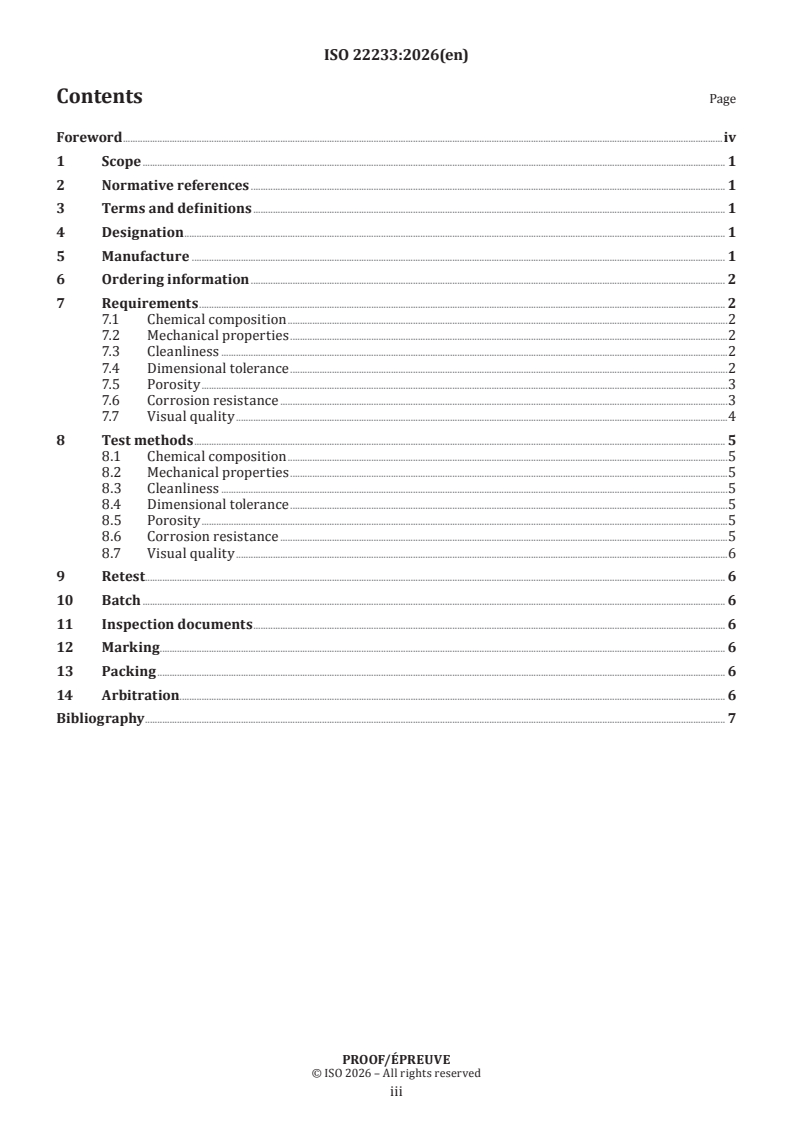
ISO 22233 covers magnesium alloy die castings and organizes the requirements into clauses for scope, references, terms, designation, manufacture, ordering information, requirements, test methods, retest, batch control, inspection documents, marking, packing, and arbitration. The document focuses on the practical points that matter in trade and acceptance: what alloy input may be used, what properties and defects are controlled, how tests are carried out, and what information must accompany an order.
In practice, the standard is built around production and acceptance of cast parts, not around secondary machining or finished assemblies. Its scope is limited to parts made by hot-chamber and cold-chamber high pressure die casting processes in the as-cast condition.
What are the key requirements of ISO 22233?
ISO 22233 ties the whole process together from ordering through inspection. The most important requirements are the alloy basis, the way quality is judged, and the test methods used to support acceptance.
Manufacture and ordering
ISO 22233 requires magnesium alloy ingot or melt that conforms to ISO 16220, and the castings themselves are designated using the system in ISO 16220. The purchaser must state the standard reference, required designation, quantity, delivery schedule, drawing, and any special requirements when placing the order. That matters because the standard relies on the order to settle the exact product definition before production starts.
The standard also restricts some shop-floor practices. Trimmed runner and biscuit material may be remelted only with the purchaser’s permission, and flux should not be used to prevent oxidation in the holding furnace. That means the foundry and buyer need to agree on melt practice if recycled metal is to be used.
Chemical composition, mechanical properties, and cleanliness
ISO 22233 requires the chemical composition of the die casting to conform to ISO 16220. For mechanical properties, it warns against basing acceptance on separately cast bars or coupons cut from the casting; the preferred approach is to test the whole casting under conditions comparable to service. In practice, that pushes acceptance toward part-representative testing instead of surrogate samples.
For cleanliness, the standard allows the purchaser to use oxygen content or fracture-surface brightness as an indicator. When oxygen content is used, the upper limit is stated in Clause 7.3, and the brightness criteria are given in Table 1 by alloy designation. This gives the buyer a way to define how clean the metal must be, while keeping the method tied to a measurable indicator.
Dimensions, porosity, corrosion, and appearance
ISO 22233 says dimensional tolerances on the drawing shall be confirmed at order time. Where linear dimensions or flatness have no specified tolerance, Tables 2 and 3 apply. That is important because it separates drawing-specific tolerances from default tolerances for unspecified features.
Porosity is handled by agreement between purchaser and manufacturer, especially in critical areas. The standard suggests considering a pressure test when leakage or pressure tightness is important, and it expects the manufacturer to control porosity through die design and process adjustment.
Corrosion resistance is not used as an acceptance criterion when the application is not in a corrosive environment. If neutral salt spray testing is used, the test follows ISO 9227 and the corrosion-rate calculation follows ISO 8407. Visual quality is controlled through four acceptance levels in Table 5, and if no level is specified, level IV applies.
Who uses ISO 22233?
ISO 22233 is used by magnesium die casting manufacturers, purchasers, and inspection personnel. It supports foundry production, incoming order definition, quality control, dimensional inspection, corrosion testing, and final acceptance of magnesium alloy die castings. It is also relevant to laboratories and NDT personnel involved in cleanliness or visual inspection work.
Which standards are used with ISO 22233?
- ISO 16220 - provides the designation system for magnesium alloy ingots and castings and is the main material reference for designation and composition.
- ISO 2470-1 - gives the brightness measurement method used for fracture-surface evaluation in cleanliness assessment.
- ISO 6506-1 - provides the Brinell hardness test method used for mechanical property testing.
- ISO 6892-1 - provides the tensile test method used for mechanical testing at room temperature.
- ISO 9227 - provides the neutral salt spray test procedure used when corrosion resistance is assessed.
- ISO 9712 - gives qualification and certification requirements for NDT personnel used for visual inspection qualification.
- ISO 8407 - is cited for corrosion-rate calculation after corrosion testing.
What does the ISO 22233 document contain?
ISO 22233 contains requirements tables and method clauses that support ordering, testing, and acceptance of magnesium alloy die castings. Table 1 gives cleanliness criteria based on fracture-surface brightness, Tables 2 and 3 give default dimensional and flatness tolerances, Table 4 gives typical corrosion rates after a 240 h neutral salt spray test, and Table 5 gives visual quality acceptance levels for surface features.
Clause 8 sets out the test approaches for composition, mechanical properties, cleanliness, dimensions, porosity, corrosion resistance, and visual quality. It also specifies practical details such as sampling from the melt, the use of a specified die for composition samples, the rotation angles for brightness measurements, and the lighting and viewing conditions for visual inspection. Clauses 9 to 14 cover retest, batch handling, inspection documents, marking, packing, and arbitration, which are the parts that support shipment and dispute resolution in real production use.
Buy Documents
ISO/PRF 22233 - Magnesium and magnesium alloys — Magnesium alloy die castings
REDLINE ISO/PRF 22233 - Magnesium and magnesium alloys — Magnesium alloy die castings
Get Certified
Connect with accredited certification bodies for this standard

Element Materials Technology
Materials testing and product certification.

Inštitut za kovinske materiale in tehnologije
Institute of Metals and Technology. Materials testing, metallurgical analysis, NDT.
Sponsored listings
Frequently Asked Questions
ISO 22233 is a draft published by the International Organization for Standardization (ISO). Its full title is "Magnesium and magnesium alloys — Magnesium alloy die castings". This standard covers: An standard designated for magnesium die castings with specifications on ingot cleanliness, manufacturing, general quality, corrosion, recycling etc.
An standard designated for magnesium die castings with specifications on ingot cleanliness, manufacturing, general quality, corrosion, recycling etc.
ISO 22233 is classified under the following ICS (International Classification for Standards) categories: 77.150.20 - Magnesium products. The ICS classification helps identify the subject area and facilitates finding related standards.
ISO 22233 is available in PDF format for immediate download after purchase. The document can be added to your cart and obtained through the secure checkout process. Digital delivery ensures instant access to the complete standard document.
Standards Content (Sample)
International
Standard
First edition
Magnesium and magnesium
alloys — Magnesium alloy die
castings
Magnésium et aliages de magnésium — Pièces moulées sous
pression en magnésium
PROOF/ÉPREUVE
Reference number
© ISO 2026
All rights reserved.
This ISO publication is protected by copyright and is owned by ISO and/or its licensors.
The content of this ISO publication is provided under licence, not sold. Use is subject to the applicable licence terms issued by ISO,
an ISO member body, or an authorized third-party distributor.
Except as required for implementation or expressly permitted by a separate licence, no part of this ISO publication may be
reproduced, distributed, modified, used, or made available in any form or by any means – electronic or mechanical, including
photocopying, scanning, recording, or posting on internal or external digital platforms.
Any use beyond the scope of the granted rights is prohibited and may result in legal action.
ISO copyright office
CP 401 • CH-1214 Vernier, Geneva
Phone: +41 22 749 01 11
Email: copyright@iso.org
Website: www.iso.org
Published in Switzerland
PROOF/ÉPREUVE
ii
Contents Page
Foreword .iv
1 Scope . 1
2 Normative references . 1
3 Terms and definitions . 1
4 Designation . 1
5 Manufacture . 1
6 Ordering information . 2
7 Requirements . 2
7.1 Chemical composition .2
7.2 Mechanical properties .2
7.3 Cleanliness .2
7.4 Dimensional tolerance .2
7.5 Porosity .3
7.6 Corrosion resistance .3
7.7 Visual quality .4
8 Test methods . 5
8.1 Chemical composition .5
8.2 Mechanical properties .5
8.3 Cleanliness .5
8.4 Dimensional tolerance .5
8.5 Porosity .5
8.6 Corrosion resistance .5
8.7 Visual quality .6
9 Retest. 6
10 Batch . 6
11 Inspection documents . 6
12 Marking . . 6
13 Packing . 6
14 Arbitration. 6
Bibliography . 7
PROOF/ÉPREUVE
iii
Foreword
ISO (the International Organization for Standardization) is a worldwide federation of national standards
bodies (ISO member bodies). The work of preparing International Standards is normally carried out through
ISO technical committees. Each member body interested in a subject for which a technical committee
has been established has the right to be represented on that committee. International organizations,
governmental and non-governmental, in liaison with ISO, also take part in the work. ISO collaborates closely
with the International Electrotechnical Commission (IEC) on all matters of electrotechnical standardization.
The procedures used to develop this document and those intended for its further maintenance are described
in the ISO/IEC Directives, Part 1. In particular, the different approval criteria needed for the different types
of ISO document should be noted. This document was drafted in accordance with the editorial rules of the
ISO/IEC Directives, Part 2 (see www.iso.org/directives).
ISO draws attention to the possibility that the implementation of this document may involve the use of (a)
patent(s). ISO takes no position concerning the evidence, validity or applicability of any claimed patent
rights in respect thereof. As of the date of publication of this document, ISO had not received notice of (a)
patent(s) which may be required to implement this document. However, implementers are cautioned that
this may not represent the latest information, which may be obtained from the patent database available at
www.iso.org/patents. ISO shall not be held responsible for identifying any or all such patent rights.
Any trade name used in this document is information given for the convenience of users and does not
constitute an endorsement.
For an explanation of the voluntary nature of standards, the meaning of ISO specific terms and expressions
related to conformity assessment, as well as information about ISO's adherence to the World Trade
Organization (WTO) principles in the Technical Barriers to Trade (TBT), see www.iso.org/iso/foreword.html.
This document was prepared by Technical Committee ISO/TC 79, Light metals and their alloys, Subcommittee
SC 5, Magnesium and alloys of cast or wrought magnesium.
Any feedback or questions on this document should be directed to the user’s national standards body. A
complete listing of these bodies can be found at www.iso.org/members.html.
PROOF/ÉPREUVE
iv
International Standard ISO 22233:2026(en)
Magnesium and magnesium alloys — Magnesium alloy die
castings
1 Scope
This document specifies the designation, manufacture, order information, requirements and test methods
of magnesium alloy die castings.
This document is applicable to magnesium alloy die casting parts produced by hot-chamber and cold-
chamber high pressure die casting processes in as-cast condition.
2 Normative references
The following documents are referred to in the text in such a way that some or all of their content constitutes
requirements of this document. For dated references, only the edition cited applies. For undated references,
the latest edition of the referenced document (including any amendments) applies.
ISO 2470-1, Paper, board and pulps — Measurement of diffuse blue reflectance factor — Part 1: Indoor daylight
conditions (ISO brightness)
ISO 6506-1, Metallic materials — Brinell hardness test — Part 1: Test method
ISO 6892-1, Metallic materials — Tensile testing — Part 1: Method of test at room temperature
ISO 9227, Corrosion tests in artificial atmospheres — Salt spray tests
ISO 9712, Non-destructive testing — Qualification and certification of NDT personnel
ISO 16220, Magnesium a
...
Formatted: Spanish (Uruguay)
ISO/DISPRF 22233
Formatted: Spanish (Uruguay)
ISO/TC 79/SC 5
Secretariat: SAC
Date: 2026-10-07-22
Magnesium and magnesium alloys — Magnesium alloy die castings
Magnésium et aliages de magnésium — Pièces moulées sous pression en magnésium
DIS stage
VVototiinngg b beeggiinnss on on:: 22002255--0055--1199
VVootintingg te termrmiinnaatetess o onn:: 2 2002255--0088--1111
© PROOF
ISO/DISPRF 22233:2026(en)
© ISO 2026
All rights reserved. Unless otherwise specified,
This ISO publication is protected by copyright and is owned by ISO and/or its licensors.
The content of this ISO publication is provided under licence, not sold. Use is subject to the applicable licence terms issued
by ISO, an ISO member body, or an authorized third-party distributor.
Except as required in the context of its for implementation or expressly permitted by a separate licence, no part of this
ISO publication may be reproduced or utilized otherwise, distributed, modified, used, or made available in any form or
by any means, – electronic or mechanical, including photocopying, scanning, recording, or posting on internal or external
digital platforms.
Any use beyond the internet or an intranet, without prior written permission. Permission can be requested from either
ISO at the address below or ISO’s member body in the countryscope of the requestergranted rights is prohibited and may
result in legal action.
ISO copyright office
CP 401 • Ch. de Blandonnet 8
CH-1214 Vernier, Geneva
Phone: + 41 22 749 01 11
E-mailEmail: copyright@iso.org
Website: www.iso.org
Published in Switzerland
iii
ISO/DISPRF 22233:2026(en)
Contents
Foreword . iv
Scope . iv
Normative references . iv
Terms and definitions . iv
Designation . iv
Manufacture . iv
Ordering information . iv
Requirements . iv
Chemical composition . iv
Mechanical properties . iv
Cleanliness . iv
Dimensional tolerance . iv
Porosity . iv
Corrosion resistance . iv
Visual quality . iv
Test methods . iv
Chemical composition . iv
Mechanical properties . iv
Cleanliness . iv
Dimensional tolerance . iv
Porosity . iv
Corrosion resistance . iv
Visual quality . iv
Retest . iv
Batch . iv
Inspection documents. iv
Marking . iv
Packing . iv
Arbitration . iv
Bibliography . iv
Foreword . vi
1 Scope . 1
2 Normative references . 1
3 Terms and definitions . 1
4 Designation . 1
5 Manufacture . 1
6 Ordering information . 2
7 Requirements . 2
7.1 Chemical composition . 2
7.2 Mechanical properties . 2
7.3 Cleanliness. 2
iv
ISO/DISPRF 22233:2026(en)
7.4 Dimensional tolerance . 3
7.5 Porosity . 3
7.6 Corrosion resistance . 4
7.7 Visual quality . 4
8 Test methods . 6
8.1 Chemical composition . 6
8.2 Mechanical properties . 6
8.3 Cleanliness. 6
8.4 Dimensional tolerance . 7
8.5 Porosity . 7
8.6 Corrosion resistance . 7
8.7 Visual quality . 7
9 Retest . 7
10 Batch . 7
11 Inspection documents . 7
12 Marking . 8
13 Packing . 8
14 Arbitration . 8
Bibliography . 9
v
ISO/DISPRF 22233:2026(en)
Foreword
ISO (the International Organization for Standardization) is a worldwide federation of national standards
bodies (ISO member bodies). The work of preparing International Standards is normally carried out through
ISO technical committees. Each member body interested in a subject for which a technical committee has been
established has the right to be represented on that committee. International organizations, governmental and
non-governmental, in liaison with ISO, also take part in the work. ISO collaborates closely with the
International Electrotechnical Commission (IEC) on all matters of electrotechnical standardization.
The procedures used to develop this document and those intended for its further maintenance are described
in the ISO/IEC Directives, Part 1. In particular, the different approval criteria needed for the different types of
ISO document should be noted. This document was drafted in accordance with the editorial rules of the
ISO/IEC Directives, Part 2 (see www.iso.org/directives).
ISO draws attention to the possibility that the implementation of this document may involve the use of (a)
patent(s). ISO takes no position concerning the evidence, validity or applicability of any claimed patent rights
in respect thereof. As of the date of publication of this document, ISO had not received notice of (a) patent(s)
which may be required to implement this document. However, implementers are cautioned that this may not
represent the latest information, which may be obtained from the patent database available at
www.iso.org/patents. ISO shall not be held responsible for identifying any or all such patent rights.
Any trade name used in this document is information given for the convenience of users and does not
constitute an endorsement.
For an explanation of the voluntary nature of standards, the meaning of ISO specific terms and expressions
related to conformity assessment, as well as information about ISO's adherence to the World Trade
Organization (WTO) principles in the Technical Barriers to Trade (TBT), see www.iso.org/iso/foreword.html.
This document was prepared by Technical Committee ISO/TC 79, Light metals and their alloys, Subcommittee
SC 5, Magnesium and alloys of cast or wrought magnesium.
Any feedback or questions on this document should be directed to the user’s national standards body. A
complete listing of these bodies can be found at www.iso.org/members.html.
vi
ISO/DISPRF 22233:2026(en)
Magnesium and magnesium alloys — Magnesium alloy die castings
1 Scope
This document specifies the designation,
...