


SIST EN ISO 12571:2022
(Main)Hygrothermal performance of building materials and products - Determination of hygroscopic sorption properties (ISO 12571:2021)
Hygrothermal performance of building materials and products - Determination of hygroscopic sorption properties (ISO 12571:2021)
This document specifies two alternative methods for determining hygroscopic sorption properties of porous building materials and products:
a) using desiccators and weighing cups (desiccator method);
b) using a climatic chamber (climatic chamber method).
The desiccator method is the reference method.
This document does not specify the method for sampling.
The methods specified in this document can be used to determine the moisture content of a sample in equilibrium with air at a specific temperature and humidity.
Wärme- und feuchtetechnisches Verhalten von Baustoffen und Bauprodukten - Bestimmung der hygroskopischen Sorptionseigenschaften (ISO 12571:2021)
Dieses Dokument legt zwei alternative Verfahren zur Bestimmung der hygroskopischen Sorptions-eigenschaften von porösen Baustoffen und produkten fest:
a) Verfahren unter Verwendung von Exsikkatoren und Wiegebehältern (Exsikkator Verfahren);
b) Verfahren unter Verwendung einer Klimakammer (Klimakammer Verfahren).
Das Exsikkator Verfahren ist das Referenzverfahren.
Diese Internationale Norm legt kein Verfahren für die Probenentnahme fest.
Die in dieser Internationalen Norm festgelegten Verfahren können angewendet werden, um den Feuchte-gehalt einer Probe im Gleichgewichtszustand mit Luft von einer bestimmten Temperatur und Feuchte zu bestimmen.
Performance hygrothermique des matériaux et produits pour le bâtiment - Détermination des propriétés de sorption hygroscopique (ISO 12571:2021)
Le présent document décrit deux méthodes de détermination des propriétés de sorption hygroscopique des matériaux et produits poreux utilisés dans le bâtiment:
la méthode utilisant des dessiccateurs et des coupelles de pesée (méthode du dessiccateur);
la méthode utilisant une chambre climatique (méthode de la chambre climatique).
La méthode du dessiccateur est la méthode de référence.
Le présent document ne spécifie pas la méthode d’échantillonnage.
Les méthodes décrites dans le présent document peuvent être utilisées pour déterminer la teneur en eau d’un échantillon en équilibre avec de l’air à température et humidité données.
Higrotermalno obnašanje gradbenih materialov in proizvodov - Ugotavljanje higroskopnosti (ISO 12571:2021)
Ta dokument določa dve alternativni metodi za določevanje higroskopnosti
poroznih gradbenih materialov in proizvodov:
a) z eksikatorji in tehtalnimi posodami (metoda eksikatorja);
b) s klimatsko komoro (metoda klimatske komore).
Metoda eksikatorja je referenčna metoda.
Ta dokument ne določa metode vzorčenja.
Metode iz tega dokumenta je mogoče uporabiti za določevanje vsebnosti vlage v vzorcu
v ravnovesju z zrakom pri določeni temperaturi in vlažnosti.
General Information
- Status
- Published
- Public Enquiry End Date
- 18-Feb-2021
- Publication Date
- 08-Feb-2022
- Technical Committee
- TOP - Thermal insulation
- Current Stage
- 6060 - National Implementation/Publication (Adopted Project)
- Start Date
- 20-Jan-2022
- Due Date
- 27-Mar-2022
Relations
- Effective Date
- 01-Mar-2022
Overview
EN ISO 12571:2021 - Hygrothermal performance of building materials and products: Determination of hygroscopic sorption properties (ISO 12571:2021) defines standardized laboratory procedures to measure how porous building materials absorb and desorb moisture from air. The document specifies two alternative test routes - the desiccator method (reference method) and the climatic chamber method - to determine the equilibrium moisture content of a sample at a given temperature and relative humidity. The standard does not cover sampling methods; it focuses on test apparatus, procedures, calculations and reporting.
Key topics and requirements
- Test methods
- Desiccator method: uses desiccators and weighing cups; treated as the reference technique.
- Climatic chamber method: uses controlled-environment chambers to establish humidity and temperature points.
- Objective: determine hygroscopic sorption properties (sorption and desorption curves) and equilibrium moisture content at specified temperature and relative humidity.
- Apparatus and specimen: requirements for desiccators, weighing equipment, climatic chambers and test specimen specification (number and preparation).
- Procedure: stepwise instructions for establishing sorption and desorption curves, control of environmental conditions, and criteria for equilibrium.
- Calculation and reporting: how to calculate moisture content (mass/volume bases), express sorption curves, and prepare a compliant test report.
- Accuracy and control: guidance on measurement error, control of humidity/temperature, and verification of test environment.
- Informative annexes: practical guidance on relative humidities above saturated solutions, preparation of saturated solutions, example procedures, and alternate methods (e.g., glass jar technique).
Applications
- Determining equilibrium moisture content and sorption isotherms for porous building materials (e.g., masonry, insulation, wood-based products, plasters).
- Supplying validated input data for hygrothermal simulation and moisture transport models used in building physics and durability assessments.
- Supporting product development, quality control and performance claims related to moisture buffering, mould risk, and long-term durability.
- Informing specification and selection of materials in damp-prone environments and aiding compliance with building regulations and performance standards.
Who uses this standard
- Laboratory technicians and accredited test labs performing hygroscopic measurements.
- Manufacturers of building materials and components for product characterization and quality assurance.
- Building physicists, hygrothermal modelers and researchers using sorption data for simulations.
- Specifiers, architects and consultants assessing moisture-related performance and material suitability.
Related standards
- ISO 9346 - Vocabulary for hygrothermal mass transfer.
- ISO 12570 - Determination of moisture content by drying at elevated temperature (referenced normative document).
Keywords: EN ISO 12571:2021, hygroscopic sorption properties, hygrothermal performance, desiccator method, climatic chamber method, equilibrium moisture content, sorption curve, building materials.


Frequently Asked Questions
SIST EN ISO 12571:2022 is a standard published by the Slovenian Institute for Standardization (SIST). Its full title is "Hygrothermal performance of building materials and products - Determination of hygroscopic sorption properties (ISO 12571:2021)". This standard covers: This document specifies two alternative methods for determining hygroscopic sorption properties of porous building materials and products: a) using desiccators and weighing cups (desiccator method); b) using a climatic chamber (climatic chamber method). The desiccator method is the reference method. This document does not specify the method for sampling. The methods specified in this document can be used to determine the moisture content of a sample in equilibrium with air at a specific temperature and humidity.
This document specifies two alternative methods for determining hygroscopic sorption properties of porous building materials and products: a) using desiccators and weighing cups (desiccator method); b) using a climatic chamber (climatic chamber method). The desiccator method is the reference method. This document does not specify the method for sampling. The methods specified in this document can be used to determine the moisture content of a sample in equilibrium with air at a specific temperature and humidity.
SIST EN ISO 12571:2022 is classified under the following ICS (International Classification for Standards) categories: 91.100.01 - Construction materials in general; 91.120.30 - Waterproofing. The ICS classification helps identify the subject area and facilitates finding related standards.
SIST EN ISO 12571:2022 has the following relationships with other standards: It is inter standard links to SIST EN ISO 12571:2013. Understanding these relationships helps ensure you are using the most current and applicable version of the standard.
SIST EN ISO 12571:2022 is available in PDF format for immediate download after purchase. The document can be added to your cart and obtained through the secure checkout process. Digital delivery ensures instant access to the complete standard document.
Standards Content (Sample)
SLOVENSKI STANDARD
01-marec-2022
Nadomešča:
SIST EN ISO 12571:2013
Higrotermalno obnašanje gradbenih materialov in proizvodov - Ugotavljanje
higroskopnosti (ISO 12571:2021)
Hygrothermal performance of building materials and products - Determination of
hygroscopic sorption properties (ISO 12571:2021)
Wärme- und feuchtetechnisches Verhalten von Baustoffen und Bauprodukten -
Bestimmung der hygroskopischen Sorptionseigenschaften (ISO 12571:2021)
Performance hygrothermique des matériaux et produits pour le bâtiment - Détermination
des propriétés de sorption hygroscopique (ISO 12571:2021)
Ta slovenski standard je istoveten z: EN ISO 12571:2021
ICS:
91.100.01 Gradbeni materiali na Construction materials in
splošno general
91.120.30 Zaščita pred vlago Waterproofing
2003-01.Slovenski inštitut za standardizacijo. Razmnoževanje celote ali delov tega standarda ni dovoljeno.
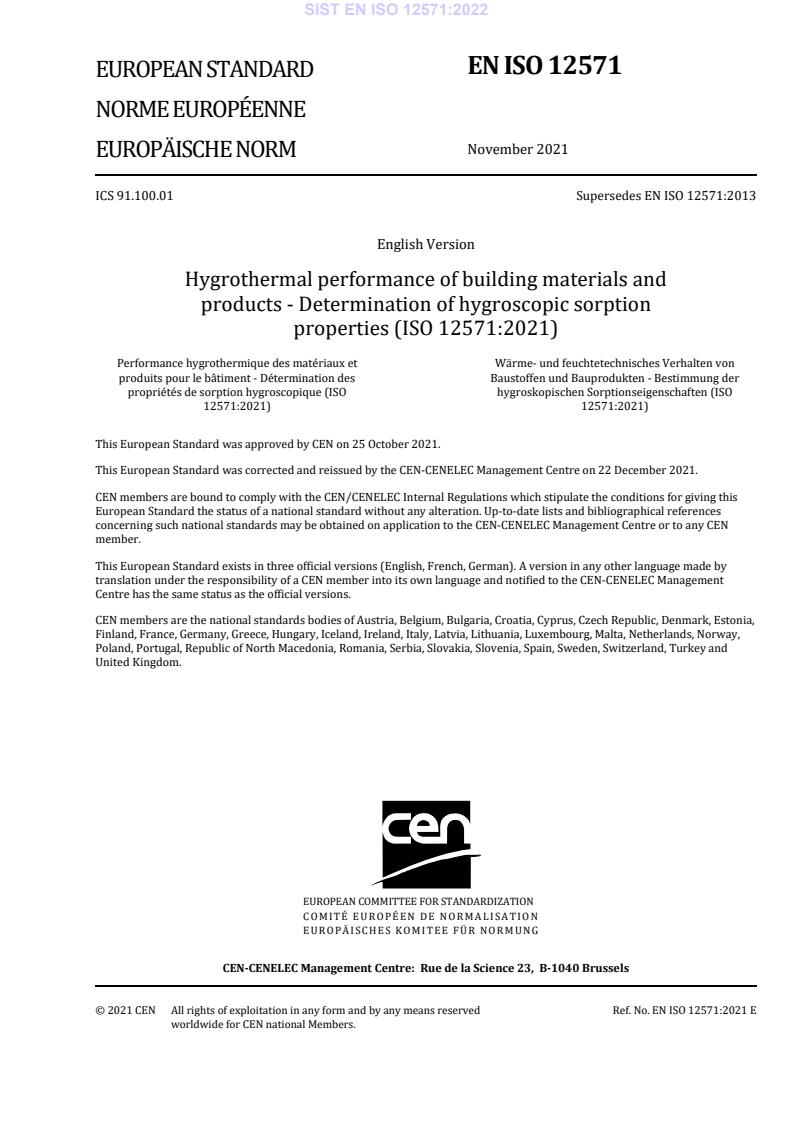
EN ISO 12571
EUROPEAN STANDARD
NORME EUROPÉENNE
November 2021
EUROPÄISCHE NORM
ICS 91.100.01 Supersedes EN ISO 12571:2013
English Version
Hygrothermal performance of building materials and
products - Determination of hygroscopic sorption
properties (ISO 12571:2021)
Performance hygrothermique des matériaux et Wärme- und feuchtetechnisches Verhalten von
produits pour le bâtiment - Détermination des Baustoffen und Bauprodukten - Bestimmung der
propriétés de sorption hygroscopique (ISO hygroskopischen Sorptionseigenschaften (ISO
12571:2021) 12571:2021)
This European Standard was approved by CEN on 25 October 2021.
This European Standard was corrected and reissued by the CEN-CENELEC Management Centre on 22 December 2021.
CEN members are bound to comply with the CEN/CENELEC Internal Regulations which stipulate the conditions for giving this
European Standard the status of a national standard without any alteration. Up-to-date lists and bibliographical references
concerning such national standards may be obtained on application to the CEN-CENELEC Management Centre or to any CEN
member.
This European Standard exists in three official versions (English, French, German). A version in any other language made by
translation under the responsibility of a CEN member into its own language and notified to the CEN-CENELEC Management
Centre has the same status as the official versions.
CEN members are the national standards bodies of Austria, Belgium, Bulgaria, Croatia, Cyprus, Czech Republic, Denmark, Estonia,
Finland, France, Germany, Greece, Hungary, Iceland, Ireland, Italy, Latvia, Lithuania, Luxembourg, Malta, Netherlands, Norway,
Poland, Portugal, Republic of North Macedonia, Romania, Serbia, Slovakia, Slovenia, Spain, Sweden, Switzerland, Turkey and
United Kingdom.
EUROPEAN COMMITTEE FOR STANDARDIZATION
COMITÉ EUROPÉEN DE NORMALISATIO N
E U R OP ÄI SCHES KOMITEE FÜR NORMUN G
CEN-CENELEC Management Centre: Rue de la Science 23, B-1040 Brussels
© 2021 CEN All rights of exploitation in any form and by any means reserved Ref. No. EN ISO 12571:2021 E
worldwide for CEN national Members.
Contents Page
European foreword . 3
European foreword
This document (EN ISO 12571:2021) has been prepared by Technical Committee ISO/TC 163 "Thermal
performance and energy use in the built environment" in collaboration with Technical Committee
CEN/TC 89 “Thermal performance of buildings and building components” the secretariat of which is
held by SIS.
This European Standard shall be given the status of a national standard, either by publication of an
identical text or by endorsement, at the latest by May 2022, and conflicting national standards shall be
withdrawn at the latest by May 2022.
Attention is drawn to the possibility that some of the elements of this document may be the subject of
patent rights. CEN shall not be held responsible for identifying any or all such patent rights.
This document supersedes EN ISO 12571:2013.
Any feedback and questions on this document should be directed to the users’ national standards
body/national committee. A complete listing of these bodies can be found on the CEN website.
According to the CEN-CENELEC Internal Regulations, the national standards organizations of the
following countries are bound to implement this European Standard: Austria, Belgium, Bulgaria,
Croatia, Cyprus, Czech Republic, Denmark, Estonia, Finland, France, Germany, Greece, Hungary, Iceland,
Ireland, Italy, Latvia, Lithuania, Luxembourg, Malta, Netherlands, Norway, Poland, Portugal, Republic of
North Macedonia, Romania, Serbia, Slovakia, Slovenia, Spain, Sweden, Switzerland, Turkey and the
United Kingdom.
Endorsement notice
The text of ISO 12571:2021 has been approved by CEN as EN ISO 12571:2021 without any modification.
INTERNATIONAL ISO
STANDARD 12571
Third edition
2021-11
Hygrothermal performance of
building materials and products —
Determination of hygroscopic sorption
properties
Performance hygrothermique des matériaux et produits pour le
bâtiment — Détermination des propriétés de sorption hygroscopique
Reference number
ISO 12571:2021(E)
ISO 12571:2021(E)
© ISO 2021
All rights reserved. Unless otherwise specified, or required in the context of its implementation, no part of this publication may
be reproduced or utilized otherwise in any form or by any means, electronic or mechanical, including photocopying, or posting on
the internet or an intranet, without prior written permission. Permission can be requested from either ISO at the address below
or ISO’s member body in the country of the requester.
ISO copyright office
CP 401 • Ch. de Blandonnet 8
CH-1214 Vernier, Geneva
Phone: +41 22 749 01 11
Email: copyright@iso.org
Website: www.iso.org
Published in Switzerland
ii
ISO 12571:2021(E)
Contents Page
Foreword .iv
1 Scope . 1
2 Normative references . 1
3 Terms and definitions, symbols and units . 1
3.1 Terms and definitions . 1
3.2 Symbols and units . 2
4 Principle . 2
4.1 Sorption curve . 2
4.2 Desorption curve . 2
5 Apparatus . 3
5.1 Desiccator method . 3
5.2 Climatic chamber method . 3
6 Test specimens . 3
6.1 Specification of the test specimens . 3
6.2 Number of test specimens . 3
7 Procedure .3
7.1 Test conditions . 3
7.2 Desiccator method . 4
7.2.1 General . 4
7.2.2 Sorption curve . 4
7.2.3 Desorption curve . 5
7.3 Climatic chamber method . 6
7.3.1 Sorption curve . 6
7.3.2 Desorption curve . 7
8 Calculation and expression of results . 7
8.1 Hygroscopic sorption . 7
8.2 Equilibrium moisture content curves . 7
9 Accuracy of measurement.8
9.1 Error in moisture content . . 8
9.2 Control of environmental conditions . 8
9.2.1 Desiccator method . 8
9.2.2 Climatic chamber method . 9
10 Test report . 9
Annex A (informative) Air relative humidities above saturated solutions in equilibrium .10
Annex B (informative) Preparation of saturated solutions .13
Annex C (informative) Example of the procedure for determining a point on a sorption
curve .16
Annex D (informative) Method using a glass jar .17
Bibliography .19
iii
ISO 12571:2021(E)
Foreword
ISO (the International Organization for Standardization) is a worldwide federation of national standards
bodies (ISO member bodies). The work of preparing International Standards is normally carried out
through ISO technical committees. Each member body interested in a subject for which a technical
committee has been established has the right to be represented on that committee. International
organizations, governmental and non-governmental, in liaison with ISO, also take part in the work.
ISO collaborates closely with the International Electrotechnical Commission (IEC) on all matters of
electrotechnical standardization.
The procedures used to develop this document and those intended for its further maintenance are
described in the ISO/IEC Directives, Part 1. In particular, the different approval criteria needed for the
different types of ISO documents should be noted. This document was drafted in accordance with the
editorial rules of the ISO/IEC Directives, Part 2 (see www.iso.org/directives).
Attention is drawn to the possibility that some of the elements of this document may be the subject of
patent rights. ISO shall not be held responsible for identifying any or all such patent rights. Details of
any patent rights identified during the development of the document will be in the Introduction and/or
on the ISO list of patent declarations received (see www.iso.org/patents).
Any trade name used in this document is information given for the convenience of users and does not
constitute an endorsement.
For an explanation of the voluntary nature of standards, the meaning of ISO specific terms and
expressions related to conformity assessment, as well as information about ISO's adherence to
the World Trade Organization (WTO) principles in the Technical Barriers to Trade (TBT), see
www.iso.org/iso/foreword.html.
This document was prepared by Technical Committee ISO/TC 163, Thermal performance and energy use
in the built environment Subcommittee SC 1, Test and measurement methods, in collaboration with the
European Committee for Standardization (CEN) Technical Committee CEN/TC 89, Thermal performance
of buildings and building components, in accordance with the Agreement on technical cooperation
between ISO and CEN (Vienna Agreement).
This third edition cancels and replaces the second edition (ISO 12571:2013), which has been technically
revised.
The main changes are as follows:
— Table A.1 was revised.
Any feedback or questions on this document should be directed to the user’s national standards body. A
complete listing of these bodies can be found at www.iso.org/members.html.
iv
INTERNATIONAL STANDARD ISO 12571:2021(E)
Hygrothermal performance of building materials and
products — Determination of hygroscopic sorption
properties
1 Scope
This document specifies two alternative methods for determining hygroscopic sorption properties of
porous building materials and products:
a) using desiccators and weighing cups (desiccator method);
b) using a climatic chamber (climatic chamber method).
The desiccator method is the reference method.
This document does not specify the method for sampling.
The methods specified in this document can be used to determine the moisture content of a sample in
equilibrium with air at a specific temperature and humidity.
2 Normative references
The following documents are referred to in the text in such a way that some or all of their content
constitutes requirements of this document. For dated references, only the edition cited applies. For
undated references, the latest edition of the referenced document (including any amendments) applies.
ISO 9346, Hygrothermal performance of buildings and building materials — Physical quantities for mass
transfer — Vocabulary
ISO 12570, Hygrothermal performance of building materials and products — Determination of moisture
content by drying at elevated temperature
3 Terms and definitions, symbols and units
For the purposes of this document, the terms and definitions given in ISO 9346 and the following apply.
ISO and IEC maintain terminology databases for use in standardization at the following addresses:
— ISO Online browsing platform: available at https:// www .iso .org/ obp
— IEC Electropedia: available at https:// www .electropedia .org/
3.1 Terms and definitions
3.1.1
equilibrium moisture content
moisture content of a porous material in equilibrium with the environment and the relative humidity of
the ambient air, at a specified temperature
3.1.2
moisture content mass by mass
mass of evaporable water divided by mass of dry material
ISO 12571:2021(E)
3.1.3
moisture content volume by volume
volume of evaporable water divided by volume of dry material
3.1.4
moisture content mass by volume
mass of evaporable water divided by volume of dry material
Note 1 to entry: The mass of water is determined by weighing the specimen before and after drying at the
appropriate drying temperature until constant mass is reached.
3.1.5
sorption curve
curve established at a series of increasing equilibrium relative humidities at a given temperature
3.1.6
desorption curve
curve established at a series of decreasing equilibrium relative humidities at a given temperature
3.2 Symbols and units
Symbol Quantity Unit
m mass of test specimen kg
m mass of dried test specimen kg
u moisture content mass by mass kg/kg
3 3
ψ moisture content volume by volume m /m
w moisture content mass by volume kg/m
4 Principle
4.1 Sorption curve
The specimen is dried to constant mass. While maintaining a constant temperature, the specimen
is placed consecutively in a series of test environments, with relative humidity increasing in stages.
The moisture content is determined when equilibrium with each environment is reached. At this
point, a uniform moisture distribution in the sample is assumed. Equilibrium with the environment
is established by weighing the specimen until constant mass is reached. A minimum of four test
atmospheres shall be selected in the humidity range under consideration.
After establishing the moisture content at each relative humidity, the sorption curve can be drawn.
4.2 Desorption curve
The starting point for desorption is a relative humidity of at least 95 %. See 7.2.3 for the procedure
to define a consistent initial condition. While maintaining a constant temperature, the specimen is
placed consecutively in a series of test environments, with relative humidity decreasing in stages. The
moisture content is determined when equilibrium with each environment is reached. Equilibrium with
the environment is established by weighing the specimen until constant mass is reached. A minimum of
four test atmospheres shall be selected in the humidity range under consideration. Finally, the specimen
is dried to constant mass.
After establishing the moisture content at each relative humidity, the desorption curve can be drawn.
ISO 12571:2021(E)
5 Apparatus
5.1 Desiccator method
The test apparatus shall include:
a) weighing cups, which do not absorb water and with tight-fitting lids;
b) balance, capable of weighing to an accuracy of ±0,01 % of the mass of the test specimen;
NOTE If larger weighing cups are used, the weighing accuracy can be determined with respect to the
total mass and the required accuracy of the test results.
c) drying oven, in accordance with ISO 12570;
d) desiccator, capable of maintaining the relative humidity within ±2 % relative humidity;
e) constant-temperature chamber, capable of maintaining the specified test temperature to an
accuracy of ±0,5 K.
5.2 Climatic chamber method
The test apparatus shall include:
a) weighing cups, which do not absorb water;
b) balance, capable of weighing to an accuracy of ±0,01 % of the mass of the test specimen;
NOTE If larger weighing cups are used, the weighing accuracy can be determined with respect to the
total mass and the required accuracy of the test results.
c) drying oven, in accordance with ISO 12570;
d) climatic chamber, capable of maintaining the relative humidity within ±5 % relative humidity and
the temperature within ±2 K over the whole test area.
6 Test specimens
6.1 Specification of the test specimens
A test specimen shall be representative of the product and have a mass of at least 10 g. Specimens of
materials with a dry density less than 300 kg/m shall have an area of at least 100 mm × 100 mm.
And the selected sample size shall take into account any heterogeneity of the materials. If it can be
demonstrated from other references that the result will not be affected, a test specimen may be cut or
crushed into smaller pieces to reduce the time to reach equilibrium with the environment.
6.2 Number of test specimens
A minimum of three specimens shall be tested. The procedure in Clause 7 shall be applied to each
specimen.
7 Procedure
7.1 Test conditions
Reference sorption curves shall be established at a temperature of (23 ± 0,5) °C or (27 ± 0,5) °C in tropical
countries. If agreed between the parties, sorption curves can be established at other temperatures for
specific applications.
ISO 12571:2021(E)
7.2 Desiccator method
7.2.1 General
Make up the appropriate saturated aqueous solution to achieve the necessary relative humidity in the
desiccator.
Standard air relative humidities to be selected for measuring sorption curves are shown in Table 1.
Choose five or more conditions that include No.2, No.4 and No.6 in Table 1.
NOTE Annex A gives the air relative humidities of various saturated solutions in equilibrium, and Annex B
describes the preparation of various solutions.
Place the desiccator in the constant-temperature chamber (see Figure 1). The d
...
Questions, Comments and Discussion
Ask us and Technical Secretary will try to provide an answer. You can facilitate discussion about the standard in here.
Loading comments...