

SIST EN 14329:2004
(Main)Inland navigation vessels - Installation of berths and loading areas
General Information
- Abstract
This European Standard applies to the installation of berths and loading areas for inland navigation vessels.
It also applies to berths and loading areas for inland navigation vessels in seaports.
This standard does not apply to Ro-Ro systems, ferry terminals, floating equipment, bunker stations, landing stages used for passenger changeovers or for holding areas.
- Status
- Published
- Publication Date
- 31-Aug-2004
- Technical Committee
- SS SPL - Technical Board for the general field
- Current Stage
- 6060 - National Implementation/Publication (Adopted Project)
- Start Date
- 01-Sep-2004
- Due Date
- 01-Sep-2004
- Completion Date
- 01-Sep-2004



Overview
EN 14329:2004 (CEN) specifies requirements for the installation of berths and loading areas for inland navigation vessels, including berths for inland vessels located in seaports. It is intended as practical guidance for designers, operators and authorities to improve safety, interoperability and intermodal logistics. The standard excludes Ro‑Ro systems, ferry terminals, floating equipment, bunker stations and landing stages used only for passenger changeovers or holding areas.
Key topics and technical requirements
- Scope & purpose: Rules for safe access, mooring, fendering, lighting, marking and service connections at berths and loading areas for inland navigation vessels.
- Mooring systems
- Preferred layout: centre‑to‑centre spacing around 30 m (shall not exceed 40 m).
- Horizontal distance from climbing device ≤ 0.85 m; lowest mooring ≤ 1.5 m above lowest expected water level.
- Vertical spacing typically 1.5 m (≤ 1.8 m maximum).
- Minimum holding forces: ≥ 100 kN (smaller waterways), ≥ 200 kN (larger vessels up to L=110 m, B=11.5 m), ≥ 300 kN (for larger vessels); at least 100 kN in harbours without current.
- Mooring systems must be clearly marked with holding force (kN).
- Stairs and quay ladders
- Climbing devices no more than 30 m apart (up to 60 m where vertical difference > 2.0 m require stairs).
- Bottom ends project to 1.0 m below lowest expected water level; safety areas at top of at least 0.5 m depth and 2.0 m height.
- Quay ladder tread spacing 250–300 mm; stair and ladder geometry referenced to EN 13056 and EN 13574.
- Fenders & berths alongside slopes
- Fenders must remain effective over changing water levels; berms minimum 0.7 m width.
- Illumination
- Uniform lighting levels (examples): storage/traffic zones 20 lx; quay edges/mooring systems 5 lx; service installations 50 lx; footpaths 5 lx.
- Safety & services
- Emergency call devices, life‑saving equipment within 100 m (lifebuoys per EN 14144), rescue instructions, and signage with emergency numbers.
- Supply/disposal: drinking water points, 230/400 V shore power connections, waste disposal in line with national regulations. Vehicle loading/unloading areas to be provided.
Applications and users
- Port and inland waterway civil engineers and designers
- Terminal and quayside operators and planners
- Coastal and harbour authorities implementing standards for intermodal logistics
- Safety officers, inspectors and surveyors assessing berth installations
- Shipowners and fleet managers integrating shore interfaces for cargo handling and crew access
Related standards
- EN 526 (gangways), EN 13056 (stairs), EN 13574 (quay ladders), EN 14144 (lifebuoys), EN 14145 (lifebuoy holders) - referenced normative documents for specific components.
Use EN 14329:2004 when designing or auditing berths and loading areas to ensure safe, interoperable interfaces between inland navigation vessels and shore infrastructure.
Relations
- Effective Date
- 28-Jan-2026
- Effective Date
- 28-Jan-2026
- Effective Date
- 28-Jan-2026
- Effective Date
- 28-Jan-2026
- Effective Date
- 28-Jan-2026
- Effective Date
- 28-Jan-2026
Get Certified
Connect with accredited certification bodies for this standard

DNV
DNV is an independent assurance and risk management provider.

Lloyd's Register
Lloyd's Register is a global professional services organisation specialising in engineering and technology.

FSC International
Forest Stewardship Council certification.
Sponsored listings
Frequently Asked Questions
SIST EN 14329:2004 is a standard published by the Slovenian Institute for Standardization (SIST). Its full title is "Inland navigation vessels - Installation of berths and loading areas". This standard covers: This European Standard applies to the installation of berths and loading areas for inland navigation vessels. It also applies to berths and loading areas for inland navigation vessels in seaports. This standard does not apply to Ro-Ro systems, ferry terminals, floating equipment, bunker stations, landing stages used for passenger changeovers or for holding areas.
This European Standard applies to the installation of berths and loading areas for inland navigation vessels. It also applies to berths and loading areas for inland navigation vessels in seaports. This standard does not apply to Ro-Ro systems, ferry terminals, floating equipment, bunker stations, landing stages used for passenger changeovers or for holding areas.
SIST EN 14329:2004 is classified under the following ICS (International Classification for Standards) categories: 47.060 - Inland navigation vessels; 93.140 - Construction of waterways, ports and dykes. The ICS classification helps identify the subject area and facilitates finding related standards.
SIST EN 14329:2004 has the following relationships with other standards: It is inter standard links to SIST EN 526:2000, SIST EN 14145:2004, SIST EN 13574:2002, SIST EN 14144:2026, SIST EN 13056:2002, SIST EN 14503:2004. Understanding these relationships helps ensure you are using the most current and applicable version of the standard.
SIST EN 14329:2004 is available in PDF format for immediate download after purchase. The document can be added to your cart and obtained through the secure checkout process. Digital delivery ensures instant access to the complete standard document.
Standards Content (Sample)
2003-01.Slovenski inštitut za standardizacijo. Razmnoževanje celote ali delov tega standarda ni dovoljeno.Fahrzeuge der Binnenschifffahrt - Einrichtung von Liege- und UmschlagplätzenBateaux de navigation intérieure - Arrangement de mouillages et d'installation de transbordementInland navigation vessels - Installation of berths and loading areas93.140SULVWDQLãþConstruction of waterways and ports47.060Inland navigation vesselsICS:Ta slovenski standard je istoveten z:EN 14329:2004SIST EN 14329:2004en01-september-2004SIST EN 14329:2004SLOVENSKI
STANDARD
EUROPEAN STANDARDNORME EUROPÉENNEEUROPÄISCHE NORMEN 14329March 2004ICS 47.060English versionInland navigation vessels - Installation of berths and loadingareasBateaux de navigation intérieure - Arrangement demouillages et d'installation de transbordementFahrzeuge der Binnenschifffahrt - Einrichtung von Liege-und UmschlagplätzenThis European Standard was approved by CEN on 2 February 2004.CEN members are bound to comply with the CEN/CENELEC Internal Regulations which stipulate the conditions for giving this EuropeanStandard the status of a national standard without any alteration. Up-to-date lists and bibliographical references concerning such nationalstandards may be obtained on application to the Central Secretariat or to any CEN member.This European Standard exists in three official versions (English, French, German). A version in any other language made by translationunder the responsibility of a CEN member into its own language and notified to the Central Secretariat has the same status as the officialversions.CEN members are the national standards bodies of Austria, Belgium, Cyprus, Czech Republic, Denmark, Estonia, Finland, France,Germany, Greece, Hungary, Iceland, Ireland, Italy, Latvia, Lithuania, Luxembourg, Malta, Netherlands, Norway, Poland, Portugal, Slovakia,Slovenia, Spain, Sweden, Switzerland and United Kingdom.EUROPEAN COMMITTEE FOR STANDARDIZATIONCOMITÉ EUROPÉEN DE NORMALISATIONEUROPÄISCHES KOMITEE FÜR NORMUNGManagement Centre: rue de Stassart, 36
B-1050 Brussels© 2004 CENAll rights of exploitation in any form and by any means reservedworldwide for CEN national Members.Ref. No. EN 14329:2004: ESIST EN 14329:2004
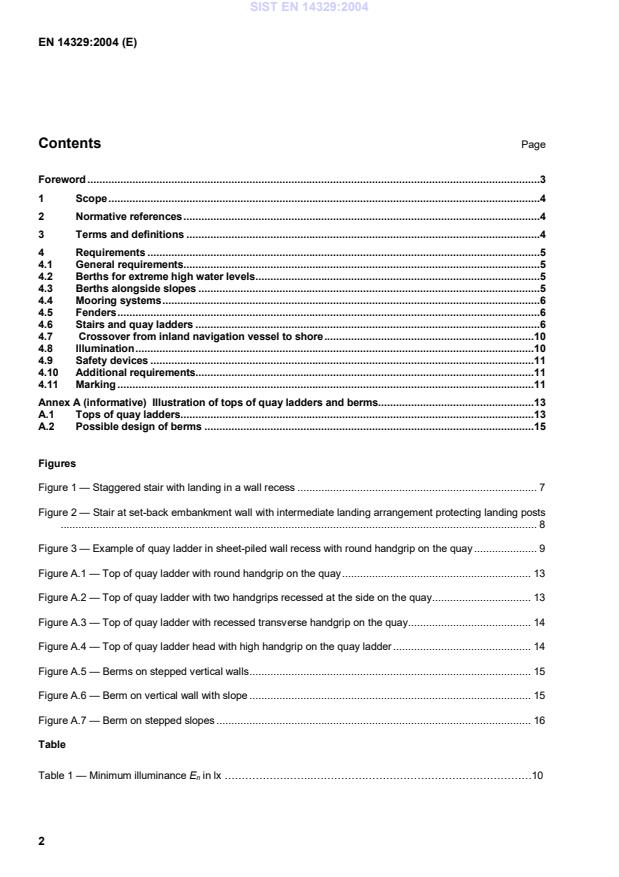
Berths alongside slopes.5 4.4 Mooring systems.6 4.5 Fenders.6 4.6 Stairs and quay ladders.6 4.7
Crossover from inland navigation vessel to shore.10 4.8 Illumination.10 4.9 Safety devices.11 4.10
Additional requirements.11 4.11 Marking.11 Annex A (informative)
Illustration of tops of quay ladders and berms.13 A.1 Tops of quay ladders.13 A.2 Possible design of berms.15
Figures Figure 1 — Staggered stair with landing in a wall recess.7 Figure 2 — Stair at set-back embankment wall with intermediate landing arrangement protecting landing posts.8 Figure 3 — Example of quay ladder in sheet-piled wall recess with round handgrip on the quay.9 Figure A.1 — Top of quay ladder with round handgrip on the quay.13 Figure A.2 — Top of quay ladder with two handgrips recessed at the side on the quay.13 Figure A.3 — Top of quay ladder with recessed transverse handgrip on the quay.14 Figure A.4 — Top of quay ladder head with high handgrip on the quay ladder.14 Figure A.5 — Berms on stepped vertical walls.15 Figure A.6 — Berm on vertical wall with slope.15 Figure A.7 — Berm on stepped slopes.16 Table Table 1 — Minimum illuminance En in lx …………………….………………………………………………………10
In this way, it is intended improving the safety of the users both on the ship and the shore side.
Berths and loading areas may be parts of handling areas, berthing areas and harbours According to the CEN/CENELEC Internal Regulations, the national standards organizations of the following countries are bound to implement this European Standard: Austria, Belgium, Cyprus, Czech Republic, Denmark, Estonia, Finland, France, Germany, Greece, Hungary, Iceland, Ireland, Italy, Latvia, Lithuania, Luxembourg, Malta, Netherlands, Norway, Poland, Portugal, Slovakia, Slovenia, Spain, Sweden, Switzerland and the United Kingdom. SIST EN 14329:2004
1 Scope This European Standard applies to the installation of berths and loading areas for inland navigation vessels. It also applies to berths and loading areas for inland navigation vessels in seaports. This standard does not apply to Ro-Ro systems, ferry terminals, floating equipment, bunker stations, landing stages used for passenger changeovers or for holding areas. 2 Normative references This standard incorporates by dated or undated reference, provisions from other publications.
These normative references are cited at the appropriate places in the text and the publications are listed hereafter.
For dated references, subsequent amendments to or revisions of any of these publications apply to this standard only when incorporated in it by amendment or revision.
For undated references the latest edition of the publication referred to applies (including amendments).
EN 526, Inland navigation vessels — Gangways with a length not exceeding 8 m - Requirements, types. EN 13056, Inland navigation vessels — Stairs with inclination angles of 30° to < 45° — Requirements, types. EN 13574:2001, Inland navigation vessels — Permanently installed climbing devices with a length not exceeding 5 m. EN 14144, Lifebuoys — Requirements, tests. EN 14145, Holders for lifebuoys. . 3 Terms and definitions
For the purposes of this European Standard, the following definitions apply:
3.1 berth landing place landing stage with mooring systems and shore connections
3.2 loading area berth for loading and unloading inland navigation vessels
3.3 holding area area used just for short-term waiting until the vessels continues its journey or is assigned a berth or loading area
3.4
climbing device stair and quay ladder 3.5 mooring system fixed device for making fast inland navigation vessels SIST EN 14329:2004
4 Requirements 4.1 General requirements Berths and loading area
...