

kSIST FprEN 18336:2026
(Main)Leather - Raw bovine hides and skins - grading
- Abstract
This document specifies requirements to grade hides and skins according to the defects listed in EN 16055. It applies to raw bovine hides and skins, both fresh and salted, intended for use throughout the leather manufacturing supply chain.
- Status
- Not Published
- Public Enquiry End Date
- 30-May-2026
- Technical Committee
- IUSN - Leather
- Current Stage
- 5020 - Formal vote (FV) (Adopted Project)
- Start Date
- 02-Oct-2026
- Due Date
- 20-Nov-2026
- Completion Date
- 02-Oct-2026

kSIST FprEN 18336:2026 is a CEN draft European Standard for grading raw bovine hides and skins. It specifies how to classify fresh and salted hides and skins by the defects listed in EN 16055, so buyers, processors and tanneries can use the same grading basis across the leather manufacturing supply chain.
What does kSIST FprEN 18336:2026 specify?
kSIST FprEN 18336:2026 specifies requirements for grading raw bovine hides and skins according to visible defects described in EN 16055. The standard applies to both fresh and salted material and is organized into four main clauses: scope, normative references, terms and definitions, and grading requirements.
Clause 4 sets out the grading system as four selections. The practical purpose is to make sorting decisions more consistent before hides and skins move further through the leather chain.
What are the key requirements of kSIST FprEN 18336:2026?
kSIST FprEN 18336:2026 grades hides and skins by visible quality, using four selections: first selection, second selection, third selection, and rejects. In practice, the closer a hide or skin is to first selection, the fewer and smaller the defects allowed.
First selection
Clause 4.2 requires hides and skins to be largely free of visually recognizable defects. No defects are allowed in the central area on either the flesh side or the grain side, the flay must follow EN 16055, and there must be no preservation defects. Non-disease defects other than holes are not allowed unless each is smaller than 8 cm, and only up to two defects are allowed in the external area.
For disease-related defects, such as warts, herpes or skin leaks, the affected area must be smaller than 0,1 m². This gives a near-prime grade for material that can be used with minimal sorting loss.
Second selection
Clause 4.3 allows only isolated defects. Hides and skins may have no more than two additional defects in the central area compared with first selection, and the defects listed for third selection are excluded.
A slight amount of dung and a slight mis-shape do not affect this grade, provided the dung is less than 1 kg. In practice, this grade covers material that is still usable but needs more tolerance for minor defects.
Third selection
Clause 4.4 allows more visible defects, especially toward the edge area. The standard permits larger holes or cuts, visible hair slip, visible mis-shape, large disease or parasite damage, and a larger amount of dung.
The clause gives specific limits for several defects: up to 8 grubs, holes or cuts larger than 15 cm, hair slip up to 20% of total surface, disease or parasite damage between 0,1 m² and two thirds of total surface, dung above 1 kg, and mis-shape up to 20% of total surface. This grade is for hides and skins that remain usable but have clear quality loss.
Rejects
Clause 4.5 classifies hides and skins as rejects when defects are widespread or beyond the third-selection limits. That includes defects spread over the whole surface, mis-shape above 20% of total surface, disease or parasite damage over 66% of the total surface, or more than 8 open grubs or similar defects.
For buyers and quality staff, this clause marks material that falls outside the grading bands intended for normal trade.
What terms does kSIST FprEN 18336:2026 define?
kSIST FprEN 18336:2026 uses the following terms in Clause 3, alongside the definitions in EN 16055 and EN 15987:
- Grub - the larval stage of certain insects, especially beetles.
- Warble fly/warble - a parasitic fly whose larvae create lumps and holes under the skin.
- Scabies - a rash caused by mite infestation.
- Alopecia - partial or complete loss of hair from the hide or skin.
These terms matter because the grading rules refer directly to damage caused by parasites, disease and hair loss.
Who uses kSIST FprEN 18336:2026?
kSIST FprEN 18336:2026 is intended for the leather supply chain, especially agriculture, slaughterhouses, hides and skins processors, and tanneries. It helps these parties sort incoming raw bovine hides and skins, agree on quality grades, and reduce disputes over acceptance and price classification.
Which standards are used with kSIST FprEN 18336:2026?
kSIST FprEN 18336:2026 relies on two normative references:
- EN 15987 - provides key leather trade terminology used in the document.
- EN 16055 - defines the description, presentation and preservation of raw bovine hides and skins, and supplies the defect basis used for grading.
These references give kSIST FprEN 18336:2026 its terminology and the defect framework it applies.
What does the kSIST FprEN 18336:2026 document contain?
kSIST FprEN 18336:2026 contains the grading clauses and supporting figures needed to apply the selections in practice. Clause 4 is supported by figures that illustrate holes in the central area, grain break, disease presence, mis-shape, hair slip, dung, and mis-shaping beyond the reject limit.
The document also includes a short introduction explaining that it was developed to avoid disagreements between parties, based on discussion with representatives of agriculture, slaughterhouses, hides and skins processors, and tanneries. This makes the grading approach practical for shared commercial use.
Get Certified
Connect with accredited certification bodies for this standard

Control Union Certifications
Global certification for agriculture and sustainability.

Hohenstein Institut
Textile testing and certification.

Bureau Veritas Bangladesh
Bureau Veritas certification services in Bangladesh.
Sponsored listings
Frequently Asked Questions
kSIST FprEN 18336:2026 is a draft published by the Slovenian Institute for Standardization (SIST). Its full title is "Leather - Raw bovine hides and skins - grading". This standard covers: This document specifies requirements to grade hides and skins according to the defects listed in EN 16055. It applies to raw bovine hides and skins, both fresh and salted, intended for use throughout the leather manufacturing supply chain.
This document specifies requirements to grade hides and skins according to the defects listed in EN 16055. It applies to raw bovine hides and skins, both fresh and salted, intended for use throughout the leather manufacturing supply chain.
kSIST FprEN 18336:2026 is classified under the following ICS (International Classification for Standards) categories: 59.140.20 - Raw skins, hides and pelts. The ICS classification helps identify the subject area and facilitates finding related standards.
kSIST FprEN 18336:2026 is available in PDF format for immediate download after purchase. The document can be added to your cart and obtained through the secure checkout process. Digital delivery ensures instant access to the complete standard document.
Standards Content (Sample)
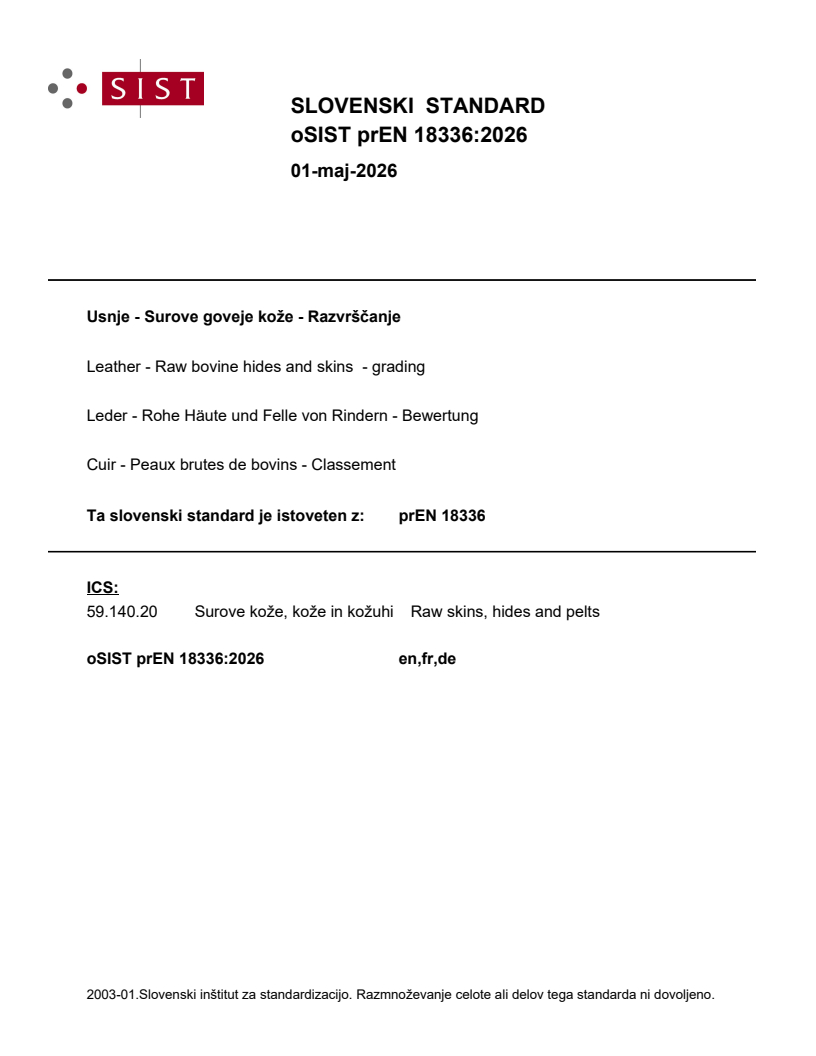
SLOVENSKI STANDARD
oSIST prEN 18336:2026
01-maj-2026
Usnje - Surove goveje kože - Razvrščanje
Leather - Raw bovine hides and skins - grading
Leder - Rohe Häute und Felle von Rindern - Bewertung
Cuir - Peaux brutes de bovins - Classement
Ta slovenski standard je istoveten z: prEN 18336
ICS:
59.140.20 Surove kože, kože in kožuhi Raw skins, hides and pelts
oSIST prEN 18336:2026 en,fr,de
2003-01.Slovenski inštitut za standardizacijo. Razmnoževanje celote ali delov tega standarda ni dovoljeno.
oSIST prEN 18336:2026
oSIST prEN 18336:2026
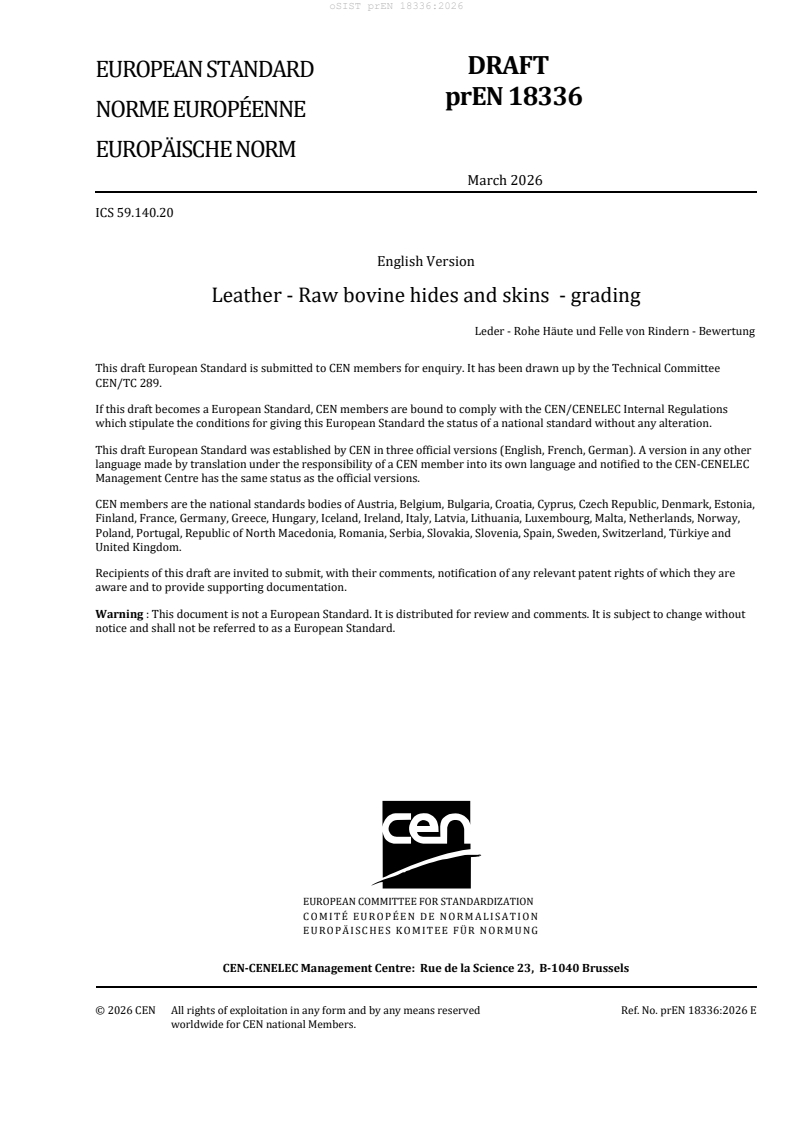
DRAFT
EUROPEAN STANDARD
prEN 18336
NORME EUROPÉENNE
EUROPÄISCHE NORM
March 2026
ICS 59.140.20
English Version
Leather - Raw bovine hides and skins - grading
Leder - Rohe Häute und Felle von Rindern - Bewertung
This draft European Standard is submitted to CEN members for enquiry. It has been drawn up by the Technical Committee
CEN/TC 289.
If this draft becomes a European Standard, CEN members are bound to comply with the CEN/CENELEC Internal Regulations
which stipulate the conditions for giving this European Standard the status of a national standard without any alteration.
This draft European Standard was established by CEN in three official versions (English, French, German). A version in any other
language made by translation under the responsibility of a CEN member into its own language and notified to the CEN-CENELEC
Management Centre has the same status as the official versions.
CEN members are the national standards bodies of Austria, Belgium, Bulgaria, Croatia, Cyprus, Czech Republic, Denmark, Estonia,
Finland, France, Germany, Greece, Hungary, Iceland, Ireland, Italy, Latvia, Lithuania, Luxembourg, Malta, Netherlands, Norway,
Poland, Portugal, Republic of North Macedonia, Romania, Serbia, Slovakia, Slovenia, Spain, Sweden, Switzerland, Türkiye and
United Kingdom.
Recipients of this draft are invited to submit, with their comments, notification of any relevant patent rights of which they are
aware and to provide supporting documentation.
Warning : This document is not a European Standard. It is distributed for review and comments. It is subject to change without
notice and shall not be referred to as a European Standard.
EUROPEAN COMMITTEE FOR STANDARDIZATION
COMITÉ EUROPÉEN DE NORMALISATION
EUROPÄISCHES KOMITEE FÜR NORMUNG
CEN-CENELEC Management Centre: Rue de la Science 23, B-1040 Brussels
© 2026 CEN All rights of exploitation in any form and by any means reserved Ref. No. prEN 18336:2026 E
worldwide for CEN national Members.
oSIST prEN 18336:2026
prEN 18336:2026 (E)
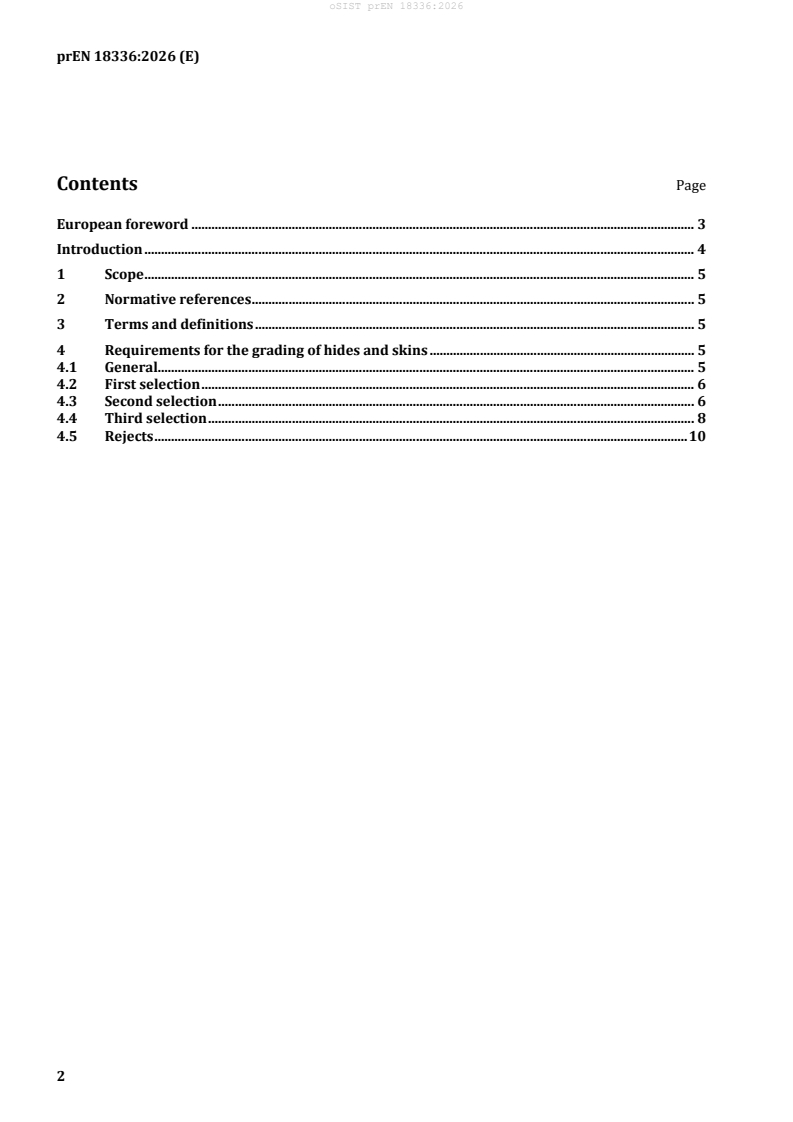
Contents Page
European foreword . 3
Introduction . 4
1 Scope . 5
2 Normative references . 5
3 Terms and definitions . 5
4 Requirements for the grading of hides and skins . 5
4.1 General. 5
4.2 First selection . 6
4.3 Second selection . 6
4.4 Third selection . 8
4.5 Rejects . 10
oSIST prEN 18336:2026
prEN 18336:2026 (E)
European foreword
This document (prEN 18336:2026) has been prepared by Technical Committee CEN/TC 289 “Leather”,
the secretariat of which is held by UNI.
This document is currently submitted to the CEN Enquiry.
oSIST prEN 18336:2026
prEN 18336:2026 (E)
Introduction
This document is intended to avoid disagreements between parties. It is the result of discussions with
representatives of agriculture, slaughterhouses, hides and skins processors and tanneries.
oSIST prEN 18336:2026
prEN 18336:2026 (E)
1 Scope
This document specifies requirements to grade hides and skins according to the defects listed in
EN 16055. It applies to raw bovine hides and skins, both fresh and salted, intended for use throughout
the leather manufa
...