

oSIST prEN ISO 4484-4:2026
(Main)Textiles and textile products - Microplastics from textile sources - Part 4: Quantitative thermal or gravimetric analysis of certain synthetic materials released from fabrics during washing (ISO/DIS 4484-4:2026)
General Information
- Abstract
This document specifies a thermal method and a gravimetric method for a quantitative determination of the certain synthetic materials (polyester, polyamide, acrylic, elastane, polypropylene and polyethylene) released from fabrics under washing test conditions.
This method is applicable to synthetic fabric and synthetic/natural blended fabric
- Synthetic/cellulosic fabrics (e.g. PET/Cotton, Nylon/Cotton, Acrylic/Cotton)
- Synthetic/protein fabrics (e.g. PET/Wool, Nylon/Wool, Acrylic/Wool)
- Status
- Not Published
- Public Enquiry End Date
- 04-Sep-2026
- Technical Committee
- ITEK - Textile and textile products
- Current Stage
- 4020 - Public enquire (PE) (Adopted Project)
- Start Date
- 14-Jul-2026
- Due Date
- 01-Dec-2026
- Completion Date
- 07-Sep-2026

Overview
oSIST prEN ISO 4484-4:2026 is an important international standard developed by SIST, focused on quantifying microplastics released from textiles during washing. The standard, part of the ISO 4484 series, specifies both thermal and gravimetric analytical methods used to determine the amount and type of certain synthetic materials-including polyester, polyamide, acrylic, elastane, polypropylene, and polyethylene-emanating from textile fabrics under laboratory washing conditions. This standard is applicable to both synthetic and blended fabric types, such as blends with cellulosic and protein fibers.
Understanding and controlling the release of microplastics from textiles play a crucial role in environmental pollution control, product quality assurance, and regulatory compliance within the textile and apparel sector.
Key Topics
Microplastics from Textile Sources: The release of small polymer-based fiber fragments (microplastics) from synthetic or blended textiles, especially during laundering.
Quantitative Analytical Methods:
- Thermal Analysis: Involves techniques such as pyrolysis-gas chromatography-mass spectrometry (Py-GC-MS) and thermo extraction desorption-gas chromatography-mass spectrometry (TED-GC-MS), primarily for polyester, polyamide, acrylic, and elastane.
- Gravimetric Analysis: Suitable for polypropylene and polyethylene, where fibers are isolated via selective dissolution and measured by mass.
Applicability:
- For both pure synthetic fabrics and blends with natural cellulosic (e.g., cotton) or protein fibers (e.g., wool).
- Includes practical procedures for sample preparation, washing, filtration, microscopic evaluation, and data reporting.
Laboratory Practices and Health & Safety: The standard provides guidance on analytical reagent grades, apparatus requirements, and safe handling of chemicals and laboratory equipment.
Applications
The use of oSIST prEN ISO 4484-4:2026 spans multiple sectors and regulatory contexts:
Environmental Monitoring and Pollution Control
Organizations can assess textile microplastic emissions and contribute to environmental protection by identifying fabric types and washing processes most prone to fiber shedding.Product Development and Eco-labeling
Textile manufacturers and brands can use the specified methods to design and market fabrics with reduced microplastic emission, supporting sustainability claims and eco-labeling programs.Quality Assurance in Textile Manufacturing
Ensures standardized testing and verification of fiber loss from textiles, which is vital for quality control in production and for responding to market demands for eco-friendly products.Regulatory Compliance
Government agencies and industry regulators reference this standard when establishing or verifying compliance with legislation related to microplastics, water pollution, and textile labeling.Research and Development
The standard supports R&D activities focused on developing low-shedding textile materials and innovative washing technologies.
Related Standards
To provide comprehensive testing and assessment in line with oSIST prEN ISO 4484-4:2026, users should refer to other relevant standards, including:
- ISO 4484-1: Specifies methods for determining the material loss from fabrics during washing.
- ISO 105-F03, F04, F05: Detail specifications for polyamide, polyester, and acrylic reference fabrics, respectively.
- ISO 3696: Outlines specifications for laboratory water.
- ISO/TR 11827: Covers identification of textile fibers.
- ISO 4484-2 and ISO 4484-3: Other parts of the microplastics test method series for textiles.
Practical Value
Adoption of oSIST prEN ISO 4484-4:2026 promotes harmonized and reliable microplastics measurement from textile sources, driving improvements in textile sustainability, aiding pollution mitigation, and helping stakeholders meet emerging regulatory and consumer expectations for environmental responsibility. This standard is an essential tool for laboratories, manufacturers, regulators, and environmental organizations working towards minimizing the environmental impact of textile-derived microplastics.
Get Certified
Connect with accredited certification bodies for this standard

BSI Group
BSI (British Standards Institution) is the business standards company that helps organizations make excellence a habit.

Bureau Veritas
Bureau Veritas is a world leader in laboratory testing, inspection and certification services.

DNV
DNV is an independent assurance and risk management provider.
Sponsored listings
Frequently Asked Questions
oSIST prEN ISO 4484-4:2026 is a draft published by the Slovenian Institute for Standardization (SIST). Its full title is "Textiles and textile products - Microplastics from textile sources - Part 4: Quantitative thermal or gravimetric analysis of certain synthetic materials released from fabrics during washing (ISO/DIS 4484-4:2026)". This standard covers: This document specifies a thermal method and a gravimetric method for a quantitative determination of the certain synthetic materials (polyester, polyamide, acrylic, elastane, polypropylene and polyethylene) released from fabrics under washing test conditions. This method is applicable to synthetic fabric and synthetic/natural blended fabric - Synthetic/cellulosic fabrics (e.g. PET/Cotton, Nylon/Cotton, Acrylic/Cotton) - Synthetic/protein fabrics (e.g. PET/Wool, Nylon/Wool, Acrylic/Wool)
This document specifies a thermal method and a gravimetric method for a quantitative determination of the certain synthetic materials (polyester, polyamide, acrylic, elastane, polypropylene and polyethylene) released from fabrics under washing test conditions. This method is applicable to synthetic fabric and synthetic/natural blended fabric - Synthetic/cellulosic fabrics (e.g. PET/Cotton, Nylon/Cotton, Acrylic/Cotton) - Synthetic/protein fabrics (e.g. PET/Wool, Nylon/Wool, Acrylic/Wool)
oSIST prEN ISO 4484-4:2026 is classified under the following ICS (International Classification for Standards) categories: 13.020.40 - Pollution, pollution control and conservation; 59.080.01 - Textiles in general. The ICS classification helps identify the subject area and facilitates finding related standards.
oSIST prEN ISO 4484-4:2026 is available in PDF format for immediate download after purchase. The document can be added to your cart and obtained through the secure checkout process. Digital delivery ensures instant access to the complete standard document.
Standards Content (Sample)
SLOVENSKI STANDARD
01-september-2026
Tekstilije in tekstilni izdelki - Mikroplastika iz tekstilnih virov - 4. del: Kvantitativna
termična ali gravimetrična analiza nekaterih sintetičnih snovi, ki se med pranjem
sproščajo iz tkanin (ISO/DIS 4484-4:2026)
Textiles and textile products - Microplastics from textile sources - Part 4: Quantitative
thermal or gravimetric analysis of certain synthetic materials released from fabrics during
washing (ISO/DIS 4484-4:2026)
Textilien und textile Erzeugnisse - Mikroplastik aus textilen Quellen - Teil 4: Quantitative
thermische oder gravimetrische Analyse bestimmter synthetischer Materialien, die beim
Waschen aus textilen Flächengebilden freigesetzt werden (ISO/DIS 4484-4:2026)
Textiles et produits textiles - Microplastiques d'origines textiles - Partie 4: Titre manque
(ISO/DIS 4484‑4:2026)
Ta slovenski standard je istoveten z: prEN ISO 4484-4
ICS:
13.020.40 Onesnaževanje, nadzor nad Pollution, pollution control
onesnaževanjem in and conservation
ohranjanje
59.080.01 Tekstilije na splošno Textiles in general
2003-01.Slovenski inštitut za standardizacijo. Razmnoževanje celote ali delov tega standarda ni dovoljeno.
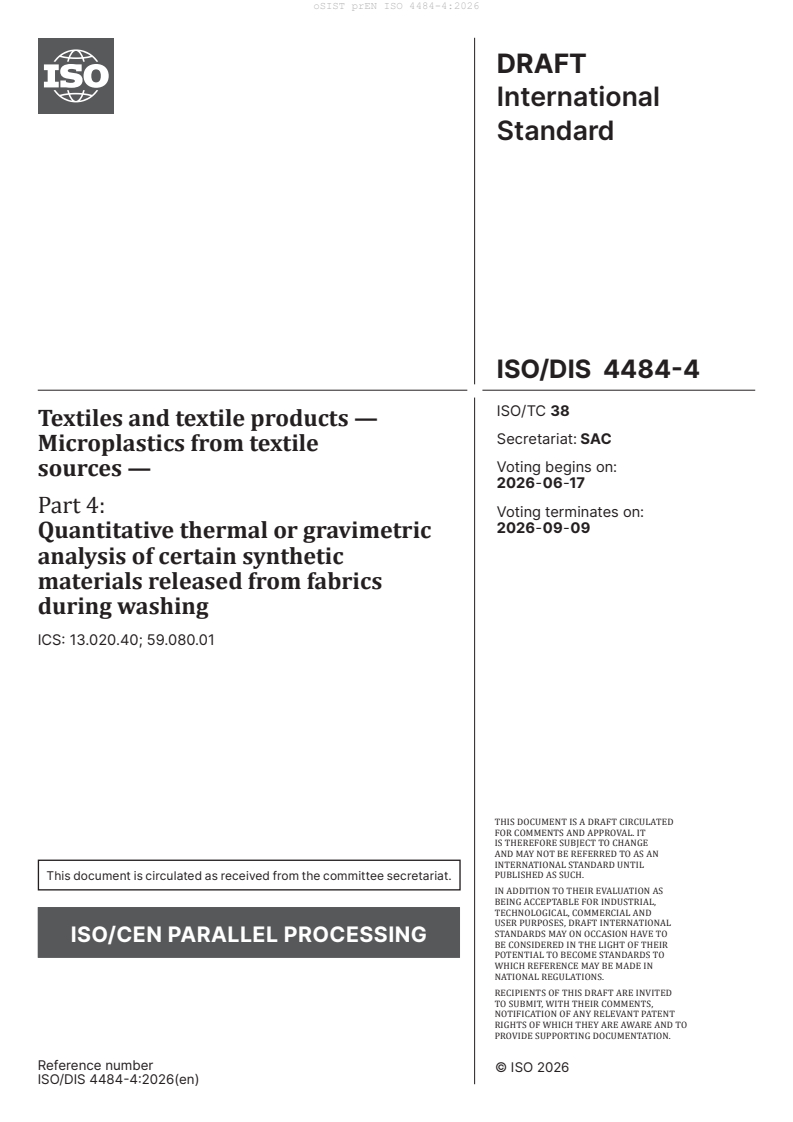
DRAFT
International
Standard
ISO/DIS 4484-4
ISO/TC 38
Textiles and textile products —
Secretariat: SAC
Microplastics from textile
Voting begins on:
sources —
2026-06-17
Part 4:
Voting terminates on:
2026-09-09
Quantitative thermal or gravimetric
analysis of certain synthetic
materials released from fabrics
during washing
ICS: 13.020.40; 59.080.01
THIS DOCUMENT IS A DRAFT CIRCULATED
FOR COMMENTS AND APPROVAL. IT
IS THEREFORE SUBJECT TO CHANGE
AND MAY NOT BE REFERRED TO AS AN
INTERNATIONAL STANDARD UNTIL
PUBLISHED AS SUCH.
This document is circulated as received from the committee secretariat.
IN ADDITION TO THEIR EVALUATION AS
BEING ACCEPTABLE FOR INDUSTRIAL,
TECHNOLOGICAL, COMMERCIAL AND
USER PURPOSES, DRAFT INTERNATIONAL
STANDARDS MAY ON OCCASION HAVE TO
ISO/CEN PARALLEL PROCESSING
BE CONSIDERED IN THE LIGHT OF THEIR
POTENTIAL TO BECOME STANDARDS TO
WHICH REFERENCE MAY BE MADE IN
NATIONAL REGULATIONS.
RECIPIENTS OF THIS DRAFT ARE INVITED
TO SUBMIT, WITH THEIR COMMENTS,
NOTIFICATION OF ANY RELEVANT PATENT
RIGHTS OF WHICH THEY ARE AWARE AND TO
PROVIDE SUPPORTING DOCUMENTATION.
Reference number
ISO/DIS 4484-4:2026(en)
DRAFT
ISO/DIS 4484-4:2026(en)
International
Standard
ISO/DIS 4484-4
ISO/TC 38
Textiles and textile products —
Secretariat: SAC
Microplastics from textile
Voting begins on:
sources —
Part 4:
Voting terminates on:
Quantitative thermal or gravimetric
analysis of certain synthetic
materials released from fabrics
during washing
ICS: 13.020.40; 59.080.01
THIS DOCUMENT IS A DRAFT CIRCULATED
FOR COMMENTS AND APPROVAL. IT
IS THEREFORE SUBJECT TO CHANGE
AND MAY NOT BE REFERRED TO AS AN
INTERNATIONAL STANDARD UNTIL
PUBLISHED AS SUCH.
This document is circulated as received from the committee secretariat.
IN ADDITION TO THEIR EVALUATION AS
BEING ACCEPTABLE FOR INDUSTRIAL,
© ISO 2026
TECHNOLOGICAL, COMMERCIAL AND
USER PURPOSES, DRAFT INTERNATIONAL
All rights reserved. Unless otherwise specified, or required in the context of its implementation, no part of this publication may
STANDARDS MAY ON OCCASION HAVE TO
ISO/CEN PARALLEL PROCESSING
be reproduced or utilized otherwise in any form or by any means, electronic or mechanical, including photocopying, or posting on
BE CONSIDERED IN THE LIGHT OF THEIR
the internet or an intranet, without prior written permission. Permission can be requested from either ISO at the address below
POTENTIAL TO BECOME STANDARDS TO
WHICH REFERENCE MAY BE MADE IN
or ISO’s member body in the country of the requester.
NATIONAL REGULATIONS.
ISO copyright office
RECIPIENTS OF THIS DRAFT ARE INVITED
CP 401 • Ch. de Blandonnet 8
TO SUBMIT, WITH THEIR COMMENTS,
CH-1214 Vernier, Geneva
NOTIFICATION OF ANY RELEVANT PATENT
Phone: +41 22 749 01 11
RIGHTS OF WHICH THEY ARE AWARE AND TO
PROVIDE SUPPORTING DOCUMENTATION.
Email: copyright@iso.org
Website: www.iso.org
Published in Switzerland Reference number
ISO/DIS 4484-4:2026(en)
ii
ISO/DIS 4484-4:2026(en)
Contents Page
Foreword .v
Introduction .vi
1 Scope . 1
2 Normative references . 1
3 Terms and definitions . 1
4 Principle . 3
5 Reagents . 3
5.3 Reference fabrics .3
5.3.1 Polyamide reference fabric (PA adjacent fabric) .3
5.3.2 Polyester reference fabric (PES adjacent fabric) .4
5.3.3 Acrylic reference fabric (PAN adjacent fabric).4
5.3.4 Elastane reference fabric (EL fabric) .4
5.4 Standard solution .4
5.4.1 Individual standard stock solutions (2 000 mg/l) .4
5.4.2 Mixed standard solution 1 (400 mg/l) .4
5.4.3 Mixed standard solution 2 (100 mg/l) .4
6 Apparatus . 5
6.1 Stainless steel filter .5
6.2 Cellulose or non-polymeric membrane filter .5
6.3 Container for filters .5
6.4 Glass micro syringes .5
6.5 Gas chromatograph – mass spectrometer equipped with a thermal accessory .5
6.6 Analytical balance .5
6.7 Analytical microbalance .6
6.8 Oven.6
6.9 Vacuum filtration device . .6
6.10 Ultrasonic bath .6
6.11 Desiccator.6
6.12 Volumetric flasks (glass) .6
6.13 Vials (glass) .6
6.14 Tweezers .6
6.15 Light microscope .6
7 Preparation of test specimen . 6
8 Procedure . 7
8.1 General .7
8.2 Microscopic observation after washing .7
8.3 Dissolution process for microparticles of polyester, polyamide, acrylic, and/or elastane .7
8.4 Purification process for polypropylene and/or polyethylene materials .8
8.5 Determination of polyester, polyamide, acrylic and elastane using Py-GC-MS and TED-
GC-MS .9
8.5.1 Calibration for Py-GC-MS and TED-GC-MS .9
8.5.2 The chromatography parameters .9
8.5.3 Identification .9
8.5.4 Quantification .9
8.5.5 Quality assessment and control .10
9 Calculation .11
9.1 Mass of microplastics released from test specimen(s) .11
9.1.1 Mass of polyester, polyamide, acrylic and elastane microplastics determined
using thermoanalytical method .11
9.1.2 Mass of polypropylene and polyethylene microplastics using gravimetric
measurements .11
iii
ISO/DIS 4484-4:2026(en)
9.2 Microplastics released from the test specimen[s] . 12
9.3 Calculation of the average for the test specimens . 12
10 Test report .12
Annex A (informative) Chromatography parameters . 14
Annex B (informative) Numerical examples of solvent effect on stainless steel filter .23
Annex C (informative) Example of commercially available standard fabrics .25
Annex D (informative) Flow chart .26
Annex E (informative) Reproducibility of the test method .27
Annex F (informative) Recovery test .29
Annex G (informative) Examination of fibre fragment release from a test specimen under a
light microscope .30
Bibliography .31
iv
ISO/DIS 4484-4:2026(en)
Foreword
ISO (the International Organization for Standardization) is a worldwide federation of national standards
bodies (ISO member bodies). The work of preparing International Standards is normally carried out through
ISO technical committees. Each member body interested in a subject for which a technical committee
has been established has the right to be represented on that committee. International organizations,
governmental and non-governmental, in liaison with ISO, also take part in the work. ISO collaborates closely
with the International Electrotechnical Commission (IEC) on all matters of electrotechnical standardization.
The procedures used to develop this document and those intended for its further maintenance are described
in the ISO/IEC Directives, Part 1. In particular, the different approval criteria needed for the different types
of ISO document should be noted. This document was drafted in accordance with the editorial rules of the
ISO/IEC Directives, Part 2 (see www.iso.org/directives).
ISO draws attention to the possibility that the implementation of this document may involve the use of (a)
patent(s). ISO takes no position concerning the evidence, validity or applicability of any claimed patent
rights in respect thereof. As of the date of publication of this document, ISO [had/had not] received notice of
(a) patent(s) which may be required to implement this document. However, implementers are cautioned that
this may not represent the latest information, which may be obtained from the patent database available at
www.iso.org/patents.ISO shall not be held responsible for identifying any or all such patent rights.
Any trade name used in this document is information given for the convenience of users and does not
constitute an endorsement.
For an explanation of the voluntary nature of standards, the meaning of ISO specific terms and expressions
related to conformity assessment, as well as information about ISO's adherence to the World Trade
Organization (WTO) principles in the Technical Barriers to Trade (TBT), see www.iso.org/iso/foreword.html.
This document was prepared by Technical Committee ISO/TC 38, Textiles.
A list of all parts in the ISO 4484 series can be found on the ISO website.
Any feedback or questions on this document should be directed to the user’s national standards body. A
complete listing of these bodies can be found at www.iso.org/members.html.
v
ISO/DIS 4484-4:2026(en)
Introduction
The purpose of this document is to outline laboratory methods for assessing the emission of microplastics
from fabrics with known fibre compositions, including polyester, polyamide, acrylic, elastane, polypropylene,
and polyethylene. The methods involve identification by microscopic observation and quantitative analysis
using thermal analysis and gravimetric analysis.
Thermal method can identify and quantify several types of microplastics. its high sensitivity and precision
allow for the detection of even trace amounts of microplasticss, making it a fast and efficient method.
vi
DRAFT International Standard ISO/DIS 4484-4:2026(en)
Textiles and textile products — Microplastics from textile
sources —
Part 4:
Quantitative thermal or gravimetric analysis of certain
synthetic materials released from fabrics during washing
1 Scope
This document specifies a method for identifying microplastics, using microscopic observation, whether the
size of captured fibre fragments released from fabrics under washing test conditions.
It also specifies a thermal method and a gravimetric method for the quantitative determination of
microplastics made of certain synthetic fibres: polyester (PES), polyamide (PA), acrylic (PAN), elastane (EL),
polypropylene (PP), and polyethylene (PE).
— The thermal methods such as pyrolysis-gas chromatography-mass spectrometry (Py-GC-MS) and
thermo extraction desorption-gas chromatography - mass spectrometry (TED-GC-MS) are applicable to
PES, PAN, PA, and EL.
— The gravimetric method is applicable to PP and PE, including blended fabrics, provided that non-PP/PE
components are dissolved by appropriate solvents so that PP and PE are isolated for quantification.
These thermal and gravimetric methods are applicable to fabrics composed of these six synthetic fibres,
either alone or in blends with other fibres (e.g., natural or non-target synthetic fibres).
Gravimetric method does not apply to:
— solvent-insoluble components (e.g., aramids) composed with polypropylene and/or polyethylene
2 Normative references
The following documents are referred to in the text in such a way that some or all of their content constitutes
requirements of this document. For dated references, only the edition cited applies. For undated references,
the latest edition of the referenced document (including any amendments) applies.
ISO 105-F03, Textiles — Tests for colour fastness — Part F03: Specification for polyamide adjacent fabric
ISO 105-F04, Textiles — Tests for colour fastness — Part F04: Specification for polyester adjacent fabric
ISO 105-F05, Textiles — Tests for colour fastness — Part F05: Specification for acrylic adjacent fabric
ISO 3696, Water for analytical laboratory use — Specification and test methods
ISO 4484-1, Textiles and textile products — Microplastics from textile sources — Part 1: Determination of
material loss from fabrics during washing
ISO/TR 11827, Textiles — Composition testing — Identification of fibres
3 Terms and definitions
For the purposes of this document, the following terms and definitions apply.
ISO/DIS 4484-4:2026(en)
ISO and IEC maintain terminological databases for use in standardization at the following addresses:
— IEC Electropedia: available at https:// www .electropedia .org/
— ISO Online browsing platform: available at https:// www .iso .org/ obp
3.1
man-made fibre
fibre obtained by a manufacturing process
[1]
[SOURCE: ISO 5157:2023 ISO 5157:2023(EN), 3.1.3.2, modified — note has been removed]
3.2
synthetic fibre
manufactured fibre made from synthetic polymers
Note 1 to entry: Synthetic fibres are made of macromolecular material which has been chemically synthesised.
[2]
[SOURCE: ISO/TR 11827:2012 , 4.2.2, modified — Additional information has been moved and
ISO 5157:2023(EN), 3.1.3.6]
3.3
natural fibre
fibre which occurs in nature
Note 1 to entry: Natural fibres can be categorized according to their origin into animal, vegetable and mineral fibre.
[3]
[SOURCE: ISO 6938:2012 , 2.1, modified – Second part of the definition given as Note 1 to entry and
ISO 5157:2023, 3.1.2.5.]
3.4
particle
minute piece of matter with defined physical boundaries
[4]
[SOURCE: ISO 26824:2022 , 3.1.1,2.1, modified – modified — Notes have been removed]
3.5
microplastic
MP
material consisting of a solid polymer containing fibre fragments, to which additives or other substances
may have been added, and where a weight fraction of ≥1% particles have:
a) all sizes 100 nm ≤ × ≤ 5 mm,
b) for fibres, a length of 300 nm ≤ × ≤ 15 mm and a length/diameter ratio >3
Note 1 to entry: Polymers that occur in nature that have not been chemically modified (other than by hydrolysis) are
excluded, as are polymers that are (bio) degradable.
[5]
[SOURCE: ISO 4484-2:2023 , 3.1.]
3.6
pyrolysis
irreversible chemical decomposition of a material due to an increase in temperature without oxidation
[6] [7] [8]
[SOURCE: ISO 8421-1:1987 , 1.44, ISO 4880:1997 , 53 and ISO 11074:2015 , 6.4.33.]
3.7
thermal decomposition
process whereby the action of heat or elevated temperature on an item causes changes in the chemical
composition
[9]
[SOURCE: ISO 472:2013 , 2.1285.]
ISO/DIS 4484-4:2026(en)
4 Principle
The test specimen is subjected to an accelerated laundering process under conditions of temperature,
time, and mechanical action in accordance with ISO 4484-1. The material released from the test specimen
during the washing process is collected by sieving and vacuum filtration. Shapes and dimensions of the fibre
fragments in the collected materials are identified by microscopic observation.
Anything that is not considered a microplastic shall be removed.
The remaining microplastics shall be treated in hexafluoro-2-propanol (HFIP) to dissolve polyester,
polyamide, acrylic and elastane. The resulting solution, dried beforehand, is used for analysis by Py-GC-MS
or TED-GC-MS.
— In Py-GC-MS, fibre fragment release dissolved in HFIP are thermally decomposed at defined temperatures
and under inert conditions. The volatile decomposition products are transferred via a high temperature
split injector into a GC-MS system with optional cryo-trapping.
— In TED-GC-MS, fibre fragment release dissolved in HFIP are heated up in a thermobalance under a
continuous nitrogen gas flow. At the outlet of the oven, a solid phase sorbent is located, collecting a
part of the decomposition products of the microplastics. After this process the solid phase sorbent is
transferred to a thermal desorption unit, in which the collected decomposition products are remobilised,
trapped, re-focused and then transferred to the GC-MS system.
For HFIP-insoluble residues, potentially composed of synthetic fibres such as polypropylene and/or
polyethylene, the mass of the residue is measured with an analytical microbalance. If natural and/or man-
made fibres are present in the insoluble fraction, these in turn shall be dissolved with a specific solvent
under appropriate conditions according to ISO/TR 11827. Subsequently, polypropylene and/or polyethylene
microplastics shall be separated by filtration, and their mass assessed gravimetrically with an analytical
microbalance. However, where polypropylene and polyethylene are blended, the gravimetric method shall
be used, resulting in the sum of the two synthetic blends.
5 Reagents
All reagents [analytical reagent grade (AR)] or their solutions and the demineralised water (5.1), shall be
filtered through filters (6.2).
NOTE Please ensure that your laboratory follow adequate and appropriate health and safety guidelines while
dealing with the chemicals described in this standard.
5.1 Demineralised water, Grade 3 quality as specified in ISO 3696.
5.2 1,1,1,3,3,3-Hexafluoro-2-propanol (HFIP), CAS No. : 920-66-1.
HFIP waste shall be disposed of in a designated container specifically for halogenated waste.
5.3 Reference fabrics
Reference fabrics are intended for use in the preparation of standard solutions for analysis by Py-GC-MS or
TED-GC-MS.
NOTE Refer to Annex C for reference fabrics that can be used as calibrants for Py-GC-MS and TED-GC-MS methods.
5.3.1 Polyamide reference fabric (PA adjacent fabric)
A standard fabric made of polyamide 6.6, shall comply withISO 105-F03 ISO 105-F03. Another fabric made of
polyamide 6 may also be selected (see Annex C).
ISO/DIS 4484-4:2026(en)
5.3.2 Polyester reference fabric (PES adjacent fabric)
A standard fabric made of polyethylene terephthalate shall comply with ISO 105-F04. Another fabric made of
polybutylene terephthalate or polytrimethylene terephthalate may also be selected.
5.3.3 Acrylic reference fabric (PAN adjacent fabric)
A standard fabric made of acrylic shall comply with ISO 105-F05.
5.3.4 Elastane reference fabric (EL fabric)
A reference fabric made of 100 % elastane should be used. If not available, a binary mixture fabric with
elastane can be used.
For fabrics of binary mixture with elastane, the complementary component can be removed using the
appropriate treatment method as described in ISO 1833 series, and the remaining elastane can be used for
the preparation of standard solutions (5.4).
NOTE Refer to Annex C for mixture binary fabrics.
5.4 Standard solution
Standard solutions shall be stored approximately at 4 °C.
5.4.1 Individual standard stock solutions (2 000 mg/l)
Weigh (20 ± 1) mg of each reference fabric, polyamide (5.3.1), polyester (5.3.2), acrylic (5.3.3) and elastane
(5.3.4), and record the mass to the nearest 0,1 mg, and transfer each into a separate 10 ml volumetric flask
(6.12) using the balance (6.6).
Add a small amount of HFIP (5.2) to dissolve reference fabrics, sonicate if necessary, and then fill up to the
mark with HFIP (5.2).
5.4.2 Mixed standard solution 1 (400 mg/l)
Add 2,0 ml of each individual standard stock solutions (5.4.1) into a 10 ml volumetric flask (6.12) and fill up
to the mark with HFIP (5.2 ).
5.4.3 Mixed standard solution 2 (100 mg/l)
Add 2,5 ml of mixed standard solution 1 (5.4.2) to a 10 ml volumetric flask (6.12) and fill up to the mark with
HFIP (5.2).
5.5 70 % Sulfuric acid solution, CAS No. : 7664-93-9.
Add carefully, while cooling, 400 ml of concentrated sulfuric acid (ρ 1,840 g/ml) to 267 ml of demineralised
water (5.1).
5.6 Sodium hypochlorite (NaOCl), 0,9 mol/l ~ 1,1 mol/l solution, CAS No. 7681-52-9.
Sodium hypochlorite solution containing (35 ± 2) g/l of active chlorine (approximately 1 mol/l) to which (5
± 0,5) g/l of previously dissolved sodium hydroxide is added.
The active chlorine content of the solution shall be checked iodometrically but its concentration is not critical
within the range 0,9 mol/l to 1,1 mol/l.
ISO/DIS 4484-4:2026(en)
5.7 1 % Ammonium hydroxide solution, CAS No. : 1336-21-6.
Ammonium hydroxide solution (approximately 28 %) is diluted with demineralised water (5.1) to make a
solution of approximately 1 % ammonium hydroxide (ρ 0,993 g/ml at 25 ℃).
5.8 Acetic acid solution, CAS No. : 64-19-7.
5 ml of glacial acetic acid is diluted with demineralised water (5.1) to a total volume of 1 l.
6 Apparatus
6.1 Stainless steel filter
A stainless-steel filter with a pore size of 1,0 μm and a diameter of 25 mm shall be used.
The filter has to be resistant to treatment with 70 % sulfuric acid (5.5) and NaOCl solution (5.6) in the way
they are used in sub-clause 8.4. This should be demonstrated. Numerical examples of results are given in
Annex B.
6.2 Cellulose or non-polymeric membrane filter
A cellulose or other non-polymeric membrane filter with a pore size of no more than 0,45 μm shall be used to
filter all reagents and demineralised water (5.1).
6.3 Container for filters
An aluminium pans/specimen tray (non-plastic) with a minimum diameter of 25 mm, having a lid, shall be
used to store filter when it is not in use in the filter assembly.
6.4 Glass micro syringes
The syringes shall have a capacity ranging from 10,0 μl to 100,0 μl, and shall be capable of accurately
delivering the specified volumes.
6.5 Gas chromatograph – mass spectrometer equipped with a thermal accessory
— a gas chromatograph – mass spectrometer equipped with pyrolyzer accessory :
A split/splitless inlet and a programmable temperature controlled oven. The mass spectrometer shall be able
to perform selected ion monitoring (SIM) and a total ion current (“full scan”). The ionization chamber and
pyrolyzer sample cup shall be made of chemically inert materials (e.g. stainless steel, quartz, or deactivated
metal). A 70 eV energy shall be applied in electron ionization (EI) mode.
— a gas chromatograph – mass spectrometer equipped with the thermo extraction desorption accessory
for TED-GC-MS :
The system shall allow thermal extraction and desorption of volatile components from the sample at
controlled heating rates. A thermogravimetric analyser (TGA) coupled with a thermal desorption unit (TDU)
may be used. The released volatile components shall be transferred to the GC–MS for analysis under defined
conditions.
6.6 Analytical balance
The balance shall be used for specimen measurement and shall have a resolution of 0,1 mg or better.
ISO/DIS 4484-4:2026(en)
6.7 Analytical microbalance
The microbalance shall be used for measuring microplastics released from test specimens and shall have a
resolution of 0,001 mg or better.
6.8 Oven
The oven shall be capable of maintaining a temperature of (50 ± 3 )°C without air circulation.
6.9 Vacuum filtration device
The vacuum filtration device shall consist of a non-plastic sintered filter support and a cylindrical glass
or stainless-steel funnel connected to a suitable vacuum source. It shall be suitable for use with 25 mm
diameter filters (6.1).
6.10 Ultrasonic bath
The ultrasonic bath shall have an adjustable temperature suitable for operation at about 60 °C.
NOTE The referring frequency range should be of 0,5 MHz to 15 MHz, from ISO OBP.
6.11 Desiccator
A desiccant such as silica gel, indicating silica gel, or another desiccant capable of maintaining a low-humidity
environment shall be placed inside the desiccator.
6.12 Volumetric flasks (glass)
Volumetric flasks made of glass shall be used (e.g., volumes of 10 ml, 100 ml and 1 000 ml).
6.13 Vials (glass)
Vials made of glass, free from interfering compounds, shall be used (e.g., with a volume of 20 ml).
6.14 Tweezers
Round-nosed tweezers, non-serrated, shall be used.
6.15 Light microscope
A light microscope suitable for the evaluation of mass loss or microparticle dimensions shall be used.
The microscope may involve the use of projection microscopes or visual microscopic image analysers.
Transmitted-light microscopes with a direct graduated scale and equipped with an optical lens are also
applicable.
7 Preparation of test specimen
For each laboratory sample, prepare a set of test specimens according to ISO 4484-1, Clause 7. Each set shall
consist of a minimum of four specimens: two with their long dimension parallel to the warp (longitudinal)
direction and two parallel to the weft (transverse) direction. Specimens for a given fabric direction shall be
spaced along a diagonal of the fabric to ensure that each specimen represents different warp and weft yarns,
as well as machine and cross direction areas of the fabric.
Subsequently, the prepared specimens shall undergo the procedures described in ISO 4484-1, Clause 8,
including determination of dry mass of test specimens (ISO 4484-1, 8.1), filter preparation (ISO 4484-1, 8.2),
determination of dry mass of the filter (ISO 4484-1, 8.3), washing process (ISO 4484-1, 8.4) and filtration
process (ISO 4484-1, 8.5).
ISO/DIS 4484-4:2026(en)
8 Procedure
8.1 General
The sample to analyse fibre fragment release is carried out in accordance with ISO 4484-1, Clause 8.
During this process, record the mass of the filter/tray combination before (Ml ) as described in ISO 4484-1,
Clause 8.3, and after (Ml ) the filtration process, including washing as described in ISO 4484-1, Clause 8.5.
The filter to be applied is specified in section 6.1. Then visually inspect the filter as specified in section 8.2.
8.2 Microscopic observation after washing
Remove the cover of the dried filter/tray combibation and place it on the stage of light microscope (6.15).
Attach an eyepiece micrometer to the eyepiece lens of the light microscope and an objective micrometer to
the objective lens. Then, determine the size of one division of the eyepiece micrometer in micrometers (µm).
Visually inspect the captured fibre fragments on the filter and select those that appear to be larger or
potentially outside the defined microparticle range.
Carefully measure the longest visible dimension (length) and the shortest perpendicular dimension
(diameter or width) of each particle by the microscopic observation and calculate the length-to-diameter
ratio. See an example in Annex G.
Compare the measurements to the microparticle criteria (pyrolysis), refer to the minimum and maximum
size thresholds. If a particle is confirmed not to meet the criteria, remove it from the filter. If removal is
performed, record the mass of the filter/tray combination (Ml ) measured in clause 8.1 again. The mass of
microplastics collected on all four filters of a set shall be consistent and within ±25 %. If this condition is not
met, the preparation of the test specimens shall be repeated in accordance with clause 7.
Capture images of the fibre fragments and record the captured image together with the measured
dimensions.
If fibre fragment released are tangled and difficult to distinguish, use tweezers with low static electricity
to untangle it and measure the size and length-to-diameter ratio. If fibre fragment release adheres to the
tweezers, rinse the tweezers with drops of distilled water on the stainless steel filter after microscopic
analysis. It is important that the water has been filtered to remove any contaminants and/or that it has been
assessed separately for contamination and accounted for in calculation.
8.3 Dissolution process for microparticles of polyester, polyamide, acrylic, and/or elastane
Prepare a new filter/tray combination, which will be used to measure the mass of the HFIP-insoluble residue,
and measure the mass (Ml ) up to 0,001 mg using a microbalance (6.7), and record it.
Place the filter (6.1) containing the remaining microplastics collected after the procedure in 8.2 into a 20 mL
glass vial (6.13) and add 10 mL of HFIP (5.2).
Perform ultrasonication at room temperature for 1 hour using an ultrasonic bath (6.10), ensuring that the
temperature does not exceed 40 °C, to dissolve microplastics of polyester, polyamide, acrylic and elastane.
Use tweezers (6.14) to place a filter (6.1) previously used to measure Ml into the vacuum filtration device
(6.9) and filter the obtained solution. Through this process, collect the HFIP- insoluble residue.
After filtration, separate the flask containing the filtered solution from the vacuum filtration device and
transfer the solution into a new glass vial (6.13).
Reassemble the flask with the filtration device and rinse the interior of the filtration device three times
with demineralised water (5.1). Subsequently, rinse the funnel of the filtration device three times with
demineralised water (5.1) and transfer the filter (6.1) from the vacuum filtration device to the tray (6.3) for
mass measurement.
ISO/DIS 4484-4:2026(en)
The filtered solution in the glass vial is used for thermoanalytical method such as Py-GC-MS and TED-GC-
MS, while the HFIP-insoluble residue is used for gravimetric measurement of microplastics of polypropylene
and/or polyethylene.
8.4 Purification process for polypropylene and/or polyethylene materials
For test specimens composed exclusively of polypropylene and/or polyethylene or blended with natural
and/or other fibres (excluding polyester, polyamide, acrylic, and elastane), use the filter after microscopic
observation (8.2) to dissolve the natural and/or other fibres. For test specimens composed of polypropylene
and/or polyethylene mixed with polyester, polyamide, acrylic, and/or elastane components, perform the
following steps.
Dry the filter/tray combination containing the HFIP-insoluble residue in an oven (6.8) at (50 ± 3) °C to reach
a constant mass for more than 4 hours.
After drying, cool each filter/tray sufficiently in a desiccator (6.11), then measure the mass (Ml ) up to 0,001
mg using a microbalance (6.7), and record it.
Place the filter containing the the HFIP-insoluble residue in a 20 mL glass vial (6.13) and add 10 mL of an
appropriate solvent capable of dissolving natural and/or other fibres, referring to Table 1. If natural and/
or other fibres are blended, for example, a mixture of cellulose-based and protein-based fibres, repeat the
dissolution steps for each fibre type. The solvents used for dissolving natural and/or other fibres may be
selected according to ISO/TR 11827, in addition to Table 1.
Table 1 — Example of solvents for dissolving natural and/or other fibres
a
Cellulose fibres Protein fibres
substances
e.g. cotton, linen, viscose e.g. wool, silk
solvent 70 % sulfuric acid solution (5.5 ) NaOCl solution (5.6)
a
Solvents such as acetone can remove a type of acetate.
Periodically check the porosity of the filters to determine whether the use of acid and hypochlorite affects
their porosity over time.
Close the lid of the 20 mL glass vial and use an ultrasonic bath (6.10), ensuring that the temperature does not
exceed 40 °C, to dissolve natural and/or other fibres for at least 1 hour.
Prepare a new filter/tray combination and measure the mass (Ml ) up to 0.001 mg using a microbalance
(6.7), and record it. This filter/tray combination is intended to measure the mass of polypropylene and/or
polyethylene microplastics remaining from the dissolution of natural and/or other fibres.
Use tweezers (6.14) to place a new filter (6.1) into the vacuum filtration device (6.9) and filter the dissolved
solution. Use the tweezers to remove the filter from the vial and rinse it three times with the solvent used
for dissolving natural and/or other fibres. Through this process, collect polypropylene and/or polyethylene
microplastics. For cellulose-based fibres, neutralize the insoluble materials with ammonia dilution solution
(5.7), and for protein-based fibres, neutralize the insoluble materials with acetic acid dilution solution (5.8).
Rinse the insoluble materials after vacuum filtration with demineralised water (5.1).
Rinse the funnel of the filtration device (6.9) three times with the demineralised water (5.1), and transfer the
filter from the vacuum filtration device to the tray (6.3) for mass measurement. Adding demineralised water
(5.1) to sulfuric acid is highly dangerous, so be careful to replace the empty suction bottle with caution after
sulfuric acid filtration or discard the contents.
NOTE Acidic or alkaline vapors are generated during vacuum filtration, so be sure to perform the procedure
under a hood.
Dry the filter/tray combination containing the remaining filtered microplastics in an oven (6.8) at (50 ± 3)
°C to reach a constant mass for more than 4 hours.
After drying, cool each filter/tray sufficiently in a desiccator (6.11), then measure the mass (Ml ) up to 0,001
mg using a microbalance (6.7), and record it.
ISO/DIS 4484-4:2026(en)
8.5 Determination of polyester, polyamide, acrylic and elastane using Py-GC-MS and TED-
GC-MS
Using a microsyringe (6.4), individually take 50 μl of test sample solution (8.3) into the Py-GC-MS or TED-
GC-MS sample cup, dry for at least 1 hour at (50 ± 3) °C, then perform analysis. The drying step is performed
separately for each test sample (4 specimens) to reduce the risk of cross-contamination in the oven.
NOTE Refer to Annex A.
8.5.1 Calibration for Py-GC-MS and TED-GC-MS
For each microparticle to be analysed, prepare at the least 4 calibration solutions from mixed standard
solutions (5.4.2 and 5.4.3), at suitable concentrations for the analysis, for example in the range of 0,001 mg
to 0,040 mg.
Examples of calibration solutions are shown in Table 2.
Table 2 — Example of calibration standard solution
Concentration of each Volume of each standard
Mass in the sample cup
standard solution solution
No.
mg
mg/l μl
1 10 0,001
2 100 20 0,002
3 50 0,005
4 25 0,010
5 400 50 0,020
6 100 0,040
NOTE I
...