

SIST EN 50160:2023
(Main)Voltage characteristics of electricity supplied by public distribution networks
- Abstract
1.1 Application
This document specifies the main characteristics of the voltage at a network user's supply terminals in public low voltage, medium, high, and extra-high voltage AC electricity networks under normal operating conditions. This document specifies the limits or values within which the voltage characteristics can be expected to remain at any supply terminal in public European electricity networks, only. Industrial networks are excluded from the scope of EN 50160.
NOTE 1 If non-public networks (e.g. residential quarters, energy communities, office centres, shopping centres) have similar end-users as public networks, it is strongly advised to apply the same requirements as for public networks.
This document does not apply under abnormal operating conditions, including the following:
a) a temporary supply arrangement to keep network users supplied during conditions arising as a result of a fault, maintenance and construction work, or to minimize the extent and duration of a loss of supply;
b) in the case of non-compliance of a network user's installation or equipment with the relevant standards or with the technical requirements for connection, established either by the public authorities or the network operator, including the limits for the emission of conducted disturbances;
NOTE 2 A network user’s installation can include load and generation.
c) in exceptional situations, in particular:
1) exceptional weather conditions and other natural disasters;
2) third party interference;
3) acts by public authorities,
4) industrial actions (subject to legal requirements);
5) force majeure;
6) power shortages resulting from external events.
The voltage characteristics given in this document refer to conducted disturbances in public electric power networks. They are not intended to be used as electromagnetic compatibility (EMC) levels or product emission limits.
Power quality is related to EMC in several ways – especially because compliance with power quality requirements depends on the control of cumulative effect of electromagnetic emissions from all/multiple equipment and/or installations. Therefore, the voltage characteristics given in this document gives guidance for specifying requirements in equipment product standards and in installation standards.
NOTE 3 The performance of equipment might be impaired if it is subjected to supply conditions which are not specified in the equipment product standard.
NOTE 4 This document can be superseded in total or in part by the terms of a contract between the individual network user and the network operator.
The sharing of complaint management and problem mitigation costs between the involved parties is outside the scope of EN 50160.
Measurement methods to be applied in this document are described in EN 61000-4-30.
[...]
- Status
- Published
- Publication Date
- 02-Feb-2023
- Technical Committee
- NTF - Electricity energy supply systems
- Current Stage
- 6100 - Translation of adopted SIST standards (Adopted Project)
- Start Date
- 06-Mar-2024
- Due Date
- 05-Mar-2025
- Completion Date
- 08-Jun-2026
Buy Documents




SIST EN 50160:2023 is the Slovenian adoption of EN 50160:2022 from CENELEC. It specifies the voltage characteristics that network users can expect at the supply terminals of public AC electricity networks, for low, medium, high and extra-high voltage systems under normal operating conditions. The document is used to describe supply quality for public networks, not to set product emission limits or EMC levels.
What does SIST EN 50160:2023 specify?
SIST EN 50160:2023 specifies the main characteristics of the supply voltage at a network user’s supply terminals in public European electricity networks. It focuses on public networks only, and it frames what can normally be expected at the point of supply under normal operating conditions.
The scope excludes industrial networks and abnormal operating conditions such as temporary supply arrangements, non-compliant installations, and exceptional events like major weather damage, third-party interference, public authority actions, industrial action, force majeure, and external power shortages. The document also states that its voltage characteristics are not intended as EMC levels or product emission limits.
The standard is organized into one scope clause, one clause on normative references, one clause on terms and definitions, and separate clauses for low-, medium-, high- and extra-high-voltage supply characteristics. It also includes five informative annexes.
| Annex | What it covers |
|---|---|
| Annex A | Special nature of electricity |
| Annex B | Indicative values for voltage events and single rapid voltage changes |
| Annex C | Additional information relating to other phenomena |
| Annex D | Relationship between Power Quality and EMC |
| Annex E | A-deviations |
What are the key requirements of SIST EN 50160:2023?
SIST EN 50160:2023 sets expectations for supply voltage quality by network level, by phenomenon, and by how the values are to be interpreted in practice. The document separates continuous phenomena, voltage events, and other phenomena, and it uses EN 61000-4-30 for the measurement methods.
Network level and voltage reference
For public low-voltage networks, SIST EN 50160:2023 uses a nominal voltage of 230 V, either between phase and neutral or between phases depending on the system. For medium voltage, high voltage and extra-high voltage, the clauses define the upper voltage ranges covered by the standard, up to 36 kV, 150 kV and 800 kV respectively.
This matters because the same power quality rules are not applied to every voltage level in the same way. A buyer, operator or tester needs to start with the correct network class and reference voltage before judging compliance or expected performance.
Power frequency
SIST EN 50160:2023 gives power frequency limits for normal operation across LV, MV, HV and EHV systems. The standard uses a 99.5% annual band around 50 Hz, a wider 100% band, and separate ranges for systems without synchronous connection to an interconnected system.
In practice, this is the basic frequency quality benchmark for public supply. It tells operators and users how often the frequency may move away from nominal values and still remain within the standard’s expectations.
Continuous voltage quality
SIST EN 50160:2023 addresses supply voltage variations, rapid voltage changes, flicker severity, voltage unbalance, harmonic voltage and interharmonic voltage in the continuous-phenomena clauses. For some of these, the document gives fixed limits; for single rapid voltage changes and some voltage events, it gives indicative values rather than hard limits.
That distinction matters because not every disturbance is treated the same way. Engineers have to know whether they are checking a firm requirement or using indicative values for comparison and investigation.
Voltage events
SIST EN 50160:2023 treats interruptions, dips, swells and transient overvoltages as voltage events. It defines a supply interruption as a condition where voltage at the supply terminals falls below 5% of the reference voltage, and it classifies accidental interruptions as short or long depending on whether they last up to 3 minutes or longer.
The document also defines a voltage dip as a temporary reduction below a 90% start threshold, and a voltage swell as a temporary increase above a 110% start threshold. Both are treated as time-dependent events, with durations from 10 ms up to 1 minute.
Other phenomena and mains communication
SIST EN 50160:2023 includes a separate treatment of other phenomena connected with mains communicating systems (MCS) and equipment using switch-mode technology. Annex C extends this to the frequency range 2 kHz to 150 kHz and points readers to time-domain and frequency-domain measurement approaches.
This is important where modern loads and signal injection can affect power quality in ways that are not captured by the classic 50 Hz view alone. The standard also links this area to EMC and immunity test standards.
Clause structure by voltage level
SIST EN 50160:2023 repeats the same structure for LV, MV, HV and EHV supply characteristics. Each level has general text, continuous phenomena, voltage events, and other phenomena, so the reader can go directly to the relevant network class.
What terms does SIST EN 50160:2023 define?
SIST EN 50160:2023 defines the terms that anchor its scope and measurements.
- Public electric power network - a network that any network user can access and that is operated by a regulated or licensed operator.
- Point of supply (POS) - the contractually fixed supply terminal where energy is exchanged between contractual partners; this is the point where the standard applies in practice.
- Network operator - the party responsible for operating, maintaining and developing the supply network in an area.
- Network user - a party supplied by, or supplying to, an electricity supply network.
- Power quality (PQ) - the characteristics of electricity at a point on the system, assessed against reference technical parameters.
- Conducted disturbance - an electromagnetic phenomenon propagated along the line conductors of a supply network.
- Voltage dip - a temporary reduction of rms voltage below the dip start threshold.
- Mains communicating system (MCS) - an electrical system that uses signals to transmit information on electricity supply systems.
Who uses SIST EN 50160:2023?
SIST EN 50160:2023 is used by network operators, network users, equipment manufacturers, and the authors of product and installation standards. It is also relevant to measurement specialists who need to check supply quality using EN 61000-4-30 methods.
In practice, it supports supply contracts, network quality monitoring, investigation of complaints, and the definition of voltage-related requirements for connected equipment. It is also useful in public low-, medium-, high- and extra-high-voltage networks where supply characteristics need to be described in a common technical language.
What changed in SIST EN 50160:2023 from the previous edition?
SIST EN 50160:2023 replaces SIST EN 50160:2011 and its amendments and corrigendum, and it is identical to EN 50160:2022. The foreword lists these significant technical changes compared with EN 50160:2010:
- implementation of amendments A2 and A3, including the new 2 kHz to 150 kHz range and the change to the 15th and 21st harmonic in LV
- slight modification of the Norway A-deviation
- clarifications in the scope
- a new clause for extra high voltage
- clarification of dips and swells
- a new Annex D on the relationship between Power Quality and EMC
Which standards are used with SIST EN 50160:2023?
SIST EN 50160:2023 relies on EN 61000-4-30 for the measurement methods used throughout the document. It also points to related standards and reports that support specific phenomena and test conditions.
- EN 61000-4-30 - power quality measurement methods
- EN 61000-4-15 - flickermeter functional and design specifications
- EN 61000-4-16 and EN 61000-4-19 - immunity tests for conducted disturbances and signalling in the 2 kHz to 150 kHz range
- EN 61000-4-34 - immunity tests for voltage dips, short interruptions and voltage variations for equipment above 16 A per phase
- EN IEC 61000-6-1 and EN IEC 61000-6-2 - generic immunity standards for residential/commercial/light-industrial and industrial environments
- IEC 60038 - standard voltages
- IEC 60364-4-44 and IEC 60364-5-53 - protection against voltage disturbances and selection of protective and switching equipment
- IEC/TR 61000-2-8, IEC/TR 61000-2-14 and IEC/TR 61000-3-7 - statistical data, overvoltages and fluctuating-load assessment
- IEC/TS 62578 - design recommendations for active infeed converter emissions below 150 kHz
What does the SIST EN 50160:2023 document contain?
SIST EN 50160:2023 contains the clause-by-clause description of supply characteristics for LV, MV, HV and EHV networks, plus informative annexes that help interpret events and compare them with EMC concepts. Annex B gives guidance on using indicative values for interruptions, dips, swells and rapid voltage changes, while Annex C explains the 2 kHz to 150 kHz phenomenon range and recommends combining time-domain and frequency-domain measurements.
Annex D provides a structured comparison between Power Quality and EMC, including a table and a schematic figure that explain why the two subjects are related but not identical. Annex E records national A-deviations, with Norway listed in the document.
Relations
- Effective Date
- 20-Dec-2022
- Replaces
SIST EN 50160:2011 - Voltage characteristics of electricity supplied by public distribution networks - Effective Date
- 20-Dec-2022
- Effective Date
- 20-Dec-2022
- Effective Date
- 20-Dec-2022
- Effective Date
- 20-Dec-2022
- Effective Date
- 03-Feb-2026
- Effective Date
- 09-Feb-2026
- Effective Date
- 09-Feb-2026
- Effective Date
- 09-Feb-2026
- Effective Date
- 03-Feb-2026
- Effective Date
- 03-Feb-2026
- Effective Date
- 03-Feb-2026
- Effective Date
- 03-Feb-2026
- Effective Date
- 03-Feb-2026
- Effective Date
- 03-Feb-2026
Buy Documents
Get Certified
Connect with accredited certification bodies for this standard

IMQ S.p.A. (Certification)
Italian electrical product certification.

SLG Prüf- und Zertifizierungs GmbH
German testing and certification body.

UL Solutions
Global safety science company with testing, inspection and certification.
Sponsored listings
Frequently Asked Questions
SIST EN 50160:2023 is a standard published by the Slovenian Institute for Standardization (SIST). Its full title is "Voltage characteristics of electricity supplied by public distribution networks". This standard covers: 1.1 Application This document specifies the main characteristics of the voltage at a network user's supply terminals in public low voltage, medium, high, and extra-high voltage AC electricity networks under normal operating conditions. This document specifies the limits or values within which the voltage characteristics can be expected to remain at any supply terminal in public European electricity networks, only. Industrial networks are excluded from the scope of EN 50160. NOTE 1 If non-public networks (e.g. residential quarters, energy communities, office centres, shopping centres) have similar end-users as public networks, it is strongly advised to apply the same requirements as for public networks. This document does not apply under abnormal operating conditions, including the following: a) a temporary supply arrangement to keep network users supplied during conditions arising as a result of a fault, maintenance and construction work, or to minimize the extent and duration of a loss of supply; b) in the case of non-compliance of a network user's installation or equipment with the relevant standards or with the technical requirements for connection, established either by the public authorities or the network operator, including the limits for the emission of conducted disturbances; NOTE 2 A network user’s installation can include load and generation. c) in exceptional situations, in particular: 1) exceptional weather conditions and other natural disasters; 2) third party interference; 3) acts by public authorities, 4) industrial actions (subject to legal requirements); 5) force majeure; 6) power shortages resulting from external events. The voltage characteristics given in this document refer to conducted disturbances in public electric power networks. They are not intended to be used as electromagnetic compatibility (EMC) levels or product emission limits. Power quality is related to EMC in several ways – especially because compliance with power quality requirements depends on the control of cumulative effect of electromagnetic emissions from all/multiple equipment and/or installations. Therefore, the voltage characteristics given in this document gives guidance for specifying requirements in equipment product standards and in installation standards. NOTE 3 The performance of equipment might be impaired if it is subjected to supply conditions which are not specified in the equipment product standard. NOTE 4 This document can be superseded in total or in part by the terms of a contract between the individual network user and the network operator. The sharing of complaint management and problem mitigation costs between the involved parties is outside the scope of EN 50160. Measurement methods to be applied in this document are described in EN 61000-4-30. [...]
1.1 Application This document specifies the main characteristics of the voltage at a network user's supply terminals in public low voltage, medium, high, and extra-high voltage AC electricity networks under normal operating conditions. This document specifies the limits or values within which the voltage characteristics can be expected to remain at any supply terminal in public European electricity networks, only. Industrial networks are excluded from the scope of EN 50160. NOTE 1 If non-public networks (e.g. residential quarters, energy communities, office centres, shopping centres) have similar end-users as public networks, it is strongly advised to apply the same requirements as for public networks. This document does not apply under abnormal operating conditions, including the following: a) a temporary supply arrangement to keep network users supplied during conditions arising as a result of a fault, maintenance and construction work, or to minimize the extent and duration of a loss of supply; b) in the case of non-compliance of a network user's installation or equipment with the relevant standards or with the technical requirements for connection, established either by the public authorities or the network operator, including the limits for the emission of conducted disturbances; NOTE 2 A network user’s installation can include load and generation. c) in exceptional situations, in particular: 1) exceptional weather conditions and other natural disasters; 2) third party interference; 3) acts by public authorities, 4) industrial actions (subject to legal requirements); 5) force majeure; 6) power shortages resulting from external events. The voltage characteristics given in this document refer to conducted disturbances in public electric power networks. They are not intended to be used as electromagnetic compatibility (EMC) levels or product emission limits. Power quality is related to EMC in several ways – especially because compliance with power quality requirements depends on the control of cumulative effect of electromagnetic emissions from all/multiple equipment and/or installations. Therefore, the voltage characteristics given in this document gives guidance for specifying requirements in equipment product standards and in installation standards. NOTE 3 The performance of equipment might be impaired if it is subjected to supply conditions which are not specified in the equipment product standard. NOTE 4 This document can be superseded in total or in part by the terms of a contract between the individual network user and the network operator. The sharing of complaint management and problem mitigation costs between the involved parties is outside the scope of EN 50160. Measurement methods to be applied in this document are described in EN 61000-4-30. [...]
SIST EN 50160:2023 is classified under the following ICS (International Classification for Standards) categories: 29.020 - Electrical engineering in general; 29.240.01 - Power transmission and distribution networks in general. The ICS classification helps identify the subject area and facilitates finding related standards.
SIST EN 50160:2023 has the following relationships with other standards: It is inter standard links to SIST EN 50160:2011/A3:2019, SIST EN 50160:2011, SIST EN 50160:2011/A2:2019, SIST EN 50160:2011/AC:2013, SIST EN 50160:2011/A1:2015, SIST EN 61000-4-30:2015, SIST EN 15267-3:2024, SIST EN 15267-4:2024, SIST EN 16644:2015, SIST-TS CLC/TS 50457-1:2008, SIST EN 50546:2020, SIST EN 50438:2008, SIST EN 50090-5-1:2020, SIST-TP CLC/TR 50646:2018, SIST-TS CLC/TS 50740:2025. Understanding these relationships helps ensure you are using the most current and applicable version of the standard.
SIST EN 50160:2023 is associated with the following European legislation: EU Directives/Regulations: TP117, TP253. When a standard is cited in the Official Journal of the European Union, products manufactured in conformity with it benefit from a presumption of conformity with the essential requirements of the corresponding EU directive or regulation.
SIST EN 50160:2023 is available in PDF format for immediate download after purchase. The document can be added to your cart and obtained through the secure checkout process. Digital delivery ensures instant access to the complete standard document.
Standards Content (Sample)
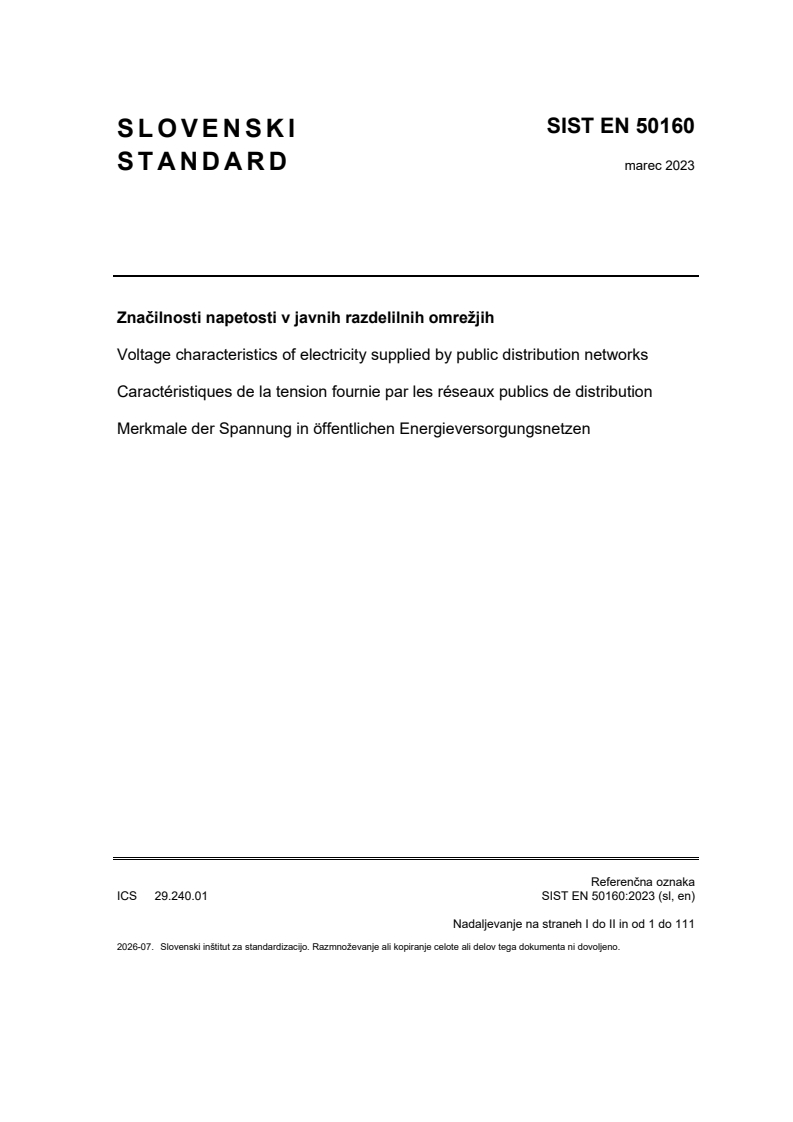
SLOVENSKI STANDARD
01-marec-2023
Nadomešča:
SIST EN 50160:2011
SIST EN 50160:2011/A1:2015
SIST EN 50160:2011/A2:2019
SIST EN 50160:2011/A3:2019
SIST EN 50160:2011/AC:2013
Značilnosti napetosti v javnih razdelilnih omrežjih
Voltage characteristics of electricity supplied by public distribution networks
Merkmale der Spannung in öffentlichen Energieversorgungsnetzen
Caractéristiques de la tension fournie par les réseaux publics de distribution
Ta slovenski standard je istoveten z: EN 50160:2022
ICS:
29.240.01 Omrežja za prenos in Power transmission and
distribucijo električne energije distribution networks in
na splošno general
2003-01.Slovenski inštitut za standardizacijo. Razmnoževanje celote ali delov tega standarda ni dovoljeno.
EUROPEAN STANDARD EN 50160
NORME EUROPÉENNE
EUROPÄISCHE NORM December 2022
ICS 29.020 Supersedes EN 50160:2010;
EN 50160:2010/corrigendum Dec. 2010;
EN 50160:2010/AC:2012; EN 50160:2010/A1:2015;
EN 50160:2010/A2:2019; EN 50160:2010/A3:2019
English Version
Voltage characteristics of electricity supplied by public electricity
networks
Caractéristiques de la tension fournie par les réseaux Merkmale der Spannung in öffentlichen
publics d´electricité Energieversorgungsnetzen
This European Standard was approved by CENELEC on 2022-11-07. CENELEC members are bound to comply with the CEN/CENELEC
Internal Regulations which stipulate the conditions for giving this European Standard the status of a national standard without any alteration.
Up-to-date lists and bibliographical references concerning such national standards may be obtained on application to the CEN-CENELEC
Management Centre or to any CENELEC member.
This European Standard exists in three official versions (English, French, German). A version in any other language made by translation
under the responsibility of a CENELEC member into its own language and notified to the CEN-CENELEC Management Centre has the
same status as the official versions.
CENELEC members are the national electrotechnical committees of Austria, Belgium, Bulgaria, Croatia, Cyprus, the Czech Republic,
Denmark, Estonia, Finland, France, Germany, Greece, Hungary, Iceland, Ireland, Italy, Latvia, Lithuania, Luxembourg, Malta, the
Netherlands, Norway, Poland, Portugal, Republic of North Macedonia, Romania, Serbia, Slovakia, Slovenia, Spain, Sweden, Switzerland,
Türkiye and the United Kingdom.
European Committee for Electrotechnical Standardization
Comité Européen de Normalisation Electrotechnique
Europäisches Komitee für Elektrotechnische Normung
CEN-CENELEC Management Centre: Rue de la Science 23, B-1040 Brussels
© 2022 CENELEC All rights of exploitation in any form and by any means reserved worldwide for CENELEC Members.
Ref. No. EN 50160:2022 E
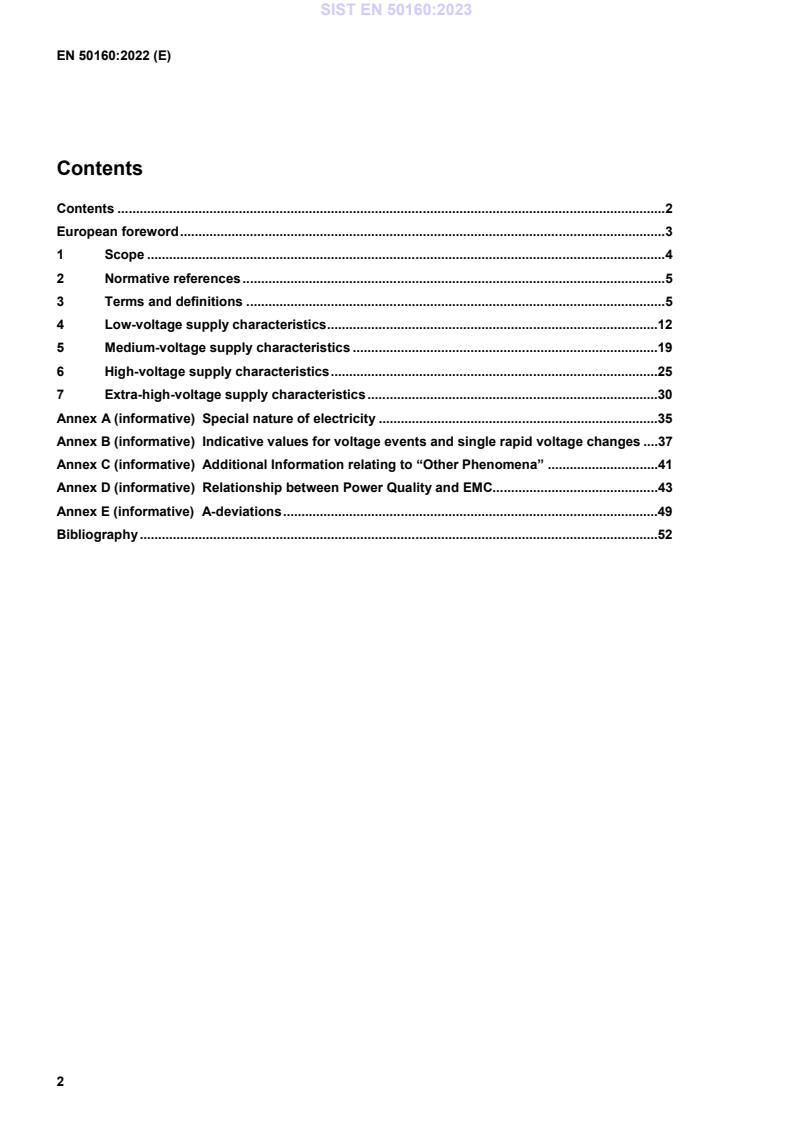
Contents
Contents . 2
European foreword . 3
1 Scope . 4
2 Normative references . 5
3 Terms and definitions . 5
4 Low-voltage supply characteristics .12
5 Medium-voltage supply characteristics .19
6 High-voltage supply characteristics .25
7 Extra-high-voltage supply characteristics .30
Annex A (informative) Special nature of electricity .35
Annex B (informative) Indicative values for voltage events and single rapid voltage changes .37
Annex C (informative) Additional Information relating to “Other Phenomena” .41
Annex D (informative) Relationship between Power Quality and EMC.43
Annex E (informative) A-deviations .49
Bibliography .52
European foreword
This document (EN 50160:2022) has been prepared by CLC TC8X “System aspects of electrical energy supply”.
The following dates are fixed:
• latest date by which this document has to be (dop) 2023-11-07
implemented at national level by publication of
an identical national standard or by
endorsement
• latest date by which the national standards (dow) 2025-11-07
conflicting with this document have to be
withdrawn
This document supersedes EN 50160:2010 and all of its amendments and corrigenda (if any).
— implementation of amendments A2 (new frequency range 2-150 kHz, amendment on power frequency) and
A3 (changed value on 15th and 21st harmonic in LV);
— The Norway A-deviation (amendment A1) was slightly modified;
— slight clarifications in the scope;
— integration of a new clause “extra high voltage”;
— clarification to dips and swells;
— new Annex D: PQ versus EMC.
Attention is drawn to the possibility that some of the elements of this document may be the subject of patent
rights. CENELEC shall not be held responsible for identifying any or all such patent rights.
Any feedback and questions on this document should be directed to the users’ national committee. A complete
listing of these bodies can be found on the CENELEC website.
1 Scope
1.1 Application
This document specifies the main characteristics of the voltage at a network user's supply terminals in public
low voltage, medium, high, and extra-high voltage AC electricity networks under normal operating conditions.
This document specifies the limits or values within which the voltage characteristics can be expected to remain
at any supply terminal in public European electricity networks, only. Industrial networks are excluded from the
scope of EN 50160.
NOTE 1 If non-public networks (e.g. residential quarters, energy communities, office centres, shopping centres) have
similar end-users as public networks, it is strongly advised to apply the same requirements as for public networks.
This document does not apply under abnormal operating conditions, including the following:
a) a temporary supply arrangement to keep network users supplied during conditions arising as a result of a
fault, maintenance and construction work, or to minimize the extent and duration of a loss of supply;
b) in the case of non-compliance of a network user's installation or equipment with the relevant standards or
with the technical requirements for connection, established either by the public authorities or the network
operator, including the limits for the emission of conducted disturbances;
NOTE 2 A network user’s installation can include load and generation.
c) in exceptional situations, in particular:
1) exceptional weather conditions and other natural disasters;
2) third party interference;
3) acts by public authorities,
4) industrial actions (subject to legal requirements);
5) force majeure;
6) power shortages resulting from external events.
The voltage characteristics given in this document refer to conducted disturbances in public electric power
networks. They are not intended to be used as electromagnetic compatibility (EMC) levels or product emission
limits.
Power quality is related to EMC in several ways – especially because compliance with power quality
requirements depends on the control of cumulative effect of electromagnetic emissions from all/multiple
equipment and/or installations. Therefore, the voltage characteristics given in this document gives guidance for
specifying requirements in equipment product standards and in installation standards.
NOTE 3 The performance of equipment might be impaired if it is subjected to supply conditions which are not specified
in the equipment product standard.
NOTE 4 This document can be superseded in total or in part by the terms of a contract between the individual network
user and the network operator.
The sharing of complaint management and problem mitigation costs between the involved parties is outside the
scope of EN 50160.
Measurement methods to be applied in this document are described in EN 61000-4-30.
1.2 Objective
The objective of this document is to define, describe and specify the characteristics of the supply voltage
concerning:
a) Frequency;
b) Magnitude;
c) Waveform;
d) Symmetry of the line voltages.
This document also covers the continuous characteristics of the supply voltage and other foreseeable
phenomena which may influence the voltage characteristics, such as e.g. operational communication,
monitoring or measurement signals which are transmitted via power lines.
These characteristics are subject to variations during the normal operation of a supply system due to changes
of load, disturbances generated by certain equipment and the occurrence of faults which are mainly caused by
external events.
The characteristics vary in a manner which is random in time, with reference to any specific supply terminal,
and random in location, with reference to any given instant of time. Because of these variations, the values
given in this document for the characteristics can be expected to be exceeded on a small number of occasions.
Some of the phenomena affecting the voltage are particularly unpredictable, which make it very difficult to give
useful definite values for the corresponding characteristics. The values given in this document for the voltage
characteristics associated with such phenomena, e.g. voltage dips and voltage interruptions, are interpreted
accordingly.
2 Normative references
The following documents are referred to in the text in such a way that some or all of their content constitutes
requirements of this document. For dated references, only the edition cited applies. For undated references, the
latest edition of the referenced document (including any amendments) applies.
EN 61000-4-30:2015, Electromagnetic compatibility (EMC) — Part 4-30: Testing and measurement techniques
— Power quality measurement methods (IEC 61000-4-30:2015)
3 Terms and definitions
For the purposes of this document, the following terms and definitions apply.
ISO and IEC maintain terminological databases for use in standardization at the following addresses:
— ISO Online browsing platform: available at https://www.iso.org/obp
— IEC Electropedia: available at https://www.electropedia.org/
3.1 Electric power network
3.1.1
public electric power network
electric power network to which any network user has access, and which is operated by a regulated (licenced)
network operator
3.1.2
closed distribution network
system which distributes electricity within an industrial, commercial, or shared service or residential sites, that
is geographically confined
Note 1 to entry: Closed distribution networks may be private networks.
[SOURCE: Directive 2009/72/EC, Article 28, modified].
3.1.3
point of supply POS
supply terminal
point in an electric power network designated as such and contractually fixed, at which electric energy is
exchanged between contractual partners
[SOURCE: IEV 614-01-02]
Note 1 to entry: In practice it is the location of the interface between the public supply network and a closed distribution
network or a network user. The characteristics of the voltage that a network user can expect according to EN 50160 apply
at the Point of Supply (supply terminals).
3.1.4
point of connection POC
reference point on the electric power system where the user’s electrical facility is connected
[SOURCE: IEV 617-04-01]
Note 1 to entry: In some regions the point of supply (supply terminals) is labelled as the point of connection (POC). In
practice, the connection to a power system can be one to the public supply network or in some cases to a closed distribution
network one. It is worth noting that many standards use the term “point of connection” generally for an interface which is
dealt with in the relevant context of the standard.
3.1.5
network operator
party responsible for operating, ensuring the maintenance of, and if necessary, developing, the supply network
in a given area and responsible for ensuring the long term ability of the network to meet reasonable demands
for electricity supply
3.1.6
(power) network user
party being supplied by or supplying to an electricity supply network
Note 1 to entry: In several countries, the term network user includes network operators connected to a supply network
with the same or higher voltage level.
3.1.7
power quality PQ
characteristics of the electricity at a given point on an electrical system, evaluated against a set of reference
technical parameters
Note 1 to entry: These parameters might, in some cases, relate to the compatibility between electricity supplied on a
network and the loads connected to that network.
Note 2 to entry: In the context of this document, power quality refers to the supply terminals and focusses on defining the
characteristics of the voltage and frequency.
3.1.8
conducted disturbance
electromagnetic phenomenon propagated along the line conductors of a supply network
Note 1 to entry: In some cases, an electromagnetic phenomenon is propagated across transformer windings and hence
between networks of different voltage levels. These disturbances may degrade the performance of a device, equipment or
system or they may cause damage.
3.1.9
normal operating condition
operating condition for an electricity network, where load and generation demands are met, system switching
operations are made and faults are cleared by automatic protection systems, in the absence of exceptional
circumstances
Note 1 to entry: Frequent examples of exceptional circumstances are:
▪ temporary supply arrangement;
▪ in the case of non-compliance of a network user’s installation or equipment with the relevant standards or with the
technical requirements for connection;
▪ exceptional situations, such as:
o exceptional weather conditions and other natural disasters;
o third party interference;
o acts by public authorities;
o industrial actions (subject to legal requirements);
o force majeure;
o power shortages resulting from external events.
3.1.10
supply interruption
condition in which the voltage at the supply terminals is lower than 5 % of the reference voltage
Note 1 to entry: Classification: a supply interruption can be classified as prearranged, when network users are informed
in advance, or accidental, caused by permanent or transient faults, mostly related to external events, equipment failures or
interference. An accidental interruption is classified as:
— a long interruption (longer than 3 min).
— a short interruption (up to and including 3 min).
Note 2 to entry: Normally, interruptions are caused by the operation of switches or protective devices.
Note 3 to entry: The effect of a prearranged interruption can be minimized by network users by taking appropriate
measures.
Note 4 to entry: Prearranged interruptions are typically due to the execution of scheduled works on the electricity network.
Note 5 to entry: Accidental supply interruptions are unpredictable, largely random events.
Note 6 to entry: For polyphase systems, an interruption occurs when the voltage falls below 5 % of the reference voltage
on all phases (otherwise, it is considered to be a dip).
Note 7 to entry: In some countries, the term Very Short Interruptions (VSI) or transitory interruptions are used to classify
interruptions with duration shorter than 1 s to 5 s. Such interruptions are related to automatic reclosing device operation.
Note 8 to entry: This point can differ from, for example, the electricity metering point or the point of common coupling.
3.2 Reference voltages and frequency
3.2.1
extra high voltage
EHV
voltage with a nominal rms-value 150 kV < U ≤ 800 kV
n
3.2.2
high voltage
HV
voltage with a nominal rms-value 36 kV < U ≤ 150 kV
n
3.2.3
medium voltage
MV
voltage with a nominal rms-value is 1 kV < U ≤ 36 kV
n
3.2.4
low voltage
LV
voltage with a nominal rms-value is U ≤ 1 kV
n
3.2.5
nominal voltage
U
n
voltage by which a supply network is designated or identified and to which certain operating characteristics are
referred
3.2.6
supply voltage
rms-value of the voltage at a given time at the supply terminal, measured over a given interval
3.2.7
declared supply voltage
U
C
supply voltage agreed by the network operator and the network user
Note 1 to entry: Generally declared supply voltage U is the nominal voltage U but it may be different according to the
c n
agreement between the network operator and the network user.
3.2.8
reference voltage
value specified as the base on which residual voltage, thresholds and other values are expressed in per unit or
percentage terms
Note 1 to entry: For the purpose of this document, the reference voltage is the nominal or declared voltage of the supply
system.
Note 2 to entry: This term is used in relation to interruptions, voltage dips and voltage swell evaluation.
3.2.9
frequency of the supply voltage
repetition rate of the fundamental wave of the supply voltage measured over a given interval of time
3.2.10
nominal frequency
nominal value of the frequency of the supply voltage
3.3 Phenomena
3.3.1
voltage variation
increase or decrease of rms-voltage normally due to load variations
3.3.2
voltage fluctuation
series of voltage changes or a cyclic variation of the voltage envelope
[SOURCE: IEV 161-08-05, modified]
3.3.3
rapid voltage change
single rapid variation of the rms-value of a voltage between two consecutive levels which are sustained for
definite but unspecified durations
Note 1 to entry: For more information see EN 61000-3-3 and EN 61000-4-30.
3.3.4
flicker
impression of unsteadiness of visual sensation induced by a light stimulus whose luminance or spectral
distribution fluctuates with time
[SOURCE: IEV 161-08-13]
3.3.5
flicker severity
intensity of flicker annoyance evaluated by the following quantities:
— short term severity (P ) measured over a period of ten minutes
st
— long term severity (P ) calculated from a sequence of twelve P -values over a two-hour interval, according
lt st
to the following expression
PP= / 12
lt ∑ sti
i=1
3.3.6
harmonic voltage U
h
sinusoidal voltage with a frequency equal to an integer multiple of the fundamental frequency of the supply
voltage
Note 1 to entry: Application: Harmonic voltages can be evaluated individually, by their relative amplitude (u ) which is the
h
harmonic voltage related to the fundamental voltage U1, where h is the order of the harmonic, or globally, for example by
the total harmonic distortion factor THD, calculated using the following expression:
THD= U/U
( )
∑ hn
n=2
3.3.7
interharmonic voltage
sinusoidal voltage with a frequency not equal to an integer multiple of the fundamental
Note 1 to entry: Interharmonic voltages at closely adjacent frequencies can appear at the same time forming a wide band
spectrum.
3.3.8
voltage unbalance
condition in a polyphase system in which the rms-values of the line-to-line voltages (fundamental component),
or the phase angles between consecutive line voltages, are not all equal
Note 1 to entry: The degree of the inequality is usually expressed as the ratios of the negative and zero sequence
components to the positive sequence component.
Note 2 to entry: In this document, voltage unbalance is considered in relation to three-phase systems and negative phase
sequence only.
[SOURCE: IEV 161-08-09, modified]
3.3.9
voltage dip
temporary reduction of the rms-voltage at a point in the electrical supply system below a specified start threshold
Note 1 to entry: Application: for the purpose of this document, the dip start threshold is equal to 90 % of the reference
voltage.
Note 2 to entry: Typically, a dip is associated with the occurrence and termination of a short circuit or other extreme current
increase on the system or installations connected to it.
Note 3 to entry: For the purpose of this document, a voltage dip is a two-dimensional electromagnetic disturbance, the
level of which is determined by both voltage and time (duration).
3.3.10
voltage dip duration
time between the instant at which the rms-voltage at a particular point of an electricity supply system falls below
the start threshold and the instant at which it rises to the end threshold
Note 1 to entry: Application: for the purpose of the standard, the duration of a voltage dip is from 10 ms up to and including
1 min.
Note 2 to entry: For polyphase events, a dip begins when one voltage falls below the dip start threshold and ends when
all voltages are equal to or above the dip end threshold.
3.3.11
voltage dip start threshold
rms-value of the voltage on an electricity supply system specified for the purpose of defining the start of a
voltage dip
3.3.12
voltage dip end threshold
rms-value of the voltage on an electricity supply system specified for the purpose of defining the end of a voltage
dip
3.3.13
voltage dip residual voltage
minimum value of rms- voltage recorded during a voltage dip
Note 1 to entry: For the purpose of this document, the residual voltage is expressed as a percentage of the reference
voltage.
3.3.14
transient overvoltage
short duration oscillatory or non-oscillatory overvoltage usually highly damped and with a duration of a few
milliseconds or less
Note 1 to entry: Transient overvoltages are usually caused by lightning, switching or operation of fuses. The rise time of a
transient overvoltage can vary from less than a microsecond up to a few milliseconds.
[SOURCE: IEV 604-03-14, modified]
3.3.15
voltage swell
temporary power frequency overvoltage
temporary increase of the rms-voltage at a point in the electrical supply system above a specified start threshold
Note 1 to entry: Application: for the purpose of this document, the swell start threshold is equal to the 110 % of the
reference voltage (see CLC/TR 50542-1:2018, Clause 3, for more information).
Note 2 to entry: For the purpose of this document, a voltage swell is a two-dimensional electromagnetic disturbance, the
level of which is determined by both voltage and time (duration).
Note 3 to entry: Voltage swells may appear between live conductors or between live conductors and earth. Depending on
the neutral arrangement, faults to ground may also give rise to overvoltages between healthy phases and neutral.
3.3.16
voltage swell duration
time between the instant at which the rms-voltage at a particular point of an electricity supply system exceeds
the start threshold and the instant at which it falls below the end threshold
Note 1 to entry: Application: for the purpose of this document, the duration of a voltage swell is from 10 ms up to and
including 1 min.
3.3.17
voltage swell end threshold
rms-value of the voltage on an electricity supply system specified for the purpose of defining the end of a voltage
swell
3.3.18
voltage swell start threshold
rms-value of the voltage on an electricity supply system specified for the purpose of defining the start of a
voltage swell
3.3.19
mains communicating system
MCS
electrical system using signals to transmit information on electricity supply systems, either on the public electric
power network or within installations of network users
3.3.20
mains signalling voltage
signal superimposed on the supply voltage for the purpose of transmission of information in the public supply
network and to network users' premises
Note 1 to entry: Classification: three types of signals in the public supply network can be classified:
— ripple control signals: superimposed sinusoidal voltage signals in the frequency range 110 Hz to 3 000 Hz;
— power-line-carrier signals: superimposed sinusoidal voltage signals in the frequency range 3 kHz to 148,5 kHz;
— mains marking signals: superimposed short time alterations (transients) at selected points of the voltage waveform.
4 Low-voltage supply characteristics
4.1 General
This clause describes the voltage characteristics of electricity supplied by public low voltage networks. In the
following, a distinction is made between
— continuous phenomena, i.e. deviations from the nominal value that occur continuously over time. Such
phenomena occur mainly due to load or generation pattern, changes of load or nonlinear loads;
— voltage events, i.e. sudden, and significant deviations from normal or desired wave shape. Voltage events
typically occur due to unpredictable events (e.g. faults) or to external causes (e.g. weather conditions, third
party actions);
— other phenomena, i.e. phenomena occurring in the presence of mains communicating systems (MCS)
and/or equipment using switch-mode technology connected to the grid.
1 2
For some continuous phenomena, limits are specified ; for voltage events, only indicative values can be given
at present (see Annex B).
The standard nominal voltage U for public low voltage is U = 230 V, either between phase and neutral, or
n n
between phases.
— for four-wire three phase systems:
U = 230 V between phase and neutral.
n
— for three-wire three phase systems:
U = 230 V between phases.
n
NOTE In low voltage systems declared and nominal voltage are equal.
4.2 Continuous phenomena
4.2.1 Power frequency
The nominal frequency of the supply voltage shall be 50 Hz. Under normal operating conditions the mean value
of the fundamental frequency measured over 10 s shall be within a range of:
— for systems with synchronous connection to an interconnected system:
50 Hz ± 1 % (i.e. 49,5 Hz. 50,5 Hz) during 99,5 % of a year;
50 Hz + 4 % / - 6 % (i.e. 47 Hz. 52 Hz) during 100 % of the time.
— for systems with no synchronous connection to an interconnected system (e.g. supply systems on certain
islands):
50 Hz ± 2 % (i.e. 49 Hz . 51 Hz) during 95 % of a week;
For single rapid voltage changes, only indicative values are given for the time being.
For some specific parameters, in some national regulations stricter limits may exist.
50 Hz ± 15 % (i.e. 42,5 Hz . 57,5 Hz) during 100 % of the time.
NOTE 1 This document defines the frequency range for normal operating conditions. During exceptional conditions wider
frequency can apply temporarily in order to maintain the continuity of electricity supply.
NOTE 2 Related monitoring is usually done by the Control Area Operator.
4.2.2 Supply voltage variations
4.2.2.1 Requirements
Under normal operating conditions excluding the periods with interruptions, supply voltage variations should not
exceed ± 10 % of the nominal voltage U .
n
In cases of electricity supplies in networks not interconnected with transmission systems or for special remote
network users, voltage variations should not exceed + 10 % / - 15 % of U . Network users should be informed
n
of the conditions.
The actual power consumption or generation required by individual network users is not fully predictable, in
terms of amount and of contemporaneity. Therefore, networks are generally designed on a probabilistic basis.
If, following a complaint, measurements carried out by the network operator according to 4.2.2.2 indicate that
the magnitude of the supply voltage departs beyond the limits given in 4.2.2.2 causing negative consequences
for the network user, the network operator should take remedial action in collaboration with the network user(s)
depending on a risk assessment. Temporarily, for the time needed to solve the problem, voltage variations
should be within the range + 10 % / - 15 % of U , unless otherwise agreed with the network users.
n
NOTE 1 In accordance with relevant product and installation standards and application of IEC 60038, network users’
appliances are typically designed to tolerate supply voltages of ± 10 % around the nominal system voltage, which is sufficient
to cover an overwhelming majority of supply conditions. Generally, appliances do not need to be designed to handle wider
voltage variations.
NOTE 2 Identification of what is a “special remote network user” can vary between countries, taking into account different
characteristics of national electric systems as, for instance, limitation of power on the supply terminal and/or power factor
limits.
4.2.2.2 Test method
Under normal operating conditions:
— during each period of one week 95 % of the 10 min rms-values of the supply voltage shall be within the
range of U ± 10 %; and
n
— all 10 min rms-values of the supply voltage shall be within the range of U + 10 % / - 15 %.
n
NOTE 1 The percentages above are referred to a measuring period of one week (i.e. to 1.008 intervals of 10 min).
For the evaluation of measurement results, care should be taken of flagged intervals. The data flagged due to
interruptions are excluded. The principles for the use of other flagged data are under consideration.
NOTE 2 The test method does not apply in cases of electricity supplies in networks not interconnected with transmission
systems or for special remote network users.
4.2.3 Rapid voltage changes
4.2.3.1 Single rapid voltage change
Rapid voltage changes of the supply voltage are mainly caused either by load or generation changes in the
network users' installations, by switching in the system, or by faults.
If the voltage during a change crosses the voltage dip and/or the voltage swell threshold, the event is classified
as a voltage dip and/or swell rather than a rapid voltage change.
NOTE Reference can be made to EN 61000-2-2; some indicative values can be found in Annex B.
4.2.3.2 Flicker severity
Under normal operating conditions, during each period of one week the long term flicker severity P caused by
lt
voltage fluctuation should be less than or equal to 1 for 95 % of the time.
NOTE 1 Originally the flicker requirements have been developed based on the reaction of humans to light changes from
a 60 W incandescent lamp, which has been subjected to changes of the supply voltage. The requirements on voltage flicker
in EN 50160 are still based on the original voltage “flicker curve”, resulting from these investigations with the 60 W
incandescent lamp. Likewise, the standard for the measurement of voltage flicker, IEC 61000-4-15, is based on this “flicker
curve”. To ensure that new energy efficient lighting devices (such as CFL and LED) do not produce more light flicker than
the old incandescent lamps, IEC TR 61547 has been developed, which defines an objective method for the measurement
of light flicker, when the lighting device is subjected to changes of the supply voltage along the original “flicker curve”. This
way the original voltage “flicker curve” also for the future remains to be the basis for the prevention of light flicker problems.
NOTE 2 Reaction to light flicker is subjective and can vary depending on the perceived cause of the flicker and the period
over which it persists. Keeping the voltage flicker below Plt = 1 can in some cases still raise annoyance, whereas in other
cases higher levels of the voltage flicker can be noticed without annoyance.
4.2.4 Supply voltage unbalance
Under normal operating conditions, during each period of one week, 95 % of the 10 min rms-values of the
negative phase sequence component (fundamental) of the supply voltage shall be within the range 0 % to 2 %
of the positive phase sequence component (fundamental).
NOTE 1 In some areas with partly single phase or two phase connected network users' installations, unbalances up to
about 3 % at three-phase supply terminals occur.
NOTE 2 In this document only values for the negative sequence component are given because this component is the
relevant one for the possible interference of appliances connected to the system.
4.2.5 Harmonic voltage
Under normal operating conditions, during each period of one week, 95 % of the 10 min rms-values of each
individual harmonic voltage shall be less than or equal to the values given in Table 1. Resonances may cause
higher voltages for an individual harmonic.
Moreover, the THD of the supply voltage (including all harmonics up to the order 40) shall be less than or equal
to 8 %.
Table 1 — Values of individual harmonic voltages at LV supply terminals
Odd harmonics
Even harmonics
Not multiples of 3 Multiples of 3
Order Relative Order Relative Order Relative
h amplitude h amplitude h amplitude
u u u
h h h
5 6,0 % 3 5,0 % 2 2,0 %
7 5,0 % 9 1,5 % 4 1,0 %
11 3,5 % 15 1,0 % 6 … 24 0,5 %
13 3,0 % 21 0,75 %
17 2,0 %
19 1,5 %
23 1,5 %
25 1,5 %
Values are given in percent of the fundamental u1.
NOTE No values are given for harmonics of order higher than 25, as they are usually small, but largely unpredictable due
to resonance effects.
4.2.6 Interharmonic voltages
The level of interharmonics is increasing due to the increasing number of converters and similar control
equipment. Levels are under consideration and will be provided in a future amendment.
In certain cases, interharmonics, even at low levels, give rise to flicker (see 4.2.3.2), or cause interference in
ripple control systems.
4.3 Voltage events
4.3.1 Interruptions of the supply voltage
Interruptions are, by their nature, very unpredictable and variable from place to place and from time to time. For
the time being, it is not possible to give fully representative statistical results of measurements of interruption
frequency covering the whole of European networks. A reference for actual values recorded in European
networks concerning interruptions is given in Annex B.
4.3.2 Supply voltage dips/swells
4.3.2.1 General
Voltage dips are typically originated by faults occurring in the public network or in network users’ installations.
Voltage swells are typically caused by switching operations and load disconnections or generation connections.
Both phenomena are unpredictable and largely random. The annual frequency varies greatly depending on the
type of supply system and on the point of observation. Moreover, the distribution over the year can be very
irregular.
4.3.2.2 Voltage dip/swell measurement and detection
If statistics are collected, voltage dips/swells shall be measured and detected according to EN 61000-4-30,
using as reference the nominal supply voltage. The voltage dips/swells characteristics of interest for this
document are residual voltage (maximum rms-voltage for swells) and duration .
On LV networks, for four-wire three phase systems, the line to neutral voltages shall be considered; for three-
wire three phase systems the line-to-line voltages shall be considered; in the case of a single phase connection,
the supply voltage (line- to-line or line to neutral, according to the network user connection) shall be considered.
Conventionally, the dip start threshold is equal to 90 % of the nominal voltage; the start threshold for swells is
equal to the 110 % of the nominal voltage. The hysteresis is typically 2 %; reference rules for hysteresis are
given in 5.4.2.1 of EN 61000-4-30:2015.
4.3.2.3 Voltage dips evaluation
Evaluation of voltage dips shall be in accordance with EN 61000-4-30. The method of analysing the voltage
dips (post treatment) depends on the purpose of the evaluation.
Typically, on LV networks:
— if a three-phase system is considered, polyphase aggregation shall be applied; polyphase aggregation
consists of defining an equivalent event characterized by a single duration and a single residual voltage.
— time aggregation applies; time aggregation consists of defining an equivalent event in the case of multiple
successive events; the method used for the aggregation of multiple events can be set according to the final
use of data; some reference rules are given in IEC/TR 61000-2-8.
4.3.2.4 Voltage dips classification
If statistics are collected, voltage dips shall be classified according to the Table 2. The figures to be put in the
cells refer to the number of equivalent events (see in 4.3.2.3). This table reflects the polyphase network
performance. Further information is needed to consider events affecting an individual single-phase voltage in
three-phase systems. To calculate the latter, a different evaluation method has to be applied.
For examples of how to present the classification of voltage dips during a measurement period, please see
Annex B.
For existing measurement equipment and/or monitoring systems, Table 2 is to be taken as a recommendation.
Table 2 — Classification of dips according to residual voltage and duration
Residual voltage Duration t
u
ms
%
10 ≤ t ≤ 200 200 < t ≤ 500 500 < t ≤ 1 000 1 000 < t ≤ 5 000 5 000 < t ≤ 60 000
90 > u ≥ 80 A1 A2 A3 A4 A5
80 > u ≥ 70 B1 B2 B3 B4 B5
70 > u ≥ 40 C1 C2 C3 C4 C5
40 > u ≥ 5 D1 D2 D3 D4 D5
5 > u X1 X2 X3 X4 X5
Voltage dips are, by their nature, very unpredictable and variable from place to place and from time to time. For
the time being, it is not possible to give fully representative statistical results of measurements of voltage dip
frequency covering the whole of European networks. A reference for actual values recorded in the European
networks concerning dips is given in Annex B.
In this document, values are expressed in percentage terms of the reference voltage.
It should be noted that, due to the measurement method adopted, measurement uncertainty affecting the results
has to be taken into account: this is particularly relevant for shorter events. Measurement uncertainty is
addressed in EN 61000-4-30.
Generally, the duration of a voltage dip depends on the protection strategy adopted on the network, which may
differ from network to network depending on network structure and on neutral earthing. Therefore, typical
durations do not necessarily match the boundaries of the columns in Table 2.
4.3.2.5 Voltage swells evaluation
Evaluation of voltage swells shall be in accordance with EN 61000-4-30. The method of analysing the voltage
swells (post treatment) depends on the purpose of the evaluation.
Typically, on LV networks:
— if a three-phase system is considered, polyphase aggregation shall be applied; polyphase aggregation
consists of defining an equivalent event characterized by a single duration and a single maximum rms-
voltage;
— time aggregation applies; time aggregation consists of defining an equivalent event in the case of multiple
successive events; the method used for the aggregation of multiple events can be set according to the final
use of data; some reference rules are given in IEC/TR 61000-2-8.
4.3.2.6 Voltage swells classification
If statistics are collected, voltage swells shall be classified according to the following table. The figures to be put
in the cells refer to the number of equivalent events (see 4.3.2.5) .
For existing measurement equipment and/or monitoring systems, Table 3 is to be taken as a recommendation.
NOTE 1 Typically, faults in the public LV network or in a network user's installation give rise to temporary power frequency
overvoltages between live conductors and earth; such overvoltages disappear when the fault is cleared. Some indicative
values are given in Annex B.
NOTE 2 For the classification of swells between live conductors and earth, reference can be made to IEC 60364-4-44.
Table 3 — Classification of swells according to maximum voltage and duration
Swell voltage u Duration t
% ms
10 ≤ t ≤ 500 500 < t ≤ 5 000 5 000 < t ≤ 60 000
u ≥ 120 S1 S2 S3
120 > u > 110 T1 T2 T3
4.3.3 Transient overvoltages
Transient overvoltages at the supply terminals are generally caused by lightning (induced overvoltage) or by
switching in the system.
NOTE 1 The rise time can cover a wide range from milliseconds down to much less than a microsecond. However, for
physical reasons, transients of longer durations usually have much lower amplitudes. Therefore, the coincidence of a high
amplitude and a long rise time is extremely unlikely.
This table reflects the polyphase network performance. Further information is needed to consider events
affecting an individual single-phase voltage in three-phase systems. To calculate the latter, a different evaluation
method has to be applied.
NOTE 2 The energy content of a transient overvoltage varies considerably according to the origin. An induced
overvoltage due to lightning generally has a higher amplitude but lower energy content than an overvoltage caused by
switching, because of the generally longer duration of such switching overvoltages.
For withstanding transient overvoltages in the vast majority of cases, LV Installations and end users’ appliances
are designed according to EN 60664-1. Where necessary (see IEC 60364-4-44), surge protective devices
should be selected according to IEC 60364-5-53, to take account of the actual situations. This is assumed to
cover also induced over-voltages due to both lightning and switching.
4.4 Other phenomena (see also Annex C)
4.4.1 General
This subclause deals with phenomena which, due to their characteristics, have not been described in the
previous subclauses on continuous phenomena or events.
Table 4 provides an overview of the situation concerning standardized PQ levels:
Table 4 — PQ standardization in the frequency range below 150 kHz
Type of equipment
Frequency range
Mains communicating Others
systems (MCS)
0,1 kHz to 2 kHz Normative PQ levels See Clauses 4 to 7 in this
document
(see item 4.4.2)
a, c, d, e
2 kHz to 9 kHz Normative PQ levels Under consideration
(see item 4.4.2)
a, c, d, e
9 kHz to 95 kHz Normative PQ levels Under consideration
(see item 4.4.2)
b, e a, c, d, e
95 kHz to 150 kHz Under consideration Under consideration
a
Compatibility levels for non-intentional emissions for the frequency range 2 kHz to 30 kHz
have been published with EN 61000-2-2:2002/A1:20
...
SIST EN 50160
SL OVEN SK I
S T A NDA RD marec 2023
Značilnosti napetosti v javnih razdelilnih omrežjih
Voltage characteristics of electricity supplied by public distribution networks
Caractéristiques de la tension fournie par les réseaux publics de distribution
Merkmale der Spannung in öffentlichen Energieversorgungsnetzen
Referenčna oznaka
ICS 29.240.01 SIST EN 50160:2023 (sl, en)
Nadaljevanje na straneh I do II in od 1 do 111
2026-07. Slovenski inštitut za standardizacijo. Razmnoževanje ali kopiranje celote ali delov tega dokumenta ni dovoljeno.
SIST EN 50160 : 2023
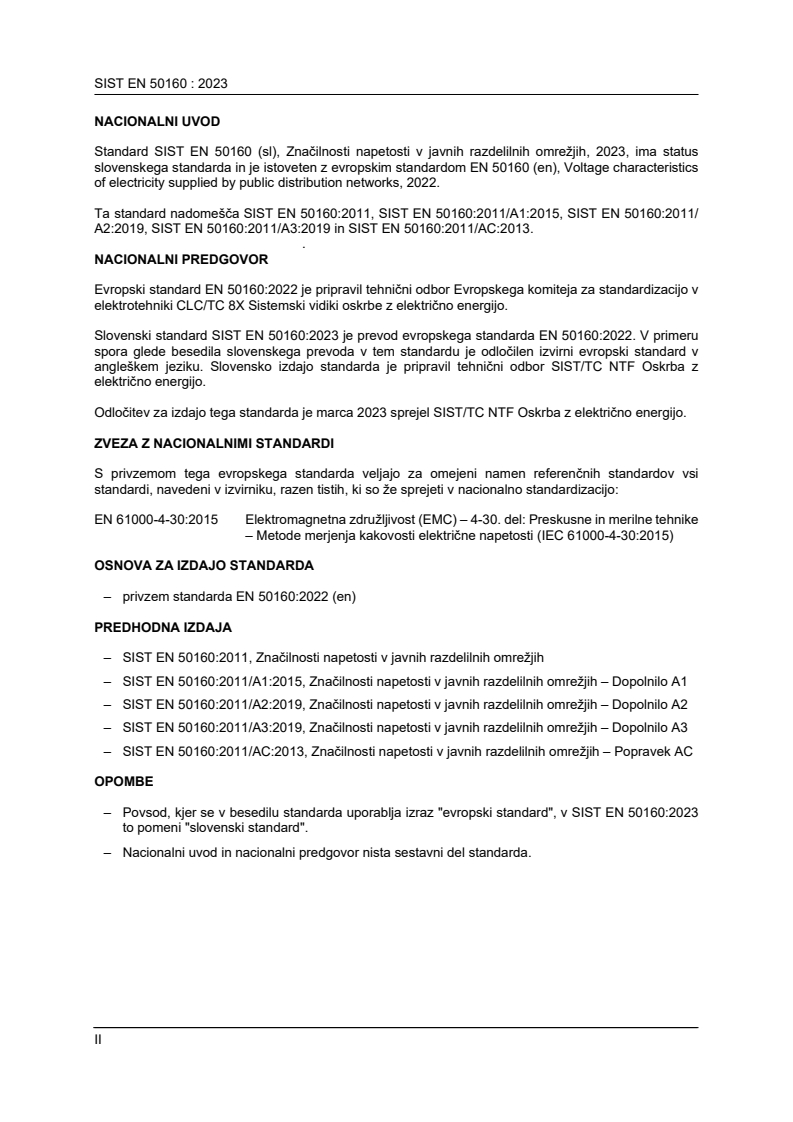
NACIONALNI UVOD
Standard SIST EN 50160 (sl), Značilnosti napetosti v javnih razdelilnih omrežjih, 2023, ima status
slovenskega standarda in je istoveten z evropskim standardom EN 50160 (en), Voltage characteristics
of electricity supplied by public distribution networks, 2022.
Ta standard nadomešča SIST EN 50160:2011, SIST EN 50160:2011/A1:2015, SIST EN 50160:2011/
A2:2019, SIST EN 50160:2011/A3:2019 in SIST EN 50160:2011/AC:2013.
.
NACIONALNI PREDGOVOR
Evropski standard EN 50160:2022 je pripravil tehnični odbor Evropskega komiteja za standardizacijo v
elektrotehniki CLC/TC 8X Sistemski vidiki oskrbe z električno energijo.
Slovenski standard SIST EN 50160:2023 je prevod evropskega standarda EN 50160:2022. V primeru
spora glede besedila slovenskega prevoda v tem standardu je odločilen izvirni evropski standard v
angleškem jeziku. Slovensko izdajo standarda je pripravil tehnični odbor SIST/TC NTF Oskrba z
električno energijo.
Odločitev za izdajo tega standarda je marca 2023 sprejel SIST/TC NTF Oskrba z električno energijo.
ZVEZA Z NACIONALNIMI STANDARDI
S privzemom tega evropskega standarda veljajo za omejeni namen referenčnih standardov vsi
standardi, navedeni v izvirniku, razen tistih, ki so že sprejeti v nacionalno standardizacijo:
EN 61000-4-30:2015 Elektromagnetna združljivost (EMC) – 4-30. del: Preskusne in merilne tehnike
– Metode merjenja kakovosti električne napetosti (IEC 61000-4-30:2015)
OSNOVA ZA IZDAJO STANDARDA
– privzem standarda EN 50160:2022 (en)
PREDHODNA IZDAJA
– SIST EN 50160:2011, Značilnosti napetosti v javnih razdelilnih omrežjih
– SIST EN 50160:2011/A1:2015, Značilnosti napetosti v javnih razdelilnih omrežjih – Dopolnilo A1
– SIST EN 50160:2011/A2:2019, Značilnosti napetosti v javnih razdelilnih omrežjih – Dopolnilo A2
– SIST EN 50160:2011/A3:2019, Značilnosti napetosti v javnih razdelilnih omrežjih – Dopolnilo A3
– SIST EN 50160:2011/AC:2013, Značilnosti napetosti v javnih razdelilnih omrežjih – Popravek AC
OPOMBE
– Povsod, kjer se v besedilu standarda uporablja izraz "evropski standard", v SIST EN 50160:2023
to pomeni "slovenski standard".
– Nacionalni uvod in nacionalni predgovor nista sestavni del standarda.
II
SIST EN 50160 : 2023
– Ta nacionalni dokument je istoveten z EN 50160:2022 in je objavljen z dovoljenjem
CEN-CENELEC
Upravni center
Rue de la Science 23
B-1040 Bruselj
This national document is identical with EN 50160:2022 and is published with the permission of
CEN-CENELEC
Management Centre
Rue de la Science 23
B-1040 Brussels
III
SIST EN 50160 : 2023
(prazna stran)
IV
EVROPSKI STANDARD EN 50160
EUROPEAN STANDARD
december 2022
NORME EUROPÉENNE
EUROPÄISCHE NORM
ICS 29.020 Nadomešča EN 50160:2010;
EN 50160:2010/corrigendum Dec. 2010;
EN 50160:2010/AC:2012; EN 50160:2010/A1:2015;
EN 50160:2010/A2:2019; EN 50160:2010/A3:2019
Slovenska izdaja
Značilnosti napetosti v javnih razdelilnih omrežjih
Voltage characteristics of Caractéristiques de la tension Merkmale der Spannung in
electricity supplied by public fournie par les réseaux publics öffentlichen
distribution networks de distribution Energieversorgungsnetzen
Ta evropski standard je CENELEC odobril 7. novembra 2022. Člani CENELEC morajo upoštevati
interne predpise CEN/CENELEC, ki temu evropskemu standardu določajo pogoje za dodelitev statusa
nacionalnega standarda brez kakršnihkoli sprememb.
Seznami najnovejših izdaj teh nacionalnih standardov in njihovi bibliografski podatki so na voljo pri
Upravnem centru CEN-CENELEC ali članih CENELEC.
Ta evropski standard obstaja v treh uradnih izdajah (angleški, francoski in nemški). Izdaje v drugih
jezikih, ki jih člani CENELEC na lastno odgovornost prevedejo in izdajo ter prijavijo pri Upravnem centru
CEN-CENELEC, veljajo kot uradne izdaje.
Člani CENELEC so nacionalni elektrotehniški komiteji Avstrije, Belgije, Bolgarije, Cipra, Češke
republike, Danske, Estonije, Finske, Francije, Grčije, Hrvaške, Islandije, Irske, Italije, Latvije, Litve,
Luksemburga, Madžarske, Malte, Nekdanje jugoslovanske republike Makedonije, Nemčije,
Nizozemske, Norveške, Poljske, Portugalske, Romunije, Srbije, Slovaške, Slovenije, Španije, Švedske,
Švice, Turčije in Združenega kraljestva.
CENELEC
Evropski komite za standardizacijo v elektrotehniki
European Committee for Electrotechnical Standardization
Comité Européen de Normalisation Electrotechnique
Europäisches Komitee für Elektrotechnische Normung
Upravni center CEN-CENELEC: Rue de la Science 23, B-1040 Bruselj
© 2022 CENELEC Vse pravice do uporabe v kakršnikoli obliki in s kakršnimikoli Ref. št. EN 50160:2022 E
sredstvi so po vsem svetu pridržane za članice CENELEC.
SIST EN 50160 : 2023
VSEBINA Stran
Evropski predgovor . 4
1 Področje uporabe . 6
2 Zveze s standardi . 8
3 Izrazi in definicije . 8
4 Značilnosti nizkonapetostnega napajanja . 22
5 Značilnosti srednjenapetostnega napajanja . 38
6 Značilnosti visokonapetostnega napajanja . 50
7 Značilnosti zelo visokonapetostnega napajanja . 62
Dodatek A (informativni): Posebna narava elektrike . 74
Dodatek B (informativni): Indikativne vrednosti za napetostne dogodke in
enkratne hitre napetostne spremembe . 78
Dodatek C (informativni): Dodatne informacije, ki se nanašajo na "druge
pojave" . 86
Dodatek D (informativni): Razmerje med kakovostjo napetosti in EMC . 91
Dodatek E (informativni): A-deviacije . 103
Viri in literatura . 109
SIST EN 50160 : 2023
Contents Page
European foreword . 5
1 Scope . 7
2 Normative references . 9
3 Terms and definitions . 9
4 Low-voltage supply characteristics . 23
5 Medium-voltage supply characteristics . 39
6 High-voltage supply characteristics . 51
7 Extra-high-voltage supply characteristics . 63
Annex A (informative) Special nature of electricity . 75
Annex B (informative) Indicative values for voltage events and single rapid
voltage changes . 79
Annex C (informative) Additional Information relating to "Other Phenomena" . 87
Annex D (informative) . 90
Annex E (informative) A-deviations . 102
Bibliography . 108
SIST EN 50160 : 2023
Evropski predgovor
Ta dokument (EN 50160:2022) je pripravil tehnični odbor CLC/TC 8X "Sistemski vidiki oskrbe z
električno energijo".
Določena sta bila naslednja datuma:
– zadnji datum, do katerega mora dokument dobiti status (dop) 2023- 11-07
nacionalnega standarda bodisi z objavo istovetnega besedila
ali z razglasitvijo
– zadnji datum, do katerega je treba razveljaviti nacionalne (dow) 2025-11-07
standarde, ki so z dokumentom v nasprotju
Ta dokument nadomešča EN 50160:2010 ter vsa njegova dopolnila in popravke (če obstajajo).
– uvedeni sta dopolnili A2 (novo frekvenčno območje 2–150 kHz, sprememba omrežne frekvence)
in A3 (spremenjena vrednost 15. in 21. harmonika v nizki napetosti);
– norveška A-deviacija (dodatek A1) je nekoliko spremenjena;
– dodana so manjša pojasnila v področju uporabe;
– vključena je nova postavka "zelo visoka napetost";
– podane so razjasnitve glede napetostnih upadov in porastov;
– dodan je nov dodatek D: Razmerje med kakovostjo napetosti in EMC.
Opozoriti je treba na možnost, da so nekateri elementi tega dokumenta lahko predmet patentnih pravic.
CENELEC ni odgovoren za ugotavljanje katerekoli ali vseh takih patentnih pravic.
Vse povratne informacije in vprašanja o tem dokumentu naj se naslovijo na nacionalni komite. Celoten
seznam teh organov je na voljo na spletni strani CENELEC.
SIST EN 50160 : 2023
European foreword
This document (EN 50160:2022) has been prepared by CLC TC8X "System aspects of electrical energy
supply".
The following dates are fixed:
– latest date by which this document has to be (dop) 2023- 11-07
implemented at national level by publication of an
identical national standard or by endorsement
– latest date by which the national standards conflicting (dow) 2025-11-07
with this document have to be withdrawn
This document supersedes EN 50160:2010 and all of its amendments and corrigenda (if any).
– implementation of amendments A2 (new frequency range 2-150 kHz, amendment on power
frequency) and A3 (changed value on 15th and 21st harmonic in LV);
– The Norway A-deviation (amendment A1) was slightly modified;
– slight clarifications in the scope;
– integration of a new clause "extra high voltage";
– clarification to dips and swells;
– new Annex D: PQ versus EMC.
Attention is drawn to the possibility that some of the elements of this document may be the subject of
patent rights. CENELEC shall not be held responsible for identifying any or all such patent rights.
Any feedback and questions on this document should be directed to the users’ national committee. A
complete listing of these bodies can be found on the CENELEC website.
SIST EN 50160 : 2023
1 Področje uporabe
1.1 Uporaba
Ta dokument določa glavne značilnosti napetosti na uporabnikovih priključnih sponkah v javnem
izmeničnem omrežju nizke napetosti, srednje napetosti, visoke napetosti in zelo visoke napetosti pri
normalnih obratovalnih pogojih. Ta dokument določa mejne vrednosti ali vrednosti, znotraj katerih je
mogoče pričakovati, da bodo napetostne značilnosti ostale nespremenjene na vseh priključnih točkah v
javnih evropskih električnih omrežjih. Industrijska omrežja so izključena iz področja uporabe SIST EN
50160.
OPOMBA 1: Če imajo nejavna omrežja (npr. stanovanjske četrti, energetske skupnosti, pisarniški centri, nakupovalna
središča) podobne končne uporabnike kot javna omrežja, je zelo priporočljivo uporabiti enake zahteve kot za
javna omrežja.
Ta dokument se ne uporablja pri nenormalnih obratovalnih pogojih, vključno:
a) z ureditvijo začasnega napajanja uporabnika omrežja pri pogojih, ki nastanejo zaradi okvare,
vzdrževanja in gradbenih del, ali da se zmanjšata obseg in trajanje odsotnosti napajanja,
b) v primeru, ko inštalacija ali naprave pri uporabniku omrežja ne ustrezajo zadevnim standardom ali
tehničnim zahtevam za priključitev naprav, ki jih postavljajo državni organi oziroma operater
omrežja, vključno z mejnimi vrednostmi oddajanja prevajanih motenj,
OPOMBA 2: Inštalacija uporabnika omrežja lahko vsebuje porabo in proizvodnjo.
c) v izjemnih primerih, kot so:
1) izredne vremenske razmere in druge naravne katastrofe,
2) motnje, ki jih povzroči tretja oseba,
3) ukrepi državnih organov,
4) delavski protesti (ob upoštevanju zakonskih pogojev),
5) višja sila,
6) zmanjšanje električnega napajanja zaradi zunanjih dogodkov.
Značilnosti napetosti, navedene v tem dokumentu, se nanašajo na prevajane motnje v javnih
elektroenergetskih omrežjih. Niso namenjene za uporabo kot ravni elektromagnetne združljivosti (EMC)
ali mejne vrednosti motenj, ki jih oddaja izdelek.
Kakovost električne napetosti je povezana z EMC na več načinov – zlasti zato, ker je skladnost z
zahtevami za kakovost električne energije odvisna od nadzora skupnega učinka elektromagnetnih
oddajanj iz posameznega dela/celotne opreme in/ali naprav. Zato značilnosti napetosti, podane v tem
dokumentu, dajejo napotke za določanje zahtev v standardih za proizvod in v standardih za inštalacije.
OPOMBA 3: Delovanje opreme se lahko poslabša, če je njeno napajanje izvedeno po pogojih, ki niso določeni v standardu za
proizvod.
OPOMBA 4: Ta standard lahko v celoti ali delno nadomestijo določila pogodbe med posameznim uporabnikom omrežja in
operaterjem omrežja.
Obvladovanja pritožb in stroškov za odpravo težav med vključenimi strankami standard EN 50160 ne
obravnava.
Merilne metode, ki se uporabijo po tem standardu, so opisane v EN 61000-4-30.
SIST EN 50160 : 2023
1 Scope
1.1 Application
This document specifies the main characteristics of the voltage at a network user's supply terminals in
public low voltage, medium, high, and extra-high voltage AC electricity networks under normal operating
conditions. This document specifies the limits or values within which the voltage characteristics can be
expected to remain at any supply terminal in public European electricity networks, only. Industrial
networks are excluded from the scope of EN 50160.
NOTE 1 If non-public networks (e.g. residential quarters, energy communities, office centres, shopping centres) have
similar end-users as public networks, it is strongly advised to apply the same requirements as for public networks.
This document does not apply under abnormal operating conditions, including the following:
a) a temporary supply arrangement to keep network users supplied during conditions arising as a
result of a fault, maintenance and construction work, or to minimize the extent and duration of a
loss of supply;
b) in the case of non-compliance of a network user's installation or equipment with the relevant
standards or with the technical requirements for connection, established either by the public
authorities or the network operator, including the limits for the emission of conducted disturbances;
NOTE 2 A network user’s installation can include load and generation.
c) in exceptional situations, in particular:
1) exceptional weather conditions and other natural disasters;
2) third party interference;
3) acts by public authorities,
4) industrial actions (subject to legal requirements);
5) force majeure;
6) power shortages resulting from external events.
The voltage characteristics given in this document refer to conducted disturbances in public electric
power networks. They are not intended to be used as electromagnetic compatibility (EMC) levels or
product emission limits.
Power quality is related to EMC in several ways – especially because compliance with power quality
requirements depends on the control of cumulative effect of electromagnetic emissions from all/multiple
equipment and/or installations. Therefore, the voltage characteristics given in this document gives
guidance for specifying requirements in equipment product standards and in installation standards.
NOTE 3 The performance of equipment might be impaired if it is subjected to supply conditions which
are not specified in the equipment product standard.
NOTE 4 This document can be superseded in total or in part by the terms of a contract between the individual network
user and the network operator.
The sharing of complaint management and problem mitigation costs between the involved parties is
outside the scope of EN 50160.
Measurement methods to be applied in this document are described in EN 61000-4-30.
SIST EN 50160 : 2023
1.2 Namen
Namen tega dokumenta je opredeliti, opisati in določiti značilnosti napajalne napetosti, ki se navezujejo
na:
a) frekvenco,
b) velikost,
c) valovno obliko,
d) simetrijo linijskih napetosti.
Ta dokument zajema tudi stalne značilnosti napajalne napetosti in druge predvidljive pojave, ki lahko
vplivajo na značilnosti napetosti, kot so npr. operativna komunikacija, nadzorni ali merilni signali, ki se
prenašajo po električnih vodih.
Te značilnosti so izpostavljene odstopanjem med normalnim obratovanjem napajalnega sistema zaradi
sprememb obremenitve, motenj, ki jih povzroča določena oprema, in pojava okvar, ki so večinoma
posledica zunanjih dogodkov.
Značilnosti napetosti se spreminjajo naključno časovno (glede na katerokoli priključno mesto) in
prostorsko (glede na katerikoli trenutek). Zaradi teh odstopanj je mogoče pričakovati, da bodo ravni
značilnosti presežene v majhnem številu primerov.
Nekateri pojavi, ki vplivajo na napetost, so še posebej nepredvidljivi, tako da je za nekatere značilnosti
nemogoče podati uporabne končne vrednosti. Vrednosti, ki so v tem dokumentu podane za značilnosti
napetosti, povezane s takšnimi pojavi, kot so na primer upadi napetosti in prekinitve napetosti, je zato
treba ustrezno obravnavati.
2 Zveze s standardi
Naslednji dokumenti so v besedilu navedeni tako, da del ali celotna njihova vsebina predstavlja zahteve
tega dokumenta. Pri datiranih sklicevanjih se uporablja zgolj navedena izdaja. Pri nedatiranih
sklicevanjih se uporablja zadnja izdaja navedenega dokumenta (vključno z vsemi dopolnili).
EN 61000-4-30:2015 Elektromagnetna združljivost (EMC) – 4-30. del: Preskusne in merilne tehnike
– Metode merjenja kakovosti električne napetosti (IEC 61000-4-30:2015)
3 Izrazi in definicije
V tem standardu veljajo naslednji pojmi:
ISO in IEC vzdržujeta terminološke podatkovne zbirke za uporabo pri standardizaciji na naslednjih
naslovih:
– platforma ISO za spletno brskanje: dostopno na naslovu https://www.iso.org/obp
– IEC Electropedia: dostopno na spletni strani https://www.electropedia.org/
3.1 Elektroenergetsko omrežje
3.1.1
javno elektroenergetsko omrežje
elektroenergetsko omrežje, do katerega ima dostop vsak uporabnik omrežja in ga upravlja regulirani (s
koncesijo) operater omrežja
SIST EN 50160 : 2023
1.2 Objective
The objective of this document is to define, describe and specify the characteristics of the supply voltage
concerning:
a) Frequency;
b) Magnitude;
c) Waveform;
d) Symmetry of the line voltages.
This document also covers the continuous characteristics of the supply voltage and other foreseeable
phenomena which may influence the voltage characteristics, such as e.g. operational communication,
monitoring or measurement signals which are transmitted via power lines.
These characteristics are subject to variations during the normal operation of a supply system due to
changes of load, disturbances generated by certain equipment and the occurrence of faults which are
mainly caused by external events.
The characteristics vary in a manner which is random in time, with reference to any specific supply
terminal, and random in location, with reference to any given instant of time. Because of these variations,
the values given in this document for the characteristics can be expected to be exceeded on a small
number of occasions.
Some of the phenomena affecting the voltage are particularly unpredictable, which make it very difficult
to give useful definite values for the corresponding characteristics. The values given in this document
for the voltage characteristics associated with such phenomena, e.g. voltage dips and voltage
interruptions, are interpreted accordingly.
2 Normative references
The following documents are referred to in the text in such a way that some or all of their content
constitutes requirements of this document. For dated references, only the edition cited applies. For
undated references, the latest edition of the referenced document (including any amendments) applies.
EN 61000-4-30:2015, Electromagnetic compatibility (EMC) — Part 4-30: Testing and measurement
techniques — Power quality measurement methods (IEC 61000-4-30:2015)
3 Terms and definitions
For the purposes of this document, the following terms and definitions apply.
ISO and IEC maintain terminological databases for use in standardization at the following addresses:
– ISO Online browsing platform: available at https://www.iso.org/obp
– IEC Electropedia: available at https://www.electropedia.org/
3.1 Electric power network
3.1.1
public electric power network
electric power network to which any network user has access, and which is operated by a regulated
(licenced) network operator
SIST EN 50160 : 2023
3.1.2
zaprto razdelilno omrežje
prostorsko omejen sistem, ki razdeljuje električno energijo znotraj industrijskih, trgovskih ali skupnih
storitev ali stanovanjskih območij
Opomba: Zaprta razdelilna omrežja so lahko zasebna omrežja.
[VIR: Direktiva 2009/72/ES, člen 28, spremenjen]
3.1.3
priključna točka (POS)
prevzemno-predajno mesto
točka v elektroenergetskem omrežju, zasnovana in pogodbeno določena tako, da se v njej izmenjuje
električna energija med pogodbenima partnerjema
[VIR: IEV 614-01-02]
Opomba 1: V praksi je to lokacija vmesnika med javnim napajalnim omrežjem in zaprtim razdelilnim omrežjem oziroma
uporabnikom omrežja. Značilnosti napetosti, ki jih uporabnik omrežja lahko pričakuje skladno z EN 50160, veljajo
na priključni točki (prevzemno-predajnem mestu).
3.1.4
stično mesto (POC)
referenčna točka v elektroenergetskem sistemu, kjer je uporabnik električno priključen
[VIR: IEV 617-04-01]
Opomba 1: V nekaterih regijah je priključna točka (prevzemno-predajno mesto) označena kot stično mesto (POC). V praksi
je lahko priključek na elektroenergetski sistem priključek na javno napajalno omrežje ali v nekaterih primerih na
zaprto razdelilno omrežje. Omeniti je treba, da mnogi standardi uporabljajo izraz "stično mesto" na splošno za
priključek, ki je obravnavan v ustreznem kontekstu standarda.
3.1.5
operater omrežja
udeleženec, odgovoren za obratovanje, zagotavljanje vzdrževanja in po potrebi za razvoj napajalnega
omrežja na danem območju ter odgovoren za zagotavljanje dolgoročne sposobnosti omrežja, da
izpolnjuje razumne potrebe za napajanje z električno energijo
3.1.6
uporabnik (elektroenergetskega) omrežja
udeleženec, ki odjema elektriko iz elektroenergetskega omrežja ali jo vanj dobavlja
Opomba 1: V več državah izraz uporabnik omrežja vključuje tudi operaterje, ki so priključeni v napajalno omrežje z istim ali
višjim nivojem napetosti.
3.1.7
kakovost električne energije, PQ
značilnosti električne energije na dani točki električnega sistema, ovrednotene glede na niz referenčnih
tehničnih parametrov
Opomba 1: Ti parametri se lahko v nekaterih primerih nanašajo na združljivost med električno energijo, dobavljeno v omrežju,
in bremeni, priključenimi v to omrežje.
Opomba 2: V okviru tega dokumenta se kakovost električne energije nanaša na priključne sponke (prevzemno-predajna
mesta) in se osredotoča na opredelitev značilnosti napetosti in frekvence.
3.1.8
prevajana motnja
elektromagnetni pojav, ki se širi po linijskih vodnikih napajalnega omrežja
SIST EN 50160 : 2023
3.1.2
closed distribution network
system which distributes electricity within an industrial, commercial, or shared service or residential
sites, that is geographically confined
Note 1 to entry: Closed distribution networks may be private networks.
[SOURCE: Directive 2009/72/EC, Article 28, modified].
3.1.3
point of supply, POS
supply terminal
point in an electric power network designated as such and contractually fixed, at which electric energy
is exchanged between contractual partners
[SOURCE: IEV 614-01-02]
Note 1 to entry: In practice it is the location of the interface between the public supply network and a closed distribution network
or a network user. The characteristics of the voltage that a network user can expect according to EN 50160 apply
at the Point of Supply (supply terminals).
3.1.4
point of connection, POC
reference point on the electric power system where the user’s electrical facility is connected
[SOURCE: IEV 617-04-01]
Note 1 to entry: In some regions the point of supply (supply terminals) is labelled as the point of connection (POC). In practice,
the connection to a power system can be one to the public supply network or in some cases to a closed distribution
network one. It is worth noting that many standards use the term "point of connection" generally for an interface
which is dealt with in the relevant context of the standard.
3.1.5
network operator
party responsible for operating, ensuring the maintenance of, and if necessary, developing, the supply
network in a given area and responsible for ensuring the long term ability of the network to meet
reasonable demands for electricity supply
3.1.6
(power) network user
party being supplied by or supplying to an electricity supply network
Note 1 to entry: In several countries, the term network user includes network operators connected to a supply network with the
same or higher voltage level.
3.1.7
power quality, PQ
characteristics of the electricity at a given point on an electrical system, evaluated against a set of
reference technical parameters
Note 1 to entry: These parameters might, in some cases, relate to the compatibility between electricity supplied on a network and
the loads connected to that network.
Note 2 to entry: In the context of this document, power quality refers to the supply terminals and focusses on defining the
characteristics of the voltage and frequency.
3.1.8
conducted disturbance
electromagnetic phenomenon propagated along the line conductors of a supply network
SIST EN 50160 : 2023
OPOMBA: V nekaterih primerih se elektromagnetni pojav širi po navitjih transformatorjev in s tem med sosednjimi omrežji,
ki imajo različne nivoje napetosti. Te motnje lahko poslabšajo tehnične lastnosti naprave, opreme ali sistema ali
pa povzročijo škodo.
3.1.9
normalni obratovalni pogoji
obratovalno stanje električnega omrežja, v katerem sta proizvodnja in poraba električne energije v
ravnotežju, se izvajajo sistemski preklopi in samodejni zaščitni sistemi izvajajo stikalne manevre in
odpravo okvar v sistemu, razen v izjemnih okoliščinah
Opomba 1: Pogosti primeri izjemnih okoliščin so:
– ureditev začasnega napajanja,
– primeri neskladnosti inštalacije ali opreme uporabnika omrežja glede na veljavne standarde ali tehnične
pogoje za priključitev,
– izjemni primeri, npr.:
– izredne vremenske razmere in druge naravne nesreče,
– motnje, ki jih povzroči tretja oseba,
– ukrepi državnih organov,
– delavski protesti (ob upoštevanju zakonskih pogojev),
– višja sila,
– omejitev napajanja z električno energijo zaradi zunanjih dogodkov.
3.1.10
prekinitev napajanja
stanje, ko je napetost na priključnih sponkah (prevzemno-predajnih mestih) nižja od 5 % referenčne
napetosti
Opomba 1: Razvrstitev: prekinitev napajanja je mogoče razvrstiti kot načrtovano, kadar so uporabniki omrežja vnaprej
obveščeni, ali nenapovedano, ki jo povzročijo trajne ali prehodne napake, večinoma povezane z zunanjimi
dogodki, odpovedmi opreme ali motnjami. Nenapovedana prekinitev se deli v:
– dolgotrajno prekinitev (daljšo od treh minut)
– kratkotrajno prekinitev (do vključno treh minut).
Opomba 2: Prekinitve po navadi povzroči delovanje stikal ali zaščitnih naprav.
Opomba 3: Posledice načrtovanih prekinitev je mogoče pri uporabniku omrežja zmanjšati z ustreznimi ukrepi.
Opomba 4: Načrtovane prekinitve so navadno posledica izvajanja načrtovanih del v električnem omrežju.
Opomba 5: Nenapovedane prekinitve napajanja so nepredvidljivi, večinoma naključni dogodki.
Opomba 6: V večfaznih sistemih se za prekinitev napajanja šteje, kadar napetost upade pod 5 % referenčne napetosti na
vseh fazah (drugače se to šteje za upad napetosti).
Opomba 7: V nekaterih državah se uporablja izraz zelo kratka prekinitev (Very Short Interruptions – VSI) ali tranzientna
prekinitev za razvrstitev prekinitev, ki trajajo manj kot 1 s do 5 s. Take prekinitve so povezane z delovanjem
avtomatskega ponovnega vklopa.
Opomba 8: Ta točka je lahko drugačna kot na primer merilno mesto ali skupna priključna točka.
3.2 Referenčna napetost in frekvenca
3.2.1
zelo visoka napetost
ZVN
napetost z nazivno efektivno vrednostjo 150 kV < U ≤ 800 kV
n
SIST EN 50160 : 2023
Note 1 to entry: In some cases, an electromagnetic phenomenon is propagated across transformer windings and hence between
networks of different voltage levels. These disturbances may degrade the performance of a device, equipment or
system or they may cause damage.
3.1.9
normal operating condition
operating condition for an electricity network, where load and generation demands are met, system
switching operations are made and faults are cleared by automatic protection systems, in the absence
of exceptional circumstances
Note 1 to entry: Frequent examples of exceptional circumstances are:
– temporary supply arrangement;
– in the case of non-compliance of a network user’s installation or equipment with the relevant standards or with the technical
requirements for connection;
– exceptional situations, such as:
– exceptional weather conditions and other natural disasters;
– third party interference;
– acts by public authorities;
– industrial actions (subject to legal requirements);
– force majeure;
– power shortages resulting from external events.
3.1.10
supply interruption
condition in which the voltage at the supply terminals is lower than 5 % of the reference voltage
Note 1 to entry: Classification: a supply interruption can be classified as prearranged, when network users are informed in
advance, or accidental, caused by permanent or transient faults, mostly related to external events, equipment
failures or interference. An accidental interruption is classified as:
– a long interruption (longer than 3 min).
– a short interruption (up to and including 3 min).
Note 2 to entry: Normally, interruptions are caused by the operation of switches or protective devices.
Note 3 to entry: The effect of a prearranged interruption can be minimized by network users by taking appropriate measures.
Note 4 to entry: Prearranged interruptions are typically due to the execution of scheduled works on the electricity network.
Note 5 to entry: Accidental supply interruptions are unpredictable, largely random events.
Note 6 to entry: For polyphase systems, an interruption occurs when the voltage falls below 5 % of the reference voltage on all
phases (otherwise, it is considered to be a dip).
Note 7 to entry: In some countries, the term Very Short Interruptions (VSI) or transitory interruptions are used to classify
interruptions with duration shorter than 1 s to 5 s. Such interruptions are related to automatic reclosing device
operation.
Note 8 to entry: This point can differ from, for example, the electricity metering point or the point of common coupling.
3.2 Reference voltages and frequency
3.2.1
extra high voltage
EHV
voltage with a nominal rms-value 150 kV < U ≤ 800 kV
n
SIST EN 50160 : 2023
3.2.2
visoka napetost
VN
napetost z nazivno efektivno vrednostjo 36 kV < U ≤ 150 kV
n
3.2.3
srednja napetost
SN
napetost z nazivno efektivno vrednostjo 1 kV < U ≤ 36 kV
n
3.2.4
nizka napetost
NN
napetost z nazivno efektivno vrednostjo U ≤ 1 kV
n
3.2.5
nazivna napetost
Un
napetost, s katero je označeno ali prepoznano napajalno omrežje in na katero se nanašajo določene
obratovalne značilnosti
3.2.6
napajalna napetost
efektivna vrednost napetosti v danem času na priključni točki (prevzemno-predajnem mestu), merjena
v danem intervalu
3.2.7
dogovorjena napajalna napetost
U
C
napajalna napetost, dogovorjena med operaterjem omrežja in uporabnikom omrežja
Opomba 1: V splošnem je dogovorjena napajalna napetost U enaka nazivni napetosti omrežja U , vendar pa je po dogovoru
c n
med operaterjem omrežja in uporabnikom omrežja lahko tudi drugačna.
3.2.8
referenčna napetost
vrednost, določena kot podlaga, na kateri so preostala napetost, pragovi in druge vrednosti izraženi na
enoto ali v odstotkih
OPOMBA 1: V tem dokumentu je referenčna napetost enaka nazivni ali dogovorjeni napetosti napajalnega omrežja.
OPOMBA 2: Ta izraz se uporablja v zvezi z vrednotenjem prekinitev, upadov in porastov napetosti.
3.2.9
frekvenca napajalne napetosti
pogostost ponavljanja osnovnega vala napajalne napetosti, merjena v določenem časovnem intervalu
3.2.10
nazivna frekvenca
nazivna vrednost frekvence napajalne napetosti
3.3 Pojavi
3.3.1
odklon napetosti
povečanje ali zmanjšanje efektivne vrednosti napetosti, ki ga navadno povzročajo spremembe
obremenitve
SIST EN 50160 : 2023
3.2.2
high voltage
HV
voltage with a nominal rms-value 36 kV < U ≤ 150 kV
n
3.2.3
medium voltage
MV
voltage with a nominal rms-value is 1 kV < U ≤ 36 kV
n
3.2.4
low voltage
LV
voltage with a nominal rms-value is U ≤ 3 1 kV
n
3.2.5
nominal voltage
Un
voltage by which a supply network is designated or identified and to which certain operating
characteristics are referred
3.2.6
supply voltage
rms-value of the voltage at a given time at the supply terminal, measured over a given interval
3.2.7
declared supply voltage
U
C
supply voltage agreed by the network operator and the network user
Note 1 to entry: Generally declared supply voltage U is the nominal voltage U but it may be different according to the agreement
C n
between the network operator and the network user.
3.2.8
reference voltage
value specified as the base on which residual voltage, thresholds and other values are expressed in per
unit or percentage terms
Note 1 to entry: For the purpose of this document, the reference voltage is the nominal or declared voltage of the supply system.
Note 2 to entry: This term is used in relation to interruptions, voltage dips and voltage swell evaluation.
3.2.9
frequency of the supply voltage
repetition rate of the fundamental wave of the supply voltage measured over a given interval of time
3.2.10
nominal frequency
nominal value of the frequency of the supply voltage
3.3 Phenomena
3.3.1
voltage variation
increase or decrease of rms-voltage normally due to load variations
SIST EN 50160 : 2023
3.3.2
kolebanje napetosti
niz napetostnih sprememb ali odstopanj napetostne ovojnice
[VIR: IEV 161-08-05, spremenjen]
3.3.3
hitra napetostna sprememba
posamezno hitro odstopanje efektivne vrednosti napetosti med dvema zaporednima nivojema v
omejenem, vendar ne določenem trajanju
Opomba 1: Za več informacij glej EN 61000-3-3 in EN 61000-4-30.
3.3.4
fliker
vtis nestalnosti vidnega zaznavanja zaradi svetlobnega dražljaja, katerega svetlost ali spektralna
porazdelitev časovno niha
[VIR: IEV 161-08-13]
3.2.2
jakost flikerja
intenzivnost motenja zaradi flikerja, ovrednotena z naslednjima veličinama:
– kratkotrajno jakostjo flikerja (P ), merjeno v obdobju desetih minut,
st
– dolgotrajno jakostjo flikerja (P ), izračunano iz dvanajstih zaporednih vrednosti P v dveurnem
lt st
intervalu po naslednji enačbi:
3.3.6
harmonska napetost, U
h
sinusna napetost s frekvenco, enako celoštevilčnemu večkratniku osnovne frekvence napajalne
napetosti
Opomba 1: Uporaba: harmonske napetosti je mogoče ovrednotiti posamično, z njihovo relativno amplitudo (u ), ki je
h
harmonska napetost v odvisnosti od osnovne napetosti U1, kjer je h red harmonika, ali na splošno, na primer s
faktorjem celotnega harmonskega popačenja THD, izračunanim z uporabo naslednjega izraza:
3.3.7
medharmonska napetost
sinusna napetost s frekvenco, ki ni enaka celoštevilčnemu večkratniku osnovne frekvence napajalne
napetosti
Opomba 1: Medharmonske napetosti sosednjih frekvenc lahko nastanejo sočasno in tvorijo širokopasovni spekter.
SIST EN 50160 : 2023
3.3.2
voltage fluctuation
series of voltage changes or a cyclic variation of the voltage envelope
[SOURCE: IEV 161-08-05, modified]
3.3.3
rapid voltage change
single rapid variation of the rms-value of a voltage between two consecutive levels which are sustained
for definite but unspecified durations
Note 1 to entry: For more information see EN 61000-3-3 and EN 61000-4-30.
3.3.4
flicker
impression of unsteadiness of visual sensation induced by a light stimulus whose luminance or spectral
distribution fluctuates with time
[SOURCE: IEV 161-08-13]
3.3.5
flicker severity
intensity of flicker annoyance evaluated by the following quantities:
– short term severity (P ) measured over a period of ten minutes
st
– long term severity (P ) calculated from a sequence of twelve P values over a two-hour interval,
lt st
according to the following expression
3.3.6
harmonic voltage, U
h
sinusoidal voltage with a frequency equal to an integer multiple of the fundamental frequency of the
supply voltage.
Note 1 to entry: Application: Harmonic voltages can be evaluated individually, by their relative amplitude (u ) which is the harmonic
h
voltage related to the fundamental voltage U1, where h is the order of the harmonic, or globally, for example by
the total harmonic distortion factor THD, calculated using the following expression:
3.3.7
interharmonic voltage
sinusoidal voltage with a frequency not equal to an integer multiple of the fundamental
Note 1 to entry: Interharmonic voltages at closely adjacent frequencies can appear at the same time forming a wide band spectrum.
SIST EN 50160 : 2023
3.3.8
napetostno neravnotežje
stanje večfaznega sistema, v katerem efektivne vrednosti medfaznih napetosti (osnovna komponenta)
ali fazni koti med zaporednimi faznimi napetostmi niso enaki
Opomba 1: Stopnja neravnotežja je po navadi določena kot razmerje med protifazno in ničelno komponento glede na sofazno
komponento.
Opomba 2: V tem dokumentu se napetostno neravnotežje upošteva za trifazni sistem, in to samo protifazna komponenta.
[VIR: IEV 161-08-09, spremenjen]
3.3.9
napetostni upad
začasno zmanjšanje efektivne vrednosti napetosti pod navedeni začetni prag na točki v električnem
napajalnem omrežju
Opomba 1: Uporaba: v tem standardu je začetni prag napetostnega upada enak 90 % referenčne napetosti.
Opomba 2: Tipično je napetostni upad povezan s pojavom in prenehanjem kratkega stika ali drugega skrajnega povečanja
toka v sistemu ali inštalacijah, ki so vezane vanj.
Opomba 3: V tem standardu je napetostni upad dvodimenzionalna elektromagnetna motnja, katere raven določata tako
napetost kot tudi čas (trajanje).
3.3.10
trajanje napetostnega upada
čas med trenutkom, v katerem se efektivna napetost v določeni točki omrežja spusti pod začetni prag,
in trenutkom, v katerem naraste nad končni prag
Opomba 1: Uporaba: v tem standardu je trajanje napetostnega upada med 10 ms in vključno 1 min.
Opomba 2: Pri večfaznih dogodkih se napetostni upad začne, ko se ena od napetosti spusti pod začetni prag, in konča, ko
so vse napetosti enake končnemu pragu ali nad njim.
3.3.11
začetni prag napetostnega upada
efektivna vrednost napetosti električnega napajalnega sistema, uporabljena za namene določitve
začetka napetostnega upada
3.3.12
končni prag napetostnega upada
efektivna vrednost napetosti električnega napajalnega sistema, uporabljena za namene določitve konca
napetostnega upada
3.3.13
preostala napetost napetostnega upada
najmanjša vrednost efektivne napetosti, zabeležena med napetostnim upadom
Opomba 1: V tem standardu je preostala napetost napetostnega upada izražena kot odstotek referenčne napetosti.
3.3.14
prehodna prenapetost
nekaj milisekund ali manj trajajoča nihajna ali nenihajna, navadno močno dušena prenapetost
Opomba 1: Prehodne prenapetosti po navadi povzročijo atmosferske razelektritve, preklopi ali delovanje varovalk. Čas
vzpona prehodne prenapetosti je lahko od manj kot mikrosekunde do nekaj milisekund.
[VIR: IEV 604-03-14, spremenjen]
SIST EN 50160 : 2023
3.3.8
voltage unbalance
condition in a polyphase system in which the rms-values of the line-to-line voltages (fundamental
component), or the phase angles between consecutive line voltages, are not all equal
Note 1 to entry: The degree of the inequality is usually expressed as the ratios of the negative and zero sequence components to
the positive sequence component.
Note 2 to entry: In this document, voltage unbalance is considered in relation to three-phase systems and negative phase
sequence only.
[SOURCE: IEV 161-08-09, modified]
3.3.9
voltage dip
temporary reduction of the rms-voltage at a point in the electrical supply system below a specified start
threshold
Note 1 to entry: Application: for the purpose of t
...