

oSIST prEN IEC 63595-1:2026
(Main)Industrial networks - 5G Communication Technology - Part 1: Terms, definitions and fundamentals
General Information
- Abstract
- Status
- Not Published
- Public Enquiry End Date
- 19-Apr-2026
- Technical Committee
- MOV - Measuring equipment for electromagnetic quantities
- Current Stage
- 4020 - Public enquire (PE) (Adopted Project)
- Start Date
- 10-Feb-2026
- Due Date
- 30-Jun-2026
- Completion Date
- 08-May-2026


Overview
oSIST prEN IEC 63595-1:2026 is the first part of the IEC 63595 series focusing on Industrial Networks - 5G Communication Technology. Developed by the International Electrotechnical Commission (IEC) under subcommittee 65C (Industrial networks), in collaboration with CENELEC, this standard defines the essential terms, definitions, and fundamental concepts relevant to the use of 5G communication technologies in industrial networks. The document establishes a unified language and foundational understanding critical for the deployment and integration of 5G in industrial automation environments.
The need for standardized terminology and concepts has increased with the growing adoption of 5G in industrial automation, spanning diverse sectors such as manufacturing, process industries, energy, and infrastructure. oSIST prEN IEC 63595-1:2026 facilitates consistent communication among stakeholders, supports interoperability, and lays the groundwork for further standards in the IEC 63595 series.
Key Topics
- Terminology and Definitions: An extensive set of terms and definitions related to 5G wireless communication, industrial automation, and related technical parameters, including those from 3GPP.
- Abbreviations and Conventions: Unified abbreviations and formatting conventions for clear industry communication.
- 5G Fundamentals in Industrial Context: Overview of 5G radio access technologies, system architecture, and the specific characteristics that distinguish industrial deployment from commercial or consumer applications.
- Industrial Use Case Considerations: Key performance parameters, technical aspects (such as transmission time, update time, error ratios), and environmental considerations affecting wireless communication in factories and production plants.
- System Models: Conceptual and structural models illustrating how 5G integrates into distributed automation systems and interacts with wired and wireless networks in industrial premises.
- Performance Parameters: Criteria like network uptime, throughput, error rates, synchronization accuracy, and security level, important for reliable and robust industrial communications.
- Influencing Quantities: Factors impacting network performance, including environmental conditions, network topology, and device movement.
Applications
Adoption of oSIST prEN IEC 63595-1:2026 is crucial for:
- System Integrators: Ensuring correct application of 5G technologies within new or existing industrial automation systems by referencing standardized terminology and concepts.
- Equipment Manufacturers: Designing industrial devices with compliant wireless communication capabilities that align with the core concepts and definitions outlined in the standard.
- Operators and End Users: Establishing technical requirements and evaluating 5G solutions based on universally accepted definitions and performance criteria.
- Standard Developers: Using the harmonized vocabulary and conceptual models to develop related international and national standards for industrial wireless communication.
- Cross-industry Collaboration: Fostering interoperability between solutions from various vendors and facilitating sector-wide communications across industries such as automotive, energy, process, and manufacturing.
5G implementation in industrial networks enables enhanced automation, flexible manufacturing, real-time monitoring, and improved productivity. The well-defined framework presented in oSIST prEN IEC 63595-1:2026 supports the digital transformation of the industrial sector through secure, reliable, and scalable wireless communication.
Related Standards
For comprehensive guidance and integration, oSIST prEN IEC 63595-1:2026 should be referenced alongside these relevant standards:
- IEC 61158, IEC 61784: Fieldbus and industrial profiles specifications
- IEC 61918: Installation of communication networks in industrial premises
- IEC 62443: Security for industrial automation and control systems
- IEEE 802.11, IEEE 802.15.4: Wireless LAN and low-rate personal area networks
- ITU-R M.2150: Specifications of IMT-2020 (5G) radio interfaces
- 5G-ACIA White Papers: Industry requirements and deployment scenarios
- ISO/IEC 27000 Series: Information security in industrial systems
- IEC 63595 Series (all parts):
- Part 2 (Use cases)
- Part 3 (Features for industrial automation)
- Part 4 (Deployment)
- Part 5 (Test methods)
- Part 6 (Cyber security)
These standards collectively ensure a robust, interoperable, and secure approach to 5G adoption in industrial networks, driving the evolution of Industry 4.0 and smart manufacturing systems.
Get Certified
Connect with accredited certification bodies for this standard

BSI Group
BSI (British Standards Institution) is the business standards company that helps organizations make excellence a habit.

DVS-ZERT GmbH
German welding certification society.

NYCE
Mexican standards and certification body.
Sponsored listings
Frequently Asked Questions
oSIST prEN IEC 63595-1:2026 is a draft published by the Slovenian Institute for Standardization (SIST). Its full title is "Industrial networks - 5G Communication Technology - Part 1: Terms, definitions and fundamentals". This standard covers: Industrial networks - 5G Communication Technology - Part 1: Terms, definitions and fundamentals
Industrial networks - 5G Communication Technology - Part 1: Terms, definitions and fundamentals
oSIST prEN IEC 63595-1:2026 is classified under the following ICS (International Classification for Standards) categories: 25.040.40 - Industrial process measurement and control; 33.020 - Telecommunications in general; 33.070.50 - Global System for Mobile Communication (GSM); 35.240.50 - IT applications in industry. The ICS classification helps identify the subject area and facilitates finding related standards.
oSIST prEN IEC 63595-1:2026 is available in PDF format for immediate download after purchase. The document can be added to your cart and obtained through the secure checkout process. Digital delivery ensures instant access to the complete standard document.
Standards Content (Sample)
SLOVENSKI STANDARD
01-april-2026
Industrijska omrežja - Komunikacijska tehnologija 5G - 1. del: Izrazi, definicije in
osnove
Industrial networks - 5G Communication Technology - Part 1: Terms, definitions and
fundamentals
Ta slovenski standard je istoveten z: prEN IEC 63595-1:2026
ICS:
33.070.50 Globalni sistem za mobilno Global System for Mobile
telekomunikacijo (GSM) Communication (GSM)
35.240.50 Uporabniške rešitve IT v IT applications in industry
industriji
2003-01.Slovenski inštitut za standardizacijo. Razmnoževanje celote ali delov tega standarda ni dovoljeno.
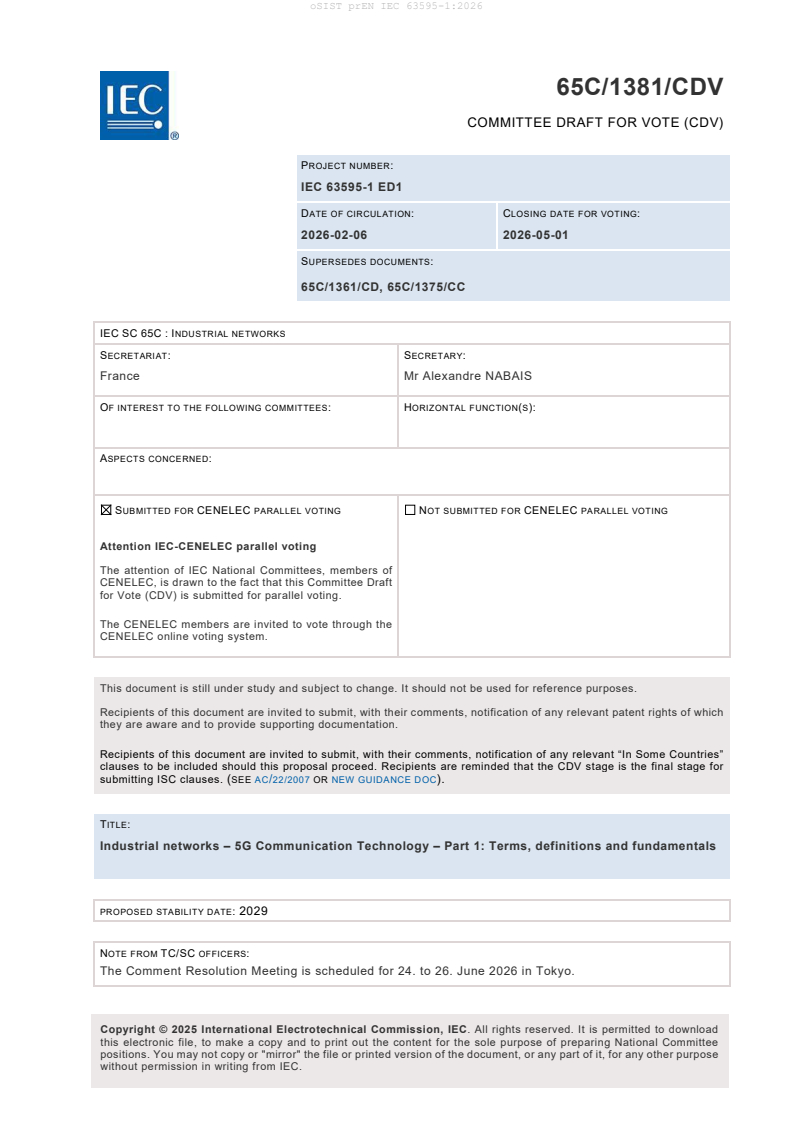
65C/1381/CDV
COMMITTEE DRAFT FOR VOTE (CDV)
PROJECT NUMBER:
IEC 63595-1 ED1
DATE OF CIRCULATION: CLOSING DATE FOR VOTING:
2026-02-06 2026-05-01
SUPERSEDES DOCUMENTS:
65C/1361/CD, 65C/1375/CC
IEC SC 65C : INDUSTRIAL NETWORKS
SECRETARIAT: SECRETARY:
France Mr Alexandre NABAIS
OF INTEREST TO THE FOLLOWING COMMITTEES: HORIZONTAL FUNCTION(S):
ASPECTS CONCERNED:
SUBMITTED FOR CENELEC PARALLEL VOTING NOT SUBMITTED FOR CENELEC PARALLEL VOTING
Attention IEC-CENELEC parallel voting
The attention of IEC National Committees, members of
CENELEC, is drawn to the fact that this Committee Draft
for Vote (CDV) is submitted for parallel voting.
The CENELEC members are invited to vote through the
CENELEC online voting system.
This document is still under study and subject to change. It should not be used for reference purposes.
Recipients of this document are invited to submit, with their comments, notification of any relevant patent rights of which
they are aware and to provide supporting documentation.
Recipients of this document are invited to submit, with their comments, notification of any relevant “In Some Countries”
clauses to be included should this proposal proceed. Recipients are reminded that the CDV stage is the final stage for
submitting ISC clauses. (SEE AC/22/2007 OR NEW GUIDANCE DOC).
TITLE:
Industrial networks – 5G Communication Technology – Part 1: Terms, definitions and fundamentals
PROPOSED STABILITY DATE: 2029
NOTE FROM TC/SC OFFICERS:
The Comment Resolution Meeting is scheduled for 24. to 26. June 2026 in Tokyo.
this electronic file, to make a copy and to print out the content for the sole purpose of preparing National Committee
positions. You may not copy or "mirror" the file or printed version of the document, or any part of it, for any other purpose
without permission in writing from IEC.
Link to Committee Draft for Vote (CDV) online document:
Click here
How to access
This link leads you to the Online Standards Development (OSD) platform for National Mirror
Committee’s (NMC) comments. The project draft may be found further down this document.
Resource materials
We recommend NCs to review the available materials to better understand the member commenting
on the OSD platform. This includes the:
• OSD NC roles overview
• How to add and submit comments to the IEC
Contact
Should you require any assistance, please contact the IEC IT Helpdesk
IEC CDV 63595-1 © IEC 2026
CONTENTS
CONTENTS . 1
FOREWORD . 4
INTRODUCTION . 6
1 Scope . 12
2 Normative references . 12
3 Terms, definitions, abbreviated terms and conventions . 12
3.1 Terms and definitions . 12
3.2 Terms defined by 3GPP . 19
3.3 Abbreviated terms . 19
3.4 Conventions . 23
3.4.1 General . 23
3.4.2 Capitalization . 23
3.4.3 Conventions used for service descriptions . 23
3.4.4 Conventions used for terms and abbreviated terms. 24
4 Considerations on 5th Generation mobile networking. 24
4.1 Overview. 24
4.2 Radio access technology and spectrum . 26
5 General system network architecture . 26
5.1 The industrial production system . 26
5.2 Technical plant system . 27
5.3 Distributed automation system . 27
5.3.1 Architecture . 27
5.3.2 Device types and data endpoint types . 28
5.3.3 Typical data connections and data traffic types . 29
5.3.4 Aspects of time behaviour . 30
5.4 Communication system . 31
5.5 Environmental conditions . 32
6 Conceptual model for 5G systems in industrial automation . 33
6.1 Fundamental structural and functional models . 33
6.2 Conceptual model . 38
6.3 Reference interface . 41
6.4 Data unit reference points and physical reference point . 42
6.5 Parameter concept . 43
6.5.1 General . 43
6.5.2 Parameter statements. 43
6.5.3 Parameter values . 44
6.6 Performance parameters . 44
6.6.1 General . 44
6.6.2 Performance parameters related to the application . 45
6.6.3 Performance parameters related to the wireless communication solution . 46
6.6.4 Performance parameters related to the radio environment . 46
6.7 Influencing quantities . 47
6.8 Quality of communication services . 48
7 Parameter description. 48
7.1 Performance parameters related to the application . 48
7.1.1 Transmission time . 48
IEC CDV 63595-1 © IEC 2026
7.1.2 Update time . 49
7.1.3 Response time . 49
7.1.4 User data throughput . 50
7.1.5 Number of incorrect messages and message error ratio . 50
7.1.6 Number of lost messages and message loss ratio. 51
7.1.7 Up time and communication service availability . 51
7.1.8 Recovery time . 52
7.1.9 Time synchronization accuracy . 52
7.1.10 Number of consecutive lost messages . 52
7.2 Performance parameters related to industrial 5G systems . 52
7.2.1 Operating bit rate . 52
7.2.2 Block error ratio . 53
7.2.3 Hybrid automatic repeat request retransmission rate . 54
7.3 Performance parameters related to the radio environment . 54
7.3.1 Reference signal received power . 54
7.3.2 Received signal strength indicator . 55
7.3.3 Reference signal received quality . 55
7.3.4 Signal to interference noise ratio . 56
7.3.5 Channel quality indicator . 57
7.4 Application related influencing quantities . 57
7.4.1 Spatial extent of the application . 57
7.4.2 User data length . 57
7.4.3 Transfer interval . 58
7.4.4 Survival time . 58
7.4.5 Position of wireless device . 58
7.4.6 Distance between wireless devices . 59
7.4.7 Movement of wireless device . 59
7.4.8 Security level . 60
7.5 Wireless communication system and device related influencing quantities . 60
7.5.1 Spatial coverage of the wireless system . 60
7.5.2 Network topology . 60
7.5.3 Communication cycle time . 61
7.5.4 Frequency band . 61
7.5.5 Security measures . 62
7.5.6 Number of wireless devices . 62
7.5.7 Wireless device density . 62
7.5.8 Bit rate of the physical link . 62
7.5.9 Time for handover . 63
7.6 Environment related influencing quantities . 63
7.6.1 Geographical dimension of the plant . 63
7.6.2 Operation space . 63
7.6.3 Natural environmental condition . 64
7.6.4 Intervisibility . 64
7.6.5 Object movement . 64
7.6.6 Interference type . 65
Annex A (informative) Terms and abbreviated terms for the IEC 63595 series . 66
Annex B (normative) Data to be provided . 69
Bibliography . 70
IEC CDV 63595-1 © IEC 2026
Figure 1 – 5G in the context of industrial communication . 7
Figure 2 – General 5G system network architecture . 26
Figure 3 – The position of the communication system in the context of the industrial
production system . 28
Figure 4 – Architecture of an automation system with spatially distributed automation
functions . 29
Figure 5 – Transfer interval in context of a cyclic production process . 32
Figure 6 – Access through 5G system . 33
Figure 7 – Structural model of distributed automation using 5G network . 35
Figure 8 – Functional model of distributed automation using 5G networks. . 36
Figure 9 – Functional model - 5G device side - variant legacy device. 37
Figure 10 – Functional model - 5G device side - variant industrial 5G device. . 38
Figure 11 – Functional model – 5G network side. . 39
Figure 12 – Conceptual model of a distributed automation system using a wireless
communication system . 40
Figure 13 – Conceptual model of a distributed automation system using an industrial
5G system . 41
Figure 14 – Reference interfaces and gaps between local automation functions and 5G
communication functions . 43
Figure 15 – Data unit reference points and physical reference point . 44
Table 1 – Possible reference interface hardware . 42
Table 2 – Possible reference interface software . 42
Table 3 – Examples of the three statements of influencing quantities and characteristic
parameters . 44
Table A.1 – Terms needed for the IEC 63595 series . 67
Table B.1 – Data to be provided . 70
IEC CDV 63595-1 © IEC 2026
INTERNATIONAL ELECTROTECHNICAL COMMISSION
____________
INDUSTRIAL NETWORKS – 5G Communication Technology –
Part 1: Terms, definitions and fundamentals
FOREWORD
1) The International Electrotechnical Commission (IEC) is a worldwide organization for
standardization comprising all national electrotechnical committees (IEC National Committees).
The object of IEC is to promote international co-operation on all questions concerning
standardization in the electrical and electronic fields. To this end and in addition to other
activities, IEC publishes International Standards, Technical Specifications, Technical Reports,
Publicly Available Specifications (PAS) and Guides (hereafter referred to as "IEC
Publication(s)"). Their preparation is entrusted to technical committees; any IEC National
Committee interested in the subject dealt with may participate in this preparatory work.
International, governmental and non-governmental organizations liaising with the IEC also
participate in this preparation. IEC collaborates closely with the International Organization for
Standardization (ISO) in accordance with conditions determined by agreement between the two
organizations.
2) The formal decisions or agreements of IEC on technical matters express, as nearly as
possible, an international consensus of opinion on the relevant subjects since each technical
committee has representation from all interested IEC National Committees.
3) IEC Publications have the form of recommendations for international use and are accepted
by IEC National Committees in that sense. While all reasonable efforts are made to ensure that
the technical content of IEC Publications is accurate, IEC cannot be held responsible for the
way in which they are used or for any misinterpretation by any end user.
4) In order to promote international uniformity, IEC National Committees undertake to apply IEC
Publications transparently to the maximum extent possible in their national and regional
publications. Any divergence between any IEC Publication and the corresponding national or
regional publication shall be clearly indicated in the latter.
5) IEC itself does not provide any attestation of conformity. Independent certification bodies
provide conformity assessment services and, in some areas, access to IEC marks of conformity.
IEC is not responsible for any services carried out by independent certification bodies.
6) All users should ensure that they have the latest edition of this publication.
7) No liability shall attach to IEC or its directors, employees, servants or agents including
individual experts and members of its technical committees and IEC National Committees for
any personal injury, property damage or other damage of any nature whatsoever, whether direct
or indirect, or for costs (including legal fees) and expenses arising out of the publication, use
of, or reliance upon, this IEC Publication or any other IEC Publications.
8) Attention is drawn to the Normative references cited in this publication. Use of the referenced
publications is indispensable for the correct application of this publication.
9) IEC draws attention to the possibility that the implementation of this document may involve
the use of (a) patent(s). IEC takes no position concerning the evidence, validity or applicability
of any claimed patent rights in respect thereof. As of the date of publication of this document,
IEC had not received notice of (a) patent(s), which may be required to implement this document.
However, implementers are cautioned that this may not represent the latest information, which
IEC CDV 63595-1 © IEC 2026
may be obtained from the patent database available at https://patents.iec.ch. IEC shall not be
held responsible for identifying any or all such patent rights.
IEC 63595-1 has been prepared by subcommittee 65C: Industrial networks, of IEC technical
committee 65: Industrial-process measurement, control and automation. It is an International
Standard.
The text of this International Standard is based on the following documents:
Draft Report on voting
XX/XX/FDIS XX/XX/RVD
Full information on the voting for its approval can be found in the report on voting indicated in
the above table.
The language used for the development of this International Standard is English.
This document was drafted in accordance with ISO/IEC Directives, Part 2, and developed in
accordance with ISO/IEC Directives, Part 1 and ISO/IEC Directives, IEC Supplement, available
at www.iec.ch/members_experts/refdocs. The main document types developed by IEC are
described in greater detail at www.iec.ch/publications.
A list of all parts in the IEC 63595 series [1] , published under the general title Industrial
networks – 5G communication technology, can be found on the IEC website.
The committee has decided that the contents of this document will remain unchanged until the
stability date indicated on the IEC website under webstore.iec.ch in the data related to the
specific document. At this date, the document will be
– reconfirmed,
– withdrawn, or
– revised.
IEC CDV 63595-1 © IEC 2026
INTRODUCTION
A production system uses an industrial automation and control system (3.1.32) (IACS). The
local automation functions can be performed by a control system (3.1.20) . These can be for
example a distributed control systems (DCS), typically used in industrial automation solution
(3.1.34) of process control applications, programmable logic controller (PLC), typically used in
factory automation solutions, etc. in combination with for example sensors, actors (e.g. drives.
valves). A production system uses an industrial automation application (3.1.33). The industrial
automation application (3.1.33) consists of industrial automation system (3.1.31) with default
values of parameters. A industrial automation solution (3.1.34) has specific parameters
assigned to a device instances.
The overall market for wireless communication solutions spans a range of diverse applications,
with differing performance and functional requirements. Within this overall market, the industrial
automation domain can include:
– process automation, covering for example the following industry branches:
• oil and gas, refining,
• chemical,
• pharmaceutical,
• mining,
• pulp & paper,
• water & wastewater,
• steel,
– electric power such as:
• power generation (for example wind turbine),
• power transmission and distribution (grid),
– factory automation, covering for example the following industry branches:
• food and beverage,
• automotive,
• machinery,
• semiconductor.
Application communication requirements for industrial wireless communication systems are
different from those of, for example, the telecommunications, commercial and consumer
markets. These industrial application requirements are identified and provided in 5G-ACIA white
papers that are referenced by the IEC 63595 [2] series.
The IEC 63595 [2] series provides general requirements for industrial automation and spectrum
considerations that are the basis for industrial communication solutions.
Industrial premises can contain a variety of wireless communication technologies and other
sources of radio emissions.
In industrial automation, many different wireless communication solutions can operate in the
same premises. Different to wired fieldbuses, wireless communication devices can interfere
with others on the same premises or environment, disturbing each other.
The IEC 63595 [2] series is intended to provide considerations on cellular wireless
communication systems according to the specifications of the terrestrial radio interfaces of
International Mobile Telecommunications-2020 (IMT-2020) for being applicable in wireless
communication system of industrial automation plants (see ITU-R M.2150-1: 02/2022 [3]).
IEC CDV 63595-1 © IEC 2026
In Figure 1 a UML class diagram is used to categorize the term "Industrial 5G", along with other
examples of standards for industrial wireless communications. Accordingly, Industrial 5G refers
to a set of functions for wireless data transmission using 5G in industrial automation
applications. In this context, only the 3rd Generation Partnership Project (3GPP) 5G radio
interface technologies (RIT) according to the detailed specifications of the terrestrial radio
interfaces of International Mobile Telecommunications-2020 (IMT-2020) are considered.
The 3GPP is a collaborative project that brings together standardization organizations from
around the world to create globally acceptable specifications for mobile networks. As its name
implies, it was first created to establish such specifications for the third generation (3G) of
mobile systems. It has continued its work for subsequent generations, including the one
considered here, the fifth generation (5G).
As an application of cellular networks in industrial automation, the class "Industrial 5G" inherits
from both class "3GPP5G - RIT" and class "wireless industrial communication".
Figure 1 – 5G in the context of industrial communication
The IEC 63595 [2] series has the general title:
INDUSTRIAL NETWORKS - 5G COMMUNICATION TECHNOLOGY -
and has six parts:
a) Part 1: Terms, definitions and fundamentals
b) Part 2 TR: Use cases
c) Part 3: Features needed for industrial automation
d) Part 4: Deployment of 5G technology in an industrial automation plant
e) Part 5: Test methods
f) Part 6: Cyber security
NOTE This document is partly a copy of the IEC PAS 63595 [4]. The other parts contain potentially other elements
of the IEC PAS 63595 [4].
Further reading:
IEC 60050 (all parts) [5], International Electrotechnical Vocabulary (IEV)
IEC 60050-712:1992 [6], International Electrotechnical Vocabulary (IEV) - Part 712: Antennas
IEC 60050-161:2018 [7], International Electrotechnical Vocabulary (IEV) - Part 161:
Electromagnetic compatibility
IEC 60050-713:1998 [8], International Electrotechnical Vocabulary (IEV) - Part 713:
Radiocommunications: transmitters, receivers, networks and operation
IEC CDV 63595-1 © IEC 2026
IEC 61158-2 [9], Industrial communication networks - Fieldbus specifications - Part 2: Physical
layer specification and service definition
IEC 61158-5 (all parts) [10], Industrial communication networks - Fieldbus specifications - Part
5-x: Application layer service definition - Type x elements
IEC 61508 (all parts) [11], Functional safety of electrical/electronic/programmable electronic
safety-related systems
IEC 61784-1 (all parts) [12], Industrial communication networks - Profiles - Part 1: Fieldbus
profiles
IEC 61784-3 (all parts) [13], Industrial communication networks - Profiles - Part 3: Functional
safety fieldbuses - General rules and profile definitions
IEC 61918:2018 [14], Industrial communication networks - Installation of communication
networks in industrial premises
IEC 62278:2002 [15], Railway applications - Specification and demonstration of reliability,
availability, maintainability and safety (RAMS)
IEC 62443 (all parts) [16], Security for industrial automation and control systems
IEC 62591:2016 [17], Industrial networks - Wireless communication network and
communication profiles - WirelessHART™
IEC 62601, Industrial networks - Wireless communication network and communication profiles
- WIA-PAIEC 62601 [18]
IEC 62657 (all parts) [19], Industrial networks - Coexistence of wireless systems
IEC 62657-3 [20], Industrial networks - Coexistence of wireless systems - Part 3: Formal
description of the automated coexistence management and application guidance
IEC 62734:2014 [21], Industrial networks - Wireless communication network and
communication profiles - ISA 100.11a
IEC 62890:2020 [22], Industrial-process measurement, control and automation - Life-cycle-
management for systems and components
IEC 62948 [23], Industrial networks - Wireless communication network and communication
profiles - WIA-FA
IEC/IEEE 60802 [24], Time-Sensitive Networking Profile for Industrial Automation
ISO 5807:1985 [25], Information processing — Documentation symbols and conventions for
data, program and system flowcharts, program network charts and system resources charts
ISO/IEC 2382-16:1996 [26] , Information technology - Vocabulary - Part 16: Information theory
___________
Under preparation. Stage at the time of publication: IEC/IEEE FDIS 60802:2025.
Withdrawn.
IEC CDV 63595-1 © IEC 2026
ISO/IEC 27000 series [27], Information technology - Security techniques - Information security
management systems - Overview and vocabulary
ITU-R BS.561-2 (07/86)[28], Definitions of radiation in LF, MF and HF broadcasting bands,
available from Internet:
ETSI TR 100 027, V1.2.1 (1999-12)[29], Electromagnetic compatibility and Radio spectrum
Matters (ERM); Methods of measurement for private mobile radio equipment
ETSI TR 102 889-2: 2011[30], Electromagnetic compatibility and Radio spectrum Matters
(ERM); System Reference Document; Short Range Devices (SRD); Part 2: Technical
characteristics for SRD equipment for wireless industrial applications using technologies
different from Ultra-Wide Band (UWB)
ETSI EN 300 328: 2019[31], Wideband transmission systems; Data transmission equipment
operating in the 2,4 GHz ISM band and using wide band modulation techniques; Harmonised
Standard covering the essential requirements of article 3.2 of Directive 2014/53/EU
IEEE Std 802.1AS [32], IEEE Standard for Local and Metropolitan Area Networks: Timing and
Synchronization for Time-Sensitive Applications
IEEE Std 802.1AB [33], IEEE Standard for Local and Metropolitan Area Networks: Station and
Media Access Control Connectivity Discovery
IEEE Std 802.3 [34], IEEE Standard for Information technology - Telecommunications and
information exchange between systems - Local and metropolitan area networks - Specific
requirements - Part 3: Carrier Sense Multiple Access with Collision Detection (CSMA/CD)
Access Method and Physical Layer Specifications
IEEE Std 802.11 [35], IEEE Standard for Information technology - Telecommunications and
information exchange between systems - Local and metropolitan area networks - Specific
requirements - Part 11: Wireless LAN Medium Access Control (MAC) and Physical Layer (PHY)
Specifications
IEEE Std 802.15.1:2005 [36], IEEE Standard for Information technology - Telecommunications
and information exchange between systems - Local and metropolitan area networks - Specific
requirements - Part 15.1: Wireless Medium Access Control (MAC) and Physical Layer (PHY)
Specifications for Wireless Personal Area Networks (WPANs)
IEEE Std 802.15.2: 2003 [37], IEEE Recommended Practice for Information technology -
Telecommunications and information exchange between systems - Local and metropolitan area
networks - Specific requirements - Part 15.2: Coexistence of Wireless Personal Area Networks
with Other Wireless Devices Operating in Unlicensed Frequency Bands
IEEE Std 802.15.4 [38], IEEE Standard for Local and metropolitan area networks - Part 15.4:
Low-Rate Wireless Personal Area Networks (LR-WPANs)
IEEE Std 1588 [39], IEEE Standard for a Precision Clock Synchronization Protocol for
Networked Measurement and Control Systems
Federal Standard 1037C, Telecommunications: Glossary of Telecommunication Terms. 07
August 1996, available at [40]
ZVEI, Frankfurt, Germany, April 2009, Coexistence of Wireless Systems in Automation
Technology - Explanations on reliable parallel operation of wireless communication
solutions[41]
IEC CDV 63595-1 © IEC 2026
ITU Radio Regulations, edition of 2020, Volume 1: Articles, available at:
[42]
Directive 2014/53/EU of the European Parliament and of the Council of 16 April 2014 on the
harmonisation of the laws of the Member States relating to the making available on the market
of radio equipment and repealing Directive 1999/5/EC, available at
lex.europa.eu/legal-content/EN/TXT/?uri=CELEX%3A32014L0053>[43]
3GPPSINR 23.503; Policy and charging control framework for the 5G System (5GS); Stage 2;:
Online Available at https://portal.3gpp.org/[44]
Draft 3GPPTR 22.830; Study on Business Role Models for Network Slicing; V0.1.0, 10/2017[45]
3GPPSINR 38.201; NR; Physical layer; General description; V15.0.0; 12/2017; Online available
at
https://portal.3gpp.org/desktopmodules/Specifications/SpecificationDetails.aspx?specificationI
d=3211[46]
Draft 3GPPTR 22.821; Feasibility Study on LAN Support in 5G; V2.0.0; 03/2018; Online
available at
https://portal.3gpp.org/desktopmodules/Specifications/SpecificationDetails.aspx?specificationI
d=3281[47]
3GPPSINR 33.501, 3rd Generation Partnership Project; Technical Specification Group Services
and System Aspects; Security architecture and procedures for 5G system (Release 18)[48]
5G-ACIA white paper; 5G for Connected Industries and Automation; Second Edition; Online
available at https://5g-acia.org/whitepapers/5g-for-connected-industries-and-automation-
second-edition/[49]
5G-ACIA white paper; Key 5G Use Cases and Requirements; Online available at https://5g-
acia.org/whitepapers/key-5g-use-cases-and-requirements/[50]
5G-ACIA white paper; A 5G Traffic Model for Industrial Use Cases; Online available at
https://5g-acia.org/whitepapers/a-5g-traffic-model-for-industrial-use-cases/[51]
5G-ACIA white paper; 5G for Automation in Industry; Online available at https://5g-
acia.org/whitepapers/5g-for-automation-in-industry/[52]
5G-ACIA white paper; Security Aspects of 5G for Industrial Networks; Online available at
https://5g-acia.org/wp-content/uploads/2021/05/5G-
ACIA_Security_Aspects_of_5G_for_Industrial_Networks_single-pages.pdf[53]
5G-ACIA white paper; 5G Non-Public Networks for Industrial Scenarios; Online available at
https://5g-acia.org/whitepapers/5g-non-public-networks-for-industrial-scenarios/[54]
5G-ACIA white paper; Exposure of 5G Capabilities for Connected Industries and Automation
Applications; Online available at https://5g-acia.org/whitepapers/exposure-of-5g-capabilities-
for-connected-industries-and-automation-applications-2/[55]
5G-ACIA white paper; Integration of 5G with Time-Sensitive Networking for Industrial
Communications; Online available at https://5g-acia.org/wp-content/uploads/2021/05/5G-
ACIA_Integration_of_5G_with_Time-
Sensitive_Networking_for_Industrial_Communicatins_single-pages.pdf[56]
IEC CDV 63595-1 © IEC 2026
5G-ACIA white paper; Integration of Industrial Ethernet Networks with 5G Networks; Online
available at https://5g-acia.org/whitepapers/integration-of-industrial-ethernet-networks-with-
5g-networks/[57]
5G-ACIA white paper; 5GQoS for Industrial Automation; Online available at https://5g-
acia.org/whitepapers/5g-quality-of-service-for-industrial-automation/[58]
Draft 3GPPTR 22.804; Study on Communication for Automation in Vertical domains (CAV);
V1.1.0; 12/2017; Online available at
https://portal.3gpp.org/desktopmodules/Specifications/SpecificationDetails.aspx?specificationI
d=3187[59]
5G-ACIA white paper; Industrial 5G Devices - Architecture and Capabilities; Online available at
https://5g-acia.org/whitepapers/industrial-5g-devices-architecture-and-capabilities/[60]
5G-ACIA white paper; Service-Level Specifications (SLSs) for 5G Technology-Enabled
Connected Industries; Online available at https://5g-acia.org/whitepapers/service-level-
specifications-slss-for-5g-technology-enabled-connected-industries/[61]
5G-ACIA white paper; Performance Testing of 5G Systems for Industrial Automation; Online
available at https://5g-acia.org/whitepapers/performance-testing-of-5g-systems-for-industrial-
automation/[62]
5G-ACIA white paper; Selected Testing and Validation Considerations for Industrial
Communication with 5G Technologies; Online available at https://5g-
acia.org/whitepapers/selected-testing-and-validation-considerations-for-industrial-
communication-with-5g-technologies/[63]
3GPPSINR 22.104. Service requirements for cyber-physical control applications in vertical
domains; Online available at https://www.3gpp.org/ftp/Specs/archive/22_series/22.104/[64]
P. Yazdani, G. Cainelli, L. Underberg, "Virtual Automation Network Simulation (VANSIM): A tool
for shared 5G campus networks in industrial working and co-working spaces", 14th Colloquium
on Communication in Automation, Magdeburg, Germany, November 21-22, 2023, Magdeburg,
Germany. Online available at https://opendata.uni-
halle.de/bitstream/1981185920/113597/1/08_KommA2023_V3-3_Yazdani%20et%20al.pdf[65]
G. Cainelli, "Modeling and Management of Wireless Communication Systems based on Digital
Twins", , Ph.D. Dissertation, Otto-von-Guericke-Universität Magdeburg, Germany 2025[66]
Gustavo P. Cainelli, Parva Yazdani, Lisa Underberg, Ulrich Jumar, Carlos E. Pereira, "
Modelling and Management of Wireless Communication Systems based on Digital Twins", IFAC
World Congress 2023, Yokohama, JAPAN, 9 July - 14 July 2023, IFAC-PapersOnLine, Volume
56, Issue 2, 2023, Pages 2108-2114, ISSN 2405-8963, Online available at
https://doi.org/10.1016/j.ifacol.2023.10.1113[67]
ISO/IEC 7498-1:1994, Information technology — Open Systems Interconnection — Basic
Reference Model: The Basic Model — Part 1 ISO/IEC 7498-1:1994 [68]
ISO/IEC/IEEE 8802-3 [69], Telecommunications and exchange between information technology
systems - Requirements for local and metropolitan area networks - Part 3: Standard for Ethernet
3GPPTR 22.804. Study on Communication for Automation in Vertical Domains; Online available
at https://www.3gpp.org/ftp/Specs/archive/22_series/22.804/[70]
IEC CDV 63595-1 © IEC 2026
1 Scope
This Part 1 of the IEC 63595 series [1] provides fundamentals for the specification of wireless
communication systems based on 5G and beyond technologies applicable for industrial process
measurement, control and automation. The basic architecture of a 5G system is presented,
which forms the basis of industrial 5G systems. Essential 5G terms are listed with references
to 3GPP documents. Additional definitions of industrial applications terms are provided. These
definitions are used in the IEC 63595 series [1].
The context of an industrial 5G system is described, from which the requirements for such a
system can be derived. Based on that this document provides a description of the conceptual
model of industrial 5G in the context of industrial production (process and manufacturing)
including interfaces of an industrial 5G communication system to automation systems
(reference interface, configuration interface, monitoring interface) and its parameters.
2 Normative references
The following documents are referred to in the text in such a way that some or all of their content
constitutes requirements of this document. For dated references, only the edition cited applies.
For undated references, the latest edition of the referenced document (including any
amendments) applies.
IEC 60050-192:2015, International Electrotechnical Vocabulary (IEV) - Part 192: Dependability
3 Terms, definitions, abbreviated terms and conventions
For the purposes of this document, the following terms and definitions apply.
ISO and IEC maintain terminology databases for use in standardization at the following
addresses:
– IEC Electropedia: available at https://www.electropedia.org/
– ISO Online browsing platform: available at https://www.iso.org/obp
3.1 Terms and definitions
NOTE The given terms and definitions are not all used in this document; these apply also to other parts of the IEC
63595 [2] series.
3.1.1
5G device
user equipment that is part of a 5G system
3.1.2
5G functions
set of functions standardized by 3GPP for 5G communication and implemented in 5G devices
or 5G network devices
3.1.3
5G network
part of a 5G system that implements radio access network functions and core network functions
3.1.4
5G network device
device that either implements radio access network functions or core network functions or both
IEC CDV 63595-1 © IEC 2026
3.1.5
5G system
cellular network system of the 5th generation and beyond
3.1.6
application adaptation unit
set of functions that manage 5G QoS parameters
Note 1 to entry: Obtain QoS parameters of the application, compare them with QoS parameters of the 5G system,
negotiate QoS parameters between application and 5G system and adjust QoS parameters.
3.1.7
application communication requirements
quantitative requirements specifying the required conditions and the required characteristics of
communication solutions at the reference interface that is met in order to achieve the purpose
of the automation application
[SOURCE: IEC 62657-2 [71] ED3, modified - The term communication interface has been
changed by reference interface and the term wireless deleted.]
3.1.8
availability
ability to be in a state to perform as required under given conditions
Note 1 to entry: Availability considers two states, the up state (available) and the down state (unavailable). All time
intervals, such as administrative delay, are defined either as belonging to one of these two states or are excluded.
(It is to be noted that the definition of dependability (3.1.22) does not refer to “states” as it has a much broader
meaning. See 192-01-22 for further clarification).
Note 2 to entry: Availability depends upon the combined attributes of the reliability (192-01-24), maintainability
(192-01-27), supportability (192-01-31) and the maintenance and support provided.
Note 3 to entry: Availability can also be affected by delays before any maintenance and support action is
recognised. For example, delays due to fault detection time and administrative delay.
Note 4 to entry: Given conditions include aspects that affect availability, such as: mode of operation, stress levels
(see 192-01-37 for examples), environmental conditions, and maintenance defined in the life profile.
Note 5 to entry: Availability may be quantified using measures defined in 192-08, Availability related measures.
[SOURCE: IEV 192-01-23, Modified - Figure 1 deleted]
3.1.9
best effort traffic
data transmission with no constant or guaranteed delivery time
Note 1 to entry: This ha
...