


SIST EN 1822-1:2019
(Main)High efficiency air filters (EPA, HEPA and ULPA) - Part 1: Classification, performance testing, marking
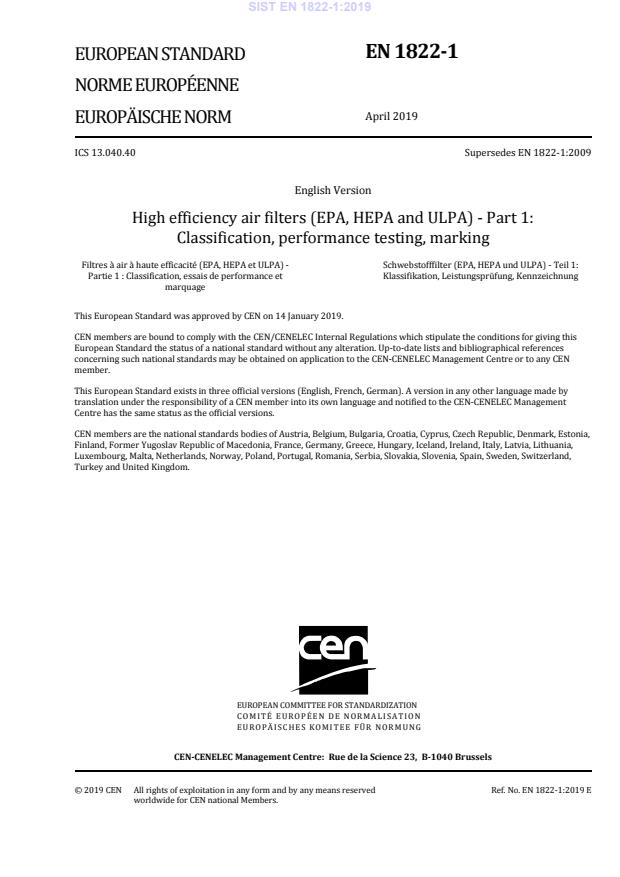
High efficiency air filters (EPA, HEPA and ULPA) - Part 1: Classification, performance testing, marking
This document applies to high efficiency particulate and ultra-low penetration air filters (EPA, HEPA and ULPA) used in the field of ventilation and air conditioning and for technical processes, e.g. for applications in clean room technology or pharmaceutical industry.
It establishes a procedure for the determination of the efficiency on the basis of a particle counting method using a liquid (or alternatively a solid) test aerosol and allows a standardized classification of these filters in terms of their efficiency, both local and integral efficiency.
Schwebstofffilter (EPA, HEPA und ULPA) - Teil 1: Klassifikation, Leistungsprüfung, Kennzeichnung
Dieses Dokument gilt für Hochleistungs-Partikelfilter und Hochleistungs-Schwebstofffilter (EPA, HEPA und ULPA) im Bereich der Raum- und Prozesslufttechnik, z. B. Anwendungen in der Reinraumtechnik oder in der pharmazeutischen Industrie.
Es legt ein Verfahren zur Prüfung des Abscheidegrades auf Basis von Partikelzählverfahren unter Verwendung eines flüssigen (oder alternativ eines festen) Prüfaerosols fest und ermöglicht eine einheitliche Klassifizierung der Schwebstofffilter nach dem Abscheidegrad, sowohl nach dem integralen als auch nach dem lokalen Abscheidegrad.
Filtres à air à haute efficacité (EPA, HEPA et ULPA) - Partie 1 : Classification, essais de performance et marquage
Le présent document s'applique aux filtres à air à très haute efficacité et à très faible pénétration (EPA, HEPA et ULPA) utilisés dans le domaine de la ventilation et du conditionnement d'air, ainsi que dans des procédés techniques, par exemple pour des applications relevant de la technique des salles blanches ou de l’industrie pharmaceutique.
Il définit un mode opératoire de détermination de l’efficacité à partir d’une méthode de comptage des particules à l’aide d’un aérosol d’essai liquide (ou solide) et permet une classification normalisée de ces filtres en fonction de leur efficacité, à la fois locale et globale.
Visoko učinkoviti zračni filtri (EPA, HEPA in ULPA) - 1. del: Klasifikacija, preskušanje lastnosti, označevanje
Ta evropski standard se uporablja za visoko učinkovite zračne filtre drobnih delcev in zračne filtre z ultra nizko penetracijo (EPA, HEPA in ULPA), ki se uporabljajo na področju prezračevanja in klimatizacije ter za tehnične postopke, npr. za naprave v tehnologiji čistega prostora ali farmacevtski industriji.
Vzpostavlja postopek za določitev učinkovitosti na osnovi metode štetja delcev z uporabo tekočega preskusnega aerosola (ali v trdnem stanju kot druga možnost) ter omogoča standardizirano klasifikacijo teh filtrov glede na njihovo (lokalno in celostno) učinkovitost.
General Information
- Status
- Published
- Public Enquiry End Date
- 06-Sep-2017
- Publication Date
- 17-Apr-2019
- Technical Committee
- I13 - Imaginarni 13
- Current Stage
- 6060 - National Implementation/Publication (Adopted Project)
- Start Date
- 18-Apr-2019
- Due Date
- 23-Jun-2019
- Completion Date
- 18-Apr-2019
Relations
- Effective Date
- 17-Apr-2019
- Effective Date
- 12-Oct-2016
Overview
EN 1822-1:2019 is the CEN European standard that defines classification, performance testing and marking for high efficiency air filters - EPA, HEPA and ULPA - used in ventilation, air conditioning and technical processes (for example cleanrooms and pharmaceutical production). The standard establishes a particle-counting test procedure (liquid aerosol, alternatively solid for leak checks) to determine filter efficiency at the most penetrating particle size (MPPS) and to assign filters to standardized classes (E10–E12, H13–H14, U15–U17).
Key topics and technical requirements
- Scope & classification
- Covers EPA, HEPA and ULPA filter elements and assigns groups/classes by integral and (for H and U) local MPPS efficiency/penetration.
- Classes: E10–E12, H13–H14, U15–U17.
- Measurement basis
- Particle-counting methods using a liquid test aerosol (e.g., DEHS, PAO, PSL). Solid aerosols allowed for some leak tests.
- Determination of MPPS from sheet-media efficiency vs particle size curves.
- Three-step test process
- Flat sheet filter media test to determine MPPS and baseline efficiency.
- Leak test of the filter element (mandatory for Groups H and U; Group E not leak-tested for classification).
- Efficiency test of the assembled filter element at the nominal air volume flow rate.
- Test conditions
- Typical test air temperature (23 ± 5) °C and relative humidity < 75%, with tighter stability during tests.
- Clean test air (background particle concentration control - e.g., < 352,000 particles/m³).
- Performance metrics
- Integral efficiency/penetration at MPPS and, for H/U groups, local (scan) leakage limits.
- Special handling for electrostatically charged media - classification based on discharged efficiency (per EN ISO 29463-5).
- Documentation & marking
- Test reports, marking and traceability requirements for manufacturers and testing laboratories.
Practical applications
- Specifying and verifying filters for:
- Cleanrooms (semiconductor, biotech, medtech)
- Pharmaceutical manufacturing and aseptic processing
- Hospital HVAC and isolation rooms
- Critical industrial processes requiring particle control
- Used by: filter manufacturers, independent test laboratories, HVAC engineers, cleanroom qualification teams, procurement/specification authors and regulatory bodies.
Who should use this standard
- Manufacturers for product classification and marking
- Test laboratories for accredited performance testing
- Engineers and facility managers for selecting and validating filters in controlled environments
Related standards
- EN ISO 29463-2 / -3 / -4 / -5 (aerosol production, sheet media testing, scan leak method, filter element testing)
- EN 14799 (terminology)
- EN ISO 5167-1, ISO 2859-1 (measurement & sampling references)
EN 1822-1:2019 supersedes EN 1822-1:2009 and emphasizes particle-counting methods (it excludes the aerosol-photometer scan leak test), making it the reference for modern HEPA/ULPA performance classification and testing.


Frequently Asked Questions
SIST EN 1822-1:2019 is a standard published by the Slovenian Institute for Standardization (SIST). Its full title is "High efficiency air filters (EPA, HEPA and ULPA) - Part 1: Classification, performance testing, marking". This standard covers: This document applies to high efficiency particulate and ultra-low penetration air filters (EPA, HEPA and ULPA) used in the field of ventilation and air conditioning and for technical processes, e.g. for applications in clean room technology or pharmaceutical industry. It establishes a procedure for the determination of the efficiency on the basis of a particle counting method using a liquid (or alternatively a solid) test aerosol and allows a standardized classification of these filters in terms of their efficiency, both local and integral efficiency.
This document applies to high efficiency particulate and ultra-low penetration air filters (EPA, HEPA and ULPA) used in the field of ventilation and air conditioning and for technical processes, e.g. for applications in clean room technology or pharmaceutical industry. It establishes a procedure for the determination of the efficiency on the basis of a particle counting method using a liquid (or alternatively a solid) test aerosol and allows a standardized classification of these filters in terms of their efficiency, both local and integral efficiency.
SIST EN 1822-1:2019 is classified under the following ICS (International Classification for Standards) categories: 23.120 - Ventilators. Fans. Air-conditioners. The ICS classification helps identify the subject area and facilitates finding related standards.
SIST EN 1822-1:2019 has the following relationships with other standards: It is inter standard links to SIST EN 1822-1:2010, SIST EN 1822-1:2010. Understanding these relationships helps ensure you are using the most current and applicable version of the standard.
SIST EN 1822-1:2019 is associated with the following European legislation: EU Directives/Regulations: 2017-01-2394, TRRTP084, TRRTP129. When a standard is cited in the Official Journal of the European Union, products manufactured in conformity with it benefit from a presumption of conformity with the essential requirements of the corresponding EU directive or regulation.
You can purchase SIST EN 1822-1:2019 directly from iTeh Standards. The document is available in PDF format and is delivered instantly after payment. Add the standard to your cart and complete the secure checkout process. iTeh Standards is an authorized distributor of SIST standards.
Standards Content (Sample)
2003-01.Slovenski inštitut za standardizacijo. Razmnoževanje celote ali delov tega standarda ni dovoljeno.VLILNDFLMDSchwebstofffilter (EPA, HEPA und ULPA) - Teil 1: Klassifikation, Leistungsprüfung, KennzeichnungFiltres à air à haute efficacité (EPA, HEPA et ULPA) - Partie 1 : Classification, essais de performance et marquageHigh efficiency air filters (EPA, HEPA and ULPA) - Part 1: Classification, performance testing, marking23.120QDSUDYHVentilators. Fans. Air-conditionersICS:Ta slovenski standard je istoveten z:EN 1822-1:2019SIST EN 1822-1:2019en,fr,de01-junij-2019SIST EN 1822-1:2019SLOVENSKI
STANDARDSIST EN 1822-1:20101DGRPHãþD
EUROPEAN STANDARD NORME EUROPÉENNE EUROPÄISCHE NORM
EN 1822-1
April
t r s { ICS
s uä r v rä v r Supersedes EN
s z t tæ sã t r r {English Version
Classificationá performance testingá marking Partie
s ã Classificationá essais de performance et marquage
Klassifikationá Leistungsprüfungá Kennzeichnung This European Standard was approved by CEN on
s v January
t r s {ä
egulations which stipulate the conditions for giving this European Standard the status of a national standard without any alterationä Upætoædate lists and bibliographical references concerning such national standards may be obtained on application to the CENæCENELEC Management Centre or to any CEN memberä
translation under the responsibility of a CEN member into its own language and notified to the CENæCENELEC Management Centre has the same status as the official versionsä
CEN members are the national standards bodies of Austriaá Belgiumá Bulgariaá Croatiaá Cyprusá Czech Republicá Denmarká Estoniaá Finlandá Former Yugoslav Republic of Macedoniaá Franceá Germanyá Greeceá Hungaryá Icelandá Irelandá Italyá Latviaá Lithuaniaá Luxembourgá Maltaá Netherlandsá Norwayá Polandá Portugalá Romaniaá Serbiaá Slovakiaá Sloveniaá Spainá Swedená Switzerlandá Turkey and United Kingdomä
EUROPEAN COMMITTEE FOR STANDARDIZATION COMITÉ EUROPÉEN DE NORMALISATION EUROPÄISCHES KOMITEE FÜR NORMUNG
CEN-CENELEC Management Centre:
Rue de la Science 23,
B-1040 Brussels
t r s { CEN All rights of exploitation in any form and by any means reserved worldwide for CEN national Membersä Refä Noä EN
s z t tæ sã t r s { ESIST EN 1822-1:2019
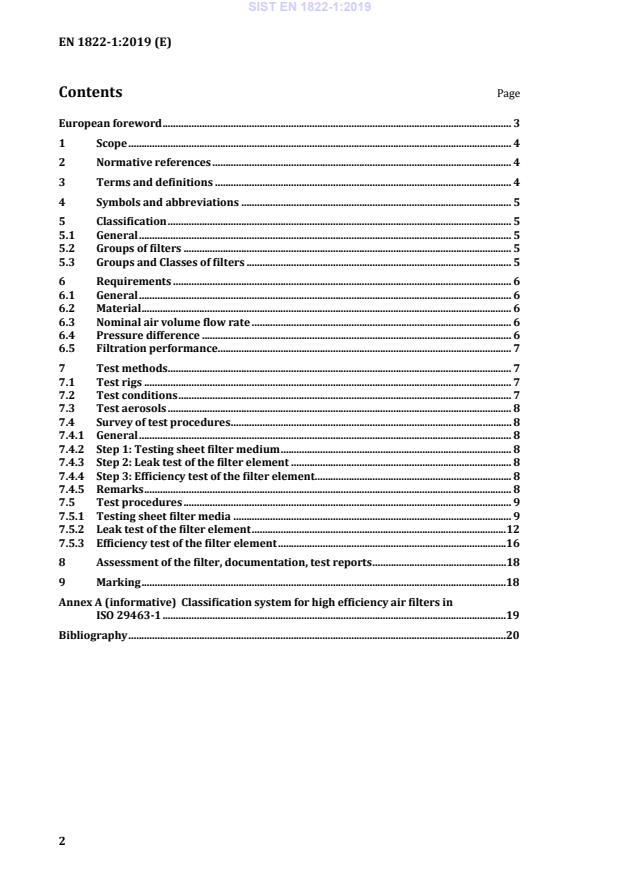
Classification system for high efficiency air filters in ISO 29463-1 .19 Bibliography .20
— EN ISO 29463-4, High-efficiency filters and filter media for removing particles in air — Part 4: Test method for determining leakage of filter element — Scan method
— EN ISO 29463-5, High-efficiency filters and filter media for removing particles in air — Part 5: Test method for filter elements When reference is made to ISO 29463-1 in EN ISO 29463-2 to -5, at European level EN 1822-1 applies. This document is based on particle counting methods which actually cover most needs of different applications. The differences between this European Standard and its previous edition lie in: — the addition of references to the existing EN ISO 29463-2, EN ISO 29463-3, EN ISO 29463-4 and EN ISO 29463-5; — the exclusion of the use of an aerosol photometer filter scan leak test; — various editorial corrections implemented in this document. According to the CEN-CENELEC Internal Regulations, the national standards organisations of the following countries are bound to implement this European Standard: Austria, Belgium, Bulgaria, Croatia, Cyprus, Czech Republic, Denmark, Estonia, Finland, Former Yugoslav Republic of Macedonia, France, Germany, Greece, Hungary, Iceland, Ireland, Italy, Latvia, Lithuania, Luxembourg, Malta, Netherlands, Norway, Poland, Portugal, Romania, Serbia, Slovakia, Slovenia, Spain, Sweden, Switzerland, Turkey and the United Kingdom. SIST EN 1822-1:2019
· 85
¶ 15 –-c –-c E11
· 95
¶ 5 –-c –-c E12
· 99,5
¶ 0,5 –-c –-c H13
· 99,95
¶ 0,05
· 99,75
¶ 0,25 H14
· 99,995
¶ 0,005
· 99,975
¶ 0,025 U15
· 99,999 5
¶ 0,000 5
· 99,997 5
¶ 0,002 5 U16
· 99,999 95
¶ 0,000 05
· 99,999 75
¶ 0,000 25 U17
· 99,999 995
¶ 0,000 005
· 99,999 9
¶ 0,000 1 a See 7.5.2 and EN ISO 29463-4. b Local penetration values lower than those given in the table may be agreed between supplier and purchaser. c Group E filters (Classes E10, E11 and E12) cannot and shall not be leak tested for classification purposes. NOTE ISO 29463-1:2017 developed by ISO/TC 142 includes a classification system for high efficiency air filters according to their filtration performance (efficiency or penetration) similar to EN 1822-1. Table A.1 gives a by-side comparison of the classification in EN 1822-1 and ISO 29463-1:2017. 7 Test methods 7.1 Test rigs The test rigs are described in detail in EN ISO 29463-3, EN ISO 29463-4 and EN ISO 29463-5. The individual methods of measurement and the measuring instruments are described in EN ISO 29463-2. 7.2 Test conditions The air in the test channel used for testing shall comply with the following requirements: — Temperature: (23 ± 5) °C; — Relative humidity < 75 %.
The temperature shall remain constant during the entire test procedure within ± 2 °C the relative humidity within ± 5 %. SIST EN 1822-1:2019
...
Questions, Comments and Discussion
Ask us and Technical Secretary will try to provide an answer. You can facilitate discussion about the standard in here.
Loading comments...