

SIST EN 228:2025
(Main)Automotive fuels - Unleaded petrol - Requirements and test methods
General Information
- Abstract
This document specifies requirements and test methods for marketed and delivered unleaded petrol. It is applicable to unleaded petrol for use in petrol engine vehicles designed to run on unleaded petrol.
This document specifies two types of unleaded petrol:
- one type with a maximum oxygen content of 3,7 % (m/m) and a maximum ethanol content of 10,0 % (V/V) in Table 1;
- one type in Table 2 with a maximum oxygen content of 2,7 % (m/m) and a maximum ethanol content of 5,0 % (V/V) intended for older vehicles that are not warranted to use unleaded petrol defined in Table 1.
NOTE 1 The two types are based on European Directive requirements [3], [4] and [13].
NOTE 2 For the purposes of this document, the terms “% (m/m)” and “% (V/V)” are used to represent respectively the mass fraction, µ, and the volume fraction, φ.
- Status
- Published
- Public Enquiry End Date
- 02-May-2024
- Publication Date
- 31-Aug-2025
- Technical Committee
- NAD - Petroleum products, lubricants and related products
- Current Stage
- 6060 - National Implementation/Publication (Adopted Project)
- Start Date
- 04-Aug-2025
- Due Date
- 09-Oct-2025
- Completion Date
- 01-Sep-2025

Overview
EN 228:2025 - Automotive fuels - Unleaded petrol - Requirements and test methods (CEN) defines the chemical, physical and labelling requirements and the associated test methods for marketed and delivered unleaded petrol in Europe. Approved by CEN in June 2025 and replacing EN 228:2012+A1:2017, this standard applies to petrol engine vehicles designed for unleaded petrol and specifies two fuel types with distinct ethanol and oxygen limits:
- Type 1: max 3.7 % (m/m) oxygen and max 10.0 % (V/V) ethanol (E10)
- Type 2: max 2.7 % (m/m) oxygen and max 5.0 % (V/V) ethanol - intended for older vehicles
EN 228:2025 aligns with EU Directives and gives requirements for sampling, pump marking, volatility, octane reporting and precision/dispute handling for test results.
Key Topics and Requirements
- Fuel composition limits: ethanol and oxygen content limits for the two petrol types; other compositional parameters referenced in the standard tables.
- Test methods: updated and new methods referenced (examples include EN 13016-3 for vapour pressure, EN 17306 micro-distillation, EN 18015 GC‑VUV, EN ISO 22854 multidimensional GC) and adoption of EN ISO 4259-1/2 for method precision.
- Sampling: mandatory sampling procedures per EN ISO 3170 / EN ISO 3171 and EN 14275 guidance.
- Volatility and vapour pressure: climatic requirements, water tolerance and vapour pressure testing (ASVP/DVPE).
- Octane reporting: requirements for declaring research and motor octane numbers.
- Additives and markers: rules for additives (including phosphorus and MMT), dyes/markers and labelling when metallic additives are present.
- Pump marking and consumer information: marking and nozzle identification per EN 16942; mandatory “Contains metallic additives” label where applicable.
- Quality control and dispute resolution: precision, arbitration methods and guidance for resolving analytical disputes.
Applications and Users
EN 228:2025 is essential for:
- Refineries and blenders ensuring compliant production and blending of unleaded petrol (including E5/E10).
- Fuel testing laboratories applying standardized methods for conformity testing and dispute resolution.
- Fuel distributors and retailers for correct pump marking, product delivery and quality control.
- Regulators and conformity assessors enforcing fuel quality rules and consumer protection.
- Vehicle manufacturers and service organizations verifying fuel compatibility and advising customers (especially owners of older vehicles).
Related Standards
Relevant normative references and complementary standards include:
- EN 16942 (vehicle compatibility / pump marking)
- EN 15376 (ethanol as blending component)
- EN ISO 3170 / EN ISO 3171 (sampling)
- EN 13016-1/3, EN 17306, EN 18015, EN ISO 22854 (analytical methods)
- EN ISO 4259-1 / EN ISO 4259-2 (precision of measurement methods)
Keywords: EN 228:2025, unleaded petrol requirements, automotive fuels standard, test methods, ethanol content, vapour pressure, octane reporting, fuel sampling, pump marking.
Relations
- Replaces
SIST EN 228:2012+A1:2017 - Automotive fuels - Unleaded petrol - Requirements and test methods - Effective Date
- 01-Oct-2025
- Effective Date
- 22-Jul-2026
- Effective Date
- 24-Jun-2026
- Effective Date
- 24-Jun-2026
- Effective Date
- 28-Jan-2026
- Effective Date
- 28-Jan-2026
- Effective Date
- 28-Jan-2026
- Effective Date
- 28-Jan-2026
- Effective Date
- 28-Jan-2026
- Effective Date
- 28-Jan-2026
- Effective Date
- 28-Jan-2026
- Effective Date
- 28-Jan-2026
- Effective Date
- 28-Jan-2026
- Effective Date
- 28-Jan-2026
- Effective Date
- 28-Jan-2026
Get Certified
Connect with accredited certification bodies for this standard

Element Materials Technology
Materials testing and product certification.

ABS Group Brazil
ABS Group certification services in Brazil.

ABS Quality Evaluations Inc.
American Bureau of Shipping quality certification.
Sponsored listings
Frequently Asked Questions
SIST EN 228:2025 is a standard published by the Slovenian Institute for Standardization (SIST). Its full title is "Automotive fuels - Unleaded petrol - Requirements and test methods". This standard covers: This document specifies requirements and test methods for marketed and delivered unleaded petrol. It is applicable to unleaded petrol for use in petrol engine vehicles designed to run on unleaded petrol. This document specifies two types of unleaded petrol: - one type with a maximum oxygen content of 3,7 % (m/m) and a maximum ethanol content of 10,0 % (V/V) in Table 1; - one type in Table 2 with a maximum oxygen content of 2,7 % (m/m) and a maximum ethanol content of 5,0 % (V/V) intended for older vehicles that are not warranted to use unleaded petrol defined in Table 1. NOTE 1 The two types are based on European Directive requirements [3], [4] and [13]. NOTE 2 For the purposes of this document, the terms “% (m/m)” and “% (V/V)” are used to represent respectively the mass fraction, µ, and the volume fraction, φ.
This document specifies requirements and test methods for marketed and delivered unleaded petrol. It is applicable to unleaded petrol for use in petrol engine vehicles designed to run on unleaded petrol. This document specifies two types of unleaded petrol: - one type with a maximum oxygen content of 3,7 % (m/m) and a maximum ethanol content of 10,0 % (V/V) in Table 1; - one type in Table 2 with a maximum oxygen content of 2,7 % (m/m) and a maximum ethanol content of 5,0 % (V/V) intended for older vehicles that are not warranted to use unleaded petrol defined in Table 1. NOTE 1 The two types are based on European Directive requirements [3], [4] and [13]. NOTE 2 For the purposes of this document, the terms “% (m/m)” and “% (V/V)” are used to represent respectively the mass fraction, µ, and the volume fraction, φ.
SIST EN 228:2025 is classified under the following ICS (International Classification for Standards) categories: 75.160.20 - Liquid fuels. The ICS classification helps identify the subject area and facilitates finding related standards.
SIST EN 228:2025 has the following relationships with other standards: It is inter standard links to SIST EN 228:2012+A1:2017, SIST EN 13132:2000, SIST EN ISO 4259-2:2026, SIST EN ISO 4259-1:2026, SIST EN 15376:2014, SIST EN ISO 12185:2024, SIST EN ISO 4259-1:2018, SIST EN 237:2004, SIST EN ISO 22854:2025, SIST EN ISO 20884:2019/A1:2021, SIST EN 15553:2022, SIST EN ISO 5163:2014, SIST EN 16136:2015, SIST EN 13016-1:2024, SIST EN 18015:2024. Understanding these relationships helps ensure you are using the most current and applicable version of the standard.
SIST EN 228:2025 is associated with the following European legislation: EU Directives/Regulations: 2011-01-3198, 2011-01-3239, 98/70/EC. When a standard is cited in the Official Journal of the European Union, products manufactured in conformity with it benefit from a presumption of conformity with the essential requirements of the corresponding EU directive or regulation.
SIST EN 228:2025 is available in PDF format for immediate download after purchase. The document can be added to your cart and obtained through the secure checkout process. Digital delivery ensures instant access to the complete standard document.
Standards Content (Sample)
SLOVENSKI STANDARD
01-oktober-2025
Nadomešča:
SIST EN 228:2012+A1:2017
Goriva za motorna vozila - Neosvinčeni motorni bencini - Zahteve in preskusne
metode
Automotive fuels - Unleaded petrol - Requirements and test methods
Kraftstoffe - Unverbleite Ottokraftstoffe - Anforderungen und Prüfverfahren
Carburants pour automobiles - Essence sans plomb - Exigences et méthodes d'essai
Ta slovenski standard je istoveten z: EN 228:2025
ICS:
75.160.20 Tekoča goriva Liquid fuels
2003-01.Slovenski inštitut za standardizacijo. Razmnoževanje celote ali delov tega standarda ni dovoljeno.
EN 228
EUROPEAN STANDARD
NORME EUROPÉENNE
July 2025
EUROPÄISCHE NORM
ICS 75.160.20 Supersedes EN 228:2012+A1:2017
English Version
Automotive fuels - Unleaded petrol - Requirements and
test methods
Carburants pour automobiles - Essence sans plomb - Kraftstoffe - Unverbleite Ottokraftstoffe -
Exigences et méthodes d'essai Anforderungen und Prüfverfahren
This European Standard was approved by CEN on 9 June 2025.
CEN members are bound to comply with the CEN/CENELEC Internal Regulations which stipulate the conditions for giving this
European Standard the status of a national standard without any alteration. Up-to-date lists and bibliographical references
concerning such national standards may be obtained on application to the CEN-CENELEC Management Centre or to any CEN
member.
This European Standard exists in three official versions (English, French, German). A version in any other language made by
translation under the responsibility of a CEN member into its own language and notified to the CEN-CENELEC Management
Centre has the same status as the official versions.
CEN members are the national standards bodies of Austria, Belgium, Bulgaria, Croatia, Cyprus, Czech Republic, Denmark, Estonia,
Finland, France, Germany, Greece, Hungary, Iceland, Ireland, Italy, Latvia, Lithuania, Luxembourg, Malta, Netherlands, Norway,
Poland, Portugal, Republic of North Macedonia, Romania, Serbia, Slovakia, Slovenia, Spain, Sweden, Switzerland, Türkiye and
United Kingdom.
EUROPEAN COMMITTEE FOR STANDARDIZATION
COMITÉ EUROPÉEN DE NORMALISATION
EUROPÄISCHES KOMITEE FÜR NORMUNG
CEN-CENELEC Management Centre: Rue de la Science 23, B-1040 Brussels
© 2025 CEN All rights of exploitation in any form and by any means reserved Ref. No. EN 228:2025 E
worldwide for CEN national Members.
Contents Page
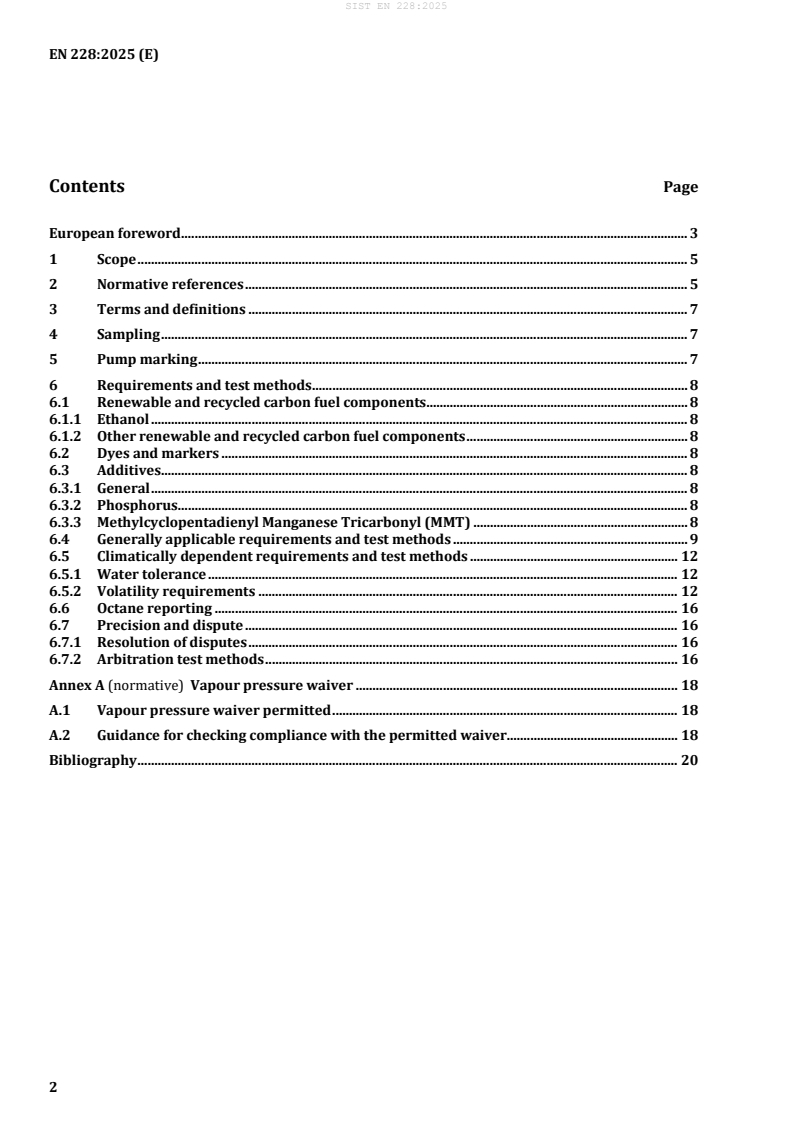
European foreword . 3
1 Scope . 5
2 Normative references . 5
3 Terms and definitions . 7
4 Sampling . 7
5 Pump marking . 7
6 Requirements and test methods . 8
6.1 Renewable and recycled carbon fuel components. 8
6.1.1 Ethanol . 8
6.1.2 Other renewable and recycled carbon fuel components . 8
6.2 Dyes and markers . 8
6.3 Additives . 8
6.3.1 General . 8
6.3.2 Phosphorus. 8
6.3.3 Methylcyclopentadienyl Manganese Tricarbonyl (MMT) . 8
6.4 Generally applicable requirements and test methods . 9
6.5 Climatically dependent requirements and test methods . 12
6.5.1 Water tolerance . 12
6.5.2 Volatility requirements . 12
6.6 Octane reporting . 16
6.7 Precision and dispute . 16
6.7.1 Resolution of disputes . 16
6.7.2 Arbitration test methods . 16
Annex A (normative) Vapour pressure waiver . 18
A.1 Vapour pressure waiver permitted . 18
A.2 Guidance for checking compliance with the permitted waiver. 18
Bibliography . 20
European foreword
This document (EN 228:2025) has been prepared by Technical Committee CEN/TC 19 “Gaseous and
liquid fuels, lubricants and related products of petroleum, synthetic and biological origin”, the secretariat
of which is held by NEN.
This European Standard shall be given the status of a national standard, either by publication of an
identical text or by endorsement, at the latest by January 2026, and conflicting national standards shall
be withdrawn at the latest by January 2026.
Attention is drawn to the possibility that some of the elements of this document may be the subject of
patent rights. CEN shall not be held responsible for identifying any or all such patent rights.
This document supersedes EN 228:2012+A1:2017.
This document was originally prepared under a mandate given to CEN by the European Commission and
the European Free Trade Association. In addition to other standards, it is intended to be complementary
to the regulatory measures contained in various EU Directives.
The following is a list of significant technical changes between this document and the previous edition:
— introduction of the new clause “Terms and definitions”;
— update of the normative references towards undated versions where they don't concern
requirements originating from European Directives (in line with decisions by CEN/TC 19 in
coordination with the European Commission), and updating the effective publication dates where
required;
— introduction of several updated test methods in the tables. The European Fuels Quality Directive
98/70/EC [1], including its Amendments [2], [3], [4], [5], [6], [7] and [13] refer to test methods in
EN 228:2012+A1:2017, with the requirement that updated analytical methods shall be shown to give
at least the same accuracy and at least the same precision as the methods they replace;
— deletion of the recommendation under 6.1 towards provision of evidence for the biological origin of
ethanol as this has now been fully covered by the (revised) EC Renewable Energy Directive;
— referencing under 6.4 of EN 16270 as a method for high boiling components in unleaded petrol;
— introduction under 6.4 of CEN/TR 17491 for further information on aniline, N-methyl aniline,
N-ethyl aniline, N,N di-methyl aniline and secondary-butyl acetate when used as blending
components in unleaded petrol;
— correct use of the decimal point for Final Boiling Point (FBP), distillation residue and existent gum
content in limits has been implemented to align with test method reporting requirements;
— clarification under 6.7.2 on how to address situations in which the test method includes a bias-
correction to the dispute method;
— introduction of the new EN ISO 4259-1 and EN ISO 4259-2 for the precision of measurement
methods and results, instead of the withdrawn EN ISO 4259;
— introduction of new test method for vapour pressure, EN 13016-3, and establishing method of
dispute as being EN 13016-1;
— introduction of a new micro-distillation test method, EN 17306, and establishing method of dispute
as being EN ISO 3405;
— change of method of dispute for content of benzene, oxygen and methanol to EN ISO 22854;
— introduction of EN 13723 as an additional analysis method for lead content and establishing method
of dispute as being EN 237, allowing an eventual change of the referee test method in the near future;
— removal of reference to EN 238 and establishing of EN ISO 22854 as referee method for benzene
content;
— removal of reference to EN 16135 as a method for the determination of manganese content;
— inclusion of new GC-VUV test method, EN 18015, for the determination of olefins, aromatics,
benzene, oxygen and oxygenates content;
— unification of distillation characteristics for E5 and E10 by lowering the E70 minimum values for E10
in Table 3 with 2 % V/V.
The marking at the pump of this product is in line with the requirements of the European Fuels Quality
Directive 98/70/EC [1], including its Amendments [2], [3], [4], [5], [6], [7] and [13] and the Alternative
Fuels Infrastructure Regulation [14].
Any feedback and questions on this document should be directed to the users’ national standards body.
A complete listing of these bodies can be found on the CEN website.
According to the CEN-CENELEC Internal Regulations, the national standards organisations of the
following countries are bound to implement this European Standard: Austria, Belgium, Bulgaria, Croatia,
Cyprus, Czech Republic, Denmark, Estonia, Finland, France, Germany, Greece, Hungary, Iceland, Ireland,
Italy, Latvia, Lithuania, Luxembourg, Malta, Netherlands, Norway, Poland, Portugal, Republic of North
Macedonia, Romania, Serbia, Slovakia, Slovenia, Spain, Sweden, Switzerland, Türkiye and the United
Kingdom.
1 Scope
This document specifies requirements and test methods for marketed and delivered unleaded petrol. It
is applicable to unleaded petrol for use in petrol engine vehicles designed to run on unleaded petrol.
This document specifies two types of unleaded petrol:
— one type with a maximum oxygen content of 3,7 % (m/m) and a maximum ethanol content of
10,0 % (V/V) in Table 1;
— one type in Table 2 with a maximum oxygen content of 2,7 % (m/m) and a maximum ethanol content
of 5,0 % (V/V) intended for older vehicles that are not warranted to use unleaded petrol defined in
Table 1.
NOTE 1 The two types are based on European Directive requirements [3], [4] and [13].
NOTE 2 For the purposes of this document, the terms “% (m/m)” and “% (V/V)” are used to represent
respectively the mass fraction, µ, and the volume fraction, φ.
2 Normative references
The following documents are referred to in the text in such a way that some or all of their content
constitutes requirements of this document. For dated references, only the edition cited applies. For
undated references, the latest edition of the referenced document (including any amendments) applies.
EN 237:2004, Liquid petroleum products — Petrol — Determination of low lead concentrations by atomic
absorption spectrometry
EN 1601:2017, Liquid petroleum products — Determination of organic oxygenate compounds and total
organically bound oxygen content in unleaded petrol — Method by gas chromatography (O-FID)
EN 12177:2022, Liquid petroleum products — Unleaded petrol — Determination of benzene content by gas
chromatography
EN 13016-1:2024, Liquid petroleum products — Vapour pressure — Part 1: Determination of air saturated
vapour pressure (ASVP) and calculated dry vapour pressure equivalent (DVPE)
FprEN 13016-3:2024, Liquid petroleum products — Vapour pressure — Part 3: Determination of vapour
pressure and calculated dry vapour pressure equivalent (DVPE) (Triple Expansion Method)
EN 13132:2000, Liquid petroleum products — Unleaded petrol — Determination of organic oxygenate
compounds and total organically bound oxygen content by gas chromatography using column switching
EN 13723:2002, Petroleum products — Determination of low lead contents in gasolines — Wavelength-
dispersive X-ray fluorescence spectrometry (XRF)
EN 14275, Automotive fuels — Assessment of petrol and diesel fuel quality — Sampling from retail site
pumps and commercial site fuel dispensers
EN 15376, Automotive fuels — Ethanol as a blending component for petrol — Requirements and test
methods
EN 15553:2021, Petroleum products and related materials — Determination of hydrocarbon types -
Fluorescent indicator adsorption method
EN 16136:2015, Automotive fuels — Determination of manganese and iron content in unleaded petrol —
Inductively coupled plasma optical emission spectrometry (ICP OES) method
EN 16942, Fuels — Identification of vehicle compatibility — Graphical expression for consumer information
EN 17306:2023, Liquid petroleum products — Determination of distillation characteristics at atmospheric
pressure — Micro-distillation
EN 18015:2024, Automotive fuels — Determination of hydrocarbon group types and select hydrocarbon
and oxygenate compounds — Gas chromatography with vacuum ultraviolet absorption spectroscopy (GC-
VUV) method
EN ISO 2160, Petroleum products — Corrosiveness to copper — Copper strip test (ISO 2160)
EN ISO 3170, Petroleum liquids — Manual sampling (ISO 3170)
EN ISO 3171, Petroleum liquids — Automatic pipeline sampling (ISO 3171)
, Petroleum and related products from natural or synthetic sources — Determination of
EN ISO 3405:2019
distillation characteristics at atmospheric pressure (ISO 3405:2019)
EN ISO 3675, Crude petroleum and liquid petroleum products — Laboratory determination of density —
Hydrometer method (ISO 3675)
EN ISO 4259-1, Petroleum and related products — Precision of measurement methods and results — Part 1:
Determination of precision data in relation to methods of test (ISO 4259-1)
EN ISO 4259-2, Petroleum and related products — Precision of measurement methods and results — Part 2:
Interpretation and application of precision data in relation to methods of test (ISO 4259-2)
EN ISO 5163:2014, Petroleum products — Determination of knock characteristics of motor and aviation
fuels — Motor method (ISO 5163:2014)
EN ISO 5164:2014, Petroleum products — Determination of knock characteristics of motor fuels —
Research method (ISO 5164:2014)
EN ISO 6246, Petroleum products — Gum content of light and middle distillate fuels — Jet evaporation
method (ISO 6246)
EN ISO 7536, Petroleum products — Determination of oxidation stability of gasoline — Induction period
method (ISO 7536)
EN ISO 12185, Crude petroleum, petroleum products and related products — Determination of density —
Laboratory density meter with an oscillating U tube sensor (ISO 12185)
EN ISO 13032:2024, Petroleum and related products — Determination of low concentration of sulfur in
automotive fuels — Energy-dispersive X-ray fluorescence spectrometric method (ISO 13032:2024)
Under revision at the time of publication of this document.
EN ISO 20846:2019 , Petroleum products — Determination of sulfur content of automotive fuels —
Ultraviolet fluorescence method (ISO 20846:2019)
EN ISO 20884:2019 , Petroleum products — Determination of sulfur content of automotive fuels —
Wavelength-dispersive X-ray fluorescence spectrometry (ISO 20884:2019)
EN ISO 22854:2025, Liquid petroleum products — Determination of hydrocarbon types and oxygenates in
automotive-motor gasoline and in ethanol (E85) automotive fuel — Multidimensional gas chromatography
method (ISO 22854:2025)
3 Terms and definitions
No terms and definitions are listed in this document.
ISO and IEC maintain terminology databases for use in standardization at the following addresses:
— ISO Online browsing platform: available at https://www.iso.org/obp
— IEC Electropedia: available at https://www.electropedia.org/
4 Sampling
Samples shall be taken as described in EN ISO 3170 or EN ISO 3171 and/or in accordance with the
requirements of national standards or regulations for the sampling of unleaded petrol. The national
requirements shall be set out in detail or shall be referred to by reference in a National Annex to this
document.
In view of the sensitivity of some of the test methods referred to in this document, particular attention
shall be paid to compliance with any guidance on sampling containers, which is included in the test
method standard.
It is essential that for sampling of unleaded petrol the containers used to take and store the samples
before testing are not contaminated, especially with lead and/or sulfur.
5 Pump marking
Information to be marked on dispensing pumps and nozzles used for delivering unleaded petrol, and the
identifier (shape, colour and size) shall be in accordance with EN 16942.
Labelling shall be clearly visible, easily legible and displayed at any point where unleaded petrol with
metallic additives is made available to consumers. The label shall contain the following text: “Contains
metallic additives” in the national language(s) and shall be laid down in the National Annex to this
document.
It is also recommended that additional pump marking be applied to specify the research octane number
(RON) supplied.
Under revision at the time of publication of this document.
As impacted by EN ISO 20884:2019/A1:2021. Under revision at the time of publication of this document.
6 Requirements and test methods
6.1 Renewable and recycled carbon fuel components
6.1.1 Ethanol
Unleaded petrol may contain up to 10,0 % (V/V) of ethanol complying with EN 15376.
When ethanol is used as a blending component, it may contain denaturants. These denaturants are
permitted provided they do not cause harmful side effects to vehicles and fuel distribution systems.
NOTE Further advice on handling and blending oxygenates in general can be found in [9]. Further guidance on
blending oxygenates in accordance with the requirements of 2009/30/EC is given in CEN/TR 16435 [8].
6.1.2 Other renewable and recycled carbon fuel components
Maximum limits for adding ethanol and other oxygenates as listed in Table 1 and Table 2 do not apply to
hydrocarbons, such as synthetic hydrocarbons, other renewable and recycled carbon hydrocarbons,
since these components are allowed in any proportions provided that the final fuel complies with the
requirements of this document. The co-processing of renewable feedstock at refineries is also allowed
provided that the final fuel meets the requirements of this document.
6.2 Dyes and markers
The use of dyes and markers is allowed provided they do not cause harmful side effects to vehicle and
fuel distribution systems.
6.3 Additives
6.3.1 General
In order to improve performance quality, the use of additives is allowed. Suitable fuel additives without
known harmful side effects are recommended in the appropriate amount to help avoid deterioration of
driveability and emissions control durability.
NOTE Deposit forming tendency t
...