

oSIST prEN 295-3:2026
(Main)Vitrified clay pipe systems for drains and sewers - Part 3: Test methods
General Information
- Abstract
This document specifies requirements for testing of products manufactured from vitrified clay and other materials specified in the following standards:
- pipes, fittings and joints according to EN 295-1;
- adaptors, connectors and flexible couplings according to EN 295-4;
- perforated pipes and fittings according to EN 295-5;
- components of manholes and inspection chambers according to EN 295 6;
- pipes and joints for pipe jacking according to EN 295-7.
- Status
- Not Published
- Public Enquiry End Date
- 24-Jun-2026
- Technical Committee
- IOVO - Water supply and waste water engineering
- Current Stage
- 4020 - Public enquire (PE) (Adopted Project)
- Start Date
- 20-Apr-2026
- Due Date
- 07-Sep-2026
- Completion Date
- 10-Jul-2026

Overview
oSIST prEN 295-3:2026:2026 specifies the standardized test methods for vitrified clay pipe systems used in drains and sewers. Developed by CEN/TC 165 “Waste water engineering,” this draft European standard provides essential procedures for testing pipes, fittings, joints, adaptors, connectors, couplings, manhole components, and inspection chamber elements made from vitrified clay and related materials. The standard plays a key role in supporting quality, performance, and long-term reliability in wastewater infrastructure projects across Europe.
Key Topics
oSIST prEN 295-3:2026:2026 covers a comprehensive range of test methods to assess the physical, mechanical, hydraulic, and chemical properties of vitrified clay pipe components, as specified in EN 295-1, EN 295-4, EN 295-5, EN 295-6, and EN 295-7. Major areas addressed include:
- Dimensional Accuracy: Tests for squareness of ends and straightness ensure pipes meet geometric requirements for effective installation and sealing.
- Mechanical Properties: Includes crushing strength, bending tensile, and bending moment resistance, critical for structural integrity under load.
- Hydraulic Performance: Methods to determine hydraulic roughness and continuity of invert guarantee efficient flow and reduced blockages.
- Watertightness and Airtightness: Tests verify joint integrity to prevent leakage and infiltration.
- Chemical and Physical Durability: Chemical resistance, abrasion resistance, and thermal stability tests assess long-term resilience against wastewaters and environmental stressors.
- Fatigue and Creep Resistance: Evaluates resistance to dynamic and sustained loading conditions.
- Compatibility of Components: Tests on adaptors, couplings, and manhole elements ensure assemblies function as a system.
Applications
The practical value of oSIST prEN 295-3:2026:2026 is seen throughout the lifecycle of vitrified clay drainage and sewer systems:
- Manufacturing Quality Control: Manufacturers of clay pipes, joints, and fittings rely on these test methods for batch acceptance, ensuring each product meets required standards.
- Third-Party Certification and Compliance: Certification bodies and inspectors use standardized tests as the basis for conformity assessment and quality assurance.
- Infrastructure Project Specification: Planners, designers, and contractors specify compliance with oSIST prEN 295-3:2026 within tender documents, ensuring material performance in municipal drainage, stormwater, and sewer networks.
- Maintenance and Rehabilitation: Accurate test procedures support condition assessments and quality checks during the repair or upgrading of existing systems.
- Product Development and R&D: Manufactures use the test methods to innovate and validate new products or components before market introduction.
Related Standards
oSIST prEN 295-3:2026:2026 is part of a coordinated family of European standards for vitrified clay pipe systems:
- EN 295-1: Requirements for pipes, fittings and joints.
- EN 295-4: Requirements for adaptors, connectors, and flexible couplings.
- EN 295-5: Requirements for perforated pipes and fittings.
- EN 295-6: Requirements for components of manholes and inspection chambers.
- EN 295-7: Requirements for pipes and joints for pipe jacking.
- EN 476: General requirements for components used in drains and sewers.
Other related standards supporting test procedures referenced in oSIST prEN 295-3:2026 include:
- EN ISO 527-2: Plastics - Determination of tensile properties for relevant coupling materials.
- EN ISO 868: Indentation hardness of plastics and elastomers.
- EN ISO 1133: Determination of melt mass-flow rate of thermoplastics.
Conclusion
Adherence to oSIST prEN 295-3:2026:2026 ensures the reliability, safety, and longevity of vitrified clay pipe systems in wastewater infrastructure. By standardizing test methods, it supports manufacturers, regulators, and project owners in delivering cost-effective and compliant drainage solutions that stand the test of time and environmental demands. For engineers and specifiers seeking robust product performance and consistent quality, this standard is an essential resource.
Relations
- Revises
SIST EN 295-3:2012 - Vitrified clay pipe systems for drains and sewers - Part 3: Test methods - Effective Date
- 04-Oct-2023
Get Certified
Connect with accredited certification bodies for this standard

DIBt (Deutsches Institut für Bautechnik)
German Institute for Building Technology.
DIN CERTCO
DIN Group product certification.
Zavod za gradbeništvo Slovenije (ZAG) - Inšpekcija
ZAG inspection body for construction products, structures, and materials.
Sponsored listings
Frequently Asked Questions
oSIST prEN 295-3:2026 is a draft published by the Slovenian Institute for Standardization (SIST). Its full title is "Vitrified clay pipe systems for drains and sewers - Part 3: Test methods". This standard covers: This document specifies requirements for testing of products manufactured from vitrified clay and other materials specified in the following standards: - pipes, fittings and joints according to EN 295-1; - adaptors, connectors and flexible couplings according to EN 295-4; - perforated pipes and fittings according to EN 295-5; - components of manholes and inspection chambers according to EN 295 6; - pipes and joints for pipe jacking according to EN 295-7.
This document specifies requirements for testing of products manufactured from vitrified clay and other materials specified in the following standards: - pipes, fittings and joints according to EN 295-1; - adaptors, connectors and flexible couplings according to EN 295-4; - perforated pipes and fittings according to EN 295-5; - components of manholes and inspection chambers according to EN 295 6; - pipes and joints for pipe jacking according to EN 295-7.
oSIST prEN 295-3:2026 is classified under the following ICS (International Classification for Standards) categories: 23.040.05 - Pipeline and its parts for external sewage systems; 23.040.50 - Pipes and fittings of other materials; 91.140.80 - Drainage systems; 93.030 - External sewage systems. The ICS classification helps identify the subject area and facilitates finding related standards.
oSIST prEN 295-3:2026 has the following relationships with other standards: It is inter standard links to SIST EN 295-3:2012. Understanding these relationships helps ensure you are using the most current and applicable version of the standard.
oSIST prEN 295-3:2026 is available in PDF format for immediate download after purchase. The document can be added to your cart and obtained through the secure checkout process. Digital delivery ensures instant access to the complete standard document.
Standards Content (Sample)
SLOVENSKI STANDARD
01-junij-2026
Keramični (iz vitrificirane gline) cevni sistemi za odvod odpadne vode in
kanalizacijo - 3. del: Preskusne metode
Vitrified clay pipe systems for drains and sewers - Part 3: Test methods
Steinzeugrohrsysteme für Abwasserleitungen und -kanäle - Teil 3: Prüfverfahren
Systèmes de tuyaux et accessoires en grès vitrifié pour les collecteurs et branchements
d'assainissement - Partie 3: Méthodes d'essai
Ta slovenski standard je istoveten z: prEN 295-3
ICS:
23.040.50 Cevi in fitingi iz drugih Pipes and fittings of other
materialov materials
91.140.80 Drenažni sistemi Drainage systems
93.030 Zunanji sistemi za odpadno External sewage systems
vodo
2003-01.Slovenski inštitut za standardizacijo. Razmnoževanje celote ali delov tega standarda ni dovoljeno.
DRAFT
EUROPEAN STANDARD
NORME EUROPÉENNE
EUROPÄISCHE NORM
April 2026
ICS 23.040.05 Will supersede EN 295-3:2012
English Version
Vitrified clay pipe systems for drains and sewers - Part 3:
Test methods
Systèmes de tuyaux et accessoires en grès vitrifié pour Steinzeugrohrsysteme für Abwasserleitungen und -
les collecteurs et branchements d'assainissement - kanäle - Teil 3: Prüfverfahren
Partie 3: Méthodes d'essai
This draft European Standard is submitted to CEN members for enquiry. It has been drawn up by the Technical Committee
CEN/TC 165.
If this draft becomes a European Standard, CEN members are bound to comply with the CEN/CENELEC Internal Regulations
which stipulate the conditions for giving this European Standard the status of a national standard without any alteration.
This draft European Standard was established by CEN in three official versions (English, French, German). A version in any other
language made by translation under the responsibility of a CEN member into its own language and notified to the CEN-CENELEC
Management Centre has the same status as the official versions.
CEN members are the national standards bodies of Austria, Belgium, Bulgaria, Croatia, Cyprus, Czech Republic, Denmark, Estonia,
Finland, France, Germany, Greece, Hungary, Iceland, Ireland, Italy, Latvia, Lithuania, Luxembourg, Malta, Netherlands, Norway,
Poland, Portugal, Republic of North Macedonia, Romania, Serbia, Slovakia, Slovenia, Spain, Sweden, Switzerland, Türkiye and
United Kingdom.
Recipients of this draft are invited to submit, with their comments, notification of any relevant patent rights of which they are
aware and to provide supporting documentation.
Warning : This document is not a European Standard. It is distributed for review and comments. It is subject to change without
notice and shall not be referred to as a European Standard.
EUROPEAN COMMITTEE FOR STANDARDIZATION
COMITÉ EUROPÉEN DE NORMALISATION
EUROPÄISCHES KOMITEE FÜR NORMUNG
CEN-CENELEC Management Centre: Rue de la Science 23, B-1040 Brussels
© 2026 CEN All rights of exploitation in any form and by any means reserved Ref. No. prEN 295-3:2026 E
worldwide for CEN national Members.
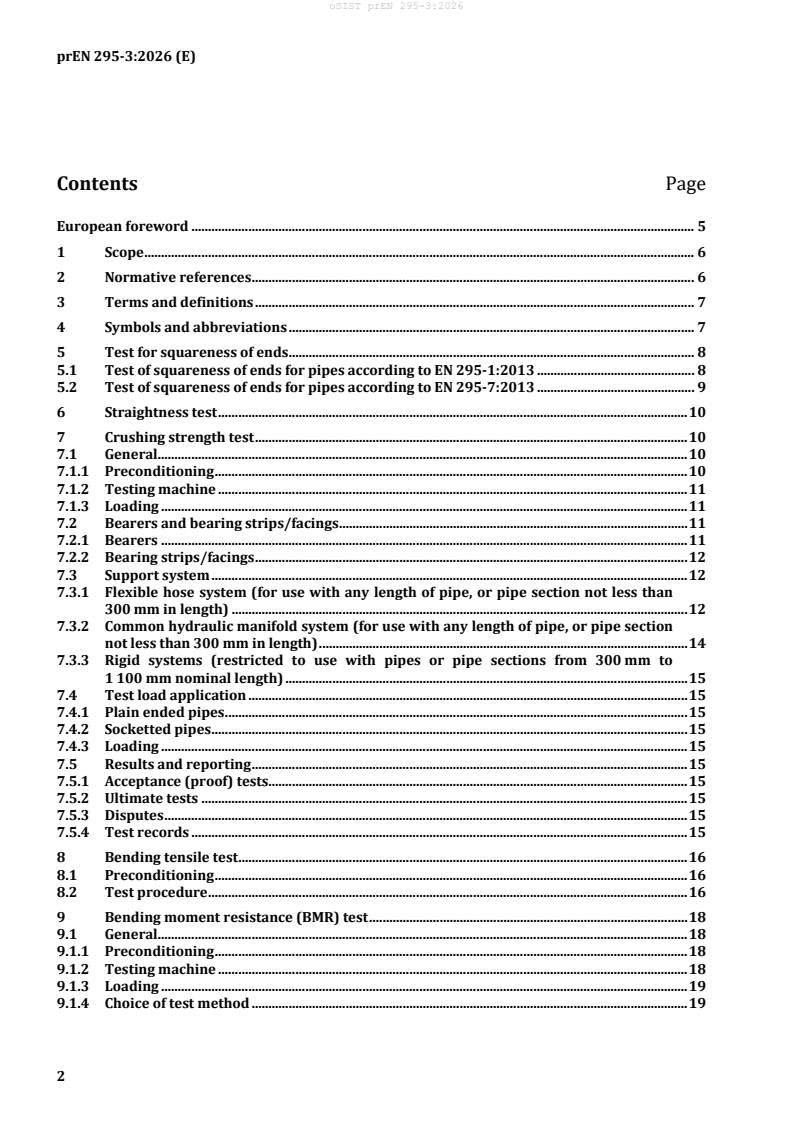
Contents Page
European foreword . 5
1 Scope . 6
2 Normative references . 6
3 Terms and definitions . 7
4 Symbols and abbreviations . 7
5 Test for squareness of ends . 8
5.1 Test of squareness of ends for pipes according to EN 295-1:2013 . 8
5.2 Test of squareness of ends for pipes according to EN 295-7:2013 . 9
6 Straightness test . 10
7 Crushing strength test . 10
7.1 General. 10
7.1.1 Preconditioning . 10
7.1.2 Testing machine . 11
7.1.3 Loading . 11
7.2 Bearers and bearing strips/facings . 11
7.2.1 Bearers . 11
7.2.2 Bearing strips/facings . 12
7.3 Support system . 12
7.3.1 Flexible hose system (for use with any length of pipe, or pipe section not less than
300 mm in length) . 12
7.3.2 Common hydraulic manifold system (for use with any length of pipe, or pipe section
not less than 300 mm in length) . 14
7.3.3 Rigid systems (restricted to use with pipes or pipe sections from 300 mm to
1 100 mm nominal length) . 15
7.4 Test load application . 15
7.4.1 Plain ended pipes . 15
7.4.2 Socketted pipes . 15
7.4.3 Loading . 15
7.5 Results and reporting . 15
7.5.1 Acceptance (proof) tests. 15
7.5.2 Ultimate tests . 15
7.5.3 Disputes . 15
7.5.4 Test records . 15
8 Bending tensile test . 16
8.1 Preconditioning . 16
8.2 Test procedure . 16
9 Bending moment resistance (BMR) test . 18
9.1 General. 18
9.1.1 Preconditioning . 18
9.1.2 Testing machine . 18
9.1.3 Loading . 19
9.1.4 Choice of test method . 19
9.2 Four point loading test . 19
9.2.1 Test procedure . 19
9.2.2 Testing by attributes . 19
9.2.3 Testing by variables . 19
9.3 Three point loading test . 20
9.3.1 Test procedure . 20
9.3.2 Testing by attributes . 20
9.3.3 Testing by variables . 20
10 Bond strength of adhesive . 21
11 Tests for fatigue strength . 22
11.1 Preconditioning . 22
11.2 Test using a pipe or pipe section . 22
11.3 Test using sawn test specimens. 22
12 Test for watertightness . 23
12.1 General . 23
12.2 Pipes and junctions . 23
12.3 Fittings other than junctions and terminal fittings . 23
13 Chemical resistance test for pipes and fittings . 23
14 Determination of hydraulic roughness . 24
15 Abrasion resistance test . 24
16 Airtightness test . 26
17 Tests for resistance to high pressure jetting . 26
17.1 General . 26
17.1.1 Water source . 26
17.1.2 Pressure measurement . 26
17.1.3 Test temperature . 26
17.2 Moving jet test . 26
17.3 Stationary jet test. 27
17.3.1 General . 27
17.3.2 Apparatus . 27
17.3.3 Test pieces . 28
17.3.4 Procedure . 28
18 Hardness test for polyurethane. 29
18.1 Test pieces . 29
18.2 Test method . 29
19 Tests for material requirements of polypropylene sleeve couplings . 29
19.1 Melt flow index . 29
19.2 Tensile strength and elongation at break . 29
19.3 Elevated temperature test . 30
20 Performance test for polypropylene sleeve couplings . 30
21 Mechanical test methods for joint assemblies . 30
21.1 General . 30
21.2 Deflection test . 31
21.3 Shear resistance test. 31
21.3.1 Loading arrangements for shear resistance . 31
21.3.2 Short-term shear resistance test . 33
21.3.3 Long-term shear resistance test . 33
22 Continuity of invert test . 33
22.1 Test methods . 33
22.2 Pipes and fittings with top marking . 34
22.3 Pipes and fittings randomly jointed . 35
22.3.1 Sampling and dimensions . 35
22.3.2 Calculations . 35
22.3.3 Evaluation . 36
23 Chemical resistance test for joint assemblies . 36
23.1 Test solutions . 36
23.2 Procedure . 36
24 Thermal stability . 37
24.1 Thermal cycling stability . 37
24.2 Long-term thermal stability . 37
25 Creep resistance of rigid fairing materials . 38
25.1 Deformation . 38
25.1.1 Test samples . 38
25.1.2 Test apparatus . 38
25.1.3 Procedure . 38
25.2 Indentation . 38
25.2.1 Test samples . 38
25.2.2 Test apparatus . 39
25.2.3 Procedure . 39
26 Water tightness test for assembled components of manholes and inspection
chambers. 39
27 Compressive strength of jacking pipes . 39
27.1 Test methods . 39
27.1.1 Testing machine . 39
27.1.2 Selection and preparation of specimens . 39
27.1.3 Test procedure . 41
27.1.4 Loading . 41
27.2 Calculation of compressive strength. 41
28 Water absorption . 41
28.1 Test specimen . 41
28.2 Water absorption test . 41
European foreword
This document (prEN 295-3:2026) has been prepared by Technical Committee CEN/TC 165 “Waste
water engineering”, the secretariat of which is held by DIN.
This document is currently submitted to the CEN Enquiry.
This document will supersede EN 295-3:2012.
This document includes the following significant technical changes:
a) Clause 15 “abrasion resistance test” was reworded to correct misleading wording;
b) 24.1 “Thermal cycling stability” was reworded to correct misleading wording;
c) The dimension of the test specimen in 28.1 “Test specimen” was corrected;
d) A duration for cooling was added in 28.2 “Water absorption test”;
e) The document was editorially revised.
The standard series EN 295 “Vitrified clay pipe systems for drains and sewers” consists of the following
parts:
— Part 1: Requirements for pipes, fittings and joints;
— Part 2: Evaluation of conformity and sampling;
— Part 3: Test methods;
— Part 4: Requirements for adaptors, connectors and flexible couplings;
— Part 5: Requirements for perforated pipes and fittings;
— Part 6: Requirements for components of manholes and inspection chambers;
— Part 7: Requirements for pipes and joints for pipe jacking;
— Part 8: Requirements for the use of vitrified clay components in the rehabilitation of drainage systems
and conditions for the application of methods for rehabilitation in existing drainage systems
(currently in preparation);
— Part 9: Environmental Product Declarations – Product Category Rules complementary to EN 15804
(currently in preparation).
This document takes into account the requirements of EN 476.
1 Scope
This document specifies requirements for testing of products manufactured from vitrified clay and
other materials specified in the following standards:
— pipes, fittings and joints according to EN 295-1;
— adaptors, connectors and flexible couplings according to EN 295-4;
— perforated pipes and fittings according to EN 295-5;
— components of manholes and inspection chambers according to EN 295-6;
— pipes and joints for pipe jacking according to EN 295-7.
2 Normative references
The following documents are referred to in the text in such a way that some or all of their content
constitutes requirements of this document. For dated references, only the edition cited applies. For
undated references, the latest edition of the referenced document (including any amendments) applies.
EN 295-1:2013, Vitrified clay pipe systems for drains and sewers — Part 1: Requirements for pipes, fittings
and joints
EN 295-4:2013, Vitrified clay pipe systems for drains and sewers — Part 4: Requirements for adaptors,
connectors and flexible couplings
EN 295-5:2013, Vitrified clay pipe systems for drains and sewers — Part 5: Requirements for perforated
pipes and fittings
EN 295-6:2013, Vitrified clay pipe systems for drains and sewers — Part 6: Requirements for components
of manholes and inspection chambers
EN 295-7:2013, Vitrified clay pipe systems for drains and sewers — Part 7: Requirements for pipes and
joints for pipe jacking
EN ISO 527-2:2025, Plastics — Determination of tensile properties — Part 2: Test conditions for moulding
and extrusion plastics (ISO 527-2:2025)
EN ISO 868, Plastics and ebonite - Determination of indentation hardness by means of a durometer (Shore
hardness) (ISO 868)
EN ISO 1133 (all parts) Plastics — Determination of the melt mass-flow rate (MFR) and the melt volume-
flow rate (MVR) of thermoplastics (ISO 1133, all parts)
CEN/TR 14920:2005, Jetting resistance of drain and sewer pipes - Moving jet test method
3 Terms and definitions
For the purposes of this European Standard, the relevant terms and definitions specified in
EN 295-1:2013, EN 295-4:2013, EN 295-5:2013, EN 295-6:2013 and EN 295-7:2013 apply.
ISO and IEC maintain terminology databases for use in standardization at the following addresses:
— ISO Online browsing platform: available at https://www.iso.org/obp/
— IEC Electropedia: available at https://www.electropedia.org/
4 Symbols and abbreviations
Symbol Description
A Outside diameter of the spigot moulding
a Measurement from inside of pipe barrel to mid point of inside of socket fairing, in
M
millimetres (continuity of invert test).
a Width of top bearer, in millimetres (crushing strength test and bending tensile strength
p
test).
B Nominal length of external barrel of pipe unobstructed by socket shape and/or jointing
configuration, in millimetres (crushing strength test).
B Distance from the outside surface of the spigot moulding to the internal surface of the
t
pipe at one point at which the outside diameter of the spigot moulding (A) was
measured, in millimetres (continuity of invert test).
b Specimen width, in millimetres (fatigue strength test).
C Distance from the outside surface of the spigot moulding to the internal surface of the
t
pipe at the opposite end to B of the diameter measured as the outside diameter of the
t
spigot (A), in millimetres (continuity of invert test).
c Concentration of solution, in moles per litre (chemical resistance tests).
c Factor for the upper (0,4) or lower (0,1) limit of the load (fatigue strength test).
i
D Inside diameter of the socket moulding
DN Nominal size - a numerical designation of size which is a convenient round number equal
to or approximately equal to the internal diameter, in millimetres (bending moment
resistance test).
D Deviation from straightness
S
d Barrel internal diameter, in millimetres (bending tensile strength test).
E Distance from the internal surface of the socket moulding to the internal surface of the
t
pipe at one point at which the inside diameter of the socket moulding (D) was measured,
in millimetres (continuity of invert test).
F Force for upper and lower limit, in kilonewtons (fatigue strength test).
i
F Crushing strength, in kilonewtons per metre.
N
F Distance from the internal surface of the socket moulding to the internal surface of the
t
pipe at the opposite end to E , of the diameter measured as the inside of the socket
t
moulding (D), in millimetres (continuity of invert test)
Symbol Description
G Mean annular gap, in millimetres (continuity of invert test).
m
IRHD International Rubber Hardness Degrees of bearing strips/facings, in degrees IRHD
(crushing strength test).
k Hydraulic roughness in millimetres
s
l Centre line distance between supports, in millimetres (fatigue strength test).
L Nominal length of the pipe
N
L Test length
T
M Bending moment resistance, in kilonewton metres (bending moment resistance test).
Mb Bending moment, in Newton millimetres (bending tensile strength test).
M Mean particle size, in millimetres (abrasion resistance test).
p
M Test piece mass before treatment, in grammes (chemical resistance test).
M Test piece mass after treatment, in grammes (chemical resistance test).
S Support span in metres
s Specimen wall thickness, in millimetres (bending tensile test).
S , S Extreme values of difference in invert, in millimetres (continuity of invert test).
min max
S Standard deviation, in millimetres (continuity of invert test).
t
s Specimen wall thickness, in millimetres (fatigue strength test).
f
t Time.
U Degree of non-uniformity of particles (abrasion resistance test).
W Water addition in 15 min, in litres per square metre (watertightness test).
β Half the depth of a socket fairing, in millimetres (continuity of invert test).
Δa Measurement of difference in invert levels, in millimetres (continuity of invert test).
Δs Deviation from squareness in millimetres.
ε Deformation of rigid fairing materials (creep resistance of rigid fairing materials test).
i j 2
σ σ Restoring stress at t = 10 and t = 10 , in N/mm (polyurethane relaxation tests).
i, j
σ Bending tensile strength, in Newtons per square millimetre (bending tensile strength
bz
test).
5 Test for squareness of ends
5.1 Test of squareness of ends for pipes according to EN 295-1:2013
A whole pipe shall be placed horizontally on two supports which have a distance of 75 mm from each
end of the barrel for up to and including DN 500 and 100 mm for pipes greater than DN 500.
The deviation from squareness shall be measured as the maximum difference, at either end, between
distances from any point on the end of the barrel to a plane rectangular to the line joining the points of
support. Any suitable apparatus may be used. An example is given in Figure 1.
Figure 1 — Measurement of squareness of ends
5.2 Test of squareness of ends for pipes according to EN 295-7:2013
A whole pipe shall be placed on a horizontal support according to Figure 2. The gauge shall be clamped
to the ground ends of the pipe. The pivot arm is located approximately 100 mm away from the cut end.
The distance between the pivot arm and the cut end is measured at 90° intervals. The deviation from
squareness is the difference between the maximum and minimum measurements. This procedure shall
be performed for both ends of the pipe. Any suitable apparatus may be used. An example is given in
Figure 2.
Key
1 gauge
2 clamp
3 support
4 calliper gauge
5 pivot arm
6 spirit level
Figure 2 — Gauge for squareness of ends
6 Straightness test
The deviation from straightness of a pipe barrel is the maximum distance from the centre of a straight
line equal to the test length spanning any concave curve on the outside of a pipe barrel to the pipe
surface, D , as shown in Figure 3. It is permissible to test for straightness using any suitable apparatus.
s
The test length shall be 150 mm less than the nominal length of the pipe to allow for clearance at the
shoulder of any socket and at any jointing material at the spigot end.
Key
L is the nominal length of the pipe
N
L is the test length
T
D is the deviation from straightness
s
L = L − 150 mm at DN ≤ 500
T N
L = L − 200 mm at DN > 500
T N
Figure 3 — Straightness test method
7 Crushing strength test
7.1 General
7.1.1 Preconditioning
Prior to crushing strength tests, sample pipes or pipe sections shall be preconditioned by either:
a) complete immersion in water at ambient temperature for the minimum times given in Table 1,
where the wall thickness is the mean wall thickness of the batch,
Table 1 — Preconditioning time for strength tests
Minimum preconditioning time
Unglazed, glazed only on
Wall thickness
interior or exterior surface, salt Ceramic glazed
glazed
mm h h
up to 20 18 42
> 20 to ≤ 35 42 66
> 35 66 90
or
b) by complete immersion in a water pressure tank at ambient temperature for 24 h at a pressure of
250 kPa (2,5 bar).
An example of the pressure tank is given in Figure 4.
Figure 4 — Example of pressure tank for preconditioning
7.1.2 Testing machine
The testing machine for crushing shall be capable of applying compressive loads and shall be
substantial and rigid throughout, so that the distribution of the load will not be affected by the
deformation or yielding of any part. The machine and bearers shall be designed to transmit the load in a
vertical plane through the longitudinal centre lines of the bearers and pipe.
The load shall be applied to the top bearer in such a way that the combination of support, bearers and
bearing strips is free to rotate in a vertical plane through the longitudinal centre lines of the top and
custom bearers.
The testing machine load shall be verified by calibration to an accuracy of 1 % by an approved agency at
intervals of not more than 12 months.
7.1.3 Loading
The pipe or pipe section of no less than 300 mm long shall be placed between the bearer strips. When
using the rigid system described in 7.3.3 the plane of any permitted longitudinal curvature shall be
approximately horizontal.
The load shall be applied to the pipe or pipe section without vibration or sudden shock, at a uniform
rate between 0,40 kN/m of pipe per second and 0,60 kN/m of pipe per second, or in increments of not
more than 0,50 kN/m at the same rate, up to the point of failure or, in the case of acceptance (proof)
testing, to the load corresponding to the required strength.
7.2 Bearers and bearing strips/facings
7.2.1 Bearers
The bearers shall consist of metal, teak or similar hard wood, be straight and free from knots, warping
or twisting, and shall be centrally located on their supports.
The top and bottom bearers shall both have a minimum thickness of 25 mm. When bearing strips are
used the widths of the bearers shall be not less than those of the corresponding bearer strips as shown
in Figure 5 a). Bearers shall be located such that they are aligned both longitudinally and transversely.
When bearing facings are used, the widths shall be as necessary to support the pipe and the width of the
top bearer shall not be less than the values given in Table 2, see Figure 5 b).
The cross-sectional shape of the bearers shall be in accordance with Figure 5. The slope of the V surface
of the bottom bearer shall be between 0° and 5°.
Table 2 — Width a of the top bearer when bearing facings are used
p
100 to 225 and
DN 300 350 400 450 500 600 700 800 900 1000 > 1000
200 250
ap 25 30 35 45 50 55 60 75 85 95 105 115 DN/9
7.2.2 Bearing strips/facings
Bearing strips shall consist of elastomeric material having a hardness of (55 ± 10) IRHD.
Strips shall be of rectangular cross section having a width of (50 ± 5) mm and a thickness of not less
than 25 mm or more than 40 mm. The 50 mm dimension shall be in contact with the pipe.
The top bearing strip shall be concentric with the top bearer. The bottom bearing strips shall be
symmetrically arranged on the bottom bearer, of equal thickness and parallel to one another at a
distance apart of (25 ± 5) mm.
Facings shall be either
a) of elastomeric material of thickness not less than 15 mm nor more than 30 mm and of hardness
(55 ± 10) IRHD, or
b) of felt of thickness (20 ± 2) mm and a density of (0,3 ± 0,025) g/cm .
7.3 Support system
7.3.1 Flexible hose system (for use with any length of pipe, or pipe section not less than 300 mm
in length)
The overall bearer length shall be (B − 50) mm for pipes up to and including 1 500 mm nominal length
and (B − 100) mm for pipes greater than 1 500 mm nominal length, where B is the nominal length (in
millimetres) of the external barrel unobstructed by socket shape and/or jointing configuration at either
end (see Figure 6).
The top and bottom bearers shall be divided, along their length, into separate segments. These
segments shall be supported by flexible high pressure hoses which are closed at each end. These hoses
shall be filled with liquid and carried in U shaped channels below the bottom bearers and above the top
bearers. Each segment shall be of the same length which shall not be greater than 300 mm except for
individual shorter sections used to make up the overall bearer length. Alternatively, any excess of
bearer length over the total length of segments may be distributed evenly as gaps between the
segments. No gap shall be greater than one third of the length of a bearer segment. The length of each
bearing strip or facing may be equal to the length of its appropriate segment.
a) Bearer shape for bearing strips
b) Bearer shape for bearing facings
Key
ap width of the top bearer
1 load
2 top bearer
3 bearing strip
4 gap width (25 ± 5) mm
5 bearing strip
6 bottom bearer
7 facing
8 elastomeric or felt facing
9 slope of the V surface (0° to 5°)
Figure 5 — Bearer shape
a) Example pipe length ≤ 1,5 m
b) Example pipe length > 1,5 m
Key
1 load
2 top bearer
3 bottom bearer
B pipe nominal length
NOTE Segmented bearers can be used for all nominal pipe lengths. Rigid bearers can only be used for pipes of
nominal length ≤ 1,1 m.
Figure 6 — Typical arrangement for crushing strength test
7.3.2 Common hydraulic manifold system (for use with any length of pipe, or pipe section not
less than 300 mm in length)
The overall bearer length shall be (B − 50) mm for pipes up to and including 1 500 mm nominal length
and (B − 100) mm for pipes greater than 1 500 mm nominal length, where B is the nominal length (in
millimetres) of the external barrel unobstructed by socket shape and/or jointing configuration at either
end of the pipe (see Figure 6).
The top and bottom bearers shall be divided along their length into separate segments. Each segment
shall be supported by a common hydraulic system to provide uniform load along the length of the pipe
barrel. The segments shall be of the same length which shall not be greater than 300 mm.
The length of each bearing strip or facing shall be equal to the length of each bearer segment.
The distance by which the overall bearer exceeds the total length of the bearer segment shall be
distributed evenly as gaps between the segments. No gap shall be greater than one third of a bearer
segment. No part of any bearer segment shall overhang either end of the pipe.
7.3.3 Rigid systems (restricted to use with pipes or pipe sections from 300 mm to 1 100 mm
nominal length)
The overall length of each bearing strip/facing shall be (B − 50) mm, where B is the nominal length (in
millimetres) of the external barrel unobstructed by socket shape and/or jointing configuration at either
end (see Figure 6).
The overall bearer length shall not be less than the length of the bearer strip/facing. No part of any
bearing strip or facing shall overhang either end of the pipe.
7.4 Test load application
7.4.1 Plain ended pipes
The test load shall be applied at the longitudinal centre of the overall bearer length for the systems
described in 7.3.1 and 7.3.2, and at the longitudinal centre of the overall bearing strip/facing length for
the system described in 7.3.3.
7.4.2 Socketted pipes
The test load of the systems described in 7.3.1 and 7.3.3 shall be applied at the positions given in 7.4.1.
For the system described in 7.3.2 the position of the application of the test load should be adjusted to
maintain horizontal stability.
7.4.3 Loading
The loading of the pipe shall be continuous operation. The pipe shall not be allowed to stand under load
longer than is required to apply the load and to record the results when proof tests are being
conducted.
7.5 Results and reporting
7.5.1 Acceptance (proof) tests
For tests on pipes sampled for testing by attributes the total test load to be applied in kN shall be
calculated by multiplying the required crushing strength in kN/m by the nominal inside length of the
barrel in m.
7.5.2 Ultimate tests
For tests on pipes sampled for testing by variables the crushing strength in kN/m is calculated by
dividing the ultimate applied load at failure by the nominal inside length of the barrel in m.
If the bending tensile strength σ is required, it can be calculated from the following equation using the
bz
symbols from 8.2
ds+
σ = 0,3⋅ F ⋅⋅α (1)
bz N K
s
7.5.3 Disputes
Where any dispute over the verification of crushing strength arises, the tests shall be carried out using
the same method as the manufacturer.
7.5.4 Test records
As well as the test results and other relevant details, the records shall contain the following additional
information:
a) method of preconditioning;
b) angle of slope of the lower support bearer;
c) whether bearing strips or facings were used, if so whether elastomeric material or felt;
d) type of support system, 7.3.1, 7.3.2 or 7.3.3, if 7.3.1 or 7.3.2, the nominal segment length.
8 Bending tensile test
8.1 Preconditioning
Prior to bending tensile test, test pieces shall be preconditioned by complete immersion in water for the
minimum times given in 7.1.1.
8.2 Test procedure
The bending tensile test shall be carried out on ten specimens having parallel surfaces, sawn from
broken pieces distributed over the length and circumferences of a pipe. The dimensions shall be
selected so that their length is approximately five times their wall thickness and their width
approximately three times the wall thickness.
The long sides of the specimens shall be at right angles on the pipe axis. The specimens shall be
supported so that free movement of one bearer is ensured. The force shall be applied centrally by
means of a steel pressure beam with a rubber facing (Shore A hardness: (60 ± 5); thickness 3 mm). The
width, a , of the pressure beam (top bearer) shall correspond to one tenth of the wall thickness of the
p
specimen (see Figure 7) with a minimum of 2,5 mm.
...