

SIST EN 14986:2024/oprA1:2026
(Amendment)Design of fans working in potentially explosive atmospheres
- Abstract
1.1 This document specifies the constructional requirements for fans constructed to Group II G (of explosion groups IIA, IIB and hydrogen) categories 1, 2 and 3, and Group II D categories 2 and 3, intended for use in explosive atmospheres.
NOTE 1 Operation conditions for the different categories of fans used in this document are defined in Clause 4.
1.3 This document specifies requirements for design, construction, testing and marking of complete fan units intended for use in potentially explosive atmospheres in air containing gas, vapour, mist and/or dusts. Such atmospheres can exist inside (the conveyed atmosphere (flammable or not)), outside, or inside and outside of the fan.
This document covers mechanical equipment, in particular fans. The “type of protection” as specified in EN ISO 80079 37:2016 is constructional safety.
1.4 This document is applicable to fans working in ambient atmospheres and with normal atmospheric conditions at the inlet, having
— absolute pressures ranging from 0,8 bar to 1,1 bar,
— and temperatures ranging from −20 °C to +60 °C,
— and maximum volume fraction of 21 % oxygen content,
— and an aerodynamic energy increase of less than 25 kJ/kg.
NOTE 1 25 kJ/kg is equivalent to 30 kPa at inlet density of 1,2 kg/m3.
This document can also be helpful for the design, construction, testing and marking of fans intended for use in atmospheres outside the validity range stated above or in cases where other material pairings need to be used. In this case, the ignition risk assessment, ignition protection provided, additional testing (if necessary), manufacturer's marking, technical documentation and instructions to the user, clearly demonstrate and indicate the equipment's suitability for the conditions the fan can encounter.
NOTE 2 Temperatures below −20 °C can be considered. Material suitability can require specific evaluation for these temperatures. With lower temperature the explosion pressure increases, which leads to increased test pressures (see A.3) and can require specific testing. Although the standard atmospheric conditions in EN ISO 80079 36:2016 give a temperature range for the atmosphere of −20 °C to +60 °C the normal ambient temperature range for the equipment is −20 °C to +40 °C unless otherwise specified and marked.
1.5 This document does not apply to:
— group I fans (fans for mining);
— explosion group IIC (other than hydrogen);
— category 1D fans;
— cooling fans or impellers on rotating electrical machines;
— cooling fans or impellers on internal combustion engines, vehicles or electric motors.
NOTE 3 Measures for category 1D fans are given in EN 1127 1:2019.
NOTE 4 Measures for explosion group IIC (other than hydrogen) are given in EN 1127 1:2019.
NOTE 5 Measures for explosion group I are given in EN ISO/IEC 80079 38:2016 and EN 1127 2:2014.
- Status
- Not Published
- Public Enquiry End Date
- 30-Aug-2026
- Technical Committee
- EXP - Product for explosive atmospheres
- Current Stage
- 4020 - Public enquire (PE) (Adopted Project)
- Start Date
- 10-Jun-2026
- Due Date
- 28-Oct-2026
- Completion Date
- 08-Sep-2026

SIST EN 14986:2024/oprA1:2026 is a CEN draft amendment to EN 14986:2024 on the design of fans working in potentially explosive atmospheres. It updates the rules for complete fan units used in Group II G and Group II D conditions, with changes aimed at designers, manufacturers, test labs and conformity assessment bodies that work with ignition risk, sealing, electrostatics and marking.
What does SIST EN 14986:2024/oprA1:2026 specify?
SIST EN 14986:2024/oprA1:2026 modifies the fan standard for potentially explosive atmospheres. The base standard covers constructional requirements for fans for Group II G categories 1, 2 and 3, and Group II D categories 2 and 3, for use in air containing gas, vapour, mist and/or dust, inside the fan, outside the fan, or both.
It applies to fans under ambient atmospheric conditions at the inlet, within the stated pressure, temperature, oxygen and aerodynamic energy limits. It excludes group I fans, explosion group IIC other than hydrogen, category 1D fans, and cooling fans or impellers on rotating electrical machines, internal combustion engines, vehicles or electric motors.
The amendment is organized as follows:
| Modified part | What it covers |
|---|---|
| Clause 2 and Bibliography | updated referenced documents |
| 4.4.2 | seal housing clarification |
| 4.7.2 | permissible material pairings |
| 4.8 | linings and tip extensions |
| 4.10 and 4.11 | electrostatic charges and earthing conducting parts |
| 4.14 | shaft seals |
| 6.3.1 | general wording change |
| Annex ZA | EU legislation correspondence |
What are the key requirements of SIST EN 14986:2024/oprA1:2026?
Electrostatic protection
SIST EN 14986:2024/oprA1:2026 strengthens the electrostatic safety wording for fans. The merged Clause 4.10 requires fan design to remove the risk of ignition from electrostatic discharges, and it points to the relevant requirements of EN ISO 80079-36, including equipotential bonding and assessment of the hazard due to the conveyed atmosphere.
In practice, this means the fan designer has to consider where charge can build up, how it is discharged, and whether the moved medium changes the risk. The note also shows that grounding static parts is often enough, but rotating parts may need a specific grounding solution if they can build up voltage.
Seals and material pairings
Clause 4.4.2 now makes clear that 4.14 is the clause for shaft seals, while the associated seal housing must meet the criteria in 4.4.2. Clause 4.14 then requires non-contact seals to have a gap width of at least 10% of the shaft diameter, and contact seal housings to meet 4.4.2.
Clause 4.7.2 updates the tables on permissible material pairings so that the electrostatic risk from plastics and rubbers is evaluated through 4.10 and 4.11. For users, that means material selection is not just a mechanical choice - it has to be checked against ignition risk as well.
Linings, tip extensions and references
Clause 4.8 keeps linings and tip extensions tied to electrostatic guidance and points readers to CLC/TR 60079-32-1:2018. Clause 2 also updates the main reference list, including EN IEC 60079-14:2024 and EN ISO/IEC 80079-49:2024.
Marking, instructions and EU conformity
Clause 6.3.1 deletes the words “by the manufacturer” from its second paragraph, which changes the clause wording used for user information or declarations. Annex ZA is updated to map the standard to Directive 2014/34/EU, so manufacturers can use it when preparing the technical basis for EU compliance.
What terms does SIST EN 14986:2024/oprA1:2026 define?
- Group II G - equipment intended for non-mining explosive atmospheres with gas, vapour or mist.
- Group II D - equipment intended for non-mining explosive atmospheres with dust.
- constructional safety - the type of protection used here, where the design itself reduces ignition risk.
- equipotential bonding - connecting conductive parts so voltage differences do not create sparks.
- electrostatic discharges - sudden releases of static charge that can ignite an explosive atmosphere.
- non-contact seals - seals that work with a gap rather than rubbing contact.
- conveyed atmosphere - the material moved by the fan, which may itself be flammable or not.
Who uses SIST EN 14986:2024/oprA1:2026?
SIST EN 14986:2024/oprA1:2026 is used by fan designers and manufacturers, especially where fans handle gas, vapour, mist or dust in explosive atmospheres. It is also used by test laboratories, notified or other conformity assessment bodies, and buyers or specifiers who need to check whether a fan design matches the intended category and atmosphere.
What changed in SIST EN 14986:2024/oprA1:2026 from the previous edition?
SIST EN 14986:2024/oprA1:2026 is an amendment to EN 14986:2024. The changes stated in the document update references, clarify seal-housing responsibilities, merge and tighten the electrostatic clauses, revise shaft seal wording, adjust the treatment of material pairings, and refresh Annex ZA for Directive 2014/34/EU.
Which standards are used with SIST EN 14986:2024/oprA1:2026?
| Standard | What it contributes |
|---|---|
| EN IEC 60079-14:2024 | installation design, selection and installation of equipment, including initial inspection |
| EN IEC 60079-0:2018 | general requirements for equipment in explosive atmospheres |
| EN ISO/IEC 80079-49:2024 | flame arresters performance requirements, test methods and limits for use |
| EN ISO 80079-36:2016 | relevant requirements for electrostatic risk and related safety aspects |
| CLC/TR 60079-32-1:2018 | guidance on electrostatic hazards |
| EN 1127-1:2019 | measures noted for category 1D fans and explosion group IIC other than hydrogen |
| EN 1127-2:2014 | measures noted for Group I fans |
| EN ISO/IEC 80079-38:2016 | measures noted for Group I fans |
What does the SIST EN 14986:2024/oprA1:2026 document contain?
The amendment contains targeted edits to Clause 2, the Bibliography and selected technical clauses rather than a full rewrite. It revises wording on seal housings, material pairings, linings, electrostatics and shaft seals, and it updates the annex that maps the standard to Directive 2014/34/EU.
It also replaces and adds reference entries so the document points to the current installation and flame-arrester standards. For users, the practical value is that the changed clauses show exactly where design checks, testing and documentation need to be revisited when the amendment is applied.
Relations
- Effective Date
- 25-Jun-2025
Get Certified
Connect with accredited certification bodies for this standard

IMQ S.p.A. (Certification)
Italian electrical product certification.

SLG Prüf- und Zertifizierungs GmbH
German testing and certification body.

UL Solutions
Global safety science company with testing, inspection and certification.
Sponsored listings
Frequently Asked Questions
SIST EN 14986:2024/oprA1:2026 is a draft published by the Slovenian Institute for Standardization (SIST). Its full title is "Design of fans working in potentially explosive atmospheres". This standard covers: 1.1 This document specifies the constructional requirements for fans constructed to Group II G (of explosion groups IIA, IIB and hydrogen) categories 1, 2 and 3, and Group II D categories 2 and 3, intended for use in explosive atmospheres. NOTE 1 Operation conditions for the different categories of fans used in this document are defined in Clause 4. 1.3 This document specifies requirements for design, construction, testing and marking of complete fan units intended for use in potentially explosive atmospheres in air containing gas, vapour, mist and/or dusts. Such atmospheres can exist inside (the conveyed atmosphere (flammable or not)), outside, or inside and outside of the fan. This document covers mechanical equipment, in particular fans. The “type of protection” as specified in EN ISO 80079 37:2016 is constructional safety. 1.4 This document is applicable to fans working in ambient atmospheres and with normal atmospheric conditions at the inlet, having — absolute pressures ranging from 0,8 bar to 1,1 bar, — and temperatures ranging from −20 °C to +60 °C, — and maximum volume fraction of 21 % oxygen content, — and an aerodynamic energy increase of less than 25 kJ/kg. NOTE 1 25 kJ/kg is equivalent to 30 kPa at inlet density of 1,2 kg/m3. This document can also be helpful for the design, construction, testing and marking of fans intended for use in atmospheres outside the validity range stated above or in cases where other material pairings need to be used. In this case, the ignition risk assessment, ignition protection provided, additional testing (if necessary), manufacturer's marking, technical documentation and instructions to the user, clearly demonstrate and indicate the equipment's suitability for the conditions the fan can encounter. NOTE 2 Temperatures below −20 °C can be considered. Material suitability can require specific evaluation for these temperatures. With lower temperature the explosion pressure increases, which leads to increased test pressures (see A.3) and can require specific testing. Although the standard atmospheric conditions in EN ISO 80079 36:2016 give a temperature range for the atmosphere of −20 °C to +60 °C the normal ambient temperature range for the equipment is −20 °C to +40 °C unless otherwise specified and marked. 1.5 This document does not apply to: — group I fans (fans for mining); — explosion group IIC (other than hydrogen); — category 1D fans; — cooling fans or impellers on rotating electrical machines; — cooling fans or impellers on internal combustion engines, vehicles or electric motors. NOTE 3 Measures for category 1D fans are given in EN 1127 1:2019. NOTE 4 Measures for explosion group IIC (other than hydrogen) are given in EN 1127 1:2019. NOTE 5 Measures for explosion group I are given in EN ISO/IEC 80079 38:2016 and EN 1127 2:2014.
1.1 This document specifies the constructional requirements for fans constructed to Group II G (of explosion groups IIA, IIB and hydrogen) categories 1, 2 and 3, and Group II D categories 2 and 3, intended for use in explosive atmospheres. NOTE 1 Operation conditions for the different categories of fans used in this document are defined in Clause 4. 1.3 This document specifies requirements for design, construction, testing and marking of complete fan units intended for use in potentially explosive atmospheres in air containing gas, vapour, mist and/or dusts. Such atmospheres can exist inside (the conveyed atmosphere (flammable or not)), outside, or inside and outside of the fan. This document covers mechanical equipment, in particular fans. The “type of protection” as specified in EN ISO 80079 37:2016 is constructional safety. 1.4 This document is applicable to fans working in ambient atmospheres and with normal atmospheric conditions at the inlet, having — absolute pressures ranging from 0,8 bar to 1,1 bar, — and temperatures ranging from −20 °C to +60 °C, — and maximum volume fraction of 21 % oxygen content, — and an aerodynamic energy increase of less than 25 kJ/kg. NOTE 1 25 kJ/kg is equivalent to 30 kPa at inlet density of 1,2 kg/m3. This document can also be helpful for the design, construction, testing and marking of fans intended for use in atmospheres outside the validity range stated above or in cases where other material pairings need to be used. In this case, the ignition risk assessment, ignition protection provided, additional testing (if necessary), manufacturer's marking, technical documentation and instructions to the user, clearly demonstrate and indicate the equipment's suitability for the conditions the fan can encounter. NOTE 2 Temperatures below −20 °C can be considered. Material suitability can require specific evaluation for these temperatures. With lower temperature the explosion pressure increases, which leads to increased test pressures (see A.3) and can require specific testing. Although the standard atmospheric conditions in EN ISO 80079 36:2016 give a temperature range for the atmosphere of −20 °C to +60 °C the normal ambient temperature range for the equipment is −20 °C to +40 °C unless otherwise specified and marked. 1.5 This document does not apply to: — group I fans (fans for mining); — explosion group IIC (other than hydrogen); — category 1D fans; — cooling fans or impellers on rotating electrical machines; — cooling fans or impellers on internal combustion engines, vehicles or electric motors. NOTE 3 Measures for category 1D fans are given in EN 1127 1:2019. NOTE 4 Measures for explosion group IIC (other than hydrogen) are given in EN 1127 1:2019. NOTE 5 Measures for explosion group I are given in EN ISO/IEC 80079 38:2016 and EN 1127 2:2014.
SIST EN 14986:2024/oprA1:2026 is classified under the following ICS (International Classification for Standards) categories: 23.120 - Ventilators. Fans. Air-conditioners; 29.260.20 - Electrical apparatus for explosive atmospheres. The ICS classification helps identify the subject area and facilitates finding related standards.
SIST EN 14986:2024/oprA1:2026 has the following relationships with other standards: It is inter standard links to SIST EN 14986:2024. Understanding these relationships helps ensure you are using the most current and applicable version of the standard.
SIST EN 14986:2024/oprA1:2026 is associated with the following European legislation: EU Directives/Regulations: 2014/34/EU; Standardization Mandates: M/596. When a standard is cited in the Official Journal of the European Union, products manufactured in conformity with it benefit from a presumption of conformity with the essential requirements of the corresponding EU directive or regulation.
SIST EN 14986:2024/oprA1:2026 is available in PDF format for immediate download after purchase. The document can be added to your cart and obtained through the secure checkout process. Digital delivery ensures instant access to the complete standard document.
Standards Content (Sample)
SLOVENSKI STANDARD
01-julij-2026
Načrtovanje ventilatorjev za delovanje v potencialno eksplozivnih atmosferah
Design of fans working in potentially explosive atmospheres
Konstruktion von Ventilatoren für den Einsatz in explosionsgefährdeten Bereichen
Conception des ventilateurs pour les atmosphères explosibles
Ta slovenski standard je istoveten z: EN 14986:2024/prA1
ICS:
23.120 Zračniki. Vetrniki. Klimatske Ventilators. Fans. Air-
naprave conditioners
29.260.20 Električni aparati za Electrical apparatus for
eksplozivna ozračja explosive atmospheres
2003-01.Slovenski inštitut za standardizacijo. Razmnoževanje celote ali delov tega standarda ni dovoljeno.
DRAFT
EUROPEAN STANDARD
EN 14986:2024
NORME EUROPÉENNE
EUROPÄISCHE NORM
prA1
August 2026
ICS
English Version
Design of fans working in potentially explosive
atmospheres
Conception des ventilateurs pour les atmosphères Konstruktion von Ventilatoren für den Einsatz in
explosibles explosionsgefährdeten Bereichen
This draft amendment is submitted to CEN members for enquiry. It has been drawn up by the Technical Committee CEN/TC 305.
This draft amendment A1, if approved, will modify the European Standard EN 14986:2024. If this draft becomes an amendment,
CEN members are bound to comply with the CEN/CENELEC Internal Regulations which stipulate the conditions for inclusion of
this amendment into the relevant national standard without any alteration.
This draft amendment was established by CEN in three official versions (English, French, German). A version in any other
language made by translation under the responsibility of a CEN member into its own language and notified to the CEN-CENELEC
Management Centre has the same status as the official versions.
CEN members are the national standards bodies of Austria, Belgium, Bulgaria, Croatia, Cyprus, Czech Republic, Denmark, Estonia,
Finland, France, Germany, Greece, Hungary, Iceland, Ireland, Italy, Latvia, Lithuania, Luxembourg, Malta, Netherlands, Norway,
Poland, Portugal, Republic of North Macedonia, Romania, Serbia, Slovakia, Slovenia, Spain, Sweden, Switzerland, Türkiye and
United Kingdom.
Recipients of this draft are invited to submit, with their comments, notification of any relevant patent rights of which they are
aware and to provide supporting documentation.
Warning : This document is not a European Standard. It is distributed for review and comments. It is subject to change without
notice and shall not be referred to as a European Standard.
EUROPEAN COMMITTEE FOR STANDARDIZATION
COMITÉ EUROPÉEN DE NORMALISATION
EUROPÄISCHES KOMITEE FÜR NORMUNG
CEN-CENELEC Management Centre: Rue de la Science 23, B-1040 Brussels
© 2026 CEN All rights of exploitation in any form and by any means reserved Ref. No. EN 14986:2024/prA1:2026 E
worldwide for CEN national Members.
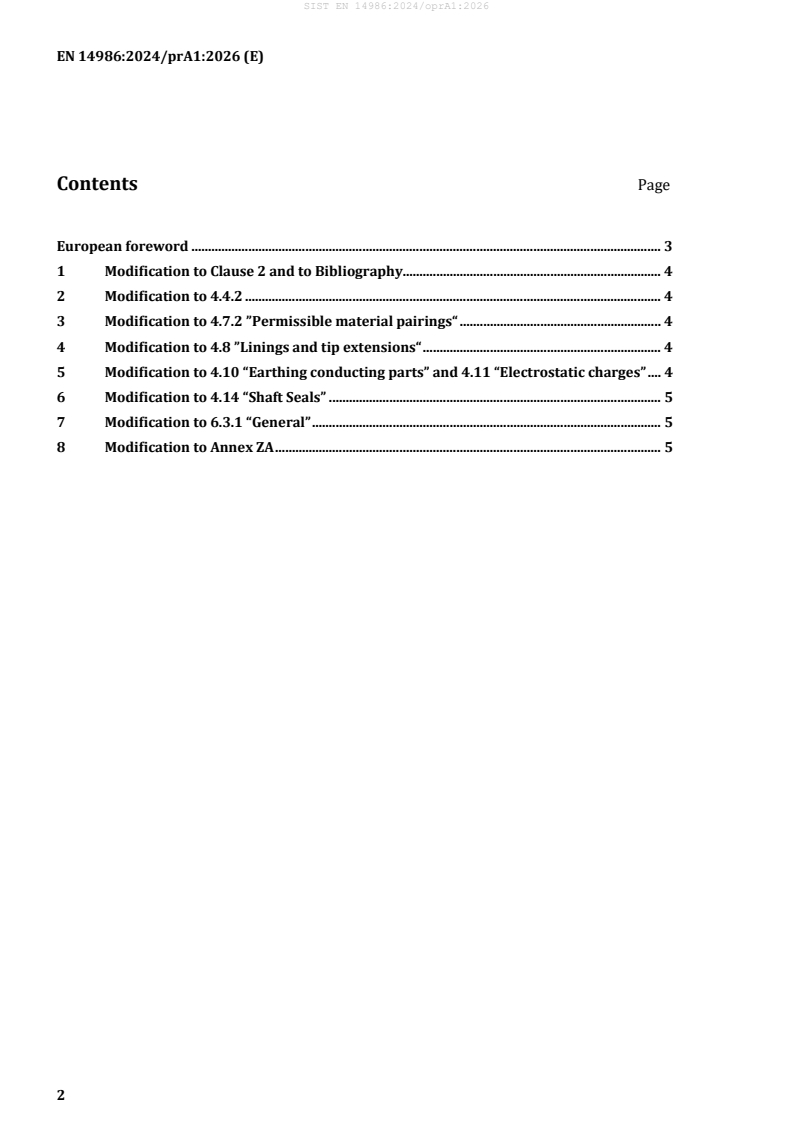
Contents Page
European foreword . 3
1 Modification to Clause 2 and to Bibliography. 4
2 Modification to 4.4.2 . 4
3 Modification to 4.7.2 ”Permissible material pairings“ . 4
4 Modification to 4.8 ”Linings and tip extensions“ . 4
5 Modification to 4.10 “Earthing conducting parts” and 4.11 “Electrostatic charges” . 4
6 Modification to 4.14 “Shaft Seals” . 5
7 Modification to 6.3.1 “General” . 5
8 Modification to Annex ZA . 5
European foreword
This document (EN 14986:2024/prA1:2026) has been prepared by Technical Committee CEN/TC 305
“Explosion prevention and protection”, the secretariat of which is held by DIN.
This document is currently submitted to the CEN Enquiry.
This document has been prepared under a standardization request addressed to CEN by the European
Commission. The Standing Committee of the EFTA States subsequently approves these requests for its
Member States.
For the relationship with EU Legislation, see informative Annex ZA, which is an integral part of this
document.
1 Modification to Clause 2 and to Bibliography
Move “CLC/TR 60079-32-1:2018 Explosive atmospheres - Part 32-1: Electrostatic hazards, guidance” to
Bibliography.
Replace “EN 60079-14:2014, Explosive atmospheres — Part 14: Electrical installations design, selection
and erection (IEC 60079-14:2013)” by “EN IEC 60079-14:2024, Explosive atmospheres — Part 14:
Electrical installation design, selection and inst
...