

SIST EN 50292:2023
(Main)Electrical apparatus for the detection of carbon monoxide in domestic premises, caravans and boats - Guide on the selection, installation, use and maintenance
General Information
- Abstract
This document serves as a guide on the selection, installation, use and maintenance of apparatus for the detection of carbon monoxide, intended for continuous operation in a fixed installation in domestic premises, caravans and boats. This guide is intended to cover any type of domestic or residential accommodation, including leisure accommodation vehicles such as touring and static caravans, and motor homes; and recreational craft such as canal barges. Some static caravans are used as permanent dwellings; in such cases EN 50291 1 is appropriate. For all other types of caravan, EN 50291 2 is appropriate. This guide is read in conjunction with EN 50291 1 and EN 50291 2 together with any additional relevant national or local regulations.
This document refers to the installation of two types of apparatus:
a) Type A apparatus, to provide a visual and audible alarm and an executive action in the form of an output signal that can be used to actuate directly or indirectly a ventilation or other ancillary device;
b) Type B apparatus, to provide a visual and audible alarm only.
This document excludes apparatus for the detection of combustible gases (see EN 50244) and for industrial installations or commercial premises.
- Status
- Published
- Public Enquiry End Date
- 30-Jun-2022
- Publication Date
- 19-Apr-2023
- Technical Committee
- I09 - Imaginarni 09
- Current Stage
- 6060 - National Implementation/Publication (Adopted Project)
- Start Date
- 19-Apr-2023
- Due Date
- 24-Jun-2023
- Completion Date
- 20-Apr-2023



Overview
EN 50292:2023 - Electrical apparatus for the detection of carbon monoxide in domestic premises, caravans and boats - is a CLC guide on the selection, installation, use and maintenance of fixed carbon monoxide (CO) detection apparatus. It covers continuous-operation CO detectors for domestic and similar residential settings, including touring/static caravans, motor homes and recreational craft (e.g., canal barges). The standard is intended to be read alongside EN 50291-1 and EN 50291-2 and applicable national/local regulations.
Key topics and technical requirements
- Scope and definitions: Clarifies terms such as fixed installation, Type A and Type B apparatus, alarm set level, warm-up time, and output signal.
- Sources of CO: Describes common CO origins and migration (including wood pellets and ethanol), normal exposure levels and special situations (inversion weather, tobacco/shisha emissions).
- Installation & siting: Guidance on planning, configuration and correct siting of CO detectors for domestic premises, caravans and boats, with specific provisions for small leisure accommodation vehicles and recreational craft.
- Types of apparatus:
- Type A - visual/audible alarm plus an executive action output (e.g., trigger ventilation, shut-off valves or mains switches).
- Type B - visual and audible alarm only.
- Executive actions: Examples and safe implementation options for Type A devices (ventilation control, remote alarms, additional signalling).
- Maintenance and lifetimes: Recommendations on servicing, sensor replacement, nuisance alarm management and end-of-life considerations.
- Safety & emergency: Health effects (Annex A), alarm philosophy (Annex B), and emergency actions moved to Annex C for practical response steps.
- Normative references: Includes EN 50291 series and other relevant standards.
Practical applications and users
EN 50292:2023 is practical for:
- Installers and electricians specifying and siting fixed CO detectors in homes, caravans and boats.
- Manufacturers and system designers integrating Type A executive outputs for ventilation or shut-off systems.
- Landlords, park-home operators and recreational craft owners who need guidance on compliant CO protection.
- Public-facing retailers and advisors supplying detectors to the public who must explain correct use and maintenance.
This guide helps ensure CO alarms are selected and installed according to good engineering practice - enhancing occupant safety while complementing proper appliance installation and servicing.
Related standards
- EN 50291-1 (CO detector performance and test methods)
- EN 50291-2 (CO detectors for caravans and leisure accommodation)
- EN 50244 (combustible gas detectors) - excluded from scope
- EN 1775 (gas supply pipework) and relevant national/local regulations
Keywords: EN 50292:2023, carbon monoxide detector guide, CO alarm installation, Type A CO detector, Type B CO detector, domestic CO safety, caravans and boats.
Relations
- Effective Date
- 01-Jun-2023
Get Certified
Connect with accredited certification bodies for this standard

CIS Institut d.o.o.
Personal Protective Equipment (PPE) certification body. Notified Body NB-2890 for EU Regulation 2016/425 PPE.

Kiwa BDA Testing
Building and construction product certification.
Kmetijski inštitut Slovenije
Agricultural Institute of Slovenia. Soil testing, plant health, agricultural product analysis.
Sponsored listings
Frequently Asked Questions
SIST EN 50292:2023 is a standard published by the Slovenian Institute for Standardization (SIST). Its full title is "Electrical apparatus for the detection of carbon monoxide in domestic premises, caravans and boats - Guide on the selection, installation, use and maintenance". This standard covers: This document serves as a guide on the selection, installation, use and maintenance of apparatus for the detection of carbon monoxide, intended for continuous operation in a fixed installation in domestic premises, caravans and boats. This guide is intended to cover any type of domestic or residential accommodation, including leisure accommodation vehicles such as touring and static caravans, and motor homes; and recreational craft such as canal barges. Some static caravans are used as permanent dwellings; in such cases EN 50291 1 is appropriate. For all other types of caravan, EN 50291 2 is appropriate. This guide is read in conjunction with EN 50291 1 and EN 50291 2 together with any additional relevant national or local regulations. This document refers to the installation of two types of apparatus: a) Type A apparatus, to provide a visual and audible alarm and an executive action in the form of an output signal that can be used to actuate directly or indirectly a ventilation or other ancillary device; b) Type B apparatus, to provide a visual and audible alarm only. This document excludes apparatus for the detection of combustible gases (see EN 50244) and for industrial installations or commercial premises.
This document serves as a guide on the selection, installation, use and maintenance of apparatus for the detection of carbon monoxide, intended for continuous operation in a fixed installation in domestic premises, caravans and boats. This guide is intended to cover any type of domestic or residential accommodation, including leisure accommodation vehicles such as touring and static caravans, and motor homes; and recreational craft such as canal barges. Some static caravans are used as permanent dwellings; in such cases EN 50291 1 is appropriate. For all other types of caravan, EN 50291 2 is appropriate. This guide is read in conjunction with EN 50291 1 and EN 50291 2 together with any additional relevant national or local regulations. This document refers to the installation of two types of apparatus: a) Type A apparatus, to provide a visual and audible alarm and an executive action in the form of an output signal that can be used to actuate directly or indirectly a ventilation or other ancillary device; b) Type B apparatus, to provide a visual and audible alarm only. This document excludes apparatus for the detection of combustible gases (see EN 50244) and for industrial installations or commercial premises.
SIST EN 50292:2023 is classified under the following ICS (International Classification for Standards) categories: 13.320 - Alarm and warning systems; 97.030 - Domestic electrical appliances in general. The ICS classification helps identify the subject area and facilitates finding related standards.
SIST EN 50292:2023 has the following relationships with other standards: It is inter standard links to SIST EN 50292:2014. Understanding these relationships helps ensure you are using the most current and applicable version of the standard.
SIST EN 50292:2023 is available in PDF format for immediate download after purchase. The document can be added to your cart and obtained through the secure checkout process. Digital delivery ensures instant access to the complete standard document.
Standards Content (Sample)
SLOVENSKI STANDARD
01-junij-2023
Električni aparati za zaznavanje ogljikovega monoksida v stanovanjskih prostorih,
bivalnih prikolicah in čolnih - Navodilo za izbiro, vgradnjo, uporabo in vzdrževanje
Electrical apparatus for the detection of carbon monoxide in domestic premises,
caravans and boats - Guide on the selection, installation, use and maintenance
Elektrische Geräte für die Detektion von Kohlenmonoxid in Wohnhäusern, Caravans und
Booten - Leitfaden für Auswahl, Installation, Benutzung und Instandhaltung
Matériels électriques pour la détection de monoxyde de carbone dans les locaux à
usage domestique, caravanes et bateaux - Guide de sélection, d'installation, d'utilisation
et de maintenance
Ta slovenski standard je istoveten z: EN 50292:2023
ICS:
13.320 Alarmni in opozorilni sistemi Alarm and warning systems
97.030 Električni aparati za dom na Domestic electrical
splošno appliances in general
2003-01.Slovenski inštitut za standardizacijo. Razmnoževanje celote ali delov tega standarda ni dovoljeno.
EUROPEAN STANDARD EN 50292
NORME EUROPÉENNE
EUROPÄISCHE NORM April 2023
ICS 13.320 Supersedes EN 50292:2013
English Version
Electrical apparatus for the detection of carbon monoxide in
domestic premises, caravans and boats - Guide on the selection,
installation, use and maintenance
Matériels électriques pour la détection de monoxyde de Elektrische Geräte für die Detektion von Kohlenmonoxid in
carbone dans les locaux à usage domestique, caravanes et Wohnhäusern, Caravans und Booten - Leitfaden für
bateaux - Guide de sélection, d'installation, d'utilisation et Auswahl, Installation, Benutzung und Instandhaltung
de maintenance
This European Standard was approved by CENELEC on 2023-03-20. CENELEC members are bound to comply with the CEN/CENELEC
Internal Regulations which stipulate the conditions for giving this European Standard the status of a national standard without any alteration.
Up-to-date lists and bibliographical references concerning such national standards may be obtained on application to the CEN-CENELEC
Management Centre or to any CENELEC member.
This European Standard exists in three official versions (English, French, German). A version in any other language made by translation
under the responsibility of a CENELEC member into its own language and notified to the CEN-CENELEC Management Centre has the
same status as the official versions.
CENELEC members are the national electrotechnical committees of Austria, Belgium, Bulgaria, Croatia, Cyprus, the Czech Republic,
Denmark, Estonia, Finland, France, Germany, Greece, Hungary, Iceland, Ireland, Italy, Latvia, Lithuania, Luxembourg, Malta, the
Netherlands, Norway, Poland, Portugal, Republic of North Macedonia, Romania, Serbia, Slovakia, Slovenia, Spain, Sweden, Switzerland,
Türkiye and the United Kingdom.
European Committee for Electrotechnical Standardization
Comité Européen de Normalisation Electrotechnique
Europäisches Komitee für Elektrotechnische Normung
CEN-CENELEC Management Centre: Rue de la Science 23, B-1040 Brussels
© 2023 CENELEC All rights of exploitation in any form and by any means reserved worldwide for CENELEC Members.
Ref. No. EN 50292:2023 E
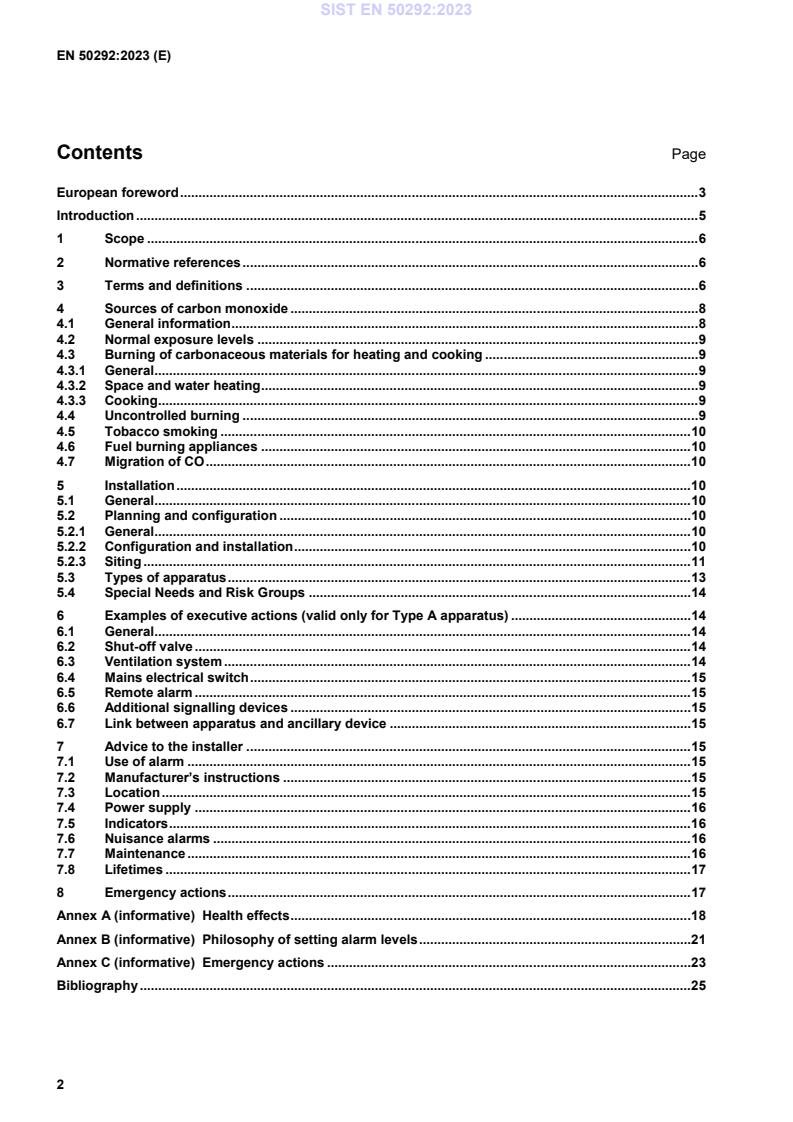
Contents Page
European foreword . 3
Introduction . 5
1 Scope . 6
2 Normative references . 6
3 Terms and definitions . 6
4 Sources of carbon monoxide . 8
4.1 General information . 8
4.2 Normal exposure levels . 9
4.3 Burning of carbonaceous materials for heating and cooking . 9
4.3.1 General . 9
4.3.2 Space and water heating . 9
4.3.3 Cooking . 9
4.4 Uncontrolled burning . 9
4.5 Tobacco smoking . 10
4.6 Fuel burning appliances . 10
4.7 Migration of CO . 10
5 Installation . 10
5.1 General . 10
5.2 Planning and configuration . 10
5.2.1 General . 10
5.2.2 Configuration and installation . 10
5.2.3 Siting . 11
5.3 Types of apparatus . 13
5.4 Special Needs and Risk Groups . 14
6 Examples of executive actions (valid only for Type A apparatus) . 14
6.1 General . 14
6.2 Shut-off valve . 14
6.3 Ventilation system . 14
6.4 Mains electrical switch . 15
6.5 Remote alarm . 15
6.6 Additional signalling devices . 15
6.7 Link between apparatus and ancillary device . 15
7 Advice to the installer . 15
7.1 Use of alarm . 15
7.2 Manufacturer’s instructions . 15
7.3 Location . 15
7.4 Power supply . 16
7.5 Indicators . 16
7.6 Nuisance alarms . 16
7.7 Maintenance . 16
7.8 Lifetimes . 17
8 Emergency actions . 17
Annex A (informative) Health effects . 18
Annex B (informative) Philosophy of setting alarm levels . 21
Annex C (informative) Emergency actions . 23
Bibliography . 25
European foreword
This document (EN 50292:2023) has been prepared by CLC/TC 216, “Gas detectors”.
The following dates are fixed:
• latest date by which this document has to be (dop) 2024-03-20
implemented at national level by publication of
an identical national standard or by
endorsement
• latest date by which the national standards (dow) 2026-03-20
conflicting with this document have to be
withdrawn
This document supersedes EN 50292:2013 and all of its amendments and corrigenda (if any).
minor changes have also been made):
— Document title revised to include applications that are similar to domestic premises;
— Section titles have been revised to be clearer;
— Normative references have been extended to include smoke and CO alarm standards;
— Clause 3, Definitions have been extended and revised, e.g. to bring in line with other standards;
— Clause 4, sources of carbon monoxide have been revised to include wood pellets, and ethanol;
— 4.3.1, included reference to Inversion weather conditions;
— 4.3.3, revised title and text to improve clarity;
— 4.5, include reference to other smoke emitting sources such as Shisha venues;
— 4.6, Revised;
— 4.7, Revised with reference to CO diffusion;
— 5.2, Title revised;
— 5.2.1, Title revised;
— 5.2.2, Title revised;
— 5.2.2, Content revised for easier reading and improved clarity;
— 5.2.2.1, revised to improve clarity and refence to other standards included;
— 5.2.2.2, New section covering wood pellets, wood chips and biomass briquettes added;
— 5.2.2.3, renumbered and revised Caravans and recreational craft;
— 5.2.3, title revised for improved clarity;
— 5.2.3.1, Revised throughout;
— 5.2.3.2, Title revised, Text revised for improved clarity;
— 5.2.3.3, Title revised, Text revised for improved clarity;
— 5.2.3.4, Title revised, Text revised for improved clarity;
— 5.2.3.5, Revised with additional information on siting in caravans and recreational craft;
— 5.3, Revised to include reference to other standards;
— 5.4, New section referencing Special needs and Risk Groups;
— Clause 6, Title revised;
— 6.1, text revised to include references to other sections in this document;
— 6.3, Title revised and updated text in relation to ventilation systems;
— 6.4, Added examples on hazards;
— 6.5, Revised section;
— 6.6, title and text revised to reference to the principle of two senses for additional signalling;
— Clause 7, Title revised;
— 7.1, revised for improved clarity;
— 7.2, revised for improved clarity;
— 7.5, revised for improved clarity;
— 7.6, Revised title and updated text on nuisance alarms;
— 7.7, Complete revision of maintenance and lifetimes sections;
— Clause 8, Emergency actions moved to Annex C.
Attention is drawn to the possibility that some of the elements of this document may be the subject of patent
rights. CENELEC shall not be held responsible for identifying any or all such patent rights.
Any feedback and questions on this document should be directed to the users’ national committee. A complete
listing of these bodies can be found on the CENELEC website.
Introduction
This document is intended to be a guide for people who, in the course of their professional activities, are required
to install apparatus for the detection of carbon monoxide (CO) in domestic premises and rooms with similar
purposes. It is also aimed at anyone who might supply such detectors to members of the public for subsequent
installation according to national regulations, so that advice may be given based on good engineering practice.
Apparatus for the detection of carbon monoxide are not a substitute for good installation and regular servicing
of fuel burning appliances or regular cleaning of chimneys, although they may provide an added margin of
reassurance for users. Domestic carbon monoxide detectors with or without some form of executive function
may overcome fears of fuel safety and may be particularly beneficial in certain circumstances.
It is necessary to understand that carbon monoxide toxicity may have different consequences according to the
physical condition of the individual. Thus, a carbon monoxide detector designed according to the
EN 50291 series may not fully safeguard individuals with specific medical conditions.
Carbon monoxide detectors are not intended to be used as an alternative to smoke alarms.
1 Scope
This document serves as a guide on the selection, installation, use and maintenance of apparatus for the
detection of carbon monoxide, intended for continuous operation in a fixed installation in domestic premises,
caravans and boats. This guide is intended to cover any type of domestic or residential accommodation,
including leisure accommodation vehicles such as touring and static caravans, and motor homes; and
recreational craft such as canal barges. Some static caravans are used as permanent dwellings; in such cases
EN 50291-1 is appropriate. For all other types of caravan, EN 50291-2 is appropriate. This guide is read in
conjunction with EN 50291-1 and EN 50291-2 together with any additional relevant national or local regulations.
This document refers to the installation of two types of apparatus:
a) Type A apparatus, to provide a visual and audible alarm and an executive action in the form of an output
signal that can be used to actuate directly or indirectly a ventilation or other ancillary device;
b) Type B apparatus, to provide a visual and audible alarm only.
This document excludes apparatus for the detection of combustible gases (see EN 50244) and for industrial
installations or commercial premises.
2 Normative references
The following documents are referred to in the text in such a way that some or all of their content constitutes
requirements of this document. For dated references, only the edition cited applies. For undated references, the
latest edition of the referenced document (including any amendments) applies.
EN 1775, Gas supply - Gas pipework for buildings - Maximum operating pressure less than or equal to 5 bar -
Functional recommendations
EN 50291-1:2018, Gas detectors - Electrical apparatus for the detection of carbon monoxide in domestic
premises - Part 1: Test methods and performance requirements
3 Terms and definitions
For the purposes of this document, the following terms and definitions apply:
ISO and IEC maintain terminology databases for use in standardization at the following addresses:
— ISO Online browsing platform: available at https://www.iso.org/obp
— IEC Electropedia: available at https://www.electropedia.org/
3.1
domestic premises
house or building, or part thereof, residential park homes, or non-recreational boats such as canal barges, in
which persons sojourn, reside or sleep as intended
3.2
fixed installation
apparatus which is intended to have all parts except replaceable batteries permanently installed
3.3
sensor
assembly in which the sensing element is housed that may contain associated circuit component
3.4
sensing element
device, the output of which will change in the presence of carbon monoxide
3.5
continuous operation
apparatus that is continuously powered with continuous or intermittent automatic sensing
3.6
apparatus
carbon monoxide detection device according to EN 50291-1
Note 1 to entry: Carbon monoxide detection apparatus may also be generically termed “gas detectors” or “CO alarms”.
3.7
volume ratio
V/V
ratio of the volume of carbon monoxide to the volume of the gas mixture
Note 1 to entry: Volume ratio (V/V) is often expressed in units of parts per million (ppm); it is commonly referred to as
concentration.
3.8
output signal
signal (Type A apparatus acc. EN 50291-1 only) characterised by a standby and an activation state, by which
action may be initiated
Note 1 to entry: In many cases, such action will entail triggering an ancillary device.
3.9
warm-up time
time interval between the time when the apparatus is switched on and the time when the apparatus is fully
operational
3.10
alarm set level
fixed setting of the apparatus that determines the volume ratio and duration of exposure at which the apparatus
will automatically initiate an alarm and, for type A apparatus, an output signal
3.11
fault warning
visual and audible signal indicating a faulty or failed apparatus
3.12
mains-powered apparatus
apparatus designed to be powered by the domestic mains electrical supply, with or without an additional power
source
3.13
battery-powered apparatus
apparatus designed to be powered by batteries only
3.14
leisure accommodation vehicle
leisure accommodation vehicle (LAV) unit of living accommodation for temporary or seasonal occupation that
may meet requirements for construction and use of road vehicles
EXAMPLE: Motor home, caravan, motorhome.
Note 1 to entry: Other motorised vehicles like trucks are known to have residential accommodation. They are not leisure
accommodation vehicles but are considered as similar vehicles in this document.
3.15
recreational craft
boat of a minimum length of 2,5 m and a maximum length of 24 m as specified in Directive 94/25/EC, which is
intended for sports or leisure purposes
3.16
corridor
connection between rooms and the exit of a unit, intended as an emergency route; this includes passageways
and stairwells within a unit
3.17
unit
apartment, one-family house or comparable single or multi-storey group of rooms with residential-like use or
suitability
3.18
connected devices
devices which are wired or wirelessly interconnected with the apparatus, to activate an audible alarm (or any
other action) on all connected devices, in cases where the apparatus is in a CO alarm condition
3.19
circulation space
space (including a stairway) inside a dwelling mainly used as a means of access between a room and an exit
from the dwelling
3.20
dwelling
flat or maisonette, comprising one or more rooms, forming a separate unit of residential accommodation within
a building
3.21
dwelling house
building comprising one or more storeys and multiple flats or maisonettes
3.22
multiple dwelling building
building comprising one or more storeys and multiple flats or maisonettes
3.23
flat
self-contained premises for residential use which are separated from other parts (e.g. other dwellings) of a
building and which have an own access door
3.24
combination/multi-sensor device
unit containing all the components, except possible the normal power source, necessary for detecting hazardous
levels of smoke or carbon monoxide and for giving an audible alarm, which can comprise one or more parts
such as a base (socket) and a head (body)
4 Sources of carbon monoxide
4.1 General information
Carbon monoxide is a colourless, odourless, non-irritating gas which is classified as a chemical asphyxiant,
whose toxic action is a direct result of the hypoxia produced by a given exposure (see Annex A and Annex B).
4.2 Normal exposure levels
Carbon monoxide can be generated within a building or enter from outside. Typically the normal average
background levels of carbon monoxide in domestic premises, measured over periods of 1 h to 24 h, are less
than 10 ppm. In cases of climatic inversion, higher levels of carbon monoxide are possible.
4.3 Burning of carbonaceous materials for heating and cooking
4.3.1 General
Most of the carbon monoxide in the environment is produced during combustion of carbonaceous material, e.g.
solid fuels (such as coal, coke and wood), liquid fuels (such as oil, petrol and ethanol) and gaseous fuels (such
as natural gas, town gas and liquefied petroleum gas (LPG)).
It should be noted that town gas might still be in use in some countries, and it can contain a significant proportion
of carbon monoxide prior to combustion The proportion and constituents of the combustion products from
carbonaceous fuels will depend on the particular fuel and the combustion conditions.
Varying concentrations of carbon monoxide are produced from most combustion processes. Exhaust gases
from burning solid and liquid fuels may contain significant concentrations of carbon monoxide: levels of
20 000 ppm to 50 000 ppm (2 % to 5 %) are not unexpected. For example, burning coal, wood or peat can
produce concentrations of 20 000 ppm, 40 000 ppm and 50 000 ppm respectively. In addition, poorly maintained
and inefficient burners can produce considerably higher levels of carbon monoxide.
Another topic of concern is flue reversal. A flue reversal may occur both under certain climatic conditions (e.g.
inversion weather situations), as well as in the cases of foreign bodies completely or partially blocking the smoke
fumes. This applies to facilities where the combustion air is taken from the rooms, as well as to those whose
combustion air is supplied to the appliance independent from room air. This is normally a temporary
phenomenon. But it cannot be foreseen, and it may occur at any time, and it may last over an incalculable period
of time, even if the appliance is correctly maintained.
4.3.2 Space and water heating
Solid, liquid and gaseous fuels may be used for space and water heating. They are used in a variety of ways,
either as a local heat source or as a remote central heat source, including
— appliance with flue using room air,
— appliance without flue using room air,
— appliance with flue using external air.
In the case of a defective ducted air heater, carbon monoxide can be distributed into remote rooms.
4.3.3 Cooking
Natural gas, town gas or LPG (Liquid Petroleum Gas) are the main fuels for cooking, typically using flueless
appliances including cooking ranges. In some cases, solid fuels or oil are used in cooking appliances that are
generally fitted with flues.
Portable cooking and heating equipment: it should be emphasized that charcoal grills emit very high levels of
carbon monoxide and should only be used outdoors, but never as an air heater in any kind of recreational
facilities, including tents.
It is also warned about the indoor operation of gas-powered mobile heaters (mushroom / patio heaters). Even
those devices can emit increased levels of carbon monoxide and should therefore be operated only outdoors.
4.4 Uncontrolled burning
Carbon monoxide is a major gaseous product from fires resulting from uncontrolled burning of carbonaceous
material. Varying concentrations of carbon monoxide are produced, depending on the material, burning
conditions, etc.
4.5 Tobacco smoking
Smoking produces a significant concentration of carbon monoxide. This becomes a particular problem in
situations where there are large number of smoke emitting sources such as shisha venues. Unfortunately, in
this particular case it is difficult to recommend the use of EN 50291-1 alarms and advise on siting due to the
fact that the sources of CO are regularly relocated.
4.6 Fuel burning appliances
The products of combustion for any fuel burning appliance are particularly dangerous in enclosed spaces. This
would include exhaust gases from internal combustion engines and large heating systems in residential boiler
rooms.
The exhaust gases from internal combustion engines (vehicles or electricity generators for example) running in
an enclosed space can quickly produce dangerous levels of carbon monoxide.
4.7 Migration of CO
Latest studies have shown that released CO (i.e. in a boiler room) can spread not only by diffusion through open
spaces such as cable ducts, door sills, keyholes, etc., but also by permeation through walls and ceilings
throughout the entire building. The speed of permeation depends on the building materials used (wood, brick,
concrete, plasterboard, etc.) and cannot generally be given as an exact value. For this reason, it is
recommended that as a minimum, every room with a fuel burning appliance should be equipped with an
apparatus to detect any notable exposition of CO as early as possible.
5 Installation
5.1 General
The manufacturer is required to provide suitable instructions for the correct and safe installation of the apparatus
and to indicate on the apparatus and its packaging that these instructions should be read carefully before
installing or operating the apparatus.
Generally, the same considerations apply to both type A and type B apparatus.
5.2 Planning and configuration
5.2.1 General
The design and layout of domestic premises, caravans and boats and the number, type and position of carbon
monoxide sources vary widely. To minimize the risk of nuisance alarms or damage to the sensors, in the
following sections only general guidance can be given as to where apparatus should be installed or which
mounting locations are unsuitable for this purpose.
5.2.2 Configuration and installation
5.2.2.1 Rooms
An apparatus should be installed in every room containing a fuel-burning appliance.
a) If a fuel-burning appliance is in a room that is part of the dwelling, the apparatus may be interconnected to
other apparatus or smoke alarms according to the requirements of EN 50291-1:2018, 5.13, within the same
dwelling, to ensure an appropriate early warning for occupants:
— in rooms in which the occupant(s) spend considerable time whilst awake and from which they may not
be able to hear an alarm from apparatus in another part of the premises, i.e. due to a complex and/ or
large dwelling or closed doors between the apparatus and other rooms;
— in every sleeping room.
b) If a dwelling is a bedsit (a single room serving as both sitting and bedroom), then the apparatus should be
positioned as far from the cooking appliances as possible but near to where the person sleeps.
c) If a fuel-burning appliance is in a room which is not normally frequented (for example a boiler room), the
apparatus should be interconnected to e.g. smoke alarms or to ancillary devices (siren, beacon) in other
rooms and/ or circular spaces to ensure an appropriate early warning is given for occupants elsewhere in
the building. If CO is detected, it is recommended that those interconnected devices operate with a sound
pattern that is different from i.e. a smoke or fire alarm.
Where a fuel-burning appliance has an extended and/or concealed flue, an apparatus should be installed in
each room through which the flue passes.
5.2.2.2 Storage rooms for biofuels
Biofuels like wood pellets, wood chips or biomass briquettes are increasingly used in residential buildings of all
sizes to substitute coal, oil or gas fired boilers with a renewable energy source.
Various studies and the evaluation of accidents in Europe have shown that particularly wood pellets and chips
produce, among others, carbon monoxide and deplete oxygen whilst in storage. It has been proven that storage
rooms should be equipped with size dependent, appropriate means of ventilation control. Additionally, the
installation of carbon monoxide alarms is recommended to prevent from unnoticed spread of carbon monoxide
from the storage room to other parts of the building.
Since carbon monoxide is generally flammable and an explosive gas-air mixture could arise in the storage room,
carbon monoxide alarms should only be installed outside the storage room, but in the immediate vicinity - ideally
near the access door.
Boiler rooms are often located in areas of a building that are normally not frequented very often, and so are the
fuel storage rooms. Consequently, an audible alarm of the apparatus may not be heard in other parts of the
building. For this reason, it is recommended to connect the apparatus to other warning devices in the building
and to attach at least a visual signalling device at the entrance to this part of the building, which is activated by
the apparatus if it is in alarm condition. To ensure a reliable activation of this signalling device a Type A
apparatus (see EN 50291-1:2018, 5.9) should be used.
5.2.2.3 Caravans and recreational craft
Caravans and boats may have additional risks of carbon monoxide ingress through air vents due to the nearby
presence of other vehicles, engines, generators or barbecues; however, this does not change the basic
guidance on location of the alarm. Caravans and boats should be fitted with an alarm in the same room as any
combustion appliance(s), located in accordance with 5.2.3.3. If the caravan or boat has a single living space
which incorporates the sleeping accommodation, it can be consi
...