

SIST EN 13061:2009
(Main)Protective clothing - Shin guards for association football players - Requirements and test methods
General Information
- Abstract
This European Standard specifies the general requirements for the ergonomics, innocuousness, sizing, coverage, performance, and cleaning of association football players' shin guards. Test methods are described and performance levels are defined. Requirements for the marking of shin guards and the information to be supplied with them are given.
- Status
- Published
- Publication Date
- 12-Oct-2009
- Technical Committee
- OVP - Personal protecting equipment
- Current Stage
- 6060 - National Implementation/Publication (Adopted Project)
- Start Date
- 22-Sep-2009
- Due Date
- 27-Nov-2009
- Completion Date
- 13-Oct-2009
- Directive
- 2016/425 - Regulation (EU) 2016/425 of the European Parliament and of the Council of 9 March 2016 on personal protective equipment and repealing Council Directive 89/686/EECOJ Ref: C 113 OJ Date: 27-Mar-2018
89/686/EEC - Personal protective equipment (PPE)OJ Ref: C 205 OJ Date: 09-Jul-2011 Conflicting Date: 06-May-2010



Overview
EN 13061:2009 is the CEN European Standard that specifies requirements and test methods for protective shin guards used by association football players. It covers ergonomics, innocuousness (safety of materials and construction), sizing, coverage, restraint, performance (stud and blunt impact resistance), cleaning and labelling. The document defines test procedures, performance levels and the information that manufacturers must supply.
Key topics and technical requirements
- Scope: Shin guards for association football; can be used in other sports only with supporting evidence.
- Ergonomics (Clause 3.2 / 4.5): Design must allow typical playing movements (running, jumping, foot flexing) without undue restriction or discomfort.
- Innocuousness (Clause 3.1 / 4.4): Materials must not harm users; manufacturers should list main substances and consider REACH and 67/548/EEC guidance.
- Sizing & coverage (Clause 3.3 / 4.3): Product must be size-marked by the range of player body heights it fits; test-area templates are defined as percentages of wearer height (e.g., total height = 9.5% of tallest wearer).
- Restraint (Clause 3.4 / 4.6): Shin guards must remain in place during play and impacts. Maximum acceptable displacement on release is <15 mm or <15% of the linear test-area dimension.
- Stud impact resistance (Clause 3.5 / 4.7): Must resist a metal stud 10 mm diameter; inner surface must not be pervasively torn or perforated and no hazardous fragments allowed.
- Blunt impact performance (Clause 3.6 / 4.8): Transmitted force from three single impacts to the same point must not exceed 2.0 kN in central or lateral test areas.
- Sampling & conditioning (Clause 4.2): New, unused samples; at least one example of each marketed size, with conditioning at 20 ±2 °C and 65 ±5% RH for 48 h. Clean five times per manufacturer instructions before testing.
- Measurement uncertainty: Instruments should be accurate; typical measurement uncertainty is expected between 2% and 5%.
Applications and who uses this standard
- Manufacturers and designers of football protective equipment - to design and validate compliant shin guards.
- Testing laboratories and certification bodies - to perform standardized impact, restraint and innocuousness tests.
- Procurement and quality managers - to specify product performance in tenders and supply contracts.
- Retailers and importers - to verify claims, labelling and conformity with EU requirements.
- Sports organisations/coaches - to understand protective performance limits of equipment.
Related standards and regulatory context
- Supersedes EN 13061:2001 (updated 2009).
- References EU safety/chemical frameworks such as Directive 67/548/EEC and REACH (EC 1907/2006).
- Annex ZA describes the relationship with EU Directive 89/686/EEC (personal protective equipment).
Keywords: EN 13061:2009, shin guards standard, protective clothing, association football, stud impact, blunt impact, ergonomics, sizing, CEN test methods.
Relations
- Effective Date
- 01-Nov-2009
Get Certified
Connect with accredited certification bodies for this standard

CIS Institut d.o.o.
Personal Protective Equipment (PPE) certification body. Notified Body NB-2890 for EU Regulation 2016/425 PPE.

Kiwa BDA Testing
Building and construction product certification.
Kmetijski inštitut Slovenije
Agricultural Institute of Slovenia. Soil testing, plant health, agricultural product analysis.
Sponsored listings
Frequently Asked Questions
SIST EN 13061:2009 is a standard published by the Slovenian Institute for Standardization (SIST). Its full title is "Protective clothing - Shin guards for association football players - Requirements and test methods". This standard covers: This European Standard specifies the general requirements for the ergonomics, innocuousness, sizing, coverage, performance, and cleaning of association football players' shin guards. Test methods are described and performance levels are defined. Requirements for the marking of shin guards and the information to be supplied with them are given.
This European Standard specifies the general requirements for the ergonomics, innocuousness, sizing, coverage, performance, and cleaning of association football players' shin guards. Test methods are described and performance levels are defined. Requirements for the marking of shin guards and the information to be supplied with them are given.
SIST EN 13061:2009 is classified under the following ICS (International Classification for Standards) categories: 13.340.50 - Leg and foot protection; 97.220.40 - Outdoor and water sports equipment. The ICS classification helps identify the subject area and facilitates finding related standards.
SIST EN 13061:2009 has the following relationships with other standards: It is inter standard links to SIST EN 13061:2002. Understanding these relationships helps ensure you are using the most current and applicable version of the standard.
SIST EN 13061:2009 is associated with the following European legislation: EU Directives/Regulations: 2016/425, 89/686/EEC; Standardization Mandates: M/031. When a standard is cited in the Official Journal of the European Union, products manufactured in conformity with it benefit from a presumption of conformity with the essential requirements of the corresponding EU directive or regulation.
SIST EN 13061:2009 is available in PDF format for immediate download after purchase. The document can be added to your cart and obtained through the secure checkout process. Digital delivery ensures instant access to the complete standard document.
Standards Content (Sample)
2003-01.Slovenski inštitut za standardizacijo. Razmnoževanje celote ali delov tega standarda ni dovoljeno.Schutzkleidung - Schienbeinschützer für Fußballspieler - Anforderungen und PrüfverfahrenVêtements de protection - Protège-tibias pour joueurs de football - Exigences et méthodes d'essaiProtective clothing - Shin guards for association football players - Requirements and test methods97.220.40Oprema za športe na prostem in vodne športeOutdoor and water sports equipment13.340.50Varovanje nog in stopalLeg and foot protectionICS:Ta slovenski standard je istoveten z:EN 13061:2009SIST EN 13061:2009en,fr,de01-november-2009SIST EN 13061:2009SLOVENSKI
STANDARDSIST EN 13061:20021DGRPHãþD
EUROPEAN STANDARDNORME EUROPÉENNEEUROPÄISCHE NORMEN 13061September 2009ICS 13.340.50Supersedes EN 13061:2001
English VersionProtective clothing - Shin guards for association football players- Requirements and test methodsVêtements de protection - Protège-tibias pour joueurs defootball - Exigences et méthodes d'essaiSchutzkleidung - Schienbeinschützer für Fußballspieler -Anforderungen und PrüfverfahrenThis European Standard was approved by CEN on 8 August 2009.CEN members are bound to comply with the CEN/CENELEC Internal Regulations which stipulate the conditions for giving this EuropeanStandard the status of a national standard without any alteration. Up-to-date lists and bibliographical references concerning such nationalstandards may be obtained on application to the CEN Management Centre or to any CEN member.This European Standard exists in three official versions (English, French, German). A version in any other language made by translationunder the responsibility of a CEN member into its own language and notified to the CEN Management Centre has the same status as theofficial versions.CEN members are the national standards bodies of Austria, Belgium, Bulgaria, Cyprus, Czech Republic, Denmark, Estonia, Finland,France, Germany, Greece, Hungary, Iceland, Ireland, Italy, Latvia, Lithuania, Luxembourg, Malta, Netherlands, Norway, Poland, Portugal,Romania, Slovakia, Slovenia, Spain, Sweden, Switzerland and United Kingdom.EUROPEAN COMMITTEE FOR STANDARDIZATIONCOMITÉ EUROPÉEN DE NORMALISATIONEUROPÄISCHES KOMITEE FÜR NORMUNGManagement Centre:
Avenue Marnix 17,
B-1000 Brussels© 2009 CENAll rights of exploitation in any form and by any means reservedworldwide for CEN national Members.Ref. No. EN 13061:2009: ESIST EN 13061:2009
Significant technical changes between this European Standard and the previous edition EN 13061:2001 . 25Annex ZA (informative)
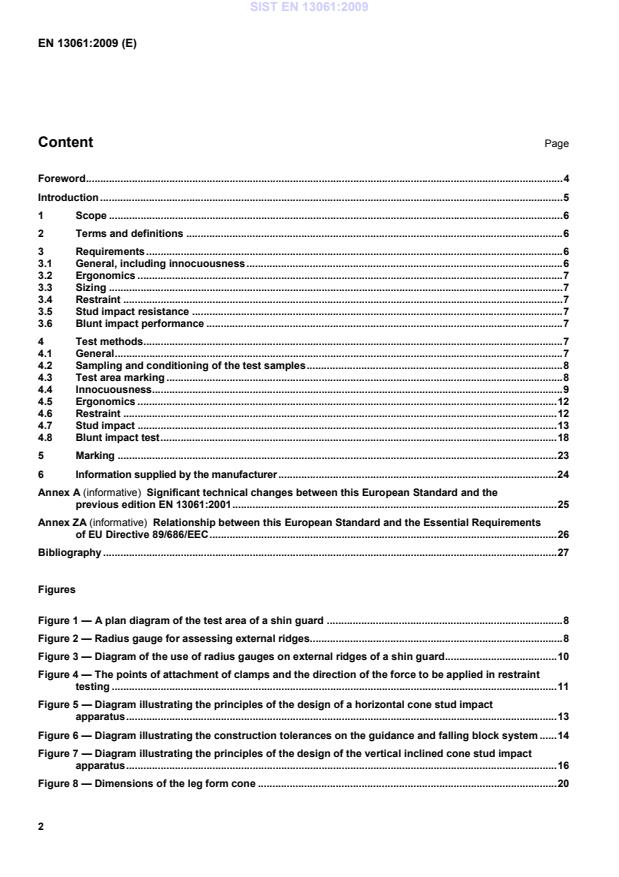
Relationship between this European Standard and the Essential Requirements of EU Directive 89/686/EEC . 26Bibliography . 27 Figures Figure 1 — A plan diagram of the test area of a shin guard . 8 Figure 2 — Radius gauge for assessing external ridges. 8 Figure 3 — Diagram of the use of radius gauges on external ridges of a shin guard . 10 Figure 4 — The points of attachment of clamps and the direction of the force to be applied in restraint testing . 11 Figure 5 — Diagram illustrating the principles of the design of a horizontal cone stud impact apparatus . 13 Figure 6 — Diagram illustrating the construction tolerances on the guidance and falling block system . 14 Figure 7 — Diagram illustrating the principles of the design of the vertical inclined cone stud impact apparatus . 16 Figure 8 — Dimensions of the leg form cone . 20 SIST EN 13061:2009
1 Scope This European Standard specifies the general requirements for the ergonomics, innocuousness, sizing, coverage, performance, and cleaning of association football players' shin guards. Test methods are described and performance levels are defined. Requirements for the marking of shin guards and the information to be supplied with them are given. 2 Terms and definitions For the purposes of this European Standard, the following terms and definitions apply. 2.1 contusion or bruise injury usually caused by a blunt impact in which the skin is not broken. Underlying soft tissue is damaged by compression and by shearing forces. Fine blood vessels are damaged leading to bleeding, discoloration and swelling 2.2 laceration irregular torn injury through the skin 2.3 puncture wound in which a penetrating object makes a discrete hole through the skin which more or less closes after withdrawal of the object 2.4 association football game of football in which the ball is not picked up or carried by field players, and in which the rules for tackling should limit the severity of body blows 2.5 internal ridges raised area of the shell material which is directed towards the user's leg. A ridge is a linear feature that has a top width of less than 5 mm or an area feature with a top area of less than 25 mm2 3 Requirements 3.1 General, including innocuousness Shin guards for association football players shall meet a general requirement that they are safe to use and fit for their purpose, and the following specific requirements: Construction materials or their derivates shall not harm those coming into contact with them. NOTE Information on the identification and classification of such substances can be found in the Directive 67/548/EEC (classification, packaging and labelling of dangerous substances) [1] as well as in the Regulation (EC) no.1907/2006 of the European Parliament and of the Council of 18 December 2006 concerning the Registration, Evaluation, Authorisation and Restriction of Chemicals (REACH) [2]. The manufacturer shall list in the information supplied by the manufacturer the substances used for the main components of the product.
If there are ridges that can be felt with the fingers on the inside of the shin guard, they shall be tested according to 4.4.2.
If there are ridges higher than 1 mm on the outer surface of the shin guard, they shall be tested according to 4.4.3. The shin guard does only perform this requirement, if the end points of the arc of the appropriate gauge touch the surface of the shin guard at all positions tested as described in 4.4.3.2 and in all orientations of the gauge. 3.2 Ergonomics Shin guards for association football players shall be so designed that in the foreseeable conditions of use for which they are intended the user can perform the typical playing movements, e.g. running, jumping, flexing the foot, without being hindered. If restriction or severe discomfort is reported, the product fails. Test method, see 4.5. 3.3 Sizing Shin guards for association football players shall be marked with their size. The size marking shall be the range of body height of players that the shin guard is designed to fit. 3.4 Restraint Shin guards for association football players shall be designed so that they should remain in place during normal play and during impacts. The restraint system recommended by the manufacturer or his authorised representative established in the community shall be tested in accordance with 4.6. On release of the force, the displacement of the shin guard from its initial position shall be less than 15 mm or less than 15 % of the linear dimension of the test area measured in line with the force applied, if this is greater than 15 mm. 3.5 Stud impact resistance Shin guards for association football players shall resist impacts by a metal stud 10 mm in diameter when tested according to 4.7.1 and 4.7.2. The inner surface of the shin guards tested shall not be pervasively torn or being perforated. No hard material shall shatter or give rise to potentially injurious fragments. When tested according to 4.7.2, the stud shall be stopped less than 25 mm below the zero line. 3.6 Blunt impact performance When tested according to 4.8, the transmitted force of the three single impacts to the same point on three shin guards shall not exceed 2,0 kN in the central or lateral test areas. 4 Test methods 4.1 General Confirm by reference to appropriate documentation, e.g. document of compliance, test reports, and by measurement, visual inspection and tactile examination of the shin guard, that it meets the requirements of 3.1. Measuring instruments unless otherwise specified shall be accurate to ± 2 % of the pass/fail level of the characteristic being measured. For each of the required sequences of measurements performed in accordance with this standard, a corresponding estimate of the uncertainty of the final result shall be determined. The uncertainty of SIST EN 13061:2009
Key 1
height 2
width at the top 3
width at the distance 1 from the top of the protective area 4
radius of curvature of an upper corner 5
radius of curvature of a lower corner Figure 1 — A plan diagram of the test area of a shin guard Table 1 — Dimensions of the template for the total test area
1 2 3 4 5 Dimension expressed as the per-centage of the tallest wearer's height 9,5 6,4 4,5 2,2 0,9 The central test area shall be marked by using a second smaller template. This template shall be placed central on the total test area and its outline traced onto the shin guard. 4.4 Innocuousness 4.4.1 Edges, seams and buckles The shin guards shall be examined visually and by hand to locate any hard or sharp edges, seams or buckles that might injure the user or another player during normal use. The shin guards meets the requirements of 3.1 if none of these structures are observed or felt. If such structures are detected, they shall be considered internal or external ridges according to 4.4.2 or 4.4.3 and shall be tested accordingly.
Key α (60 ± 2)° r radius of curvature of the gauge as specified in Table 2. Figure 2 — Radius gauge for assessing external ridges Table 2 — Dimensions of the radius gauges for testing external ridges Height of ridges on the outer surface of the shin guard mm Radius r of the testing gauge
mm < 1,4 (0,6 ± 0,1) 1,4 to 1,8 (0,8 ± 0,1) > 1,8 to 2,2 (1,0 ± 0,1) > 2,2 to 2,6 (1,2 ± 0,1) > 2,6 to 3,4 (1,5 ± 0,15) > 3,4 (2,0 ± 0,2) 4.4.3.2 Procedure If hard or sharp ridges can be visually or manually detected on the outer surface of a shin guard, the following test shall be carried out on each of these ridges: SIST EN 13061:2009
Figure 3 illustrates this procedure and the pass and fail conditions. b) Pass and fail conditions: Figure 3a) The radius of the arc of the appropriate gauge is smaller than the radius of the ridge, so that the gauge touches the surface of the shin guard with no other points of the arc than its end points. The shin guard performs the requirement. Figure 3b) The radius of curvature of the ridge is the same like in figure 3a), however the height “l” of the ridge is higher. Therefore a gauge with a bigger radius of the arc shall be selected according to Table 2. The radius of the arc of this gauge is bigger than the radius of the ridge. Therefore it does not touch the surface of the shin guard with both end points of the arc at the same time. This shin guard does not perform the requirement. Figure 3c) The
angle of the ridge is bigger than 120°. The gauge touches the surface of the shin guard with both end points of the arc independent from the radius of the ridge. The shin guard performs the requirement. Figure 3d) The height and the radius of curvature of the ridge is the same as in figure 3c) however the angle is smaller than 120°. The radius of curvature of the ridge is smaller than the radius of the arc
...