

SIST EN 14120:2003+A1:2007
(Main)Protective clothing - Wrist, palm, knee and elbow protectors for users of roller sports equipment - Requirements and test methods
General Information
- Abstract
This European Standard specifies the requirements and test methods for ergonomics, innocuousness, comfort, restraint, strength, abrasion, impact performance as well as provisions for marking and instructions supplied by the manufacturer for wrist, palm, knee and elbow protectors (hereinafter referred to as protectors) for all users of roller sports equipment.
It does not apply to protectors used in roller sports hockey.
- Status
- Published
- Publication Date
- 12-Sep-2007
- Technical Committee
- OVP - Personal protecting equipment
- Current Stage
- 6060 - National Implementation/Publication (Adopted Project)
- Start Date
- 05-Sep-2007
- Due Date
- 10-Nov-2007
- Completion Date
- 13-Sep-2007
- Directive
- 2016/425 - Regulation (EU) 2016/425 of the European Parliament and of the Council of 9 March 2016 on personal protective equipment and repealing Council Directive 89/686/EECOJ Ref: C 113 OJ Date: 27-Mar-2018
89/686/EEC - Personal protective equipment (PPE)OJ Ref: C 205 OJ Date: 09-Jul-2011 Conflicting Date: 31-Dec-2007



Overview
EN 14120:2003+A1:2007 (CEN) is the European standard that specifies requirements and test methods for wrist, palm, knee and elbow protectors used by users of roller sports equipment (e.g., roller skates, inline skates, skateboards). The standard covers ergonomics, innocuousness (chemical safety), comfort, restraint, strength, abrasion resistance, impact performance, marking and manufacturer instructions. It does not apply to protectors used in roller sports hockey.
Key topics and technical requirements
- Performance levels: Two levels are defined - Level 1 for normal roller sports and Level 2 for acrobatic roller sports (higher performance demands). Performance is assessed against three user body-mass ranges (A: ≤25 kg, B: >25–50 kg, C: >50 kg).
- Ergonomics & comfort: Protectors must allow normal movement and not hinder expected roller-sport activities.
- Innocuousness (chemical & physical safety): Materials and components shall not harm users; manufacturers must list main composition and label known hazardous substances. Annex A gives guidance on chemical innocuousness assessment.
- Restraint (retention): Protectors must remain positioned during movement and impacts. Maximum permitted displacements are specified (e.g., elbow protectors: 20 mm for range A, 40 mm for B, 50 mm for C; knee: 30/50/60 mm; wrist/palm: 20 mm for all ranges).
- Abrasion resistance & impact strength: Abrasion layers must resist perforation; abrasion-resistant layers must not split or break under specified impact tests.
- Impact performance: Knee, palm and elbow protectors are tested for peak force transmission; the standard defines test methods and allowable limits for compliance (see clause 6.7).
- Wrist-specific requirements: Continuous adjustment of restraint system, defined stiffness elements (minimum dimensions by user mass range: e.g., length from wrist up the arm 30/40/50 mm; towards fingertip 40/50/60 mm; palmar width 15/20/25 mm) and limits on wrist extension as specified in the standard.
- Testing & sampling: New protectors tested; sampling rules (two pairs per size, or four pairs if only one size); measurement uncertainty and conditioning requirements are specified.
Applications and who uses this standard
- Manufacturers & product designers: to design, test and certify wrist, palm, knee and elbow protectors for the European market.
- Testing laboratories & conformity assessors: to perform abrasion, impact and retention testing per clause 6.
- Retailers & procurement teams: to validate claims and choose appropriate protectors for target users (normal vs acrobatic use).
- Sports organizations, safety officers and regulators: to set equipment recommendations and ensure user protection.
Related standards
- EN 1082-1 (glove/arm guard test methods)
- EN 13595-2 (impact abrasion resistance methods)
- ISO 6344-2 (abrasive grain size analysis)
Keywords: EN 14120:2003+A1:2007, wrist protectors, knee protectors, elbow protectors, palm protectors, roller sports, test methods, abrasion resistance, impact performance, ergonomics, innocuousness, CEN.
Relations
- Effective Date
- 28-Jan-2026
- Effective Date
- 28-Jan-2026
- Effective Date
- 28-Jan-2026
- Effective Date
- 28-Jan-2026
- Effective Date
- 28-Jan-2026
- Effective Date
- 28-Jan-2026
- Effective Date
- 28-Jan-2026
- Effective Date
- 01-Nov-2007
- Effective Date
- 01-Nov-2007
Get Certified
Connect with accredited certification bodies for this standard

CIS Institut d.o.o.
Personal Protective Equipment (PPE) certification body. Notified Body NB-2890 for EU Regulation 2016/425 PPE.

Kiwa BDA Testing
Building and construction product certification.
Kmetijski inštitut Slovenije
Agricultural Institute of Slovenia. Soil testing, plant health, agricultural product analysis.
Sponsored listings
Frequently Asked Questions
SIST EN 14120:2003+A1:2007 is a standard published by the Slovenian Institute for Standardization (SIST). Its full title is "Protective clothing - Wrist, palm, knee and elbow protectors for users of roller sports equipment - Requirements and test methods". This standard covers: This European Standard specifies the requirements and test methods for ergonomics, innocuousness, comfort, restraint, strength, abrasion, impact performance as well as provisions for marking and instructions supplied by the manufacturer for wrist, palm, knee and elbow protectors (hereinafter referred to as protectors) for all users of roller sports equipment. It does not apply to protectors used in roller sports hockey.
This European Standard specifies the requirements and test methods for ergonomics, innocuousness, comfort, restraint, strength, abrasion, impact performance as well as provisions for marking and instructions supplied by the manufacturer for wrist, palm, knee and elbow protectors (hereinafter referred to as protectors) for all users of roller sports equipment. It does not apply to protectors used in roller sports hockey.
SIST EN 14120:2003+A1:2007 is classified under the following ICS (International Classification for Standards) categories: 13.340.40 - Hand and arm protection; 13.340.50 - Leg and foot protection; 97.220.40 - Outdoor and water sports equipment. The ICS classification helps identify the subject area and facilitates finding related standards.
SIST EN 14120:2003+A1:2007 has the following relationships with other standards: It is inter standard links to SIST EN 17092-1:2020, SIST EN 17092-6:2020, SIST EN 17092-4:2020, SIST EN 17092-2:2020, SIST EN 17092-3:2020, SIST EN 17092-5:2020, SIST EN 1082-1:1998, SIST EN 14120:2003, SIST EN 14120:2003/oprA1:2006. Understanding these relationships helps ensure you are using the most current and applicable version of the standard.
SIST EN 14120:2003+A1:2007 is associated with the following European legislation: EU Directives/Regulations: 2016/425, 89/686/EEC, 93/68/EEC, 93/95/EEC, 96/58/EC, EUR-PUB; Standardization Mandates: M/031. When a standard is cited in the Official Journal of the European Union, products manufactured in conformity with it benefit from a presumption of conformity with the essential requirements of the corresponding EU directive or regulation.
SIST EN 14120:2003+A1:2007 is available in PDF format for immediate download after purchase. The document can be added to your cart and obtained through the secure checkout process. Digital delivery ensures instant access to the complete standard document.
Standards Content (Sample)
2003-01.Slovenski inštitut za standardizacijo. Razmnoževanje celote ali delov tega standarda ni dovoljeno.Schutzkleidung - Handgelenk-, Handflächen-, Knie- und Ellenbogenschützer für Benutzer von Rollsportgeräten - Anforderungen und PrüfverfahrenVetements de protection - Dispositifs de protection des poignets,des paumes, des genoux et des coudes pour les utilisateurs d'équipements de sports a roulettes - Exigences et méthodes d'essaiProtective clothing - Wrist, palm, knee and elbow protectors for users of roller sports equipment - Requirements and test methods97.220.40Oprema za športe na prostem in vodne športeOutdoor and water sports equipment13.340.50Varovanje nog in stopalLeg and foot protection13.340.40Varovanje dlani in rokHand and arm protectionICS:Ta slovenski standard je istoveten z:EN 14120:2003+A1:2007SIST EN 14120:2003+A1:2007en,fr,de01-november-2007SIST EN 14120:2003+A1:2007SLOVENSKI
STANDARD
EUROPEAN STANDARD NORME EUROPÉENNE EUROPÄISCHE NORM
EN 14120:2003+A1
June 2007 ICS 13.340.40; 13.340.50 Supersedes EN 14120:2003English Version
Protective clothing - Wrist, palm, knee and elbow protectors for users of roller sports equipment - Requirements and test methods
Vêtements de protection - Dispositifs de protection des poignets,des paumes, des genoux et des coudes pour les utilisateurs d'équipements de sports à roulettes - Exigences et méthodes d'essai
Schutzkleidung - Handgelenk-, Handflächen-, Knie- und Ellenbogenschützer für Benutzer von Rollsportgeräten - Anforderungen und Prüfverfahren This European Standard was approved by CEN on 13 February 2003 and includes Amendment 1 approved by CEN on 10 May 2007.
CEN members are bound to comply with the CEN/CENELEC Internal Regulations which stipulate the conditions for giving this European Standard the status of a national standard without any alteration. Up-to-date lists and bibliographical references concerning such national standards may be obtained on application to the CEN Management Centre or to any CEN member.
This European Standard exists in three official versions (English, French, German). A version in any other language made by translation under the responsibility of a CEN member into its own language and notified to the CEN Management Centre has the same status as the official versions.
CEN members are the national standards bodies of Austria, Belgium, Bulgaria, Cyprus, Czech Republic, Denmark, Estonia, Finland, France, Germany, Greece, Hungary, Iceland, Ireland, Italy, Latvia, Lithuania, Luxembourg, Malta, Netherlands, Norway, Poland, Portugal, Romania, Slovakia, Slovenia, Spain, Sweden, Switzerland and United Kingdom.
EUROPEAN COMMITTEE FOR STANDARDIZATION
COMITÉ EUROPÉEN DE NORMALISATION EUROPÄISCHES KOMITEE FÜR NORMUNG
Management Centre: rue de Stassart, 36
B-1050 Brussels © 2007 CEN All rights of exploitation in any form and by any means reserved worldwide for CEN national Members. Ref. No. EN 14120:2003+A1:2007: ESIST EN 14120:2003+A1:2007
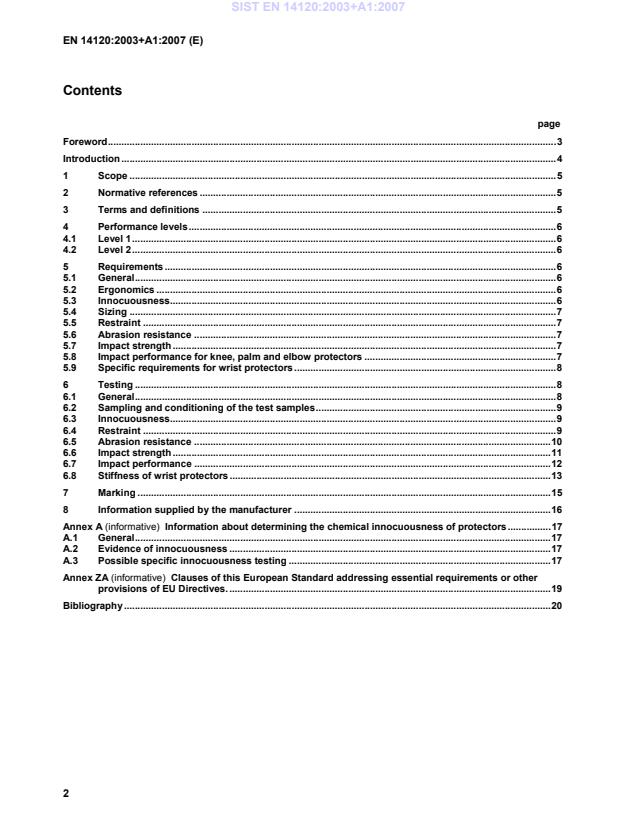
Information about determining the chemical innocuousness of protectors.17 A.1 General.17 A.2 Evidence of innocuousness.17 A.3 Possible specific innocuousness testing.17 Annex ZA (informative)
Clauses of this European Standard addressing essential requirements or other provisions of EU Directives.19 Bibliography.20
ranges of body mass as follows: a) range A: Users of up to 25 kg body mass; b) range B: Users of body mass more than 25 kg to 50 kg; c) range C: Users of body mass above 50 kg. Combined protectors such as palm and wrist protectors shall meet the requirements for each protector. 5.2 Ergonomics Protectors shall be so designed and manufactured that in the foreseeable conditions of use for which they are intended the user can perform the roller sports normally and unhindered whilst enjoying protection at the specified limit. 5.3 Innocuousness Protectors shall be safe to use and fit for their purpose. They shall be designed and manufactured to provide protection when used according to the manufacturer’s instructions, without endangering the user or others. There shall not be hard or sharp edges, seams, buckles or other items on the surfaces of the products that could harm the user or others during normal use. Examination shall be made according to 6.3. Construction materials and incorporated substances, shall not harm those coming into contact with them. The manufacturer shall list in the information supplied with the protectors the main composition of the protectors and shall label any protector containing substances or preparations generally known to be hazardous. Information about determining the chemical innocuousness of protectors is given in annex A. SIST EN 14120:2003+A1:2007
Elbow protector 20 40 50
Knee protector 30 50 60
Wrist protector 20 20 20
Palm protector 20 20 20
5.6 Abrasion resistance When tested in accordance with 6.5 the abrasion resistant layer of the protector shall not be perforated. 5.7 Impact strength When tested in accordance with 6.6 the abrasion resistant layer of the knee, elbow, wrist or palm protector shall not break or split. 5.8 Impact performance for knee, palm and elbow protectors A protector complies with this standard if the mean value of the peak force does not exceed the values in Table 2 when tested in accordance with 6.7. Table 2 — Impact performance requirements for knee, palm and elbow protectors Protectors level 1 Protectors level 2 Range of body mass Range of body mass A B C A B C r e r e r e r e r e r e Kind of protector mm J mm J mm J mm J mm J mm J Maxi-mumpeakforcekN
Knee protectors 25
3 35 8
50 12 25
50 25 6
Elbow protectors
12,5 1
17,54
12,5
7,5
17,5 10
25 15 4
Palm protectors 100
3 100
4 100
5 100
8 100 10 3 r
is the radius of curvature of the anvil e
is the impact energy SIST EN 14120:2003+A1:2007
Length from the wrist up to the arm 30 40 50
Length from the wrist towards the
finger tip 40 50 60
Width in the palmar region 15 20 25
Testing in accordance with 6.1. 6 Testing 6.1 General If no specific methods are specified compliance with the requirements of this European Standard shall be examined by measurement, visual inspection and tactile examination. For the tests new protectors shall be used. Measuring instruments unless otherwise specified shall be accurate to ± 2 % of the pass/fail level of the characteristic being measured. For each of the required sequences of measurements performed in accordance with this standard a corresponding estimate of the uncertainty of the final result shall be determined. The uncertainty of measurement shall be expressed in the form ± X. It shall be used in determining whether a “Pass” performance has been achieved. If the final result minus X is below the pass level when the requirement that a certain value shall be exceeded, the sample shall be deemed to have failed. NOTE It is anticipated that values of uncertainty of measurement will be usually between 2 % and 5 % of the measured value for force and length measurements. SIST EN 14120:2003+A1:2007
...