

SIST EN 15752-1:2014
(Main)Glass in building - Adhesive backed polymeric film - Part 1: Definitions and requirements
General Information
- Abstract
This European Standard defines adhesive backed polymeric film based on biaxially oriented polyester film, and the performance characteristics of adhesive backed polymeric film for use on glass in buildings.
This European Standard does not apply to adhesive backed polymeric films manufactured using polyvinylchloride (PVC).
Other requirements, not specified in this standard, may apply to other glass or glazing products, e.g. laminated glass or insulating glass units, when adhesive backed polymeric film is included as part of the original assembly or manufacture of the glazing product. These additional requirements are specified in the appropriate product standard. Adhesive backed polymeric film, in this case, does not lose its mechanical or thermal characteristics.
- Status
- Published
- Public Enquiry End Date
- 29-Jan-2014
- Publication Date
- 18-Aug-2014
- Technical Committee
- STV - Steklo, svetloba in razsvetljava v gradbeništvu
- Current Stage
- 6060 - National Implementation/Publication (Adopted Project)
- Start Date
- 05-Aug-2014
- Due Date
- 10-Oct-2014
- Completion Date
- 19-Aug-2014



Overview
EN 15752-1:2014 - "Glass in building - Adhesive backed polymeric film - Part 1: Definitions and requirements" is a European Standard published by CEN that defines adhesive backed polymeric film based on biaxially oriented polyester film and specifies the performance characteristics required for films intended for application to glass in buildings. The standard explicitly excludes PVC-based films. It covers terminology, film types, required properties, dimensions and tolerances, and durability test methods.
Key Topics
- Scope & definitions
- Formal definitions of adhesive backed polymeric film and related terms used in building glazing applications.
- Types of films
- Solar-control film, clear film, safety film, security film, decorative film, anti-graffiti film, UV-reducing film, low-emissivity (low-e) film, privacy film, and RF/EMF shield‑attenuating film.
- Performance characteristics
- Solar-optical properties (visible transmittance, glare reduction, total solar energy rejected, UV rejection).
- Thermal properties such as emissivity for low-e films.
- Mechanical properties including thickness, dimensional tolerances, and splice requirements.
- Durability and test methods
- Accelerated weathering procedures and criteria for changes in physical and solar-optical properties.
- Scratch/abrasion resistance with haze measurement procedures (annexed test method).
- Adhesive strength testing requirements for safety/security films.
- Sampling, specimen preparation, conditioning and reporting requirements.
- Dimensions & tolerances
- Nominal thickness, thickness tolerances and roll width/length guidance.
Applications and Users
EN 15752-1:2014 is practical for:
- Manufacturers of polyester-based adhesive films to define product specifications and to demonstrate compliance.
- Architects and façade engineers specifying solar-control, privacy, or decorative glazing upgrades.
- Glazing contractors and installers selecting appropriate film types for retrofit and new-build applications.
- Test laboratories performing accelerated weathering, abrasion/haze and adhesive strength testing.
- Building owners and facility managers assessing options for solar gain reduction, safety/security retrofit, UV protection for interiors, and improved thermal performance (low-e films).
Practical uses include retrofit solar control, occupant glare reduction, protection against glass breakage, UV damage mitigation to interiors, decorative finishes, anti-graffiti protection, EM shielding, and thermal upgrading of glazing.
Related standards
- The standard notes that when adhesive backed polymeric film is included in laminated glass or insulating glass units, additional requirements from the relevant product standards for those glazing products apply. Users should consult the appropriate laminated or insulating glass product standards and national regulations for integrated assemblies.
Keywords: EN 15752-1:2014, adhesive backed polymeric film, glass in building, biaxially oriented polyester film, solar-control film, safety film, abrasion resistance, accelerated weathering, UV rejection, low-e film.
Relations
- Effective Date
- 09-Feb-2026
- Effective Date
- 28-Jan-2026
- Effective Date
- 28-Jan-2026
- Effective Date
- 28-Jan-2026
- Effective Date
- 28-Jan-2026
- Effective Date
- 28-Jan-2026
- Effective Date
- 28-Jan-2026
- Effective Date
- 28-Jan-2026
- Effective Date
- 28-Jan-2026
- Effective Date
- 28-Jan-2026
- Effective Date
- 28-Jan-2026
- Effective Date
- 28-Jan-2026
- Effective Date
- 28-Jan-2026
- Effective Date
- 28-Jan-2026
Get Certified
Connect with accredited certification bodies for this standard

DIN CERTCO
DIN Group product certification.

Smithers Quality Assessments
US management systems and product certification.
Sponsored listings
Frequently Asked Questions
SIST EN 15752-1:2014 is a standard published by the Slovenian Institute for Standardization (SIST). Its full title is "Glass in building - Adhesive backed polymeric film - Part 1: Definitions and requirements". This standard covers: This European Standard defines adhesive backed polymeric film based on biaxially oriented polyester film, and the performance characteristics of adhesive backed polymeric film for use on glass in buildings. This European Standard does not apply to adhesive backed polymeric films manufactured using polyvinylchloride (PVC). Other requirements, not specified in this standard, may apply to other glass or glazing products, e.g. laminated glass or insulating glass units, when adhesive backed polymeric film is included as part of the original assembly or manufacture of the glazing product. These additional requirements are specified in the appropriate product standard. Adhesive backed polymeric film, in this case, does not lose its mechanical or thermal characteristics.
This European Standard defines adhesive backed polymeric film based on biaxially oriented polyester film, and the performance characteristics of adhesive backed polymeric film for use on glass in buildings. This European Standard does not apply to adhesive backed polymeric films manufactured using polyvinylchloride (PVC). Other requirements, not specified in this standard, may apply to other glass or glazing products, e.g. laminated glass or insulating glass units, when adhesive backed polymeric film is included as part of the original assembly or manufacture of the glazing product. These additional requirements are specified in the appropriate product standard. Adhesive backed polymeric film, in this case, does not lose its mechanical or thermal characteristics.
SIST EN 15752-1:2014 is classified under the following ICS (International Classification for Standards) categories: 81.040.20 - Glass in building; 83.140.10 - Films and sheets. The ICS classification helps identify the subject area and facilitates finding related standards.
SIST EN 15752-1:2014 has the following relationships with other standards: It is inter standard links to SIST EN 50147-1:1997, SIST EN ISO 4892-2:2013, SIST EN ISO 8510-2:2011, SIST EN 12898:2019, SIST EN 410:2011, SIST EN ISO 4892-1:2024, SIST EN 12600:2004, SIST EN 572-2:2012, SIST EN 572-1:2012+A1:2016, SIST EN 356:2000, SIST EN ISO 14554-2:2014, SIST EN 673:2026, SIST EN 15755-1:2014, SIST EN ISO 8253-1:2011. Understanding these relationships helps ensure you are using the most current and applicable version of the standard.
SIST EN 15752-1:2014 is associated with the following European legislation: EU Directives/Regulations: 88/609/EEC; Standardization Mandates: M/135_Am1. When a standard is cited in the Official Journal of the European Union, products manufactured in conformity with it benefit from a presumption of conformity with the essential requirements of the corresponding EU directive or regulation.
SIST EN 15752-1:2014 is available in PDF format for immediate download after purchase. The document can be added to your cart and obtained through the secure checkout process. Digital delivery ensures instant access to the complete standard document.
Standards Content (Sample)
2003-01.Slovenski inštitut za standardizacijo. Razmnoževanje celote ali delov tega standarda ni dovoljeno.Steklo v gradbeništvu - Samolepljiva polimerna folija - 1. del: Definicije in zahteveGlas im Bauwesen - Selbstklebende Polymerfolie - Teil 1: Begriffe und AnforderungenVerre dans la construction - Film polymère adhésif - Partie 1: Définitions et exigencesGlass in building - Adhesive backed polymeric film - Part 1: Definitions and requirements83.140.10Filmi in folijeFilms and sheets81.040.20Steklo v gradbeništvuGlass in buildingICS:Ta slovenski standard je istoveten z:EN 15752-1:2014SIST EN 15752-1:2014en,fr,de01-september-2014SIST EN 15752-1:2014SLOVENSKI
STANDARD
EUROPEAN STANDARD NORME EUROPÉENNE EUROPÄISCHE NORM
EN 15752-1
August 2014 ICS 81.040.20; 83.140.10 English Version
Glass in building - Adhesive backed polymeric film - Part 1: Definitions and requirements
Verre dans la construction - Film polymère adhésif - Partie 1: Définitions et exigences
Glas im Bauwesen - Selbstklebende Polymerfolie - Teil 1: Begriffe und Anforderungen This European Standard was approved by CEN on 15 May 2014.
CEN members are bound to comply with the CEN/CENELEC Internal Regulations which stipulate the conditions for giving this European Standard the status of a national standard without any alteration. Up-to-date lists and bibliographical references concerning such national standards may be obtained on application to the CEN-CENELEC Management Centre or to any CEN member.
This European Standard exists in three official versions (English, French, German). A version in any other language made by translation under the responsibility of a CEN member into its own language and notified to the CEN-CENELEC Management Centre has the same status as the official versions.
CEN members are the national standards bodies of Austria, Belgium, Bulgaria, Croatia, Cyprus, Czech Republic, Denmark, Estonia, Finland, Former Yugoslav Republic of Macedonia, France, Germany, Greece, Hungary, Iceland, Ireland, Italy, Latvia, Lithuania, Luxembourg, Malta, Netherlands, Norway, Poland, Portugal, Romania, Slovakia, Slovenia, Spain, Sweden, Switzerland, Turkey and United Kingdom.
EUROPEAN COMMITTEE FOR STANDARDIZATION
COMITÉ EUROPÉEN DE NORMALISATION EUROPÄISCHES KOMITEE FÜR NORMUNG
CEN-CENELEC Management Centre:
Avenue Marnix 17,
B-1000 Brussels © 2014 CEN All rights of exploitation in any form and by any means reserved worldwide for CEN national Members. Ref. No. EN 15752-1:2014 ESIST EN 15752-1:2014
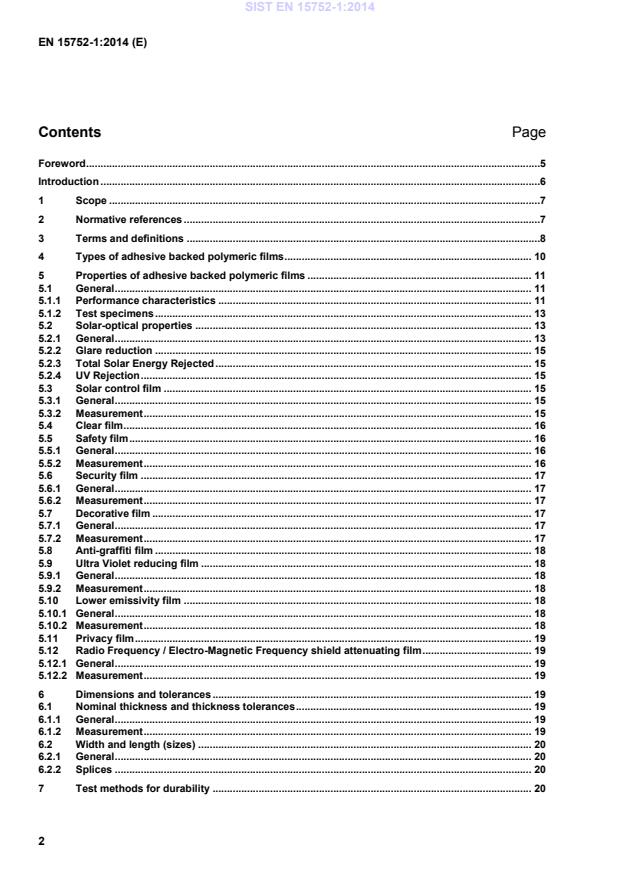
Abrasion testing of adhesive backed polymeric film with measurement of haze . 31 A.1 Introduction . 31 A.2 Definitions and Descriptions . 31 A.2.1 eaze . 31 A.2.2 ûeaze . 31 A.3 Test Equipment . 31 A.3.1 Abrader . 31 A.3.2 Refacing Stone . 31 A.3.3 Abrasive Wheels . 31 A.3.4 ppecimen eolder . 32 A.3.5 eazemetre . 32 A.3.5.1 Instrument . 32 A.3.5.2 Interior surfaces . 32 A.3.5.3 Light trap . 32 A.3.5.4 Entrance and exit ports . 32 A.3.5.5 Photocells position . 32 SIST EN 15752-1:2014
Key a scratch or abrasion resistant coating b polyester film with coated layer(s) c laminating adhesive d polyester film with UV protection dyed into the mass of the polymeric film e adhesive with UV protection f protective release liner with silicone coating g glass h layer f is removed prior to installation Colour may be added to layers c, d and/or layer e. UV absorbers may be added to layer d and/ or layer e. A second layer may be added, with a laminating adhesive, either for darker tints, or for safety/security performance, or for improved durability. Figure 1- Example of a construction of an adhesive backed polymeric film (interior grade) 5 Properties of adhesive backed polymeric films 5.1 General The properties of adhesive backed polymeric films are wide ranging. Their specific performance characteristics are given below: 5.1.1 Performance characteristics The performance characteristics and the properties of adhesive backed polymeric film are described in relation to their class, i.e. where they can be used, and to their type, i.e. the performance of the glass that will be modified. The class of film is given in Table 1 and Figure 2 and their property modifications are given in Table 2, where surface 1 is always towards the external environment. SIST EN 15752-1:2014
Class D adhesive backed polymeric film is normally an internal film used within the cavity of an insulating glass unit.
Key A – D installation position for adhesive backed polymeric film Classes A to D 1 - 6 surface number of glazing (surface 1 is to the exterior) Figure 2 - Classes of adhesive backed polymeric filmed glass – installation position SIST EN 15752-1:2014
B5 – An adhesive backed polymeric film designed to be applied on surface 2 of single glazing, surface 4 of double glazing, or surface 6 of triple glazing, generally known as an internal film, in order to modify the appearance of the glass pane to a decorative product. EXAMPLE 2
D1248 – An adhesive backed polymeric film designed to be applied to surface 2 of double glazing or surface 2 and / or surface 4 of triple glazing in order to modify the solar control, emissivity, privacy and EMI shielding of the glazing. 5.1.2 Test specimens The performance characteristics shall not be determined for the adhesive backed polymeric film alone, unless otherwise specified in this standard; performance characteristics shall be determined using test samples consisting of the adhesive backed polymeric film applied to clear, monolithic, uncoated float glass of nominal thickness of 4 mm. The glass shall be monolithic soda lime silicate and shall be in accordance with EN 572-1 and EN 572-2. One or more tests may be conducted on glass meeting these requirements but with a different thickness; these tests shall only be accepted if the same tests have been completed and reported in accordance with this standard for 4 mm thick glass. The adhesive backed polymeric film shall be applied to the glass substrate in accordance with the original manufacturer’s recommendations. Measurement of the properties of test specimens shall be made after the cure time has elapsed. The adhesive backed polymeric manufacturer should supply cure time requirements. Test specimens shall be representative of normal production material. Where the film shall be installed to a glass substrate in order to perform the test, the installation method shall be representative of the normal method used to install the adhesive backed polymeric film to the glass substrate. 5.2 Solar-optical properties 5.2.1 General Almost all adhesive backed polymeric films can be characterized directly for solar-optical properties. Properties specific to different types of adhesive backed polymeric films are considered in 5.3 to 5.12. The spectrophotometric properties shall be determined in accordance with EN 410 on a sample that is made up of adhesive backed polymeric film applied to clear monolithic float glass of 4 mm thickness, in accordance with the requirements in 5.1.2. If repeat measurements are required in order to obtain average values, measurements shall be made on separate samples prepared and constructed in identical manner. SIST EN 15752-1:2014
Properties of the adhesive backed polymeric film alone can be determined by calculation in accordance with EN 410 using appropriate software. Hence the performance of the filmed glass can be calculated by combining the properties of the adhesive backed polymeric film with those of the glass substrate. NOTE 4 Nominal values are given for the adhesive backed polymeric filmed glass. Due to the inherent variations in the manufacturing processes the measured values may vary from the nominal values. 5.2.2 Glare reduction Glare reduction is the % reduction in visible light transmittance of glazing, given by: Glare Reduction =
VgVfVg100τττ−× where τVg = visible light transmittance through 4 mm clear glass, i.e. 0,89 τVf = visible light transmittance through 4 mm clear glass with adhesive backed polymeric film Visible light transmittances, τv, shall be determined in accordance with EN 410 and in accordance with the requirements in 5.2.1. 5.2.3 Total Solar Energy Rejected Total Solar Energy Rejection (TSER) is the amount of solar energy that is rejected by the glazing to the outside environment; it is calculated from: TSER = (1-g) × 100 % where g is the total solar energy transmittance determined in accordance with EN 410 and in accordance with the requirements in 5.2.1. 5.2.4 UV Rejection UV rejection (UVR) is the percentage of UV radiation that is not transmitted by the glazing and is calculated from: UVR % = 100
×
(1 – τUV) where τUV is the Ultra-Violet radiation transmittance determined in accordance with EN 410 and in accordance with the requirements in 5.2.1. 5.3 Solar control film 5.3.1 General The purpose of adhesive backed polymeric solar control film applied to glass is reduction of the g value of the glass substrate to which it has been applied. 5.3.2 Measurement Determination of the g value and other solar-optical characteristics shall be determined in accordance with EN 410 and in accordance with the requirements in 5.2. SIST EN 15752-1:2014
...