

SIST EN 15170:2009
Characterization of sludges - Determination of calorific value
General Information
- Abstract
This European Standard specifies a method for the determination of the gross calorific value of sludge at constant volume and at the reference temperature 25 °C in a bomb calorimeter calibrated by combustion of certified benzoic acid.
The result obtained is the gross calorific value of the sample at constant volume with both the water of the combustion products and the moisture of the sludge as liquid water. In practice, sludges are burned at constant (atmospheric) pressure and the water is not condensed but is removed as vapour with the flue gases. Under these conditions, the operative heat of combustion to be used is the net calorific value of the fuel at constant pressure. In this European Standard the net calorific value at constant volume is described as it requires less additional determinations.
This method is applicable to all kinds of sludges.
- Status
- Published
- Publication Date
- 14-Apr-2009
- Technical Committee
- KAT - Soil quality
- Current Stage
- 6060 - National Implementation/Publication (Adopted Project)
- Start Date
- 24-Mar-2009
- Due Date
- 29-May-2009
- Completion Date
- 15-Apr-2009

Overview - EN 15170:2008 (Characterization of sludges - Determination of calorific value)
EN 15170:2008 is a CEN European Standard that specifies a laboratory method to determine the gross calorific value of sludges using a bomb calorimeter. Measurements are performed at constant volume and referenced to 25 °C. Calibration is carried out by combustion of certified benzoic acid. The standard reports the gross calorific value with combustion and sludge moisture considered as liquid water; a calculated net calorific value (at constant volume) can be derived from additional data (hydrogen and moisture content). The method is applicable to all kinds of sludges and is intended to support assessment for thermal treatment and energy recovery.
Key topics and technical requirements
- Measurement principle: Combustion of a weighed sludge sample in a high‑pressure oxygen bomb calorimeter; corrected temperature rise and calibrated effective heat capacity yield gross calorific value.
- Calibration: Use of calorimetric‑standard benzoic acid with traceable certification.
- Reference conditions: Constant volume, reference temperature 25 °C; oxygen purity ≥ 99.5% and bomb filling to about 3 MPa.
- Apparatus & accuracy: Calorimeter with thermostat, stirrer, thermometer with resolution ~0.001 K (short‑term repeatability 0.001 K), balances with 0.1 mg (0.01 mg recommended for very small samples), crucibles, and pressure control (relief at ~3.5 MPa).
- Corrections and calculations: Allowances for ignition energy, fuse combustion, formation of acids (sulfuric acid correction), and conversion from gross to net calorific values using hydrogen and moisture data.
- Scope limitations: Gross calorific value represents heat with water condensed; practical combustion at atmospheric pressure uses net calorific value (water as vapor), so calculation steps are needed to obtain operative heating value.
Applications and users
EN 15170 is used by:
- Environmental and analytical laboratories performing sludge characterization.
- Wastewater treatment operators assessing sludge suitability for incineration, co‑combustion or energy recovery.
- Engineers and consultants designing thermal sludge treatment and energy-from-waste systems.
- Regulatory bodies and auditors verifying fuel value data for mass‑balance and permitting. Practical benefits include reliable comparison of sludge fuels, feedstock evaluation for thermal processes, and data to support feasibility studies for sludge-to-energy projects.
Related standards
- EN 12832 (sludge vocabulary)
- EN 12880 (dry residue and water content)
- EN ISO 16720 (sample pretreatment)
- ISO 651 / 652 / 1770 / 1771 (thermometers)
- ISO/TS 12902, ISO 1928, CEN/TS 14918 (additional calorimetric and fuel calculation methods)
Keywords: EN 15170, sludge calorific value, bomb calorimeter, gross calorific value, net calorific value, benzoic acid calibration, sludge characterization, sludge-to-energy.
Relations
- Effective Date
- 25-Aug-2026
- Effective Date
- 28-Jan-2026
- Effective Date
- 28-Jan-2026
- Effective Date
- 28-Jan-2026
- Effective Date
- 28-Jan-2026
- Effective Date
- 28-Jan-2026
- Effective Date
- 28-Jan-2026
- Effective Date
- 28-Jan-2026
- Refers
SIST EN 12832:2000 - Characterization of sludges - Utilization and disposal of sludges - Vocabulary - Effective Date
- 28-Jan-2026
Get Certified
Connect with accredited certification bodies for this standard

CIS Institut d.o.o.
Personal Protective Equipment (PPE) certification body. Notified Body NB-2890 for EU Regulation 2016/425 PPE.

Kiwa BDA Testing
Building and construction product certification.
Kmetijski inštitut Slovenije
Agricultural Institute of Slovenia. Soil testing, plant health, agricultural product analysis.
Sponsored listings
Frequently Asked Questions
SIST EN 15170:2009 is a standard published by the Slovenian Institute for Standardization (SIST). Its full title is "Characterization of sludges - Determination of calorific value". This standard covers: This European Standard specifies a method for the determination of the gross calorific value of sludge at constant volume and at the reference temperature 25 °C in a bomb calorimeter calibrated by combustion of certified benzoic acid. The result obtained is the gross calorific value of the sample at constant volume with both the water of the combustion products and the moisture of the sludge as liquid water. In practice, sludges are burned at constant (atmospheric) pressure and the water is not condensed but is removed as vapour with the flue gases. Under these conditions, the operative heat of combustion to be used is the net calorific value of the fuel at constant pressure. In this European Standard the net calorific value at constant volume is described as it requires less additional determinations. This method is applicable to all kinds of sludges.
This European Standard specifies a method for the determination of the gross calorific value of sludge at constant volume and at the reference temperature 25 °C in a bomb calorimeter calibrated by combustion of certified benzoic acid. The result obtained is the gross calorific value of the sample at constant volume with both the water of the combustion products and the moisture of the sludge as liquid water. In practice, sludges are burned at constant (atmospheric) pressure and the water is not condensed but is removed as vapour with the flue gases. Under these conditions, the operative heat of combustion to be used is the net calorific value of the fuel at constant pressure. In this European Standard the net calorific value at constant volume is described as it requires less additional determinations. This method is applicable to all kinds of sludges.
SIST EN 15170:2009 is classified under the following ICS (International Classification for Standards) categories: 13.030.20 - Liquid wastes. Sludge. The ICS classification helps identify the subject area and facilitates finding related standards.
SIST EN 15170:2009 has the following relationships with other standards: It is inter standard links to SIST ISO/TS 12902:2002, SIST EN 12543-1:2000, SIST EN ISO 16720:2007, SIST EN ISO 11465:2026, SIST EN 12589:2001, SIST EN 12238:2001, SIST EN 1729-1:2016, SIST EN ISO 12706:2002, SIST EN 12832:2000. Understanding these relationships helps ensure you are using the most current and applicable version of the standard.
SIST EN 15170:2009 is associated with the following European legislation: EU Directives/Regulations: 89/369/EEC. When a standard is cited in the Official Journal of the European Union, products manufactured in conformity with it benefit from a presumption of conformity with the essential requirements of the corresponding EU directive or regulation.
SIST EN 15170:2009 is available in PDF format for immediate download after purchase. The document can be added to your cart and obtained through the secure checkout process. Digital delivery ensures instant access to the complete standard document.
Standards Content (Sample)
2003-01.Slovenski inštitut za standardizacijo. Razmnoževanje celote ali delov tega standarda ni dovoljeno.Charakterisierung von Schlämmen - Bestimmung des Brenn- und HeizwertesCaractérisation des boues - Détermination du pouvoir calorifiqueCharacterization of sludges - Determination of calorific value13.030.20Liquid wastes. SludgeICS:Ta slovenski standard je istoveten z:EN 15170:2008SIST EN 15170:2009en,fr,de01-maj-2009SIST EN 15170:2009SLOVENSKI
STANDARD
EUROPEAN STANDARDNORME EUROPÉENNEEUROPÄISCHE NORMEN 15170November 2008ICS 13.030.40 English VersionCharacterization of sludges - Determination of calorific valueCaractérisation des boues - Détermination du pouvoircalorifiqueCharakterisierung von Schlämmen - Bestimmung desBrenn- und HeizwertesThis European Standard was approved by CEN on 11 October 2008.CEN members are bound to comply with the CEN/CENELEC Internal Regulations which stipulate the conditions for giving this EuropeanStandard the status of a national standard without any alteration. Up-to-date lists and bibliographical references concerning such nationalstandards may be obtained on application to the CEN Management Centre or to any CEN member.This European Standard exists in three official versions (English, French, German). A version in any other language made by translationunder the responsibility of a CEN member into its own language and notified to the CEN Management Centre has the same status as theofficial versions.CEN members are the national standards bodies of Austria, Belgium, Bulgaria, Cyprus, Czech Republic, Denmark, Estonia, Finland,France, Germany, Greece, Hungary, Iceland, Ireland, Italy, Latvia, Lithuania, Luxembourg, Malta, Netherlands, Norway, Poland, Portugal,Romania, Slovakia, Slovenia, Spain, Sweden, Switzerland and United Kingdom.EUROPEAN COMMITTEE FOR STANDARDIZATIONCOMITÉ EUROPÉEN DE NORMALISATIONEUROPÄISCHES KOMITEE FÜR NORMUNGManagement Centre: rue de Stassart, 36
B-1050 Brussels© 2008 CENAll rights of exploitation in any form and by any means reservedworldwide for CEN national Members.Ref. No. EN 15170:2008: ESIST EN 15170:2009
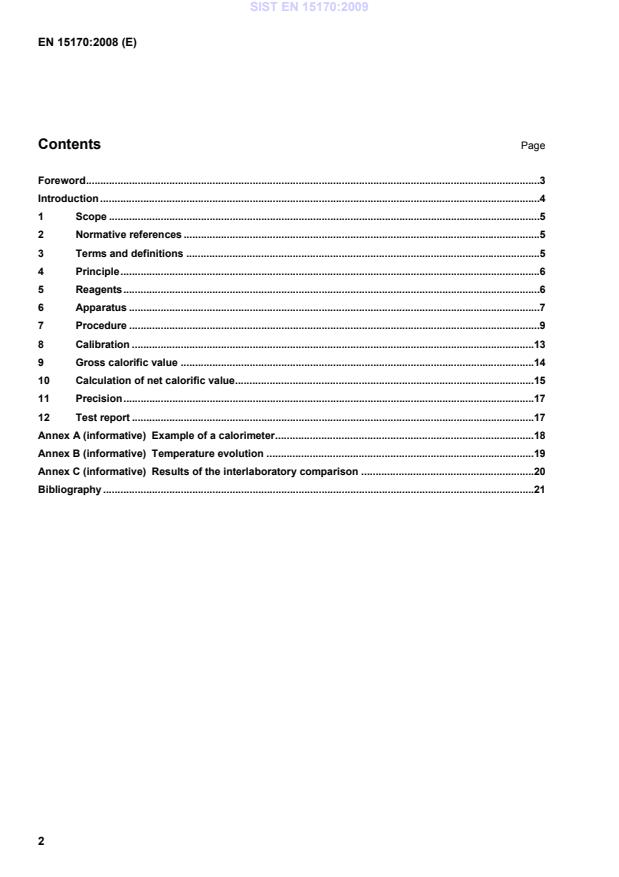
Example of a calorimeter.18 Annex B (informative)
Temperature evolution.19 Annex C (informative)
Results of the interlaboratory comparison.20 Bibliography.21
...