

SIST IEC 60364-5-51:2006
(Main)Installations électriques des bâtiments - Partie 5-51: Choix et mise en oeuvre des matériels électriques - Règles communes
General Information
- Abstract
This part of IEC 60364 deals with the selection of equipment and its erection. It provides
common rules for compliance with measures of protection for safety, requirements for proper
functioning for intended use of the installation, and requirements appropriate to the external
influences foreseen.
- Status
- Withdrawn
- Publication Date
- 31-Aug-2006
- Withdrawal Date
- 11-Oct-2020
- Technical Committee
- ELI - Electrical and communication installations
- Current Stage
- 9900 - Withdrawal (Adopted Project)
- Start Date
- 12-Oct-2020
- Due Date
- 04-Nov-2020
- Completion Date
- 12-Oct-2020

Overview
The SIST IEC 60364-5-51:2006 standard, titled Electrical installations of buildings - Part 5-51: Selection and erection of electrical equipment – Common rules, is an essential international guideline developed by the International Electrotechnical Commission (IEC). This standard focuses on the proper choice and implementation of electrical equipment in building installations. It ensures that electrical installations meet safety protection measures, operate efficiently for their intended use, and adapt appropriately to foreseeable external environmental influences.
This edition, a thorough revision of previous releases, incorporates corrections to previous errors and introduces new clauses on protective conductor currents and mitigation measures, aligning with the IEC 61140 series. The document is pivotal for electrical engineers, contractors, and specifiers seeking compliance with global best practices in building electrical installations.
Key Topics
Selection and Installation Criteria
- Equipment Suitability: Selection is based on compliance with safety protections, operational effectiveness, and environmental conditions that the equipment must withstand.
- Compliance with Standards: Equipment must conform to relevant IEC and ISO standards to assure reliability and safety.
Operational Conditions
- Voltage Rating: Equipment must be compatible with nominal voltages, considering installation system types (e.g., IT systems where phase-to-neutral voltage considerations apply).
- Current Capacity: Select equipment that carries both normal design currents and withstands abnormal currents for specific durations as protected by safety devices.
- Frequency Matching: The equipment’s rated frequency must correspond to the supply frequency.
- Power and Load Factor: Equipment capacity should consider regular load factors and operating conditions to ensure longevity and safety.
- Electromagnetic Compatibility: Equipment must avoid causing or being affected by harmful electromagnetic interference during operation.
External Influences and Environmental Adaptation
- Environmental Conditions: The standard includes detailed criteria for equipment selection reflective of external influences such as ambient temperatures (ranging from –60 °C up to +5 °C or higher based on location classifications), humidity, dust, mechanical stresses, and chemical exposure.
- Degree of Protection (IP Code): Selection based on the appropriate enclosure protection standards suitable for the installation environment.
- Mitigation of Protective Conductor Currents: New provisions for managing currents in protective conductors, reducing risks related to unexpected current flow.
- Compatibility with Other Equipment: Equipment should not adversely affect other components or power supply quality during normal and switching operations.
Identification and Marking
- Adherence to identification standards such as IEC 60073 and IEC 60446 for clear marking and wiring identification is mandatory to facilitate maintenance and safety.
Applications
SIST IEC 60364-5-51:2006 applies across a wide spectrum of building electrical installations including:
- Residential buildings where safety and reliability of electrical installations are paramount.
- Commercial and industrial buildings requiring robust electrical infrastructure.
- Special locations subject to challenging environmental conditions, such as high humidity, extreme temperatures, or risk of corrosion.
- New building projects and retrofit or maintenance work seeking to align with international safety and operational standards.
- Installations requiring precise coordination with protective equipment to ensure effective fault clearance and personnel safety.
Professionals use this standard to guide the design, installation, and verification phases ensuring installations not only comply with safety legislation but provide optimal performance and longevity of electrical systems.
Related Standards
- IEC 60364-1: Fundamental principles and general characteristics of electrical installations.
- IEC 60364-4: Protection for safety including electric shock, thermal effects, and voltage disturbances.
- IEC 60364-5-52: Specific guidelines on wiring systems selection and erection.
- IEC 60364-5-54: Requirements for earthing arrangements and protective conductors.
- IEC 61140: Protection against electric shock – relevant for the newly integrated provisions on conductor currents.
- IEC 60529: Degrees of protection provided by enclosures (IP Code).
- IEC 60068 series: Environmental testing methods essential for defining external influences.
- IEC 60446 & IEC 60073: Standards on conductor identification and marking for safe and effective installation.
By integrating these standards, SIST IEC 60364-5-51:2006 ensures comprehensive guidance for selecting and erecting electrical equipment that meets modern demands for safety, reliability, and environmental compatibility.
Keywords: SIST IEC 60364-5-51:2006, electrical installations, building electrical equipment, equipment selection, installation safety, external influences, protective conductor currents, IEC standards, electrical safety, electrical engineering standards, degree of protection, operational conditions.
Get Certified
Connect with accredited certification bodies for this standard

DIBt (Deutsches Institut für Bautechnik)
German Institute for Building Technology.
DIN CERTCO
DIN Group product certification.

Kiwa BDA Testing
Building and construction product certification.
Sponsored listings
Frequently Asked Questions
SIST IEC 60364-5-51:2006 is a standard published by the Slovenian Institute for Standardization (SIST). Its full title is "Installations électriques des bâtiments - Partie 5-51: Choix et mise en oeuvre des matériels électriques - Règles communes". This standard covers: This part of IEC 60364 deals with the selection of equipment and its erection. It provides common rules for compliance with measures of protection for safety, requirements for proper functioning for intended use of the installation, and requirements appropriate to the external influences foreseen.
This part of IEC 60364 deals with the selection of equipment and its erection. It provides common rules for compliance with measures of protection for safety, requirements for proper functioning for intended use of the installation, and requirements appropriate to the external influences foreseen.
SIST IEC 60364-5-51:2006 is classified under the following ICS (International Classification for Standards) categories: 13.260 - Protection against electric shock. Live working; 91.140.50 - Electricity supply systems. The ICS classification helps identify the subject area and facilitates finding related standards.
SIST IEC 60364-5-51:2006 is associated with the following European legislation: EU Directives/Regulations: TRRTP131. When a standard is cited in the Official Journal of the European Union, products manufactured in conformity with it benefit from a presumption of conformity with the essential requirements of the corresponding EU directive or regulation.
SIST IEC 60364-5-51:2006 is available in PDF format for immediate download after purchase. The document can be added to your cart and obtained through the secure checkout process. Digital delivery ensures instant access to the complete standard document.
Standards Content (Sample)
SLOVENSKI SIST IEC 60364-5-51:2006
STANDARD
september 2006
Električne inštalacije zgradb – 5-51. del: Izbira in namestitev električne
opreme – Splošna pravila
Electrical installations of buildings - Part 5-51: Selection and erection of electrical
equipment - Common rules
ICS 91.140.50 Referenčna številka
© Standard je založil in izdal Slovenski inštitut za standardizacijo. Razmnoževanje ali kopiranje celote ali delov tega dokumenta ni dovoljeno
NORME CEI
INTERNATIONALE
IEC
60364-5-51
INTERNATIONAL
Cinquième édition
STANDARD
Fifth edition
2005-04
Installations électriques des bâtiments –
Partie 5-51:
Choix et mise en œuvre des matériels
électriques – Règles communes
Electrical installations of buildings –
Part 5-51:
Selection and erection of electrical
equipment – Common rules
IEC 2005 Droits de reproduction réservés Copyright - all rights reserved
Aucune partie de cette publication ne peut être reproduite ni No part of this publication may be reproduced or utilized in any
utilisée sous quelque forme que ce soit et par aucun procédé, form or by any means, electronic or mechanical, including
électronique ou mécanique, y compris la photocopie et les photocopying and microfilm, without permission in writing from
microfilms, sans l'accord écrit de l'éditeur. the publisher.
International Electrotechnical Commission, 3, rue de Varembé, PO Box 131, CH-1211 Geneva 20, Switzerland
Telephone: +41 22 919 02 11 Telefax: +41 22 919 03 00 E-mail: inmail@iec.ch Web: www.iec.ch
CODE PRIX
X
PRICE CODE
Commission Electrotechnique Internationale
International Electrotechnical Commission
МеждународнаяЭлектротехническаяКомиссия
Pour prix, voir catalogue en vigueur
For price, see current catalogue
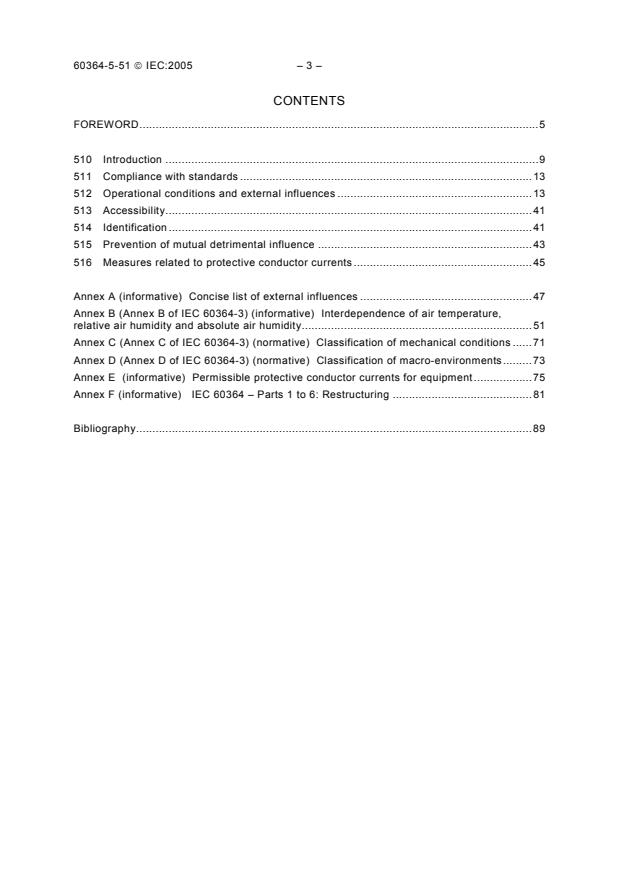
60364-5-51 IEC:2005 – 3 –
CONTENTS
FOREWORD.5
510 Introduction .9
511 Compliance with standards .13
512 Operational conditions and external influences .13
513 Accessibility.41
514 Identification .41
515 Prevention of mutual detrimental influence .43
516 Measures related to protective conductor currents .45
Annex A (informative) Concise list of external influences .47
Annex B (Annex B of IEC 60364-3) (informative) Interdependence of air temperature,
relative air humidity and absolute air humidity.51
Annex C (Annex C of IEC 60364-3) (normative) Classification of mechanical conditions .71
Annex D (Annex D of IEC 60364-3) (normative) Classification of macro-environments.73
Annex E (informative) Permissible protective conductor currents for equipment.75
Annex F (informative) IEC 60364 – Parts 1 to 6: Restructuring .81
Bibliography.89
60364-5-51 IEC:2005 – 5 –
INTERNATIONAL ELECTROTECHNICAL COMMISSION
____________
ELECTRICAL INSTALLATIONS OF BUILDINGS –
Part 5-51: Selection and erection of electrical equipment –
Common rules
FOREWORD
1) The International Electrotechnical Commission (IEC) is a worldwide organization for standardization comprising
all national electrotechnical committees (IEC National Committees). The object of IEC is to promote
international co-operation on all questions concerning standardization in the electrical and electronic fields. To
this end and in addition to other activities, IEC publishes International Standards, Technical Specifications,
Technical Reports, Publicly Available Specifications (PAS) and Guides (hereafter referred to as “IEC
Publication(s)”). Their preparation is entrusted to technical committees; any IEC National Committee interested
in the subject dealt with may participate in this preparatory work. International, governmental and non-
governmental organizations liaising with the IEC also participate in this preparation. IEC collaborates closely
with the International Organization for Standardization (ISO) in accordance with conditions determined by
agreement between the two organizations.
2) The formal decisions or agreements of IEC on technical matters express, as nearly as possible, an international
consensus of opinion on the relevant subjects since each technical committee has representation from all
interested IEC National Committees.
3) IEC Publications have the form of recommendations for international use and are accepted by IEC National
Committees in that sense. While all reasonable efforts are made to ensure that the technical content of IEC
Publications is accurate, IEC cannot be held responsible for the way in which they are used or for any
misinterpretation by any end user.
4) In order to promote international uniformity, IEC National Committees undertake to apply IEC Publications
transparently to the maximum extent possible in their national and regional publications. Any divergence
between any IEC Publication and the corresponding national or regional publication shall be clearly indicated in
the latter.
5) IEC provides no marking procedure to indicate its approval and cannot be rendered responsible for any
equipment declared to be in conformity with an IEC Publication.
6) All users should ensure that they have the latest edition of this publication.
7) No liability shall attach to IEC or its directors, employees, servants or agents including individual experts and
members of its technical committees and IEC National Committees for any personal injury, property damage or
other damage of any nature whatsoever, whether direct or indirect, or for costs (including legal fees) and
expenses arising out of the publication, use of, or reliance upon, this IEC Publication or any other IEC
Publications.
8) Attention is drawn to the Normative references cited in this publication. Use of the referenced publications is
indispensable for the correct application of this publication.
9) Attention is drawn to the possibility that some of the elements of this IEC Publication may be the subject of
patent rights. IEC shall not be held responsible for identifying any or all such patent rights.
International Standard IEC 60364-5-51 has been prepared by IEC technical committee 64:
Electrical installations and protection against electric shock.
This fifth edition of IEC 60364-5-51 cancels and replaces the fourth edition published in 2001
and constitutes a technical revision.
The document 64/1438/FDIS, circulated to National Committees as Amendment 1, led to the
publication of the new edition.
60364-5-51 IEC:2005 – 7 –
The main changes with respect to the previous edition are listed below:
− corrections of misprints in Table 51 based on Table 321 derived from the old Part 3;
− introduction of a new Clause 516 dealing with measures for mitigation of protective
conductor currents;
− introduction of an informative Annex B extracted from IEC 61140 in Annex E of this
standard. Annex B of IEC 61140 deals with protective conductor currents.
The text of this standard is based on the following documents:
FDIS Report on voting
64/1438/FDIS 64/1460/RVD
Full information on the voting for the approval of this standard can be found in the report on
voting indicated in the above table.
This publication has been drafted in accordance with the ISO/IEC Directives, Part 2.
IEC 60364 consists of the following parts, under the general title Electrical installations of
buildings:
Part 1: Fundamental principles, assessment of general characteristics, definitions
Part 2: Void
Part 3: Void
Part 4: Protection for safety
Part 5: Selection and erection of electrical equipment
Part 6: Verification
Part 7: Requirements for special installations or locations
The committee has decided that the contents of this amendment and the base publication will
remain unchanged until the maintenance result date indicated on the IEC web site under
"http://webstore.iec.ch" in the data related to the specific publication. At this date, the
publication will be
• reconfirmed,
• withdrawn,
• replaced by a revised edition, or
• amended.
60364-5-51 IEC:2005 – 9 –
ELECTRICAL INSTALLATIONS OF BUILDINGS –
Part 5-51: Selection and erection of electrical equipment –
Common rules
510 Introduction
510.1 Scope
This part of IEC 60364 deals with the selection of equipment and its erection. It provides
common rules for compliance with measures of protection for safety, requirements for proper
functioning for intended use of the installation, and requirements appropriate to the external
influences foreseen.
510.2 Normative references
The following referenced documents are indispensable for the application of this document.
For dated references, only the edition cited applies. For undated references, the latest edition
of the referenced document (including any amendments) applies.
IEC 60068-2-11:1981, Environmental testing – Part 2: Tests. Test Ka: Salt mist
IEC 60073:1996, Basic and safety principles for man-machine interface, marking and
identification – Coding principles for indication devices and actuators
IEC 60079 (all parts), Electrical apparatus for explosive gas atmospheres
IEC 60255-22-1:1988, Electrical relays – Part 22: Electrical disturbance tests for measuring
relays and protection equipment – Section 1: 1 MHz burst disturbance tests
IEC 60364-1:2001, Electrical installations of buildings – Part 1: Fundamental principles
IEC 60364-4-41:2001, Electrical installations of buildings – Part 4-41: Protection for safety –
Protection against electric shock
IEC 60364-4-42:2001, Electrical installations of buildings – Part 4-42: Protection for safety –
Protection against thermal effects
IEC 60364-4-44:2001, Electrical installations of buildings – Part 4-44: Protection for safety –
Protection against voltage disturbances and electromagnetic disturbances
IEC 60364-5-52:2001, Electrical installations of buildings − Part 5-52: Selection and erection
of electrical equipment – Wiring systems
IEC 60364-5-54, Electrical installations of buildings − Part 5-54: Selection and erection of
electrical equipment – Earthing arrangements and protective conductors and protective
bonding conductors
IEC 60446:1999, Basic and safety principles for man-machine interface, marking and
identification – Identification of conductors by colours or numerals
IEC 60447:1993, Man-machine interface (MMI) – Actuating principles
60364-5-51 IEC:2005 – 11 –
IEC 60529:1989, Degrees of protection provided by enclosures (IP Code)
IEC 60617-DB:2001 , Graphical symbols for diagrams
IEC 60707:1999, Flammability of solid non-metallic materials when exposed to flame sources –
List of test methods
IEC 60721-3-0:1984, Classification of environmental conditions – Part 3: Classification of
groups of environmental parameters and their severities – Introduction
IEC 60721-3-3:1994, Classification of environmental conditions – Part 3: Classification of
groups of environmental parameters and their severities – Section 3: Stationary use at
weather-protected locations
IEC 60721-3-4:1995, Classification of environmental conditions – Part 3: Classification of
groups of environmental parameters and their severities – Section 4: Stationary use at non-
weatherprotected locations
IEC 60884-1:2002, Plugs and socket-outlets for household and similar purposes – Part 1:
General requirements
IEC 61000-2 (all parts) Electromagnetic compatibility (EMC) – Part 2: Environment
IEC 61000-2-2:1990, Electromagnetic compatibility (EMC) – Part 2: Environment – Section 2:
Compatibility levels for low-frequency conducted disturbances and signalling in public low-
voltage power supply systems
IEC 61000-2-5:1995, Electromagnetic compatibility (EMC) – Part 2: Environment – Section 5:
Classification of electromagnetic environments. Basic EMC publication
IEC 61000-4-2:1995, Electromagnetic compatibility (EMC) – Part 4: Testing and measurement
techniques – Section 2: Electrostatic discharge immunity test. Basic EMC publication
IEC 61000-4-3:2002, Electromagnetic compatibility (EMC) – Part 4-3: Testing and measurement
techniques – Radiated, radio-frequency, electromagnetic field immunity test
IEC 61000-4-4:1995, Electromagnetic compatibility (EMC) – Part 4: Testing and measurement
techniques – Section 4: Electrical fast transient/burst immunity test. Basic EMC publication
IEC 61000-4-6:1996, Electromagnetic compatibility (EMC) – Part 4: Testing and measurement
techniques – Section 6: Immunity to conducted disturbances, induced by radio-frequency
fields
IEC 61000-4-8:1993, Electromagnetic compatibility (EMC) – Part 4: Testing and measurement
techniques – Section 8: Power frequency magnetic field immunity test. Basic EMC publication
IEC 61000-4-12:1995, Electromagnetic compatibility (EMC) – Part 4: Testing and measurement
techniques – Section 12: Oscillatory waves immunity test. Basic EMC publication
IEC 61024-1:1990, Protection of structures against lightning – Part 1: General principles
IEC 61082 (all parts), Preparation of documents used in electrotechnology
___________
“DB” refers to the IEC on-line database.
60364-5-51 IEC:2005 – 13 –
IEC 61140:2001, Protection against electric shock – Common aspects for installation and
equipment
IEC 61346-1:1996, Industrial systems, installations and equipment and industrial products –
Structuring principles and reference designations – Part 1: Basic rules
510.3 General
Every item of equipment shall be selected and erected so as to allow compliance with the
rules stated in the following clauses of this part of IEC 60364 and the relevant rules in other
parts of the IEC 60364 series.
511 Compliance with standards
511.1 Every item of equipment shall comply with such standards as are appropriate and, in
addition, with any applicable standards of the ISO.
511.2 Where there are no applicable or ISO standards, the item of equipment concerned
shall be selected by special agreement between the person specifying the installation and the
installer.
512 Operational conditions and external influences
512.1 Operational conditions
512.1.1 Voltage
Equipment shall be suitable for the nominal voltage (r.m.s. value for a.c.) of the installation.
If, in IT installations, the neutral conductor is distributed, equipment connected between
phase and neutral shall be insulated for the voltage between phases.
NOTE For certain equipment, it may be necessary to take account of the highest and/or lowest voltage likely to
occur in normal service.
512.1.2 Current
Equipment shall be selected for the design current (r.m.s. value for a.c.) which it has to carry
in normal service.
Equipment shall also be capable of carrying the currents likely to flow in abnormal conditions
for such periods of time as are determined by the characteristics of the protective devices.
512.1.3 Frequency
If frequency has an influence on the characteristics of equipment, the rated frequency of the
equipment shall correspond to the frequency of the current in the circuit concerned.
512.1.4 Power
Equipment selected for its power characteristics shall be suitable for the normal operational
conditions taking account of the load factor.
60364-5-51 IEC:2005 – 15 –
512.1.5 Compatibility
Unless other suitable precautions are taken during erection, all equipment shall be selected
so that it will not cause harmful effects on other equipment nor impair the supply during
normal service, including switching operations.
512.2 External influences
512.2.1 Electrical equipment shall be selected and erected in accordance with the
requirements of Table 51A, which indicates the characteristics of equipment necessary
according to the external influences to which the equipment may be subjected.
Equipment characteristics shall be determined either by a degree of protection or by
conformity to tests.
512.2.2 If the equipment does not, by its construction, have the characteristics relevant to
the external influences of its location, it may nevertheless be used on condition that it is
provided with appropriate additional protection in the erection of the installation. Such
protection shall not adversely affect the operation of the equipment thus protected.
512.2.3 When different external influences occur simultaneously, they may have
independent or mutual effect and the degree of protection shall be provided accordingly.
512.2.4 The selection of equipment according to external influences is necessary not only
for proper functioning, but also to ensure the reliability of the measures of protection for
safety complying with the rules of IEC 60364 generally. Measures of protection afforded by
the construction of equipment are valid only for the given conditions of external influence if
the corresponding equipment specification tests are made in these conditions of external
influence.
NOTE 1 For the purposes of this standard, the following classes of external influences are conventionally
regarded as normal:
AA Ambient temperature AA4
AB Atmospheric humidity AB4
Other environmental conditions XX1 of each parameter
(AC to AR)
Utilization and construction XX1 of each parameter, except
of buildings (B and C) XX2 for the parameter BC
NOTE 2 The word "normal" appearing in the third column of the table signifies that the equipment must generally
satisfy applicable IEC standards.
60364-5-51 IEC:2005 – 17 –
Table 51A – Characteristics of external influences
Code External influences Characteristics required Reference
for selection and
erection of equipment
A Environmental conditions
AA Ambient temperature
The ambient temperature is that of the ambient
air where the equipment is to be installed
It is assumed that the ambient temperature
includes the effects of other equipment
installed in the same location
The ambient temperature to be considered for
the equipment is the temperature at the place
where the equipment is to be installed resulting
from the influence of all other equipment in the
same location, when operating, not taking into
account the thermal contribution of the
equipment to be installed
Lower and upper limits of ranges of ambient
temperature:
AA1 –60 °C +5 °C
Includes temperature range
of IEC 60721-3-3, class 3K8,
with high air temperature
restricted to +5 °C. Part of
temperature range of
IEC 60721-3-4, class 4K4,
with low air temperature
restricted to –60 °C and high
air temperature restricted
to +5 °C
Part of temperature range of
AA2 –40 °C +5 °C
IEC 60721-3-3, class 3K7,
with high air temperature
restricted to +5 °C. Includes
part of temperature range
of IEC 60721-3-4, class 4K3,
Specially designed with high air temperature
equipment or appropriate restricted to +5 °C
a
arrangements
Part of temperature range
AA3 –25 °C +5 °C
of IEC 60721-3-3, class 3K6,
with high air temperature
restricted to +5 °C. Includes
temperature range
of IEC 60721-3-4, class 4K1,
with high air temperature
restricted to +5 °C
AA4 –5 °C +40 °C Normal (in certain cases Part of the temperature range
special precautions may of IEC 60721-3-3, class 3K5,
be necessary) with the high air
temperatures restricted
to +40 °C
AA5 +5°C +40 °C Normal Identical to temperature
range of IEC 60721-3-3,
class 3K3
a
May necessitate certain supplementary precautions (e.g. special lubrication).
b
This means that ordinary equipment will operate safely under the described external influences.
c
This means that special arrangements should be made, for example, between the designer of the installation
and the equipment manufacturer, e.g. for specially designed equipment.
60364-5-51 IEC:2005 – 19 –
Table 51A (continued)
Code External influences Characteristics required for Reference
selection and erection of
equipment
AA6 +5 °C +60 °C Specially designed equipment Part of temperature range
a
of IEC 60721-3-3,
or appropriate arrangements
class 3K7, with low air
temperature restricted
to +5 °C and high air
temperature restricted
to +60 °C. Includes
temperature range
of IEC 60721-3-4, class
4K4 with low air tempera-
ture restricted to +5 °C
AA7 Specially designed equipment – Identical with temperature
–25 °C +55 °C
a
range of IEC 60721-3-3,
or appropriate arrangements
class 3K6
AA8 – Identical with temperature
–50 °C +40 °C
range of IEC 60721-3-4,
class 4K3
Ambient temperature classes are applicable
only where humidity has no influence
The average temperature over a 24 h
period must not exceed 5 °C below the
upper limits
Combination of two ranges to define some
environments may be necessary.
Installations subject to temperatures
outside the ranges require special
consideration
AB Atmospheric humidity
Air Relative Absolute
temperature humidity humidity
°C %
g/m
a) low c) low
e) low
b) high d) high
f) high
AB1 –60 +5 3 100 0,003 7 Indoor and outdoor locations Includes temperature range
with extremely low ambient of IEC 60721-3-3,
temperatures class 3K8, with high air
temperature restricted
to +5 °C. Part of tempera-
Appropriate arrangements shall
ture range of IEC 60721-3-
c
be made 4, class 4K4, with low air
temperature restricted to –
60 °C and high air
temperature restricted
to +5 °C
AB2 –40 +5 10 100 0,1 7 Indoor and outdoor locations Part of temperature range
with low ambient temperatures of IEC 60721-3-3,
class 3K7, with high
Appropriate arrangements shall
temperature restricted
c
be made
to +5 °C. Part of
temperature range
of IEC 60721-3-4, class
4K4, with low air
temperature restricted to –
60 °C and high air
temperature restricted
to +5 °C
a
May necessitate certain supplementary precautions (e.g. special lubrication).
b
This means that ordinary equipment will operate safely under the described external influences.
c
This means that special arrangements should be made, for example, between the designer of the installation and
the equipment manufacturer, e.g. for specially designed equipment.
60364-5-51 IEC:2005 – 21 –
Table 51A (continued)
External influences
Air Relative Absolute Characteristics required
Code temperature humidity humidity for selection and erection Reference
°C % of equipment
g/m
Low high low high low high
AB3 -25 +5 10 100 0,5 7 Indoor and outdoor locations Part of temperature range
with low ambient of IEC 60721-3-3, class 3K6,
temperatures with high air temperature
restricted to +5 °C. Includes
Appropriate arrangements
temperature range
c
shall be made
of IEC 60721-3-4, class 4K1,
with high air temperature range
restricted to +5 °C
AB4 -5 +40 5 95 1 29
Weather protected locations Identical with temperature
having neither temperature range of IEC 60721-3-3,
nor humidity control. Heating class 3K5. The high air
may be used to raise low temperature restricted to
ambient temperatures +40 °C
b
Normal
AB5 +5 +40 5 85 1 25 Weather protected locations Identical with temperature
with temperature control range of IEC 60721-3-3,
class 3K3
b
Normal
AB6 +5 +60 10 100 1 35 Indoor and outdoor locations Part of temperature range
with extremely high ambient of IEC 60721-3-3, class 3K7,
temperatures, influence of with low air temperature
cold ambient temperatures restricted to +5 °C and high air
is prevented. Occurrence of temperature restricted
solar and heat radiation to +60 °C. Includes temperature
range of IEC 60721-3-4, class
Appropriate arrangements
4K4, with low air temperature
c
shall be made
restricted to +5 °C
AB7 -25 +55 10 100 0,5 29 Indoor weather-protected Identical with temperature
locations having neither range of IEC 60721-3-3,
temperature nor humidity class 3K6
control; the locations may
have openings directly to the
open air and be subjected to
solar radiation
Appropriate arrangements
c
shall be made
AB8 -50 +40 15 100 0,04 36 Outdoor and non-weather Identical with temperature
protected locations, with low range of IEC 60721-3-4, class
and high temperatures 4K3
Appropriate arrangements
c
shall be made
a
May necessitate certain supplementary precautions (e.g. special lubrication).
b
This means that ordinary equipment will operate safely under the described external influences.
c
This means that special arrangements need to be made, for example, between the designer of the installation
and the equipment manufacturer, e.g. for specially designed equipment.
NOTE 1 All specified values are maximum or limit values which will have a low possibility of being exceeded.
NOTE 2 The low and high relative humidities are limited by the low and high absolute humidities, so that e.g. for
environmental parameters a and c, or b and d, the limit values given do not occur simultaneously. Therefore, Annex B
contains climatograms which describes the interdependence of air temperature, relative humidity and absolute humidity
for the climatic classes specified.
60364-5-51 IEC:2005 – 23 –
Table 51A (continued)
Code External influences Characteristics required for selection Reference
and erection of equipment
AC Altitude
b
AC1
≤2 000 m Normal
May necessitate special precautions such as the
AC2 >2 000 m
application of derating factors
For some equipment special arrangements may be
necessary at altitudes of 1 000 m and above
AD Presence of water
AD1 Negligible Probability of presence of water is negligible IEC 60721-3-4, class 4Z6
Location in which the walls do not generally show
traces of water but may do so for short periods, for
example in the form of vapour which good ventilation
dries rapidly
IEC 60529
IPX0
AD2 Free-falling drops Possibility of vertically falling drops IEC 60721-3-3, class 3Z7
Location in which water vapour occasionally condenses
as drops or where steam may occasionally be present
IPX1 or IPX2 IEC 60529
AD3 Sprays Possibility of water falling as a spray at an angle up to IEC 60721-3-3, class 3Z8
60° from the vertical
IEC 60721-3-4, class 4Z7
Locations in which sprayed water forms a continuous
film on floors and/or walls
IPX3 IEC 60529
AD4 Splashes Possibility of splashes from any direction IEC 60721-3-3, class 3Z9
Locations where equipment may be subjected to IEC 60721-3-4, class 4Z7
splashed water; this applies, for example, to certain
external luminaires, construction site equipment
IPX4 IEC 60529
AD5 Jets Possibility of jets of water from any direction IEC 60721-3-3, class
3Z10
Locations where hot water is used regularly (yards,
car-washing bays) IEC 60721-3-4, class 4Z8
IPX5
IEC 60529
AD6 Waves Possibility of water waves IEC 60721-3-4, class 4Z9
Seashore locations such as piers, beaches, quays, etc.
IPX6 IEC 60529
AD7 Immersion Possibility of intermittent partial or total covering by
water
Locations which may be flooded and/or where the
equipment is immersed as follows:
• Equipment with a height of less than 850 mm is
located in such a way that its lowest point is not
more than 1 000 mm below the surface of the water
• Equipment with a height equal to or greater than
850 mm is located in such a way that its highest
point is not more than 150 mm below the surface of
the water
IEC 60529
IPX7
AD8 Submersion Possibility of permanent and total covering by water
Locations such as swimming pools where electrical
equipment is permanently and totally covered with
water under a pressure greater than 10 kPa.
IPX8 IEC 60529
a
May necessitate certain supplementary precautions (e.g. special lubrication).
b
This means that ordinary equipment will operate safely under the described external influences.
c
This means that special arrangements need to be made, for example, between the designer of the installation
and the equipment manufacturer, e.g. for specially designed equipment.
60364-5-51 IEC:2005 – 25 –
Table 51A (continued)
Code External Characteristics required for selection and erection of Reference
influences equipment
AE Presence of foreign solid bodies or dust
AE1 Negligible The quantity or nature of dust or foreign solid bodies is not IEC 60721-3-3, class 3S1
significant IEC 60721-3-4, class 4S1
IP0X IEC 60529
AE2 Small objects Presence of foreign solid bodies where the smallest IEC 60721-3-3, class 3S2
(2,5 mm) dimension is not less than 2,5 mm IEC 60721-3-4, class 4S2
IP3X IEC 60529
Tools and small objects are examples of foreign solid
bodies of which the smallest dimension is at least 2,5 mm
AE3 Very small objects Presence of foreign solid bodies where the smallest IEC 60721-3-3, class 3S3
(1 mm) dimension is not less than 1 mm IEC 60721-3-4, class 4S3
IP4X IEC 60529
Wires are examples of foreign solid bodies of which the
smallest dimension is not less than 1 mm
AE4 Light dust Presence of light deposits of dust: IEC 60721-3-3, class 3S2
IEC 60721-3-4, class 4S2
10 < deposit of dust ≤ 35 mg/m² a day
IEC 60529
IP5X or equipment IP6X if dust should not penetrate
equipment
AE5 Moderate dust Presence of medium deposits of dust: IEC 60721-3-3, class 3S3
IEC 60721-3-4, class 4S3
35 < deposit of dust ≤ 350 mg/m² a day
IEC 60529
IP5X or equipment IP6X if dust should not penetrate
equipment
AE6 Heavy dust Presence of large deposits of dust:
IEC 60721-3-3, class 3S4
IEC 60721-3-4, class 4S4
350 < deposit of dust ≤ 1 000 mg/m² a day
IEC 60529
IP6X
AF Presence of corrosive or polluting substances
AF1 Negligible
The quantity or nature of corrosive or polluting substances IEC 60721-3-3, class 3C1
is not significant IEC 60721-3-4, class 4C1
b
Normal
AF2 Atmospheric The presence of corrosive or polluting substances of IEC 60721-3-3, class 3C2
atmospheric origin is significant IEC 60721-3-4, class 4C2
Installations situated by the sea or near industrial zones
producing serious atmospheric pollution, such as chemical
works, cement works; this type of pollution arises
especially in the production of abrasive, insulating or
conductive dusts
According to the nature of substances (for example,
satisfaction of salt mist test according to IEC 60068-2-11)
AF3 Intermittent or Intermittent or accidental subjection to corrosive or IEC 60721-3-3, class 3C3
accidental polluting chemical substances being used or produced IEC 60721-3-4, class 4C3
Locations where some chemicals products are handled in
small quantities and where these products may come only
accidentally into contact with electrical equipment; such
conditions are found in factory laboratories, other
laboratories or in locations where hydrocarbons are used
(boiler-rooms, garages, etc.)
Protection against corrosion according to equipment
specification
AF4 Continuous Continuously subject to corrosive or polluting chemical IEC 60721-3-3, class 3C4
substances in substantial quantity, e.g. chemical works IEC 60721-3-4, class 4C4
Equipment specially designed according to the nature of
substances
b
May necessitate certain supplementary precautions (e.g. special lubrication).
b
This means that ordinary equipment will operate safely under the described external influences.
c
This means that special arrangements need to be made, for example, between the designer of the installation
and the equipment manufacturer, e.g. for specially designed equipment.
60364-5-51 IEC:2005 – 27 –
Table 51A (continued)
Code External influences Characteristics required for selection Reference
and erection of equipment
AG Mechanical shock (see Annex C)
AG1 Low severity Normal, e.g. household and similar equipment IEC 60721-3-3,
classes 3M1/3M2/3M3
IEC 60721-3-4,
classes 4M1/4M2/4M3
AG2 Medium severity Standard industrial equipment, where applicable, or IEC 60721-3-3,
reinforced protection classes 3M4/3M5/3M6
IEC 60721-3-4,
classes 4M4/4M5/4M6
AG3 High severity Reinforced protection IEC 60721-3-3,
classes 3M7/3M8
IEC 60721-3-4,
classes 4M7/4M8
AH Vibration (see Annex C)
AH1 Low severity Household and similar conditions where the effects IEC 60721-3-3,
of vibration are generally negligible classes 3M1/3M/3M3
a
IEC 60721-3-4,
Normal
classes 4M1/4M2/4M3
AH2 Medium severity Usual industrial conditions IEC 60721-3-3,
classes 3M4/3M5/3M6
Specially designed equipment or special
IEC 60721-3-4,
arrangements
classes 4M4/4M5/4M6
AH3 High severity Industrial installations subject to severe conditions IEC 60721-3-3,
classes 3M7/3M8
Specially designed equipment or special
IEC 60721-3-4,
arrangements
classes 4M7/4M8
AK Presence of flora and/or moulds growth
AK1 No hazard No harmful hazard from flora and/or mould growth. IEC 60721-3-3, class 3B1
a
IEC 60721-3-4, class 4B1
Normal
AK2 Hazard Harmful hazard from flora and/or mould growth. IEC 60721-3-3, class 3B2
IEC 60721-3-4, class 4B2
The hazard depends on local conditions and the
nature of flora. Distinction should be made between
harmful growth of vegetation or conditions for
promotion of mould growth
Special protection, such as:
– increased degree of protection (see AE)
– special materials or protective coating of
enclosures
– arrangements to exclude flora from location
a
This means that ordinary equipment will operate safely under the described external influences.
___________
NOTE In France, reference to IK code defined in IEC 62262 applies as follows :
AG Mechanical shock (see Annex C)
AG1 Low severity Environment subjected to low energy shock of 0,2 J at IEC 60721-3-3,
the most classes 3M1/3M2/3M3
IK02 IEC 60721-3-4,
Normal household installations and the like classes 4M1/4M2/4M3
Bare lamps are permitted
AG2 Medium severity Environment subjected to low energy shock of 2 J at IEC 60721-3-3,
the most classes 3M4/3M5/3M6
IK07 IEC 60721-3-4,
Standard industrial installation and the like classes 4M4/4M5/4M6
AG3 High severity Environment subjected to energy shock of 5 J at the IEC 60721-3-3,
most classes 3M7/3M8
IK08 IEC 60721-3-4,
Severe industrial installations and the like classes 4M7/4M8
AG4 Very high severity Environment subjected to energy shock of 20 J at he
most
IK10
Very severe industrial installations and the like
60364-5-51 IEC:2005 – 29 –
Table 51A (continued)
Code External influences Characteristics required for selection Reference
and erection of equipment
AL Presence of fauna
AL1 No hazard No harmful hazard from fauna IEC 60721-3-3, class 3B1
IEC 60721-3-4, class 4B1
b
Normal
AL2 Hazard Harmful hazard from fauna (insects, birds, small IEC 60721-3-3, class 3B2
animals) IEC 60721-3-4, class 4B2
The hazard depends on the nature of the fauna.
Distinction should be made between:
– presence of insects in harmful quantity or of an
aggressive nature;
– presence of small animals or birds in harmful
quantity or of an aggressive nature
Protection may include:
– an appropriate degree of protection against
penetration of foreign solid bodies (see AE);
– sufficient mechanical resistance (see AG);
– precautions to exclude fauna from the location
(such as cleanliness, use of pesticides);
– special equipment or protective coating of
enclosures
AM Electromagnetic, electrostatic, or ionising influences (See IEC 61000-2 series and IEC 61000-4 series)
Low-frequency electromagnetic phenomena (conducted or radiated)
Harmonics, interharmonics
AM1-1 Controlled level Care should be taken that the controlled situation is
not impaired
Complying with Table 1 of
Normal level
IEC 61000-2-2
AM1- Special measures in the design of the installation,
2AM1-3 e.g. filters
High level Locally higher than Table 1
of IEC 61000-2-2
Signalling voltages
AM-2-1 Controlled level Possibly: blocking circuits Lower than specified below
AM-2-2 Medium level No additional requirement IEC 61000-2-1 and
AM-2-3 High level Appropriate measures IEC 61000-2-2
Voltage amplitude variations
AM-3-1 Controlled level
AM-3-2 Normal level
Compliance with
IEC 60364-4-44
AM-4 Voltage unbalance
Compliance with
IEC 61000-2-2
AM-5 Power frequency variations ±1 Hz according to
IEC 61000-2-2
Induced low-frequency voltages
AM-6 No classification Refer to IEC 60364-4-44 ITU-T
High withstand of signal and control systems of
switchgear and controlgear
AM7 Direct current in a.c. network
No classification Measures to limit their presence in level and time in
the current-using equipment or their vicinity
a
May necessitate certain supplementary precautions (e.g. special lubrication).
b
This means that ordinary equipment will operate safely under the described external influences.
c
This means that special arrangements need to be made, for example, between the designer of the installation and
the equipment manufacturer, e.g. for specially designed equipment.
60364-5-51 IEC:2005 – 31 –
Table 51A (continued)
Code External influences Characteristics required for selection Reference
and erection of equipment
Radiated magnetic fields
b
AM-8-1 Medium level Normal Level 2
of IEC 61000-4-8
AM-8-2 High level Protection by appropriate measures e.g. screening Level 4
and/or separation of IEC 61000-4-8
Electric fields
b
AM-9-1 Negligible level Normal
AM-9-2 Medium level Refer to IEC 61000-2-5 IEC 61000-2-5
AM-9-3 High level Refer to IEC 61000-2-5
AM-9-4 Very high level Refer to IEC 61000-2-5
High-frequency electromagnetic phenomena conducted, induced or radiated (continuous or transient)
Induced oscillatory voltages or currents
b
AM-21 No classification IEC 61000-4-6
Normal
Conducted unidirectional transients of the nanosecond time scale IEC 61000-4-4
AM-22-1 Negligible level Protective measures are necessary Level 1
AM-22-2 Medium level Protective measures are necessary (see 321.10.2.2) Level 2
AM-22-3 High level Normal equipment Level 3
AM-22-4 Very high level High immunity equipment Level 4
Conducted unidirectional transients of the microsecond to the millisecond time
scale
Controlled level
Impulse withstand of equipment and overvoltage IEC 60364-4-44
AM-23-1
protective means chosen taking into account the
AM-23-2 Medium level
nominal supply voltage and the impulse withstand
AM-23-3
category according to IEC 60364-4-44 IEC 60364-4-44
High level
Conducted oscillatory transients
AM-24-1 Medium level Refer to IEC 61000-4-12 IEC 61000-4-12
AM-24-2 High level Refer to IEC 60255-22-1 IEC 60255-22-1
Radiated high-frequency phenomena IEC 61000-4-3
AM-25-1 Negligible level Level 1
b
AM-25-2 Medium level Level 2
Normal
AM-25-3 High level Reinforced level Level 3
Electrostatic discharges IEC 61000-4-2
b
AM-31-1 Small level Level 1
Normal
b
AM-31-2 Medium level Level 2
Normal
b
AM-31-3 High level Level 3
Normal
AM-31-4 Very high level Reinforced Level 4
AM-41-1 Ionization Special protection such as:
No classification – Spacings from source
– Interposition of screens, enclosure by special
materials
a
May necessitate certain supplementary precautions (e.g. special lubrication).
b
This means that ordinary equipment will operate safely under the described external influences.
c
This means that special arrangements need to be made, for example, between the designer of the installation
and the equipment manufacturer, e.g. for specially designed equipment.
60364-5-51 IEC:2005 – 33 –
Table 51A (continued)
Code External influences Characteristics required for selection Reference
and erection of equipment
AN Solar radiation
AN1 Low IEC 60721-3-3
Intensity ≤ 500 W/m²
b
Normal
AN2 Medium IEC 60721-3-3
500 W/m² < intensity ≤ 700 W/m²
c
Appropriate arrangements shall be made
AN3 High IEC 60721-3-4
700 W/m² < Intensity ≤ 1 120 W/m²
c
Appropriate arrangements shall be made
Such arrangements could be:
– material resistant to ultra-violet radiation
– special colour coating
– interposition of screens
AP Seismic effects
AP1 Negligible
Acceleration ≤ 30 Gal (1Gal = 1cm/s²)
Normal
AP2 Low severity
30 Gal < acceleration ≤ 300 Gal
Under consideration
AP3 Medium severity
300 Gal < acceleration ≤ 600 Gal
under consideration
AP4 High severity
600 Gal < acceleration
Under consideration
Vibration which may cause the destruction of the
building is outside the classification
Frequency is not taken into account in the
classification; however, if the seismic wave
resonates with the building, seismic effects must be
specially considered. In general, the frequency of
seismic acceleration is between 0 Hz and 10 Hz
AQ Lightning
AQ1 Negligible
≤ 25 days per year or result of risk assessment in
accordance with Clause 443 of IEC 60364-4-44.
Normal
AQ2 Indirect exposure
> 25 days per year or result of risk assessment in
accordance with Clause 443 of IEC 60364-4-44
Normal
AQ3 Direct exposure Hazard from exposure of equipment
If lightning protection is necessary, it shall be
arranged according to IEC 61024-1
AR Movement of air
AR1 Low Speed ≤ 1 m/s
b
Normal
AR2 Medium
1 m/s < speed ≤ 5 m/s
c
Appropriate arrangements shall be made
AR3 High
5 m/s < speed ≤ 10 m/s
c
Appropriate arrangements shall be made
a
May necessitate certain supplementary precautions (e.g. special lubrication).
b
This means that ordinary equipment will operate safely under the described external influences.
c
This means that special arrangements need to be made, for example, between the designer of the installation
and the equipment manufacturer, e.g. for specially designed equipment.
60364-5-51 IEC:2005 – 35 –
Table 51A (continued)
Code External influences Characteristics required for selection Reference
and erection of equipment
AS Wind
AS1 Low
Speed ≤ 20 m/s
b
Normal
AS2 Medium
20 m/s < speed ≤ 30 m/s
c
Appropriate arrangements shall be made
AS3 High
30 m/s < speed ≤ 50 m/s
c
Appropriate arrangements shall be made
B Utilization
BA Capability of persons
BA1 Ordinary Uninstructed persons
b
Normal
d
BA2 Children Locations intended for presence of groups of children
Nurseries
Equipment of degrees of protection higher than IP2X.
Socket outlets shall be provided with at least IP2X or
IPXXB and with increased protection according to
IEC 60884-1
Inaccessibility of equipment with external surface
temperature exceeding 80 °C (60 °C for nurseries and
the like)
BA3 Handicapped
Persons not in command of all their physical and
intellectual abilities (sick persons, old persons)
Hospitals
According to the nature of the handicap
BA4 Instructed Persons adequately advised or supervised by skilled
persons to enable them to avoid dangers which
electricity may create (operating and maintenance staff)
Electrical operating areas
BA5 Skilled Persons with technical knowledge or sufficient
experience to enable them to a
...