

SIST EN 13100-3:2026
(Main)Non destructive testing of welded joints in thermoplastics semifinished products - Part 3: Ultrasonic testing
- Abstract
This document specifies methods for the manual ultrasonic examination of heated tool, electrofusion, extrusion and hot gas joints in plastics materials. It applies to joints in single wall pipes and plates. The range of thicknesses covered is from 10 mm to 100 mm.
This document does not specify acceptance levels of the indications.
- Status
- Published
- Public Enquiry End Date
- 30-Jul-2025
- Publication Date
- 13-Sep-2026
- Technical Committee
- IPMA - Polimer materials and products
- Current Stage
- 6060 - National Implementation/Publication (Adopted Project)
- Start Date
- 04-Sep-2026
- Due Date
- 09-Nov-2026
- Completion Date
- 14-Sep-2026

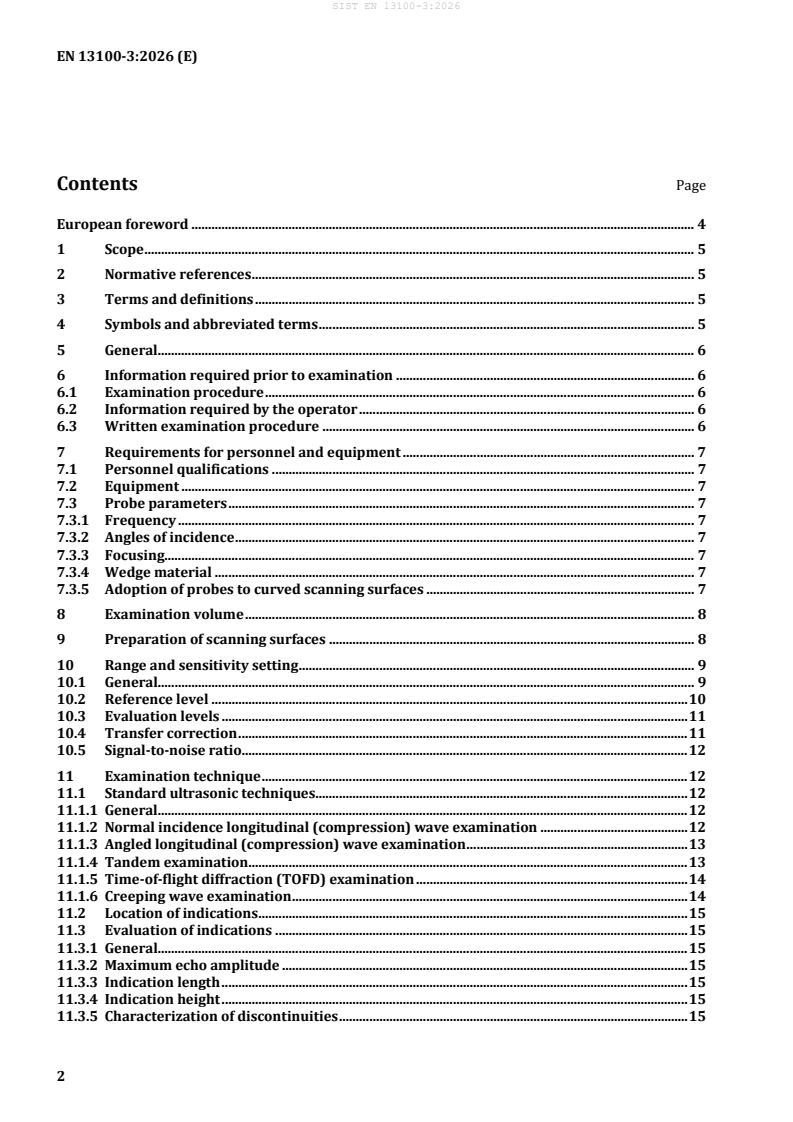
EN 13100-3:2026 is a SIST-adopted European Standard from CEN for manual ultrasonic testing of welded joints in thermoplastics semifinished products. It specifies how to examine heated tool, electrofusion, extrusion and hot gas joints in single wall pipes and plates, for thicknesses from 10 mm to 100 mm. The standard is used by NDT personnel, inspectors, manufacturers and quality staff who need a defined examination method and report format for these joints.
What does SIST EN 13100-3:2026 specify?
SIST EN 13100-3:2026 specifies the scope and method structure for manual ultrasonic examination of welded thermoplastic joints. It is organized into clauses on scope, references, terms, symbols, general requirements, pre-examination information, personnel and equipment, examination volume, surface preparation, range and sensitivity setting, examination techniques, indication evaluation, and reporting.
The document applies to joints in single wall pipes and plates, and it does not set acceptance levels for indications. In practice, that means the inspection method is standardized, but the pass/fail criteria still have to be agreed for the job.
What are the key requirements of SIST EN 13100-3:2026?
EN 13100-3:2026 sets out the examination procedure, the test setup, how to scan, how to judge indications, and what must be reported.
Before the examination
Clause 6 requires the examination procedure to state the reference level method, the evaluation method, acceptance levels, examination level, stage of manufacture or operation, personnel qualification, and whether a written procedure is needed. The operator also needs access to the joint material, joint dimensions, welding procedure information and reporting requirements. In practice, the inspection cannot start until the job is fully defined.
Personnel and equipment
Clause 7 requires personnel qualified to an appropriate level in accordance with EN ISO 9712 or a more relevant standard, with awareness of thermoplastic- and joint-specific problems. The equipment has to meet EN ISO 22232-1, EN ISO 22232-2 and EN ISO 22232-3. This matters because results depend on both operator competence and verified instruments and probes.
Probe setup and scanning conditions
The standard limits the inspection to longitudinal (compression) wave transducers, with frequencies from 1 MHz to 7,5 MHz chosen for best flaw sensitivity without losing signal-to-noise performance. Probe angles should place the beam at, or as near as possible to, normal incidence on the weld fusion face(s), and electrofusion joints use focusing probes aimed at the weld depth. The wedge-to-surface gap must stay within 0,5 mm, and curved surfaces may need adapted wedges. In practice, the probe choice is part of the test method, not a matter of operator preference.
Examination volume and surface preparation
Clause 8 requires the full weld and adjacent parent material, at least 5 mm on each side of the weld or the melt zone width, whichever is greater, to be covered. Clause 9 requires the scanning surface to be even, clean and suitable for coupling, and the couplant has to be applied consistently. This is what ensures the ultrasound reaches the joint area that matters.
Range, sensitivity and evaluation
Clause 10 requires range and sensitivity setting whenever probe type, angle, weld type, material, thickness or joint temperature changes by more than 10 °C, and checks at least every 4 h and at the end of the examination. The standard also requires agreed evaluation levels, transfer correction when the reference block material differs from the test object, and a signal-to-noise ratio at least 12 dB below the evaluation level unless the parties agree otherwise. That gives a controlled basis for comparing indications from one inspection to another.
Techniques, location and reporting
Clause 11 describes normal incidence, angled longitudinal, tandem, TOFD and creeping wave examination, and explains where each is normally used. Clauses 11.2 and 11.3 require indications to be located in a coordinate system and assessed by maximum echo amplitude, indication length, and, when agreed, indication height and discontinuity character. Clause 12 then defines the minimum report content for the object, equipment, technique, settings, results and unusual features.
What terms does SIST EN 13100-3:2026 define?
EN 13100-3:2026 uses the terminology from EN 1330-2 and EN ISO 5577, together with its own symbols and technique terms. Key items include:
- Reference level - the signal level used as the baseline for setting up and comparing indications.
- Evaluation level - the agreed threshold above which indications are assessed.
- Transfer correction - the adjustment made when the reference block and test object do not match perfectly.
- Signal-to-noise ratio - the margin between useful indication signals and background noise.
- TOFD - time-of-flight diffraction, a technique using a transmitter and receiver on opposite sides of the weld.
- t, D and a - symbols for reference block thickness, component diameter and wedge dimension in the direction of examination.
Who uses SIST EN 13100-3:2026?
EN 13100-3:2026 is used by ultrasonic testing personnel, weld inspectors, quality managers, fabrication shops and inspection authorities working with thermoplastic welds. It is relevant in plastics and piping work where heated tool, electrofusion, extrusion or hot gas joints need non-destructive examination. Buyers and contractors use it to define a repeatable inspection method and the information that must appear in the report.
What changed in SIST EN 13100-3:2026 from the previous edition?
EN 13100-3:2026 supersedes EN 13100-3:2004. The listed changes are updated referenced standards, a revised figure for the examination volume of electrofusion joints, and a new instruction to reset range and sensitivity when joint temperature changes by more than 10 °C.
Which standards are used with SIST EN 13100-3:2026?
| Standard | What it contributes |
|---|---|
| EN 1330-2 | Common NDT terminology. |
| EN ISO 5577 | Ultrasonic testing vocabulary. |
| EN ISO 9712 | Qualification and certification of NDT personnel. |
| EN ISO 16811 | Sensitivity and range setting. |
| EN ISO 16826 | Tandem examination method. |
| EN ISO 16828 | TOFD method for detection and sizing. |
| EN ISO 22232-1 | Ultrasonic instrument requirements. |
| EN ISO 22232-2 | Probe requirements. |
| EN ISO 22232-3 | Combined equipment requirements. |
| EN 13100-1, EN 13100-2, EN 13100-4 | Companion parts for visual examination, X-ray radiographic testing and high voltage testing in the same series. |
What does the SIST EN 13100-3:2026 document contain?
EN 13100-3:2026 contains the method setup for manual ultrasonic inspection, including probe selection, examination volume definition, surface preparation and sensitivity control. It includes figures for the examination volume and reference blocks, plus a formula for adapting probes to curved surfaces. The document also gives correction rules for range and sensitivity, the location and evaluation steps for indications, and a detailed report checklist for traceable inspection records.
Relations
- Effective Date
- 07-Aug-2024
Get Certified
Connect with accredited certification bodies for this standard

DIN CERTCO
DIN Group product certification.
DVS-ZERT GmbH
German welding certification society.
CARES (UK Certification Authority for Reinforcing Steels)
UK certification for reinforcing steels and construction.
Sponsored listings
Frequently Asked Questions
SIST EN 13100-3:2026 is a standard published by the Slovenian Institute for Standardization (SIST). Its full title is "Non destructive testing of welded joints in thermoplastics semifinished products - Part 3: Ultrasonic testing". This standard covers: This document specifies methods for the manual ultrasonic examination of heated tool, electrofusion, extrusion and hot gas joints in plastics materials. It applies to joints in single wall pipes and plates. The range of thicknesses covered is from 10 mm to 100 mm. This document does not specify acceptance levels of the indications.
This document specifies methods for the manual ultrasonic examination of heated tool, electrofusion, extrusion and hot gas joints in plastics materials. It applies to joints in single wall pipes and plates. The range of thicknesses covered is from 10 mm to 100 mm. This document does not specify acceptance levels of the indications.
SIST EN 13100-3:2026 is classified under the following ICS (International Classification for Standards) categories: 25.160.40 - Welded joints and welds; 83.140.01 - Rubber and plastics products in general. The ICS classification helps identify the subject area and facilitates finding related standards.
SIST EN 13100-3:2026 has the following relationships with other standards: It is inter standard links to SIST EN 13100-3:2005. Understanding these relationships helps ensure you are using the most current and applicable version of the standard.
SIST EN 13100-3:2026 is available in PDF format for immediate download after purchase. The document can be added to your cart and obtained through the secure checkout process. Digital delivery ensures instant access to the complete standard document.
Standards Content (Sample)
SLOVENSKI STANDARD
01-oktober-2026
Neporušitveno preskušanje zvarjenih spojev plastomernih polizdelkov - 3. del:
Ultrazvočno preskušanje
Non destructive testing of welded joints in thermoplastics semifinished products - Part 3:
Ultrasonic testing
Zerstörungsfreie Prüfung von Schweißverbindungen thermoplastischer Kunststoffe - Teil
3: Ultraschallprüfung
Contrôle non destructif des assemblages soudés sur produits semi-finis en
thermoplastiques - Partie 3 : Contrôle par ultrasons
Ta slovenski standard je istoveten z: EN 13100-3:2026
ICS:
25.160.40 Varjeni spoji in vari Welded joints and welds
83.140.01 Izdelki iz gume in polimernih Rubber and plastics products
materialov na splošno in general
2003-01.Slovenski inštitut za standardizacijo. Razmnoževanje celote ali delov tega standarda ni dovoljeno.
EN 13100-3
EUROPEAN STANDARD
NORME EUROPÉENNE
August 2026
EUROPÄISCHE NORM
ICS 25.160.40; 83.140.01 Supersedes EN 13100-3:2004
English Version
Non-destructive testing of welded joints in thermoplastics
semifinished products - Part 3: Ultrasonic testing
Contrôle non destructif des assemblages soudés sur Zerstörungsfreie Prüfung von Schweißverbindungen
produits semi-finis en thermoplastiques - Partie 3 : an Halbzeugen aus thermoplastischen Kunststoffen -
Contrôle par ultrasons Teil 3: Ultraschallprüfung
This European Standard was approved by CEN on 19 July 2026.
CEN members are bound to comply with the CEN/CENELEC Internal Regulations which stipulate the conditions for giving this
European Standard the status of a national standard without any alteration. Up-to-date lists and bibliographical references
concerning such national standards may be obtained on application to the CEN-CENELEC Management Centre or to any CEN
member.
This European Standard exists in three official versions (English, French, German). A version in any other language made by
translation under the responsibility of a CEN member into its own language and notified to the CEN-CENELEC Management
Centre has the same status as the official versions.
CEN members are the national standards bodies of Austria, Belgium, Bulgaria, Croatia, Cyprus, Czech Republic, Denmark, Estonia,
Finland, France, Germany, Greece, Hungary, Iceland, Ireland, Italy, Latvia, Lithuania, Luxembourg, Malta, Netherlands, Norway,
Poland, Portugal, Republic of North Macedonia, Romania, Serbia, Slovakia, Slovenia, Spain, Sweden, Switzerland, Türkiye and
United Kingdom.
EUROPEAN COMMITTEE FOR STANDARDIZATION
COMITÉ EUROPÉEN DE NORMALISATION
EUROPÄISCHES KOMITEE FÜR NORMUNG
CEN-CENELEC Management Centre: Rue de la Science 23, B-1040 Brussels
© 2026 CEN All rights of exploitation in any form and by any means reserved Ref. No. EN 13100-3:2026 E
worldwide for CEN national Members.
Contents Page
European foreword . 4
1 Scope . 5
2 Normative references . 5
3 Terms and definitions . 5
4 Symbols and abbreviated terms . 5
5 General. 6
6 Information required prior to examination . 6
6.1 Examination procedure . 6
6.2 Information required by the operator . 6
6.3 Written examination procedure . 6
7 Requirements for personnel and equipment . 7
7.1 Personnel qualifications . 7
7.2 Equipment . 7
7.3 Probe parameters . 7
7.3.1 Frequency . 7
7.3.2 Angles of incidence . 7
7.3.3 Focusing. 7
7.3.4 Wedge material . 7
7.3.5 Adoption of probes to curved scanning surfaces . 7
8 Examination volume . 8
9 Preparation of scanning surfaces . 8
10 Range and sensitivity setting . 9
10.1 General. 9
10.2 Reference level . 10
10.3 Evaluation levels . 11
10.4 Transfer correction . 11
10.5 Signal-to-noise ratio. 12
11 Examination technique . 12
11.1 Standard ultrasonic techniques. 12
11.1.1 General. 12
11.1.2 Normal incidence longitudinal (compression) wave examination . 12
11.1.3 Angled longitudinal (compression) wave examination . 13
11.1.4 Tandem examination. 13
11.1.5 Time-of-flight diffraction (TOFD) examination . 14
11.1.6 Creeping wave examination . 14
11.2 Location of indications . 15
11.3 Evaluation of indications . 15
11.3.1 General. 15
11.3.2 Maximum echo amplitude . 15
11.3.3 Indication length . 15
11.3.4 Indication height . 15
11.3.5 Characterization of discontinuities . 15
12 Examination report . 15
12.1 General . 15
12.2 Equipment . 16
12.3 Technique . 16
12.4 Results . 16
Bibliography . 18
European foreword
This document (EN 13100-3:2026) has been prepared by Technical Committee CEN/TC 249 “Plastics”,
the secretariat of which is held by SIS.
This European Standard shall be given the status of a national standard, either by publication of an
identical text or by endorsement, at the latest by February 2027, and conflicting national standards shall
be withdrawn at the latest by February 2027.
Attention is drawn to the possibility that some of the elements of this document may be the subject of
patent rights. CEN shall not be held responsible for identifying any or all such patent rights.
This document supersedes EN 13100-3:2004.
— the referenced standards have been updated, the figure showing the examination volume for
electrofusion joints has been revised and it has been specified that the setting of range and sensitivity
shall be carried out if the temperature of the joints being examined changes by more than 10 °C.
The EN 13100 series, under the general title Non-destructive testing of welded joints in thermoplastics
semi-finished products, consists of the following parts:
— Part 1: Visual examination;
— Part 2: X-ray radiographic testing;
— Part 3: Ultrasonic testing;
— Part 4: High voltage testing.
Any feedback and questions on this document should be directed to the users’ national standards body.
A complete listing of these bodies can be found on the CEN website.
According to the CEN-CENELEC Internal Regulations, the national standards organisations of the
following countries are bound to implement this European Standard: Austria, Belgium, Bulgaria, Croatia,
Cyprus, Czech Republic, Denmark, Estonia, Finland, France, Germany, Greece, Hungary, Iceland, Ireland,
Italy, Latvia, Lithuania, Luxembourg, Malta, Netherlands, Norway, Poland, Portugal, Republic of North
Macedonia, Romania, Serbia, Slovakia, Slovenia, Spain, Sweden, Switzerland, Türkiye and the United
Kingdom.
1 Scope
This document specifies methods for the manual ultrasonic examination of heated tool, electrofusion,
extrusion and hot gas joints in plastics materials. It applies to joints in single wall pipes and plates. The
range of thicknesses covered is from 10 mm to 100 mm.
This document does not specify acceptance levels of the indications.
2 Normative references
The following documents are referred to in the text in such a way that some or all of their content
constitutes requirements of this document. For dated references, only the edition cited applies. For
undated references, the latest edition of the referenced document (including any amendments) applies.
EN 1330-2, Non destructive testing — Terminology — Part 2: Terms common to the non-destructive testing
methods
EN ISO 5577, Non-destructive testing — Ultrasonic testing — Vocabulary (ISO 5577)
EN ISO 9712, Non-destructive testing — Qualification and certification of NDT personnel (ISO 9712)
EN ISO 16811, Non-destructive testing — Ultrasonic testing — Sensitivity and range setting (ISO 16811)
EN ISO 16826, Non-destructive testing — Ultrasonic testing — Testing for discontinuities perpendicular to
the surface (ISO 16826)
EN ISO 16828, Non-destructive testing — Ultrasonic testing — Time-of-flight diffraction technique for
detection and sizing of discontinuities (ISO 16828)
EN ISO 22232-1, Non-destructive testing — Characterization and verification of ultrasonic test
equipment — Part 1: Instruments (ISO 22232-1)
EN ISO 22232-2, Non-destructive testing — Characterization and verification of ultrasonic test
equipment — Part 2: Probes (ISO 22232-2)
EN ISO 22232-3, Non-destructive testing — Characterization and verification of ultrasonic test
equipment — Part 3: Combined equipment (ISO 22232-3)
3 Terms and definitions
For the purposes of this document, the terms and definitions given in EN 1330-2 and EN ISO 5577 apply.
ISO and IEC maintain terminology databases for use in standardization at the following addresses:
— ISO Online browsing platform: available at https://www.iso.org/obp/
— IEC Electropedia: available at https://www.electropedia.org/
4 Symbols and abbreviated terms
For the purposes of this document, the following symbols and abbreviated terms apply:
t thickness of reference block (mm)
D diameter of the component (mm)
a dimension of the wedge in the direction of examination (mm)
5 General
The purpose of this document is to describe general methods of ultrasonic examination for the most
commonly used welded joints in thermoplastics. The specific requirements specified by this document
cover the equipment, preparation, performance of the examination and reporting. Methods to be used for
ultrasonic assessment of indications and acceptance criteria shall be specified.
6 Information required prior to examination
6.1 Examination procedure
The following items shall be specified:
— method for setting the reference level;
— method to be used for evaluation of indications;
— acceptance levels;
— examination level;
— manufacturing and operation stage(s) at which the examination is to be carried out;
— qualification of personnel;
— whether or not a written examination procedure is required;
— requirements for written examination procedures.
6.2 Infor
...