

ASTM F1347-23
(Specification)Standard Specification for Manually Operated Fueling Hose Reels
General Information
- Abstract
ABSTRACT
This specification covers manually operated fueling hose reels for use with collapsible and noncollapsible hose. Fueling hose reels shall be of one of the following types as specified: type 1, type 2, type 3, and type 4. The hose reel shall be of a durable, rigid construction, as light in weight and compact as practicable. The reel drum may have either smoothly formed flat sides or suitable spoke ribs, so formed as not to damage the hose. Reels shall be provided with a holding brake to lock the reel in any position. The reel shall be fitted with a device for clamping the hose nozzle securely to the reel to prevent unwinding of the hose and damage to the nozzle. The reel hub discharge shall be angled to provide a smooth tangential contact of the hose with the reel drum. The reel shall have an aromatic fuels tight rotating joint between reel inlet connection and the rotating hub on the reel drum. The reel inlet connection shall be flanged, the flange being part of the rotating swivel joint. Hydrostatic tset and operating test shall be performed to meet the requirements prescribed.
SCOPE
1.1 This specification covers manually operated fueling hose reels for use with collapsible and noncollapsible hose.
1.2 The values stated in inch-pound units are to be regarded as standard. The values given in parentheses are mathematical conversions to SI units that are provided for information only and are not considered standard.
1.3 The following precautionary caveat pertains only to the test methods portion, Section 12 of this specification: This standard does not purport to address all of the safety concerns, if any, associated with its use. It is the responsibility of the user of this standard to establish appropriate safety, health, and environmental practices and determine the applicability of regulatory limitations prior to use.
1.4 This international standard was developed in accordance with internationally recognized principles on standardization established in the Decision on Principles for the Development of International Standards, Guides and Recommendations issued by the World Trade Organization Technical Barriers to Trade (TBT) Committee.
- Status
- Published
- Publication Date
- 30-Apr-2023
- Technical Committee
- F25 - Ships and Marine Technology
- Drafting Committee
- F25.07 - General Requirements
Buy Documents
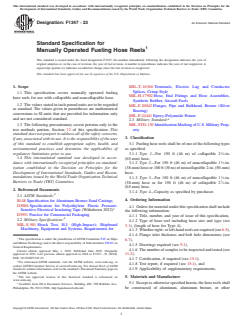
ASTM F1347-23 - Standard Specification for Manually Operated Fueling Hose Reels
REDLINE ASTM F1347-23 - Standard Specification for Manually Operated Fueling Hose Reels
Overview
ASTM F1347-23 - Standard Specification for Manually Operated Fueling Hose Reels - defines the requirements for the design, construction, testing, and marking of manually operated hose reels used for fueling with collapsible and noncollapsible hoses. Developed by ASTM International, this standard ensures durability, performance, and safety for hose reels in fueling operations. Industries such as marine, aviation, military, and bulk fuel distribution rely on compliance with ASTM F1347 to promote effective fuel handling and equipment longevity.
Key Topics
Scope and Coverage
- Applies to manually operated fuel hose reels for both collapsible and noncollapsible hoses.
- Specifies four types of hose reels based on hose capacity and design.
- Ensures compatibility with both inch-pound and SI units.
Construction and Materials
- Reels constructed from light-weight, rigid, and durable materials (e.g., aluminum, aluminum-bronze, or other nonsparking materials).
- Precautions for corrosion resistance and prevention of material incompatibility in marine environments.
- Smooth drum side or ribbed designs to prevent hose damage.
- Fitting requirements include aromatic fuels tight rotating joints and flanged inlet connections.
Safety and Performance Features
- Mandatory holding brake for securing the reel in any position.
- Nozzle clamping device to prevent hose unwinding and nozzle damage.
- Angled reel hub discharge to avoid hose kinking and maintain smooth operation.
- Hydrostatic and operational testing procedures to ensure pressure resistance and functional performance.
- Temperature operation range from -20°F to 120°F (-29°C to +49°C).
Inspection, Testing, and Marking
- Defined sampling and quality conformance processes.
- Hydrostatic and operating tests to verify strength, tightness, and functionality.
- Marking requirements include standard number, hose reel type, capacity, and hose specifications.
Applications
ASTM F1347-23 is essential wherever reliable, safe, and efficient dispensing of fuel is required via hose reels. Common applications include:
- Marine vessels: Shipboard fueling stations for transfer and refueling operations.
- Aviation: Ground fueling systems for aircraft using both collapsible and rigid hoses.
- Military: Defense applications requiring shock-tested, rugged hose reels for demanding environments, as referenced by Department of Defense.
- Fuel distribution: Industrial and commercial transfer stations where manual reel operation is preferred, including remote or hazardous areas where powered reels are not viable.
- Emergency response: Portable refueling equipment for disaster recovery and field operations.
Related Standards
Organizations implementing ASTM F1347-23 may also need to consider compliance or compatibility with related documents, including:
- ASTM B148: Specification for Aluminum-Bronze Sand Castings
- ASTM D3951: Practice for Commercial Packaging
- MIL-H-17902: Synthetic Rubber Hose, End Fittings, and Hose Assemblies for Aircraft Fuels
- MIL-S-901: Shock Test Requirements for Shipboard Machinery and Equipment
- MIL-T-16366: Terminals, Electric Lug and Conductor Splices, Crimp Style
- MIL-F-20042: Flanges, Pipe, and Bulkhead, Bronze
- MIL-P-24441: Epoxy-Polyamide Primer
- MIL-STD-130: Identification Marking of U.S. Military Property
By specifying ASTM F1347-23, users ensure that manually operated fueling hose reels deliver consistent safety, reliability, and performance in critical fuel handling operations. Adherence to this standard supports compliance with military and industry regulations, enhances operational efficiency, and reduces the risk of equipment failure in demanding environments.
Relations
- Effective Date
- 01-Oct-2023
- Effective Date
- 01-Oct-2018
- Effective Date
- 01-May-2018
- Effective Date
- 01-Dec-2015
- Effective Date
- 01-Apr-2014
- Effective Date
- 15-Aug-2010
- Effective Date
- 01-May-2010
- Effective Date
- 01-Apr-2009
- Effective Date
- 10-Apr-2003
- Effective Date
- 10-Apr-2003
- Effective Date
- 10-Mar-1999
- Effective Date
- 10-Mar-1999
- Effective Date
- 10-Nov-1998
- Effective Date
- 10-Nov-1998
- Effective Date
- 01-Jan-1997
Buy Documents
ASTM F1347-23 - Standard Specification for Manually Operated Fueling Hose Reels
REDLINE ASTM F1347-23 - Standard Specification for Manually Operated Fueling Hose Reels
Get Certified
Connect with accredited certification bodies for this standard

Institut za varilstvo d.o.o. (Welding Institute)
Slovenia's leading welding institute since 1952. ISO 3834, EN 1090, pressure equipment certification, NDT personnel, welder qualification. Only IIW Au
Sponsored listings
Frequently Asked Questions
ASTM F1347-23 is a technical specification published by ASTM International. Its full title is "Standard Specification for Manually Operated Fueling Hose Reels". This standard covers: ABSTRACT This specification covers manually operated fueling hose reels for use with collapsible and noncollapsible hose. Fueling hose reels shall be of one of the following types as specified: type 1, type 2, type 3, and type 4. The hose reel shall be of a durable, rigid construction, as light in weight and compact as practicable. The reel drum may have either smoothly formed flat sides or suitable spoke ribs, so formed as not to damage the hose. Reels shall be provided with a holding brake to lock the reel in any position. The reel shall be fitted with a device for clamping the hose nozzle securely to the reel to prevent unwinding of the hose and damage to the nozzle. The reel hub discharge shall be angled to provide a smooth tangential contact of the hose with the reel drum. The reel shall have an aromatic fuels tight rotating joint between reel inlet connection and the rotating hub on the reel drum. The reel inlet connection shall be flanged, the flange being part of the rotating swivel joint. Hydrostatic tset and operating test shall be performed to meet the requirements prescribed. SCOPE 1.1 This specification covers manually operated fueling hose reels for use with collapsible and noncollapsible hose. 1.2 The values stated in inch-pound units are to be regarded as standard. The values given in parentheses are mathematical conversions to SI units that are provided for information only and are not considered standard. 1.3 The following precautionary caveat pertains only to the test methods portion, Section 12 of this specification: This standard does not purport to address all of the safety concerns, if any, associated with its use. It is the responsibility of the user of this standard to establish appropriate safety, health, and environmental practices and determine the applicability of regulatory limitations prior to use. 1.4 This international standard was developed in accordance with internationally recognized principles on standardization established in the Decision on Principles for the Development of International Standards, Guides and Recommendations issued by the World Trade Organization Technical Barriers to Trade (TBT) Committee.
ABSTRACT This specification covers manually operated fueling hose reels for use with collapsible and noncollapsible hose. Fueling hose reels shall be of one of the following types as specified: type 1, type 2, type 3, and type 4. The hose reel shall be of a durable, rigid construction, as light in weight and compact as practicable. The reel drum may have either smoothly formed flat sides or suitable spoke ribs, so formed as not to damage the hose. Reels shall be provided with a holding brake to lock the reel in any position. The reel shall be fitted with a device for clamping the hose nozzle securely to the reel to prevent unwinding of the hose and damage to the nozzle. The reel hub discharge shall be angled to provide a smooth tangential contact of the hose with the reel drum. The reel shall have an aromatic fuels tight rotating joint between reel inlet connection and the rotating hub on the reel drum. The reel inlet connection shall be flanged, the flange being part of the rotating swivel joint. Hydrostatic tset and operating test shall be performed to meet the requirements prescribed. SCOPE 1.1 This specification covers manually operated fueling hose reels for use with collapsible and noncollapsible hose. 1.2 The values stated in inch-pound units are to be regarded as standard. The values given in parentheses are mathematical conversions to SI units that are provided for information only and are not considered standard. 1.3 The following precautionary caveat pertains only to the test methods portion, Section 12 of this specification: This standard does not purport to address all of the safety concerns, if any, associated with its use. It is the responsibility of the user of this standard to establish appropriate safety, health, and environmental practices and determine the applicability of regulatory limitations prior to use. 1.4 This international standard was developed in accordance with internationally recognized principles on standardization established in the Decision on Principles for the Development of International Standards, Guides and Recommendations issued by the World Trade Organization Technical Barriers to Trade (TBT) Committee.
ASTM F1347-23 is classified under the following ICS (International Classification for Standards) categories: 23.040.70 - Hoses and hose assemblies. The ICS classification helps identify the subject area and facilitates finding related standards.
ASTM F1347-23 has the following relationships with other standards: It is inter standard links to ASTM D3951-18(2023), ASTM B148-18, ASTM D3951-18, ASTM D3951-15, ASTM B148-14, ASTM D3951-10, ASTM D3006-10, ASTM B148-97(2009), ASTM B148-97(2003), ASTM B148-97(2003)e1, ASTM D3006-99(2004), ASTM D3006-99, ASTM D3951-98, ASTM D3951-98(2004), ASTM B148-97e1. Understanding these relationships helps ensure you are using the most current and applicable version of the standard.
ASTM F1347-23 is available in PDF format for immediate download after purchase. The document can be added to your cart and obtained through the secure checkout process. Digital delivery ensures instant access to the complete standard document.
Standards Content (Sample)
This international standard was developed in accordance with internationally recognized principles on standardization established in the Decision on Principles for the
Development of International Standards, Guides and Recommendations issued by the World Trade Organization Technical Barriers to Trade (TBT) Committee.
Designation: F1347 − 23 An American National Standard
Standard Specification for
Manually Operated Fueling Hose Reels
This standard is issued under the fixed designation F1347; the number immediately following the designation indicates the year of
original adoption or, in the case of revision, the year of last revision. A number in parentheses indicates the year of last reapproval. A
superscript epsilon (´) indicates an editorial change since the last revision or reapproval.
This standard has been approved for use by agencies of the U.S. Department of Defense.
1. Scope MIL-T-16366 Terminals, Electric Lug and Conductor
Splices, Crimp Style
1.1 This specification covers manually operated fueling
MIL-H-17902 Hose, End Fittings and Hose Assemblies,
hose reels for use with collapsible and noncollapsible hose.
Synthetic Rubber, Aircraft Fuels
1.2 The values stated in inch-pound units are to be regarded
MIL-F-20042 Flanges, Pipe and Bulkhead, Bronze (Silver
as standard. The values given in parentheses are mathematical
Brazing)
conversions to SI units that are provided for information only
MIL-P-24441 Epoxy-Polyamide Primer
and are not considered standard.
2.3 Military Standard:
1.3 The following precautionary caveat pertains only to the
MIL-STD-130 Identification Marking of U.S. Military Prop-
test methods portion, Section 12 of this specification: This erty
standard does not purport to address all of the safety concerns,
3. Classification
if any, associated with its use. It is the responsibility of the user
of this standard to establish appropriate safety, health, and
3.1 Fueling hose reels shall be of one of the following types
environmental practices and determine the applicability of
as specified:
regulatory limitations prior to use.
3.1.1 Type 1—For 150 ft (46 m) of collapsible 2 ⁄2-in.
1.4 This international standard was developed in accor-
(65-mm) hose.
dance with internationally recognized principles on standard-
3.1.2 Type 2—For 150 ft (46 m) of noncollapsible 1 ⁄2-in.
ization established in the Decision on Principles for the
(38-mm) hose or 100 ft (30 m) of noncollapsible 2-in. (50-mm)
Development of International Standards, Guides and Recom-
hose.
mendations issued by the World Trade Organization Technical
3.1.3 Type 3—For 150 ft (46 m) of noncollapsible 1 ⁄2-in.
Barriers to Trade (TBT) Committee.
(38-mm) hose or for 150 ft (46 m) of collapsible 2 ⁄2-in.
(65-mm) hose.
2. Referenced Documents
3.1.4 Type 4—Capacity as specified by purchaser.
2.1 ASTM Standards:
4. Ordering Information
B148 Specification for Aluminum-Bronze Sand Castings
D3006 Specification for Polyethylene Plastic Pressure-
4.1 Orders for material under this specification shall include
Sensitive Electrical Insulating Tape (Withdrawn 2022)
the following information:
D3951 Practice for Commercial Packaging
4.1.1 Title, number, and year of issue of this specification,
2.2 Military Specifications:
4.1.2 Type of hose reel including hose size and type (see
MIL-S-901 Shock Test, H.I. (High-Impact); Shipboard
3.1), (length of hose for Type 4),
Machinery, Equipment and Systems, Requirements for
4.1.3 Whether right- or left-hand reels are required (see 6.5),
4.1.4 Flange inlet thickness and bolt hole dimensions (see
This specification is under the jurisdiction of ASTM Committee F25 on Ships
6.7),
and Marine Technology and is the direct responsibility of Subcommittee F25.07 on
4.1.5 Drawings required (see 9.1),
General Requirements.
4.1.6 The number of samples to be inspected and tested (see
Current edition approved May 1, 2023. Published June 2023. Originally
approved in 1991. Last previous edition approved in 2018 as F1347 – 91 (2018).
11.2),
DOI: 10.1520/F1347-23.
4.1.7 Certification, if required (see 15.1),
For referenced ASTM standards, visit the ASTM website, www.astm.org, or
4.1.8 Test report, if required (see 15.1), and
contact ASTM Customer Service at service@astm.org. For Annual Book of ASTM
4.1.9 Applicability of supplementary requirements.
Standards volume information, refer to the standard’s Document Summary page on
the ASTM website.
The last approved version of this historical standard is referenced on 5. Materials and Manufacture
www.astm.org.
4 5.1 Except as otherwise specified herein, the hose reels shall
Available from DLA Document Services, Building 4/D, 700 Robbins Ave.,
Philadelphia, PA 19111-5094, http://quicksearch.dla.mil. be constructed of aluminum, aluminum bronze, or other
Copyright © ASTM International, 100 Barr Harbor Drive, PO Box C700, West Conshohocken, PA 19428-2959. United States
F1347 − 23
suitable nonsparking materials. All fittings conveying aromatic surfaces, and all such parts shall be lubricated before delivery
fuels through the hose reel shall be made of aluminum bronze with a lubricant soluble in aromatic fuels. Bearing seals shall
in accordance with Specification B148, copper alloy UNS No. be such that the pressure caused by forced lubrication will not
C95300. To prevent deterioration in sea atmosphere, aluminum bind the shaft.
parts should not contact brass or bronze; however, where such
6.2 Reel Drum—The reel drum may have either smoothly
aluminum parts come in contact with brass or bronze, they
formed flat sides or suitable spoke ribs, so formed as not to
shall be protected by adhesive-backed insulating tape, Speci-
damage the hose. The rims of the drum shall provide a good
fication D3006. All aluminum parts shall be given a coat of
grip for hand rewind.
epoxy-polyamide primer.
6.3 Holding Brake—Reels shall be provided with a holding
brake to lock the reel in any position.
6. Construction
6.4 Nozzle Clamp—The reel shall be fitted with a device for
6.1 Reel and Drum Assembly—The hose reel shall be of a
clamping the hose nozzle securely to the reel to prevent
durable, rigid construction, as light in weight and compact as
unwinding of the hose and damage to the nozzle.
practicable. The drum assembly (drum, reel sides, and its
reinforcements) shall withstand the hose pull without distortion 6.5 Reel Hub Discharge—The reel hub discharge shall be
or collapse and shall be capable of withstanding some sideways angled to provide a smooth tangential contact of the hose with
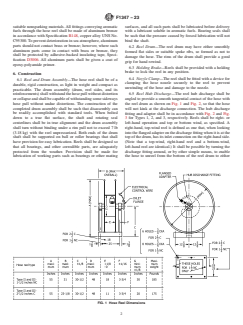
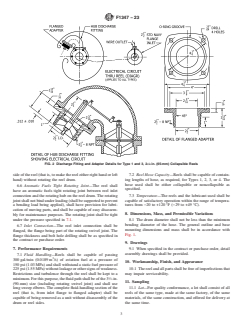
hose pull without undue distortions. The construction of the the reel drum as shown on Fig. 1 and Fig. 2, so that the hose
completed drum assembly shall be such that disassembly can
will not kink at the discharge connection. The hub discharge
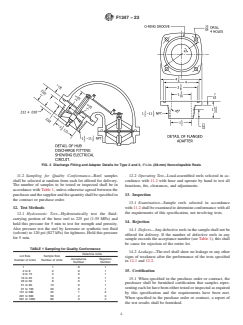
be readily accomplished with standard tools. When bolted fitting and adapter shall be in accordance with Fig. 2 and Fig.
down to a true flat surface, the shaft and rotating seal 3 for Types 1, 2, and 3, respectively. Reels shall be right- or
centerlines shall be in true alignment and the drum assembly left-hand operation and top or bottom wind, as specified. A
shall turn without binding under a rim pull not to exceed 7 lb right-hand, top-wind reel is defined as one that, when looking
(3.18 kg) with the reel unpressurized. Both ends of the drum into the flanged adapter on the discharge fitting when it is at the
shaft shall be supported on ball or roller bearings that shall top of the drum, has its inlet connection on the right-hand side.
have provision for easy lubrication. Reels shall be designed so (Note that a top-wind, right-hand reel and a bottom-wind,
that all bearings, and other corrodible parts, are adequately left-hand reel are identical.) It shall be possible by turning the
protected from the weather. Provision shall be made for discharge fitting around, or by other simple means, to enable
lubrication of working parts such as bearings or other mating the hose to unreel from the bottom of the reel drum to either
FIG. 1 Hose Reel Dimensions
F1347 − 23
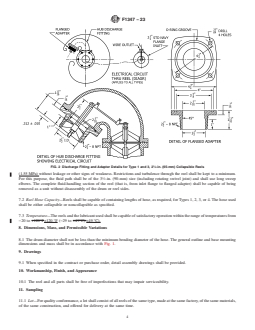
FIG. 2 Discharge Fitting and Adapter Details for Type 1 and 3, 2 ⁄2-in. (65-mm) Collapsible Reels
side of the reel (that is, to make the reel either right hand or left 7.2 Reel Hose Capacity—Reels shall be capable of contain-
hand) without rotating the reel drum. ing lengths of hose, as required, for Types 1, 2, 3, or 4. The
hose used shall be either collapsible or noncollapsible as
6.6 Aromatic Fuels Tight Rotating Joint—The reel shall
specified.
have an aromatic fuels tight rotating joint between reel inlet
connection and the rotating hub on the reel drum. The rotating 7.3 Temperature—The reels and the lubricant used shall be
joint shall not bind under loading (shall be supported to prevent capable of satisfactory operation within the range of tempera-
a bending load being applied), shall have provision for lubri- tures from −20 to +120 °F (−29 to +49 °C).
cation of moving parts, and shall be capable of easy disassem-
8. Dimensions, Mass, and Permissible Variations
bly for maintenance purposes. The rotating joint shall be tight
under the pressure specified in 7.1.
8.1 The drum diameter shall not be less than the minimum
bending diameter of the hose. The general outline and base
6.7 Inlet Connection—The reel inlet connection shall be
mounting dimensions and mass shall be in accordance with
flanged, the flange being part of the rotating swivel joint. The
Fig. 1.
flange thickness and bolt hole drilling shall be as specified in
the contract or purchase order.
9. Drawings
7. Performance Requirements
9.1 When specified in the contract or purchase order, detail
assembly drawings shall be provided.
7.1 Fluid
...
This document is not an ASTM standard and is intended only to provide the user of an ASTM standard an indication of what changes have been made to the previous version. Because
it may not be technically possible to adequately depict all changes accurately, ASTM recommends that users consult prior editions as appropriate. In all cases only the current version
of the standard as published by ASTM is to be considered the official document.
Designation: F1347 − 91 (Reapproved 2018) F1347 − 23 An American National Standard
Standard Specification for
Manually Operated Fueling Hose Reels
This standard is issued under the fixed designation F1347; the number immediately following the designation indicates the year of
original adoption or, in the case of revision, the year of last revision. A number in parentheses indicates the year of last reapproval. A
superscript epsilon (´) indicates an editorial change since the last revision or reapproval.
This standard has been approved for use by agencies of the U.S. Department of Defense.
1. Scope
1.1 This specification covers manually operated fueling hose reels for use with collapsible and noncollapsible hose.
1.2 The values stated in inch-pound units are to be regarded as standard. The values given in parentheses are mathematical
conversions to SI units that are provided for information only and are not considered standard.
1.3 The following precautionary caveat pertains only to the test methods portion, Section 1212 of this specification: This
standard does not purport to address all of the safety concerns, if any, associated with its use. It is the responsibility of the user
of this standard to establish appropriate safety, health, and environmental practices and determine the applicability of regulatory
limitations prior to use.
1.4 This international standard was developed in accordance with internationally recognized principles on standardization
established in the Decision on Principles for the Development of International Standards, Guides and Recommendations issued
by the World Trade Organization Technical Barriers to Trade (TBT) Committee.
2. Referenced Documents
2.1 ASTM Standards:
B148 Specification for Aluminum-Bronze Sand Castings
D3006 Specification for Polyethylene Plastic Pressure-Sensitive Electrical Insulating Tape (Withdrawn 2022)
D3951 Practice for Commercial Packaging
2.2 Military Specifications:
MIL-S-901 Shock Test, H.I. (High-Impact); Shipboard Machinery, Equipment and Systems, Requirements for
MIL-T-16366 Terminals, Electric Lug and Conductor Splices, Crimp Style
MIL-H-17902 Hose, End Fittings and Hose Assemblies, Synthetic Rubber, Aircraft Fuels
MIL-F-20042 Flanges, Pipe and Bulkhead, Bronze (Silver Brazing)
MIL-P-24441 Epoxy-Polyamide Primer
2.3 Military Standard:
MIL-STD-130 Identification Marking of U.S. Military Property
This specification is under the jurisdiction of ASTM Committee F25 on Ships and Marine Technology and is the direct responsibility of Subcommittee F25.07 on General
Requirements.
Current edition approved Oct. 1, 2018May 1, 2023. Published October 2018June 2023. Originally approved in 1991. Last previous edition approved in 20122018 as
F1347 – 91 (2018). (2012). DOI: 10.1520/F1347-91R18.10.1520/F1347-23.
For referenced ASTM standards, visit the ASTM website, www.astm.org, or contact ASTM Customer Service at service@astm.org. For Annual Book of ASTM Standards
volume information, refer to the standard’s Document Summary page on the ASTM website.
The last approved version of this historical standard is referenced on www.astm.org.
Available from DLA Document Services, Building 4/D, 700 Robbins Ave., Philadelphia, PA 19111-5094, http://quicksearch.dla.mil.
Copyright © ASTM International, 100 Barr Harbor Drive, PO Box C700, West Conshohocken, PA 19428-2959. United States
F1347 − 23
3. Classification
3.1 Fueling hose reels shall be of one of the following types as specified:
3.1.1 Type 1—For 150 ft (46 m) of collapsible 2 ⁄2-in. (65-mm) hose.
3.1.2 Type 2—For 150 ft (46 m) of noncollapsible 1 ⁄2-in. (38-mm) hose or 100 ft (30 m) of noncollapsible 2-in. (50-mm) hose.
1 1
3.1.3 Type 3—For 150 ft (46 m) of noncollapsible 1 ⁄2-in. (38-mm) hose or for 150 ft (46 m) of collapsible 2 ⁄2-in. (65-mm) hose.
3.1.4 Type 4—Capacity as specified by purchaser.
4. Ordering Information
4.1 Orders for material under this specification shall include the following information:
4.1.1 Title, number, and year of issue of this specification,
4.1.2 Type of hose reel including hose size and type (see 3.1), (length of hose for Type 4),
4.1.3 Whether right- or left-hand reels are required (see 6.5),
4.1.4 Flange inlet thickness and bolt hole dimensions (see 6.7),
4.1.5 Drawings required (see 9.1),
4.1.6 The number of samples to be inspected and tested (see 11.2),
4.1.7 Certification, if required (see 15.1),
4.1.8 Test report, if required (see 15.1), and
4.1.9 Applicability of supplementary requirements.
5. Materials and Manufacture
5.1 Except as otherwise specified herein, the hose reels shall be constructed of aluminum, aluminum bronze, or other suitable
nonsparking materials. All fittings conveying aromatic fuels through the hose reel shall be made of aluminum bronze in accordance
with Specification B148, copper alloy UNS No. C95300. To prevent deterioration in sea atmosphere, aluminum parts should not
contact brass or bronze; however, where such aluminum parts come in contact with brass or bronze, they shall be protected by
adhesive-backed insulating tape, Specification D3006. All aluminum parts shall be given a coat of epoxy-polyamide primer.
6. Construction
6.1 Reel and Drum Assembly—The hose reel shall be of a durable, rigid construction, as light in weight and compact as practicable.
The drum assembly (drum, reel sides, and its reinforcements) shall withstand the hose pull without distortion or collapse and shall
be capable of withstanding some sideways hose pull without undue distortions. The construction of the completed drum assembly
shall be such that disassembly can be readily accomplished with standard tools. When bolted down to a true flat surface, the shaft
and rotating seal centerlines shall be in true alignment and the drum assembly shall turn without binding under a rim pull not to
exceed 7 lb (198 kg) 7 lb (3.18 kg) with the reel unpressurized. Both ends of the drum shaft shall be supported on ball or roller
bearings that shall have provision for easy lubrication. Reels shall be designed so that all bearings, and other corrodible parts, are
adequately protected from the weather. Provision shall be made for lubrication of working parts such as bearings or other mating
surfaces, and all such parts shall be lubricated before delivery with a lubricant soluble in aromatic fuels. Bearing seals shall be such
that the pressure caused by forced lubrication will not bind the shaft.
6.2 Reel Drum—The reel drum may have either smoothly formed flat sides or suitable spoke ribs, so formed as not to damage the
hose. The rims of the drum shall provide a good grip for hand rewind.
F1347 − 23
6.3 Holding Brake—Reels shall be provided with a holding brake to lock the reel in any position.
6.4 Nozzle Clamp—The reel shall be fitted with a device for clamping the hose nozzle securely to the reel to prevent unwinding
of the hose and damage to the nozzle.
6.5 Reel Hub Discharge—The reel hub discharge shall be angled to provide a smooth tangential contact of the hose with the reel
drum as shown on Fig. 1 and Fig. 2, so that the hose will not kink at the discharge connection. The hub discharge fitting and adapter
shall be in accordance with Fig. 2 and Fig. 3 for Types 1, 2, and 3, respectively. Reels shall be right- or left-hand operation and
top or bottom wind, as specified. A right-hand, top-wind reel is defined as one that, when looking into the flanged adapter on the
discharge fitting when it is at the top of the drum, has its inlet connection on the right-hand side. (Note that a top-wind, right-hand
reel and a bottom-wind, left-hand reel are identical.) It shall be possible by turning the discharge fitting around, or by other simple
means, to enable the hose to unreel from the bottom of the reel drum to either side of the reel (that is, to make the reel either right
hand or left hand) without rotating the reel drum.
6.6 Aromatic Fuels Tight Rotating Joint—The reel shall have an aromatic fuels tight rotating joint between reel inlet connection
and the rotating hub on the reel drum. The rotating joint shall not bind under loading (shall be supported to prevent a bending load
being applied), shall have provision for lubrication of moving parts, and shall be capable of easy disassembly for maintenance
purposes. The rotating joint shall be tight under the pressure specified in 7.1.
6.7 Inlet Connection—The reel inlet connection shall be flanged, the flange being part of the rotating swivel joint. The flange
thickness and bolt hole drilling shall be as specified in the contract or purchase order.
7. Performance Requirements
7.1 Fluid Handling—Reels shall be capable of passing 300300 gal gal/min (0.0189 m⁄min (0.0189 m /s) of aviation fuel at a
pressure of 150 psi (1.03 MPa) 150 psi (1.03 MPa) and shall withstand a static fuel pressure of 225 psi (1.55 MPa) 225 psi
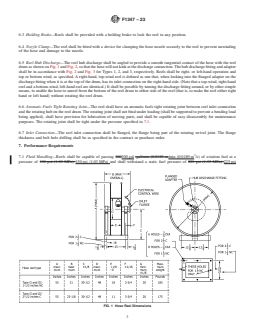
FIG. 1 Hose Reel Dimensions
F1347 − 23
FIG. 2 Discharge Fitting and Adapter Details for Type 1 and 3, 2 ⁄2-in. (65-mm) Collapsible Reels
(1.55 MPa) without leakage or other signs of weakness. Restrictions and turbulence through the reel shall be kept to a minimum.
For this purpose, the fluid path shall be of the 3 ⁄2-in. (90-mm) size (including rotating swivel joint) and shall use long sweep
elbows. The complete fluid-handling section of the reel (that is, from inlet flange to flanged adapter) shall be capable of being
removed as a unit
...