

ASTM D7465/D7465M-15(2023)
(Specification)Standard Specification for Ethylene Propylene Diene Terpolymer (EPDM) Sheet Used In Geomembrane Applications
General Information
- Abstract
SCOPE
1.1 This specification covers flexible sheet made from ethylene propylene diene terpolymer (EPDM) geomembrane intended for use in geotechnical and geoenvironmental applications. The tests and property limits used to characterize the sheet are values to ensure minimum quality for the intended use. The vulcanized rubber sheet may be non-reinforced, fabric or scrim reinforced.
1.2 In-place geomembrane design criteria, such as field seaming strength and material compatibility, among others, are factors that must be considered but are beyond the scope of this specification.
1.3 The values stated in either SI units or inch-pound units are to be regarded separately as standard. The values stated in each system are not necessarily exact equivalents; therefore, to ensure conformance with the standard, each system shall be used independently of the other, and values from the two systems shall not be combined.
1.4 This standard does not purport to address all of the safety concerns, if any, associated with its use. It is the responsibility of the user of this standard to establish appropriate safety, health, and environmental practices and determine the applicability of regulatory limitations prior to use.
1.5 This international standard was developed in accordance with internationally recognized principles on standardization established in the Decision on Principles for the Development of International Standards, Guides and Recommendations issued by the World Trade Organization Technical Barriers to Trade (TBT) Committee.
- Status
- Published
- Publication Date
- 14-Apr-2023
- Technical Committee
- D35 - Geosynthetics
- Drafting Committee
- D35.06 - Geosynthetic Specifications
Overview
ASTM D7465/D7465M-15(2023) is the international standard specification for ethylene propylene diene terpolymer (EPDM) sheets used in geomembrane applications. Developed by ASTM, this standard outlines minimum quality requirements and testing methods for EPDM geomembrane sheets, supporting their use in critical geotechnical and geoenvironmental projects. EPDM sheets addressed under this standard can be non-reinforced or reinforced with fabric or scrim, ensuring suitability for various containment and barrier applications. The standard supports global harmonization in geomembrane material selection, aligns with WTO Technical Barriers to Trade (TBT) guidelines, and is widely referenced in the construction, environmental engineering, and civil infrastructure industries.
Key Topics
- Material Specification: Defines EPDM rubber as the principal component, with minimum purity levels and quality criteria for vulcanized sheets used as geomembranes.
- Type Classification:
- Type I: Non-reinforced EPDM sheet.
- Type II: Scrim or fabric-reinforced EPDM sheet.
- Physical Property Requirements: Establishes minimum values and test methods for:
- Thickness
- Breaking and tensile strength
- Puncture and tear resistance
- Elongation and tensile set
- Brittleness point and dimensional stability
- Ozone and heat aging resistance
- Water absorption
- Weathering performance under accelerated laboratory conditions
- Testing Methods: Cites standardized ASTM test methods for assessing key properties, such as ASTM D412 for tensile strength, D4833 for puncture resistance, and D1149 for ozone resistance.
- Product Marking and Packaging: Specifies mandatory markings for traceability, including ASTM designation, type, manufacturer, and key ordering details.
- Workmanship: Requires sheets to be watertight, free from pinholes and major irregularities, and suitable for reliable seaming and installation.
Applications
EPDM geomembrane sheets manufactured and tested under ASTM D7465/D7465M-15(2023) are applied in a wide variety of geotechnical and geoenvironmental projects, including:
- Landfill Liners and Covers: Essential for restricting leachate migration and containing waste materials.
- Water Containment Structures: Used in ponds, reservoirs, irrigation canals, and decorative water features requiring robust waterproof barriers.
- Mining and Industrial Impoundments: Provides chemical-resistant, durable lining in tailings dams and containment basins.
- Environmental Remediation: Acts as barriers in capping contaminated sites or for groundwater protection.
- Secondary Containment: Employed as containment liners beneath storage tanks and chemical storage areas.
These applications benefit from the flexibility, chemical stability, and resistance to weathering and ozone degradation that EPDM offers.
Related Standards
ASTM D7465/D7465M-15(2023) references several other key ASTM standards that support comprehensive testing and consistent quality assessment of EPDM and related geomembrane materials:
- ASTM D412: Test Methods for Vulcanized Rubber and Thermoplastic Elastomers-Tension
- ASTM D471: Rubber Property-Effect of Liquids
- ASTM D573: Rubber-Deterioration in an Air Oven (Heat Aging)
- ASTM D624: Tear Strength of Conventional Vulcanized Rubber
- ASTM D751: Test Methods for Coated Fabrics
- ASTM D1149: Rubber Deterioration-Cracking in an Ozone Controlled Environment
- ASTM D4833: Index Puncture Resistance of Geomembranes
- ASTM D5884: Tearing Strength of Internally Reinforced Geomembranes
- ASTM D7004: Grab Tensile Properties of Reinforced Geomembranes
- ASTM D7635: Measurement of Thickness of Coatings Over Fabric Reinforcement
- ASTM G151 and G155: Weathering Tests Using Laboratory Light Sources
For terminology, ASTM D4439 provides definitions for geosynthetics, while ASTM D1418 covers nomenclature for rubber and latex materials.
Practical Value
Utilizing ASTM D7465/D7465M-15(2023) ensures that EPDM geomembrane sheets used in civil, environmental, and industrial projects meet consistent, internationally recognized quality benchmarks. This improves project outcomes, facilitates regulatory compliance, and enables reliable, long-term containment solutions across geotechnical markets.
Relations
- Effective Date
- 01-Feb-2024
- Effective Date
- 01-Jun-2020
- Effective Date
- 01-Apr-2020
- Effective Date
- 01-Nov-2018
- Effective Date
- 15-Apr-2018
- Effective Date
- 01-Aug-2017
- Effective Date
- 01-Sep-2015
- Effective Date
- 01-Jul-2015
- Effective Date
- 01-Mar-2014
- Effective Date
- 01-Mar-2014
- Effective Date
- 01-May-2013
- Effective Date
- 01-Oct-2011
- Effective Date
- 01-Jun-2010
- Effective Date
- 01-Apr-2010
- Effective Date
- 01-Mar-2010
Get Certified
Connect with accredited certification bodies for this standard

Control Union Certifications
Global certification for agriculture and sustainability.

DIN CERTCO
DIN Group product certification.
Hohenstein Institut
Textile testing and certification.
Sponsored listings
Frequently Asked Questions
ASTM D7465/D7465M-15(2023) is a technical specification published by ASTM International. Its full title is "Standard Specification for Ethylene Propylene Diene Terpolymer (EPDM) Sheet Used In Geomembrane Applications". This standard covers: SCOPE 1.1 This specification covers flexible sheet made from ethylene propylene diene terpolymer (EPDM) geomembrane intended for use in geotechnical and geoenvironmental applications. The tests and property limits used to characterize the sheet are values to ensure minimum quality for the intended use. The vulcanized rubber sheet may be non-reinforced, fabric or scrim reinforced. 1.2 In-place geomembrane design criteria, such as field seaming strength and material compatibility, among others, are factors that must be considered but are beyond the scope of this specification. 1.3 The values stated in either SI units or inch-pound units are to be regarded separately as standard. The values stated in each system are not necessarily exact equivalents; therefore, to ensure conformance with the standard, each system shall be used independently of the other, and values from the two systems shall not be combined. 1.4 This standard does not purport to address all of the safety concerns, if any, associated with its use. It is the responsibility of the user of this standard to establish appropriate safety, health, and environmental practices and determine the applicability of regulatory limitations prior to use. 1.5 This international standard was developed in accordance with internationally recognized principles on standardization established in the Decision on Principles for the Development of International Standards, Guides and Recommendations issued by the World Trade Organization Technical Barriers to Trade (TBT) Committee.
SCOPE 1.1 This specification covers flexible sheet made from ethylene propylene diene terpolymer (EPDM) geomembrane intended for use in geotechnical and geoenvironmental applications. The tests and property limits used to characterize the sheet are values to ensure minimum quality for the intended use. The vulcanized rubber sheet may be non-reinforced, fabric or scrim reinforced. 1.2 In-place geomembrane design criteria, such as field seaming strength and material compatibility, among others, are factors that must be considered but are beyond the scope of this specification. 1.3 The values stated in either SI units or inch-pound units are to be regarded separately as standard. The values stated in each system are not necessarily exact equivalents; therefore, to ensure conformance with the standard, each system shall be used independently of the other, and values from the two systems shall not be combined. 1.4 This standard does not purport to address all of the safety concerns, if any, associated with its use. It is the responsibility of the user of this standard to establish appropriate safety, health, and environmental practices and determine the applicability of regulatory limitations prior to use. 1.5 This international standard was developed in accordance with internationally recognized principles on standardization established in the Decision on Principles for the Development of International Standards, Guides and Recommendations issued by the World Trade Organization Technical Barriers to Trade (TBT) Committee.
ASTM D7465/D7465M-15(2023) is classified under the following ICS (International Classification for Standards) categories: 59.080.70 - Geotextiles; 83.140.10 - Films and sheets. The ICS classification helps identify the subject area and facilitates finding related standards.
ASTM D7465/D7465M-15(2023) has the following relationships with other standards: It is inter standard links to ASTM D4439-24, ASTM D4833/D4833M-07(2020), ASTM D1204-14(2020), ASTM D7635/D7635M-18, ASTM D4439-18, ASTM D4439-17, ASTM D4439-15a, ASTM D4439-15, ASTM D1204-14, ASTM D4439-14, ASTM D4833/D4833M-07(2013)e1, ASTM D4439-11, ASTM D7635/D7635M-10, ASTM G151-10, ASTM D5884-04a(2010). Understanding these relationships helps ensure you are using the most current and applicable version of the standard.
ASTM D7465/D7465M-15(2023) is available in PDF format for immediate download after purchase. The document can be added to your cart and obtained through the secure checkout process. Digital delivery ensures instant access to the complete standard document.
Standards Content (Sample)
This international standard was developed in accordance with internationally recognized principles on standardization established in the Decision on Principles for the
Development of International Standards, Guides and Recommendations issued by the World Trade Organization Technical Barriers to Trade (TBT) Committee.
Designation: D7465/D7465M − 15 (Reapproved 2023)
Standard Specification for
Ethylene Propylene Diene Terpolymer (EPDM) Sheet Used In
Geomembrane Applications
This standard is issued under the fixed designation D7465/D7465M; the number immediately following the designation indicates the
year of original adoption or, in the case of revision, the year of last revision. A number in parentheses indicates the year of last
reapproval. A superscript epsilon (´) indicates an editorial change since the last revision or reapproval.
1. Scope D412 Test Methods for Vulcanized Rubber and Thermoplas-
tic Elastomers—Tension
1.1 This specification covers flexible sheet made from
D471 Test Method for Rubber Property—Effect of Liquids
ethylene propylene diene terpolymer (EPDM) geomembrane
D518 Test Method for Rubber Deterioration—Surface
intended for use in geotechnical and geoenvironmental appli-
Cracking (Withdrawn 2007)
cations. The tests and property limits used to characterize the
D573 Test Method for Rubber—Deterioration in an Air
sheet are values to ensure minimum quality for the intended
Oven
use. The vulcanized rubber sheet may be non-reinforced, fabric
D624 Test Method for Tear Strength of Conventional Vul-
or scrim reinforced.
canized Rubber and Thermoplastic Elastomers
1.2 In-place geomembrane design criteria, such as field
D751 Test Methods for Coated Fabrics
seaming strength and material compatibility, among others, are
D1149 Test Methods for Rubber Deterioration—Cracking in
factors that must be considered but are beyond the scope of this
an Ozone Controlled Environment
specification.
D1204 Test Method for Linear Dimensional Changes of
Nonrigid Thermoplastic Sheeting or Film at Elevated
1.3 The values stated in either SI units or inch-pound units
are to be regarded separately as standard. The values stated in Temperature
D1418 Practice for Rubber and Rubber Latices—
each system are not necessarily exact equivalents; therefore, to
ensure conformance with the standard, each system shall be Nomenclature
D2137 Test Methods for Rubber Property—Brittleness Point
used independently of the other, and values from the two
systems shall not be combined. of Flexible Polymers and Coated Fabrics
D4439 Terminology for Geosynthetics
1.4 This standard does not purport to address all of the
D4833/D4833M Test Method for Index Puncture Resistance
safety concerns, if any, associated with its use. It is the
of Geomembranes and Related Products
responsibility of the user of this standard to establish appro-
D5884 Test Method for Determining Tearing Strength of
priate safety, health, and environmental practices and deter-
Internally Reinforced Geomembranes
mine the applicability of regulatory limitations prior to use.
D7004/D7004M Test Method for Grab Tensile Properties of
1.5 This international standard was developed in accor-
Reinforced Geomembranes
dance with internationally recognized principles on standard-
D7635/D7635M Test Method for Measurement of Thickness
ization established in the Decision on Principles for the
of Coatings Over Fabric Reinforcement
Development of International Standards, Guides and Recom-
G151 Practice for Exposing Nonmetallic Materials in Accel-
mendations issued by the World Trade Organization Technical
erated Test Devices that Use Laboratory Light Sources
Barriers to Trade (TBT) Committee.
G155 Practice for Operating Xenon Arc Lamp Apparatus for
2. Referenced Documents Exposure of Materials
2.1 ASTM Standards:
3. Terminology
3.1 Definitions:
This specification is under the jurisdiction of ASTM Committee D35 on
3.1.1 For definitions of other geosynthetics terms used in
Geosynthetics and is the direct responsibility of Subcommittee D35.06 on Geosyn-
this specification, refer to Terminology D4439.
thetic Specifications.
Current edition approved April 15, 2023. Published April 2023. Originally 3.1.2 composite, n—factory-laminated non-woven geotex-
approved in 2008. Last previous edition approved in 2019 as D7465/D7465M – 15
tile and EPDM.
(2019). DOI: 10.1520/D7465_D7465M-15R23.
For referenced ASTM standards, visit the ASTM website, www.astm.org, or
contact ASTM Customer Service at service@astm.org. For Annual Book of ASTM
Standards volume information, refer to the standard’s Document Summary page on The last approved version of this historical standard is referenced on
the ASTM website. www.astm.org.
Copyright © ASTM International, 100 Barr Harbor Drive, PO Box C700, West Conshohocken, PA 19428-2959. United States
D7465/D7465M − 15 (2023)
3.1.3 EPDM, n—terpolymer of ethylene, propylene, and polymer used in the sheet and shall be greater than 95 % of the
diene with the residual unsaturated portion of the diene in the total polymer content.
side chain. D1418
5.2 To make seams and repairs, the sheet shall be capable of
being bonded watertight to itself and the supplier or fabricator
4. Classification
shall recommend suitable methods.
4.1 Types describe the sheet construction:
6. Physical Properties and Requirements
4.1.1 Type I—Non-reinforced.
6.1 The sheet shall conform to the physical requirements
4.1.2 Type II—Scrim (or fabric) internally reinforced.
prescribed in Table 1.
5. Materials and Manufacture
6.2 The tolerance for time conditions (aging, weathering,
5.1 The sheet shall be formulated from EPDM polymers and and so forth) is 615 min or 61 % of the period, whichever is
other compounding ingredients. EPDM shall be the principal greater, unless otherwise specified.
TABLE 1 Physical Requirements for EPDM Sheet
Nominal Sheet
Property ASTM Type I Type II
Thickness
Thickness, min, mm [in.]:
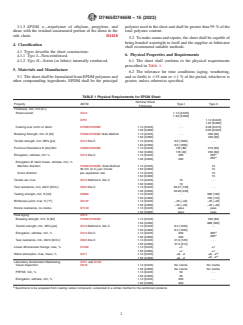
Sheet-overall D412 1.14 [0.045]
1.52 [0.060]
D751 1.14 [0.045]
1.52 [0.060]
Coating over scrim or fabric D7635/D7635M 1.14 [0.045] . . . 0.38 [0.015]
1.52 [0.060] 0.59 [0.022]
Breaking Strength, min, N [lbf] D7004/D7004M Grab Method 1.14 [0.045] . . . 400 [90]
1.52 [0.060] 400 [90]
Tensile strength, min, MPa [psi] D412 Die C 1.14 [0.045] 9.0 [1305] . . .
1.52 [0.060] 9.0 [1305]
Puncture Resistance N [lbs] Min. D4833/D4833M 1.14 [0.045] 133 [30] 270 [60]
1.52 [0.060] 178 [40] 350 [80]
A
Elongation, ultimate, min % D412 Die C 1.14 [0.045] 300 250
A
1.52 [0.060] 300
Elongation @ fabric break, ultimate, min, %
Machine direction D7004/D7004M, Grab Method, 1.14 [0.045] 15
50 mm [2 in.] per minute 1.52 [0.060] 15
Cross direction jaw separation rate 1.14 [0.045] 15
1.52 [0.060] 15
Tensile set, max D412 Method A, Die C 1.14 [0.045] 10 . . .
1.52 [0.060] 10
Tear resistance, min, kN/m [lbf/in.] D624 Die C 1.14 [0.045] 26.27 [150] . . .
1.52 [0.060] 40.28 [230]
Tearing strength, min, N [lbf] D5884 1.14 [0.045] . . . 580 [130]
1.52 [0.060] 750 [170]
Brittleness point, max °C [°F] D2137 1.14 [0.045] –45 [–49] –45 [–49]
1.52 [0.060] –45 [–49] –45 [–49]
Ozone resistance, no cracks D1149 1.14 [0.045] pass pass
1.52 [0.060] pass pass
Heat Aging: D573
Breaking strength, min, N [lbf] D7004/D7004M 1.14 [0.045] 356 [80]
1.52 [0.060] 888 [200]
Tensile strength, min, MPa [psi] D412 Method A, Die C 1.14 [0.045] 8.3 [1205] . . .
1.52 [0.060] 8.3 [1205]
A
Elongation, ultimate, min, % D412 Die C 1.14 [0.045] 200 200
A
1.52 [0.060] 200
Tear resistance, min, kN/m [lbf/in.] D624 Die C 1.14 {0.045] 21.9 [125] . . .
1.52 [0.060] 37.3 [213]
Linear dimensional change, max, % D1204 1.14 [0.045] ±1 ±1
1.52 [0.060] ±1 ±1
A
Water absorption, max, mass, % D471 1.14 [0.045] ±8, –2 ±8, –2
A
±8, –2
1.52 [0.060] ±8, –2
Laboratory Accelerated Weathering: G151 and G155
Visual Inspection D518 1.14 [0.045] No cracks No cracks
1.52 [0.060] No cracks No cracks
PRFSE, min, % 1.14 [0.045] 30 . . .
1.52 [0.060] 30
Elongation, ultimate, min, % 1.14 [0.045] 200 . . .
1.52 [0.060] 200
A
Specimens to be prepared from coating rubber compound, vulcanized in a similar method to the reinforced products.
D7465/D7465M − 15 (2023)
6.3 Tolerances for temperature shall be 62 °C [64 °F]. [3 in.] diameter mandrel for 166 6 1.66 h exposure. The
required specimen width is 25 mm [1 in.].
7. Dimensions
9.14 Heat Aging—Test Method D573. Age sheet at 116 6
2 °C [240 6 4 °F] for 670 6 6.7 h. Specimens are then cut
7.1 The width and length of the sheet shall be agreed upon
from the aged sheet for testing of breaking strength, tensile
between the purchaser and the supplier.
strength, elongation, and tear resistance.
7.1.1 The width and length tolerance shall be +3 %, –0 %.
9.15 Linear Dimensional Change—Test Method D1204.
7.2 The thickness tolerance shall be +15 %, –10 % of the
thickness agreed upon between the purchaser and supplier, but
9.16 Water Absorption—Test Method D471, at 70 6 2 °C
in no case shall the thickness be less than the minimum listed
[158 6 4 °F] for 166 6 1.66 h.
in Table 1.
9.17 Laboratory-Accelerated Weathering—Accelerated
weathering tests shall be performed in accordance with Prac-
8. Workmanship, Finish, and Appearance
tices G151 and G155. These tests are performed on the intact
8.1 The sheet, including the full width of factory seams if sheet with the weathering side facing the lamps.
...