

prEN 18389
(Main)Bitumens and bituminous binders - Complementary Performance-related Specification Framework
- Abstract
This document specifies a framework of additional characteristics and associated test methods for bitumens and bituminous binders, which is complementary to other product standards for bitumens and bituminous binders. This document is applicable to bitumens and bituminous binders suitable for use in paving applications, but it is also applicable for other uses such as waterproofing membranes.
With regard to paving applications, the following characteristics are addressed:
- resistance to permanent deformation (rutting);
- resistance to low-temperature cracking;
- resistance to ravelling;
- resistance to fatigue cracking;
- temperature susceptibility;
- equi-stiffness temperature and phase angle;
- durability (evolution of equi-stiffness temperature and phase angle);
- mixing and handling characteristics (paving and compaction) temperatures;
- additional characteristics (e.g. solubility, elastic recovery and storage stability).
Not all the properties and characteristics established in the framework are universally relevant to all binders. For example, elastic recovery is not relevant for unmodified binders.
- Status
- Not Published
- Publication Date
- 07-Dec-2027
- Technical Committee
- CEN/TC 336 - Bituminous binders
- Drafting Committee
- CEN/TC 336/WG 1 - Bituminous binders for paving
- Current Stage
- 4020 - Submission to enquiry - Enquiry
- Start Date
- 13-Aug-2026
- Due Date
- 26-Aug-2026
- Completion Date
- 13-Aug-2026

prEN 18389 is a CEN draft European Standard for bitumens and bituminous binders. It sets a complementary framework of additional performance characteristics and associated test methods for binders used in paving applications and also in other uses such as waterproofing membranes. For suppliers, laboratories and specifiers, it provides a common way to describe binder performance in terms such as rutting resistance, low-temperature cracking, fatigue, durability, handling temperatures and other quality properties.
What does prEN 18389 specify?
prEN 18389 specifies a framework of additional characteristics, test methods and performance classes for bitumens and bituminous binders. It is intended to sit alongside other product standards, not replace them.
The standard applies to binders suitable for paving applications, while also covering other uses such as waterproofing membranes. Clause 1 lists the performance topics the framework addresses, and Annex A explains how to use the tables and choose classes in practice.
| Annex | What it covers |
|---|---|
| Annex A | Guidance on using the tables, selecting classes of performance, and reporting results |
The structure is practical: the early clauses cover scope, references, terms, abbreviations, sampling and sample preparation, then Clause 6 gives the characteristics, ageing conditions, test methods, precision and performance tables.
What are the key requirements of prEN 18389?
prEN 18389 builds its specification around selected performance properties, ageing procedures and class tables. In practice, this means the user does not just name a binder type - they choose the relevant performance characteristics and report them in the framework given by the standard.
Sampling and sample preparation
Clause 5 requires laboratory samples of bulk products to be taken in accordance with EN 58, and test samples to be prepared in accordance with EN 12594. This matters because the performance classes only make sense if the sample truly represents the binder being assessed.
Ageing conditions
Clauses 6.2 and 6.3 distinguish short-term and long-term ageing. Short-term ageing uses rolling thin film oven test (RTFOT) conditioning in accordance with EN 12607-1, while some soft binders use thin film oven test (TFOT) conditioning in accordance with EN 12607-2.
Long-term ageing uses RTFOT or TFOT followed by pressure ageing vessel (PAV) conditioning in accordance with EN 14769. The PAV conditions are fixed at 100 °C, 2.1 MPa and 20 h ± 10 min. In practice, this is how the standard simulates service-related ageing before several of the performance tests are read.
Performance framework and classes
Clause 6.4.1 says characteristics and test methods are selected from Tables 1 to 8, and results are compared with the classes or thresholds in those tables unless a declared value (DV) or not required (NR) is used. This is important for specification writing: the document is a framework, so the user chooses the relevant properties rather than applying every table to every binder.
Resistance to permanent deformation
Clause 6.4.2 and Table 1 describe rutting-related performance using percentage recovery and non-recoverable compliance at a stress level of 3.2 kPa. The test temperature is selected between 40 °C and 80 °C according to regional conditions and intended use. In practice, this lets users match the binder specification to the climate and loading expected in service.
Low-temperature cracking, ravelling and fatigue cracking
Clause 6.4.3 and Table 2 use critical stiffness temperature, critical m-value temperature and ΔTc for low-temperature cracking. Clause 6.4.4 and Table 3 use total cohesion energy and elongation to break for ravelling resistance. Clause 6.4.5 and Table 4 use viscous-elastic transition temperature Tcross at 1.59 Hz for fatigue cracking, while Clause 6.4.6 uses crossover modulus for temperature susceptibility.
These properties matter because they describe how the binder behaves when it becomes cold, when the asphalt surface can lose particles, and when repeated loading can damage the pavement. Annex A notes that ΔTc needs careful calculation and reporting, especially for polymer-modified bitumens.
Equi-stiffness temperature and durability
Clause 6.4.7 and Tables 5 and 6 use equi-stiffness temperatures, phase angle values and their changes after ageing. The measurements are made at 1.59 Hz, with Table 5 using values for |G*| = 5 MPa and 15 kPa, and Table 6 expressing durability as the changes between short- and long-term aged states.
In practice, this gives specifiers a way to compare how much binder stiffness and elastic response evolve with ageing. That helps when the project needs a binder that stays stable over time.
Mixing, handling and additional characteristics
Clause 6.4.8 and Table 7 set mixing, paving and compaction temperatures through viscosity targets. The table also notes a safety upper limit of 190 °C for handling. Clause 6.4.9 and Table 8 cover solubility, flash point, elastic recovery after short-term ageing, and storage stability.
These are the checks that affect production and day-to-day use: whether the binder is sufficiently pure, safely handled, flexible after ageing, and stable in storage. For polymer-modified binders, storage stability is especially important because phase separation can affect uniformity.
Precision and disputes
Clause 6.5 says the test methods include precision statements when available, and that EN ISO 4259-2 is used to interpret results in case of dispute. That means measured values are not read in isolation - they are judged using the precision rules attached to the method.
What terms does prEN 18389 define?
prEN 18389 uses the terms and definitions of EN 12597, and Clause 4 adds the abbreviations used in the tables.
- Declared Value (DV) - a value supplied by the manufacturer or supplier and used as the declared basis for a characteristic.
- Not Required (NR) - a characteristic that is not applicable to a binder type or is not selected for a particular specification.
- Short-term ageing - ageing used in Tables 1 to 6 and Table 8, normally by RTFOT, with TFOT used for some soft binders.
- Long-term ageing - ageing that combines RTFOT or TFOT with PAV conditioning.
- Tcross - the viscous-elastic transition temperature, also called the crossover temperature, where phase angle is 45° and storage and loss moduli are equal.
- Equi-stiffness temperature - the temperature at which the binder reaches a specified complex shear modulus, used together with phase angle to describe stiffness and elastic response.
Who uses prEN 18389?
prEN 18389 is used by binder producers, laboratories, specifiers, quality managers and purchasers who need to describe or compare binder performance. It is also relevant to road construction and waterproofing applications where binder behaviour affects durability, handling and in-service performance.
For a manufacturer, the standard helps define product declarations and test reporting. For a laboratory, it tells which ageing conditions, test methods and temperatures to use. For a buyer or specifier, it gives a framework for writing an application document that selects the properties needed for a specific project or binder family.
Which standards are used with prEN 18389?
Clause 2 relies on several standards for sampling, preparation, terminology, ageing, rheology and precision:
- EN 58 - sampling of bituminous binders.
- EN 12594 - preparation of test samples.
- EN 12597 - terminology used for the terms and definitions.
- EN 12607-1 - RTFOT conditioning for short-term and some long-term ageing.
- EN 12607-2 - TFOT conditioning for some soft binders.
- EN 14769 - PAV conditioning for long-term ageing.
- EN 14770 - DSR measurement of complex shear modulus and phase angle.
- EN 14771 - BBR measurement of flexural creep stiffness.
- EN 16659 - MSCRT for permanent deformation.
- EN 13302 and EN 13702 - dynamic viscosity methods used for mixing and handling temperatures.
- EN 12592 - solubility.
- EN 13398 - elastic recovery.
- EN 13399 - storage stability.
- EN 13589 - tensile properties by force ductility.
- EN ISO 2592 and EN ISO 2719 - flash point methods.
- EN ISO 4259-2 - precision data interpretation.
The bibliography also points to related specification frameworks for paving grade bitumen, hard paving grade bitumens, multigrade paving grade bitumens, polymer modified bitumens, cationic bituminous emulsions, and cut-back and fluxed bituminous binders.
What does the prEN 18389 document contain?
prEN 18389 contains a framework of tables rather than a fixed product specification. Tables 1 to 4 cover performance-related behaviour such as rutting, low-temperature cracking, ravelling, fatigue cracking and temperature susceptibility, while Table 5 gives the underlying equi-stiffness parameters used for durability calculations in Table 6.
Table 7 gives the viscosity-based temperatures used for mixing, paving and compaction. Table 8 gives additional characteristics linked to quality, safety and storage behaviour. Annex A adds guidance on selecting classes, explains how the tables should be read, and includes an example of selected classes for a theoretical polymer-modified binder.
The document also includes a figure showing how the European product standards for bitumens and bituminous binders are mapped for paving applications.
Get Certified
Connect with accredited certification bodies for this standard

Element Materials Technology
Materials testing and product certification.

ABS Group Brazil
ABS Group certification services in Brazil.

ABS Quality Evaluations Inc.
American Bureau of Shipping quality certification.
Sponsored listings
Frequently Asked Questions
prEN 18389 is a draft published by the European Committee for Standardization (CEN). Its full title is "Bitumens and bituminous binders - Complementary Performance-related Specification Framework". This standard covers: This document specifies a framework of additional characteristics and associated test methods for bitumens and bituminous binders, which is complementary to other product standards for bitumens and bituminous binders. This document is applicable to bitumens and bituminous binders suitable for use in paving applications, but it is also applicable for other uses such as waterproofing membranes. With regard to paving applications, the following characteristics are addressed: - resistance to permanent deformation (rutting); - resistance to low-temperature cracking; - resistance to ravelling; - resistance to fatigue cracking; - temperature susceptibility; - equi-stiffness temperature and phase angle; - durability (evolution of equi-stiffness temperature and phase angle); - mixing and handling characteristics (paving and compaction) temperatures; - additional characteristics (e.g. solubility, elastic recovery and storage stability). Not all the properties and characteristics established in the framework are universally relevant to all binders. For example, elastic recovery is not relevant for unmodified binders.
This document specifies a framework of additional characteristics and associated test methods for bitumens and bituminous binders, which is complementary to other product standards for bitumens and bituminous binders. This document is applicable to bitumens and bituminous binders suitable for use in paving applications, but it is also applicable for other uses such as waterproofing membranes. With regard to paving applications, the following characteristics are addressed: - resistance to permanent deformation (rutting); - resistance to low-temperature cracking; - resistance to ravelling; - resistance to fatigue cracking; - temperature susceptibility; - equi-stiffness temperature and phase angle; - durability (evolution of equi-stiffness temperature and phase angle); - mixing and handling characteristics (paving and compaction) temperatures; - additional characteristics (e.g. solubility, elastic recovery and storage stability). Not all the properties and characteristics established in the framework are universally relevant to all binders. For example, elastic recovery is not relevant for unmodified binders.
prEN 18389 is classified under the following ICS (International Classification for Standards) categories: 75.140 - Waxes, bituminous materials and other petroleum products; 93.080.20 - Road construction materials. The ICS classification helps identify the subject area and facilitates finding related standards.
prEN 18389 is available in PDF format for immediate download after purchase. The document can be added to your cart and obtained through the secure checkout process. Digital delivery ensures instant access to the complete standard document.
Standards Content (Sample)
SLOVENSKI STANDARD
01-oktober-2026
Bitumen in bitumenska veziva - Okvir dodatnih specifikacij glede na zmogljivost
Bitumens and bituminous binders - Complementary Performance-related Specification
Framework
Bitumen und bitumenhaltige Bindemittel - Ergänzende Produktspezifikationen -
Bitumenhaltige Bindemittel für den Straßenbau
Bitumes et liants bitumineux - Cadre de spécifications complémentaires relatives aux
performances
Ta slovenski standard je istoveten z: prEN 18389
ICS:
75.140 Voski, bitumni in drugi naftni Waxes, bituminous materials
proizvodi and other petroleum products
93.080.20 Materiali za gradnjo cest Road construction materials
2003-01.Slovenski inštitut za standardizacijo. Razmnoževanje celote ali delov tega standarda ni dovoljeno.
DRAFT
EUROPEAN STANDARD
NORME EUROPÉENNE
EUROPÄISCHE NORM
August 2026
ICS 93.080.20
English Version
Bitumens and bituminous binders - Complementary
Performance-related Specification Framework
Bitumes et liants bitumineux - Cadre de spécifications Bitumen und bitumenhaltige Bindemittel - Ergänzende
complémentaires relatives aux performances Produktspezifikationen -Bitumenhaltige Bindemittel
für den Straßenbau
This draft European Standard is submitted to CEN members for enquiry. It has been drawn up by the Technical Committee
CEN/TC 336.
If this draft becomes a European Standard, CEN members are bound to comply with the CEN/CENELEC Internal Regulations
which stipulate the conditions for giving this European Standard the status of a national standard without any alteration.
This draft European Standard was established by CEN in three official versions (English, French, German). A version in any other
language made by translation under the responsibility of a CEN member into its own language and notified to the CEN-CENELEC
Management Centre has the same status as the official versions.
CEN members are the national standards bodies of Austria, Belgium, Bulgaria, Croatia, Cyprus, Czech Republic, Denmark, Estonia,
Finland, France, Germany, Greece, Hungary, Iceland, Ireland, Italy, Latvia, Lithuania, Luxembourg, Malta, Netherlands, Norway,
Poland, Portugal, Republic of North Macedonia, Romania, Serbia, Slovakia, Slovenia, Spain, Sweden, Switzerland, Türkiye and
United Kingdom.
Recipients of this draft are invited to submit, with their comments, notification of any relevant patent rights of which they are
aware and to provide supporting documentation.
Warning : This document is not a European Standard. It is distributed for review and comments. It is subject to change without
notice and shall not be referred to as a European Standard.
EUROPEAN COMMITTEE FOR STANDARDIZATION
COMITÉ EUROPÉEN DE NORMALISATION
EUROPÄISCHES KOMITEE FÜR NORMUNG
CEN-CENELEC Management Centre: Rue de la Science 23, B-1040 Brussels
© 2026 CEN All rights of exploitation in any form and by any means reserved Ref. No. prEN 18389:2026 E
worldwide for CEN national Members.
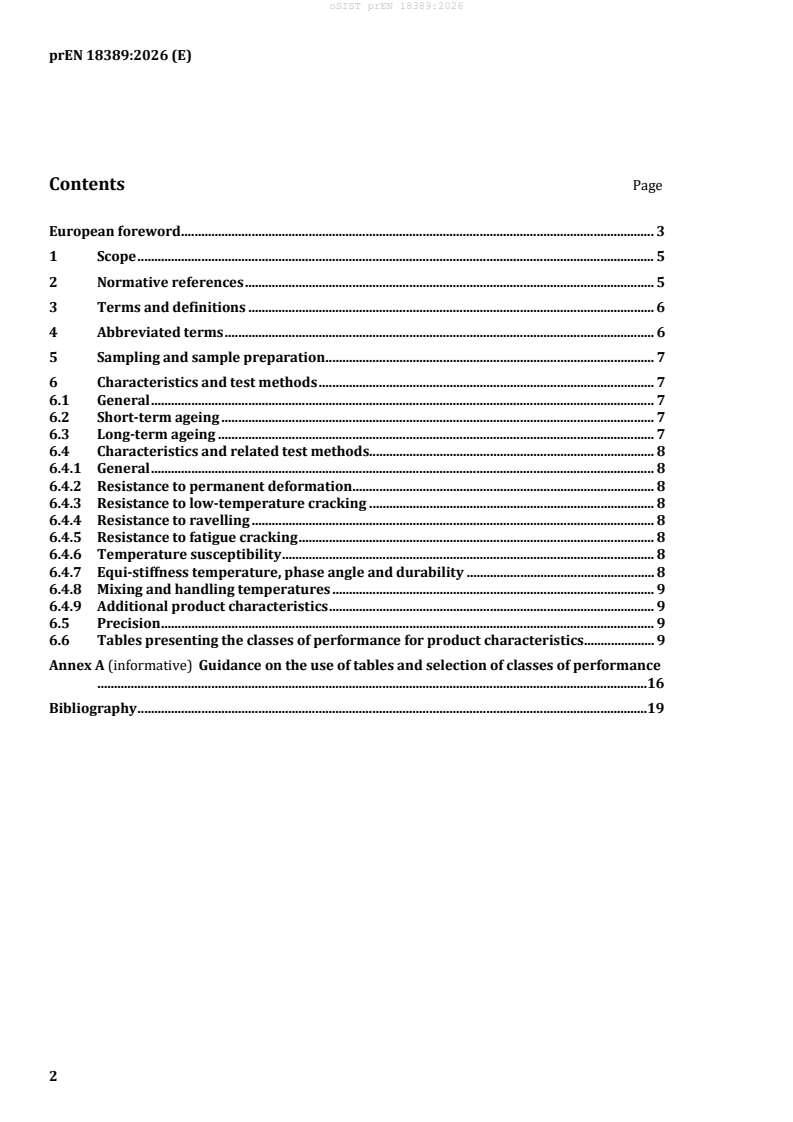
Contents Page
European foreword . 3
1 Scope . 5
2 Normative references . 5
3 Terms and definitions . 6
4 Abbreviated terms . 6
5 Sampling and sample preparation . 7
6 Characteristics and test methods . 7
6.1 General . 7
6.2 Short-term ageing . 7
6.3 Long-term ageing . 7
6.4 Characteristics and related test methods. 8
6.4.1 General . 8
6.4.2 Resistance to permanent deformation . 8
6.4.3 Resistance to low-temperature cracking . 8
6.4.4 Resistance to ravelling . 8
6.4.5 Resistance to fatigue cracking . 8
6.4.6 Temperature susceptibility . 8
6.4.7 Equi-stiffness temperature, phase angle and durability . 8
6.4.8 Mixing and handling temperatures . 9
6.4.9 Additional product characteristics . 9
6.5 Precision . 9
6.6 Tables presenting the classes of performance for product characteristics . 9
Annex A (informative) Guidance on the use of tables and selection of classes of performance
....................................................................................................................................................................16
Bibliography .19
European foreword
This document (prEN 18389:2026) has been prepared by Technical Committee CEN/TC 336 “Bitumens
and bituminous binders”, the secretariat of which is held by AFNOR.
This document is submitted to the CEN Enquiry.
Introduction
This document defines performance-related properties to better define the performance of bitumens and
bituminous binders in construction works, for example asphalt paving.
This document is designed to be complementary to other CEN/TC 336 product standards for bitumens
and bituminous binders, some of which are harmonized within the European construction product
regulation and cited in the Official Journal of the European Union. It aims to provide additional product
performance characteristics by addressing performance-related properties and critical ageing states and
does not overlap with other product standards for bitumens and bituminous binders. It is the outcome of
works carried out by CEN/TC 336/WG 1 on bitumens and bituminous binders future specifications.
At the time of publication of this document, adhesion performance is not addressed in CEN/TC 336
product standards, as this is determined by tests on the asphalt mix. However, this document does
address handling temperatures which are important in the production of notably asphalt mixtures.
This document is part of a family of CEN/TC 336 product standards for bitumens and bituminous binders
for paving applications, as shown in Figure 1, but can also apply to other uses.
Figure 1 — Mapping of European product standards for bitumens and bituminous binders for
paving applications
1 Scope
This document specifies a framework of additional characteristics and associated test methods for
bitumens and bituminous binders, which is complementary to other product standards for bitumens and
bituminous binders. This document is applicable to bitumens and bituminous binders suitable for use in
paving applications, but it is also applicable for other uses such as waterproofing membranes.
With regard to paving applications, the following characteristics are addressed:
— resistance to permanent deformation (rutting);
— resistance to low-temperature cracking;
— resistance to ravelling;
— resistance to fatigue cracking;
— temperature susceptibility;
— equi-stiffness temperature and phase angle;
— durability (evolution of equi-stiffness temperature and phase angle);
— mixing and handling characteristics (paving and compaction) temperatures;
— additional characteristics (e.g. solubility, elastic recovery and storage stability).
Not all the properties and characteristics established in the framework are universally relevant to all
binders. For example, elastic recovery is not relevant for unmodified binders.
2 Normative references
The following documents are referred to in the text in such a way that some or all of their content
constitutes requirements of this document. For dated references, only the edition cited applies. For
undated references, the latest edition of the referenced document (including any amendments) applies.
EN 58, Bitumens and bituminous binders — Sampling of bituminous binders
EN 1426, Bitumens and bituminous binders — Determination of needle penetration
EN 1427, Bitumens and bituminous binders — Determination of the softening point — Ring and Ball
method
EN 12592, Bitumen and bituminous binders — Determination of solubility
EN 12594, Bitumens and bituminous binders — Preparation of test samples
EN 12597, Bitumens and bituminous binders — Terminology
EN 12607-1, Bitumens and bituminous binders — Determination of the resistance to hardening under the
influence of heat and air — Part 1: RTFOT method
EN 12607-2, Bitumen and bituminous binders — Determination of the resistance to hardening under the
influence of heat and air — Part 2: TFOT method
EN 13302, Bitumens and bituminous binders — Determination of dynamic viscosity of bituminous binder
using a rotating spindle apparatus
EN 13398, Bitumen and bituminous binders — Determination of the elastic recovery of modified bitumen
EN 13399, Bitumen and bituminous binders — Determination of storage stability of modified bitumen
EN 13589, Bitumens and bituminous binders — Determination of the tensile properties of modified
bitumens by the force ductility method
EN 13702, Bitumen and bituminous binders — Determination of dynamic viscosity of bitumen and
bituminous binders by the cone and plate method
EN 14769, Bitumen and bituminous binders — Accelerated long-term ageing conditioning by a Pressure
Ageing Vessel (PAV)
EN 14770, Bitumen and bituminous binders — Determination of complex shear modulus and phase angle —
Dynamic Shear Rheometer (DSR)
EN 14771, Bitumen and bituminous binders — Determination of the flexural creep stiffness — Bending
Beam Rheometer (BBR)
EN 16659, Bitumens and bituminous binders — Multiple stress creep and recovery test (MSCRT)
EN ISO 2592, Determination of flash and fire points — Cleveland open cup method (ISO 2592)
EN ISO 2719, Determination of flash point — Pensky-Martens closed cup method (ISO 2719)
EN ISO 4259-2, Petroleum and related products — Precision of measurement methods and results —
Part 2: Interpretation and application of precision data in relation to methods of test (ISO 4259-2)
3 Terms and definitions
For the purposes of this document, the terms and definitions given in EN 12597 apply.
ISO and IEC maintain terminology databases for use in standardization at the following addresses:
— ISO Online browsing platform: available at https://www.iso.org/obp
— IEC Electropedia: available at https://www.electropedia.org/
4 Abbreviated terms
For the purposes of this document, the following abbreviated terms are used in Tables 1 to 8:
— DV for “Declared Value” made available by the supplier or manufacturer of the bituminous binder;
— NR for “Not Required”, e.g. where a particular characteristic is not applicable to a certain type of
bituminous binder or has not been selected for the specification of a particular group of binders.
In Tables 1 to 8, for a given characteristic, performance can be defined by a declared value (DV), not
required (NR), a threshold (limit) or a class (range).
5 Sampling and sample preparation
Samples of bulk products, so called “laboratory samples”, shall be taken in accordance with EN 58.
Test samples shall be taken from the laboratory samples and prepared for testing, in accordance with
EN 12594. Additional requirements on the test samples or specimen preparation can be specified in the
related test methods.
6 Characteristics and test methods
6.1 General
European product standards cover a large variety of road materials for different applications, to
accommodate local traffic loads and climatic conditions. Therefore, this document covers a large range of
bitumens and bituminous binders to facilitate production and application for the intended use and the
designed paving.
This document provides a performance framework for the characteristics of bitumens and bituminous
binders which are selected from Tables 1 to 4 and Table 6 which are distributed as follows:
— Table 1 gives characteristics related to permanent deformation;
— Table 2 gives characteristics related to low-temperature cracking;
— Table 3 gives characteristics related to ravelling resistance;
— Table 4 gives characteristics related to fatigue cracking and temperature susceptibility;
— Table 6 gives characteristics related to durability.
Tables 5, 7 and 8 give details of product characteristics which are important in determining some aspects
of performance, safety or handling.
Guidance on the use of Tables 1 to 8 and subsequent reporting of performance classes is given in Annex A.
6.2 Short-term ageing
Short-term ageing, as used in Tables 1 to 6 and Table 8, means rolling thin film oven test (RTFOT)
conditioning in accordance with EN 12607-1. For soft binders, such as those described in
EN 12591:2009 [1], Tables 3A and 3B, short-term ageing is carried out by thin film oven test (TFOT)
conditioning in accordance with EN 12607-2.
The main test is the RTFOT at a temperature of 163 °C. In some cases (e.g. for highly viscous polymer-
modified bitumens or low-viscosity binders for reduced-temperature application), this temperature may
be modified when necessary to ensure that a moving film is generated and remains in the bottle.
Experience has shown that a temperature up to 180 °C can be necessary for high viscosity binders. For
low-viscosity binders, a temperature of 140 °C may be used, as long as a continuous moving film is
generated. If a temperature other than 163 °C is used, this shall be declared.
6.3 Long-term ageing
Long-term ageing as used in Tables 2 to 6 means RTFOT conditioning in accordance with EN 12607-1 or
TFOT in accordance with EN 12607-2, followed by pressure ageing vessel (PAV) conditioning in
accordance with EN 14769. PAV conditioning shall be carried out at a temperature T of 100 °C, a
pressure P of 2,1 MPa and for a duration t of 20 h ± 10 min.
6.4 Characteristics and related test methods
6.4.1 General
The characteristics of bitumens and bituminous binders as well as related test methods shall be selected
from the performance classes given in Tables 1 to 8. When tested by the methods given in Tables 1 to 8,
the various performances shall conform to the classes or thresholds specified in Tables 1 to 8 unless DV
or NR is selected.
6.4.2 Resistance to permanent deformation
Resistance to permanent deformation shall be indicated by the percentage recovery, %R, and non-
recoverable compliance, J , at a stress level of 3,2 kPa of short-term aged binders as defined in Table 1. A
nr
single test temperature value within the range 40 °C to 80 °C shall be selected according to regional
conditions and the intended use of the binder.
6.4.3 Resistance to low-temperature cracking
Resistance to low-temperature cracking shall be indicated by the critical stiffness temperature, critical
m-value temperature and the parameter ΔT of long-term aged binder as defined in Table 2. ΔT is defined
c c
as the difference between the temperatures at which the binder stiffness S = 300 MPa and the
m-value = 0,3.
6.4.4 Resistance to ravelling
Ravelling resistance shall be indicated by the total cohesion energy and elongation to break of long-term
aged binder as defined in Table 3.
Total cohesion energy is defined as the total area under the curve of the force-extension graph until
...