

EN 16020:2011
(Main)Explosion diverters
General Information
- Abstract
An explosion diverter is used to divert explosions propagating through ducts, thus preventing flame jet ignition and pressure piling in connected protected enclosures. It will reduce the risk of flame transmission.
This European Standard describes the basic design of a pipe-in-pipe diverter and specifies the testing requirements and the application of explosion diverters.
This European Standard covers:
- a test method for assessing the efficacy of explosion diverters;
- design rules for a type of pipe-in-pipe diverter;
- demands to venting device on diverter;
- installation requirements;
- maintenance requirements;
- marking.
This European Standard considers dust/air explosive atmospheres only.
- Status
- Published
- Publication Date
- 26-Jul-2011
- Withdrawal Date
- 30-Jan-2012
- Current Stage
- 9060 - Closure of 2 Year Review Enquiry - Review Enquiry
- Start Date
- 04-Jun-2026
- Completion Date
- 04-Jun-2026
- Directive
- 2014/34/EU - Directive 2014/34/EU Of The European Parliament And Of The Council of 26 February 2014 on the harmonisation of the laws of the Member States relating to equipment and protective systems intended for use in potentially explosive atmospheres (recast)OJ Ref: C, C 126, C 293/52, HARMONIZIRAN OJ Date: 08-Apr-2016
94/9/EC - Equipment and protective systems intended for use in potentially explosive atmospheres (ATEX)OJ Ref: C, C 338 OJ Date: 18-Nov-2011
- Ref Project
SIST EN 16020:2011 - Explosion diverters



Overview
EN 16020:2011 - Explosion diverters (CEN, July 2011) defines the basic design, testing and application requirements for explosion diverters used in dust/air explosive atmospheres. The standard focuses on the common pipe-in-pipe diverter concept and specifies how to verify that a diverter will prevent flame jet ignition, pressure piling and reduce flame transmission through ducts. EN 16020:2011 applies to passive inline protective systems installed in ducting where combustible dust clouds may propagate.
Key topics and technical requirements
- Scope limitation: applies to dust/air explosive atmospheres only.
- Design rules: basic construction guidance for a pipe-in-pipe diverter (annexed drawings and recommendations).
- Explosion venting device: venting parts should comply with EN 14797 except that their efficiency on diverters is verified by EN 16020 test procedures.
- Mechanical integrity: diverter bodies must resist expected internal explosion loads (explosion-pressure resistant or pressure shock-resistant per EN 14460); restraining arrangements (e.g., cages) are required if parts may detach.
- Testing framework: two main test modules:
- Module A (mechanical integrity): one test to demonstrate the diverter withstands intended explosion pressures without producing flying parts.
- Module B (functional efficacy): assesses performance and establishes maximum permissible pipe lengths (installation distances). Module B has subsets B1–B4 depending on ignition location and objective. Acceptance criteria include either no flame beyond the diverter (stop propagation) or limits such as flame velocity < 100 m/s and explosion pressure < 0.3 bar at the inlet of the protected vessel. Test counts vary (e.g., 3 or 10 valid tests depending on subset).
- Installation, maintenance and marking: requirements for correct placement, service routines and product identification/marking are specified.
Applications and who uses it
EN 16020:2011 is intended for:
- Manufacturers of explosion protection equipment and pipe-in-pipe diverters
- Process, safety and plant engineers in dust-handling industries (food, wood, metal, chemical, pharmaceutical)
- Certification and testing laboratories verifying compliance
- Safety managers and compliance officers ensuring installations meet European requirements under CEN harmonization
Practical uses include selecting and certifying diverters for duct networks, defining installation distances, and setting maintenance and marking practices to manage dust explosion risk.
Related standards
Normative references and related standards frequently used with EN 16020:2011:
- EN 13237 (terms & definitions)
- EN 14034‑1 / EN 14034‑2 (dust explosion characteristics)
- EN 14460 (explosion resistant construction)
- EN 14491 (venting protective systems)
- EN 14797 (venting devices)
- EN 15089 (explosion isolation systems)
- EN ISO/IEC 17025 (testing laboratory competence)
Keywords: EN 16020:2011, explosion diverters, pipe-in-pipe diverter, dust explosion, explosion protection, venting device, testing requirements, CEN.
Relations
- Effective Date
- 28-Jan-2026
- Effective Date
- 28-Jan-2026
- Effective Date
- 28-Jan-2026
- Effective Date
- 28-Jan-2026
- Effective Date
- 28-Jan-2026
- Effective Date
- 28-Jan-2026
- Effective Date
- 28-Jan-2026
Get Certified
Connect with accredited certification bodies for this standard

CIS Institut d.o.o.
Personal Protective Equipment (PPE) certification body. Notified Body NB-2890 for EU Regulation 2016/425 PPE.

Kiwa BDA Testing
Building and construction product certification.
Kmetijski inštitut Slovenije
Agricultural Institute of Slovenia. Soil testing, plant health, agricultural product analysis.
Sponsored listings
Frequently Asked Questions
EN 16020:2011 is a standard published by the European Committee for Standardization (CEN). Its full title is "Explosion diverters". This standard covers: An explosion diverter is used to divert explosions propagating through ducts, thus preventing flame jet ignition and pressure piling in connected protected enclosures. It will reduce the risk of flame transmission. This European Standard describes the basic design of a pipe-in-pipe diverter and specifies the testing requirements and the application of explosion diverters. This European Standard covers: - a test method for assessing the efficacy of explosion diverters; - design rules for a type of pipe-in-pipe diverter; - demands to venting device on diverter; - installation requirements; - maintenance requirements; - marking. This European Standard considers dust/air explosive atmospheres only.
An explosion diverter is used to divert explosions propagating through ducts, thus preventing flame jet ignition and pressure piling in connected protected enclosures. It will reduce the risk of flame transmission. This European Standard describes the basic design of a pipe-in-pipe diverter and specifies the testing requirements and the application of explosion diverters. This European Standard covers: - a test method for assessing the efficacy of explosion diverters; - design rules for a type of pipe-in-pipe diverter; - demands to venting device on diverter; - installation requirements; - maintenance requirements; - marking. This European Standard considers dust/air explosive atmospheres only.
EN 16020:2011 is classified under the following ICS (International Classification for Standards) categories: 13.230 - Explosion protection. The ICS classification helps identify the subject area and facilitates finding related standards.
EN 16020:2011 has the following relationships with other standards: It is inter standard links to EN 14034-2:2006+A1:2011, EN 14797:2006, EN 14491:2012, EN 14460:2006, EN 13237:2024, EN 15089:2009, EN 12779:2015. Understanding these relationships helps ensure you are using the most current and applicable version of the standard.
EN 16020:2011 is associated with the following European legislation: EU Directives/Regulations: 2014/34/EU, 94/9/EC. When a standard is cited in the Official Journal of the European Union, products manufactured in conformity with it benefit from a presumption of conformity with the essential requirements of the corresponding EU directive or regulation.
EN 16020:2011 is available in PDF format for immediate download after purchase. The document can be added to your cart and obtained through the secure checkout process. Digital delivery ensures instant access to the complete standard document.
Standards Content (Sample)
2003-01.Slovenski inštitut za standardizacijo. Razmnoževanje celote ali delov tega standarda ni dovoljeno.Preusmerjevalniki eksplozijExplosionsschloteDispositifs déviateurs d'explosionExplosion diverters13.230Varstvo pred eksplozijoExplosion protectionICS:Ta slovenski standard je istoveten z:EN 16020:2011SIST EN 16020:2011en,de01-oktober-2011SIST EN 16020:2011SLOVENSKI
STANDARD
EUROPEAN STANDARD NORME EUROPÉENNE EUROPÄISCHE NORM
EN 16020
July 2011 ICS 13.230 English Version
Explosion diverters
Dispositifs déviateurs d'explosion
Explosionsschlote This European Standard was approved by CEN on 25 June 2011.
CEN members are bound to comply with the CEN/CENELEC Internal Regulations which stipulate the conditions for giving this European Standard the status of a national standard without any alteration. Up-to-date lists and bibliographical references concerning such national standards may be obtained on application to the CEN-CENELEC Management Centre or to any CEN member.
This European Standard exists in three official versions (English, French, German). A version in any other language made by translation under the responsibility of a CEN member into its own language and notified to the CEN-CENELEC Management Centre has the same status as the official versions.
CEN members are the national standards bodies of Austria, Belgium, Bulgaria, Croatia, Cyprus, Czech Republic, Denmark, Estonia, Finland, France, Germany, Greece, Hungary, Iceland, Ireland, Italy, Latvia, Lithuania, Luxembourg, Malta, Netherlands, Norway, Poland, Portugal, Romania, Slovakia, Slovenia, Spain, Sweden, Switzerland and United Kingdom.
EUROPEAN COMMITTEE FOR STANDARDIZATION
COMITÉ EUROPÉEN DE NORMALISATION EUROPÄISCHES KOMITEE FÜR NORMUNG
Management Centre:
Avenue Marnix 17,
B-1000 Brussels © 2011 CEN All rights of exploitation in any form and by any means reserved worldwide for CEN national Members. Ref. No. EN 16020:2011: ESIST EN 16020:2011
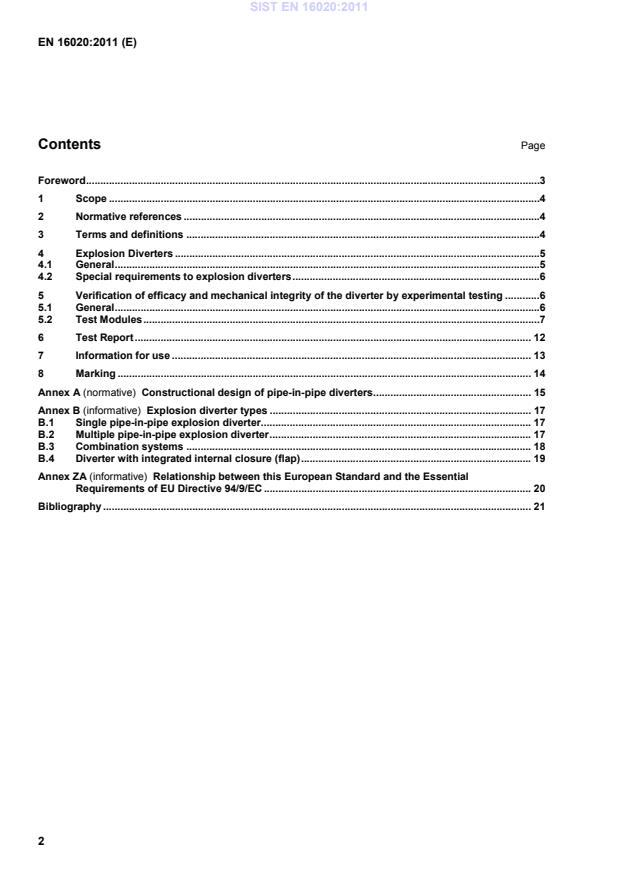
Constructional design of pipe-in-pipe diverters . 15Annex B (informative)
Explosion diverter types . 17B.1Single pipe-in-pipe explosion diverter. 17B.2Multiple pipe-in-pipe explosion diverter . 17B.3Combination systems . 18B.4Diverter with integrated internal closure (flap) . 19Annex ZA (informative)
Relationship between this European Standard and the Essential Requirements of EU Directive 94/9/EC . 20Bibliography . 21 SIST EN 16020:2011
This European Standard covers: a test method for assessing the efficacy of explosion diverters; design rules for a type of pipe-in-pipe diverter; demands to venting device on diverter; installation requirements; maintenance requirements; marking. This European Standard considers dust/air explosive atmospheres only. 2 Normative references The following referenced documents are indispensable for the application of this document. For dated references, only the edition cited applies. For undated references, the latest edition of the referenced document (including any amendments) applies. EN 13237, Potentially explosive atmospheres — Terms and definitions for equipment and protective systems intended for use in potentially explosive atmospheres EN 14034-1, Determination of explosion characteristics of dust clouds — Part 1: Determination of the maximum explosion pressure pmax of dust clouds EN 14034-2, Determination of explosion characteristics of dust clouds — Part 2: Determination of the maximum rate of explosion pressure rise (dp/dt)max of dust clouds EN 14460:2006, Explosion resistant equipment EN 14491: Dust explosion venting protective systems EN 14797, Explosion venting devices EN 15089:2009, Explosion isolation systems EN ISO/IEC 17025, General requirements for the competence of testing and calibration laboratories
(ISO/IEC 17025:2005) 3 Terms and definitions For the purposes of this document, the terms and definitions given in EN 13237, EN 14797, EN 14491 , EN 15089:2009 and the following apply. SIST EN 16020:2011
Key 1,2,3 pressure transducer (Pt) 4
explosion diverter body (ED) 5
explosion diverter venting device L
installation distance Figure 2 — Test arrangement for mechanical and explosion resistance testing The dimensions of the pipe (length and diameter), the pipe arrangement (e.g. horizontal/vertical), the volume of the test vessel, the maximum reduced explosion pressure in the test vessel and the explosion characteristics of the explosive atmosphere shall reflect the intended use of the diverter (see 5.1). The length to diameter ratio of the vessel shall be equal to or smaller than 2,5 and the pipe volume up to the explosion diverter shall be smaller than the volume of the vessel. The explosion pressure generated within the diverter shall reflect the maximum allowable explosion pressure according to the intended use of the diverter. If the intended use includes scenarios in which the explosion can propagate in both directions, the testing shall be repeated with the diverter reversed such that the outlet now becomes the inlet. 5.2.2.3 Measuring technique The following parameter shall be measured: Pressure The explosion pressure shall be measured by installing transducers in the explosion enclosure, the diverter and the interconnecting duct (see Figure 2). The pressure transducer shall have a sufficient short response time. 5.2.2.4 Testing method Sufficient explosive dust shall be injected in the test vessel to generate an explosive dust/air mixture in the duct to support flame propagation into the diverter. The generation of the dust cloud inside the test vessel shall be carried out according to EN 14034-1 and EN 14034-2. SIST EN 16020:2011
...