


EN ISO 10218-1:2025
(Main)Robotics - Safety requirements - Part 1: Industrial robots (ISO 10218-1:2025)
Robotics - Safety requirements - Part 1: Industrial robots (ISO 10218-1:2025)
This document specifies requirements for the inherently safe design, risk reduction measures and information for use of robots for an industrial environment.
This document addresses the robot as an incomplete machine.
This document is not applicable to the following uses and products:
— underwater;
— law enforcement;
— military (defence);
— airborne and space robots, including outer space;
— medical robots;
— healthcare robots;
— prosthetics and other aids for the physically impaired;
— service robots, which provide a service to a person and as such where the public can have access;
— consumer products, as this is household use to which the public can have access;
— lifting or transporting people.
NOTE 1 Requirements for robot integration and robot applications are covered in ISO 10218-2:2025.
NOTE 2 Additional hazards can be created by robot applications (e.g. welding, laser cutting, machining). These hazards are addressed during robot application design. See ISO 10218-2:2025.
This document deals with the significant hazards, hazardous situations or hazardous events when used as intended and under specified conditions of misuse which are reasonably foreseeable by the manufacturer.
This document does not cover the hazards related to:
— severe conditions (e.g. extreme climates, freezer use, strong magnetic fields) outside of manufacturer’s specifications;
— underground use;
— use that has hygienic requirements;
— use in nuclear environments;
— use in potentially explosive environments;
— mobility when robots or manipulators are fixed to or part of driverless industrial trucks;
— mobility when robots or manipulators are fixed to or part of mobile platforms;
— use in environments with ionizing and non-ionizing radiation levels;
— hazardous ionizing and non-ionizing radiation;
— handling loads the nature of which can lead to dangerous situations (e.g. molten metals, acids/bases, radiating materials);
— handling or lifting or transporting people;
— when the public, all ages or non-working adults have access (e.g. service robots, consumer products).
Noise emission is generally not considered a significant hazard of the robot alone, and consequently noise is excluded from the scope of this document.
This document is not applicable to robots that are manufactured before the date of its publication.
Robotik - Sicherheitsanforderungen - Teil 1: Industrieroboter (ISO 10218-1:2025)
Dieses Dokument legt Anforderungen für die eigensichere Konstruktion, für Risikominderungsmaßnahmen und Informationen für die Nutzung von Robotern in Industrieumgebungen fest.
Dieses Dokument betrachtet den Roboter als unvollständige Maschine.
Dieses Dokument gilt nicht für die folgenden Verwendungen und Produkte:
- Unterwasser;
- Strafverfolgung;
- Militär (Verteidigung);
- Luft- und Raumfahrtroboter, einschließlich Weltraum;
- Medizinroboter;
- Gesundheitspflegeroboter;
- Prothesen und sonstige Hilfsmittel für Körperbehinderte;
- Serviceroboter, deren Dienste von Personen beansprucht werden und daher öffentlich zugänglich sind;
- Konsumprodukte für die Verwendung im Haushalt, da diese öffentlich zugänglich sind;
- Anheben oder Transport von Personen;
- mobile Plattformen;
- telebetriebene Manipulatoren.
ANMERKUNG 1 Anforderungen an Robotersysteme, die Integration und Anwendungen werden in ISO/FDIS 10218 2:2024 behandelt.
ANMERKUNG 2 Durch Roboteranwendungen können zusätzliche Gefährdungen verursacht werden (z. B. Schweißen, Laserstrahlschneiden, spanabhebende Bearbeitung). Diese Gefährdungen werden bei der Konstruktion von Robotersystemen und Roboteranwendungen behandelt. Siehe ISO/FDIS 10218 2:2024.
Dieses Dokument behandelt alle signifikanten Gefährdungen, Gefährdungssituationen oder Gefährdungs-ereignisse, wenn sie bestimmungsgemäß und unter bestimmten Bedingungen von durch den Hersteller vernünftigerweise vorhersehbaren Fehlanwendungen verwendet werden.
Dieses Dokument behandelt nicht Gefährdungen in Zusammenhang mit:
- schweren Bedingungen (z. B. extreme Klimabedingungen, Anwendungen bei sehr niedrigen Temperaturen, starke Magnetfelder) außerhalb der Herstellerangaben;
- Untertagenutzung;
- spezifischen Hygieneanforderungen;
- der Verwendung in nuklearen Umgebungen;
- der Verwendung in möglicherweise explosiven Umgebungen;
- der Verwendung in Umgebungen mit ionisierender und nichtionisierender Strahlungsbelastung;
- gefährlicher ionisierender und nichtionisierender Strahlung;
- der Handhabung von Lasten, deren Eigenschaften zu gefährlichen Situationen führen können (z. B. geschmolzene Metalle, Säuren/Basen, strahlende Materialien);
- Umgang, Beförderung oder Transport von Personen;
- dem öffentlichen Zugang von Personen jeden Alters oder nicht arbeitender Erwachsener (z. B. Serviceroboter, Konsumgüter).
Lärmemission wird im Allgemeinen nicht als signifikante Gefährdung, die vom Roboter allein ausgeht, betrachtet; daher ist Lärm aus dem Anwendungsbereich dieses Dokuments ausgeschlossen.
Dieses Dokument ist nicht anwendbar für Roboter, die vor seiner Veröffentlichung hergestellt wurden.
Robotique - Exigences de sécurité - Partie 1: Robots industriels (ISO 10218-1:2025)
Le présent document spécifie les exigences pour la prévention intrinsèque, les mesures de réduction du risque et les informations pour l'utilisation de robots destinés à un environnement industriel.
Le présent document traite le robot comme une machine incomplète.
Le présent document ne s'applique pas aux utilisations et produits suivants:
— sous-marines;
— maintien de l’ordre;
— militaires (défense);
— robots aériens et spatiaux, y compris extra-atmosphériques;
— robots médicaux;
— robots de soins de santé;
— prothèses et autres aides pour personnes physiquement déficientes;
— robots de service qui fournissent un service à la personne et sont, en tant que tels, accessibles au public;
— produits de consommation, car il s'agit d'une utilisation domestique à laquelle le public peut avoir accès;
— levage ou transport de personnes.
NOTE 1 Les exigences relatives à l’intégration de robots et aux applications robotisées sont couvertes par l'ISO 10218-2:2025.
NOTE 2 Des phénomènes dangereux supplémentaires peuvent être générés par des applications robotisées (par exemple, soudage, découpe au laser, usinage). Ces phénomènes dangereux sont traités lors de la conception de l'application robotisée. Voir l’ISO 10218-2:2025.
Le présent document traite des phénomènes dangereux, situations dangereuses ou événements dangereux significatifs lorsqu’ils sont utilisés normalement et dans des conditions spécifiées de mauvais usage raisonnablement prévisibles par le fabricant.
Le présent document ne couvre pas les phénomènes dangereux relatifs:
— aux conditions difficiles (par exemple, conditions climatiques extrêmes, utilisation de congélateur, champs magnétiques importants) en dehors des spécifications du fabricant;
— à une utilisation souterraine;
— à l’utilisation avec des exigences hygiéniques;
— à l’utilisation dans des environnements nucléaires;
— à l’utilisation dans des environnements explosibles;
— à la mobilité lorsque des robots ou manipulateurs sont fixés à des chariots industriels sans conducteur ou en font partie;
— à la mobilité lorsque des robots ou manipulateurs sont fixés à des plateformes mobiles ou en font partie;
— à l’utilisation dans des environnements comprenant des niveaux de rayonnements ionisants et non ionisants;
— à des rayonnements ionisants et non ionisants dangereux;
— à la manutention de charges pouvant provoquer des situations dangereuses (par exemple, métaux en fusion, acides/bases, matériaux-rayonnants);
— à la manutention ou levage ou transport de personnes;
— à l’accès possible pour le public, des personnes de tous âges ou des adultes non professionnels (par exemple, robots de service, produits de consommation).
L'émission sonore n'est généralement pas considérée comme un phénomène dangereux significatif du robot lui-même et par conséquent, le bruit est exclu du domaine d'application du présent document.
Le présent document n'est pas applicable aux robots qui ont été fabriqués avant sa date de publication.
Robotika - Varnostne zahteve - 1. del: Industrijski roboti (ISO 10218-1:2025)
Ta dokument določa zahteve za inherentno varno zasnovo, ukrepe za zmanjšanje tveganja in informacije za uporabo robotov za industrijska okolja. V tem dokumentu je robot obravnavan kot nepopoln stroj. Ta dokument se ne uporablja za naslednje vrste uporabe in izdelke: – uporaba pod vodo; – organi pregona; – vojska (obramba); – letalski in vesoljski roboti, vključno z uporabo v vesolju; – medicinski roboti; – roboti za zdravstveno oskrbo; – proteze in drugi pripomočki za osebe s telesno okvaro; – storitveni roboti, ki zagotavljajo storitve osebam in do katerih ima dostop javnost; – potrošniški izdelki, saj gre za gospodinjsko uporabo, do katere ima dostop javnost; – dvigovanje ali prevoz ljudi. OPOMBA 1: Zahteve za integracijo robotov in njihovo uporabo so zajete v standardu ISO 10218-2:2025. OPOMBA 2: Nekatere vrste robotske uporabe (npr. varjenje, lasersko rezanje, strojna obdelava) lahko povzročijo dodatna tveganja, ki jih je treba upoštevati že med načrtovanjem uporabe robota. Glej standard ISO 10218-2:2025. Ta dokument obravnava večja tveganja, nevarne situacije ali nevarne dogodke v okoliščinah predvidene uporabe in pod pogoji nepravilne uporabe, ki jih lahko proizvajalec upravičeno predvidi. Ta dokument ne zajema tveganj v zvezi z naslednjim: – zahtevni pogoji (npr. skrajne podnebne razmere, zmrzal, močna magnetna polja), ki niso v skladu s specifikacijami proizvajalca; – uporaba pod zemljo; – uporaba, pri kateri veljajo higienske zahteve; – uporaba v jedrskih okoljih; – uporaba v potencialno eksplozivnih okoljih; – mobilnost, kadar so roboti ali manipulatorji pritrjeni na vozila brez voznika ali njihov del; – mobilnost, kadar so roboti ali manipulatorji pritrjeni na mobilne platforme ali njihov del; – uporaba v okoljih z ionizirajočim in neionizirajočim sevanjem; – nevarno ionizirajoče in neionizirajoče sevanje; – ravnanje s tovorom, ki lahko povzroči nevarne razmere (npr. taljena kovina, kisline/baze, sevajoči materiali); – dvigovanje ali prevoz ljudi; – primeri, v katerih ima dostop javnost, vse starostne skupine ali nezaposlene odrasle osebe (npr. servisni roboti, potrošniški izdelki). Ker hrup običajno ne predstavlja večjega tveganja pri samem robotu, ne spada na področje uporabe tega dokumenta. Ta dokument se ne uporablja za robote, ki so bili izdelani pred datumom njegove objave.
General Information
Relations
Standards Content (Sample)
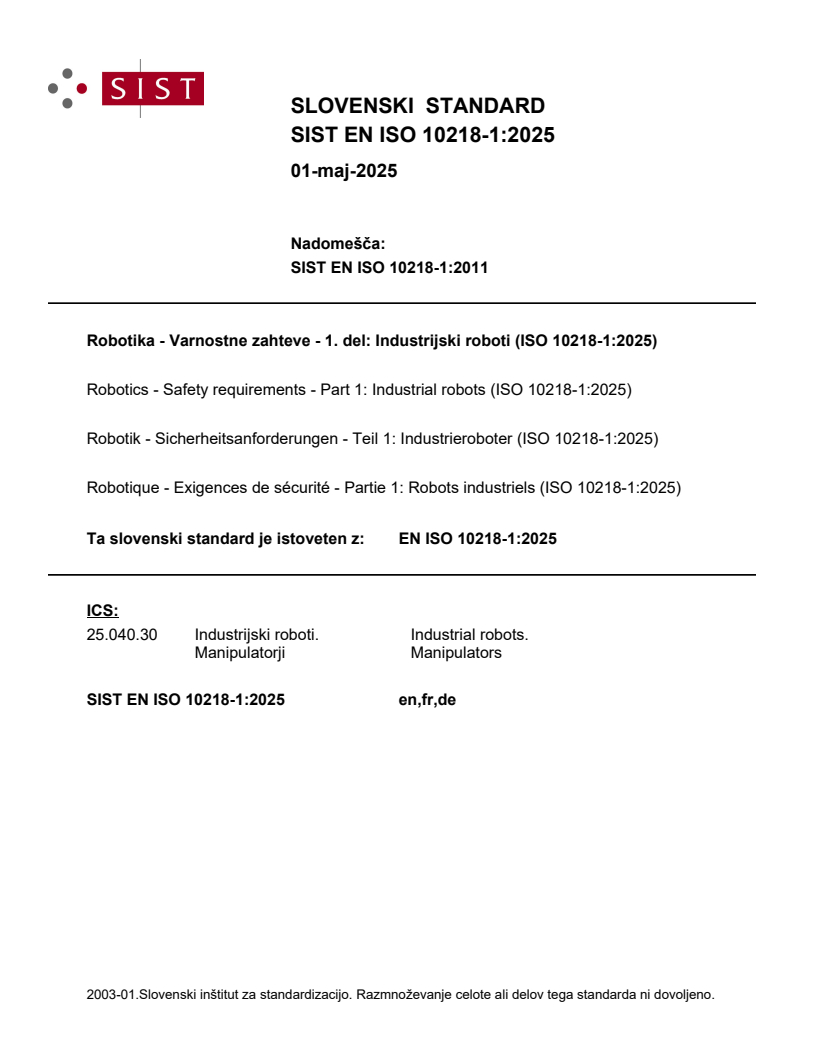
SLOVENSKI STANDARD
01-maj-2025
Nadomešča:
SIST EN ISO 10218-1:2011
Robotika - Varnostne zahteve - 1. del: Industrijski roboti (ISO 10218-1:2025)
Robotics - Safety requirements - Part 1: Industrial robots (ISO 10218-1:2025)
Robotik - Sicherheitsanforderungen - Teil 1: Industrieroboter (ISO 10218-1:2025)
Robotique - Exigences de sécurité - Partie 1: Robots industriels (ISO 10218-1:2025)
Ta slovenski standard je istoveten z: EN ISO 10218-1:2025
ICS:
25.040.30 Industrijski roboti. Industrial robots.
Manipulatorji Manipulators
2003-01.Slovenski inštitut za standardizacijo. Razmnoževanje celote ali delov tega standarda ni dovoljeno.
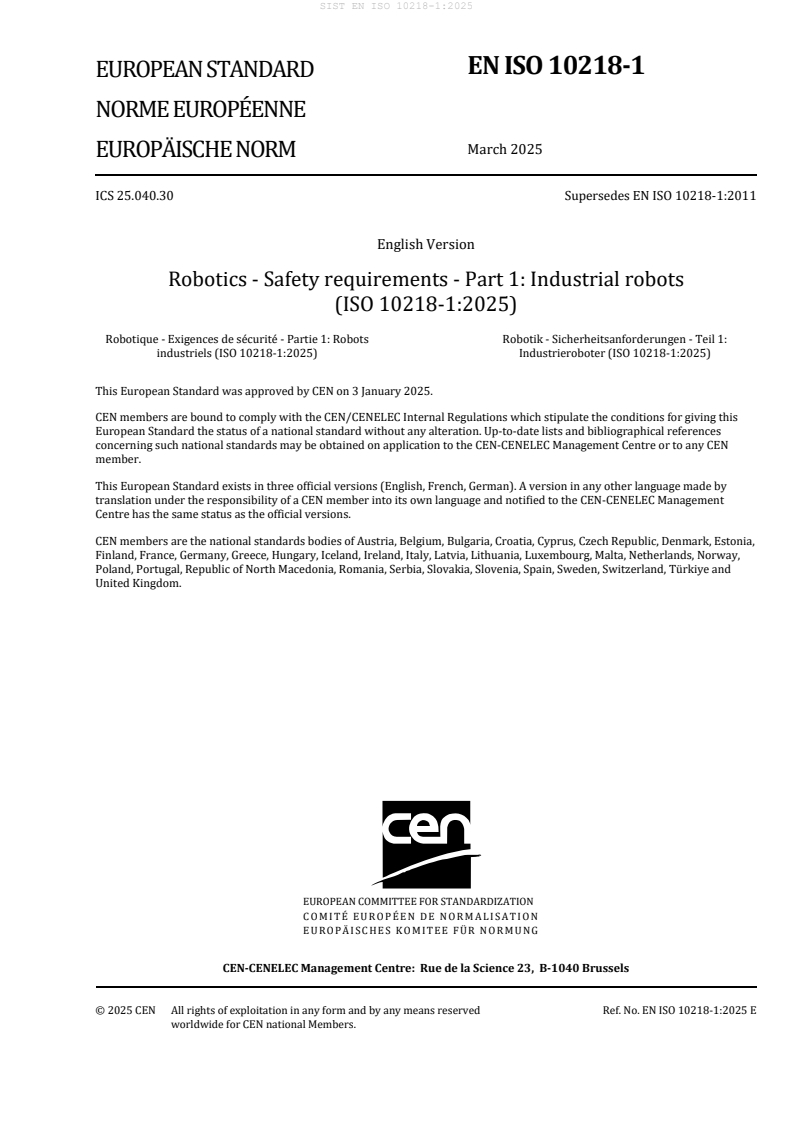
EN ISO 10218-1
EUROPEAN STANDARD
NORME EUROPÉENNE
March 2025
EUROPÄISCHE NORM
ICS 25.040.30 Supersedes EN ISO 10218-1:2011
English Version
Robotics - Safety requirements - Part 1: Industrial robots
(ISO 10218-1:2025)
Robotique - Exigences de sécurité - Partie 1: Robots Robotik - Sicherheitsanforderungen - Teil 1:
industriels (ISO 10218-1:2025) Industrieroboter (ISO 10218-1:2025)
This European Standard was approved by CEN on 3 January 2025.
CEN members are bound to comply with the CEN/CENELEC Internal Regulations which stipulate the conditions for giving this
European Standard the status of a national standard without any alteration. Up-to-date lists and bibliographical references
concerning such national standards may be obtained on application to the CEN-CENELEC Management Centre or to any CEN
member.
This European Standard exists in three official versions (English, French, German). A version in any other language made by
translation under the responsibility of a CEN member into its own language and notified to the CEN-CENELEC Management
Centre has the same status as the official versions.
CEN members are the national standards bodies of Austria, Belgium, Bulgaria, Croatia, Cyprus, Czech Republic, Denmark, Estonia,
Finland, France, Germany, Greece, Hungary, Iceland, Ireland, Italy, Latvia, Lithuania, Luxembourg, Malta, Netherlands, Norway,
Poland, Portugal, Republic of North Macedonia, Romania, Serbia, Slovakia, Slovenia, Spain, Sweden, Switzerland, Türkiye and
United Kingdom.
EUROPEAN COMMITTEE FOR STANDARDIZATION
COMITÉ EUROPÉEN DE NORMALISATION
EUROPÄISCHES KOMITEE FÜR NORMUNG
CEN-CENELEC Management Centre: Rue de la Science 23, B-1040 Brussels
© 2025 CEN All rights of exploitation in any form and by any means reserved Ref. No. EN ISO 10218-1:2025 E
worldwide for CEN national Members.
Contents Page
European foreword . 3
Annex ZA (informative) Relationship between this European Standard and the essential
requirements of Directive 2006/42/EC aimed to be covered . 4
European foreword
This document (EN ISO 10218-1:2025) has been prepared by Technical Committee ISO/TC 299
"Robotics" in collaboration with Technical Committee CEN/TC 310 “Advanced automation technologies
and their applications” the secretariat of which is held by BSI.
This European Standard shall be given the status of a national standard, either by publication of an
identical text or by endorsement, at the latest by September 2025, and conflicting national standards
shall be withdrawn at the latest by March 2027.
Attention is drawn to the possibility that some of the elements of this document may be the subject of
patent rights. CEN shall not be held responsible for identifying any or all such patent rights.
This document supersedes EN ISO 10218-1:2011.
This document has been prepared under a standardization request addressed to CEN by the European
Commission. The Standing Committee of the EFTA States subsequently approves these requests for its
Member States.
For the relationship with EU Legislation, see informative Annex ZA, which is an integral part of this
document.
Any feedback and questions on this document should be directed to the users’ national standards
body/national committee. A complete listing of these bodies can be found on the CEN website.
According to the CEN-CENELEC Internal Regulations, the national standards organizations of the
following countries are bound to implement this European Standard: Austria, Belgium, Bulgaria,
Croatia, Cyprus, Czech Republic, Denmark, Estonia, Finland, France, Germany, Greece, Hungary, Iceland,
Ireland, Italy, Latvia, Lithuania, Luxembourg, Malta, Netherlands, Norway, Poland, Portugal, Republic of
North Macedonia, Romania, Serbia, Slovakia, Slovenia, Spain, Sweden, Switzerland, Türkiye and the
United Kingdom.
Endorsement notice
The text of ISO 10218-1:2025 has been approved by CEN as EN ISO 10218-1:2025 without any
modification.
Annex ZA
(informative)
Relationship between this European Standard and the essential
requirements of Directive 2006/42/EC aimed to be covered
This European Standard has been prepared under a Commission’s standardization request “M/396
Mandate to CEN and CENELEC for Standardisation in the field of machinery" to provide one voluntary
means of conforming to essential requirements of Directive 2006/42/EC of the European Parliament
and of the Council of 17 May 2006 on machinery, and amending Directive 95/16/EC (recast).
Once this standard is cited in the Official Journal of the European Union under that Directive,
compliance with the normative clauses of this standard given in Table ZA.1 confers, within the limits of
the scope of this standard, a presumption of conformity with the corresponding essential requirements
of that Directive, and associated EFTA regulations.
Table ZA.1 — Correspondence between this European Standard and Annex I of Directive
2006/42/EC
The relevant Essential Requirements Clause(s)/sub-clause(s) of this Remarks/Notes
of Directive 2006/42/EC EN
1.1.2. a Principles of safety integration 5, 6, 7
1.1.2. c Principles of safety integration 5, 6, 7
1.1.2. d Principles of safety integration 5, 6, 7
1.1.2. e Principles of safety integration 5, 6, 7
1.1.3. Materials and products 5.1.2
1.1.5. Design of machinery to facilitate its 5.1.3, 5.1.4, 7.5.18
handling
1.1.6. Ergonomics 5.2.5, 5.2.8.1, 5.2.8.4
1.2.1. Safety and reliability of control 5.1.8, 5.2.2, 5.2.9, 5.3, 5.4, 5.5, 5.6,
systems 5.7, 5.10, Annex C
1.2.2. Control devices 5.1.13, 5.2.5, 5.2.7.2.3, 5.2.8, 5.2.9,
5.4.1, 5.4.2, 5.5.1, 5.5.2.2, 5.5.4.2,
5.6, 5.10.2
1.2.3. Starting 5.2.7.1, 5.2.7.3, 5.2.8.5, 5.2.9, 5.5.2
1.2.4.1. Normal stop 5.4.1, 5.4.4
1.2.4.2. Operational stop 5.4.3
1.2.4.3. Emergency stop 5.2.8.5, 5.4.1, 5.4.2
1.2.5. Selection of control or operating 5.2.7
modes
1.2.6. Failure of the power supply 5.1.8, 5.1.10, 5.3, 5.5.2.1
1.3.1. Risk of loss of stability 5.1.2, 5.1.3, 5.1.5, 7.5.4
1.3.2. Risk of break-up during operation 5.1.2, 5.1.11, 5.1.13, 7.5.16
1.3.4. Risks due to surfaces, edges or 5.1.2.4, 5.10.2
angles
1.3.7. Risks related to moving parts 5.1.2.4, 7.5.16
1.3.8. Choice of protection against risks 5.1.2.4
arising from moving parts
1.3.8.1. Moving transmission parts 5.1.2.4, 5.2.4
1.3.9. Risks of uncontrolled movements 5.1.8, 5.1.12, 7.5.9, 7.5.16
1.4.1. General requirements 5.5.4, 5.7, 5.10
1.4.2.1. Fixed guards 5.1.2.4
1.4.2.2. Interlocking movable guards 5.1.2.4, 5.2.4
1.4.3. Special requirements for protective 5.3, Annex H
devices
1.5.1. Electricity supply 5.1.13
1.5.2 Static electricity 5.1.12
1.5.3. Energy supply other than 5.1.13
electricity
1.5.4. Errors of fitting 5.1.2.4, 5.1.13, 7.5.16
1.5.5. Extreme temperature 5.1.6
1.5.6. Fire 5.1.6
1.5.7. Explosion Not covered
1.5.8. Noise Not covered
1.5.9 Vibrations 5.10.2
1.5.10. Radiation Not covered
1.5.11. External radiation Not covered
1.5.12. Laser radiation 5.9
1.6.3. Isolation of energy sources 5.1.12
1.7.1. Information and warnings on the 7.1, 7.4
machinery
1.7.1.1. Information and information 5.2.5, 5.2.6, 5.2.8.1, 7.1
devices
1.7.1.2. Warning devices 5.2.5, 7.2
1.7.2. Warning of residual risks 7.5.3, 7.5.12.6
1.7.3. Marking of machinery 7.3
1.7.4. Instructions 7
1.7.4.1. General principles for the 7.5.1
drafting of instructions
1.7.4.2. Contents of the instructions 7.1, 7.5
1.7.4.3. Sales literature Not covered
2.1.1. General Not covered
2.1.2. Instructions Not covered
2.2.1. General 5.10.2
2.2.1.1. Instructions 7.5.16
3. SUPPLEMENTARY ESSENTIAL Not covered
HEALTH AND SAFETY REQUIREMENTS
TO OFFSET HAZARDS DUE TO THE
MOBILITY OF MACHINERY
4.1.2.1. Risks due to lack of stability 5.1
4.1.2.3. Mechanical strength 5.1.2
4.1.2.4. Pulleys, drums, wheels, ropes and 5.1.2.3
chains
4.1.3. Fitness for purpose 5.1.2.3
4.2.1. Control of movements 5.2.7, 5.5.4, 5.10.2
4.3.3. Lifting machinery 7.3
4.4.2. Lifting machinery 7.5.3
5. SUPPLEMENTARY ESSENTIAL Not covered
HEALTH AND SAFETY REQUIREMENTS
FOR MACHINERY INTENDED FOR
UNDER GROUND WORK
WARNING 1 — Presumption of conformity stays valid only as long as a reference to this European
Standard is maintained in the list published in the Official Journal of the European Union. Users of this
standard should consult frequently the latest list published in the Official Journal of the European
Union.
WARNING 2 — Other Union legislation may be applicable to the product(s) falling within the scope of
this standard.
International
Standard
ISO 10218-1
Third edition
Robotics — Safety requirements —
2025-02
Part 1:
Industrial robots
Robotique — Exigences de sécurité —
Partie 1: Robots industriels
Reference number
ISO 10218-1:2025(en) © ISO 2025
ISO 10218-1:2025(en)
© ISO 2025
All rights reserved. Unless otherwise specified, or required in the context of its implementation, no part of this publication may
be reproduced or utilized otherwise in any form or by any means, electronic or mechanical, including photocopying, or posting on
the internet or an intranet, without prior written permission. Permission can be requested from either ISO at the address below
or ISO’s member body in the country of the requester.
ISO copyright office
CP 401 • Ch. de Blandonnet 8
CH-1214 Vernier, Geneva
Phone: +41 22 749 01 11
Email: copyright@iso.org
Website: www.iso.org
Published in Switzerland
ii
ISO 10218-1:2025(en)
Contents Page
Foreword .vi
Introduction .vii
1 Scope . 1
2 Normative references . 2
3 Terms, definitions and abbreviated terms . 3
3.1 Terms and definitions .3
3.1.1 Robot, robot system, robot application, application . .3
3.1.2 Sub-assemblies and components .4
3.1.3 Controls-related .6
3.1.4 Program-related .7
3.1.5 Power-, energy-related . .8
3.1.6 Hazard-related .8
3.1.7 Role-related .8
3.1.8 Functional safety-related .9
3.1.9 Spaces, zones and distances .10
3.1.10 Risk reduction measures .11
3.1.11 Verification and validation . 12
3.2 Abbreviated terms and symbols. 12
4 Risk assessment .13
5 Design and risk reduction measures .13
5.1 Robot design . 13
5.1.1 General . 13
5.1.2 Materials, mechanical strength and mechanical design . 13
5.1.3 Handling, lifting and transportation .14
5.1.4 Packaging . 15
5.1.5 Stability . 15
5.1.6 Temperature and fire risks . 15
5.1.7 Special equipment . 15
5.1.8 Position holding . 15
5.1.9 Auxiliary axis (axes) . 15
5.1.10 Power loss or change .16
5.1.11 Component malfunction .16
5.1.12 Hazardous energy .16
5.1.13 Electrical, pneumatic and hydraulic parts .17
5.1.14 Tool centre point (TCP) setting .17
5.1.15 Payload setting . .18
5.1.16 Cybersecurity .18
5.1.17 Robot class .18
5.2 Controls .19
5.2.1 General .19
5.2.2 Protection from unexpected start-up .19
5.2.3 Singularity . 20
5.2.4 Interlocking devices . 20
5.2.5 Status indication and warning devices . 20
5.2.6 Labelling . 20
5.2.7 Modes. 20
5.2.8 Means of controlling the robot. 23
5.2.9 Means of initiating automatic operation . 25
5.3 Safety functions . 25
5.3.1 General . 25
5.3.2 Functional safety standards . 25
5.3.3 Performance . 25
5.3.4 Failure or fault detection . 26
iii
ISO 10218-1:2025(en)
5.3.5 Parameterization of safety functions . 26
5.3.6 Communications . 26
5.3.7 Electromagnetic compatibility (EMC) .27
5.4 Stopping functions . 28
5.4.1 General . 28
5.4.2 Emergency stop . 28
5.4.3 Protective stop . 29
5.4.4 Normal stop . 29
5.5 Other safety functions . 30
5.5.1 Single-point-of-control . 30
5.5.2 Start/restart interlock and reset . 30
5.5.3 Speed limit(s) monitoring.31
5.5.4 Enabling function.32
5.5.5 Monitored-standstill . 33
5.5.6 Stopping time limiting . 33
5.5.7 Stopping distance limiting . 34
5.6 Simultaneous motion . 34
5.7 Limiting robot motion . 34
5.7.1 General . 34
5.7.2 Mechanical limiting . 35
5.7.3 Electro-mechanical limiting. 35
5.7.4 Software-based limiting . 35
5.7.5 Dynamic limiting . 36
5.8 Movement without drive power . 36
5.9 Lasers and laser equipment . 36
5.10 Capabilities for collaborative applications . 36
5.10.1 General . 36
5.10.2 Hand-guided control (HGC) . 36
5.10.3 Speed and separation monitoring (SSM) .37
5.10.4 Power and force limiting (PFL). 38
6 Verification and validation .38
6.1 General . 38
6.2 Verification and validation . 38
7 Information for use .38
7.1 General . 38
7.2 Signals and warning devices . 39
7.3 Marking . 39
7.4 Signs (pictograms) and written warnings . 39
7.5 Instruction handbook. 40
7.5.1 General . 40
7.5.2 Identification . 40
7.5.3 Intended use . 40
7.5.4 Installation .41
7.5.5 Stopping . .41
7.5.6 Commissioning and programming . .41
7.5.7 Operation and setting .42
7.5.8 Singularity .42
7.5.9 Hazardous energy .42
7.5.10 Movement without drive power .42
7.5.11 Cybersecurity .42
7.5.12 Functional safety . . .43
7.5.13 Teach pendants .45
7.5.14 Change or addition of component parts . 46
7.5.15 Standards . 46
7.5.16 Maintenance . 46
7.5.17 Abnormal and emergency situations . 46
7.5.18 Handling, lifting and transportation . 46
iv
ISO 10218-1:2025(en)
Annex A (informative) List of significant hazards . 47
Annex B (informative) Illustrations of spaces .52
Annex C (normative) Safety functions .55
Annex D (informative) Safety function information . 61
Annex E (normative) Test methodology for Class I robots – Maximum force per manipulator
(F ) .63
MPM
Annex F (informative) Symbols .71
Annex G (informative) Means of verification and validation of the design and risk reduction
measures .73
Annex H (normative) Stopping time and distance measurement .92
Annex I (informative) Implementation of start/restart interlock and reset functions .93
Bibliography .95
v
ISO 10218-1:2025(en)
Foreword
ISO (the International Organization for Standardization) is a worldwide federation of national standards
bodies (ISO member bodies). The work of preparing International Standards is normally carried out through
ISO technical committees. Each member body interested in a subject for which a technical committee
has been established has the right to be represented on that committee. International organizations,
governmental and non-governmental, in liaison with ISO, also take part in the work. ISO collaborates closely
with the International Electrotechnical Commission (IEC) on all matters of electrotechnical standardization.
The procedures used to develop this document and those intended for its further maintenance are described
in the ISO/IEC Directives, Part 1. In particular, the different approval criteria needed for the different types
of ISO document should be noted. This document was drafted in accordance with the editorial rules of the
ISO/IEC Directives, Part 2 (see www.iso.org/directives).
ISO draws attention to the possibility that the implementation of this document may involve the use of (a)
patent(s). ISO takes no position concerning the evidence, validity or applicability of any claimed patent
rights in respect thereof. As of the date of publication of this document, ISO had not received notice of (a)
patent(s) which may be required to implement this document. However, implementers are cautioned that
this may not represent the latest information, which may be obtained from the patent database available at
www.iso.org/patents. ISO shall not be held responsible for identifying any or all such patent rights.
Any trade name used in this document is information given for the convenience of users and does not
constitute an endorsement.
For an explanation of the voluntary nature of standards, the meaning of ISO specific terms and expressions
related to conformity assessment, as well as information about ISO's adherence to the World Trade
Organization (WTO) principles in the Technical Barriers to Trade (TBT), see www.iso.org/iso/foreword.html.
This document was prepared by Technical Committee ISO/TC 299, Robotics, in collaboration with the
European Committee for Standardization (CEN) Technical Committee CEN/TC 310, Advanced automation
technologies and their applications, in accordance with the Agreement on technical cooperation between
ISO and CEN (Vienna Agreement).
This third edition cancels and replaces the second edition (ISO 10218-1:2011), which has been technically
revised.
The main changes are as follows:
— additional requirements for design;
— mode requirements;
— clarifying requirements for functional safety;
— robot classification (Class I and Class II) for functional safety requirements;
— test methodology to determine the maximum force per manipulator for Class I robots;
— adding requirements for cybersecurity to the extent that it applies to industrial robot safety;
— incorporating safety requirements for industrial robots intended for use in collaborative applications
(formerly, the content of ISO/TS 15066).
A list of all parts in the ISO 10218 series can be found on the ISO website.
Any feedback or questions on this document should be directed to the user’s national standards body. A
complete listing of these bodies can be found at www.iso.org/members.html.
vi
ISO 10218-1:2025(en)
Introduction
The ISO 10218 series has been created in recognition of the hazards that are presented by robotics in an
industrial environment. This document addresses robots as partly completed machinery, while ISO 10218-2
addresses robots integrated into machinery (robot applications and cells).
This document is a type-C standard according to ISO 12100.
This document is of relevance for the following stakeholder groups representing the market players
regarding robot safety:
— robot manufacturers (small, medium and large enterprises);
— robot application integrators (small, medium and large enterprises);
— health and safety bodies (regulators, accident prevention organisations, market surveillance, etc.).
Others can be affected by the level of safety achieved with the means of the document by the above mentioned
stakeholder groups:
— robot application users/employers (small, medium and large enterprises);
— robot application users/employees (e.g. trade unions);
— service providers, e.g. for maintenance (small, medium and large enterprises);
The above-mentioned stakeholder groups have been given the possibility to participate in the drafting
process of this document.
Robots and the extent to which hazards, hazardous situations or hazardous events are covered are indicated
in the Scope of this document.
When provisions of a type-C standard are different from those that are stated in type-A or type-B standards,
the provisions of the type-C standard take precedence over the provisions of the other standards for
machines that have been designed and built in accordance with the provisions of the type-C standard.
In recognition of the variable nature of hazards with different uses of industrial robots, the ISO 10218 series
is divided into two parts. This document provides requirements for safety of the robot. For safety of the
integration and commissioning of industrial robot applications, ISO 10218-2:2025 provides requirements
for the safeguarding of operators during integration, commissioning, functional testing, programming,
operation, maintenance and repair.
The ISO 10218 series deals with robotics in an industrial environment, which is comprised of workplaces
where the public is excluded and the allowed people (operators) are working adults. Other standards
cover topics such as general characteristics, coordinate systems and axis motions, mechanical interfaces
performance criteria and related testing methods, and end-effectors.
For ease of reading this document, the words “robot” and “robot application” refer to “industrial robot” and
“industrial robot application” as defined in this document.
This document has been updated based on experience gained since the release of the ISO 10218 series in
2011. This document remains aligned with the minimum requirements of a harmonized type-C standard for
robots in an industrial environment.
Where appropriate, ISO/TS 15066:2016 on the safety of collaborative robot applications was added to the
ISO 10218 series. Because human-robot collaboration relates to the application and not to the robot alone,
most of the requirements of ISO/TS 15066 have been incorporated into ISO 10218-2:2025. Safety functions
that enable a collaborative task can be part of the robot or can be provided by a protective device, or a
combination.
It is important to emphasize that the terms “collaborative operation” and “collaborative robot” are not used
in this document. Only the application can be developed, verified and validated as a collaborative application.
vii
International Standard ISO 10218-1:2025(en)
Robotics — Safety requirements —
Part 1:
Industrial robots
1 Scope
This document specifies requirements for the inherently safe design, risk reduction measures and
information for use of robots for an industrial environment.
This document addresses the robot as an incomplete machine.
This document is not applicable to the following uses and products:
— underwater;
— law enforcement;
— military (defence);
— airborne and space robots, including outer space;
— medical robots;
— healthcare robots;
— prosthetics and other aids for the physically impaired;
— service robots, which provide a service to a person and as such where the public can have access;
— consumer products, as this is household use to which the public can have access;
— lifting or transporting people.
NOTE 1 Requirements for robot integration and robot applications are covered in ISO 10218-2:2025.
NOTE 2 Additional hazards can be created by robot applications (e.g. welding, laser cutting, machining). These
hazards are addressed during robot application design. See ISO 10218-2:2025.
This document deals with the significant hazards, hazardous situations or hazardous events when used as
intended and under specified conditions of misuse which are reasonably foreseeable by the manufacturer.
This document does not cover the hazards related to:
— severe conditions (e.g. extreme climates, freezer use, strong magnetic fields) outside of manufacturer’s
specifications;
— underground use;
— use that has hygienic requirements;
— use in nuclear environments;
— use in potentially explosive environments;
— mobility when robots or manipulators are fixed to or part of driverless industrial trucks;
ISO 10218-1:2025(en)
— mobility when robots or manipulators are fixed to or part of mobile platforms;
— use in environments with ionizing and non-ionizing radiation levels;
— hazardous ionizing and non-ionizing radiation;
— handling loads the na
...
Questions, Comments and Discussion
Ask us and Technical Secretary will try to provide an answer. You can facilitate discussion about the standard in here.