


EN 18222:2026
(Main)Digital Product Passport - Application Programming Interfaces (APIs) for the product passport lifecycle management and searchability
General Information
- Abstract
This document aims to standardize the specifications for the API of the digital product passport (DPP) as mandated by the ESPR of the European Commission. The purpose of this API is to facilitate the searchability of DPPs, as well as to provide the necessary means for interactions throughout the lifecycle of a product's DPP.
- Status
- Published
- Publication Date
- 26-May-2026
- Technical Committee
- JTC 24 - Digital Product Passport (DPP)
- Drafting Committee
- WG 4 - Interoperability framework
- Current Stage
- 6060 - Definitive text made available (DAV) - Publishing
- Start Date
- 27-May-2026
- Due Date
- 22-May-2026
- Completion Date
- 27-May-2026
- Directive
- Not Harmonized2024/1781 - Regulation (EU) 2024/1781 of the European Parliament and of the Council of 13 June 2024 establishing a framework for the setting of ecodesign requirements for sustainable products, amending Directive (EU) 2020/1828 and Regulation (EU) 2023/1542 and repealing Directive 2009/125/ECText with EEA relevanceOJ Ref: OJ L, 2026/1736 OJ Date: 15-Jul-2026

Overview
EN 18222:2026 - Digital Product Passport (DPP): Application Programming Interfaces (APIs) for Product Passport Lifecycle Management and Searchability defines a standardized approach for the API-driven management, registration, and searchability of digital product passports. Published by CEN, this European Standard is mandated under the European Commission’s Ecodesign for Sustainable Products Regulation (ESPR). Serving industries in trade, manufacturing, and supply chain management, EN 18222:2026 aims to foster interoperability, transparency, and lifecycle tracking for products across the European Union.
The standard sets forth abstract and technology-neutral API specifications, supporting the creation, reading, updating, deleting, and registration of digital product passports throughout the product lifecycle. Detailed REST/HTTPS mapping guidelines facilitate smooth integration by IT professionals, system architects, and sustainability officers.
Key Topics
Digital Product Passport API Specification
Defines core methods to access and manage DPPs, including reading by ID, product reference, or date, creating and updating passports, and deleting when required.Searchability and Data Retrieval
Outlines API methods to search and retrieve DPPs by various criteria, supporting granular data access and interoperability with multiple business processes.Registry Registration
Provides API endpoints for registering product passports with a central registry, ensuring regulatory compliance and product traceability.Granular Data Operations
Describes fine-grained API operations to fetch or update specific data elements or collections within a DPP, supporting flexible data management throughout a product’s life.Error Handling and Status Codes
Specifies clear status and error messages, supporting robust integration, diagnostics, and support for API consumers.RESTful Integration
Includes mappings for seamless RESTful API implementation, allowing straightforward adoption in modern IT environments using standard HTTP methods (GET, POST, PATCH, DELETE).
Applications
EN 18222:2026 is essential for organizations impacted by the European ESPR, especially those handling product lifecycle information, sustainable reporting, or legal compliance for product data management. Key application scenarios include:
Manufacturers and Producers
- Automate the creation, update, and maintenance of digital product passports.
- Facilitate transfer of product data across supply chains and regulatory platforms.
Retailers and Distributors
- Enable efficient product passport lookup and validation at points of sale.
- Support traceability and sustainability communication with customers and regulators.
IT Service Providers & Integrators
- Build interoperable DPP management solutions aligned with EU regulations.
- Connect enterprise resource planning (ERP) systems with central product registries.
Regulatory Bodies
- Monitor product compliance and sustainability attributes using standardized API calls.
- Audit or access product passport data reliably across different manufacturers or importers.
Sustainability and Environmental Management
- Support the collection and reporting of sustainability metrics using DPP data.
- Facilitate recycling, reuse, or responsible disposal by accessing detailed DPP records.
Related Standards
Several standards intersect or complement EN 18222:2026 to frame the broader context of digital product passport management and sustainable product regulation:
ESPR (Ecodesign for Sustainable Products Regulation)
The regulatory foundation underpinning the digital product passport framework.IEC and ISO Terminology Databases
Ensure consistent interpretation of key terms and definitions within API specifications.REST/HTTP Standards (e.g., RFC 7386, RFC 5261)
Provide technical base for partial updates and data handling in API operations.Data Exchange Protocols (as referenced in related ESPR modules)
Define payload structure, serialization formats, and security requirements for API interactions.
Organizations adopting EN 18222:2026 should review these related documents to ensure full compliance, interoperability, and optimal implementation of digital product passport APIs.
Keywords: Digital Product Passport, DPP, API Standard, ESPR, lifecycle management, product traceability, sustainability, CEN Standard, REST API, EU product compliance, registry integration, product data searchability, environmental impact reporting.
Get Certified
Connect with accredited certification bodies for this standard

BSI Group
BSI (British Standards Institution) is the business standards company that helps organizations make excellence a habit.

Bureau Veritas
Bureau Veritas is a world leader in laboratory testing, inspection and certification services.

DNV
DNV is an independent assurance and risk management provider.
Sponsored listings
Frequently Asked Questions
EN 18222:2026 is a standard published by the European Committee for Standardization (CEN). Its full title is "Digital Product Passport - Application Programming Interfaces (APIs) for the product passport lifecycle management and searchability". This standard covers: This document aims to standardize the specifications for the API of the digital product passport (DPP) as mandated by the ESPR of the European Commission. The purpose of this API is to facilitate the searchability of DPPs, as well as to provide the necessary means for interactions throughout the lifecycle of a product's DPP.
This document aims to standardize the specifications for the API of the digital product passport (DPP) as mandated by the ESPR of the European Commission. The purpose of this API is to facilitate the searchability of DPPs, as well as to provide the necessary means for interactions throughout the lifecycle of a product's DPP.
EN 18222:2026 is classified under the following ICS (International Classification for Standards) categories: 13.020.20 - Environmental economics. Sustainability; 35.240.63 - IT applications in trade. The ICS classification helps identify the subject area and facilitates finding related standards.
EN 18222:2026 is associated with the following European legislation: EU Directives/Regulations: 2024/1781, (EU) 2024/1781; Standardization Mandates: M/604, M/604 Amd 1. When a standard is cited in the Official Journal of the European Union, products manufactured in conformity with it benefit from a presumption of conformity with the essential requirements of the corresponding EU directive or regulation.
EN 18222:2026 is available in PDF format for immediate download after purchase. The document can be added to your cart and obtained through the secure checkout process. Digital delivery ensures instant access to the complete standard document.
Standards Content (Sample)
SLOVENSKI STANDARD
01-julij-2026
Digitalni potni list izdelka - Programski aplikacijski vmesniki (API) za upravljanje
življenjskega cikla in možnost iskanja potnega lista proizvodov
Digital Product Passport - Application Programming Interfaces (APIs) for the product
passport lifecycle management and searchability
Digitaler Produktpass - Programmierschnittstellen (APIs) für das
Lebenszyklusmanagement und die Durchsuchbarkeit vom Produktpass
Passeport numérique des produits - Interfaces de programmation d'applications (API)
pour la gestion du cycle de vie et la recherchabilité du passeport d'un produit
Ta slovenski standard je istoveten z: EN 18222:2026
ICS:
13.020.20 Okoljska ekonomija. Environmental economics.
Trajnostnost Sustainability
35.240.63 Uporabniške rešitve IT v IT applications in trade
trgovini
2003-01.Slovenski inštitut za standardizacijo. Razmnoževanje celote ali delov tega standarda ni dovoljeno.
EUROPEAN STANDARD EN 18222
NORME EUROPÉENNE
EUROPÄISCHE NORM
May 2026
ICS 13.020.20
English version
Digital Product Passport - Application Programming
Interfaces (APIs) for the product passport lifecycle
management and searchability
Passeport numérique des produits - Interfaces de Digitaler Produktpass - Programmierschnittstellen
programmation d'applications (API) pour la gestion du (APIs) für das Lebenszyklusmanagement und die
cycle de vie et la recherchabilité du passeport d'un Durchsuchbarkeit vom Produktpass
produit
This European Standard was approved by CEN on 3 May 2026.
This European Standard was corrected and reissued by the CEN-CENELEC Management Centre on 2 June 2026.
CEN and CENELEC members are bound to comply with the CEN/CENELEC Internal Regulations which stipulate the conditions for
giving this European Standard the status of a national standard without any alteration. Up-to-date lists and bibliographical
references concerning such national standards may be obtained on application to the CEN-CENELEC Management Centre or to
any CEN and CENELEC member.
This European Standard exists in three official versions (English, French, German). A version in any other language made by
translation under the responsibility of a CEN and CENELEC member into its own language and notified to the CEN-CENELEC
Management Centre has the same status as the official versions.
CEN and CENELEC members are the national standards bodies and national electrotechnical committees of Austria, Belgium,
Bulgaria, Croatia, Cyprus, Czech Republic, Denmark, Estonia, Finland, France, Germany, Greece, Hungary, Iceland, Ireland, Italy,
Latvia, Lithuania, Luxembourg, Malta, Netherlands, Norway, Poland, Portugal, Republic of North Macedonia, Romania, Serbia,
Slovakia, Slovenia, Spain, Sweden, Switzerland, Türkiye and United Kingdom.
CEN-CENELEC Management Centre:
Rue de la Science 23, B-1040 Brussels
© 2026 CEN/CENELEC All rights of exploitation in any form and by any means Ref. No. EN 18222:2026 E
reserved worldwide for CEN national Members and for
CENELEC Members.
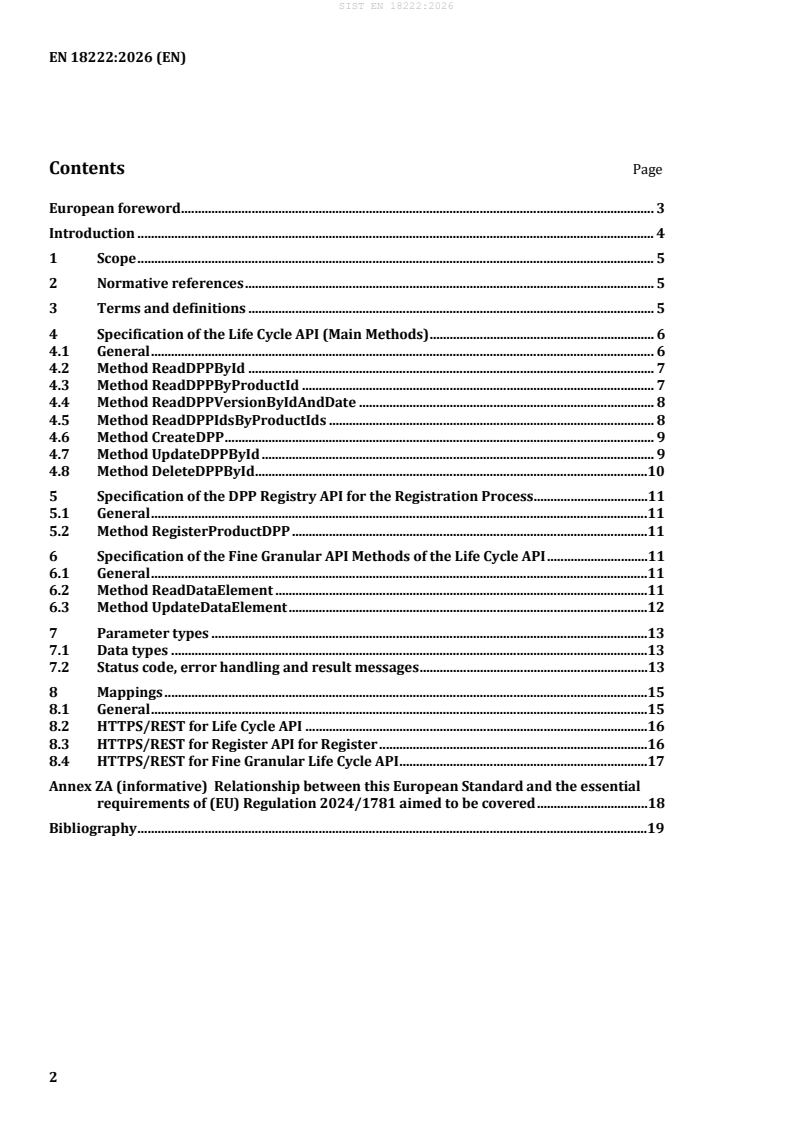
Contents Page
European foreword . 3
Introduction . 4
1 Scope . 5
2 Normative references . 5
3 Terms and definitions . 5
4 Specification of the Life Cycle API (Main Methods) . 6
4.1 General . 6
4.2 Method ReadDPPById . 7
4.3 Method ReadDPPByProductId . 7
4.4 Method ReadDPPVersionByIdAndDate . 8
4.5 Method ReadDPPIdsByProductIds . 8
4.6 Method CreateDPP . 9
4.7 Method UpdateDPPById . 9
4.8 Method DeleteDPPById .10
5 Specification of the DPP Registry API for the Registration Process .11
5.1 General .11
5.2 Method RegisterProductDPP .11
6 Specification of the Fine Granular API Methods of the Life Cycle API .11
6.1 General .11
6.2 Method ReadDataElement .11
6.3 Method UpdateDataElement .12
7 Parameter types .13
7.1 Data types .13
7.2 Status code, error handling and result messages .13
8 Mappings .15
8.1 General .15
8.2 HTTPS/REST for Life Cycle API .16
8.3 HTTPS/REST for Register API for Register .16
8.4 HTTPS/REST for Fine Granular Life Cycle API .17
Annex ZA (informative) Relationship between this European Standard and the essential
requirements of (EU) Regulation 2024/1781 aimed to be covered .18
Bibliography .19
European foreword
This document (EN 18222:2026) has been prepared by Technical Committee CEN/CLC/JTC 24 “Digital
Product Passport – Framework and System”, the secretariat of which is held by DIN.
This European Standard shall be given the status of a national standard, either by publication of an
identical text or by endorsement, at the latest by November 2026, and conflicting national standards shall
be withdrawn at the latest by November 2026.
Attention is drawn to the possibility that some of the elements of this document may be the subject of
patent rights. CEN shall not be held responsible for identifying any or all such patent rights.This document
has been prepared under a standardization request addressed to CEN by the European Commission. The
Standing Committee of the EFTA States subsequently approves these requests for its Member States.
For the relationship with EU Legislation, see informative Annex ZA, which is an integral part of this
document.
Any feedback and questions on this document should be directed to the users’ national standards body.
A complete listing of these bodies can be found on the CEN website.
According to the CEN-CENELEC Internal Regulations, the national standards organisations of the
following countries are bound to implement this European Standard: Austria, Belgium, Bulgaria, Croatia,
Cyprus, Czech Republic, Denmark, Estonia, Finland, France, Germany, Greece, Hungary, Iceland, Ireland,
Italy, Latvia, Lithuania, Luxembourg, Malta, Netherlands, Norway, Poland, Portugal, Republic of North
Macedonia, Romania, Serbia, Slovakia, Slovenia, Spain, Sweden, Switzerland, Türkiye and the United
Kingdom.
Introduction
0.1 Background
A digital product passport (DPP) is a key enabling mechanism to make product information traceable and
accessible across value chains - supporting economic operators, manufacturers, distributors, repairers,
recyclers and consumers to make informed decisions and to support a circular economy. The
implementation of digital product passports will be carried out progressively. Sector-specific initiatives
will determine the precise DPP content and requirements for individual product groups.
To support the implementation of DPPs, 8 standards have been developed so far:
— EN 18219:2026 – Digital product passport – Unique identifiers
— EN 18220:2026 – Digital product passport – Data carriers
— EN 18216:2026 – Digital product passport – Data exchange protocols
— EN 18222: 2026 – Digital Product Passport – Application Programming Interfaces (APIs) for the
product passport lifecycle management and searchability (this document)
— EN 18223:2026 – Digital Product Passport – System interoperability
— EN 18221:2026 – Digital product passport – data storage, archiving, and data persistence
— EN 18239:— – Digital Product Passport – access rights management, information system security,
and business confidentiality
— EN 18246:— – Digital Product Passport – Data authentication, reliability and integrity
0.2 Overview
The Ecodesign for Sustainable Products Regulation (ESPR) is an initiative by the European Commission
aimed at promoting sustainable products by setting comprehensive requirements for product design,
production, and lifecycle management. Central to this initiative is the digital product passport (DPP),
which tracks and provides essential information about a product's sustainability attributes. Beside of that
also other data can be stored in a DPP depending on future delegated acts and the needs of economic
operators.
This document introduces the specifications for the API of the DPP, as mandated by the ESPR. The API is
designed to enhance the searchability of DPPs and to support interactions throughout the lifecycle of a
product's DPP. Furthermore, it also provides an API to register a DPP at the DPP registry.
The API methods are presented on a technology-neutral level, detailing the expected inputs and outputs
for each method. A detailed technological implementation using a REST-HTTP API is described in the
Clause 8, providing guidelines for developers to implement the functionality effectively within their
specific environments.
The specification document of EN 18223 describes the logical content of the payload that is used by the
API. EN 18216 defines the basic principles of the exchange protocol and the allowed serialization formats
of the payload data. Security requirements need to be followed based on the specification document of
EN 18246 .
Under preparation. Stage at the time of publication: prEN 18239:2025.
Under preparation. Stage at the time of publication: prEN 18246:2025.
1 Scope
This document aims to standardize the specifications for the API of the digital product passport (DPP) as
mandated by the ESPR of the European Commission. The purpose of this API is to facilitate the
searchability of DPPs, as well as to provide the necessary means for interactions throughout the lifecycle
of a product's DPP.
2 Normative references
The following documents are referred to in the text in such a way that some or all of their content
constitutes requirements of this document. For dated references, only the edition cited applies. For
undated references, the latest edition of the referenced document (including any amendments) applies.
EN 18221:2026, Digital product passport - data storage, archiving, and data persistence
3 Terms and definitions
For the purposes of this document, the following terms and definitions apply.
ISO and IEC maintain terminology databases for use in standardization at the following addresses:
— ISO Online browsing platform: available at http://www.iso.org/obp
— IEC Electropedia: available at http://www.electropedia.org/
3.1
application programming interface
API
set of methods (3.3) provided by an application component for use by other application components
3.1.1
representational state transfer application programming interface
REST API
service that allows for interaction with resources via a stateless, client-server architecture, typically using
standard HTTP calls like GET, POST, PUT, and DELETE to perform methods (3.3) by an application
component on these resources
3.2
digital product passport
DPP
digital record of product characteristics throughout its life cycle
Note 1 to entry: Example characteristics include environmental sustainability, environmental impact, and
recyclability
3.3
method
particular way used to perform a specific action on a resource
EXAMPLE read a DPP
3.4
parameter
data provided by a client, that is needed to perform a method (3.3)
EXAMPLE DPP ID for read DPP
3.5
result
return value after the execution of a method (3.3)
EXAMPLE the DPP
3.6
unique registration identifier
identifier returned after uploading the unique identifiers and any other data required to the DPP registry
EXAMPLE Unique identifiers can be unique product identifier, unique facility identifier, unique operator
identifier of the economic operator etc.
4 Specification of the Life Cycle API (Main Methods)
4.1 General
In this clause only the API methods as can be made available by the custodian of a DPP (either economic
operator or service provider) are contained. These methods are specified in an abstract manner, the
precise implementation is provided in Clause 8, which also contains information how the input and
output parameters are provided.
The following methods shall be made available by the creator of the digital product passport or their main
digital product passport service provider as well as by back-up digital product passport service provider:
— ReadDPPById
— ReadDPPByProductId
— ReadDPPIdsByProductIds
The following methods should be made available by the creator of the digital product passport or their
main digital product passport service provider as well as by back-up digital product passport service
provider:
— ReadDataElement
The following methods should be made available by the main digital product passport service provider
as well as by back-up digital product passport service provider:
— CreateDPP
— DeleteDPPById
— ReadDPPVersionByIdAndDate
The following methods shall be made available by the creator of the digital product passport or their main
digital product passport service provider if authorized third parties have access rights to update parts of
the DPP:
— UpdateDPPById
The following methods should be made available by the creator of the digital product passport or their
main digital product passport service provider if authorized third parties have access rights to update
parts of the DPP:
— UpdateDataElement
In principle, the DPP API will offer these set of methods, that is requested with some parameters,
performing a behaviour (e.g. executing an action), and responding with a result. These expectations are
formally described for each method in the following subclauses.
Following methods support querying that may be used to create search functionality
— ReadDPPByProductId
— ReadDPPIdsByProductIds
— ReadDPPVersionByProductIdAndDate
Content negotiation according to EN 18216 [1] should be used if multiple response types are supported.
4.2 Method ReadDPPById
...