

EN 18246:2026
(Main)Digital product passport - Data authentication, reliability and integrity
- Abstract
This document defines the requirements and frameworks for secure information processing and communication to safeguard integrity, authenticity and reliability in the digital product passport (DPP) data exchange, minimizing product fraud and counterfeiting through data verification and integrity enforcement mechanisms.
This document provides a framework for establishing trust, interoperability, and interoperation via secure electronically signed data construct (ESDC) for multi-actor applications, applicable across various sectors and in multilingual environments. Existing hardware and software systems for unique product identification and storage of this identification are to be considered.
The following is out of scope of the document: system architecture for DPP, DPP use cases, secure elements related to data carriers and cryptographic security features for unique product identifiers.
NOTE 1 While not disrupting existing traceability and authentication systems, this document facilitates interoperability by introducing an ESDC scheme to be combined with existing data constructs to cover and preserve existing data models.
NOTE 2 Annex B includes illustrative examples and references to supporting implementations, intended to demonstrate approaches that promote interoperability across diverse environments. These references are provided to assist stakeholders in selecting appropriate solutions that comply with applicable legal obligations and technical standards, while preserving existing systems.
- Status
- Published
- Publication Date
- 15-Sep-2026
- Technical Committee
- JTC 24 - Digital Product Passport (DPP)
- Drafting Committee
- WG 3 - Security
- Current Stage
- 6060 - Definitive text made available (DAV) - Publishing
- Start Date
- 16-Sep-2026
- Due Date
- 02-Sep-2026
- Completion Date
- 16-Sep-2026

EN 18246:2026 is a CEN European Standard on digital product passport (DPP) data authentication, reliability and integrity. It specifies requirements and frameworks for secure information processing and communication so that DPP data can be trusted, verified and protected against fraud and counterfeiting. It is intended for DPP actors across sectors, including economic operators, service providers, verifiers and others who create, exchange or check DPP data.
What does EN 18246:2026 specify?
EN 18246:2026 specifies how DPP data exchange should protect authenticity, integrity and reliability, and how secure electronically signed data construct (ESDC) mechanisms support trust in multi-actor, multilingual DPP environments. It also sets out what is outside its scope and how the document is structured.
The scope covers secure information processing and communication for DPP data exchange, while considering existing hardware and software for unique product identification and storage of that identification. The document excludes system architecture for DPP, DPP use cases, secure elements related to data carriers, and cryptographic security features for unique product identifiers.
| Annex | What it covers |
|---|---|
| Annex A | Normative requirements for electronically signed data constructs (ESDCs) |
| Annex B | Informative examples of ESDCs, including EAA, VDS, DigSig, W3C Verifiable Credentials, and digital signatures and seals |
| Annex C | Informative risks and considerations related to fair competition |
| Annex ZA | Informative relationship to Regulation (EU) 2024/1781 |
The document is organized into scope, normative references, terms and definitions, general security assumptions, and risk-based requirements for identifiers, data carriers and DPP data. That structure matters in practice because it separates the core security rules from the examples and the EU-law mapping.
What are the key requirements of EN 18246:2026?
EN 18246:2026 requires DPP data to be protected against unauthorised modification and to be attributable to a verifiable source. It also requires the mechanisms for integrity and authenticity to be independent from the communication channels used to transmit the data.
General security and actor identification
Clause 4 requires a DPP to contain public and controlled data, with controlled access limited by user rights. All actors accessing controlled DPP data shall be identified by a globally unique identifier, and authentication shall use the required level of assurance.
In practice, this means the DPP system must know who is allowed to do more than read public data, and it must tie that access to a reliable identity. That is what makes later verification, logging and accountability workable.
Public access to DPP data
Clause 4.3 requires public DPP data to be readable without authentication and without additional software. It also requires measures to avoid profiling, and optional extra security must not block access for users without special tools.
This matters because a consumer, inspector or buyer should be able to reach the public DPP quickly from a normal browser or device. Public access is meant to stay simple, even when the system includes extra security for other data.
Communication and identifiers
Clause 4.4 requires secure communication using encryption and authentication methods in accordance with relevant standards, while public data access does not require encryption or authentication. Clause 4.5 and 4.6 require product identifiers and data carriers to align with EN 18219:2026 and EN 18220:2026, and at least one data carrier on each product shall let all users reach public DPP data without additional software.
In practice, this links the DPP to a readable product identifier and a usable carrier such as a code or tag. The standard is trying to preserve interoperability, so a reader can still reach the DPP even when the product or carrier is protected.
Authenticity, integrity and non-repudiation
Clause 4.7 requires DPP authenticity and data integrity to be verifiable free of charge, and without limitations for the verifier. Every creation, change or deletion shall be bound to the authenticated actor, with non-repudiation and audit-proof logging over time.
That means the system must show who changed what, when and by which trusted credential. For an operator, this supports traceability; for a verifier, it supports confidence that the data has not been altered silently.
Privacy, exclusion and fair access
Clause 5.1 requires public-data access not to collect personal information from users, not to use external analytics tools, and not to rely on device functions such as location, messaging or network management. Clause 5.4 requires access for any consumer device and accessibility for persons with disabilities, while preserving data integrity and authenticity.
In practice, the DPP must work without creating barriers for ordinary users or people who rely on assistive technologies. It also means privacy-by-design choices are part of the standard, not an optional extra.
Risk-based protection against fraud and misuse
Clause 5.2 addresses identification risks and requires controlled-data actors to remain identifiable, without location-based restrictions where legal requirements are met. Clause 5.3 calls for counterfeiting risk assessment where relevant, and for measures such as verifiable authentication elements or DPP-linked authentication services when risk is elevated.
That gives organizations a basis for proportionate controls rather than one fixed technical solution for every product. It is especially relevant when a valid DPP could be misused with counterfeit goods.
What terms does EN 18246:2026 define?
- electronically signed data construct (ESDC) - A structured data set with a header, payload, signature and optional data fields.
- digital product passport (DPP) - A digital record of product characteristics throughout its life cycle.
- unique product identifier - A unique string used to identify a product and link to the DPP.
- data carrier - A device or medium that stores data as a relay mechanism in an automatic identification and data capture system.
- controlled DPP data - DPP information whose access is limited according to the user’s access rights.
- verifier - The entity that performs the verification process.
- digital certificate - Public key information of an entity signed by a certification authority, used to support trusted authentication.
Who uses EN 18246:2026?
EN 18246:2026 is used by economic operators, manufacturers, authorized representatives, importers, distributors, dealers and fulfilment service providers that place products on the market. It is also relevant to DPP service providers, Trust Service Providers, verifiers, regulators, customs, market surveillance authorities and end users.
In practice, these groups use the standard to design or assess DPP data protection, sign and verify DPP data, manage access rights, build public-reading interfaces, and record changes in a non-repudiable way. It is also relevant for buyers, quality managers and compliance teams checking whether a DPP solution is readable, interoperable and auditable.
Which standards are used with EN 18246:2026?
EN 18246:2026 cites five normative references that provide the DPP building blocks it depends on:
- EN 18216:2026 - DPP data exchange protocols
- EN 18219:2026 - Unique identifiers
- EN 18220:2026 - Data carriers
- EN 18221:2026 - Data storage, archiving, and data persistence
- EN 18239:2026 - Access rights management, information system security, and business confidentiality
The text also points to ETSI EN 319 401:2024 for Trust Service Providers, and Annex B gives examples using ISO 22376, ISO/IEC 20248 and W3C Verifiable Credentials. Those references help implementers choose a compatible signing or verification approach.
What does the EN 18246:2026 document contain?
The document contains general security assumptions for DPPs, then a risk-based set of requirements covering data security and privacy, identification, product counterfeiting, and exclusion. It also contains a normative annex on ESDCs, which explains how signed data constructs support DPP trust, authenticity and non-repudiation.
Annex B gives worked examples of possible ESDC approaches, including electronic attestation of attributes, visible digital seal (VDS), AIDC digital signature verifiable data structure (DigSig), W3C Verifiable Credentials, and digital signatures and electronic seals. Annex C discusses fair competition, including the risk of vendor-specific software and the burden on SMEs.
Annex ZA maps the standard to Regulation (EU) 2024/1781 and explains the relationship to the listed regulatory requirements. That makes the document useful both for implementation and for compliance planning.
Relations
- Referred By
EN ISO 28881:2022 - Machine tools - Safety - Electrical discharge machines (ISO 28881:2022) - Effective Date
- 28-Jan-2026
- Referred By
EN ISO 19085-15:2025 - Woodworking machines - Safety - Part 15: Presses (ISO 19085-15:2025) - Effective Date
- 28-Jan-2026
- Effective Date
- 28-Jan-2026
Get Certified
Connect with accredited certification bodies for this standard

BSI Group
BSI (British Standards Institution) is the business standards company that helps organizations make excellence a habit.

Bureau Veritas
Bureau Veritas is a world leader in laboratory testing, inspection and certification services.

DNV
DNV is an independent assurance and risk management provider.
Sponsored listings
Frequently Asked Questions
EN 18246:2026 is a standard published by the European Committee for Standardization (CEN). Its full title is "Digital product passport - Data authentication, reliability and integrity". This standard covers: This document defines the requirements and frameworks for secure information processing and communication to safeguard integrity, authenticity and reliability in the digital product passport (DPP) data exchange, minimizing product fraud and counterfeiting through data verification and integrity enforcement mechanisms. This document provides a framework for establishing trust, interoperability, and interoperation via secure electronically signed data construct (ESDC) for multi-actor applications, applicable across various sectors and in multilingual environments. Existing hardware and software systems for unique product identification and storage of this identification are to be considered. The following is out of scope of the document: system architecture for DPP, DPP use cases, secure elements related to data carriers and cryptographic security features for unique product identifiers. NOTE 1 While not disrupting existing traceability and authentication systems, this document facilitates interoperability by introducing an ESDC scheme to be combined with existing data constructs to cover and preserve existing data models. NOTE 2 Annex B includes illustrative examples and references to supporting implementations, intended to demonstrate approaches that promote interoperability across diverse environments. These references are provided to assist stakeholders in selecting appropriate solutions that comply with applicable legal obligations and technical standards, while preserving existing systems.
This document defines the requirements and frameworks for secure information processing and communication to safeguard integrity, authenticity and reliability in the digital product passport (DPP) data exchange, minimizing product fraud and counterfeiting through data verification and integrity enforcement mechanisms. This document provides a framework for establishing trust, interoperability, and interoperation via secure electronically signed data construct (ESDC) for multi-actor applications, applicable across various sectors and in multilingual environments. Existing hardware and software systems for unique product identification and storage of this identification are to be considered. The following is out of scope of the document: system architecture for DPP, DPP use cases, secure elements related to data carriers and cryptographic security features for unique product identifiers. NOTE 1 While not disrupting existing traceability and authentication systems, this document facilitates interoperability by introducing an ESDC scheme to be combined with existing data constructs to cover and preserve existing data models. NOTE 2 Annex B includes illustrative examples and references to supporting implementations, intended to demonstrate approaches that promote interoperability across diverse environments. These references are provided to assist stakeholders in selecting appropriate solutions that comply with applicable legal obligations and technical standards, while preserving existing systems.
EN 18246:2026 is classified under the following ICS (International Classification for Standards) categories: 13.020.20 - Environmental economics. Sustainability; 35.240.63 - IT applications in trade. The ICS classification helps identify the subject area and facilitates finding related standards.
EN 18246:2026 has the following relationships with other standards: It is inter standard links to EN ISO 28881:2022, EN ISO 19085-15:2025, EN ISO 3691-4:2023. Understanding these relationships helps ensure you are using the most current and applicable version of the standard.
EN 18246:2026 is associated with the following European legislation: EU Directives/Regulations: 2024/1781, (EU) 2024/1781; Standardization Mandates: M/604, M/604 AMD 1. When a standard is cited in the Official Journal of the European Union, products manufactured in conformity with it benefit from a presumption of conformity with the essential requirements of the corresponding EU directive or regulation.
EN 18246:2026 is available in PDF format for immediate download after purchase. The document can be added to your cart and obtained through the secure checkout process. Digital delivery ensures instant access to the complete standard document.
Standards Content (Sample)
SLOVENSKI STANDARD
01-november-2026
Digitalni potni list izdelka - Preverjanje pristnosti, zanesljivost in celovitost
podatkov
Digital product passport - Data authentication, reliability and integrity
Digitaler Produktpass - Datenauthentifizierung, Zuverlässigkeit und Integrität
Passeport numérique des produits - Authentification, fiabilité et intégrité des données
Ta slovenski standard je istoveten z: EN 18246:2026
ICS:
13.020.20 Okoljska ekonomija. Environmental economics.
Trajnostnost Sustainability
35.240.63 Uporabniške rešitve IT v IT applications in trade
trgovini
2003-01.Slovenski inštitut za standardizacijo. Razmnoževanje celote ali delov tega standarda ni dovoljeno.
EUROPEAN STANDARD EN 18246
NORME EUROPÉENNE
EUROPÄISCHE NORM
September 2026
ICS 35.240.63
English version
Digital product passport - Data authentication, reliability
and integrity
Passeport numérique des produits - Authentification, Digitaler Produktpass - Datenauthentifizierung,
fiabilité et intégrité des données Zuverlässigkeit und Integrität
This European Standard was approved by CEN on 17 August 2026.
CEN and CENELEC members are bound to comply with the CEN/CENELEC Internal Regulations which stipulate the conditions for
giving this European Standard the status of a national standard without any alteration. Up-to-date lists and bibliographical
references concerning such national standards may be obtained on application to the CEN-CENELEC Management Centre or to
any CEN and CENELEC member.
This European Standard exists in three official versions (English, French, German). A version in any other language made by
translation under the responsibility of a CEN and CENELEC member into its own language and notified to the CEN-CENELEC
Management Centre has the same status as the official versions.
CEN and CENELEC members are the national standards bodies and national electrotechnical committees of Austria, Belgium,
Bulgaria, Croatia, Cyprus, Czech Republic, Denmark, Estonia, Finland, France, Germany, Greece, Hungary, Iceland, Ireland, Italy,
Latvia, Lithuania, Luxembourg, Malta, Netherlands, Norway, Poland, Portugal, Republic of North Macedonia, Romania, Serbia,
Slovakia, Slovenia, Spain, Sweden, Switzerland, Türkiye and United Kingdom.
CEN-CENELEC Management Centre:
Rue de la Science 23, B-1040 Brussels
© 2026 CEN/CENELEC All rights of exploitation in any form and by any means
Ref. No. EN 18246:2026 E
reserved worldwide for CEN national Members and for
CENELEC Members.
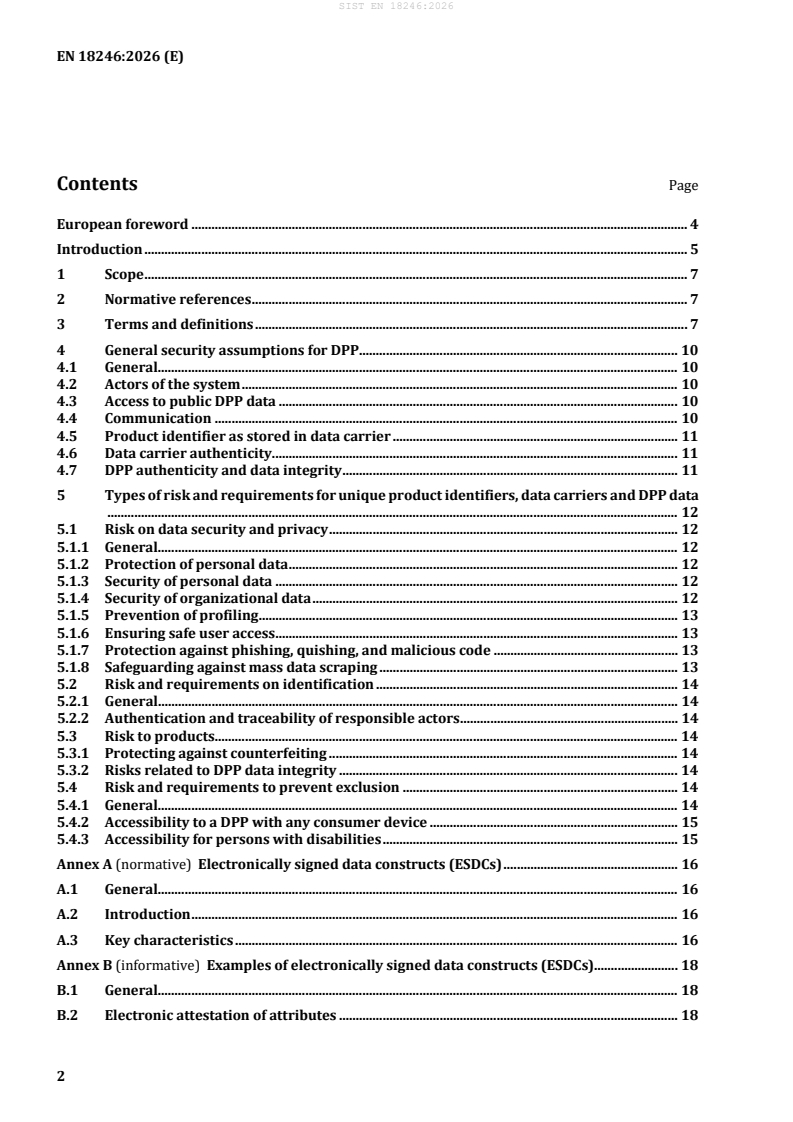
Contents Page
European foreword . 4
Introduction . 5
1 Scope . 7
2 Normative references . 7
3 Terms and definitions . 7
4 General security assumptions for DPP. 10
4.1 General. 10
4.2 Actors of the system . 10
4.3 Access to public DPP data . 10
4.4 Communication . 10
4.5 Product identifier as stored in data carrier . 11
4.6 Data carrier authenticity. 11
4.7 DPP authenticity and data integrity . 11
5 Types of risk and requirements for unique product identifiers, data carriers and DPP data
.......................................................................................................................................................................... 12
5.1 Risk on data security and privacy . 12
5.1.1 General. 12
5.1.2 Protection of personal data . 12
5.1.3 Security of personal data . 12
5.1.4 Security of organizational data . 12
5.1.5 Prevention of profiling . 13
5.1.6 Ensuring safe user access . 13
5.1.7 Protection against phishing, quishing, and malicious code . 13
5.1.8 Safeguarding against mass data scraping . 13
5.2 Risk and requirements on identification . 14
5.2.1 General. 14
5.2.2 Authentication and traceability of responsible actors . 14
5.3 Risk to products. 14
5.3.1 Protecting against counterfeiting . 14
5.3.2 Risks related to DPP data integrity . 14
5.4 Risk and requirements to prevent exclusion . 14
5.4.1 General. 14
5.4.2 Accessibility to a DPP with any consumer device . 15
5.4.3 Accessibility for persons with disabilities . 15
Annex A (normative) Electronically signed data constructs (ESDCs) . 16
A.1 General. 16
A.2 Introduction . 16
A.3 Key characteristics . 16
Annex B (informative) Examples of electronically signed data constructs (ESDCs). 18
B.1 General. 18
B.2 Electronic attestation of attributes . 18
B.3 Visible digital seal (VDS - ISO 22376) . 19
B.4 AIDC digital signature verifiable data structure (DigSig - ISO/IEC 20248) . 20
B.5 W3C Verifiable Credentials . 21
B.6 Digital signatures and electronic seals . 22
Annex C (informative) Risk and considerations related to fair competition . 23
C.1 General . 23
C.2 Avoiding market restrictions by vendor-specific software . 23
C.3 Disproportionate resource demand for SMEs . 23
Annex ZA (informative) Relationship between this European Standard and the requirements of
Regulation (EU) 2024/1781 aimed to be covered . 24
Bibliography . 25
European foreword
This document (EN 18246:2026) has been prepared by the Joint Technical Committee CEN-CENELEC/
JTC 24 “Digital Product Passport - Framework and System”, the secretariat of which is held by DIN.
This European Standard shall be given the status of a national standard, either by publication of an
identical text or by endorsement, at the latest by March 2027, and conflicting national standards shall be
withdrawn at the latest by March 2027.
Attention is drawn to the possibility that some of the elements of this document may be the subject of
patent rights. CEN-CENELEC shall not be held responsible for identifying any or all such patent rights.
This document has been prepared under a standardization request addressed to CEN-CENELEC by the
European Commission. The Standing Committee of the EFTA States subsequently approves these
requests for its Member States.
For the relationship with EU Legislation, see informative Annex ZA, which is an integral part of this
document.
Any feedback and questions on this document should be directed to the users’ national standards
body/national committee. A complete listing of these bodies can be found on the CEN and CENELEC
websites.
According to the CEN-CENELEC Internal Regulations, the national standards organisations of the
following countries are bound to implement this European Standard: Austria, Belgium, Bulgaria, Croatia,
Cyprus, Czech Republic, Denmark, Estonia, Finland, France, Germany, Greece, Hungary, Iceland, Ireland,
Italy, Latvia, Lithuania, Luxembourg, Malta, Netherlands, Norway, Poland, Portugal, Republic of North
Macedonia, Romania, Serbia, Slovakia, Slovenia, Spain, Sweden, Switzerland, Türkiye and the United
Kingdom.
Introduction
0.1 Background
A digital product passport (DPP) is a key enabling mechanism to make product information traceable and
accessible across value chains – supporting economic operators, manufacturers, distributors, repairers,
recyclers and consumers to make informed decisions and to support a circular economy. The
implementation of DPPs will be carried out progressively. Sector-specific initiatives will determine the
precise DPP content and requirements for individual product groups.
To support the implementation of DPPs, 8 standards have been developed:
— EN 18219:2026 – Digital product passport – Unique identifiers
— EN 18220:2026 – Digital product passport – Data carriers
— EN 18216:2026 – Digital product passport – Data exchange protocols
— EN 18222:2026 – Digital product passport – Application Programming Interfaces (APIs) for the
product passport lifecycle management and searchability
— EN 18223:2026 – Digital product passport – System interoperability
— EN 18221:2026 – Digital product passport – Data storage, archiving, and data persistence
— EN 18239:2026 – Digital product passport – Access rights management, information system security,
and business confidentiality
— EN 18246:2026 – Digital product passport – Data authentication, reliability and integrity (this
document)
0.2 Overview
Trust is key to any transaction whether physical or digital. Data and information collected during the
whole life cycle of the product is to be protected from both accidental and malicious compromise and
misuse.
Reasonable security expectation is likely to address the following elements of the DPP deployment:
— management and verification of identifiers;
— relationship between the unique identifiers and possible authentication elements related to them;
— questions that deal with the identification of the verifier and any authorized access to privileged
product-related information;
— authentication solutions;
— artefact metrics (technical measurements used to support verification or trust in physical objects),
where relevant;
— information processing and communication that protects integrity along the supply chain of physical
and related electronic documents, products, software and services life cycle to mitigate the risk of
product fraud and counterfeit goods, by using object identification techniques; and
— electronically signed data constructs (ESDCs) or equivalent functions.
A wide variety of information security techniques are routinely deployed at scale and at different levels.
For example, the banking, retail, and entertainment industries are global, connected, and always
available. The EU DPP system should leverage industry standards and best practices in all aspects of the
DPP solution, from data generation by the economic operator and data storage in distributed data
centres, through to the management of access rights for data access and data queries. The DPP end users,
product owners, and enforcement agencies will all benefit from a trustworthy DPP infrastructure.
The unique product identifier, as stored in a data carrier can be considered as the DPP access anchor.
Trust in the identifier is therefore a foundational element to the trust of DPP.
1 Scope
This document defines the requirements and frameworks for secure information processing and
communication to safeguard integrity, authenticity and reliability in the digital product passport (DPP)
data exchange, minimizing product fraud and counterfeiting through data verification and integrity
enforcement mechanisms.
This document provides a framework for establishing trust, interoperability, and interoperation via
secure electronically signed data construct (ESDC) for multi-actor applications, applicable across various
sectors and in multilingual environments. Existing hardware and software systems for unique product
identification and storage of this identification are to be considered.
The following is out of scope of the document: system architecture for DPP, DPP use cases, secure
elements related to data carriers and cryptographic security features for unique product identifiers.
NOTE 1 While not disrupting existing traceability and authentication systems, this document facilitates
interoperability by introducing an ESDC scheme to be combined with existing data constructs to cover and preserve
existing data models.
NOTE 2 Annex B includes illustrative examples and references to supporting implementations, intended to
demonstrate approaches that promote interoperability across diverse environments. These references are
provided to assist stakeholders in selecting appropriate solutions that comply with applicable legal obligations and
technical standards, while preserving existing systems.
2 Normative references
The following documents are referred to in the text in such a way that some or all of their content
constitutes requirements of this document. For dated references, only the edition cited applies. For
undated references, the latest edition of the referenced document (including any amendments) applies.
EN 18216:2026, Digital product passport — Data exchange protocols
EN 18219:2026, Digital product passport — Unique identifiers
EN 18220:2026, Digital product passport — Data carriers
EN 18221:2026, Digital product passport — Data storage, archiving, and data persistence
EN 18239:2026, Digital product passport — Access rights management, information system security, and
business confidentiality
3 Terms and definitions
For the purposes of this document, the following terms and definitions apply.
ISO and IEC maintain terminology databases for use in standardization at the following addresses:
— ISO Online browsing platform: available at https://www.iso.org/obp/
— IEC Electropedia: available at https://www.electropedia.org/
3.1
electronically signed data construct
ESDC
structured data set containing the header, payload, signature and optional data fields
3.2
digital product passport
DPP
digital record of product characteristics throughout its life cycle
Note 1 to entry: Example characteristics include environmental sustainability, environmental impact, and
recyclability
3.3
unique product identifier
unique string of characters for the identification of a product that also enables a web link to the DPP
3.4
identity proofing
process by which the Registration Authority (RA) captures and verifies sufficient information to identify
an entity to a specified or understood level of assurance
[SOURCE: ISO/IEC 29115:2013, 3.15]
3.5
level of assurance
description of the strength of entity authentication assurance
Note 1 to entry: ISO/IEC 29115:2013 specifies multiple levels of assurance.
[SOURCE: ISO/IEC 24760-1:2025, 3.4.11]
3.6
digital certificate
certificate
public key information of an entity signed by the certification authority (CA) and thereby rendered
unforgeable
[SOURCE: ISO/IEC 9798-1]
3.7
data carrier
device or medium used to store data as a relay mechanism in an automatic identification and data capture
system
[SOURCE: EN 18220:2026]
3.8
signature
digital signature
data appended to, or a cryptographic transformation of, a data unit that allows the recipient of the data
unit to prove the origin and integrity of the data unit and protect against forgery, e.g. by the recipient
Note 1 to entry: Digital signatures may be used for purposes of authentication, data integrity, and non-repudiation.
[SOURCE: ISO/IEC 19784-1:2018, 4.34]
3.9
unique economic operator identifier
unique string of characters for the identification of an actor involved in a product’s value chain
3.10
additional software
additional application, program, or tool that a user will install or access separately from the default setup
of most smartphones or similar devices to interact with the DPP
EXAMPLE Proprietary applications, plugins or extensions, dedicated apps, specialized middleware, or
customized software readers.
Note 1 to entry: Standard functionalities, such as web browsers, camera-based QR readers, and universal
communication protocols (e.g. DNS, HTTP, HTTPS), are not considered as additional software.
3.11
non-repudiation
ability to prove an action or event has taken place, so that this event or action cannot be repudiated later
[SOURCE: ISO/IEC 27000]
3.12
personally identifiable information
PII
information that can be used in a given context to identify, contact, or locate a single person, or to identify
an individual in context
[SOURCE: ISO 19414:2020, 3.1]
3.13
verifier
entity that performs the verification process
[SOURCE: ISO/IEC 23264-1:2021, 3.27]
3.14
economic operator
manufacturer, authorized representative, importer, distributor, dealer or fulfilment service provider that
places the product onto the market
3.15
controlled DPP data
information on DPP whose access is controlled based on the user’s access rights
Note 1 to entry: User: person who interacts with a system, product or service.
[SOURCE: ISO 26800:2011, 2.10, modified – Notes changed]
3.16
DPP service
means by which DPP data is made accessible or presented
4 General security assumptions for DPP
4.1 General
The DPP provides required information for products. Product information consists of public and
controlled data.
All DPP data shall be protected against unauthorised modification and shall be attributable to a verifiable
source.
The mechanisms ensuring the integrity and authenticity of DPP data shall be independent from the
security mechanisms used for the communication channels over which the data are transmitted.
NOTE 1 The existence of a unique product identifier is a prerequisite for data verifiability.
NOTE 2 ISO 22373, ISO 22380 and ISO 22383 outline principles for addressing physical product fraud, focusing
on authenticity, integrity, and trust for products and documents. They provide guidelines for organizations to
identify and mitigate risks associated with inter alia product fraud, which can range from counterfeiting to
tampering and substitution. The standard emphasizes the importance of understanding the situational context of
fraud, including the motives and behaviours of fraudsters, to develop effective countermeasures such as the
selection of relevant physical authentication solutions. Types of fraud addressed include recreational, situational
context, occasional, occupational, professional and activism fraud and misinformation.
4.2 Actors of the system
Actors within the DPP system are defined in EN 18239:2026.
The unique economic operator identifier is defined in 3.9 in this document and in EN 18219:2026.
All actors accessing controlled DPP data shall be identified by a globally unique identifier.
Authentication processes shall be based on the required level of assurance.
4.3 Access to public DPP data
Access to DPP data, limited to reading purposes, differ from other use cases due to the following
considerations:
— No Authentication Required: Accessing public data shall not require authentication.
— Privacy Considerations: Measures shall be put in place to avoid profiling of users.
— Ease of Use and Scalability: The access control of DPP data should be capable of handling a large
number of requests while maintaining usability and system stability.
— No technological barriers: public DPP data shall be accessible without any additional software.
— Optional Additional Security: Additional security measures shall not prevent access to public DPP
data without additional software.
4.4 Communication
Communication within the DPP context refers to the transmission of product-related information
between stakeholders, ensuring that all involved parties, such as manufacturers, regulators, and
consumers, have access to accurate, relevant and up-to-date data.
The communication of this data shall be secure, using encryption and authentication methods in
accordance with relevant standards to prevent tampering, unauthorized access, or data breaches,
maintaining the integrity and confidentiality of the DPP. For access to public data, no encryption or
authentication mechanisms are required.
The requirements from ETSI EN 319 401:2024, relevant for Trust Service Providers, should be applied to
DPP service providers.
Responsible parties shall establish seamless and interoperable communication channels. These channels
shall enable different systems and actors to exchange DPP data while ensuring compatibility across
various platforms and compliance with both national and international regulatory frameworks as defined
in EN 18216:2026.
4.5 Product identifier as stored in data carrier
The product identifier contained within the data carrier should be, where relevant and appropriate,
protected by security measures to support authenticity and integrity.
Any solution for ensuring the authenticity and integrity of the product identifier shall be fully
interoperable with the unique identifiers as defined in EN 18219:2026.
At least one data carrier on each product shall allow all users to access the public DPP data without the
need for additional software.
DPP data may indicate that the unique identifier is protected and may provide the user with explicit
instructions for authenticating it.
4.6 Data carrier authenticity
The economic operator may secure the data carrier. In such cases, the DPP can include information on
how to inspect the related security feature(s).
Any solution for ensuring the physical authenticity of the physical data carrier shall be fully interoperable
with the data carriers as they are defined in EN 18220:2026.
Such solutions may require additional data carrier(s) and/or data source(s).
The protected data carrier shall allow all users to access the public DPP data without the need for
additional software.
DPP data may indicate that the data carrier(s) are protected and may provide the user with explicit
instructions for authenticating it.
4.7 DPP authenticity and data integrity
A DPP shall be verifiable in terms of authenticity and integrity of the data. Such verification shall be free
of charge and based on interoperable mechanisms in regulated scenarios, e.g. cross border.
All actors providing DPP data shall be authenticated using a mechanism that requires proof of ownership
of a digital certificate issued through an identity proofing process compatible with the provisions of the
relevant legal acts.
Every modification to the DPP data, including its first creation and deletion, shall be bound to the identity
of the authenticated actor performing such modification, through e.g. valid digital certificates, to provide
non-repudiation over the specific modification. Examples of technologies for achieving this are digital
signatures, digital seals, electronic attestation of attributes or ESDCs, based on digital certificates.
Checking the validity and integrity of the DPP data shall be free of charge and without limitations for the
verifier.
A user is not obliged to verify the DPP data.
Any creation, modification, or deletion of data shall be logged in a non-repudiable manner, should be
tamper-proof. Log data integrity shall be provided over time. This should be ensured without the need
for additional supporting documents or offline procedures.
The responsible editor of any change shall be identifiable through a globally unique operator identifier.
Any event that modifies a DPP during its operational phase shall be logged in an audit-proof manner, such
that they can be accessed by the relevant parties.
5 Types of risk and requirements for unique product identifiers, data carriers
and DPP data
5.1 Risk on data security and privacy
5.1.1 General
These subclauses refer to anonymous access to public data of one or many DPPs of interest, when using
common devices, such as smartphones using built-in capabilities, without requiring additional software.
These devices will follow the link enabled by the unique product identifier from the data carrier, as well
as using any kind of online system or software to access DPP data from a server running on behalf of the
economic operator or a DPP service provider.
These subclauses cover authenticated access to controlled data by authorized user groups, including the
performance of CRUD (create, read, update, delete) operations.
5.1.2 Protection of personal data
Implementation shall not gather any personal information from natural persons accessing public data
only.
In case of access to restricted data, authentication information may be requested.
5.1.3 Security of personal data
In case that personal data are gathered for permitted reasons, this data shall be secured against data loss,
disallowed access and against any use not intended and not covered by permitted reasons.
Implementation and/or operator shall provide legally required information, correction and deletion
possibilities for personal data.
DPP service shall not use external analytic tools and shall not include any reference to external
components in the response to the user.
5.1.4 Security of organizational data
Ensuring the security of organizational data is crucial to protect sensitive business information,
intellectual property, and operationa
...