


EN 13757-2:2018
(Main)Communication systems for meters - Part 2: Wired M-Bus communication
Communication systems for meters - Part 2: Wired M-Bus communication
This draft European standard is applicable to the physical and link layer parameters of baseband communication over twisted pair (M Bus) for meter communication systems. It is especially applicable to thermal energy meters, heat cost allocators, water meters and gas meters.
NOTE It is usable also for other meters (like electricity meters) and for sensors and actuators. For generic descriptions concerning communication systems for meters and remote reading of meters see EN 13757-1.
Kommunikationssysteme für Zähler - Teil 2: Drahtgebundene M-Bus-Kommunikation
Systèmes de communication pour compteurs - Partie 2 : Communication M-Bus filaire
La présente Norme européenne est applicable aux paramètres de la couche physique et de liaison de la communication en bande de base sur paire torsadée (M-Bus) pour les systèmes de communication des compteurs. Elle s'applique tout particulièrement aux compteurs d'énergie thermique, aux répartiteurs de frais de chauffage, aux compteurs d'eau et aux compteurs de gaz.
NOTE Elle est également applicable à d'autres compteurs (tels que les compteurs électriques) ainsi qu'à d'autres capteurs et organes de commande. Pour les descriptions génériques concernant les systèmes de communication et de télérelevé de compteurs, voir l'EN 13757-1.
Komunikacijski sistemi za števce - 2. del: Žične komunikacije po M-vodilu
Ta osnutek evropskega standarda se uporablja za parametre fizične in povezovalne plasti komunikacije v osnovnem pasu prek sukane parice (M-vodilo) za komunikacijske sisteme za merilnike. Uporablja se zlasti za merilnike toplotne energije, delilnike stroškov, merilnike vode in merilnike plina.
OPOMBA: Lahko se uporablja tudi za druge merilnike (npr. merilnike električne energije) ter za tipala in pogone. Za generične opise v zvezi s komunikacijskimi sistemi za merilnike in oddaljeno odbiranje merilnikov glej standard EN 13757-1.
General Information
- Status
- Withdrawn
- Publication Date
- 03-Apr-2018
- Withdrawal Date
- 13-Apr-2025
- Technical Committee
- CEN/TC 294 - Communication systems for meters and remote reading of meters
- Drafting Committee
- CEN/TC 294/WG 4 - Data exchange for meters on bus-systems and interface
- Current Stage
- 9960 - Withdrawal effective - Withdrawal
- Start Date
- 20-Dec-2023
- Completion Date
- 14-Apr-2025
Relations
- Effective Date
- 11-Apr-2018
- Merged Into
EN 13757-2:2018+A1:2023 - Communication systems for meters - Part 2: Wired M-Bus communication - Effective Date
- 11-Oct-2023
- Amended By
EN 13757-2:2018/FprA1 - Communication systems for meters - Part 2: Wired M-Bus communication - Effective Date
- 04-Aug-2021


Frequently Asked Questions
EN 13757-2:2018 is a standard published by the European Committee for Standardization (CEN). Its full title is "Communication systems for meters - Part 2: Wired M-Bus communication". This standard covers: This draft European standard is applicable to the physical and link layer parameters of baseband communication over twisted pair (M Bus) for meter communication systems. It is especially applicable to thermal energy meters, heat cost allocators, water meters and gas meters. NOTE It is usable also for other meters (like electricity meters) and for sensors and actuators. For generic descriptions concerning communication systems for meters and remote reading of meters see EN 13757-1.
This draft European standard is applicable to the physical and link layer parameters of baseband communication over twisted pair (M Bus) for meter communication systems. It is especially applicable to thermal energy meters, heat cost allocators, water meters and gas meters. NOTE It is usable also for other meters (like electricity meters) and for sensors and actuators. For generic descriptions concerning communication systems for meters and remote reading of meters see EN 13757-1.
EN 13757-2:2018 is classified under the following ICS (International Classification for Standards) categories: 33.200 - Telecontrol. Telemetering; 35.100.10 - Physical layer; 35.240.99 - IT applications in other fields; 91.140.50 - Electricity supply systems. The ICS classification helps identify the subject area and facilitates finding related standards.
EN 13757-2:2018 has the following relationships with other standards: It is inter standard links to EN 13757-2:2004, EN 13757-2:2018+A1:2023, EN 13757-2:2018/FprA1. Understanding these relationships helps ensure you are using the most current and applicable version of the standard.
EN 13757-2:2018 is associated with the following European legislation: Standardization Mandates: M/441. When a standard is cited in the Official Journal of the European Union, products manufactured in conformity with it benefit from a presumption of conformity with the essential requirements of the corresponding EU directive or regulation.
You can purchase EN 13757-2:2018 directly from iTeh Standards. The document is available in PDF format and is delivered instantly after payment. Add the standard to your cart and complete the secure checkout process. iTeh Standards is an authorized distributor of CEN standards.
Standards Content (Sample)
2003-01.Slovenski inštitut za standardizacijo. Razmnoževanje celote ali delov tega standarda ni dovoljeno.0YRGLOXKommunikationssysteme für Zähler - Teil 2: Drahtgebundene M-Bus-KommunikationSystèmes de communication pour compteurs - Partie 2 : Communication M-Bus filaireCommunication systems for meters - Part 2: Wired M-Bus communication35.100.10Physical layer33.200Daljinsko krmiljenje, daljinske meritve (telemetrija)Telecontrol. TelemeteringICS:Ta slovenski standard je istoveten z:EN 13757-2:2018SIST EN 13757-2:2018en,fr,de01-junij-2018SIST EN 13757-2:2018SLOVENSKI
STANDARDSIST EN 13757-2:20051DGRPHãþD
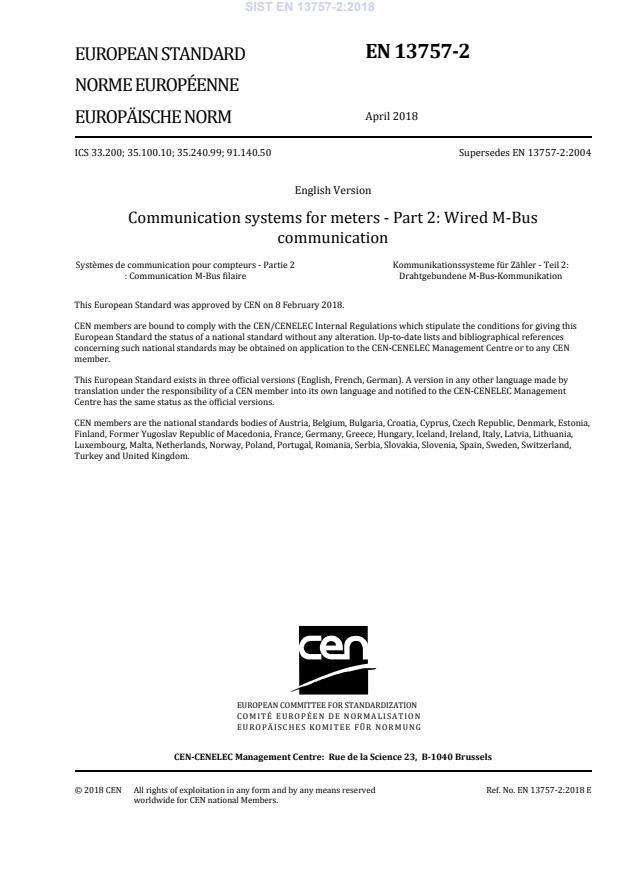
EUROPEAN STANDARD NORME EUROPÉENNE EUROPÄISCHE NORM
EN 13757-2
April
t r s z ICS
u uä t r râ
u wä s r rä s râ
u wä t v rä { {â
{ sä s v rä w r Supersedes EN
s u y w yæ tã t r r vEnglish Version
Communication systems for meters æ Part
tã Wired MæBus communication Systèmes de communication pour compteurs æ Partie
t ã Communication MæBus filaire
Kommunikationssysteme für Zähler æ Teil
tã Drahtgebundene MæBusæKommunikation This European Standard was approved by CEN on
z February
t r s zä
egulations which stipulate the conditions for giving this European Standard the status of a national standard without any alterationä Upætoædate lists and bibliographical references concerning such national standards may be obtained on application to the CENæCENELEC Management Centre or to any CEN memberä
translation under the responsibility of a CEN member into its own language and notified to the CENæCENELEC Management Centre has the same status as the official versionsä
CEN members are the national standards bodies of Austriaá Belgiumá Bulgariaá Croatiaá Cyprusá Czech Republicá Denmarká Estoniaá Finlandá Former Yugoslav Republic of Macedoniaá Franceá Germanyá Greeceá Hungaryá Icelandá Irelandá Italyá Latviaá Lithuaniaá Luxembourgá Maltaá Netherlandsá Norwayá Polandá Portugalá Romaniaá Serbiaá Slovakiaá Sloveniaá Spainá Swedená Switzerlandá Turkey and United Kingdomä
EUROPEAN COMMITTEE FOR STANDARDIZATION COMITÉ EUROPÉEN DE NORMALISATION EUROPÄISCHES KOMITEE FÜR NORMUNG
CEN-CENELEC Management Centre:
Rue de la Science 23,
B-1040 Brussels
t r s z CEN All rights of exploitation in any form and by any means reserved worldwide for CEN national Membersä Refä Noä EN
s u y w yæ tã t r s z ESIST EN 13757-2:2018
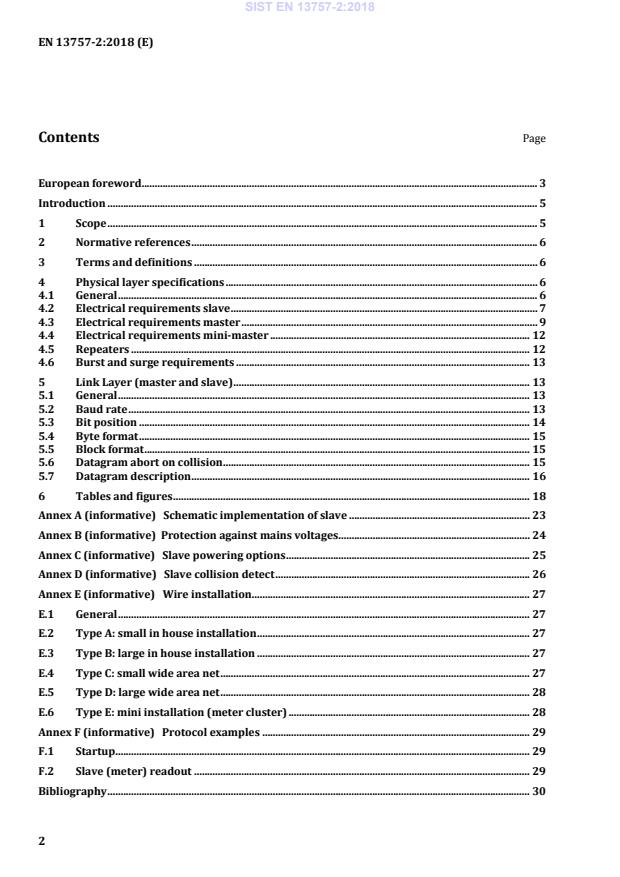
European foreword . 3 Introduction . 5 1 Scope . 5 2 Normative references . 6 3 Terms and definitions . 6 4 Physical layer specifications . 6 4.1 General . 6 4.2 Electrical requirements slave . 7 4.3 Electrical requirements master . 9 4.4 Electrical requirements mini-master . 12 4.5 Repeaters . 12 4.6 Burst and surge requirements . 13 5 Link Layer (master and slave) . 13 5.1 General . 13 5.2 Baud rate . 13 5.3 Bit position . 14 5.4 Byte format . 15 5.5 Block format . 15 5.6 Datagram abort on collision . 15 5.7 Datagram description . 16 6 Tables and figures . 18 Annex A (informative)
Schematic implementation of slave . 23 Annex B (informative)
Protection against mains voltages . 24 Annex C (informative)
Slave powering options . 25 Annex D (informative)
Slave collision detect . 26 Annex E (informative)
Wire installation . 27 E.1 General . 27 E.2 Type A: small in house installation . 27 E.3 Type B: large in house installation . 27 E.4 Type C: small wide area net . 27 E.5 Type D: large wide area net . 28 E.6 Type E: mini installation (meter cluster) . 28 Annex F (informative)
Protocol examples . 29 F.1 Startup . 29 F.2 Slave (meter) readout . 29 Bibliography . 30 SIST EN 13757-2:2018
It is usable also for other meters (like electricity meters) and for sensors and actuators. For generic descriptions concerning communication systems for meters and remote reading of meters see EN 13757–1. 2 Normative references The following documents, in whole or in part, are normatively referenced in this document and are indispensable for its application. For dated references, only the edition cited applies. For undated references, the latest edition of the referenced document (including any amendments) applies. EN 13757-1:2014, Communication systems for meters - Part 1: Data exchange EN 60870-5, (all parts), Telecontrol equipment and systems (IEC 60870-5 series) EN 60870-5-1, Telecontrol equipment and systems - Part 5: Transmission protocols - Section 1: Transmission frame formats EN 60870-5-2:1993, Telecontrol equipment and systems - Part 5: Transmission protocols - Section 2: Link transmission procedures EN 61000-4-4, Electromagnetic compatibility (EMC) - Part 4-4: Testing and measurement techniques - Electrical fast transient/burst immunity test EN 61000-4-5, Electromagnetic compatibility (EMC) - Part 4-5: Testing and measurement techniques - Surge immunity test 3 Terms and definitions For the purposes of this document, the terms and definitions given in EN 13757-1:2014 and the following apply. 3.1 unit load one unit load (1 UL) is the maximum mark state current of 1,5 mA 4 Physical layer specifications 4.1 General Figure 1 shows the principal electrical concept of the physical layer: Information from the master to the slaves is transmitted via voltage level changes. A mark state voltage UMark (idle state, typically 36 V) and an space state voltage which is typically 12 V below UMark (but at least 12 V) is used for the data transmission. The high voltage step improves the noise immunity in the master to slave direction. The required minimum voltage supports a stable remote powering of all slaves of a segment. Signalling via a voltage change rather than by absolute voltage levels supports even large voltage drops due to wiring SIST EN 13757-2:2018
Key 1 Bus Voltage at Repeater, Master transmits to Slave 2 Current composition of a Slave, Slave transmits to Master t time Figure 1 — Representation of bits on the M-Bus All specification requirements shall be held over the full range of temperature and operating voltage for the responsible system component. 4.2 Electrical requirements slave 4.2.1 Master to slave bus voltages Maximum permanent voltage: - 50 V to 0 V to + 50 V (no damage). Voltage range for meeting all specifications: ± (12 V to 42 V). The Bus voltage at the slave terminals in mark-(quiescent) state of master slave communication (= UMark) shall be ± (21 V to 42 V). SIST EN 13757-2:2018
UMark - 5,7 V; b) maximum space state time: 50 ms; c) maximum space state duty cycle: 0,92. 4.2.2 Slave bus current and multiple unit loads 4.2.2.1 General A slave device may require a maximum mark state current of an integer multiple N (in the range 1 to 4) unit loads. Each terminal device shall be marked with the unit load number N (If > 1) and the device description shall contain a note on the multiple unit loads for this device. 4.2.2.2 Mark state current of a slave device The mark state current IMark shall be
N unit loads. 4.2.2.3 Variation of the mark state current over bus voltage For bus voltages in the range of ± (12 V to 42 V) a voltage variation of 1 V to 15 V shall not change the bus current by more than N × 3 µA/V. 4.2.2.4 Short-term variation of the mark state current At constant bus voltage the bus current shall not change by more than ± 1 % within 10 s. 4.2.2.5 Total variation over allowed temperature and voltage range of slave device The total variation of the mark state current of a slave device shall not vary by more than ± 10 % over the full voltage and temperature range of the slave device. 4.2.2.6 Maximum bus current for any single semiconductor or capacitor defect 1 min after any single semiconductor or capacitor defect the maximum current of any slave device shall be less than 100 mA for any bus voltage
42 V. 4.2.2.7 Slow start For any bus voltage in the range of (0 to ± 42) V the bus current shall be limited to
N × UL. SIST EN 13757-2:2018
N × UL within 1 ms. 4.2.2.9 Space state current The bus current for a slave space state send shall be higher by (11 to 20) mA than in the mark state for all allowed bus voltages: ISpace = IMark + (11 to 20) mA 4.2.2.10 Input capacitance at the slave terminals:
0,5 nF This capacitance shall be measured with a DC bias of (15 to 30) V. 4.2.2.11 Startup delay In case of a bus voltage drop below 12 V for longer than 0,1 s the recovery time after applying an allowed mark state voltage until reaching full communication capabilities shall be less than 3 s. 4.2.2.12 Galvanic Isolation The isolation resistance between any bus terminal and all metal parts accessible without violating seals shall be > 1 M. Excluded are terminals for the connection of other floating or isolated external components. The test voltage is 500 V. For mains operated terminal devices the appropriate safety rules apply. 4.2.2.13 Optional reversible mains protection The slave interface can be equipped with an optional reversible mains protection. This guarantees that even for a prolonged period (test duration: 1 min) the slave interface can withstand mains voltages of 230 V + 10 % and 50 Hz or 60 Hz and that afterwards all specifications are met again. This mains protection function is recommended for all mains operated terminal devices. For possible implementations see Annex B. 4.2.3 Dynamic requirements Any link layer or application layer protocol of up to 38 400 Baud is acceptable if it guarantees that a mark state is reached for at least one bit time at least once in every 11 bit times and not later than after 50 ms. Note that this is applicable for any asynchronous protocol with 5 data bits to 8 data bits (with or without a parity bit) for any baud rate of at least 300 Baud, including a break signal (see 4.3.3.8). It is also applicable for many synchronous protocols with or without bit coding. 4.3 Electrical requirements master 4.3.1 Parameters 4.3.1.1 Max current (IMax) A master for this physical layer is characterized by its maximum current IMaximum. For all bus currents between zero and IMax it shall meet all functional and parametric requirements. For example a maximally loaded segment with up to 250 slaves with 1 UL each (375 mA) plus an allowance for one slave with a short circuit (+ 100 mA) plus the maximum space send current (+ 20 mA) an Imax
0,5 A is required. SIST EN 13757-2:2018
1/2 of a nominal bit time. The asymmetry of these transition times shall be
1/8 of a nominal bit time. Test conditions (CLoad selected from the E12 value series): — baud rate 300 Baud: CLoad = 1,5 F; — baud rate 2 400 Baud: CLoad = 1,2 F; — baud rate 9 600 Baud: CLoad = 0,82 F; — baud rate 38 400 Baud: CLoad = 0,39 F. 4.3.3.5 Effective source impedance The voltage drop of the bus voltage for a short (<50 ms) increase of the bus current by 20 mA shall be
1,2 V. 4.3.3.6 Hum, ripple and short-term (<10 s) stability of the bus voltages Hum, ripple and short-term (<10 s) stability of the bus voltages: < 200 mV peak to peak. 4.3.3.7 Data detection current (Reception of slave current pulses) Bus current
Bus idle current + 6 mA: Mark state receive. Bus current
Bus idle current + 9 mA: Space state receive. Measurement with current pulses of < 50 ms, duty cycle < 0,92. 4.3.3.8 Reaction at large data current (collision state, break signal) A current increase beyond a certain level shall be considered as a collision state. Current increases
25 mA shall never be detected as collision state. Current increases between 25 mA and 50 mA may be considered as collision state. Current increases of
50 mA shall be considered as collision state. For collision detection the collision state shall persist for at least 2 bit times at all supported baud rates. If a collision state persists for
50 µs the master shall not emit a break signal. If a collision state persists for > 50 µs to < 6,6 ms the master may emit a break signal. If a collision state persists for
6,6 ms the master shall emit a break signal. A break signal is characterized by a bus voltage = USpace and a duration of 40 ms up to 50 ms. This state shall also be signalled to the user side. If the bus current is > IMax, the master may switch off the bus voltage completely. Note that for voltage switch off the requirements for minimum recovery time (switch off time > 100 ms, please refer to SIST EN 13757-2:2018
...
記事のタイトル:EN 13757-2:2018 - メーターの通信システム - 第2部:有線M-Bus通信 記事の内容:この欧州の規格案は、メーターの通信システムにおける物理的およびリンク層のパラメータに適用されます。ベースバンド通信(M-Bus)におけるツイストペアを介した通信に特に適用され、熱量メーター、熱費割り当て器、水メーター、ガスメーターに特に適用されます。 備考:これは電力メーターなどの他のメーターやセンサー、アクチュエーターにも使用できます。メーターの通信システムとリモート読み取りに関する一般的な記述については、EN 13757-1を参照してください。
기사 제목: EN 13757-2:2018 - 계량기용 통신 시스템 - 2부: 유선 M-Bus 통신 기사 내용: 이 유럽표준 초안은 계량기 통신 시스템에서의 물리적 및 링크 레이어 매개변수, 트위스트 페어를 통한 베이스밴드 통신(M Bus)에 적용됩니다. 특히, 열에너지 미터, 난방 비용 할당기, 수도 미터 및 가스 미터에 적용됩니다. 참고: 이는 전기 미터뿐만 아니라 센서 및 구동기에도 사용할 수 있습니다. 계량기 및 원격 미터 읽기에 대한 일반적인 설명은 EN 13757-1을 참조하십시오.
The article discusses EN 13757-2:2018, a draft European standard that focuses on the physical and link layer parameters for wired M-Bus communication in meter communication systems. This standard is particularly relevant for thermal energy meters, heat cost allocators, water meters, and gas meters, but it can also be used for other meters, sensors, and actuators. For more general information on communication systems for meters and remote meter reading, refer to EN 13757-1.
Questions, Comments and Discussion
Ask us and Technical Secretary will try to provide an answer. You can facilitate discussion about the standard in here.
Loading comments...