

EN 16523-1:2015+A1:2018
(Main + Amendment)Determination of material resistance to permeation by chemicals - Part 1: Permeation by potentially hazardous liquid chemicals under conditions of continuous contact
General Information
- Abstract
This European Standard specifies a test method for the determination of the resistance of protective clothing, gloves and footwear materials to permeation by potential hazardous liquid chemicals under the condition of continuous contact.
This test method is applicable to the assessment of protection against liquid chemicals that can be collected only by liquid or gaseous collecting media.
This test method is not adapted for the assessment of chemical mixtures, except for aqueous solutions.
This standard shall be used with the specifications given in the products standards (for examples EN 374 1 for gloves) where the following information shall be defined:
- any pre-conditioning;
- precise sampling (place, size, number);
- associated levels of performance.
- Status
- Published
- Publication Date
- 23-Oct-2018
- Withdrawal Date
- 29-Apr-2019
- Current Stage
- 9000 - Start of review/2 Year Review Enquiry - Review Enquiry
- Start Date
- 18-Feb-2020
- Completion Date
- 18-Feb-2020


Overview
EN 16523-1:2015+A1:2018 is a CEN European standard that defines a laboratory test method for permeation by potentially hazardous liquid chemicals under conditions of continuous contact. It is used to determine the resistance of materials for protective clothing, gloves and footwear to chemical permeation when a liquid chemical is in continuous contact with the outer surface. The method yields key performance metrics such as breakthrough time, normalized breakthrough time (NBT) and permeation rate to support PPE selection and comparison.
Key Topics
- Scope and limitations
- Applies to continuous-contact permeation by liquid chemicals that can be collected in liquid or gas collecting media.
- Not suitable for assessing chemical mixtures (except aqueous solutions) and does not assess penetration or chemical degradation.
- Test principle and parameters
- Uses a permeation cell with a collecting medium on the clean (inner) side; systems can be open loop or closed loop.
- Important metrics: breakthrough time, normalized permeation rate (NPR = 1.0 µg·cm⁻²·min⁻¹), minimum detectable permeation rate (MDPR) and response time of the analytical method.
- Apparatus and control
- Specifies equipment categories: permeation cells, temperature-controlled chamber or water bath, gas supply (dry air/nitrogen) or liquid collecting medium, pumps/stirrers, and analytical detection instrumentation.
- Analytical techniques
- Recommends appropriate analytical methods (e.g., spectrophotometry, chromatography with detectors) tailored to the chemical and collecting medium (see Annex C).
- Procedure and reporting
- Calibration, specimen assembly, sampling, calculation of permeation rates and expression of results; uncertainty of measurement considerations are included.
- Integration with product standards
- To be used together with product standards (for example EN ISO 374-1 for gloves) that define pre-conditioning, sampling location/size/number and performance levels.
Applications
- Who uses it: PPE manufacturers, textile and polymer material developers, accredited testing laboratories, occupational safety professionals, regulators and procurement teams evaluating chemical-resistant PPE.
- Why it’s used: To compare material barrier performance, determine suitability of gloves, garments or footwear for specific liquid chemical hazards, and support conformity to product-specific performance requirements.
- Practical value: Provides reproducible laboratory data (breakthrough times and permeation rates) to inform PPE selection, risk assessments and compliance documentation.
Related Standards
- EN ISO 374-1 (product-level requirements for gloves)
- ISO 6530 (liquid penetration testing)
- EN 374-4 and EN 13832-1 (chemical degradation and footwear)
- EN 16523 series (other parts for gases, solids, intermittent contact)
Keywords: EN 16523-1:2015+A1:2018, permeation test, protective clothing, chemical permeation, breakthrough time, PPE testing.
Relations
- Effective Date
- 19-Jan-2023
- Effective Date
- 19-Jan-2023
- Effective Date
- 28-Jan-2026
- Effective Date
- 28-Jan-2026
- Effective Date
- 28-Jan-2026
- Effective Date
- 28-Jan-2026
- Effective Date
- 28-Jan-2026
- Effective Date
- 28-Jan-2026
- Effective Date
- 28-Jan-2026
- Effective Date
- 28-Jan-2026
- Effective Date
- 28-Jan-2026
- Effective Date
- 28-Jan-2026
- Effective Date
- 28-Jan-2026
- Effective Date
- 28-Jan-2026
- Effective Date
- 28-Jan-2026
Get Certified
Connect with accredited certification bodies for this standard

CIS Institut d.o.o.
Personal Protective Equipment (PPE) certification body. Notified Body NB-2890 for EU Regulation 2016/425 PPE.

Kiwa BDA Testing
Building and construction product certification.
Kmetijski inštitut Slovenije
Agricultural Institute of Slovenia. Soil testing, plant health, agricultural product analysis.
Sponsored listings
Frequently Asked Questions
EN 16523-1:2015+A1:2018 is a standard published by the European Committee for Standardization (CEN). Its full title is "Determination of material resistance to permeation by chemicals - Part 1: Permeation by potentially hazardous liquid chemicals under conditions of continuous contact". This standard covers: This European Standard specifies a test method for the determination of the resistance of protective clothing, gloves and footwear materials to permeation by potential hazardous liquid chemicals under the condition of continuous contact. This test method is applicable to the assessment of protection against liquid chemicals that can be collected only by liquid or gaseous collecting media. This test method is not adapted for the assessment of chemical mixtures, except for aqueous solutions. This standard shall be used with the specifications given in the products standards (for examples EN 374 1 for gloves) where the following information shall be defined: - any pre-conditioning; - precise sampling (place, size, number); - associated levels of performance.
This European Standard specifies a test method for the determination of the resistance of protective clothing, gloves and footwear materials to permeation by potential hazardous liquid chemicals under the condition of continuous contact. This test method is applicable to the assessment of protection against liquid chemicals that can be collected only by liquid or gaseous collecting media. This test method is not adapted for the assessment of chemical mixtures, except for aqueous solutions. This standard shall be used with the specifications given in the products standards (for examples EN 374 1 for gloves) where the following information shall be defined: - any pre-conditioning; - precise sampling (place, size, number); - associated levels of performance.
EN 16523-1:2015+A1:2018 is classified under the following ICS (International Classification for Standards) categories: 13.340.01 - Protective equipment in general. The ICS classification helps identify the subject area and facilitates finding related standards.
EN 16523-1:2015+A1:2018 has the following relationships with other standards: It is inter standard links to EN 16523-1:2015, EN 16523-1:2015/FprA1:2018, EN ISO 374-1:2016, EN 14225-3:2017, EN 1300:2023, EN 14225-2:2017, CEN/TR 15419:2017, EN 14325:2004, EN 17169:2020, EN 12307:1997, EN ISO 374-6:2025, EN 943-1:2002, EN 421:2010, EN 1300:2018, EN 374-1:2003. Understanding these relationships helps ensure you are using the most current and applicable version of the standard.
EN 16523-1:2015+A1:2018 is associated with the following European legislation: EU Directives/Regulations: 2016/425; Standardization Mandates: M/031. When a standard is cited in the Official Journal of the European Union, products manufactured in conformity with it benefit from a presumption of conformity with the essential requirements of the corresponding EU directive or regulation.
EN 16523-1:2015+A1:2018 is available in PDF format for immediate download after purchase. The document can be added to your cart and obtained through the secure checkout process. Digital delivery ensures instant access to the complete standard document.
Standards Content (Sample)
2003-01.Slovenski inštitut za standardizacijo. Razmnoževanje celote ali delov tega standarda ni dovoljeno.WLNDBestimmung des Widerstands von Materialien gegen die Permeation von Chemikalien - Teil 1: Permeation durch potentiell gefährliche flüssige Chemikalien unter DauerkontaktDétermination de la résistance des matériaux à la perméation par des produits chimiques - Partie 1: Perméation par des produits chimiques liquides potentiellement dangereux dans des conditions de contact continuDetermination of material resistance to permeation by chemicals - Part 1: Permeation by potentially hazardous liquid chemicals under conditions of continuous contact13.340.01Varovalna oprema na splošnoProtective equipment in generalICS:Ta slovenski standard je istoveten z:EN 16523-1:2015+A1:2018SIST EN 16523-1:2015+A1:2018en,fr,de01-december-2018SIST EN 16523-1:2015+A1:2018SLOVENSKI
STANDARDSIST EN 16523-1:20151DGRPHãþD
EUROPEAN STANDARD NORME EUROPÉENNE EUROPÄISCHE NORM
EN 16523-1:2015+A1
October
t r s z ICS
s uä u v rä r s Supersedes EN
s x w t uæ sã t r s wEnglish Version
Determination of material resistance to permeation by chemicals æ Part
sã Permeation by potentially hazardous liquid chemicals under conditions of continuous contact Détermination de la résistance des matériaux à la perméation par des produits chimiques æ Partie
sã Perméation par des produits chimiques liquides potentiellement dangereux dans des conditions de contact continu
Bestimmung des Widerstands von Materialien gegen die Permeation von Chemikalien æ Teil
sã Permeation durch potentiell gefährliche flüssige Chemikalien unter Dauerkontakt This European Standard was approved by CEN on
w December
t r s v and includes Amendment
s approved by CEN on
y May
t r s zä
egulations which stipulate the conditions for giving this European Standard the status of a national standard without any alterationä Upætoædate lists and bibliographical references concerning such national standards may be obtained on application to the CENæCENELEC Management Centre or to any CEN memberä
translation under the responsibility of a CEN member into its own language and notified to the CENæCENELEC Management Centre has the same status as the official versionsä
CEN members are the national standards bodies of Austriaá Belgiumá Bulgariaá Croatiaá Cyprusá Czech Republicá Denmarká Estoniaá Finlandá Former Yugoslav Republic of Macedoniaá Franceá Germanyá Greeceá Hungaryá Icelandá Irelandá Italyá Latviaá Lithuaniaá Luxembourgá Maltaá Netherlandsá Norwayá Polandá Portugalá Romaniaá Serbiaá Slovakiaá Sloveniaá Spainá Swedená Switzerlandá Turkey and United Kingdomä
EUROPEAN COMMITTEE FOR STANDARDIZATION COMITÉ EUROPÉEN DE NORMALISATION EUROPÄISCHES KOMITEE FÜR NORMUNG
CEN-CENELEC Management Centre:
Rue de la Science 23,
B-1040 Brussels
t r s z CEN All rights of exploitation in any form and by any means reserved worldwide for CEN national Membersä Refä Noä EN
s x w t uæ sã t r s w ªA sã t r s z ESIST EN 16523-1:2015+A1:2018
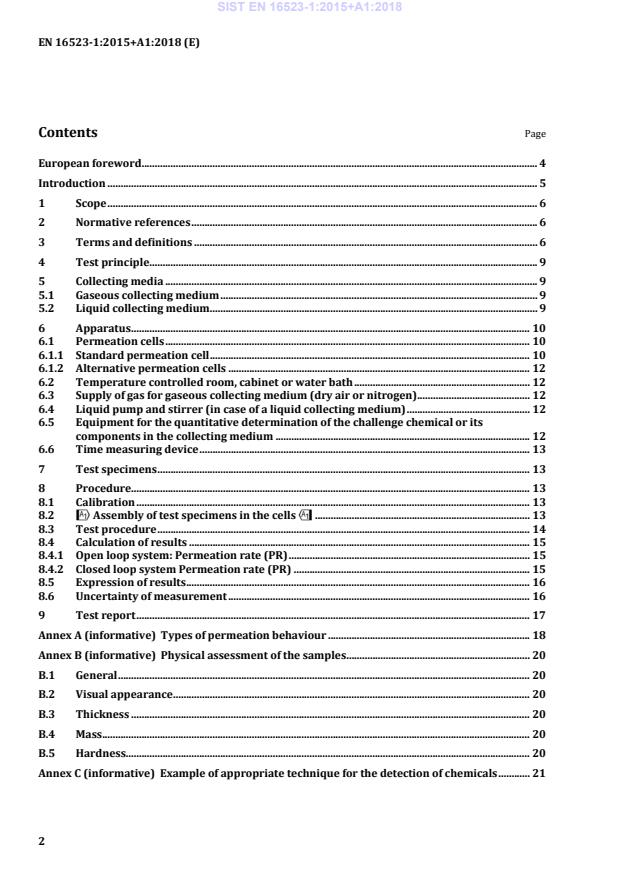
Types of permeation behaviour . 18 Annex B (informative)
Physical assessment of the samples . 20 B.1 General . 20 B.2 Visual appearance . 20 B.3 Thickness . 20 B.4 Mass . 20 B.5 Hardness . 20 Annex C (informative)
Example of appropriate technique for the detection of chemicals . 21 SIST EN 16523-1:2015+A1:2018
!Possible techniques to assess flow and stirring for permeation with liquid collecting medium" . 23 D.1 For the open loop system . 23 D.2 For open and closed loop system . 23 D.3 For open and close loop system . 24 Annex E (informative)
Example of permeation cell . 25 Annex F (informative)
Results of the interlaboratory trials . 27 Bibliography . 29
This method provides tests results in terms of breakthrough time. This parameter is a key measure of the effectiveness of a material to act as a barrier to the challenge chemical. Such information is used in the comparison of the performances of PPE materials during the process of selecting PPE for protection from hazardous chemicals. Long breakthrough times are characteristic of high permeation resistance. Breakthrough time does not provide a correlation between protection and the toxicity of the chemicals tested, only cumulative permeation can provide this information. It has been assumed in the drafting of this part of EN 16523 that the execution of its provisions will be entrusted to appropriately qualified and experienced people with a sound understanding of analytical chemistry. Appropriate precautions should be taken when carrying out this type of testing in order to avoid injury to health and contamination of the environment. A future part of EN 16523 will explain the use of the series of standards EN 16523. SIST EN 16523-1:2015+A1:2018
3 Terms and definitions For the purposes of this document, the following terms and definitions apply. 3.1 analytical technique method of identifying and quantifying the amount of permeated chemical in the collection medium Note 1 to entry: Such methods are often specific to individual chemical and collection-medium combinations. EXAMPLE Applicable analytical techniques can include ultraviolet (UV) or infrared (IR) spectrophotometry, mass spectrometry, pH measurement, ion chromatography, conductimetry, colourimetry, atmospheric analytical detector tubes and radionuclide tagging/detection counting. Although liquid and/or gas chromatography are separation techniques rather than detection methods they can be used in conjunction with suitable detectors to quantify the amount of permeated chemical in the collection medium (see Annex C). 3.2 liquid challenge chemical liquid chemical that is used to challenge the protective clothing, gloves and footwear material specimen 3.3 collecting medium liquid or gas on the inner “clean” side of the test sample in which any permeated chemical is collected SIST EN 16523-1:2015+A1:2018
3.6.1 closed loop system in which the collecting medium is re-circulated or stirred through the sampling compartments of the test cell Note 1 to entry: Closed loop systems are not commonly used with gaseous collection media. 3.6.2 open loop system where the collecting medium passes through the sampling compartment of the test cell without re-circulation Note 1 to entry: Open loop systems may be used with either liquid or gaseous collection media. 3.7 minimum detectable permeation rate MDPR lowest rate of permeation that is measurable with the complete permeation-test system Note 1 to entry:
This value is not necessarily the intrinsic limit of detection for the analytical instrument. Note 2 to entry: MDPR is usually based upon 3 times the average background noise. Note 3 to entry: Useful information can be found on the following websites: — http://www.measurementuncertainty.org/guide/app_f.thml; — http://www.iupac.org/publications/pac/1997/pdf/6902x0297.pdf. 3.8 normalized breakthrough time NBT time at which the permeation rate reaches the normalization permeation rate
Note 1 to entry: See Figure 1: SIST EN 16523-1:2015+A1:2018
Key Y
permeation rate in µg cm2 min-1 a normalized permeation rate (NPR) t
time
b minimum detectable permeation rate (MDPR) 1
steady-state permeation t2 normalized breakthrough time (NBT) Figure 1 — Schematic permeation graph showing actual and normalized breakthrough times 3.9 normalized permeation rate NPR arbitrary fixed figure of 1,0 µg cm2 min1 Note 1 to entry: This optimized figure is a compromise between test method parameters (mixing, flow rate, detection limits, etc.) and the scientific analysis possibilities at the present time, to ensure a better repeatability and reproducibility of the test. Note 2 to entry: In some standards, the NPR is fixed at a lower concentration (for example 0,1 µg cm-2 min1). However, the parameters of the other standards, flow rate, mixing are often less severe than the present test method. The tests are only designed to evaluate protective clothing, gloves and footwear. 3.10 permeation process by which a chemical moves through a PPE (protective clothing, gloves and footwear) material, on a molecular level (see Annex A) and which involves the following: — absorption of molecules of the chemical into the contacted (outside) surface of a material; — diffusion of the absorbed molecules in the material; — desorption of the molecules from the opposite (inside) surface of the material 3.11 permeation rate mass of challenge chemical permeating unit area of the protective clothing, gloves and footwear per unit time Note 1 to entry: The permeation rate is expressed in µg cm 2 min1. SIST EN 16523-1:2015+A1:2018
Note 1 to entry: See Figure 1. Note 2 to entry: Steady-state permeation may not be achieved during the period for which permeation testing is conducted. 4 Test principle The resistance of protective clothing, gloves and footwear material to permeation by a liquid chemical is characterized by measuring through the normalized breakthrough time (NBT). In the permeation test apparatus, the protective clothing, gloves or footwear material separates the challenge chemical from the collecting medium. The collecting medium, which can be a gas or a liquid, is analysed quantitatively for its concentration of the chemical as a function of time. 5 Collecting media 5.1 Gaseous collecting medium A gaseous collecting medium is usually used under continuous flow conditions for the collection of permeating molecules that are capable of vaporizing in sufficient quantities for analysis. The gaseous collection medium shall be a gas or gas mixture which does not interfere with the detection of the challenge chemical and does not itself permeate or degrade the material under test. The quality of the gas supply shall be of sufficient consistency over the duration of the test that changes do not interfere with detection of the challenge chemical. NOTE Dry air or nitrogen are often used. 5.2 Liquid collecting medium !A liquid collecting medium is usually used for the collection of permeated challenge chemicals of low volatility that are soluble in the collecting medium under the conditions of the test. The challenge chemical shall be soluble in the collecting medium in sufficient quantities for analysis. The liquid collecting medium shall not influence the resistance of a material to permeation. NOTE 1 Water is generally used (Water grade 3 see EN ISO 3696). In the case of water soluble test specimen (e.g. PVAL-polyvinyl alcohol), an alternative collecting medium shall be used. It shall have no effect on the material. NOTE 2 Limitation due to collecting media: It can be recognized that there are circumstances under which the above criteria are mutually exclusive. For example, when testing a PVC (polyvinyl chloride) fabric for resistance to permeation by involatile isocyanates, it will be found that the challenge chemical is insoluble in aqueous collection media and that the test fabric is readily permeated or degraded by virtually all non-aqueous liquids. Under such circumstances testing is, unfortunately, not possible."
Key 1
!deleted text" compartment for collecting medium 3 outlet collecting medium 2
inlet collecting medium
NOTE Dimensional deviations: ± 2 mm. Figure 2 — Important dimensions for the !deleted text" compartment for collecting medium SIST EN 16523-1:2015+A1:2018
Key 1 !deleted text"compartment for challenge chemical 2 fill pipe Figure 3 — Important dimensions for the !deleted text" compartment for challenge chemical Dimensions in millimetres
Key 1
sample 3 challenge chemical wetting all the sample 2
seals
4 closing system NOTE The cells can be assembled horizontally or vertically. Figure 4 — Cell assembly The open ends of the sections are fitted with connecting joints. The inlet of the section containing the challenge chemical may be closed by a stopper or a valve. SIST EN 16523-1:2015+A1:2018
...